QUANTUM PHYSICS
Lesson 1:
INTRODUCTION TO
QUANTUM PHYSICS
2
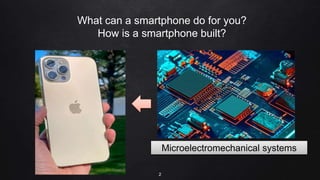
What can a smartphone do for you?
How is a smartphone built?
Microelectromechanical systems
Do you know that the entire computer industry is built on
QUANTUM PHYSICS?
Modern semiconductor-based electronics rely on the band structure of solid objects.
By understanding the electron behavior, the electrical properties of silicon can be manipulated by mixing in just a tiny
fraction of the right other elements changes the band structure and thus the conductivity.
Stacking up layers of silicon doped with different elements allows the making of transistors on the nanometer scale.
(Science knowledge)
(Mathematical skill)
Millions of these packed together in a single block of material make the computer chips that power all the
technological gadgets that are so central to modern life.
Desktops, laptops, tablets, smartphones, even small household appliances and kids' toys are driven by
computer chips that simply would not be possible to make without our modern understanding of quantum
physics
(Engineering skill)
(Technology skill)
3
4
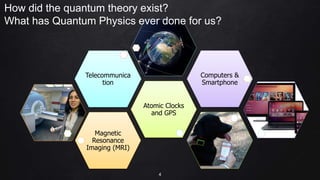
Magnetic
Resonance
Imaging (MRI)
Atomic Clocks
and GPS
Telecommunica
tion
Computers &
Smartphone
How did the quantum theory exist?
What has Quantum Physics ever done for us?
5
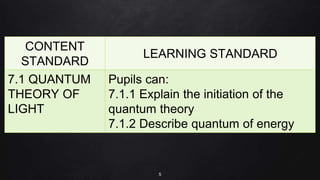
CONTENT
STANDARD
LEARNING STANDARD
7.1 QUANTUM
THEORY OF
LIGHT
Pupils can:
7.1.1 Explain the initiation of the
quantum theory
7.1.2 Describe quantum of energy
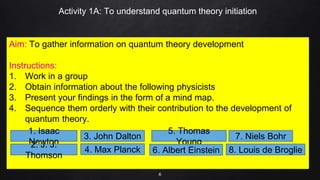
Activity 1A: To understand quantum theory initiation
6
Aim: To gather information on quantum theory development
Instructions:
1. Work in a group
2. Obtain information about the following physicists
3. Present your findings in the form of a mind map.
4. Sequence them orderly with their contribution to the development of
quantum theory.
1. Isaac
Newton
3. John Dalton
2. J. J.
Thomson
4. Max Planck
7. Niels Bohr
5. Thomas
Young
8. Louis de Broglie
6. Albert Einstein
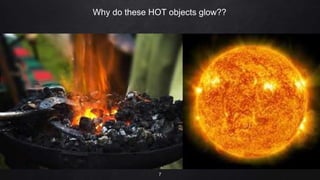
Why do these HOT objects glow??
7
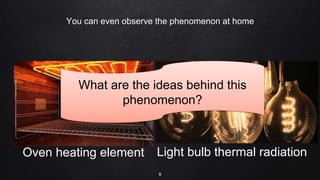
You can even observe the phenomenon at home
8
Oven heating element Light bulb thermal radiation
What are the ideas behind this
phenomenon?
VIDEO A: BLACKBODY RADIATION DEMONSTRATION
9
https://www.youtube.com/watch?v=Psvo_XEc784
Scan me:
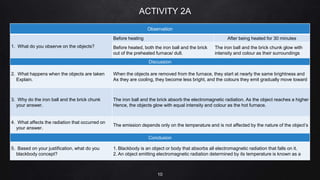
ACTIVITY 2A
10
Observation
1. What do you observe on the objects?
Before heating After being heated for 30 minutes
Before heated, both the iron ball and the brick
out of the preheated furnace/ dull.
The iron ball and the brick chunk glow with
intensity and colour as their surroundings
Discussion
2. What happens when the objects are taken
Explain.
When the objects are removed from the furnace, they start at nearly the same brightness and
As they are cooling, they become less bright, and the colours they emit gradually move toward
3. Why do the iron ball and the brick chunk
your answer.
The iron ball and the brick absorb the electromagnetic radiation. As the object reaches a higher
Hence, the objects glow with equal intensity and colour as the hot furnace.
4. What affects the radiation that occurred on
your answer.
The emission depends only on the temperature and is not affected by the nature of the object’s
Conclusion
5. Based on your justification, what do you
blackbody concept?
1. Blackbody is an object or body that absorbs all electromagnetic radiation that falls on it.
2. An object emitting electromagnetic radiation determined by its temperature is known as a
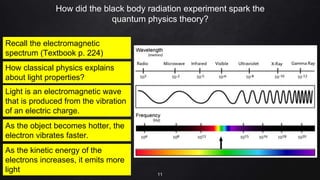
How did the black body radiation experiment spark the
quantum physics theory?
11
Recall the electromagnetic
spectrum (Textbook p. 224)
How classical physics explains
about light properties?
As the object becomes hotter, the
electron vibrates faster.
As the kinetic energy of the
electrons increases, it emits more
light
Light is an electromagnetic wave
that is produced from the vibration
of an electric charge.
12
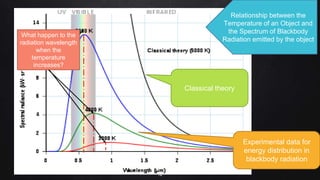
Relationship between the
Temperature of an Object and
the Spectrum of Blackbody
Radiation emitted by the object
Experimental data for
energy distribution in
blackbody radiation
Classical theory
What happen to the
radiation wavelength
when the
temperature
increases?
Activity 3A
Aim:
1. To discuss and compare the classical theory with the experimental result of the blackbody radiation
experiment
2. To discuss and compare the continuous energy and discrete energy
Instructions:
1. Carry out this activity in groups.
2. Discuss and compare the classical theory with the experimental result of the blackbody radiation experiment
by analyzing the graph of radiation intensity versus wavelength.
3. Gather information related to the concepts of continuous energy and discrete energy on the following
aspects:
a) the visible light spectrum
b) the line spectrum of mercury lamps and other lamps
c) differences between continuous energy and discrete energy
4. You can obtain information from websites or various reading sources.
5. Answer all the questions in Worksheet 3A based on your research.
6. Present your findings.
13
14
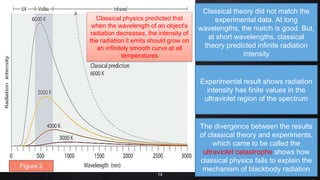
The divergence between the results
of classical theory and experiments,
which came to be called the
ultraviolet catastrophe shows how
classical physics fails to explain the
mechanism of blackbody radiation
Experimental result shows radiation
intensity has finite values in the
ultraviolet region of the spectrum
Classical theory did not match the
experimental data. At long
wavelengths, the match is good. But,
at short wavelengths, classical
theory predicted infinite radiation
intensity
Figure 2
Classical physics predicted that
when the wavelength of an object's
radiation decreases, the intensity of
the radiation it emits should grow on
an infinitely smooth curve at all
temperatures
15
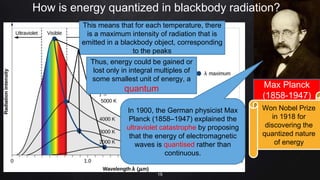
In 1900, the German physicist Max
Planck (1858–1947) explained the
ultraviolet catastrophe by proposing
that the energy of electromagnetic
waves is quantised rather than
continuous.
Max Planck
(1858-1947)
This means that for each temperature, there
is a maximum intensity of radiation that is
emitted in a blackbody object, corresponding
to the peaks
Thus, energy could be gained or
lost only in integral multiples of
some smallest unit of energy, a
quantum
Won Nobel Prize
in 1918 for
discovering the
quantized nature
of energy
How is energy quantized in blackbody radiation?
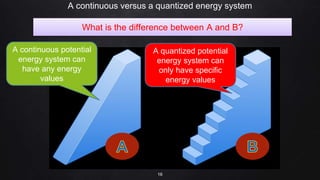
A continuous versus a quantized energy system
16
A continuous potential
energy system can
have any energy
values
A quantized potential
energy system can
only have specific
energy values
What is the difference between A and B?
A continuous versus a quantized energy system
17
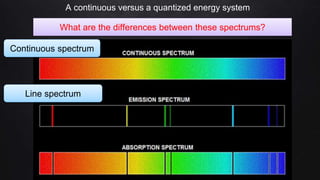
Line spectrum
Continuous spectrum
What are the differences between these spectrums?
18
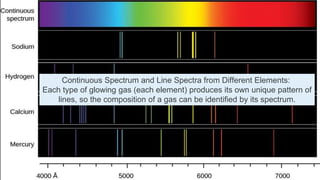
Continuous Spectrum and Line Spectra from Different Elements:
Each type of glowing gas (each element) produces its own unique pattern of
lines, so the composition of a gas can be identified by its spectrum.
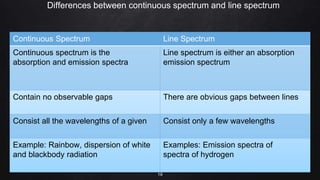
Differences between continuous spectrum and line spectrum
19
Continuous Spectrum Line Spectrum
Continuous spectrum is the
absorption and emission spectra
Line spectrum is either an absorption
emission spectrum
Contain no observable gaps There are obvious gaps between lines
Consist all the wavelengths of a given Consist only a few wavelengths
Example: Rainbow, dispersion of white
and blackbody radiation
Examples: Emission spectra of
spectra of hydrogen
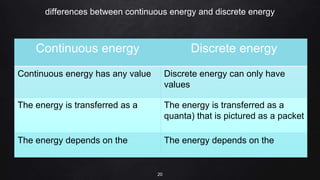
differences between continuous energy and discrete energy
20
Continuous energy Discrete energy
Continuous energy has any value Discrete energy can only have
values
The energy is transferred as a The energy is transferred as a
quanta) that is pictured as a packet
The energy depends on the The energy depends on the
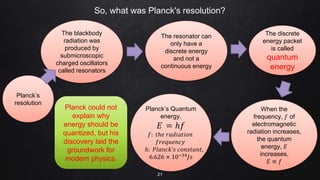
So, what was Planck's resolution?
21
Planck’s
resolution
The blackbody
radiation was
produced by
submicroscopic
charged oscillators
called resonators
Planck’s Quantum
energy,
𝐸 = ℎ𝑓
𝑓: 𝑡ℎ𝑒 𝑟𝑎𝑑𝑖𝑎𝑡𝑖𝑜𝑛
𝑓𝑟𝑒𝑞𝑢𝑒𝑛𝑐𝑦
ℎ: 𝑃𝑙𝑎𝑛𝑐𝑘’𝑠 𝑐𝑜𝑛𝑠𝑡𝑎𝑛𝑡,
6.626 × 10⁻³⁴𝐽𝑠
When the
frequency, 𝑓 of
electromagnetic
radiation increases,
the quantum
energy, 𝐸
increases,
𝐸 ∝ 𝑓
The resonator can
only have a
discrete energy
and not a
continuous energy
Planck could not
explain why
energy should be
quantized, but his
discovery laid the
groundwork for
modern physics.
The discrete
energy packet
is called
quantum
energy

Introduction to quantum physics.pptx

  • 1.
  • 2.
    2 What can asmartphone do for you? How is a smartphone built? Microelectromechanical systems
  • 3.
    Do you knowthat the entire computer industry is built on QUANTUM PHYSICS? Modern semiconductor-based electronics rely on the band structure of solid objects. By understanding the electron behavior, the electrical properties of silicon can be manipulated by mixing in just a tiny fraction of the right other elements changes the band structure and thus the conductivity. Stacking up layers of silicon doped with different elements allows the making of transistors on the nanometer scale. (Science knowledge) (Mathematical skill) Millions of these packed together in a single block of material make the computer chips that power all the technological gadgets that are so central to modern life. Desktops, laptops, tablets, smartphones, even small household appliances and kids' toys are driven by computer chips that simply would not be possible to make without our modern understanding of quantum physics (Engineering skill) (Technology skill) 3
  • 4.
    4 Magnetic Resonance Imaging (MRI) Atomic Clocks andGPS Telecommunica tion Computers & Smartphone How did the quantum theory exist? What has Quantum Physics ever done for us?
  • 5.
    5 CONTENT STANDARD LEARNING STANDARD 7.1 QUANTUM THEORYOF LIGHT Pupils can: 7.1.1 Explain the initiation of the quantum theory 7.1.2 Describe quantum of energy
  • 6.
    Activity 1A: Tounderstand quantum theory initiation 6 Aim: To gather information on quantum theory development Instructions: 1. Work in a group 2. Obtain information about the following physicists 3. Present your findings in the form of a mind map. 4. Sequence them orderly with their contribution to the development of quantum theory. 1. Isaac Newton 3. John Dalton 2. J. J. Thomson 4. Max Planck 7. Niels Bohr 5. Thomas Young 8. Louis de Broglie 6. Albert Einstein
  • 7.
    Why do theseHOT objects glow?? 7
  • 8.
    You can evenobserve the phenomenon at home 8 Oven heating element Light bulb thermal radiation What are the ideas behind this phenomenon?
  • 9.
    VIDEO A: BLACKBODYRADIATION DEMONSTRATION 9 https://www.youtube.com/watch?v=Psvo_XEc784 Scan me:
  • 10.
    ACTIVITY 2A 10 Observation 1. Whatdo you observe on the objects? Before heating After being heated for 30 minutes Before heated, both the iron ball and the brick out of the preheated furnace/ dull. The iron ball and the brick chunk glow with intensity and colour as their surroundings Discussion 2. What happens when the objects are taken Explain. When the objects are removed from the furnace, they start at nearly the same brightness and As they are cooling, they become less bright, and the colours they emit gradually move toward 3. Why do the iron ball and the brick chunk your answer. The iron ball and the brick absorb the electromagnetic radiation. As the object reaches a higher Hence, the objects glow with equal intensity and colour as the hot furnace. 4. What affects the radiation that occurred on your answer. The emission depends only on the temperature and is not affected by the nature of the object’s Conclusion 5. Based on your justification, what do you blackbody concept? 1. Blackbody is an object or body that absorbs all electromagnetic radiation that falls on it. 2. An object emitting electromagnetic radiation determined by its temperature is known as a
  • 11.
    How did theblack body radiation experiment spark the quantum physics theory? 11 Recall the electromagnetic spectrum (Textbook p. 224) How classical physics explains about light properties? As the object becomes hotter, the electron vibrates faster. As the kinetic energy of the electrons increases, it emits more light Light is an electromagnetic wave that is produced from the vibration of an electric charge.
  • 12.
    12 Relationship between the Temperatureof an Object and the Spectrum of Blackbody Radiation emitted by the object Experimental data for energy distribution in blackbody radiation Classical theory What happen to the radiation wavelength when the temperature increases?
  • 13.
    Activity 3A Aim: 1. Todiscuss and compare the classical theory with the experimental result of the blackbody radiation experiment 2. To discuss and compare the continuous energy and discrete energy Instructions: 1. Carry out this activity in groups. 2. Discuss and compare the classical theory with the experimental result of the blackbody radiation experiment by analyzing the graph of radiation intensity versus wavelength. 3. Gather information related to the concepts of continuous energy and discrete energy on the following aspects: a) the visible light spectrum b) the line spectrum of mercury lamps and other lamps c) differences between continuous energy and discrete energy 4. You can obtain information from websites or various reading sources. 5. Answer all the questions in Worksheet 3A based on your research. 6. Present your findings. 13
  • 14.
    14 The divergence betweenthe results of classical theory and experiments, which came to be called the ultraviolet catastrophe shows how classical physics fails to explain the mechanism of blackbody radiation Experimental result shows radiation intensity has finite values in the ultraviolet region of the spectrum Classical theory did not match the experimental data. At long wavelengths, the match is good. But, at short wavelengths, classical theory predicted infinite radiation intensity Figure 2 Classical physics predicted that when the wavelength of an object's radiation decreases, the intensity of the radiation it emits should grow on an infinitely smooth curve at all temperatures
  • 15.
    15 In 1900, theGerman physicist Max Planck (1858–1947) explained the ultraviolet catastrophe by proposing that the energy of electromagnetic waves is quantised rather than continuous. Max Planck (1858-1947) This means that for each temperature, there is a maximum intensity of radiation that is emitted in a blackbody object, corresponding to the peaks Thus, energy could be gained or lost only in integral multiples of some smallest unit of energy, a quantum Won Nobel Prize in 1918 for discovering the quantized nature of energy How is energy quantized in blackbody radiation?
  • 16.
    A continuous versusa quantized energy system 16 A continuous potential energy system can have any energy values A quantized potential energy system can only have specific energy values What is the difference between A and B?
  • 17.
    A continuous versusa quantized energy system 17 Line spectrum Continuous spectrum What are the differences between these spectrums?
  • 18.
    18 Continuous Spectrum andLine Spectra from Different Elements: Each type of glowing gas (each element) produces its own unique pattern of lines, so the composition of a gas can be identified by its spectrum.
  • 19.
    Differences between continuousspectrum and line spectrum 19 Continuous Spectrum Line Spectrum Continuous spectrum is the absorption and emission spectra Line spectrum is either an absorption emission spectrum Contain no observable gaps There are obvious gaps between lines Consist all the wavelengths of a given Consist only a few wavelengths Example: Rainbow, dispersion of white and blackbody radiation Examples: Emission spectra of spectra of hydrogen
  • 20.
    differences between continuousenergy and discrete energy 20 Continuous energy Discrete energy Continuous energy has any value Discrete energy can only have values The energy is transferred as a The energy is transferred as a quanta) that is pictured as a packet The energy depends on the The energy depends on the
  • 21.
    So, what wasPlanck's resolution? 21 Planck’s resolution The blackbody radiation was produced by submicroscopic charged oscillators called resonators Planck’s Quantum energy, 𝐸 = ℎ𝑓 𝑓: 𝑡ℎ𝑒 𝑟𝑎𝑑𝑖𝑎𝑡𝑖𝑜𝑛 𝑓𝑟𝑒𝑞𝑢𝑒𝑛𝑐𝑦 ℎ: 𝑃𝑙𝑎𝑛𝑐𝑘’𝑠 𝑐𝑜𝑛𝑠𝑡𝑎𝑛𝑡, 6.626 × 10⁻³⁴𝐽𝑠 When the frequency, 𝑓 of electromagnetic radiation increases, the quantum energy, 𝐸 increases, 𝐸 ∝ 𝑓 The resonator can only have a discrete energy and not a continuous energy Planck could not explain why energy should be quantized, but his discovery laid the groundwork for modern physics. The discrete energy packet is called quantum energy