OM-460: Total Quality Management


Introduction to TQM
Resource Person
Haris Aslam
History of Quality Management

• Skilled craftsmanship during Middle Ages

• Industrial Revolution: rise of inspection and
  separate quality departments
• Statistical methods at Bell System
• Quality control during World War II
• Quality management in Japan
History of Quality Assurance

• Quality awareness in U.S. manufacturing industry
  during 1980s: “Total Quality Management”
• Malcolm Baldrige National Quality Award (1987)
• Development of Quality Standards in Europe
• Quality in service industries, government, health
  care, and education
• Current and future challenge: keep progress in
  quality management alive
Definitions of Quality


• Product-based definition: quantities of product

  attributes
• User-based definition: fitness for intended use

• Value-based definition: quality vs. price

• Manufacturing-based definition: conformance

  to specifications
Total Quality Management

• People-focused management system

• Focus on increasing customer satisfaction and
  reducing costs
• A systems approach that integrates organizational
  functions and the entire supply chain
• Stresses learning and adaptation to change

• Based on the scientific method
Principles of Total Quality


•   Customer and stakeholder focus

•   Participation and teamwork

•   Process focus and continuous improvement
Continuous Improvement


• Enhancing value through new products and
  services
• Reducing errors, defects, waste, and costs

• Increasing productivity and effectiveness

• Improving responsiveness and cycle time
  performance
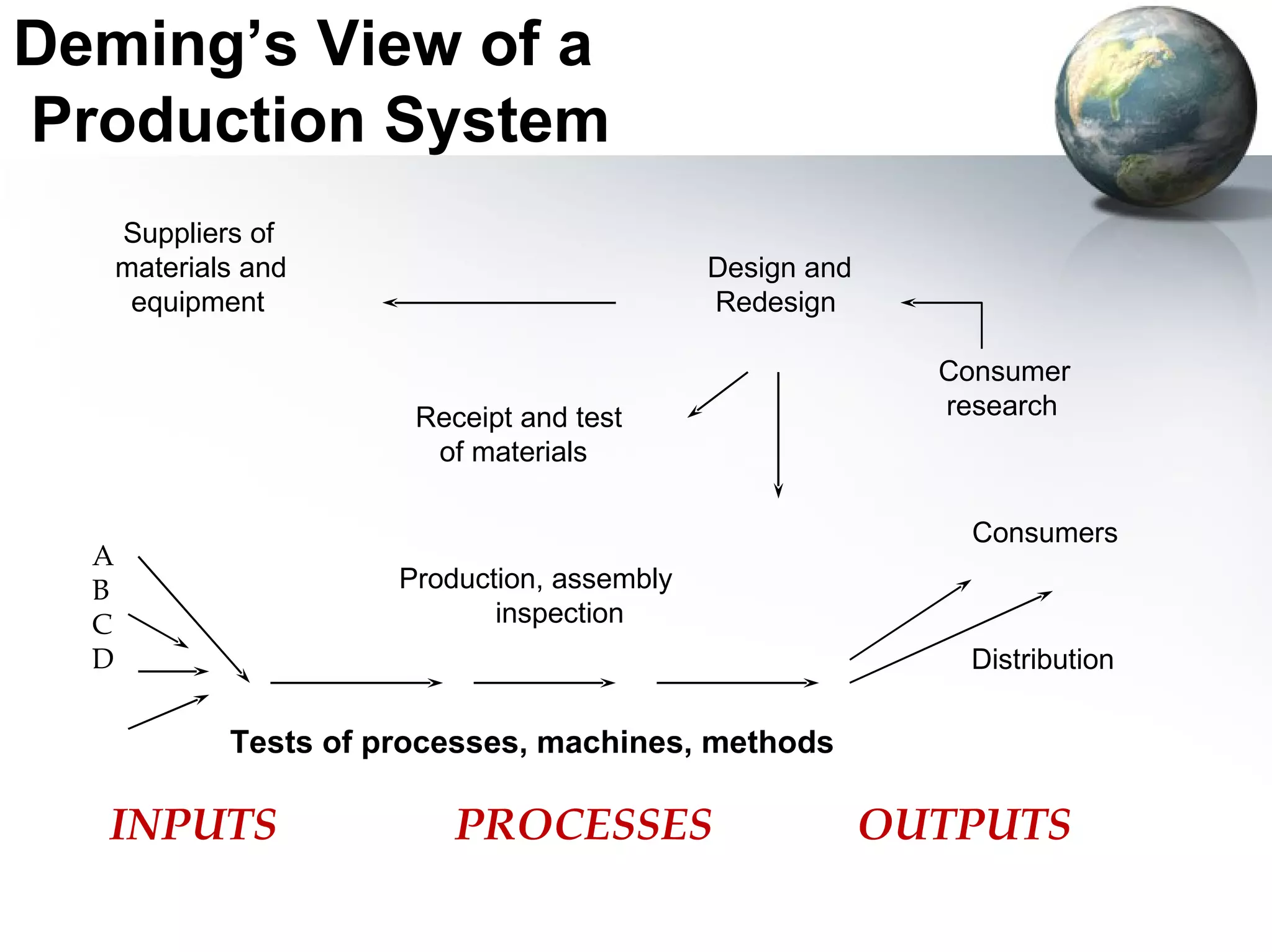
Deming’s View of a
Production System
      Suppliers of
      materials and                            Design and
       equipment                               Redesign

                                                              Consumer
                         Receipt and test                     research
                          of materials

                                                                Consumers
  A
  B                     Production, assembly
  C                            inspection
  D                                                            Distribution

              Tests of processes, machines, methods

  INPUTS                    PROCESSES                       OUTPUTS
Learning

• The foundation for improvement … Understanding
  why changes are successful through feedback
  between practices and results, which leads to new
  goals and approaches
• Learning cycle:
  – Planning
  – Execution of plans
  – Assessment of progress
  – Revision of plans based on assessment findings
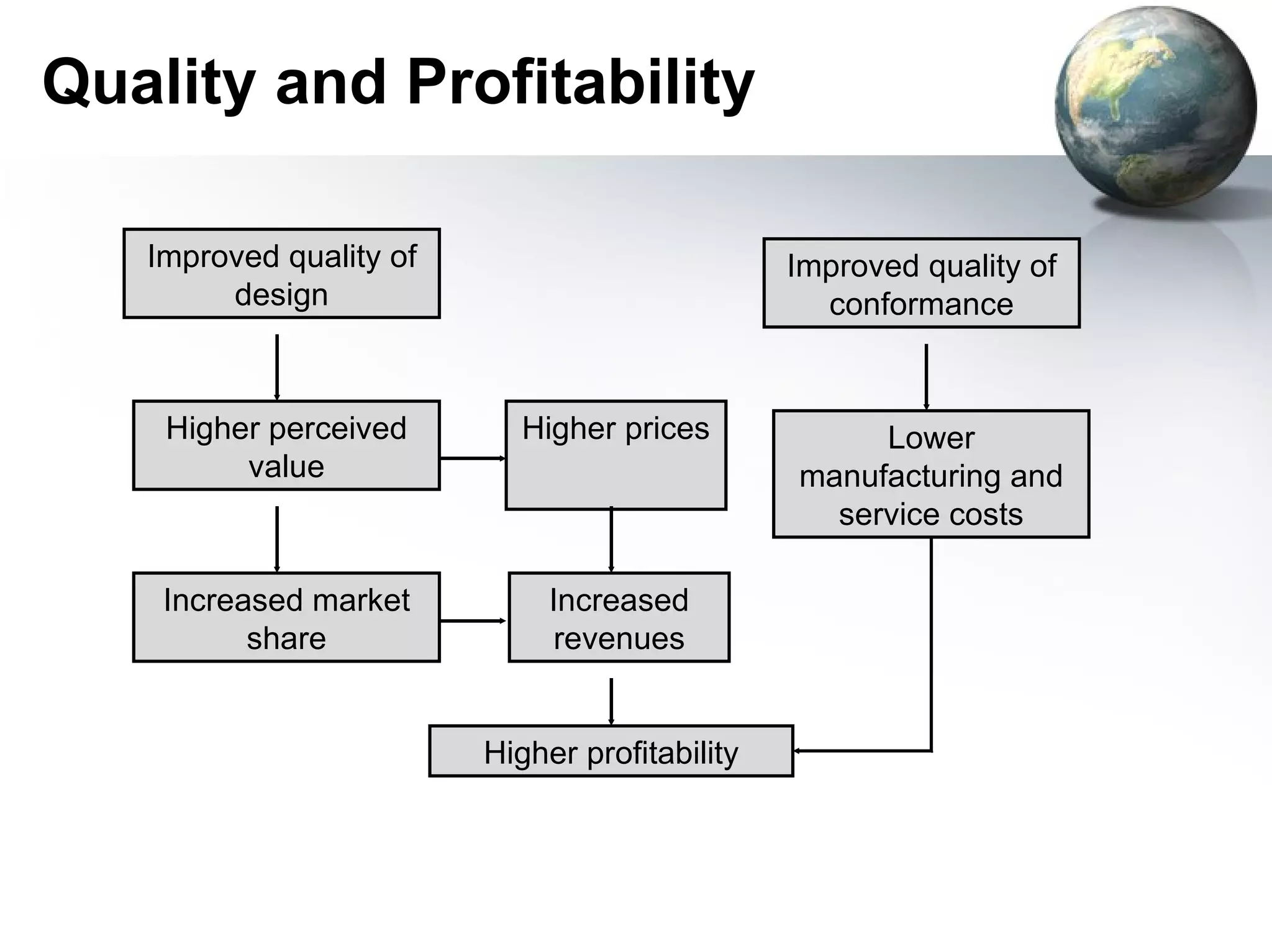
Quality and Profitability

   Improved quality of                          Improved quality of
        design                                    conformance


    Higher perceived       Higher prices             Lower
         value                                  manufacturing and
                                                  service costs

    Increased market          Increased
          share                revenues


                         Higher profitability
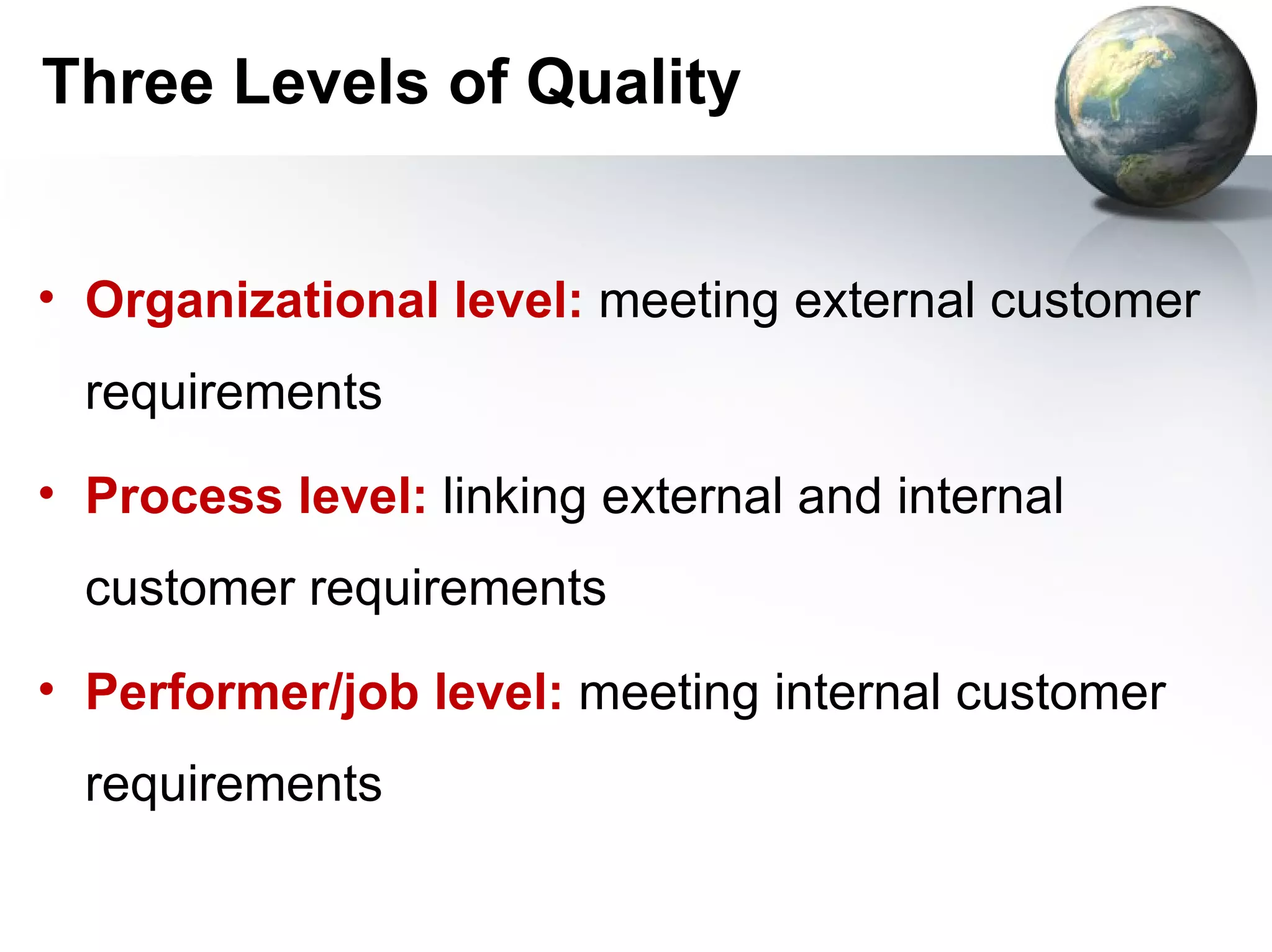
Three Levels of Quality


• Organizational level: meeting external customer
  requirements
• Process level: linking external and internal
  customer requirements
• Performer/job level: meeting internal customer
  requirements
Quality and Personal Values

• Personal initiative has a positive impact on
  business success
• Quality begins with personal attitudes
• Quality-focused individuals often exceed customer
  expectations
• Attitudes can be changed through awareness and
  effort (e.g., personal quality checklists)
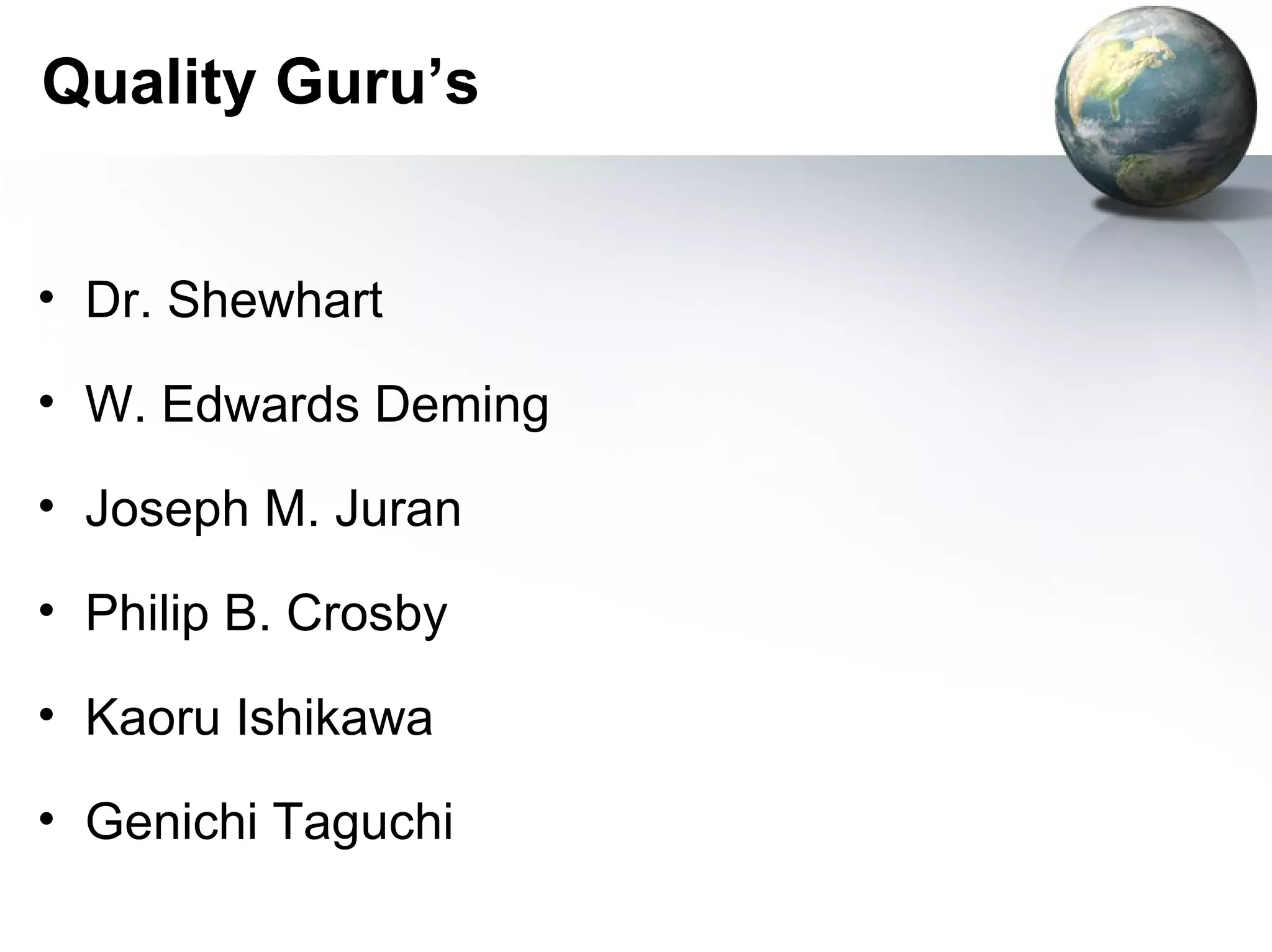
Quality Guru’s


• Dr. Shewhart

• W. Edwards Deming

• Joseph M. Juran

• Philip B. Crosby

• Kaoru Ishikawa

• Genichi Taguchi
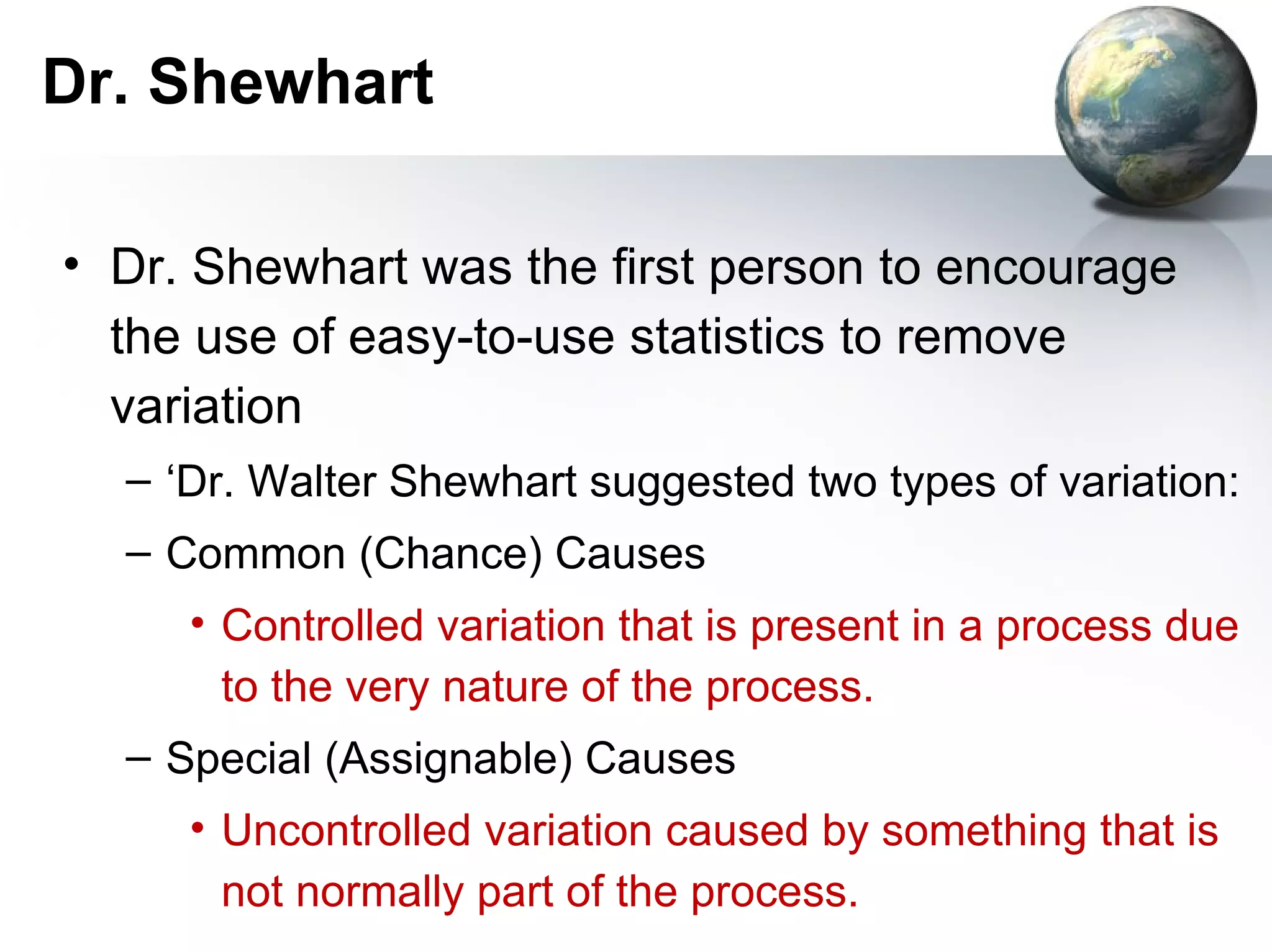
Dr. Shewhart

• Dr. Shewhart was the first person to encourage
  the use of easy-to-use statistics to remove
  variation
  – ‘Dr. Walter Shewhart suggested two types of variation:
  – Common (Chance) Causes
     • Controlled variation that is present in a process due
       to the very nature of the process.
  – Special (Assignable) Causes
     • Uncontrolled variation caused by something that is
       not normally part of the process.
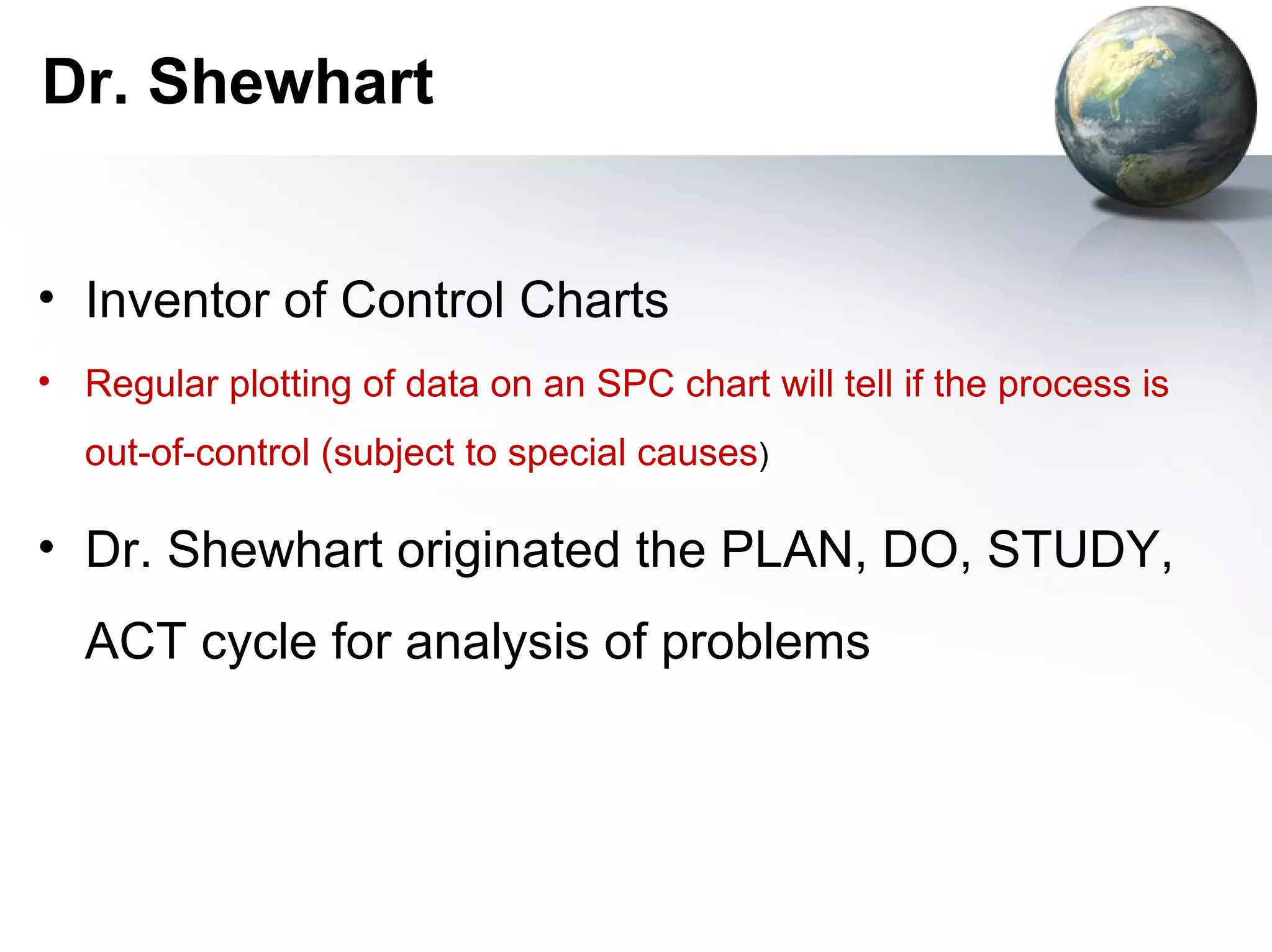
Dr. Shewhart


• Inventor of Control Charts
• Regular plotting of data on an SPC chart will tell if the process is
  out-of-control (subject to special causes)

• Dr. Shewhart originated the PLAN, DO, STUDY,
  ACT cycle for analysis of problems
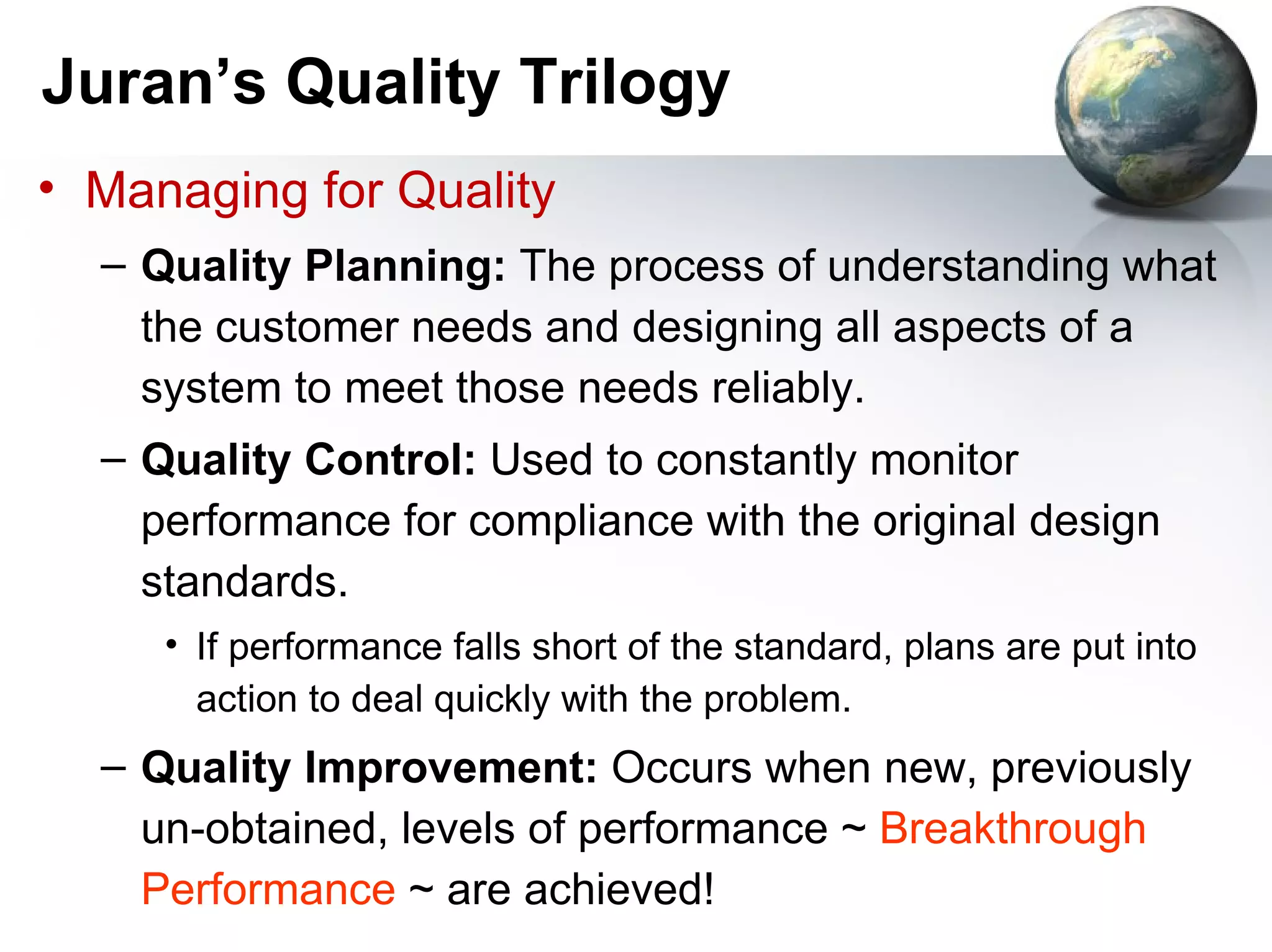
Juran’s Quality Trilogy
• Managing for Quality
  – Quality Planning: The process of understanding what
    the customer needs and designing all aspects of a
    system to meet those needs reliably.
  – Quality Control: Used to constantly monitor
    performance for compliance with the original design
    standards.
     • If performance falls short of the standard, plans are put into
       action to deal quickly with the problem.
  – Quality Improvement: Occurs when new, previously
    un-obtained, levels of performance ~ Breakthrough
    Performance ~ are achieved!
Phillip B. Crosby


• Quality is free . . . :
• “Quality is free. It’s not a gift, but it is free. What
  costs money are the unquality things -- all the
  actions that involve not doing jobs right the first
  time.”
Philip B. Crosby

Absolutes of Quality Management:
•   Quality means conformance to requirements
•   Problems are functional in nature
•   There is no optimum level of defects
•   Cost of quality is the only useful measurement
•   Zero defects is the only performance standard
Kaoru Ishikawa


 – Two biggest contributions: Quality circles &
  Cause & Effect Diagrams
 – Focused on four areas to influence quality:
   • Market-in Quality

   • Worker Involvement

   • Quality Begins and Ends with Education

   • Selfless Personal Commitment
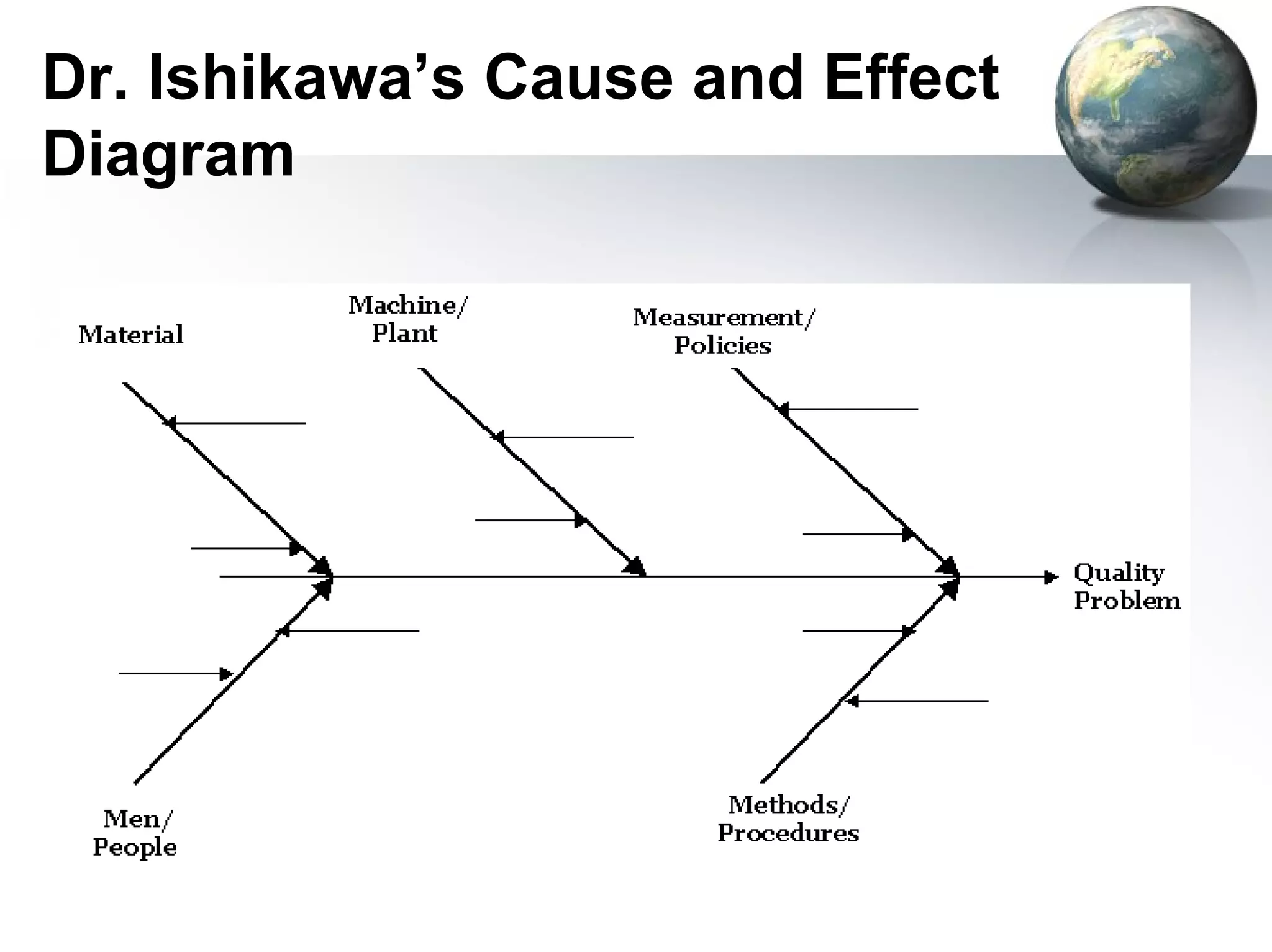
Dr. Ishikawa’s Cause and Effect
Diagram
Genichi Taguchi

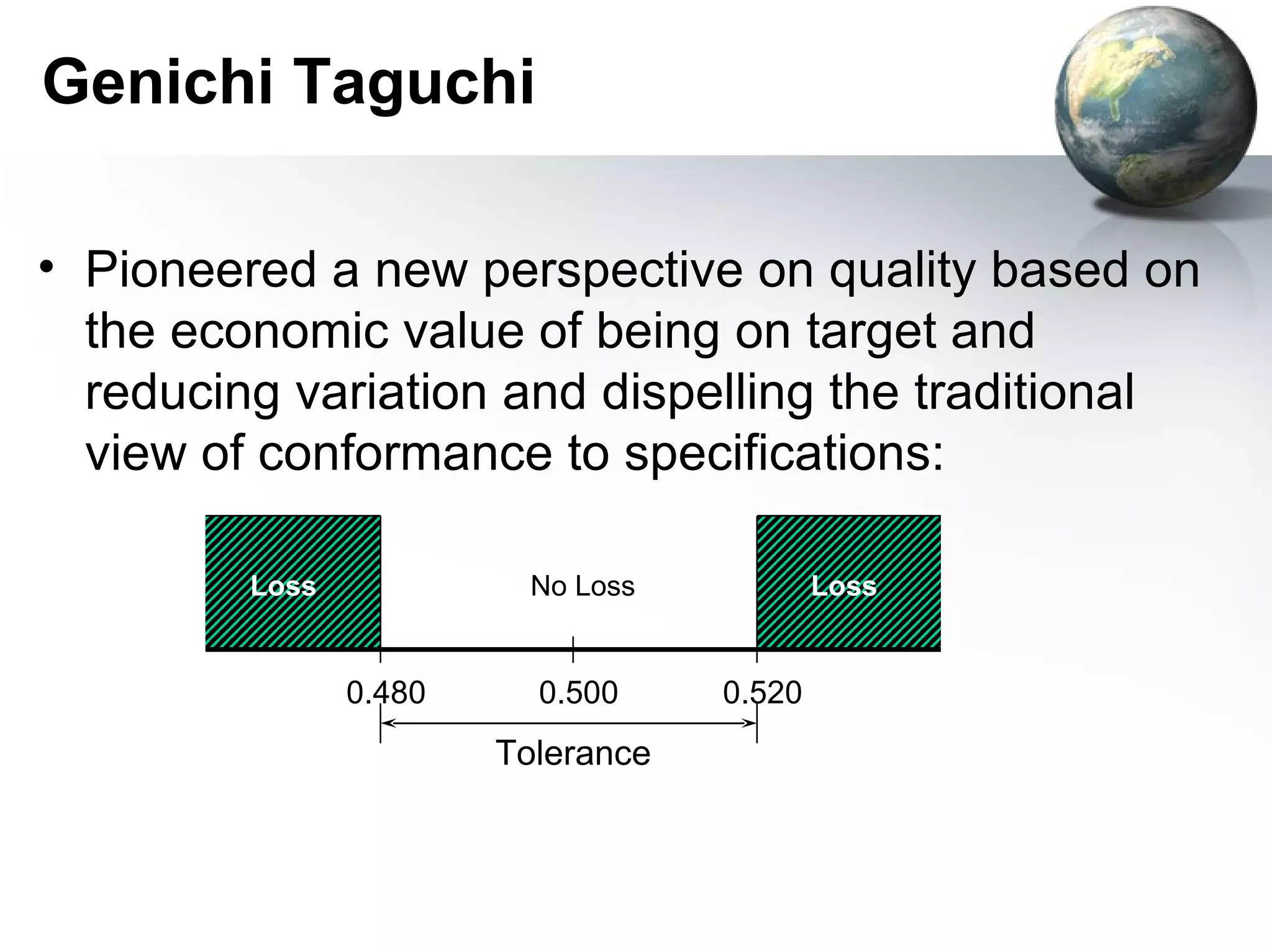
• Pioneered a new perspective on quality based on
  the economic value of being on target and
  reducing variation and dispelling the traditional
  view of conformance to specifications:

         Loss             No Loss           Loss


                0.480     0.500     0.520
                        Tolerance
Dr. W. Edwards Deming (1900-1993)

  – The Father of Quality Management
  – Strongly humanistic philosophy
  – “Problems in a production process are due to flaws in
    the design of the system, as opposed to being rooted
    in the motivation or professional commitment of the
    workforce”.
  – Quality is maintained and improved when leaders,
    managers, and the workforce understand and commit
    to constant customer satisfaction through continuous
    quality improvement.
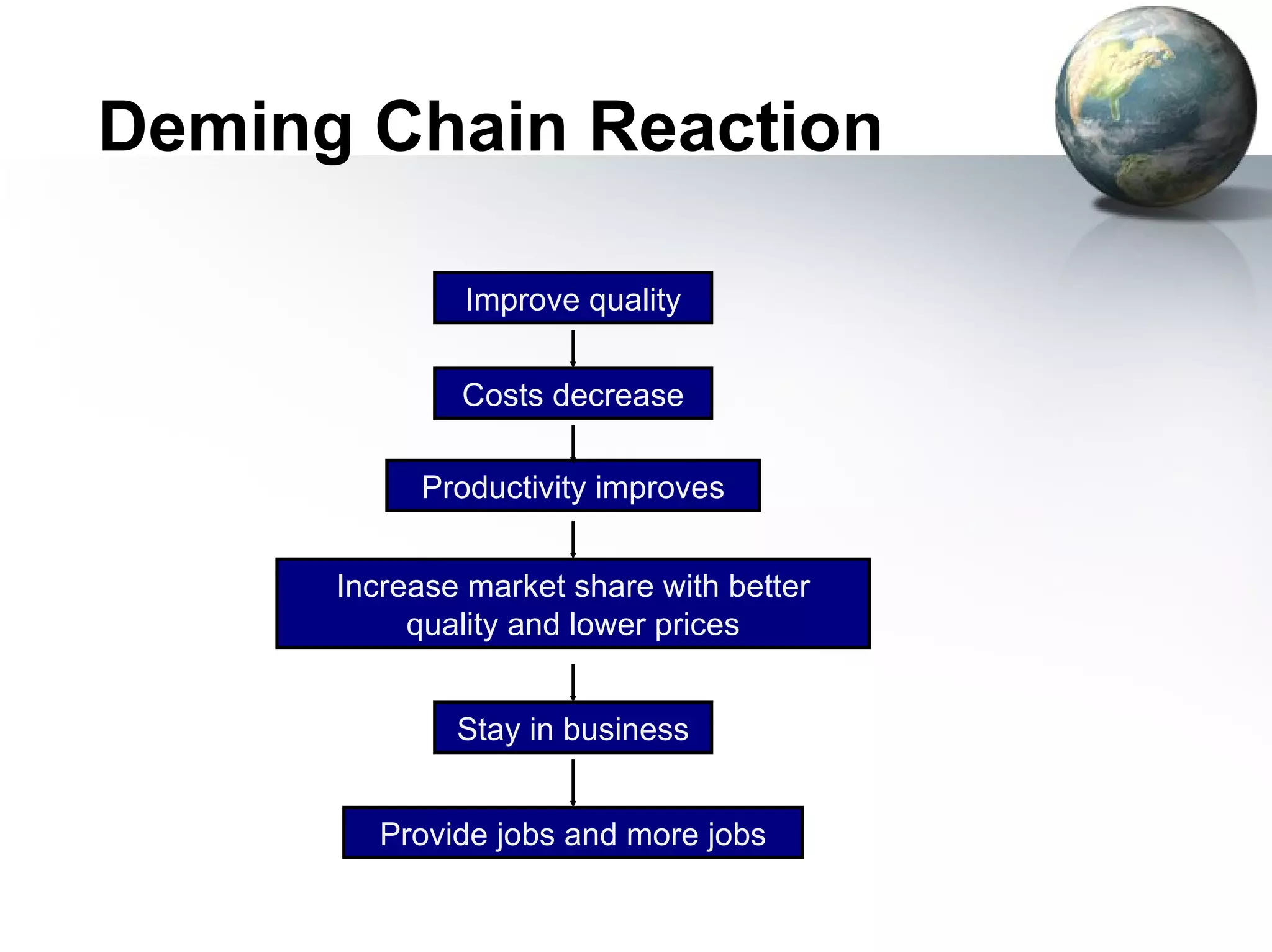
Deming Chain Reaction

              Improve quality


              Costs decrease

           Productivity improves


      Increase market share with better
           quality and lower prices


              Stay in business


         Provide jobs and more jobs
Deming’s System
 of Profound Knowledge

• Appreciation for a system

• Understanding variation

• Theory of knowledge

• Psychology
Appreciation for a system


• Most organizational processes are cross-
  functional
• Parts of a system must work together

• Every system must have a purpose

• Management must optimize the system as a whole
Variation

• Many sources of uncontrollable variation exist in
  any process
• Excessive variation results in product failures,
  unhappy customers, and unnecessary costs
• Statistical methods can be used to identify and
  quantify variation to help understand it and lead to
  improvements
Theory of Knowledge


• Knowledge is not possible without theory

• Experience alone does not establish a theory, it
  only describes
• Theory shows cause-and-effect relationships that
  can be used for prediction
Psychology


• People are motivated intrinsically and extrinsically

• Fear is demotivating

• Managers should develop pride and joy in work
Criteria for Performance
Excellence

•   Leadership
•   Strategic Planning
•   Customer and Market Focus
•   Information and Analysis
•   Human Resource Focus
•   Process Management
•   Business Results
READING MATERIAL
Chapter 1: Introduction
Article: What does product quality really
mean

Introduction to qm (1)

  • 1.
    OM-460: Total QualityManagement Introduction to TQM Resource Person Haris Aslam
  • 2.
    History of QualityManagement • Skilled craftsmanship during Middle Ages • Industrial Revolution: rise of inspection and separate quality departments • Statistical methods at Bell System • Quality control during World War II • Quality management in Japan
  • 3.
    History of QualityAssurance • Quality awareness in U.S. manufacturing industry during 1980s: “Total Quality Management” • Malcolm Baldrige National Quality Award (1987) • Development of Quality Standards in Europe • Quality in service industries, government, health care, and education • Current and future challenge: keep progress in quality management alive
  • 4.
    Definitions of Quality •Product-based definition: quantities of product attributes • User-based definition: fitness for intended use • Value-based definition: quality vs. price • Manufacturing-based definition: conformance to specifications
  • 5.
    Total Quality Management •People-focused management system • Focus on increasing customer satisfaction and reducing costs • A systems approach that integrates organizational functions and the entire supply chain • Stresses learning and adaptation to change • Based on the scientific method
  • 6.
    Principles of TotalQuality • Customer and stakeholder focus • Participation and teamwork • Process focus and continuous improvement
  • 7.
    Continuous Improvement • Enhancingvalue through new products and services • Reducing errors, defects, waste, and costs • Increasing productivity and effectiveness • Improving responsiveness and cycle time performance
  • 8.
    Deming’s View ofa Production System Suppliers of materials and Design and equipment Redesign Consumer Receipt and test research of materials Consumers A B Production, assembly C inspection D Distribution Tests of processes, machines, methods INPUTS PROCESSES OUTPUTS
  • 9.
    Learning • The foundationfor improvement … Understanding why changes are successful through feedback between practices and results, which leads to new goals and approaches • Learning cycle: – Planning – Execution of plans – Assessment of progress – Revision of plans based on assessment findings
  • 10.
    Quality and Profitability Improved quality of Improved quality of design conformance Higher perceived Higher prices Lower value manufacturing and service costs Increased market Increased share revenues Higher profitability
  • 11.
    Three Levels ofQuality • Organizational level: meeting external customer requirements • Process level: linking external and internal customer requirements • Performer/job level: meeting internal customer requirements
  • 12.
    Quality and PersonalValues • Personal initiative has a positive impact on business success • Quality begins with personal attitudes • Quality-focused individuals often exceed customer expectations • Attitudes can be changed through awareness and effort (e.g., personal quality checklists)
  • 13.
    Quality Guru’s • Dr.Shewhart • W. Edwards Deming • Joseph M. Juran • Philip B. Crosby • Kaoru Ishikawa • Genichi Taguchi
  • 14.
    Dr. Shewhart • Dr.Shewhart was the first person to encourage the use of easy-to-use statistics to remove variation – ‘Dr. Walter Shewhart suggested two types of variation: – Common (Chance) Causes • Controlled variation that is present in a process due to the very nature of the process. – Special (Assignable) Causes • Uncontrolled variation caused by something that is not normally part of the process.
  • 15.
    Dr. Shewhart • Inventorof Control Charts • Regular plotting of data on an SPC chart will tell if the process is out-of-control (subject to special causes) • Dr. Shewhart originated the PLAN, DO, STUDY, ACT cycle for analysis of problems
  • 16.
    Juran’s Quality Trilogy •Managing for Quality – Quality Planning: The process of understanding what the customer needs and designing all aspects of a system to meet those needs reliably. – Quality Control: Used to constantly monitor performance for compliance with the original design standards. • If performance falls short of the standard, plans are put into action to deal quickly with the problem. – Quality Improvement: Occurs when new, previously un-obtained, levels of performance ~ Breakthrough Performance ~ are achieved!
  • 17.
    Phillip B. Crosby •Quality is free . . . : • “Quality is free. It’s not a gift, but it is free. What costs money are the unquality things -- all the actions that involve not doing jobs right the first time.”
  • 18.
    Philip B. Crosby Absolutesof Quality Management: • Quality means conformance to requirements • Problems are functional in nature • There is no optimum level of defects • Cost of quality is the only useful measurement • Zero defects is the only performance standard
  • 19.
    Kaoru Ishikawa –Two biggest contributions: Quality circles & Cause & Effect Diagrams – Focused on four areas to influence quality: • Market-in Quality • Worker Involvement • Quality Begins and Ends with Education • Selfless Personal Commitment
  • 20.
    Dr. Ishikawa’s Causeand Effect Diagram
  • 21.
    Genichi Taguchi • Pioneereda new perspective on quality based on the economic value of being on target and reducing variation and dispelling the traditional view of conformance to specifications: Loss No Loss Loss 0.480 0.500 0.520 Tolerance
  • 22.
    Dr. W. EdwardsDeming (1900-1993) – The Father of Quality Management – Strongly humanistic philosophy – “Problems in a production process are due to flaws in the design of the system, as opposed to being rooted in the motivation or professional commitment of the workforce”. – Quality is maintained and improved when leaders, managers, and the workforce understand and commit to constant customer satisfaction through continuous quality improvement.
  • 23.
    Deming Chain Reaction Improve quality Costs decrease Productivity improves Increase market share with better quality and lower prices Stay in business Provide jobs and more jobs
  • 24.
    Deming’s System ofProfound Knowledge • Appreciation for a system • Understanding variation • Theory of knowledge • Psychology
  • 25.
    Appreciation for asystem • Most organizational processes are cross- functional • Parts of a system must work together • Every system must have a purpose • Management must optimize the system as a whole
  • 26.
    Variation • Many sourcesof uncontrollable variation exist in any process • Excessive variation results in product failures, unhappy customers, and unnecessary costs • Statistical methods can be used to identify and quantify variation to help understand it and lead to improvements
  • 27.
    Theory of Knowledge •Knowledge is not possible without theory • Experience alone does not establish a theory, it only describes • Theory shows cause-and-effect relationships that can be used for prediction
  • 28.
    Psychology • People aremotivated intrinsically and extrinsically • Fear is demotivating • Managers should develop pride and joy in work
  • 29.
    Criteria for Performance Excellence • Leadership • Strategic Planning • Customer and Market Focus • Information and Analysis • Human Resource Focus • Process Management • Business Results
  • 30.
    READING MATERIAL Chapter 1:Introduction Article: What does product quality really mean