KLM Technology Group
Practical Engineering Solutions
KLM Technology Group
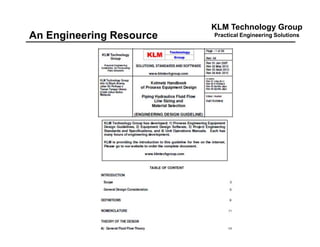
Solutions, Standards and Software
www.klmtechgroup.com
KLM Technology Group
Practical Engineering Solutions
Based in USA since 1995,
KLM is a technical consultancy
group, providing specialized
services and equipment to
improve process plant operational
efficiency, profitability and safety.
KLM Technology Group
Practical Engineering SolutionsTraining
Today we are discussing - Introduction To Process
Simulation
We also offer training classes in,
1.Advanced Process Simulation with Case Studies
2.Advanced Refinery Process Simulation with Case
Studies
3.Advanced Ethylene Simulation with Case Studies
4.Advanced Specialty Chemical Simulation with Case
Studies
As well as other process units and equipment groups.
The course descriptions may be found on the website.
www.klmtechgroup.com/training
KLM Technology Group
Practical Engineering SolutionsTraining
Kolmetz Handbook of Process Equipment Design
There are multiple chapters for distillation design in the
Kolmetz Handbook of Process Equipment Design. We
have over 50 individual chapters on a wide range of
subjects.
Each chapter is 80 to 100 pages including design and
sizing guidelines. As we revise the chapters we are
adding a troubleshooting section.
The handbook may be found here;
www.klmtechgroup.com/Engineering_Design_Guildelines.htm
KLM Technology Group
Practical Engineering SolutionsTraining
Some of the Distillation Chapters include;
1. General Distillation Tower Design
2. Trayed Column Hydraulics
3. Packed Column Hydraulics
4. Refinery Crude Tower
5. Refinery Vacuum Tower
6. Reboiler Selection and Sizing
7. BTX Extraction Units
8. Ethylene Plant Quench Oil Towers
9. Ethylene Plant Quench Water Tower
10.Ethylene Plant C2 Splitters
11.Ethylene Plant C3 Splitters
KLM Technology Group
Practical Engineering Solutions
A.Introduction
B.Case Study - Ethylene DePentanizer
C.Guidelines
D.Conclusions
Introduction to Process Simulation
KLM Technology Group
Practical Engineering Solutions
Simulation is a powerful engineering
tool that has wide spread use in the
chemical processing industry.
Utilized correctly it can help design,
optimize and troubleshoot process
units, when you follow guidelines
developed from the fundamental
basics of engineering.
Introduction
KLM Technology Group
Practical Engineering Solutions
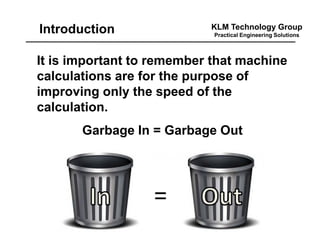
It is important to remember that machine
calculations are for the purpose of
improving only the speed of the
calculation.
Garbage In = Garbage Out
Introduction
KLM Technology Group
Practical Engineering Solutions
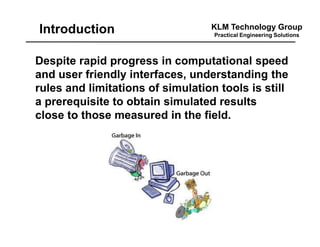
Despite rapid progress in computational speed
and user friendly interfaces, understanding the
rules and limitations of simulation tools is still
a prerequisite to obtain simulated results
close to those measured in the field.
Introduction
KLM Technology Group
Practical Engineering Solutions
The user needs to supply the correct
input data, interpret errors that occurred
and make critical judgment on the
results.
Mastering these techniques often
requires substantial field experience and
practice.
Accumulating such knowledge in form of
design guidelines can help users to ramp
up their learning curves.
Introduction
KLM Technology Group
Practical Engineering Solutions
Working steps like correct selection of;
actual field efficiencies,
choosing appropriate vapor and liquid
equilibrium (VLE) data,
feed modeling,
and analysis of actual hydraulic behavior all
have a strong influence on the accuracy of the
model’s results.
Developing guidelines for each of these steps
is very important to a practicing simulation
user.
Introduction
KLM Technology Group
Practical Engineering Solutions
Without the actual field efficiencies
1. Energy usage will be high
2. Product recovery will be low
3. Product purity will be low
$$$$
Introduction
KLM Technology Group
Practical Engineering Solutions
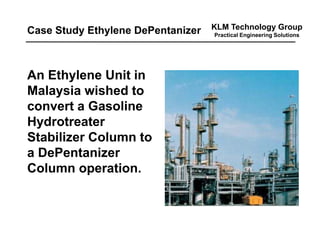
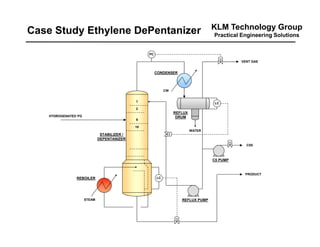
An Ethylene Unit in
Malaysia wished to
convert a Gasoline
Hydrotreater
Stabilizer Column to
a DePentanizer
Column operation.
Case Study Ethylene DePentanizer
KLM Technology Group
Practical Engineering Solutions
The Stabilizer was designed to remove
C4s and lighter hydrocarbons.
They now wished to remove C5s and
lighter hydrocarbons, while minimizing
benzene (C6) loss in the overhead.
Case Study Ethylene DePentanizer
KLM Technology Group
Practical Engineering Solutions
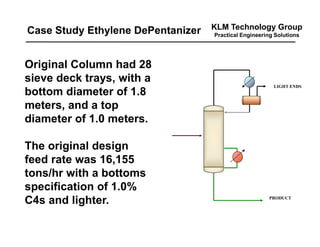
LIGHT ENDS
PRODUCT
Original Column had 28
sieve deck trays, with a
bottom diameter of 1.8
meters, and a top
diameter of 1.0 meters.
The original design
feed rate was 16,155
tons/hr with a bottoms
specification of 1.0%
C4s and lighter.
Case Study Ethylene DePentanizer
KLM Technology Group
Practical Engineering Solutions
PRODUCT
1
2
9
10
STEAM
CW
PC
LC
LC
HYDROGENATED PG
VENT GAS
STABILIZER /
DEPENTANIZER
REBOILER
CONDENSER
REFLUX
DRUM
REFLUX PUMP
WATER
C5S
C5 PUMP
Case Study Ethylene DePentanizer
KLM Technology Group
Practical Engineering Solutions
A good place to start in a revamp would
be to go research what has been
successful and not successful in the
proposed revamp unit operation.
Case Study Ethylene DePentanizer
KLM Technology Group
Practical Engineering Solutions
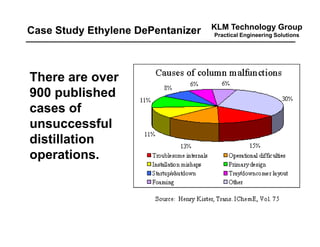
There are over
900 published
cases of
unsuccessful
distillation
operations.
Case Study Ethylene DePentanizer
KLM Technology Group
Practical Engineering Solutions
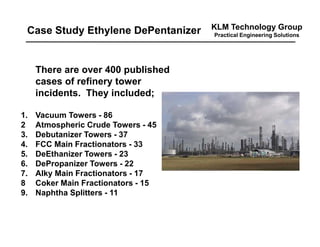
There are over 400 published
cases of refinery tower
incidents. They included;
1. Vacuum Towers - 86
2 Atmospheric Crude Towers - 45
3. Debutanizer Towers - 37
4. FCC Main Fractionators - 33
5. DeEthanizer Towers - 23
6. DePropanizer Towers - 22
7. Alky Main Fractionators - 17
8 Coker Main Fractionators - 15
9. Naphtha Splitters - 11
Case Study Ethylene DePentanizer
KLM Technology Group
Practical Engineering Solutions
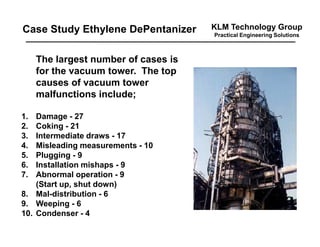
The largest number of cases is
for the vacuum tower. The top
causes of vacuum tower
malfunctions include;
1. Damage - 27
2. Coking - 21
3. Intermediate draws - 17
4. Misleading measurements - 10
5. Plugging - 9
6. Installation mishaps - 9
7. Abnormal operation - 9
(Start up, shut down)
8. Mal-distribution - 6
9. Weeping - 6
10. Condenser - 4
Case Study Ethylene DePentanizer
KLM Technology Group
Practical Engineering Solutions
The top causes of damage in vacuum
tower include
1. Water induced pressure surges - 9
2. Insufficient mechanical strength - 5
3. Broken nozzles or headers - of spray
distributors - 4
4. High bottoms level - 3
5. Packing Fires - 3
Case Study Ethylene DePentanizer
KLM Technology Group
Practical Engineering Solutions
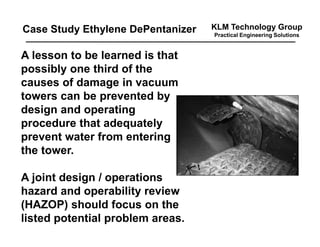
A lesson to be learned is that
possibly one third of the
causes of damage in vacuum
towers can be prevented by
design and operating
procedure that adequately
prevent water from entering
the tower.
A joint design / operations
hazard and operability review
(HAZOP) should focus on the
listed potential problem areas.
Case Study Ethylene DePentanizer
KLM Technology Group
Practical Engineering Solutions
It is a very good idea to have a ball
park range of what the correct
answer should be before you began
to simulate to prevent the 901st
case.
Case Study Ethylene DePentanizer
KLM Technology Group
Practical Engineering Solutions
Many successful DePentanizers have
about 38 - 45 trays. Average tray
efficiency has been about 75 - 85%. For
our design case we utilized 70%.
There are many short cut methods to
establish number of trays and reflux
ratios based on relative volatilities of
the light and heavy keys.
Case Study Ethylene DePentanizer
KLM Technology Group
Practical Engineering Solutions
A second step in a revamp might be to
simulate the original heat and material
balance provided by the licensor, and
the then the current unit operation.
The current unit operation may need a
test run with data analysis to develop
an accurate current heat and material
balance. Most flow meter accuracy is
only +/- 2.0%.
Case Study Ethylene DePentanizer
KLM Technology Group
Practical Engineering Solutions
If these two cases can be matched then
one can utilize that tuned model to
project the future cases.
Without accurate models that match the
original heat and material balance and
current unit operation future
projections are a risky adventure.
Case Study Ethylene DePentanizer
KLM Technology Group
Practical Engineering Solutions
Step three would be to utilize the
tuned model to verify if the
existing tower could be utilized,
possibility by raising the reflux
ratio, adjusting the pressure or
other simple modifications.
Case Study Ethylene DePentanizer
KLM Technology Group
Practical Engineering Solutions
Step three is really has two parts.
Part one would be to modify the
tuned model, and then rate the tray
hydraulics.
In this case the client desired
increased capacity and increased
separation ability, which is difficult
to achieve in an existing column.
Case Study Ethylene DePentanizer
KLM Technology Group
Practical Engineering Solutions
The existing column could not
easily provide the increased
capacity and separation.
A design was developed utilizing
the tuned model which met the
desired capacity and separation.
Case Study Ethylene DePentanizer
KLM Technology Group
Practical Engineering Solutions
The proposed new tower design had 40
stages.
This required a 1.8 meter bottom
diameter and a 1.2 meter top diameter
due to the increase capacity and
separation requirements.
Case Study Ethylene DePentanizer
KLM Technology Group
Practical Engineering Solutions
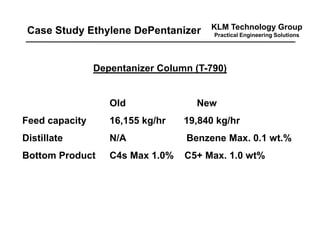
Depentanizer Column (T-790)
Old New
Feed capacity 16,155 kg/hr 19,840 kg/hr
Distillate N/A Benzene Max. 0.1 wt.%
Bottom Product C4s Max 1.0% C5+ Max. 1.0 wt%
Case Study Ethylene DePentanizer
KLM Technology Group
Practical Engineering Solutions
Design of New 40 Tray Column Hydraulics
1. Max Recommended Jet Flood is 83% - at
83% jet flood there is about 95%
confidence level – jet flood is a vapor
limitation.
For a new system design at 70%. For a
new system do not design below 50%,
below 50% jet flood decreases your tray
efficiency.
Case Study Ethylene DePentanizer
KLM Technology Group
Practical Engineering Solutions
Design of New 40 Tray Column Hydraulics
2. Max Recommended Down-comer Back
up is 80% - down-comer back up is a
liquid limitation.
For a new system design about 60%.
Case Study Ethylene DePentanizer
KLM Technology Group
Practical Engineering SolutionsGuidelines for the Field
1. Investigate Previous Operations
2. Simulate Original Heat and Material
Balance and Tune Model
3. Simulate Current Operation and Tune Model
4. Rate existing tower
5. Recommend proposed changes if required
KLM Technology Group
Practical Engineering SolutionsGuidelines for the Field
1. Investigate Previous Operations
There is large data base of knowledge, go
research on the web and find;
a. VLE Data
b. Tray Efficiencies
c. Normal Designs
d. Challenges
Make industry friends and be a friend.
KLM Technology Group
Practical Engineering SolutionsGuidelines for the Field
2. Simulate Original Heat and Material
Balance and Tune Model
A. Most licensors have good heat and
material balances developed from the
plant operations data.
B. VLE data, tray efficiencies can be
verified.
C. You should be able to match this
quickly.
KLM Technology Group
Practical Engineering SolutionsGuidelines for the Field
3. Simulate Current Operation and Tune Model
A. This can be a challenge.
B. Pressure, flow and temperatures
measurement can be an issues.
C. A test run to collect data may be
required
KLM Technology Group
Practical Engineering SolutionsGuidelines for the Field
3. Simulate Current Operation and Tune
Model
If you cannot match the original heat and
balance and the current operation you may
not wish to utilize this model for a revamp or
tower ratings.
KLM Technology Group
Practical Engineering SolutionsGuidelines for the Field
4. Rate existing tower
a. Can the existing tower with operational
changes meet the desired targets.
b. In one case we identified the problem as
laboratory issue. We sent samples to an
independent lab – problem solved.
c. Utilize hydraulic analysis of simulated
internal vapor and liquid flows
KLM Technology Group
Practical Engineering SolutionsGuidelines for the Field
5. Recommend proposed changes if required
a. From the tuned model design new
equipment specifications
b. May wish to modify in a step wise fashion,
with the highest return items implemented
first.
KLM Technology Group
Practical Engineering Solutions
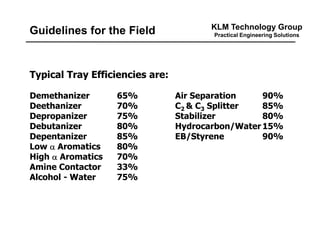
Typical Tray Efficiencies are:
Demethanizer 65% Air Separation 90%
Deethanizer 70% C2 & C3 Splitter 85%
Depropanizer 75% Stabilizer 80%
Debutanizer 80% Hydrocarbon/Water 15%
Depentanizer 85% EB/Styrene 90%
Low  Aromatics 80%
High  Aromatics 70%
Amine Contactor 33%
Alcohol - Water 75%
Guidelines for the Field
KLM Technology Group
Practical Engineering SolutionsGuidelines for the Field
Choosing Tray Efficiencies
1. Low relative volatility gives higher efficiencies
and the converse.
2. L/V ratios affect efficiencies.
3. Very high / very low hydraulics rate decrease
efficiencies.
KLM Technology Group
Practical Engineering SolutionsGuidelines for the Field
Choosing Packing Efficiencies
1. Low relative volatility gives higher efficiencies
and the converse
2. L/V ratios affect efficiencies
3. Very high hydraulics rate decrease
efficiencies – recommended max of 50 m3/m2
4. In packing liquid to vapor densities are
important – particularly above 10 bar (150
psig)
KLM Technology Group
Practical Engineering SolutionsGuidelines for the Field
Choosing Tray Hydraulics
1. Recommended max 83% Jet flood
2. Recommended max 80% down-comer back
up.
KLM Technology Group
Practical Engineering SolutionsGuidelines for the Field
Choosing Packing Hydraulics
1. Capacity decreases as packing surface area
increases.
2. Avoid bed heights taller than 6 meters (20 ft),
cannot compensate for poor distribution with
more packing – rule of thumb is 15 stages per
bed.
3. Most common reason for loss of efficiency
with operating packed columns is poor
distribution, higher surface area packing
requires more distribution points.
KLM Technology Group
Practical Engineering SolutionsGuidelines for the Field
Challenges
1. One engineer runs a simulation.
2. A second engineer runs hydraulics.
3. A third engineer designs the trays.
Each assumes the other engineer has
adequate safety margin in his design. They
can be employed by two different companies
in three locations. It is very important that
there is adequate communication among the
designers.
KLM Technology Group
Practical Engineering SolutionsConclusions
Process simulation is a powerful chemical
engineering tool that has wide spread use in
the chemical processing industry.
Working steps like correct selection of actual
field efficiencies, choosing appropriate vapor
and liquid equilibrium (VLE) data, feed
modeling, and analysis of actual hydraulic
behavior all have a strong influence on the
accuracy of the model’s results.
Developing guidelines for each of these steps
is very important to a practicing engineer
KLM Technology Group
Practical Engineering Solutions
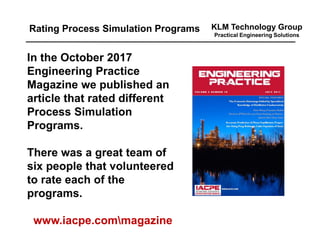
In the October 2017
Engineering Practice
Magazine we published an
article that rated different
Process Simulation
Programs.
There was a great team of
six people that volunteered
to rate each of the
programs.
www.iacpe.commagazine
Rating Process Simulation Programs
KLM Technology Group
Practical Engineering Solutions
Training
Kolmetz Handbook of Process Equipment Design
Process Optimization Studies
HAZOP Facilitation
Engineering Support
An Engineering Resource
KLM Core Business
KLM Technology Group
Practical Engineering SolutionsAn Engineering Resource
KLM Technology Group
Practical Engineering SolutionsTraining
KLM has a group of very senior associates and
trainers that can assist your team. We teach at
regional seminars, at your facility and in
Webinars.
We have a very large group of courses that we
offer on the website;
www.klmtechgroup.comtraining
KLM Technology Group
Practical Engineering Solutions
Thank You

Introduction To Process Simulation

  • 1.
    KLM Technology Group PracticalEngineering Solutions KLM Technology Group Solutions, Standards and Software www.klmtechgroup.com
  • 2.
    KLM Technology Group PracticalEngineering Solutions Based in USA since 1995, KLM is a technical consultancy group, providing specialized services and equipment to improve process plant operational efficiency, profitability and safety. KLM Technology Group
  • 3.
    KLM Technology Group PracticalEngineering SolutionsTraining Today we are discussing - Introduction To Process Simulation We also offer training classes in, 1.Advanced Process Simulation with Case Studies 2.Advanced Refinery Process Simulation with Case Studies 3.Advanced Ethylene Simulation with Case Studies 4.Advanced Specialty Chemical Simulation with Case Studies As well as other process units and equipment groups. The course descriptions may be found on the website. www.klmtechgroup.com/training
  • 4.
    KLM Technology Group PracticalEngineering SolutionsTraining Kolmetz Handbook of Process Equipment Design There are multiple chapters for distillation design in the Kolmetz Handbook of Process Equipment Design. We have over 50 individual chapters on a wide range of subjects. Each chapter is 80 to 100 pages including design and sizing guidelines. As we revise the chapters we are adding a troubleshooting section. The handbook may be found here; www.klmtechgroup.com/Engineering_Design_Guildelines.htm
  • 5.
    KLM Technology Group PracticalEngineering SolutionsTraining Some of the Distillation Chapters include; 1. General Distillation Tower Design 2. Trayed Column Hydraulics 3. Packed Column Hydraulics 4. Refinery Crude Tower 5. Refinery Vacuum Tower 6. Reboiler Selection and Sizing 7. BTX Extraction Units 8. Ethylene Plant Quench Oil Towers 9. Ethylene Plant Quench Water Tower 10.Ethylene Plant C2 Splitters 11.Ethylene Plant C3 Splitters
  • 6.
    KLM Technology Group PracticalEngineering Solutions A.Introduction B.Case Study - Ethylene DePentanizer C.Guidelines D.Conclusions Introduction to Process Simulation
  • 7.
    KLM Technology Group PracticalEngineering Solutions Simulation is a powerful engineering tool that has wide spread use in the chemical processing industry. Utilized correctly it can help design, optimize and troubleshoot process units, when you follow guidelines developed from the fundamental basics of engineering. Introduction
  • 8.
    KLM Technology Group PracticalEngineering Solutions It is important to remember that machine calculations are for the purpose of improving only the speed of the calculation. Garbage In = Garbage Out Introduction
  • 9.
    KLM Technology Group PracticalEngineering Solutions Despite rapid progress in computational speed and user friendly interfaces, understanding the rules and limitations of simulation tools is still a prerequisite to obtain simulated results close to those measured in the field. Introduction
  • 10.
    KLM Technology Group PracticalEngineering Solutions The user needs to supply the correct input data, interpret errors that occurred and make critical judgment on the results. Mastering these techniques often requires substantial field experience and practice. Accumulating such knowledge in form of design guidelines can help users to ramp up their learning curves. Introduction
  • 11.
    KLM Technology Group PracticalEngineering Solutions Working steps like correct selection of; actual field efficiencies, choosing appropriate vapor and liquid equilibrium (VLE) data, feed modeling, and analysis of actual hydraulic behavior all have a strong influence on the accuracy of the model’s results. Developing guidelines for each of these steps is very important to a practicing simulation user. Introduction
  • 12.
    KLM Technology Group PracticalEngineering Solutions Without the actual field efficiencies 1. Energy usage will be high 2. Product recovery will be low 3. Product purity will be low $$$$ Introduction
  • 13.
    KLM Technology Group PracticalEngineering Solutions An Ethylene Unit in Malaysia wished to convert a Gasoline Hydrotreater Stabilizer Column to a DePentanizer Column operation. Case Study Ethylene DePentanizer
  • 14.
    KLM Technology Group PracticalEngineering Solutions The Stabilizer was designed to remove C4s and lighter hydrocarbons. They now wished to remove C5s and lighter hydrocarbons, while minimizing benzene (C6) loss in the overhead. Case Study Ethylene DePentanizer
  • 15.
    KLM Technology Group PracticalEngineering Solutions LIGHT ENDS PRODUCT Original Column had 28 sieve deck trays, with a bottom diameter of 1.8 meters, and a top diameter of 1.0 meters. The original design feed rate was 16,155 tons/hr with a bottoms specification of 1.0% C4s and lighter. Case Study Ethylene DePentanizer
  • 16.
    KLM Technology Group PracticalEngineering Solutions PRODUCT 1 2 9 10 STEAM CW PC LC LC HYDROGENATED PG VENT GAS STABILIZER / DEPENTANIZER REBOILER CONDENSER REFLUX DRUM REFLUX PUMP WATER C5S C5 PUMP Case Study Ethylene DePentanizer
  • 17.
    KLM Technology Group PracticalEngineering Solutions A good place to start in a revamp would be to go research what has been successful and not successful in the proposed revamp unit operation. Case Study Ethylene DePentanizer
  • 18.
    KLM Technology Group PracticalEngineering Solutions There are over 900 published cases of unsuccessful distillation operations. Case Study Ethylene DePentanizer
  • 19.
    KLM Technology Group PracticalEngineering Solutions There are over 400 published cases of refinery tower incidents. They included; 1. Vacuum Towers - 86 2 Atmospheric Crude Towers - 45 3. Debutanizer Towers - 37 4. FCC Main Fractionators - 33 5. DeEthanizer Towers - 23 6. DePropanizer Towers - 22 7. Alky Main Fractionators - 17 8 Coker Main Fractionators - 15 9. Naphtha Splitters - 11 Case Study Ethylene DePentanizer
  • 20.
    KLM Technology Group PracticalEngineering Solutions The largest number of cases is for the vacuum tower. The top causes of vacuum tower malfunctions include; 1. Damage - 27 2. Coking - 21 3. Intermediate draws - 17 4. Misleading measurements - 10 5. Plugging - 9 6. Installation mishaps - 9 7. Abnormal operation - 9 (Start up, shut down) 8. Mal-distribution - 6 9. Weeping - 6 10. Condenser - 4 Case Study Ethylene DePentanizer
  • 21.
    KLM Technology Group PracticalEngineering Solutions The top causes of damage in vacuum tower include 1. Water induced pressure surges - 9 2. Insufficient mechanical strength - 5 3. Broken nozzles or headers - of spray distributors - 4 4. High bottoms level - 3 5. Packing Fires - 3 Case Study Ethylene DePentanizer
  • 22.
    KLM Technology Group PracticalEngineering Solutions A lesson to be learned is that possibly one third of the causes of damage in vacuum towers can be prevented by design and operating procedure that adequately prevent water from entering the tower. A joint design / operations hazard and operability review (HAZOP) should focus on the listed potential problem areas. Case Study Ethylene DePentanizer
  • 23.
    KLM Technology Group PracticalEngineering Solutions It is a very good idea to have a ball park range of what the correct answer should be before you began to simulate to prevent the 901st case. Case Study Ethylene DePentanizer
  • 24.
    KLM Technology Group PracticalEngineering Solutions Many successful DePentanizers have about 38 - 45 trays. Average tray efficiency has been about 75 - 85%. For our design case we utilized 70%. There are many short cut methods to establish number of trays and reflux ratios based on relative volatilities of the light and heavy keys. Case Study Ethylene DePentanizer
  • 25.
    KLM Technology Group PracticalEngineering Solutions A second step in a revamp might be to simulate the original heat and material balance provided by the licensor, and the then the current unit operation. The current unit operation may need a test run with data analysis to develop an accurate current heat and material balance. Most flow meter accuracy is only +/- 2.0%. Case Study Ethylene DePentanizer
  • 26.
    KLM Technology Group PracticalEngineering Solutions If these two cases can be matched then one can utilize that tuned model to project the future cases. Without accurate models that match the original heat and material balance and current unit operation future projections are a risky adventure. Case Study Ethylene DePentanizer
  • 27.
    KLM Technology Group PracticalEngineering Solutions Step three would be to utilize the tuned model to verify if the existing tower could be utilized, possibility by raising the reflux ratio, adjusting the pressure or other simple modifications. Case Study Ethylene DePentanizer
  • 28.
    KLM Technology Group PracticalEngineering Solutions Step three is really has two parts. Part one would be to modify the tuned model, and then rate the tray hydraulics. In this case the client desired increased capacity and increased separation ability, which is difficult to achieve in an existing column. Case Study Ethylene DePentanizer
  • 29.
    KLM Technology Group PracticalEngineering Solutions The existing column could not easily provide the increased capacity and separation. A design was developed utilizing the tuned model which met the desired capacity and separation. Case Study Ethylene DePentanizer
  • 30.
    KLM Technology Group PracticalEngineering Solutions The proposed new tower design had 40 stages. This required a 1.8 meter bottom diameter and a 1.2 meter top diameter due to the increase capacity and separation requirements. Case Study Ethylene DePentanizer
  • 31.
    KLM Technology Group PracticalEngineering Solutions Depentanizer Column (T-790) Old New Feed capacity 16,155 kg/hr 19,840 kg/hr Distillate N/A Benzene Max. 0.1 wt.% Bottom Product C4s Max 1.0% C5+ Max. 1.0 wt% Case Study Ethylene DePentanizer
  • 32.
    KLM Technology Group PracticalEngineering Solutions Design of New 40 Tray Column Hydraulics 1. Max Recommended Jet Flood is 83% - at 83% jet flood there is about 95% confidence level – jet flood is a vapor limitation. For a new system design at 70%. For a new system do not design below 50%, below 50% jet flood decreases your tray efficiency. Case Study Ethylene DePentanizer
  • 33.
    KLM Technology Group PracticalEngineering Solutions Design of New 40 Tray Column Hydraulics 2. Max Recommended Down-comer Back up is 80% - down-comer back up is a liquid limitation. For a new system design about 60%. Case Study Ethylene DePentanizer
  • 34.
    KLM Technology Group PracticalEngineering SolutionsGuidelines for the Field 1. Investigate Previous Operations 2. Simulate Original Heat and Material Balance and Tune Model 3. Simulate Current Operation and Tune Model 4. Rate existing tower 5. Recommend proposed changes if required
  • 35.
    KLM Technology Group PracticalEngineering SolutionsGuidelines for the Field 1. Investigate Previous Operations There is large data base of knowledge, go research on the web and find; a. VLE Data b. Tray Efficiencies c. Normal Designs d. Challenges Make industry friends and be a friend.
  • 36.
    KLM Technology Group PracticalEngineering SolutionsGuidelines for the Field 2. Simulate Original Heat and Material Balance and Tune Model A. Most licensors have good heat and material balances developed from the plant operations data. B. VLE data, tray efficiencies can be verified. C. You should be able to match this quickly.
  • 37.
    KLM Technology Group PracticalEngineering SolutionsGuidelines for the Field 3. Simulate Current Operation and Tune Model A. This can be a challenge. B. Pressure, flow and temperatures measurement can be an issues. C. A test run to collect data may be required
  • 38.
    KLM Technology Group PracticalEngineering SolutionsGuidelines for the Field 3. Simulate Current Operation and Tune Model If you cannot match the original heat and balance and the current operation you may not wish to utilize this model for a revamp or tower ratings.
  • 39.
    KLM Technology Group PracticalEngineering SolutionsGuidelines for the Field 4. Rate existing tower a. Can the existing tower with operational changes meet the desired targets. b. In one case we identified the problem as laboratory issue. We sent samples to an independent lab – problem solved. c. Utilize hydraulic analysis of simulated internal vapor and liquid flows
  • 40.
    KLM Technology Group PracticalEngineering SolutionsGuidelines for the Field 5. Recommend proposed changes if required a. From the tuned model design new equipment specifications b. May wish to modify in a step wise fashion, with the highest return items implemented first.
  • 41.
    KLM Technology Group PracticalEngineering Solutions Typical Tray Efficiencies are: Demethanizer 65% Air Separation 90% Deethanizer 70% C2 & C3 Splitter 85% Depropanizer 75% Stabilizer 80% Debutanizer 80% Hydrocarbon/Water 15% Depentanizer 85% EB/Styrene 90% Low  Aromatics 80% High  Aromatics 70% Amine Contactor 33% Alcohol - Water 75% Guidelines for the Field
  • 42.
    KLM Technology Group PracticalEngineering SolutionsGuidelines for the Field Choosing Tray Efficiencies 1. Low relative volatility gives higher efficiencies and the converse. 2. L/V ratios affect efficiencies. 3. Very high / very low hydraulics rate decrease efficiencies.
  • 43.
    KLM Technology Group PracticalEngineering SolutionsGuidelines for the Field Choosing Packing Efficiencies 1. Low relative volatility gives higher efficiencies and the converse 2. L/V ratios affect efficiencies 3. Very high hydraulics rate decrease efficiencies – recommended max of 50 m3/m2 4. In packing liquid to vapor densities are important – particularly above 10 bar (150 psig)
  • 44.
    KLM Technology Group PracticalEngineering SolutionsGuidelines for the Field Choosing Tray Hydraulics 1. Recommended max 83% Jet flood 2. Recommended max 80% down-comer back up.
  • 45.
    KLM Technology Group PracticalEngineering SolutionsGuidelines for the Field Choosing Packing Hydraulics 1. Capacity decreases as packing surface area increases. 2. Avoid bed heights taller than 6 meters (20 ft), cannot compensate for poor distribution with more packing – rule of thumb is 15 stages per bed. 3. Most common reason for loss of efficiency with operating packed columns is poor distribution, higher surface area packing requires more distribution points.
  • 46.
    KLM Technology Group PracticalEngineering SolutionsGuidelines for the Field Challenges 1. One engineer runs a simulation. 2. A second engineer runs hydraulics. 3. A third engineer designs the trays. Each assumes the other engineer has adequate safety margin in his design. They can be employed by two different companies in three locations. It is very important that there is adequate communication among the designers.
  • 47.
    KLM Technology Group PracticalEngineering SolutionsConclusions Process simulation is a powerful chemical engineering tool that has wide spread use in the chemical processing industry. Working steps like correct selection of actual field efficiencies, choosing appropriate vapor and liquid equilibrium (VLE) data, feed modeling, and analysis of actual hydraulic behavior all have a strong influence on the accuracy of the model’s results. Developing guidelines for each of these steps is very important to a practicing engineer
  • 48.
    KLM Technology Group PracticalEngineering Solutions In the October 2017 Engineering Practice Magazine we published an article that rated different Process Simulation Programs. There was a great team of six people that volunteered to rate each of the programs. www.iacpe.commagazine Rating Process Simulation Programs
  • 49.
    KLM Technology Group PracticalEngineering Solutions Training Kolmetz Handbook of Process Equipment Design Process Optimization Studies HAZOP Facilitation Engineering Support An Engineering Resource KLM Core Business
  • 50.
    KLM Technology Group PracticalEngineering SolutionsAn Engineering Resource
  • 51.
    KLM Technology Group PracticalEngineering SolutionsTraining KLM has a group of very senior associates and trainers that can assist your team. We teach at regional seminars, at your facility and in Webinars. We have a very large group of courses that we offer on the website; www.klmtechgroup.comtraining
  • 52.
    KLM Technology Group PracticalEngineering Solutions Thank You