INTRODUCTION TO
PRACTICAL RESEARCH 2 –
PRIMING ACTIVITIES
Menandro M. Merlin
Master Teacher III – Senior High
Marinduque National High School
Key Concepts
• Research was coined from the French word “cerhier” which
means seek and prefix “re” means to repeat or again.
• Practical Research 2 is a course which aims to develop
critical thinking and problem-solving skills through
quantitative research.
• By definition, quantitative research is an objective,
systematic, empirical investigation of observable phenomena
through the use of computational techniques. It is
concerned with numbers and its relationship with events.
Learning Objectives
1. Rate competencies in Practical Research 2 based
on difficulty
2. Differentiate competencies of Practical research 2
from Practical Research 1
3. Relate learning competencies of other subject
areas (e.g. English, Filipino and Statistics) to
Practical Research 2
4. Write a Gantt Chart of activities in Practical
Research 2
Pre-activity – A quick interview
with the participants
1. Who has master units? Master degree
holder? With doctoral units? Doctoral
degree holder?
2. Who are researchers? Statisticians?
3. Who are teaching Practical Research 1,
Practical Research 2, and Statistics?
4. How do you teach research?
Activity 1. This is me… –
Diagnosing Expected
Learning in Practical
Research 2
1. Given a copy of Practical Research 2
Curriculum Guide, rate the different learning
competencies according to difficulty. Use the
following Likert scale: (5) – Very difficult, (4) –
Difficult, (3) – Moderately difficult (Average),
(2) – Less difficult, (1) – Not difficult
2. Identify the Top 5 learning competencies with
the highest rating
3. Write your answer on Manila paper and share
your answer to the big group
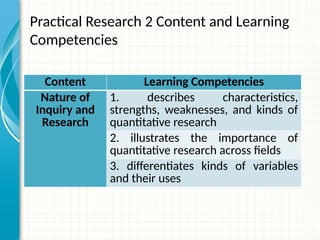
Practical Research 2 Content and Learning
Competencies
Content Learning Competencies
Nature of
Inquiry and
Research
1. describes characteristics,
strengths, weaknesses, and kinds of
quantitative research
2. illustrates the importance of
quantitative research across fields
3. differentiates kinds of variables
and their uses
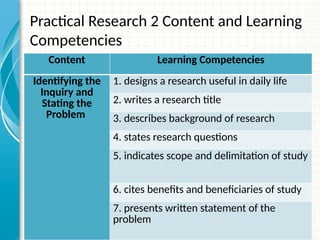
Practical Research 2 Content and Learning
Competencies
Content Learning Competencies
Identifying the
Inquiry and
Stating the
Problem
1. designs a research useful in daily life
2. writes a research title
3. describes background of research
4. states research questions
5. indicates scope and delimitation of study
6. cites benefits and beneficiaries of study
7. presents written statement of the
problem
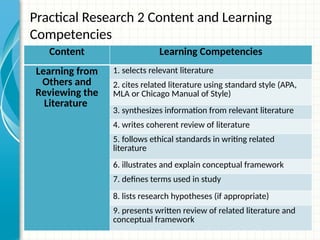
Practical Research 2 Content and Learning
Competencies
Content Learning Competencies
Learning from
Others and
Reviewing the
Literature
1. selects relevant literature
2. cites related literature using standard style (APA,
MLA or Chicago Manual of Style)
3. synthesizes information from relevant literature
4. writes coherent review of literature
5. follows ethical standards in writing related
literature
6. illustrates and explain conceptual framework
7. defines terms used in study
8. lists research hypotheses (if appropriate)
9. presents written review of related literature and
conceptual framework
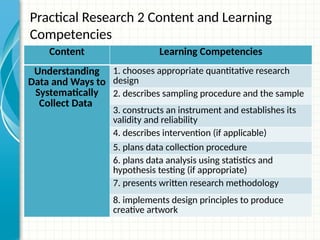
Practical Research 2 Content and Learning
Competencies
Content Learning Competencies
Understanding
Data and Ways to
Systematically
Collect Data
1. chooses appropriate quantitative research
design
2. describes sampling procedure and the sample
3. constructs an instrument and establishes its
validity and reliability
4. describes intervention (if applicable)
5. plans data collection procedure
6. plans data analysis using statistics and
hypothesis testing (if appropriate)
7. presents written research methodology
8. implements design principles to produce
creative artwork
Practical Research 2 Content and Learning
Competencies
Content Learning Competencies
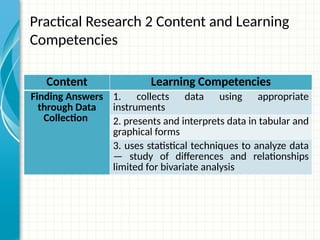
Finding Answers
through Data
Collection
1. collects data using appropriate
instruments
2. presents and interprets data in tabular and
graphical forms
3. uses statistical techniques to analyze data
— study of differences and relationships
limited for bivariate analysis
Practical Research 2 Content and Learning
Competencies
Content Learning Competencies
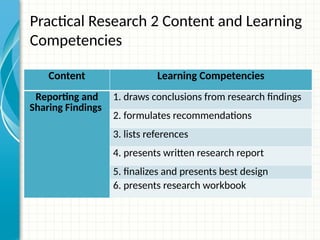
Reporting and
Sharing Findings
1. draws conclusions from research findings
2. formulates recommendations
3. lists references
4. presents written research report
5. finalizes and presents best design
6. presents research workbook
Activity 2. You and me in this
world… – Comparing Practical
Research 2 from Practical
Research 1
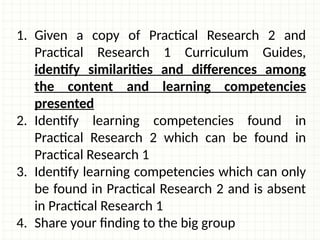
1. Given a copy of Practical Research 2 and
Practical Research 1 Curriculum Guides,
identify similarities and differences among
the content and learning competencies
presented
2. Identify learning competencies found in
Practical Research 2 which can be found in
Practical Research 1
3. Identify learning competencies which can only
be found in Practical Research 2 and is absent
in Practical Research 1
4. Share your finding to the big group
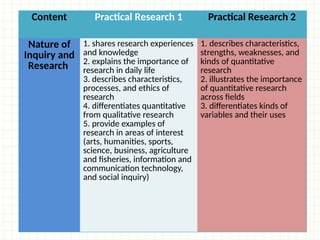
Content Practical Research 1 Practical Research 2
Nature of
Inquiry and
Research
1. shares research experiences
and knowledge
2. explains the importance of
research in daily life
3. describes characteristics,
processes, and ethics of
research
4. differentiates quantitative
from qualitative research
5. provide examples of
research in areas of interest
(arts, humanities, sports,
science, business, agriculture
and fisheries, information and
communication technology,
and social inquiry)
1. describes characteristics,
strengths, weaknesses, and
kinds of quantitative
research
2. illustrates the importance
of quantitative research
across fields
3. differentiates kinds of
variables and their uses
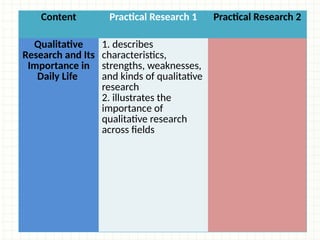
Content Practical Research 1 Practical Research 2
Qualitative
Research and Its
Importance in
Daily Life
1. describes
characteristics,
strengths, weaknesses,
and kinds of qualitative
research
2. illustrates the
importance of
qualitative research
across fields
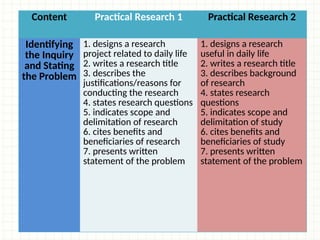
Content Practical Research 1 Practical Research 2
Identifying
the Inquiry
and Stating
the Problem
1. designs a research
project related to daily life
2. writes a research title
3. describes the
justifications/reasons for
conducting the research
4. states research questions
5. indicates scope and
delimitation of research
6. cites benefits and
beneficiaries of research
7. presents written
statement of the problem
1. designs a research
useful in daily life
2. writes a research title
3. describes background
of research
4. states research
questions
5. indicates scope and
delimitation of study
6. cites benefits and
beneficiaries of study
7. presents written
statement of the problem
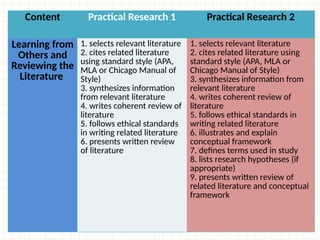
Content Practical Research 1 Practical Research 2
Learning from
Others and
Reviewing the
Literature
1. selects relevant literature
2. cites related literature
using standard style (APA,
MLA or Chicago Manual of
Style)
3. synthesizes information
from relevant literature
4. writes coherent review of
literature
5. follows ethical standards
in writing related literature
6. presents written review
of literature
1. selects relevant literature
2. cites related literature using
standard style (APA, MLA or
Chicago Manual of Style)
3. synthesizes information from
relevant literature
4. writes coherent review of
literature
5. follows ethical standards in
writing related literature
6. illustrates and explain
conceptual framework
7. defines terms used in study
8. lists research hypotheses (if
appropriate)
9. presents written review of
related literature and conceptual
framework
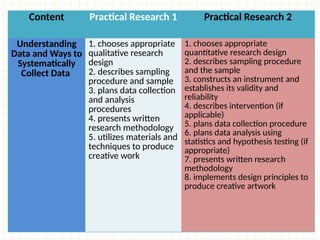
Content Practical Research 1 Practical Research 2
Understanding
Data and Ways to
Systematically
Collect Data
1. chooses appropriate
qualitative research
design
2. describes sampling
procedure and sample
3. plans data collection
and analysis
procedures
4. presents written
research methodology
5. utilizes materials and
techniques to produce
creative work
1. chooses appropriate
quantitative research design
2. describes sampling procedure
and the sample
3. constructs an instrument and
establishes its validity and
reliability
4. describes intervention (if
applicable)
5. plans data collection procedure
6. plans data analysis using
statistics and hypothesis testing (if
appropriate)
7. presents written research
methodology
8. implements design principles to
produce creative artwork
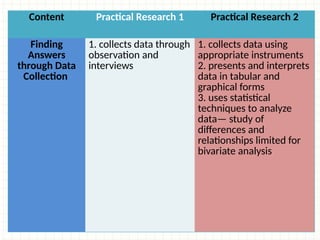
Content Practical Research 1 Practical Research 2
Finding
Answers
through Data
Collection
1. collects data through
observation and
interviews
1. collects data using
appropriate instruments
2. presents and interprets
data in tabular and
graphical forms
3. uses statistical
techniques to analyze
data— study of
differences and
relationships limited for
bivariate analysis
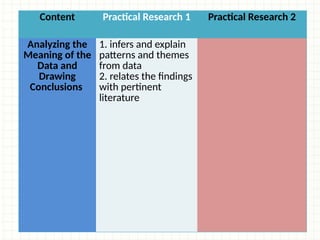
Content Practical Research 1 Practical Research 2
Analyzing the
Meaning of the
Data and
Drawing
Conclusions
1. infers and explain
patterns and themes
from data
2. relates the findings
with pertinent
literature
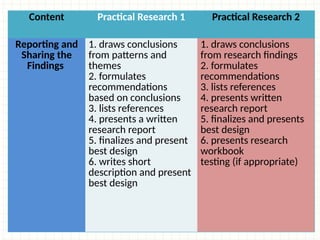
Content Practical Research 1 Practical Research 2
Reporting and
Sharing the
Findings
1. draws conclusions
from patterns and
themes
2. formulates
recommendations
based on conclusions
3. lists references
4. presents a written
research report
5. finalizes and present
best design
6. writes short
description and present
best design
1. draws conclusions
from research findings
2. formulates
recommendations
3. lists references
4. presents written
research report
5. finalizes and presents
best design
6. presents research
workbook
testing (if appropriate)
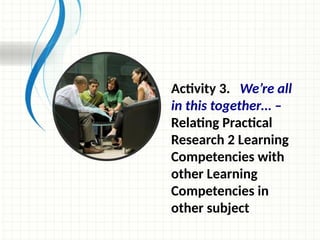
Activity 3. We’re all
in this together… –
Relating Practical
Research 2 Learning
Competencies with
other Learning
Competencies in
other subject
1.Given learning competencies in other subject
area (e.g. English, Filipino, Statistics), examine
the learning competencies which are applicable
and is related to learning Practical Research 2.
2.List at least five (5) learning competencies
related to Practical Research 2.
Question: Are the competencies in other
subject area (e.g. English,
Filipino, Statistics) useful or important in
learning Practical Research 2?
3. Report your answer in a big group.
• Are these priming activities important
before the conceptual teaching and
learning of Practical Research 2?
1
• How do these diagnostic activities
promote eliciting prior knowledge and
self-reflection among students?
2
Reflection
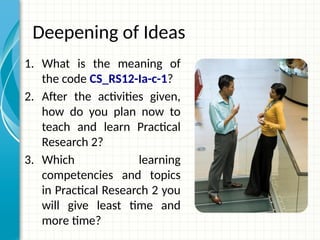
Deepening of Ideas
1. What is the meaning of
the code CS_RS12-Ia-c-1?
2. After the activities given,
how do you plan now to
teach and learn Practical
Research 2?
3. Which learning
competencies and topics
in Practical Research 2 you
will give least time and
more time?
APPLICATION
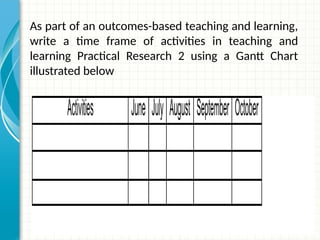
As part of an outcomes-based teaching and learning,
write a time frame of activities in teaching and
learning Practical Research 2 using a Gantt Chart
illustrated below
• Note: Activities must reflect an output of
students and shall be in line with the learning
competencies and topics for Practical
Research 2. This activity promotes “planning
how to plan” among our students.
Concluding Statement
“Kung hindi mo
ngayon susubukan,
kalian? Baka bukas,
kapag handa ka na,
ang bukas naman
ang hindi handa
sa’yo.”
– Leo sa indie film na
Binyag (2008)

Introduction to Practical Research 2.pptx

  • 1.
    INTRODUCTION TO PRACTICAL RESEARCH2 – PRIMING ACTIVITIES Menandro M. Merlin Master Teacher III – Senior High Marinduque National High School
  • 2.
    Key Concepts • Researchwas coined from the French word “cerhier” which means seek and prefix “re” means to repeat or again. • Practical Research 2 is a course which aims to develop critical thinking and problem-solving skills through quantitative research. • By definition, quantitative research is an objective, systematic, empirical investigation of observable phenomena through the use of computational techniques. It is concerned with numbers and its relationship with events.
  • 3.
    Learning Objectives 1. Ratecompetencies in Practical Research 2 based on difficulty 2. Differentiate competencies of Practical research 2 from Practical Research 1 3. Relate learning competencies of other subject areas (e.g. English, Filipino and Statistics) to Practical Research 2 4. Write a Gantt Chart of activities in Practical Research 2
  • 4.
    Pre-activity – Aquick interview with the participants
  • 5.
    1. Who hasmaster units? Master degree holder? With doctoral units? Doctoral degree holder? 2. Who are researchers? Statisticians? 3. Who are teaching Practical Research 1, Practical Research 2, and Statistics? 4. How do you teach research?
  • 6.
    Activity 1. Thisis me… – Diagnosing Expected Learning in Practical Research 2
  • 7.
    1. Given acopy of Practical Research 2 Curriculum Guide, rate the different learning competencies according to difficulty. Use the following Likert scale: (5) – Very difficult, (4) – Difficult, (3) – Moderately difficult (Average), (2) – Less difficult, (1) – Not difficult 2. Identify the Top 5 learning competencies with the highest rating 3. Write your answer on Manila paper and share your answer to the big group
  • 8.
    Practical Research 2Content and Learning Competencies Content Learning Competencies Nature of Inquiry and Research 1. describes characteristics, strengths, weaknesses, and kinds of quantitative research 2. illustrates the importance of quantitative research across fields 3. differentiates kinds of variables and their uses
  • 9.
    Practical Research 2Content and Learning Competencies Content Learning Competencies Identifying the Inquiry and Stating the Problem 1. designs a research useful in daily life 2. writes a research title 3. describes background of research 4. states research questions 5. indicates scope and delimitation of study 6. cites benefits and beneficiaries of study 7. presents written statement of the problem
  • 10.
    Practical Research 2Content and Learning Competencies Content Learning Competencies Learning from Others and Reviewing the Literature 1. selects relevant literature 2. cites related literature using standard style (APA, MLA or Chicago Manual of Style) 3. synthesizes information from relevant literature 4. writes coherent review of literature 5. follows ethical standards in writing related literature 6. illustrates and explain conceptual framework 7. defines terms used in study 8. lists research hypotheses (if appropriate) 9. presents written review of related literature and conceptual framework
  • 11.
    Practical Research 2Content and Learning Competencies Content Learning Competencies Understanding Data and Ways to Systematically Collect Data 1. chooses appropriate quantitative research design 2. describes sampling procedure and the sample 3. constructs an instrument and establishes its validity and reliability 4. describes intervention (if applicable) 5. plans data collection procedure 6. plans data analysis using statistics and hypothesis testing (if appropriate) 7. presents written research methodology 8. implements design principles to produce creative artwork
  • 12.
    Practical Research 2Content and Learning Competencies Content Learning Competencies Finding Answers through Data Collection 1. collects data using appropriate instruments 2. presents and interprets data in tabular and graphical forms 3. uses statistical techniques to analyze data — study of differences and relationships limited for bivariate analysis
  • 13.
    Practical Research 2Content and Learning Competencies Content Learning Competencies Reporting and Sharing Findings 1. draws conclusions from research findings 2. formulates recommendations 3. lists references 4. presents written research report 5. finalizes and presents best design 6. presents research workbook
  • 14.
    Activity 2. Youand me in this world… – Comparing Practical Research 2 from Practical Research 1
  • 15.
    1. Given acopy of Practical Research 2 and Practical Research 1 Curriculum Guides, identify similarities and differences among the content and learning competencies presented 2. Identify learning competencies found in Practical Research 2 which can be found in Practical Research 1 3. Identify learning competencies which can only be found in Practical Research 2 and is absent in Practical Research 1 4. Share your finding to the big group
  • 16.
    Content Practical Research1 Practical Research 2 Nature of Inquiry and Research 1. shares research experiences and knowledge 2. explains the importance of research in daily life 3. describes characteristics, processes, and ethics of research 4. differentiates quantitative from qualitative research 5. provide examples of research in areas of interest (arts, humanities, sports, science, business, agriculture and fisheries, information and communication technology, and social inquiry) 1. describes characteristics, strengths, weaknesses, and kinds of quantitative research 2. illustrates the importance of quantitative research across fields 3. differentiates kinds of variables and their uses
  • 17.
    Content Practical Research1 Practical Research 2 Qualitative Research and Its Importance in Daily Life 1. describes characteristics, strengths, weaknesses, and kinds of qualitative research 2. illustrates the importance of qualitative research across fields
  • 18.
    Content Practical Research1 Practical Research 2 Identifying the Inquiry and Stating the Problem 1. designs a research project related to daily life 2. writes a research title 3. describes the justifications/reasons for conducting the research 4. states research questions 5. indicates scope and delimitation of research 6. cites benefits and beneficiaries of research 7. presents written statement of the problem 1. designs a research useful in daily life 2. writes a research title 3. describes background of research 4. states research questions 5. indicates scope and delimitation of study 6. cites benefits and beneficiaries of study 7. presents written statement of the problem
  • 19.
    Content Practical Research1 Practical Research 2 Learning from Others and Reviewing the Literature 1. selects relevant literature 2. cites related literature using standard style (APA, MLA or Chicago Manual of Style) 3. synthesizes information from relevant literature 4. writes coherent review of literature 5. follows ethical standards in writing related literature 6. presents written review of literature 1. selects relevant literature 2. cites related literature using standard style (APA, MLA or Chicago Manual of Style) 3. synthesizes information from relevant literature 4. writes coherent review of literature 5. follows ethical standards in writing related literature 6. illustrates and explain conceptual framework 7. defines terms used in study 8. lists research hypotheses (if appropriate) 9. presents written review of related literature and conceptual framework
  • 20.
    Content Practical Research1 Practical Research 2 Understanding Data and Ways to Systematically Collect Data 1. chooses appropriate qualitative research design 2. describes sampling procedure and sample 3. plans data collection and analysis procedures 4. presents written research methodology 5. utilizes materials and techniques to produce creative work 1. chooses appropriate quantitative research design 2. describes sampling procedure and the sample 3. constructs an instrument and establishes its validity and reliability 4. describes intervention (if applicable) 5. plans data collection procedure 6. plans data analysis using statistics and hypothesis testing (if appropriate) 7. presents written research methodology 8. implements design principles to produce creative artwork
  • 21.
    Content Practical Research1 Practical Research 2 Finding Answers through Data Collection 1. collects data through observation and interviews 1. collects data using appropriate instruments 2. presents and interprets data in tabular and graphical forms 3. uses statistical techniques to analyze data— study of differences and relationships limited for bivariate analysis
  • 22.
    Content Practical Research1 Practical Research 2 Analyzing the Meaning of the Data and Drawing Conclusions 1. infers and explain patterns and themes from data 2. relates the findings with pertinent literature
  • 23.
    Content Practical Research1 Practical Research 2 Reporting and Sharing the Findings 1. draws conclusions from patterns and themes 2. formulates recommendations based on conclusions 3. lists references 4. presents a written research report 5. finalizes and present best design 6. writes short description and present best design 1. draws conclusions from research findings 2. formulates recommendations 3. lists references 4. presents written research report 5. finalizes and presents best design 6. presents research workbook testing (if appropriate)
  • 24.
    Activity 3. We’reall in this together… – Relating Practical Research 2 Learning Competencies with other Learning Competencies in other subject
  • 25.
    1.Given learning competenciesin other subject area (e.g. English, Filipino, Statistics), examine the learning competencies which are applicable and is related to learning Practical Research 2. 2.List at least five (5) learning competencies related to Practical Research 2. Question: Are the competencies in other subject area (e.g. English, Filipino, Statistics) useful or important in learning Practical Research 2? 3. Report your answer in a big group.
  • 26.
    • Are thesepriming activities important before the conceptual teaching and learning of Practical Research 2? 1 • How do these diagnostic activities promote eliciting prior knowledge and self-reflection among students? 2 Reflection
  • 27.
    Deepening of Ideas 1.What is the meaning of the code CS_RS12-Ia-c-1? 2. After the activities given, how do you plan now to teach and learn Practical Research 2? 3. Which learning competencies and topics in Practical Research 2 you will give least time and more time?
  • 28.
  • 29.
    As part ofan outcomes-based teaching and learning, write a time frame of activities in teaching and learning Practical Research 2 using a Gantt Chart illustrated below
  • 30.
    • Note: Activitiesmust reflect an output of students and shall be in line with the learning competencies and topics for Practical Research 2. This activity promotes “planning how to plan” among our students.
  • 31.
  • 32.
    “Kung hindi mo ngayonsusubukan, kalian? Baka bukas, kapag handa ka na, ang bukas naman ang hindi handa sa’yo.” – Leo sa indie film na Binyag (2008)

Editor's Notes

  • #28 Use a section header for each of the topics, so there is a clear transition to the audience.
  • #31 Oliver Napoleon Hill - American author known for his book Think and Grow Rich which is among the Top 10 best selling self-help book of all time.