PURSUING WISDOM
AND FACING
CHALLENGES IN THE
TWENTY- FIRST
CENTURY
GROUP 1
OBJECTIVES
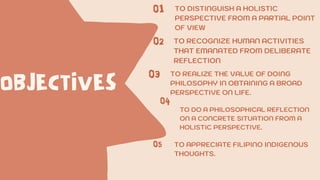
TO DISTINGUISH A HOLISTIC
PERSPECTIVE FROM A PARTIAL POINT
OF VIEW
01
TO RECOGNIZE HUMAN ACTIVITIES
THAT EMANATED FROM DELIBERATE
REFLECTION
02
TO REALIZE THE VALUE OF DOING
PHILOSOPHY IN OBTAINING A BROAD
PERSPECTIVE ON LIFE.
03
TO DO A PHILOSOPHICAL REFLECTION
ON A CONCRETE SITUATION FROM A
HOLISTIC PERSPECTIVE.
04
TO APPRECIATE FILIPINO INDIGENOUS
THOUGHTS.
05
One of the key elements in many
educational reforms is diversity.
Diversity is the difference that makes
each person unique. ( biology, ethnicity,
and culture, family life, beliefs,
geography ,experiences, and religion)
INTRODUCTION OF
PHILOSOPHY
THE MEANING OF
PHILOSOPHY
The word philosophy comes
from the greek words,
Philo- meaning to LOVE and
Sophia- m.eaning WISDOM
Philosophy originally meant, love
of wisdom, and in a broad sense,
wisdom is still the goal of
philosophy.
Philosophy is also defined as the
science that by natural light of
reason studies the first causes
and highest principle of all things.
FOUR THINGS TO
CONSIDER
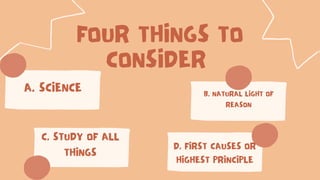
A. SCIENCE B. NATURAL LIGHT OF
REASON
C. STUDY OF ALL
THINGS
D. FIRST CAUSES OR
HIGHEST PRINCIPLE
SCIENCE
IT IS CALLED SCIENCE
BECAUSE THE
INVESTIGATION IS
SYSTEMATIC, IT
FOLLOWS CERTAIN
STEPS, OR IT EMPLOYS
CERTAIN PROCEDURES.
NATURAL
LIGHT OF
REASON
PHILOSOPHY INVESTIGATES
THINGS, NOT BY USING ANY
OTHER LABORATORY
INSTRUMENTS OR
INVESTIGATIVE TOOLS.
NEITHER ON THE BASIS OF
SUPERNATURAL. INSTEAD
THE PHILOSOPHER USES HIS
NATURAL CAPACITY TO
THINK OR SIMPLY HUMAN
REASON ALONE CALLED
UNAIDED REASON.
STUDY
OF ALL
THINGS
A PHILOSOPHER STUDIES
HUMAN BEINGS, SOCIETY,
RELIGION, LANGUAGE, GOD
AND PLANTS. THE REASON
IS THE PHILOSOPHY NOT
DIMENSIONAL OR PARTIAL.
THE PHILOSOPHER THAT
NOT LIMIT HIMSELF TO A
PARTICULAR OF OBJECT
FIRST
CAUSES
OR
HIGHEST
PRINCIPLE
A. PRINCIPLE OF IDENTITY –WHAT
EVER IT IS; AND WHAT EVER IS
NOT. EVERYTHING IS WHAT IS.
B. PRINCIPLE OF NON-
CONTRADICTION- ITIS
IMPOSSIBLEFOR A THING TO BE
AND NOT TO BE AT THE SAME
TIME,AND AT THE SAME RESPECT.
C. PRINCIPLE OF EXCLUDED
MIDDLE- THE THING IS EITHER IS
OR IS NOT.
D. PRINCIPLE OF SUFFICIENT
REASON- NOTHING EXIST
WITHOUT A SUFFICIENT REASON.
Early greek philosophers study aspects or natural sciences and human world
that later become separate sciences----astronomy, physics, psychology, and
sociology. On the other hand, certain basic problems--- the nature of the
universe, the standard of justice, the validity of knowledge, the correct
application of reason and the criteria of beauty have been the domain of
philosophy from its beginning s to the present.
Five branches of philosophy---metaphysics,ethics, epistemology,logic and
aesthetics. (to be discussed)
Special branches of Philosophy---philosophy of science,philosophy of
state,philosophy of politics, philosophy of mathematics, philosophy of
education, philosophy of law, philosophy of language and others.
·In attaining wisdom, there is a need for emptying. Emptying can be intellectual,
spiritual and also physical.
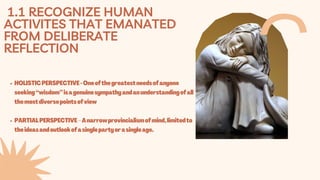
1.1 RECOGNIZE HUMAN
ACTIVITES THAT EMANATED
FROM DELIBERATE
REFLECTION
HOLISTICPERSPECTIVE-Oneofthegreatestneedsofanyone
seeking“wisdom”isagenuinesympathyandanunderstandingofall
themostdiversepointsofview
PARTIALPERSPECTIVE–Anarrowprovincialismofmind,limitedto
theideasandoutlookofasinglepartyorasingleage.
1.2.1 THE BRANCHES OF
PHILOSOPHY
METHAPHYSICS
ETHICS
EPISTEMOLOGY
LOGIC
METHAPHYSICS
-Metaphysics is really only and extension of a fundamental and necessary drive in every human
being to know what is real.
-the metaphysician’s task is to explain that part of our experience, which we call unreal in terms of
what we call real.
- for instance, for Thales, a greek philosopher, everything is water. He claims that everything we
experience is water--- which we call “reality”
-both the idealist and the materialist metaphysical theories are similarly based on unobservable
entities: mind and matter
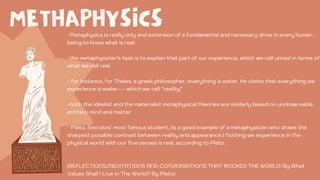
- Plato, Socrates` most famous student, (is a good example of a metaphysician who draws the
sharpest possible contrast between reality and appearance.) Nothing we experience in the
physical world with our five senses is real, according to Plato.
(REFLECTIONS,MEDITATIONS AND CONVERSATIONS THAT ROCKED THE WORLD: By What
Values Shall I Live In The World? By Plato)
ETHICS
·Is the branch of philosophy that explores the nature or moral
virtue and evaluates human actions
·Ethics is generally a study of the nature of moral judgements.
·Philosophy insist that obedience to moral law be given a rational
foundation
(REFLECTIONS, MEDITIATIONS, AND CONVERSATIONS THAT
ROCKED THE WORLD: What Constitutes A Human Person?
PLATO, SOCRATES, ARISTOTLE)
(REFLECTIONS,MEDITIATIONS, AND CONVERSATIONS THAT
ROCKED THE WORLD: How Much Freedom Should We Have?
Who Should Decide?)
·Specifically, epistemology deals with nature, sources,
limitations and validity of knowledge (Soccio 2001
·Epistemology explains:
(1) how we know;what we claim to know
(2) how we can find out what we wish to know; and
(3) how we can differentiate truth from falsehood.
EPISTEMOLOGY
1. On the one hand, he sees,hears, and touches; on the other hand, he organize in his
mind what he learns through the senses.Some philosophers think that the particular
thing seen, heard and touched are more important . They believe that general ideas are
formed from the examination of particular facts. This method is called induction, and
philosphers who feel that knowledge is acquired in this way are called empiricists. (e.g,.
John Locke). Empiricsm is the view that knowledge can be attained through sense
experience.
2. Other philosphers think that it is more important to find a general law according to
which particular facts can be understood or judged. This method is called deduction; its
advocates are called rationalists (e.g,, Rene Descartes)
HOW DO WE ACQUIRE RELIABLE KNOWLEDGE?
HUMAN KNOWLEDGE MAY BE REGARDED AS
HAVING TWO PARTS?
LOGIC
·The term “logic” comes from the greek word logike and was coined by Zeno, the Stoic (c.340-265BC)
·Etymologically, it means a treatise on matters pertaining to the human thought.
·Aristotle was the first philosopher to devise a logical method.
·Logical reasoning makes us certain thatb our conclusions are true, and this provides us with accepted
scientific proofs or universally valid proposiitons or statements.
·Since the time of Aristotle the study of lies and fallacies has been considered an integral part of logic.
·Zeno of Citium is one of the successors of Aristotle. He is also the founder of the movement known as
stoicism, derived from the greek stoa poikile (painted porch
·Other more influential authors of logic then are Cierco, Porphyry, and Boethius, in the later Roman
Empire.; the Byzantine Scholar--- Philoponus and Al-Farabi, Avicenna, and Averroes in the arab world.
(REFLECTION, MEDITATIONS, AND CONVERSATIONS THAT ROCKED THE WORLD: Artificial Intelligence)
AESTHETICS
·The establishment of criteria of beauty is the
function of aesthetics.
·Aesthetic is the science of the beautiful in its
various manifestations—including sublime,
comic, tragic, pathetic, and ugly.
·It vitalizes our knowledge.
·It helps us more deeply and richly
·It brings us in touch with our culture
-Hans-Georg Gadamer, a german philosopher, argues that our taste
and judgements regarding beauty, work in connection with ones own
personal experience nad culture. That is why a “dialog” or conversation
is important in interpreting works or art. ( white 1991)
According to Gadamer, interpretative and isofar as all interpretation,
involves the exchange between the familiar and thr alien, so all
interpretation is also translative.


Asbranchofphilosophystudentsshouldconsidertheimportanceof
philosophybecauseofthefollowing:
A Background in Sculpture (1).pdf

A Background in Sculpture (1).pdf

  • 1.
    PURSUING WISDOM AND FACING CHALLENGESIN THE TWENTY- FIRST CENTURY GROUP 1
  • 2.
    OBJECTIVES TO DISTINGUISH AHOLISTIC PERSPECTIVE FROM A PARTIAL POINT OF VIEW 01 TO RECOGNIZE HUMAN ACTIVITIES THAT EMANATED FROM DELIBERATE REFLECTION 02 TO REALIZE THE VALUE OF DOING PHILOSOPHY IN OBTAINING A BROAD PERSPECTIVE ON LIFE. 03 TO DO A PHILOSOPHICAL REFLECTION ON A CONCRETE SITUATION FROM A HOLISTIC PERSPECTIVE. 04 TO APPRECIATE FILIPINO INDIGENOUS THOUGHTS. 05
  • 3.
    One of thekey elements in many educational reforms is diversity. Diversity is the difference that makes each person unique. ( biology, ethnicity, and culture, family life, beliefs, geography ,experiences, and religion) INTRODUCTION OF PHILOSOPHY
  • 4.
    THE MEANING OF PHILOSOPHY Theword philosophy comes from the greek words, Philo- meaning to LOVE and Sophia- m.eaning WISDOM Philosophy originally meant, love of wisdom, and in a broad sense, wisdom is still the goal of philosophy. Philosophy is also defined as the science that by natural light of reason studies the first causes and highest principle of all things.
  • 5.
    FOUR THINGS TO CONSIDER A.SCIENCE B. NATURAL LIGHT OF REASON C. STUDY OF ALL THINGS D. FIRST CAUSES OR HIGHEST PRINCIPLE
  • 6.
    SCIENCE IT IS CALLEDSCIENCE BECAUSE THE INVESTIGATION IS SYSTEMATIC, IT FOLLOWS CERTAIN STEPS, OR IT EMPLOYS CERTAIN PROCEDURES.
  • 7.
    NATURAL LIGHT OF REASON PHILOSOPHY INVESTIGATES THINGS,NOT BY USING ANY OTHER LABORATORY INSTRUMENTS OR INVESTIGATIVE TOOLS. NEITHER ON THE BASIS OF SUPERNATURAL. INSTEAD THE PHILOSOPHER USES HIS NATURAL CAPACITY TO THINK OR SIMPLY HUMAN REASON ALONE CALLED UNAIDED REASON.
  • 8.
    STUDY OF ALL THINGS A PHILOSOPHERSTUDIES HUMAN BEINGS, SOCIETY, RELIGION, LANGUAGE, GOD AND PLANTS. THE REASON IS THE PHILOSOPHY NOT DIMENSIONAL OR PARTIAL. THE PHILOSOPHER THAT NOT LIMIT HIMSELF TO A PARTICULAR OF OBJECT
  • 9.
    FIRST CAUSES OR HIGHEST PRINCIPLE A. PRINCIPLE OFIDENTITY –WHAT EVER IT IS; AND WHAT EVER IS NOT. EVERYTHING IS WHAT IS. B. PRINCIPLE OF NON- CONTRADICTION- ITIS IMPOSSIBLEFOR A THING TO BE AND NOT TO BE AT THE SAME TIME,AND AT THE SAME RESPECT. C. PRINCIPLE OF EXCLUDED MIDDLE- THE THING IS EITHER IS OR IS NOT. D. PRINCIPLE OF SUFFICIENT REASON- NOTHING EXIST WITHOUT A SUFFICIENT REASON.
  • 10.
    Early greek philosophersstudy aspects or natural sciences and human world that later become separate sciences----astronomy, physics, psychology, and sociology. On the other hand, certain basic problems--- the nature of the universe, the standard of justice, the validity of knowledge, the correct application of reason and the criteria of beauty have been the domain of philosophy from its beginning s to the present. Five branches of philosophy---metaphysics,ethics, epistemology,logic and aesthetics. (to be discussed) Special branches of Philosophy---philosophy of science,philosophy of state,philosophy of politics, philosophy of mathematics, philosophy of education, philosophy of law, philosophy of language and others. ·In attaining wisdom, there is a need for emptying. Emptying can be intellectual, spiritual and also physical.
  • 11.
    1.1 RECOGNIZE HUMAN ACTIVITESTHAT EMANATED FROM DELIBERATE REFLECTION HOLISTICPERSPECTIVE-Oneofthegreatestneedsofanyone seeking“wisdom”isagenuinesympathyandanunderstandingofall themostdiversepointsofview PARTIALPERSPECTIVE–Anarrowprovincialismofmind,limitedto theideasandoutlookofasinglepartyorasingleage.
  • 12.
    1.2.1 THE BRANCHESOF PHILOSOPHY METHAPHYSICS ETHICS EPISTEMOLOGY LOGIC
  • 13.
    METHAPHYSICS -Metaphysics is reallyonly and extension of a fundamental and necessary drive in every human being to know what is real. -the metaphysician’s task is to explain that part of our experience, which we call unreal in terms of what we call real. - for instance, for Thales, a greek philosopher, everything is water. He claims that everything we experience is water--- which we call “reality” -both the idealist and the materialist metaphysical theories are similarly based on unobservable entities: mind and matter - Plato, Socrates` most famous student, (is a good example of a metaphysician who draws the sharpest possible contrast between reality and appearance.) Nothing we experience in the physical world with our five senses is real, according to Plato. (REFLECTIONS,MEDITATIONS AND CONVERSATIONS THAT ROCKED THE WORLD: By What Values Shall I Live In The World? By Plato)
  • 14.
    ETHICS ·Is the branchof philosophy that explores the nature or moral virtue and evaluates human actions ·Ethics is generally a study of the nature of moral judgements. ·Philosophy insist that obedience to moral law be given a rational foundation (REFLECTIONS, MEDITIATIONS, AND CONVERSATIONS THAT ROCKED THE WORLD: What Constitutes A Human Person? PLATO, SOCRATES, ARISTOTLE) (REFLECTIONS,MEDITIATIONS, AND CONVERSATIONS THAT ROCKED THE WORLD: How Much Freedom Should We Have? Who Should Decide?)
  • 15.
    ·Specifically, epistemology dealswith nature, sources, limitations and validity of knowledge (Soccio 2001 ·Epistemology explains: (1) how we know;what we claim to know (2) how we can find out what we wish to know; and (3) how we can differentiate truth from falsehood. EPISTEMOLOGY
  • 16.
    1. On theone hand, he sees,hears, and touches; on the other hand, he organize in his mind what he learns through the senses.Some philosophers think that the particular thing seen, heard and touched are more important . They believe that general ideas are formed from the examination of particular facts. This method is called induction, and philosphers who feel that knowledge is acquired in this way are called empiricists. (e.g,. John Locke). Empiricsm is the view that knowledge can be attained through sense experience. 2. Other philosphers think that it is more important to find a general law according to which particular facts can be understood or judged. This method is called deduction; its advocates are called rationalists (e.g,, Rene Descartes) HOW DO WE ACQUIRE RELIABLE KNOWLEDGE? HUMAN KNOWLEDGE MAY BE REGARDED AS HAVING TWO PARTS?
  • 17.
    LOGIC ·The term “logic”comes from the greek word logike and was coined by Zeno, the Stoic (c.340-265BC) ·Etymologically, it means a treatise on matters pertaining to the human thought. ·Aristotle was the first philosopher to devise a logical method. ·Logical reasoning makes us certain thatb our conclusions are true, and this provides us with accepted scientific proofs or universally valid proposiitons or statements. ·Since the time of Aristotle the study of lies and fallacies has been considered an integral part of logic. ·Zeno of Citium is one of the successors of Aristotle. He is also the founder of the movement known as stoicism, derived from the greek stoa poikile (painted porch ·Other more influential authors of logic then are Cierco, Porphyry, and Boethius, in the later Roman Empire.; the Byzantine Scholar--- Philoponus and Al-Farabi, Avicenna, and Averroes in the arab world. (REFLECTION, MEDITATIONS, AND CONVERSATIONS THAT ROCKED THE WORLD: Artificial Intelligence)
  • 18.
    AESTHETICS ·The establishment ofcriteria of beauty is the function of aesthetics. ·Aesthetic is the science of the beautiful in its various manifestations—including sublime, comic, tragic, pathetic, and ugly.
  • 19.
    ·It vitalizes ourknowledge. ·It helps us more deeply and richly ·It brings us in touch with our culture -Hans-Georg Gadamer, a german philosopher, argues that our taste and judgements regarding beauty, work in connection with ones own personal experience nad culture. That is why a “dialog” or conversation is important in interpreting works or art. ( white 1991) According to Gadamer, interpretative and isofar as all interpretation, involves the exchange between the familiar and thr alien, so all interpretation is also translative. Asbranchofphilosophystudentsshouldconsidertheimportanceof philosophybecauseofthefollowing: