Introduction to Patttern Making
• Pattern making is the art of manipulating and
shaping a flat piece of fabric to conform to one or
more curves of the human figure. It acts as a bridge
between design and production, where a sketch can
be turned into a garment via a pattern that
interprets the design into the form of garment
components - (Cooklin).
Definition
Methods of Pattern
Making
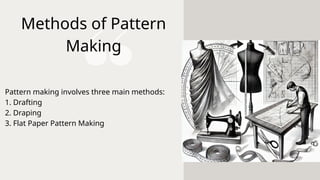
Pattern making involves three main methods:
1. Drafting
2. Draping
3. Flat Paper Pattern Making
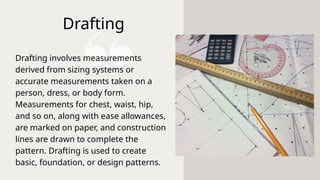
Drafting
Drafting involves measurements
derived from sizing systems or
accurate measurements taken on a
person, dress, or body form.
Measurements for chest, waist, hip,
and so on, along with ease allowances,
are marked on paper, and construction
lines are drawn to complete the
pattern. Drafting is used to create
basic, foundation, or design patterns.
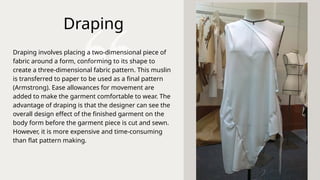
Draping
Draping involves placing a two-dimensional piece of
fabric around a form, conforming to its shape to
create a three-dimensional fabric pattern. This muslin
is transferred to paper to be used as a final pattern
(Armstrong). Ease allowances for movement are
added to make the garment comfortable to wear. The
advantage of draping is that the designer can see the
overall design effect of the finished garment on the
body form before the garment piece is cut and sewn.
However, it is more expensive and time-consuming
than flat pattern making.
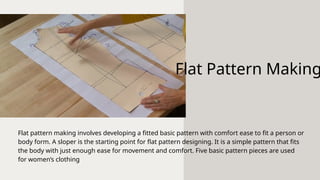
Flat Pattern Making
Flat pattern making involves developing a fitted basic pattern with comfort ease to fit a person or
body form. A sloper is the starting point for flat pattern designing. It is a simple pattern that fits
the body with just enough ease for movement and comfort. Five basic pattern pieces are used
for women’s clothing
Pattern Making in
Today’s World
Pattern making today has become easier with the use of
computers. Various software tools such as Gerber, Lectra,
Tukatech, and OptiTex have made the job of the pattern
master more economical and less time-consuming. These
software tools enable you to input your measurements and
draft out a pattern, eliminating much fitting trial and error in
the sewing room.
A pattern can be made from a 3D form in just a few steps
using these software tools. Individual measurements are
collected from a 3D body scanner. The measurements are
used to create a virtual 3D model of the individual’s body. The
3D to 2D software allows the user to define a garment surface
in relation to the 3D body model. Once the garment surface is
defined, the application automatically unwraps and outputs a
2D flat pattern in .dxf format.
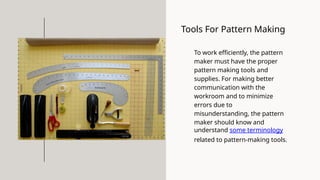
To work efficiently, the pattern
maker must have the proper
pattern making tools and
supplies. For making better
communication with the
workroom and to minimize
errors due to
misunderstanding, the pattern
maker should know and
understand some terminology
related to pattern-making tools.
Tools For Pattern Making
Tools
Straight pins Straight Pin holder Scissors
1. Straight pins:
The dressmaker used it for draping and fitting.
2.Straight pin holder:
Pincushion or magnetic holder which is used for wrist and table.
3. Scissors:
There are different types of scissors such as paper scissors, fabric scissors, etc.
Tools
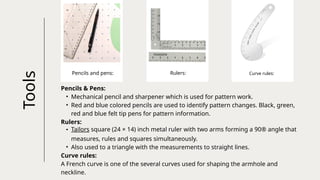
Pencils and pens: Rulers: Curve rules:
Pencils & Pens:
• Mechanical pencil and sharpener which is used for pattern work.
• Red and blue colored pencils are used to identify pattern changes. Black, green,
red and blue felt tip pens for pattern information.
Rulers:
• Tailors square (24 × 14) inch metal ruler with two arms forming a 90® angle that
measures, rules and squares simultaneously.
• Also used to a triangle with the measurements to straight lines.
Curve rules:
A French curve is one of the several curves used for shaping the armhole and
neckline.
Tools
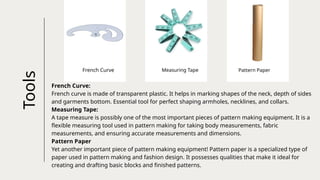
French Curve Measuring Tape
French Curve:
French curve is made of transparent plastic. It helps in marking shapes of the neck, depth of sides
and garments bottom. Essential tool for perfect shaping armholes, necklines, and collars.
Measuring Tape:
A tape measure is possibly one of the most important pieces of pattern making equipment. It is a
flexible measuring tool used in pattern making for taking body measurements, fabric
measurements, and ensuring accurate measurements and dimensions.
Pattern Paper
Yet another important piece of pattern making equipment! Pattern paper is a specialized type of
paper used in pattern making and fashion design. It possesses qualities that make it ideal for
creating and drafting basic blocks and finished patterns.
Pattern Paper
Tools
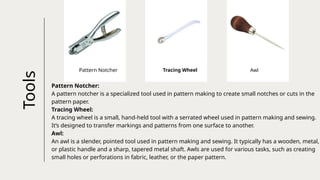
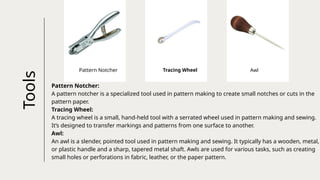
Pattern Notcher Tracing Wheel
Pattern Notcher:
A pattern notcher is a specialized tool used in pattern making to create small notches or cuts in the
pattern paper.
Tracing Wheel:
A tracing wheel is a small, hand-held tool with a serrated wheel used in pattern making and sewing.
It’s designed to transfer markings and patterns from one surface to another.
Awl:
An awl is a slender, pointed tool used in pattern making and sewing. It typically has a wooden, metal,
or plastic handle and a sharp, tapered metal shaft. Awls are used for various tasks, such as creating
small holes or perforations in fabric, leather, or the paper pattern.
Awl
Tools
Pattern Notcher Tracing Wheel
Pattern Notcher:
A pattern notcher is a specialized tool used in pattern making to create small notches or cuts in the
pattern paper.
Tracing Wheel:
A tracing wheel is a small, hand-held tool with a serrated wheel used in pattern making and sewing.
It’s designed to transfer markings and patterns from one surface to another.
Awl:
An awl is a slender, pointed tool used in pattern making and sewing. It typically has a wooden, metal,
or plastic handle and a sharp, tapered metal shaft. Awls are used for various tasks, such as creating
small holes or perforations in fabric, leather, or the paper pattern.
Awl
Tools
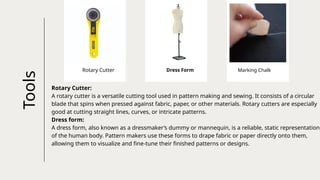
Rotary Cutter Dress Form
Rotary Cutter:
A rotary cutter is a versatile cutting tool used in pattern making and sewing. It consists of a circular
blade that spins when pressed against fabric, paper, or other materials. Rotary cutters are especially
good at cutting straight lines, curves, or intricate patterns.
Dress form:
A dress form, also known as a dressmaker’s dummy or mannequin, is a reliable, static representation
of the human body. Pattern makers use these forms to drape fabric or paper directly onto them,
allowing them to visualize and fine-tune their finished patterns or designs.
Marking Chalk
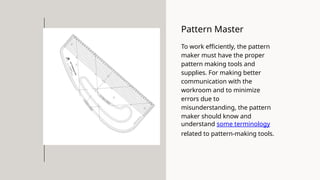
To work efficiently, the pattern
maker must have the proper
pattern making tools and
supplies. For making better
communication with the
workroom and to minimize
errors due to
misunderstanding, the pattern
maker should know and
understand some terminology
related to pattern-making tools.
Pattern Master
Tools
Thank
You

Introduction to Pattern Drafting & Garment Constructions.pptx

  • 1.
  • 2.
    • Pattern makingis the art of manipulating and shaping a flat piece of fabric to conform to one or more curves of the human figure. It acts as a bridge between design and production, where a sketch can be turned into a garment via a pattern that interprets the design into the form of garment components - (Cooklin). Definition
  • 3.
    Methods of Pattern Making Patternmaking involves three main methods: 1. Drafting 2. Draping 3. Flat Paper Pattern Making
  • 4.
    Drafting Drafting involves measurements derivedfrom sizing systems or accurate measurements taken on a person, dress, or body form. Measurements for chest, waist, hip, and so on, along with ease allowances, are marked on paper, and construction lines are drawn to complete the pattern. Drafting is used to create basic, foundation, or design patterns.
  • 5.
    Draping Draping involves placinga two-dimensional piece of fabric around a form, conforming to its shape to create a three-dimensional fabric pattern. This muslin is transferred to paper to be used as a final pattern (Armstrong). Ease allowances for movement are added to make the garment comfortable to wear. The advantage of draping is that the designer can see the overall design effect of the finished garment on the body form before the garment piece is cut and sewn. However, it is more expensive and time-consuming than flat pattern making.
  • 6.
    Flat Pattern Making Flatpattern making involves developing a fitted basic pattern with comfort ease to fit a person or body form. A sloper is the starting point for flat pattern designing. It is a simple pattern that fits the body with just enough ease for movement and comfort. Five basic pattern pieces are used for women’s clothing
  • 7.
    Pattern Making in Today’sWorld Pattern making today has become easier with the use of computers. Various software tools such as Gerber, Lectra, Tukatech, and OptiTex have made the job of the pattern master more economical and less time-consuming. These software tools enable you to input your measurements and draft out a pattern, eliminating much fitting trial and error in the sewing room. A pattern can be made from a 3D form in just a few steps using these software tools. Individual measurements are collected from a 3D body scanner. The measurements are used to create a virtual 3D model of the individual’s body. The 3D to 2D software allows the user to define a garment surface in relation to the 3D body model. Once the garment surface is defined, the application automatically unwraps and outputs a 2D flat pattern in .dxf format.
  • 8.
    To work efficiently,the pattern maker must have the proper pattern making tools and supplies. For making better communication with the workroom and to minimize errors due to misunderstanding, the pattern maker should know and understand some terminology related to pattern-making tools. Tools For Pattern Making
  • 9.
    Tools Straight pins StraightPin holder Scissors 1. Straight pins: The dressmaker used it for draping and fitting. 2.Straight pin holder: Pincushion or magnetic holder which is used for wrist and table. 3. Scissors: There are different types of scissors such as paper scissors, fabric scissors, etc.
  • 10.
    Tools Pencils and pens:Rulers: Curve rules: Pencils & Pens: • Mechanical pencil and sharpener which is used for pattern work. • Red and blue colored pencils are used to identify pattern changes. Black, green, red and blue felt tip pens for pattern information. Rulers: • Tailors square (24 × 14) inch metal ruler with two arms forming a 90® angle that measures, rules and squares simultaneously. • Also used to a triangle with the measurements to straight lines. Curve rules: A French curve is one of the several curves used for shaping the armhole and neckline.
  • 11.
    Tools French Curve MeasuringTape French Curve: French curve is made of transparent plastic. It helps in marking shapes of the neck, depth of sides and garments bottom. Essential tool for perfect shaping armholes, necklines, and collars. Measuring Tape: A tape measure is possibly one of the most important pieces of pattern making equipment. It is a flexible measuring tool used in pattern making for taking body measurements, fabric measurements, and ensuring accurate measurements and dimensions. Pattern Paper Yet another important piece of pattern making equipment! Pattern paper is a specialized type of paper used in pattern making and fashion design. It possesses qualities that make it ideal for creating and drafting basic blocks and finished patterns. Pattern Paper
  • 12.
    Tools Pattern Notcher TracingWheel Pattern Notcher: A pattern notcher is a specialized tool used in pattern making to create small notches or cuts in the pattern paper. Tracing Wheel: A tracing wheel is a small, hand-held tool with a serrated wheel used in pattern making and sewing. It’s designed to transfer markings and patterns from one surface to another. Awl: An awl is a slender, pointed tool used in pattern making and sewing. It typically has a wooden, metal, or plastic handle and a sharp, tapered metal shaft. Awls are used for various tasks, such as creating small holes or perforations in fabric, leather, or the paper pattern. Awl
  • 13.
    Tools Pattern Notcher TracingWheel Pattern Notcher: A pattern notcher is a specialized tool used in pattern making to create small notches or cuts in the pattern paper. Tracing Wheel: A tracing wheel is a small, hand-held tool with a serrated wheel used in pattern making and sewing. It’s designed to transfer markings and patterns from one surface to another. Awl: An awl is a slender, pointed tool used in pattern making and sewing. It typically has a wooden, metal, or plastic handle and a sharp, tapered metal shaft. Awls are used for various tasks, such as creating small holes or perforations in fabric, leather, or the paper pattern. Awl
  • 14.
    Tools Rotary Cutter DressForm Rotary Cutter: A rotary cutter is a versatile cutting tool used in pattern making and sewing. It consists of a circular blade that spins when pressed against fabric, paper, or other materials. Rotary cutters are especially good at cutting straight lines, curves, or intricate patterns. Dress form: A dress form, also known as a dressmaker’s dummy or mannequin, is a reliable, static representation of the human body. Pattern makers use these forms to drape fabric or paper directly onto them, allowing them to visualize and fine-tune their finished patterns or designs. Marking Chalk
  • 15.
    To work efficiently,the pattern maker must have the proper pattern making tools and supplies. For making better communication with the workroom and to minimize errors due to misunderstanding, the pattern maker should know and understand some terminology related to pattern-making tools. Pattern Master
  • 16.