Introduction to Multisim:
Learn to Capture, Simulate, and Layout in Less Than 30 Minutes
Overview
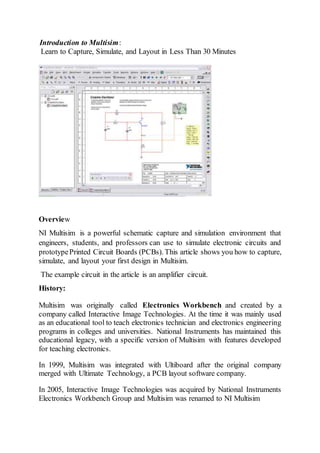
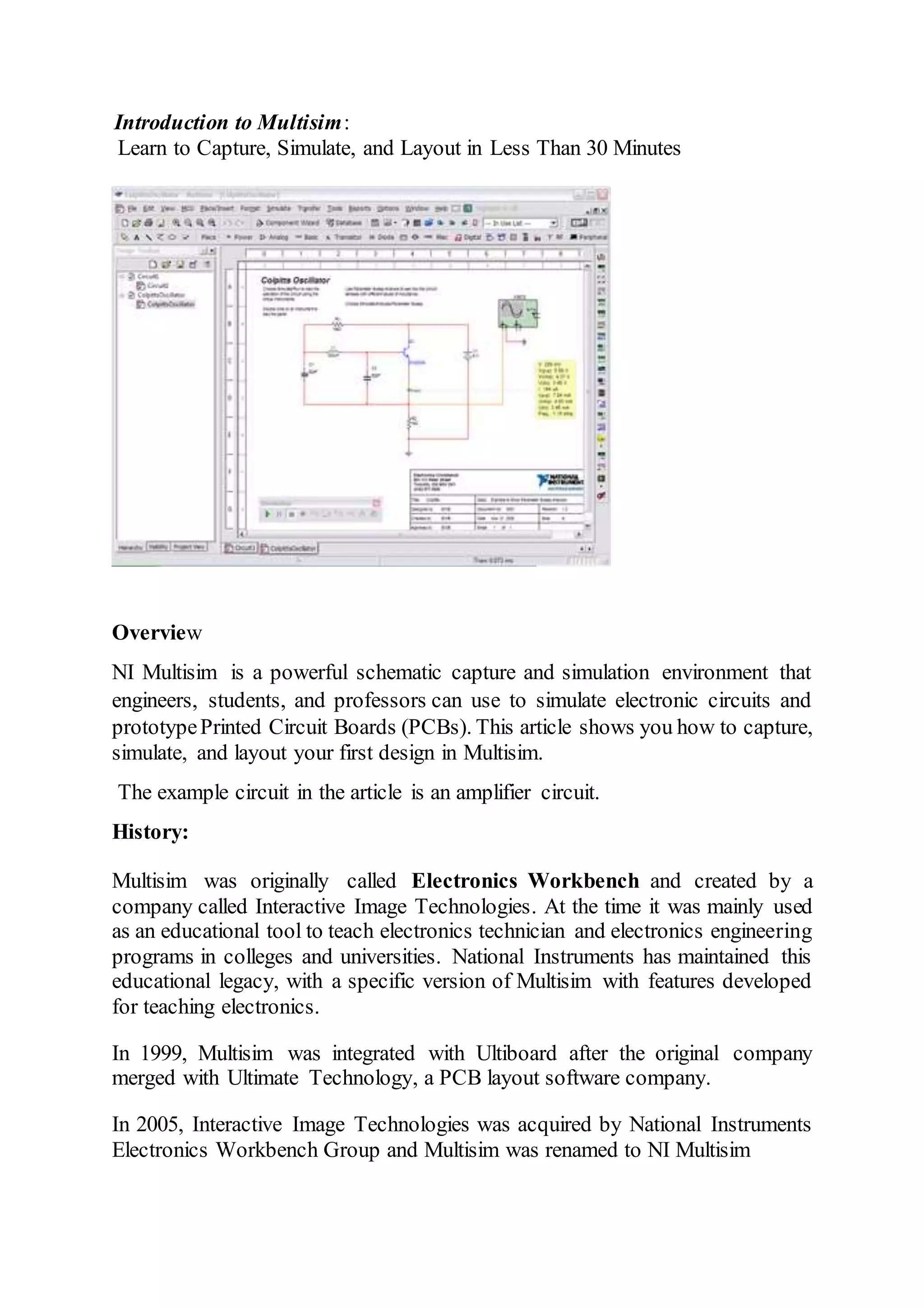
NI Multisim is a powerful schematic capture and simulation environment that
engineers, students, and professors can use to simulate electronic circuits and
prototypePrinted Circuit Boards (PCBs). This article shows you how to capture,
simulate, and layout your first design in Multisim.
The example circuit in the article is an amplifier circuit.
History:
Multisim was originally called Electronics Workbench and created by a
company called Interactive Image Technologies. At the time it was mainly used
as an educational tool to teach electronics technician and electronics engineering
programs in colleges and universities. National Instruments has maintained this
educational legacy, with a specific version of Multisim with features developed
for teaching electronics.
In 1999, Multisim was integrated with Ultiboard after the original company
merged with Ultimate Technology, a PCB layout software company.
In 2005, Interactive Image Technologies was acquired by National Instruments
Electronics Workbench Group and Multisim was renamed to NI Multisim
Kirchhoff's Laws
Kirchhoff's current law and voltage law, defined by Gustav Kirchhoff, describe
the relation of values of currents that flow through a junction point and voltages
in a an electrical circuit loop, in an electrical
circuit.
KVL:
The sum of all the voltages in a closed loop is zero
KCL:
The sum of the currents leaving a node=the sum ofthe currents entering the
node
Kirchhoff's Current Law (KCL)
This is Kirchhoff's first law.
The sum of all currents that enter an electrical circuit junction is 0. When the
currents enter the junction have positive sign and the current that leave the
junction have negative sign:
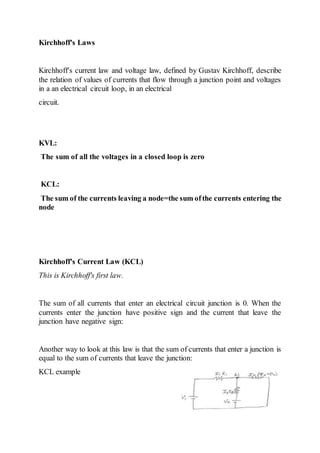
Another way to look at this law is that the sum of currents that enter a junction is
equal to the sum of currents that leave the junction:
KCL example
Kirchhoff's Voltage Law (KVL)
This is Kirchhoff's second law.
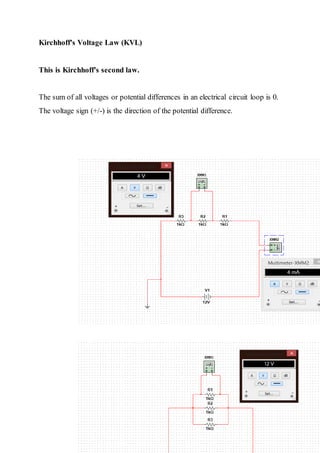
The sum of all voltages or potential differences in an electrical circuit loop is 0.
The voltage sign (+/-) is the direction of the potential difference.

Introduction to multisim by diar ismail

  • 1.
    Introduction to Multisim: Learnto Capture, Simulate, and Layout in Less Than 30 Minutes Overview NI Multisim is a powerful schematic capture and simulation environment that engineers, students, and professors can use to simulate electronic circuits and prototypePrinted Circuit Boards (PCBs). This article shows you how to capture, simulate, and layout your first design in Multisim. The example circuit in the article is an amplifier circuit. History: Multisim was originally called Electronics Workbench and created by a company called Interactive Image Technologies. At the time it was mainly used as an educational tool to teach electronics technician and electronics engineering programs in colleges and universities. National Instruments has maintained this educational legacy, with a specific version of Multisim with features developed for teaching electronics. In 1999, Multisim was integrated with Ultiboard after the original company merged with Ultimate Technology, a PCB layout software company. In 2005, Interactive Image Technologies was acquired by National Instruments Electronics Workbench Group and Multisim was renamed to NI Multisim
  • 2.
    Kirchhoff's Laws Kirchhoff's currentlaw and voltage law, defined by Gustav Kirchhoff, describe the relation of values of currents that flow through a junction point and voltages in a an electrical circuit loop, in an electrical circuit. KVL: The sum of all the voltages in a closed loop is zero KCL: The sum of the currents leaving a node=the sum ofthe currents entering the node Kirchhoff's Current Law (KCL) This is Kirchhoff's first law. The sum of all currents that enter an electrical circuit junction is 0. When the currents enter the junction have positive sign and the current that leave the junction have negative sign: Another way to look at this law is that the sum of currents that enter a junction is equal to the sum of currents that leave the junction: KCL example
  • 3.
    Kirchhoff's Voltage Law(KVL) This is Kirchhoff's second law. The sum of all voltages or potential differences in an electrical circuit loop is 0. The voltage sign (+/-) is the direction of the potential difference.