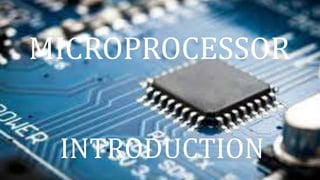
MICROPROCESSOR
INTRODUCTION
Understanding the Brain of
Modern Computers
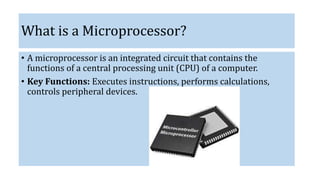
What is a Microprocessor?
• A microprocessor is an integrated circuit that contains the
functions of a central processing unit (CPU) of a computer.
• Key Functions: Executes instructions, performs calculations,
controls peripheral devices.
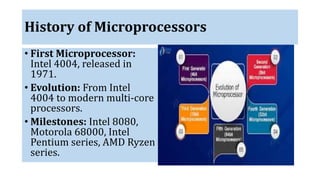
History of Microprocessors
• First Microprocessor:
Intel 4004, released in
1971.
• Evolution: From Intel
4004 to modern multi-core
processors.
• Milestones: Intel 8080,
Motorola 68000, Intel
Pentium series, AMD Ryzen
series.
How Microprocessors Work
• Fetch-Decode-Execute Cycle:
• Fetch: Retrieves instructions
from memory.
• Decode: Interprets the
instructions.
• Execute: Performs the
instruction.
• Components: Control Unit
(CU), Arithmetic Logic Unit
(ALU), Registers, Cache.
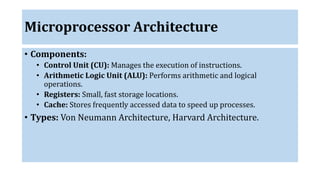
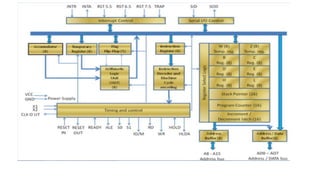
Microprocessor Architecture
• Components:
• Control Unit (CU): Manages the execution of instructions.
• Arithmetic Logic Unit (ALU): Performs arithmetic and logical
operations.
• Registers: Small, fast storage locations.
• Cache: Stores frequently accessed data to speed up processes.
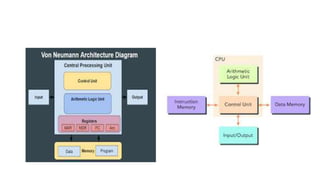
• Types: Von Neumann Architecture, Harvard Architecture.
VON NEUMANN ARCHITECTURE HARVARD ARCHITECTURE
It is ancient computer architecture based on
stored program computer concept.
It is modern computer architecture based on
Harvard Mark I relay based model.
Same physical memory address is used for
instructions and data.
Separate physical memory address is used for
instructions and data.
There is common bus for data and instruction
transfer.
Separate buses are used for transferring data
and instruction.
Two clock cycles are required to execute single
instruction.
An instruction is executed in a single cycle.
It is cheaper in cost. It is costly than Von Neumann Architecture.
CPU can not access instructions and
read/write at the same time.
CPU can access instructions and read/write at
the same time.
It is used in personal computers and small
computers.
It is used in micro controllers and signal
processing.
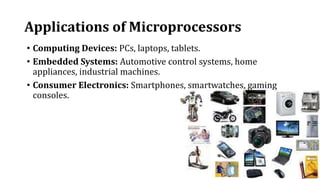
Applications of Microprocessors
• Computing Devices: PCs, laptops, tablets.
• Embedded Systems: Automotive control systems, home
appliances, industrial machines.
• Consumer Electronics: Smartphones, smartwatches, gaming
consoles.
Link for microprocessor architecture
• https://www.youtube.com/watch?v=I78iyzXQrP4

Introduction to Microprocessor in powerpoint

  • 1.
  • 2.
    Understanding the Brainof Modern Computers
  • 3.
    What is aMicroprocessor? • A microprocessor is an integrated circuit that contains the functions of a central processing unit (CPU) of a computer. • Key Functions: Executes instructions, performs calculations, controls peripheral devices.
  • 4.
    History of Microprocessors •First Microprocessor: Intel 4004, released in 1971. • Evolution: From Intel 4004 to modern multi-core processors. • Milestones: Intel 8080, Motorola 68000, Intel Pentium series, AMD Ryzen series.
  • 5.
    How Microprocessors Work •Fetch-Decode-Execute Cycle: • Fetch: Retrieves instructions from memory. • Decode: Interprets the instructions. • Execute: Performs the instruction. • Components: Control Unit (CU), Arithmetic Logic Unit (ALU), Registers, Cache.
  • 6.
    Microprocessor Architecture • Components: •Control Unit (CU): Manages the execution of instructions. • Arithmetic Logic Unit (ALU): Performs arithmetic and logical operations. • Registers: Small, fast storage locations. • Cache: Stores frequently accessed data to speed up processes. • Types: Von Neumann Architecture, Harvard Architecture.
  • 8.
    VON NEUMANN ARCHITECTUREHARVARD ARCHITECTURE It is ancient computer architecture based on stored program computer concept. It is modern computer architecture based on Harvard Mark I relay based model. Same physical memory address is used for instructions and data. Separate physical memory address is used for instructions and data. There is common bus for data and instruction transfer. Separate buses are used for transferring data and instruction. Two clock cycles are required to execute single instruction. An instruction is executed in a single cycle. It is cheaper in cost. It is costly than Von Neumann Architecture. CPU can not access instructions and read/write at the same time. CPU can access instructions and read/write at the same time. It is used in personal computers and small computers. It is used in micro controllers and signal processing.
  • 11.
    Applications of Microprocessors •Computing Devices: PCs, laptops, tablets. • Embedded Systems: Automotive control systems, home appliances, industrial machines. • Consumer Electronics: Smartphones, smartwatches, gaming consoles.
  • 13.
    Link for microprocessorarchitecture • https://www.youtube.com/watch?v=I78iyzXQrP4