Metabolism: anabolism and
catabolism
437
Biochemistry
Team
Color index:
Doctors slides
Notes and explanations
Extra information
Highlights
‫م‬ْ‫س‬ِ‫ب‬
‫هللا‬
‫الرحمن‬
‫الرحيم‬
Objectives:
●Understand the concept of metabolic pathway
●Identify types and characters of metabolic pathways- anabolic
and catabolic
●Identify ATP as the energy currency of cells
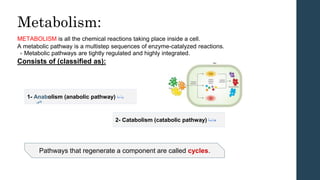
Metabolism:
METABOLISM is all the chemical reactions taking place inside a cell.
A metabolic pathway is a multistep sequences of enzyme-catalyzed reactions.
> Metabolic pathways are tightly regulated and highly integrated.
Consists of (classified as):
Pathways that regenerate a component are called cycles.
1- Anabolism (anabolic pathway) ‫بناءة‬
2- Catabolism (catabolic pathway) ‫هدامة‬
‫بنى‬
Pathway Vs
Chemical reaction
Metabolic pathways:
● A multi-step sequence of
chemical reactions.
● A product of first reaction
becomes a substrate for
second reaction.
● Integrated (not separated)
pathways.
Metabolic pathways
are bidirectional.
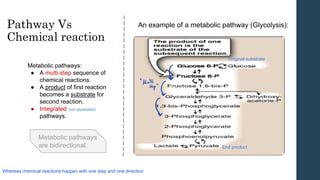
An example of a metabolic pathway (Glycolysis):
Original substrate
End product
Whereas chemical reactions happen with one step and one direction
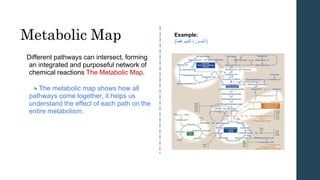
Metabolic Map
Different pathways can intersect, forming
an integrated and purposeful network of
chemical reactions The Metabolic Map.
> The metabolic map shows how all
pathways come together, it helps us
understand the effect of each path on the
entire metabolism.
Example:
( ‫الصورة‬
‫للفهم‬
‫فقط‬ )
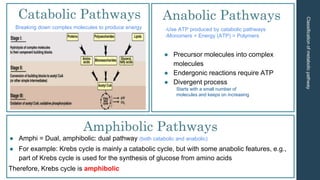
Catabolic Pathways Anabolic Pathways
Breaking down complex molecules to produce energy
● Precursor molecules into complex
molecules
● Endergonic reactions require ATP
● Divergent process
-Use ATP produced by catabolic pathways
-Monomers + Energy (ATP) = Polymers
Amphibolic Pathways
● Amphi = Dual, amphibolic: dual pathway (both catabolic and anabolic)
● For example: Krebs cycle is mainly a catabolic cycle, but with some anabolic features, e.g.,
part of Krebs cycle is used for the synthesis of glucose from amino acids
Therefore, Krebs cycle is amphibolic
Starts with a small number of
molecules and keeps on increasing
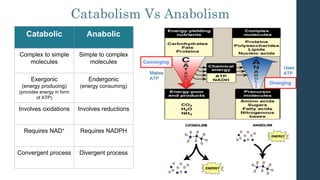
Catabolism Vs Anabolism
Catabolic Anabolic
Complex to simple
molecules
Simple to complex
molecules
Exergonic
(energy producing)
(provides energy in form
of ATP)
Endergonic
(energy consuming)
Involves oxidations Involves reductions
Requires NAD+ Requires NADPH
Convergent process Divergent process
Converging
Diverging
Uses
ATP
Makes
ATP
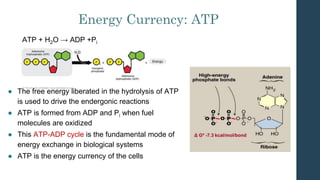
Energy Currency: ATP
● The free energy liberated in the hydrolysis of ATP
is used to drive the endergonic reactions
● ATP is formed from ADP and Pi when fuel
molecules are oxidized
● This ATP-ADP cycle is the fundamental mode of
energy exchange in biological systems
● ATP is the energy currency of the cells
ATP + H2O → ADP +Pi
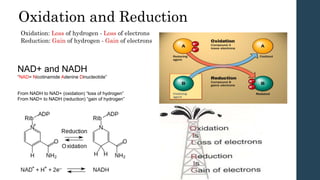
Oxidation and Reduction
Oxidation: Loss of hydrogen - Loss of electrons
Reduction: Gain of hydrogen - Gain of electrons
From NADH to NAD+ (oxidation) “loss of hydrogen”
From NAD+ to NADH (reduction) “gain of hydrogen”
NAD+ and NADH
“NAD= Nicotinamide Adenine Dinucleotide”
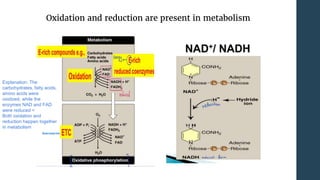
Oxidation and reduction are present in metabolism
Explanation: The
carbohydrates, fatty acids,
amino acids were
oxidized, while the
enzymes NAD and FAD
were reduced =
Both oxidation and
reduction happen together
in metabolism
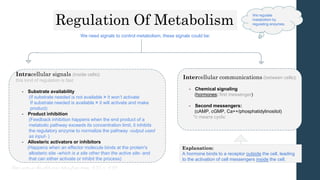
Regulation Of Metabolism
We need signals to control metabolism, these signals could be:
Intercellular communications (between cells):
- Chemical signaling
(hormones: first messenger)
- Second messengers:
(cAMP, cGMP, Ca++/phosphatidylinositol)
*c means cyclic
Intracellular signals (inside cells):
this kind of regulation is fast
- Substrate availability
(If substrate needed is not available > it won’t activate
If substrate needed is available > it will activate and make
product)
- Product inhibition
(Feedback inhibition happens when the end product of a
metabolic pathway exceeds its concentration limit, it inhibits
the regulatory enzyme to normalize the pathway -output used
as input- )
- Allosteric activators or inhibitors
(Happens when an effector molecule binds at the protein's
allosteric site -which is a site other than the active site- and
that can either activate or inhibit the process)
We regulate
metabolism by
regulating enzymes.
Explanation:
A hormone binds to a receptor outside the cell, leading
to the activation of cell messengers inside the cell.
Some notes in this slide were taken from teams 435 & 436
Metabolic Fuel
Carbohydrates & lipids (mainly) and proteins (little extent) are used for energy production.
1- Carbohydrates (glucose)
2- Lipids (fatty acids)
3- Protein (amino acids)
Glucose is the major metabolic fuel of most tissues
GIRLS TEAM:
● ‫الهنوف‬
‫الجلعود‬
● ‫رهف‬
‫الشنيببر‬
● ‫شهد‬
‫الجبرين‬
● ‫لينا‬
‫الرحمة‬
● ‫منيرة‬
‫المسعد‬
● ‫ليلى‬
‫باغ‬ّ‫ص‬‫ال‬
● ‫العنود‬
‫المنصور‬
● ‫أرجوانة‬
‫العقيل‬
● ‫ريناد‬
‫الغريبي‬
● ‫مجد‬
‫البراك‬
● ‫روان‬
‫المشعل‬
Team leaders:
1- Mohammed hassan
hakeem
2- Reham alhalabi
Contact us:
teambiochem437@gmail.com
For editing file:
https://docs.google.com/prese
ntation/d/16yNcm2Y08Cr0Am8
3lDRfH5NB4F1ng3tdHiB3O1A
qMc8
BOYS TEAM:
●
‫داوود‬
‫اسماعيل‬
●
‫عبدهللا‬
‫الحربي‬
●
‫عبدالملك‬
‫الشرهان‬
●
٤
-
‫تركي‬
‫آل‬
‫بنهار‬
●
‫احمد‬
‫ابراهيم‬
‫العريفي‬
●
‫سعيد‬
‫آل‬
‫سرار‬
●
‫عبدالرحمن‬
‫التركي‬
●
‫سلطان‬
‫بن‬
‫عبيد‬
●
‫صالح‬
‫المعيقل‬
●
‫صالح‬
‫الوكيل‬
●
‫عدنان‬
‫المقبل‬
●
-
‫علي‬
‫العماري‬
●
‫محمد‬
‫ابراهيم‬
●
‫محمد‬
‫صالح‬
‫القسومي‬
●
‫نواف‬
‫عبدالعزيز‬

Introduction to metabolism.pptx biotechnology engineering

  • 1.
    Metabolism: anabolism and catabolism 437 Biochemistry Team Colorindex: Doctors slides Notes and explanations Extra information Highlights ‫م‬ْ‫س‬ِ‫ب‬ ‫هللا‬ ‫الرحمن‬ ‫الرحيم‬
  • 2.
    Objectives: ●Understand the conceptof metabolic pathway ●Identify types and characters of metabolic pathways- anabolic and catabolic ●Identify ATP as the energy currency of cells
  • 3.
    Metabolism: METABOLISM is allthe chemical reactions taking place inside a cell. A metabolic pathway is a multistep sequences of enzyme-catalyzed reactions. > Metabolic pathways are tightly regulated and highly integrated. Consists of (classified as): Pathways that regenerate a component are called cycles. 1- Anabolism (anabolic pathway) ‫بناءة‬ 2- Catabolism (catabolic pathway) ‫هدامة‬ ‫بنى‬
  • 4.
    Pathway Vs Chemical reaction Metabolicpathways: ● A multi-step sequence of chemical reactions. ● A product of first reaction becomes a substrate for second reaction. ● Integrated (not separated) pathways. Metabolic pathways are bidirectional. An example of a metabolic pathway (Glycolysis): Original substrate End product Whereas chemical reactions happen with one step and one direction
  • 5.
    Metabolic Map Different pathwayscan intersect, forming an integrated and purposeful network of chemical reactions The Metabolic Map. > The metabolic map shows how all pathways come together, it helps us understand the effect of each path on the entire metabolism. Example: ( ‫الصورة‬ ‫للفهم‬ ‫فقط‬ )
  • 6.
    Catabolic Pathways AnabolicPathways Breaking down complex molecules to produce energy ● Precursor molecules into complex molecules ● Endergonic reactions require ATP ● Divergent process -Use ATP produced by catabolic pathways -Monomers + Energy (ATP) = Polymers Amphibolic Pathways ● Amphi = Dual, amphibolic: dual pathway (both catabolic and anabolic) ● For example: Krebs cycle is mainly a catabolic cycle, but with some anabolic features, e.g., part of Krebs cycle is used for the synthesis of glucose from amino acids Therefore, Krebs cycle is amphibolic Starts with a small number of molecules and keeps on increasing
  • 7.
    Catabolism Vs Anabolism CatabolicAnabolic Complex to simple molecules Simple to complex molecules Exergonic (energy producing) (provides energy in form of ATP) Endergonic (energy consuming) Involves oxidations Involves reductions Requires NAD+ Requires NADPH Convergent process Divergent process Converging Diverging Uses ATP Makes ATP
  • 8.
    Energy Currency: ATP ●The free energy liberated in the hydrolysis of ATP is used to drive the endergonic reactions ● ATP is formed from ADP and Pi when fuel molecules are oxidized ● This ATP-ADP cycle is the fundamental mode of energy exchange in biological systems ● ATP is the energy currency of the cells ATP + H2O → ADP +Pi
  • 9.
    Oxidation and Reduction Oxidation:Loss of hydrogen - Loss of electrons Reduction: Gain of hydrogen - Gain of electrons From NADH to NAD+ (oxidation) “loss of hydrogen” From NAD+ to NADH (reduction) “gain of hydrogen” NAD+ and NADH “NAD= Nicotinamide Adenine Dinucleotide”
  • 10.
    Oxidation and reductionare present in metabolism Explanation: The carbohydrates, fatty acids, amino acids were oxidized, while the enzymes NAD and FAD were reduced = Both oxidation and reduction happen together in metabolism
  • 11.
    Regulation Of Metabolism Weneed signals to control metabolism, these signals could be: Intercellular communications (between cells): - Chemical signaling (hormones: first messenger) - Second messengers: (cAMP, cGMP, Ca++/phosphatidylinositol) *c means cyclic Intracellular signals (inside cells): this kind of regulation is fast - Substrate availability (If substrate needed is not available > it won’t activate If substrate needed is available > it will activate and make product) - Product inhibition (Feedback inhibition happens when the end product of a metabolic pathway exceeds its concentration limit, it inhibits the regulatory enzyme to normalize the pathway -output used as input- ) - Allosteric activators or inhibitors (Happens when an effector molecule binds at the protein's allosteric site -which is a site other than the active site- and that can either activate or inhibit the process) We regulate metabolism by regulating enzymes. Explanation: A hormone binds to a receptor outside the cell, leading to the activation of cell messengers inside the cell. Some notes in this slide were taken from teams 435 & 436
  • 12.
    Metabolic Fuel Carbohydrates &lipids (mainly) and proteins (little extent) are used for energy production. 1- Carbohydrates (glucose) 2- Lipids (fatty acids) 3- Protein (amino acids) Glucose is the major metabolic fuel of most tissues
  • 13.
    GIRLS TEAM: ● ‫الهنوف‬ ‫الجلعود‬ ●‫رهف‬ ‫الشنيببر‬ ● ‫شهد‬ ‫الجبرين‬ ● ‫لينا‬ ‫الرحمة‬ ● ‫منيرة‬ ‫المسعد‬ ● ‫ليلى‬ ‫باغ‬ّ‫ص‬‫ال‬ ● ‫العنود‬ ‫المنصور‬ ● ‫أرجوانة‬ ‫العقيل‬ ● ‫ريناد‬ ‫الغريبي‬ ● ‫مجد‬ ‫البراك‬ ● ‫روان‬ ‫المشعل‬ Team leaders: 1- Mohammed hassan hakeem 2- Reham alhalabi Contact us: teambiochem437@gmail.com For editing file: https://docs.google.com/prese ntation/d/16yNcm2Y08Cr0Am8 3lDRfH5NB4F1ng3tdHiB3O1A qMc8 BOYS TEAM: ● ‫داوود‬ ‫اسماعيل‬ ● ‫عبدهللا‬ ‫الحربي‬ ● ‫عبدالملك‬ ‫الشرهان‬ ● ٤ - ‫تركي‬ ‫آل‬ ‫بنهار‬ ● ‫احمد‬ ‫ابراهيم‬ ‫العريفي‬ ● ‫سعيد‬ ‫آل‬ ‫سرار‬ ● ‫عبدالرحمن‬ ‫التركي‬ ● ‫سلطان‬ ‫بن‬ ‫عبيد‬ ● ‫صالح‬ ‫المعيقل‬ ● ‫صالح‬ ‫الوكيل‬ ● ‫عدنان‬ ‫المقبل‬ ● - ‫علي‬ ‫العماري‬ ● ‫محمد‬ ‫ابراهيم‬ ● ‫محمد‬ ‫صالح‬ ‫القسومي‬ ● ‫نواف‬ ‫عبدالعزيز‬