02/18/15 tksabarwal@gmail.coom 1
Marketing in action
A Managerial Approach
02/18/15 tksabarwal@gmail.coom 2
Some Perspective
Marketing and History
“In well-ordered states, storekeepers and salesmen are commonly
those who are weakest in bodily strength and, therefore, of little
use for any other purpose.” - Plato
“Merchants are to be accounted vulgar; for they can make no
profit except by a certain amount of falsehood.” - Cicero
“Advertising ... is a meretricious endeavor in which psychological
appeals to ‘fear’ and ‘shame’ are developed to bamboozle the
public into purchasing essentially worthless packaged goods at
bloated prices.” - Thorstein Veblen
02/18/15 tksabarwal@gmail.coom 3
Some Perspective
A Modern View
“Corporate leaders nationwide are discovering that their most
powerful competitive weapon is marketing -- the development,
pricing, distribution, and promotion of products.” - Newsweek
“Marketing is now central to success at any company in any
business, and it is going to make the difference between winners and
losers.” - Stephen Greyser, Harvard Business School
“Stop being a company with its face towards the CEO and back
towards the customer” -
Jack Welch, CEO, G.E.
02/18/15 tksabarwal@gmail.coom 4
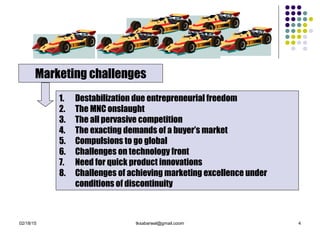
Marketing challenges
1. Destabilization due entrepreneurial freedom
2. The MNC onslaught
3. The all pervasive competition
4. The exacting demands of a buyer’s market
5. Compulsions to go global
6. Challenges on technology front
7. Need for quick product innovations
8. Challenges of achieving marketing excellence under
conditions of discontinuity
02/18/15 tksabarwal@gmail.coom 5
Key Issues in the Business Environment
 Customer Satisfaction - markets are saturated and we cannot rely
on pent up demand to make profits.
 Must provide greater quality and value to smarter shoppers.
 From mass marketing to segments of one.
 Increase speed of innovation, diffusion and distribution.
 Globalization
 Global brands, different positioning or similar positioning in
different countries?
 New ideas developed in country A, designed in country B,
manufactured in country C and sold in country D.
 Environmental and Health Care Concerns
 Must address concerns of better educated and better
informed consumers.
02/18/15 tksabarwal@gmail.coom 6
Misconceptions of MarketingMisconceptions of Marketing
 Marketer create needs, manipulate people to buy something
they don't want
 Marketing = selling = advertising
 Marketing = shoes polishing
 Customer will favour those products that offer the most
quality, performance & innovative feature
02/18/15 tksabarwal@gmail.coom 7
Marketing Is Important!
 Marketing impacts all of us in our lives as consumers
 Gives us choices
 Stimulates innovation and economic growth
 There are many good job opportunities in marketing
 Regardless of what career path you take, no firm (or non-
profit organization) survives for long if it can’t satisfy some
group of customers.
1-5
02/18/15 tksabarwal@gmail.coom 8
What is Marketing ? (1)
 A social & managerial process by which individuals &
groups obtain what they need & want through
creating & exchanging values with others
 Marketing ( management ) is the process of planning
& executing the production, pricing, promotion &
distribution of ideas, goods & services to create
exchange that satisfy individual & organizational
goals. ( integrated marketing activities)
02/18/15 tksabarwal@gmail.coom 9
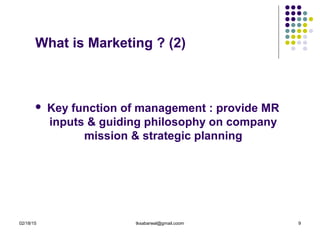
What is Marketing ? (2)
 Key function of management : provide MR
inputs & guiding philosophy on company
mission & strategic planning
02/18/15 tksabarwal@gmail.coom 10
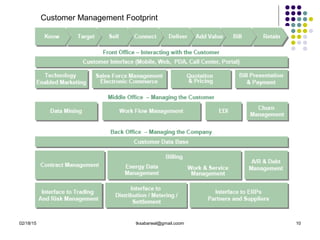
Customer Management Footprint
02/18/15 tksabarwal@gmail.coom 11
Why the change over the ages?
Changing approaches to business over time
 the production concept
 the product concept
 the sales concept
 the marketing concept
 Why is Marketing one of the most critical components of modern
business?
02/18/15 tksabarwal@gmail.coom 12
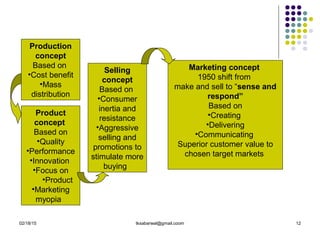
Production
concept
Based on
•Cost benefit
•Mass
distribution
Product
concept
Based on
•Quality
•Performance
•Innovation
•Focus on
•Product
•Marketing
myopia
Selling
concept
Based on
•Consumer
inertia and
resistance
•Aggressive
selling and
promotions to
stimulate more
buying
Marketing concept
1950 shift from
make and sell to “sense and
respond”
Based on
•Creating
•Delivering
•Communicating
Superior customer value to
chosen target markets
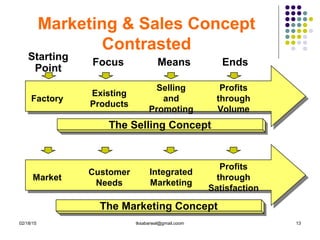
02/18/15 tksabarwal@gmail.coom 13
Factory
Existing
Products
Selling
and
Promoting
Profits
through
Volume
Market
Customer
Needs
Integrated
Marketing
Profits
through
Satisfaction
The Selling ConceptThe Selling Concept
The Marketing ConceptThe Marketing Concept
Starting
Point
Focus Means Ends
Marketing & Sales Concept
Contrasted
02/18/15 tksabarwal@gmail.coom 14
Society
(Human Welfare)
Society
(Human Welfare)
Consumers
(Satisfaction)
Consumers
(Satisfaction)
Company
(Profits)
Company
(Profits)
Societal
Marketing
Concept
Societal
Marketing
Concept
The Societal Marketing
Concept
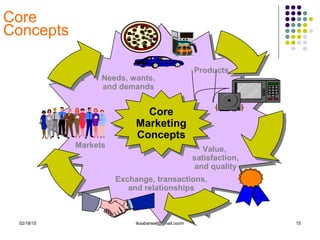
02/18/15 tksabarwal@gmail.coom 15
Products
Needs, wants,
and demands
Exchange, transactions,
and relationships
Markets
Core
Marketing
Concepts
Core
Marketing
Concepts
Value,
satisfaction,
and quality
Core
Concepts
02/18/15 tksabarwal@gmail.coom 16
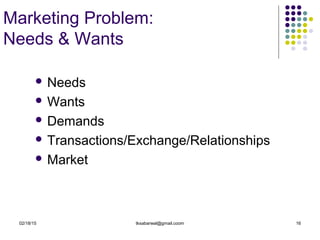
 Needs
 Wants
 Demands
 Transactions/Exchange/Relationships
 Market
Marketing Problem:
Needs & Wants
02/18/15 tksabarwal@gmail.coom 17
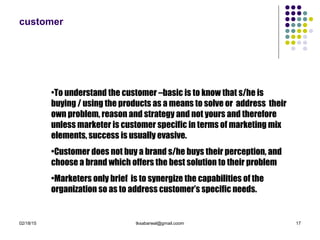
customer
•To understand the customer –basic is to know that s/he is
buying / using the products as a means to solve or address their
own problem, reason and strategy and not yours and therefore
unless marketer is customer specific in terms of marketing mix
elements, success is usually evasive.
•Customer does not buy a brand s/he buys their perception, and
choose a brand which offers the best solution to their problem
•Marketers only brief is to synergize the capabilities of the
organization so as to address customer’s specific needs.
02/18/15 tksabarwal@gmail.coom 18
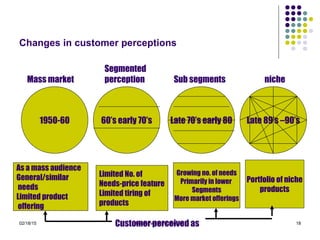
Changes in customer perceptions
1950-60 60’s early 70’s Late 70’s early 80 Late 89’s –90’s
Mass market
Segmented
perception Sub segments niche
Customer perceived as
As a mass audience
General/similar
needs
Limited product
offering
Limited No. of
Needs-price feature
Limited tiring of
products
Growing no. of needs
Primarily in lower
Segments
More market offerings
Portfolio of niche
products
02/18/15 tksabarwal@gmail.coom 19
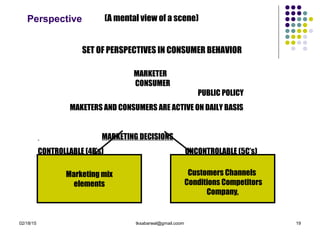
Perspective (A mental view of a scene)
SET OF PERSPECTIVES IN CONSUMER BEHAVIOR
MARKETER
CONSUMER
PUBLIC POLICY
MAKETERS AND CONSUMERS ARE ACTIVE ON DAILY BASIS
MARKETING DECISIONS
CONTROLLABLE (4P’s) UNCONTROLABLE (5C’s)
Marketing mix
elements
Customers Channels
Conditions Competitors
Company,
02/18/15 tksabarwal@gmail.coom 20
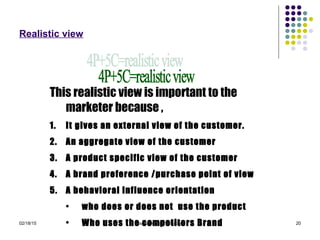
Realistic view
This realistic view is important to the
marketer because ,
1. It gives an external view of the customer.
2. An aggregate view of the customer
3. A product specific view of the customer
4. A brand preference /purchase point of view
5. A behavioral influence orientation
• who does or does not use the product
• Who uses the competitors Brand
02/18/15 tksabarwal@gmail.coom 21
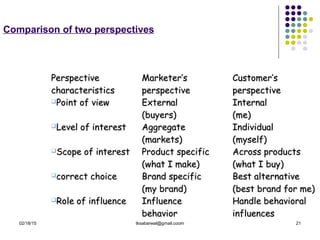
Comparison of two perspectives
PerspectivePerspective
characteristicscharacteristics
Marketer’sMarketer’s
perspectiveperspective
Customer’sCustomer’s
perspectiveperspective
Point of viewPoint of view ExternalExternal
(buyers)(buyers)
InternalInternal
(me)(me)
Level of interestLevel of interest AggregateAggregate
(markets)(markets)
IndividualIndividual
(myself)(myself)
Scope of interestScope of interest Product specificProduct specific
(what I make)(what I make)
Across productsAcross products
(what I buy)(what I buy)
correct choicecorrect choice Brand specificBrand specific
(my brand)(my brand)
Best alternativeBest alternative
(best brand for me)(best brand for me)
Role of influenceRole of influence InfluenceInfluence
behaviorbehavior
Handle behavioralHandle behavioral
influencesinfluences
02/18/15 tksabarwal@gmail.coom 22
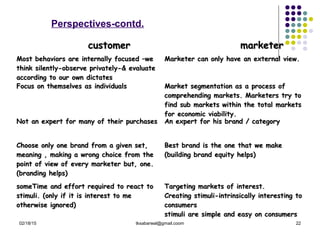
Perspectives-contd.
customercustomer marketermarketer
Most behaviors are internally focused –weMost behaviors are internally focused –we
think silently-observe privately-& evaluatethink silently-observe privately-& evaluate
according to our own dictatesaccording to our own dictates
Marketer can only have an external view.Marketer can only have an external view.
Focus on themselves as individualsFocus on themselves as individuals Market segmentation as a process ofMarket segmentation as a process of
comprehending markets. Marketers try tocomprehending markets. Marketers try to
find sub markets within the total marketsfind sub markets within the total markets
for economic viability.for economic viability.
Not an expert for many of their purchasesNot an expert for many of their purchases An expert for his brand / categoryAn expert for his brand / category
Choose only one brand from a given set,Choose only one brand from a given set,
meaning , making a wrong choice from themeaning , making a wrong choice from the
point of view of every marketer but, one.point of view of every marketer but, one.
(branding helps)(branding helps)
Best brand is the one that we makeBest brand is the one that we make
(building brand equity helps)(building brand equity helps)
someTime and effort required to react tosomeTime and effort required to react to
stimuli. (only if it is interest to mestimuli. (only if it is interest to me
otherwise ignored)otherwise ignored)
Targeting markets of interest.Targeting markets of interest.
Creating stimuli-intrinsically interesting toCreating stimuli-intrinsically interesting to
consumersconsumers
stimuli are simple and easy on consumersstimuli are simple and easy on consumers
02/18/15 tksabarwal@gmail.coom 23
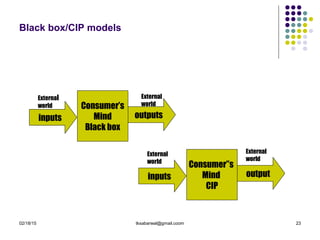
Black box/CIP models
Consumer’s
Mind
Black box
Consumer”s
Mind
CIP
inputs outputs
outputinputs
External
world
External
world
External
world
External
world
02/18/15 tksabarwal@gmail.coom 24
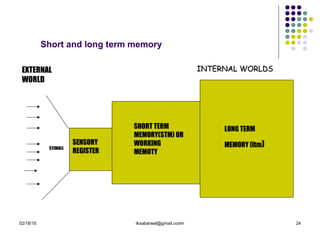
INTERNAL WORLDSINTERNAL WORLDSEXTERNAL
WORLD
SENSORY
REGISTER
SHORT TERM
MEMORY(STM) OR
WORKING
MEMOTY
LONG TERM
MEMORY (ltm)STIMULI
Short and long term memory
02/18/15 tksabarwal@gmail.coom 25
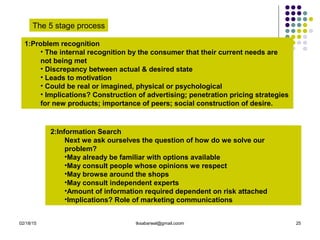
The 5 stage process
1:Problem recognition
• The internal recognition by the consumer that their current needs are
not being met
• Discrepancy between actual & desired state
• Leads to motivation
• Could be real or imagined, physical or psychological
• Implications? Construction of advertising; penetration pricing strategies
for new products; importance of peers; social construction of desire.
2:Information Search
Next we ask ourselves the question of how do we solve our
problem?
•May already be familiar with options available
•May consult people whose opinions we respect
•May browse around the shops
•May consult independent experts
•Amount of information required dependent on risk attached
•Implications? Role of marketing communications
02/18/15 tksabarwal@gmail.coom 26
The 5 stage process (continued)
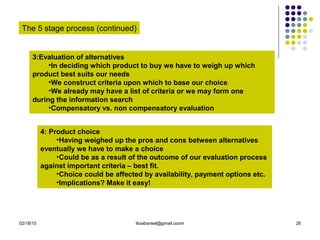
3:Evaluation of alternatives
•In deciding which product to buy we have to weigh up which
product best suits our needs
•We construct criteria upon which to base our choice
•We already may have a list of criteria or we may form one
during the information search
•Compensatory vs. non compensatory evaluation
4: Product choice
•Having weighed up the pros and cons between alternatives
eventually we have to make a choice
•Could be as a result of the outcome of our evaluation process
against important criteria – best fit.
•Choice could be affected by availability, payment options etc.
•Implications? Make it easy!
02/18/15 tksabarwal@gmail.coom 27
The 5 stage process (continued)
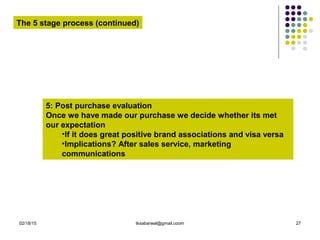
5: Post purchase evaluation
Once we have made our purchase we decide whether its met
our expectation
•If it does great positive brand associations and visa versa
•Implications? After sales service, marketing
communications
02/18/15 tksabarwal@gmail.coom 28
Value Creation
02/18/15 tksabarwal@gmail.coom 29
Reference Group Influences
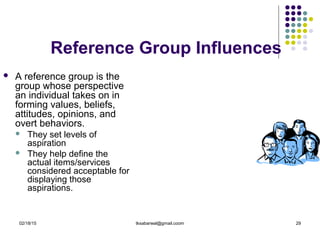
 A reference group is the
group whose perspective
an individual takes on in
forming values, beliefs,
attitudes, opinions, and
overt behaviors.
 They set levels of
aspiration
 They help define the
actual items/services
considered acceptable for
displaying those
aspirations.
02/18/15 tksabarwal@gmail.coom 30
Social Norms and Conformity
 Social norm – any rule or behavior for meeting
societal expectations  normative system
 Conformity pressures – actions taken to
encourage or force members to act, think and/or
express themselves in certain ways.
 The more important a group is in our lives, the
greater our desire to accept and conform to its
norms
02/18/15 tksabarwal@gmail.coom 31
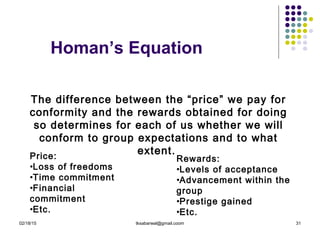
Homan’s Equation
The difference between the “price” we pay for
conformity and the rewards obtained for doing
so determines for each of us whether we will
conform to group expectations and to what
extent.Price:
•Loss of freedoms
•Time commitment
•Financial
commitment
•Etc.
Rewards:
•Levels of acceptance
•Advancement within the
group
•Prestige gained
•Etc.
02/18/15 tksabarwal@gmail.coom 32
Reference Group Types
 Primary reference group: one with which the individual has
frequent face-to-face contact and in which members are
close-knit.
 Examples: families, households, study groups, work teams,
roommates, etc.
 Secondary reference group: one in which interaction with
other members is less frequent
 Formal group: one in which there is some sort of structure
and/or for which there are specific membership
requirements.
 Informal group: one that has no special membership or
attendance requirements, other than common interests.
02/18/15 tksabarwal@gmail.coom 33
Reference Group Types
(continued)
 Membership group: one to which a person
currently belongs.
 Aspirational group: a group that a person
would like to be part of, but to which he or she
does not currently/ may never belong
 Dissociative group: a group that an individual
avoids or denies connection with.
02/18/15 tksabarwal@gmail.coom 34
Reference Group Influences
 Reference groups as
 part of the socialization process
 setters of roles
 information sources
 normative influences
 an expression of self-value
02/18/15 tksabarwal@gmail.coom 35
Conformity Pressure and
Marketplace behavior
 The influence of reference groups varies
 Groups tend to be more influential on product
decisions than they are on either brand or
outlet choices
 Conspicuousness “based on exclusivity” -- product
decisions (bikers and black leather jackets)
 Conspicuousness “associated with the individual” --
brand decisions possible within product class, “allowed
personal expression”
02/18/15 tksabarwal@gmail.coom 36
Social Power
 Power of reward – praise, approval,
acceptance, status, recognition, etc.
 Coercive power – unacceptable behavior
strongly discouraged
 Expert power – informational attraction
 Referent power – closer the match between
person and group, more willingness to
conform
02/18/15 tksabarwal@gmail.coom 37
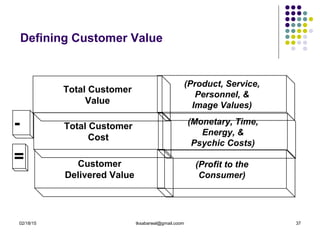
Defining Customer Value
-
=
Total Customer
Value
Total Customer
Cost
(Product, Service,
Personnel, &
Image Values)
(Monetary, Time,
Energy, &
Psychic Costs)
Customer
Delivered Value
(Profit to the
Consumer)
02/18/15 tksabarwal@gmail.coom 38
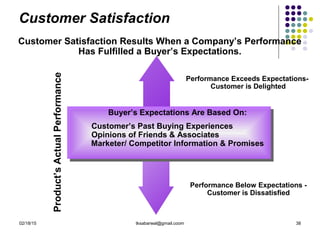
Customer Satisfaction
Customer Satisfaction Results When a Company’s Performance
Has Fulfilled a Buyer’s Expectations.
Buyer’s Expectations Are Based On:
Customer’s Past Buying Experiences
Opinions of Friends & Associates
Marketer/ Competitor Information & Promises
Product’sActualPerformance
Performance Exceeds Expectations-
Customer is Delighted
Performance Below Expectations -
Customer is Dissatisfied
02/18/15 tksabarwal@gmail.coom 39
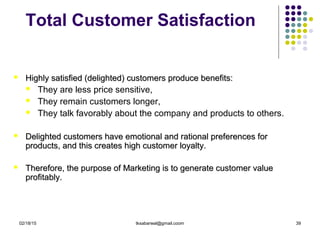
Total Customer Satisfaction
 Highly satisfied (delighted) customers produce benefits:Highly satisfied (delighted) customers produce benefits:
 They are less price sensitive,
 They remain customers longer,
 They talk favorably about the company and products to others.
 Delighted customers have emotional and rational preferences forDelighted customers have emotional and rational preferences for
products, and this creates high customer loyalty.products, and this creates high customer loyalty.
 Therefore, the purpose of Marketing is to generate customer valueTherefore, the purpose of Marketing is to generate customer value
profitably.profitably.
02/18/15 tksabarwal@gmail.coom 40
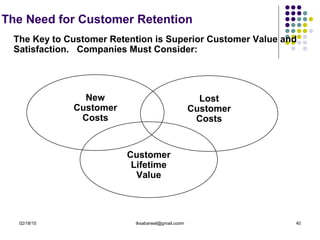
The Need for Customer Retention
New
Customer
Costs
Lost
Customer
Costs
Customer
Lifetime
Value
The Key to Customer Retention is Superior Customer Value and
Satisfaction. Companies Must Consider:
02/18/15 tksabarwal@gmail.coom 41
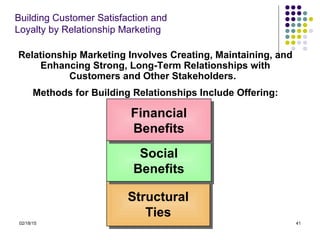
Building Customer Satisfaction and
Loyalty by Relationship Marketing
Structural
Ties
Structural
Ties
Social
Benefits
Social
Benefits
Relationship Marketing Involves Creating, Maintaining, and
Enhancing Strong, Long-Term Relationships with
Customers and Other Stakeholders.
Methods for Building Relationships Include Offering:
Financial
Benefits
Financial
Benefits
02/18/15 tksabarwal@gmail.coom 42
Value Chain Analysis
Business Policy and Strategy
02/18/15 tksabarwal@gmail.coom 43
Value Chain Analysis
The term value chain describes a way of looking at a
business as a chain of activities that transform inputs into
outputs that customers value.
Customer value derives from three basic sources:
activities that differentiate the product
activities that lower its cost
activities that meet the customer’s need quickly.
Value chain analysis views the organization as a sequential
process of value-creating activities, and attempts to
understand how a business creates customer value by
examining the contributions of different activities within the
business to that value.
02/18/15 tksabarwal@gmail.coom 44
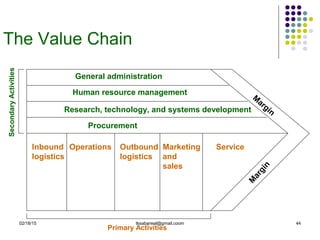
The Value Chain
Primary Activities
SecondaryActivities
General administration
Human resource management
Research, technology, and systems development
Procurement
Inbound
logistics
Operations Outbound
logistics
Marketing
and
sales
Service
M
argin
M
argin
02/18/15 tksabarwal@gmail.coom 45
Conducting a Value Chain Analysis
 Step 1. Divide the firm’s operations into specific activities or
business processes, usually grouping them according to
primary and support activities. Within each category, a firm
typically performs a number of discrete activities that may
represent key strengths or weaknesses.
 Step 2. Next, attach costs to each discrete activity.
 Step 3. Recognize the difficulty in activity-based accounting.
 Step 4. Identify the activities that differentiate the firm from
their competitors.
02/18/15 tksabarwal@gmail.coom 46
Conducting a Value Chain Analysis
 Step 5. After documenting the value chain, managers need to
identify the activities that are critical to buyer satisfaction and
market success. These are the activities that deserve major
scrutiny in an internal analysis.
 The mission should influence managers’ choice of the activities they
examine in detail.
 The nature of value chains and the relative importance of the activities
within them vary by industry.
 The relative importance of value activities can vary by a company’s
position in a broader value system that includes the value chains of its
upstream suppliers and downstream customers or partners involved in
providing products or services.
 Step 6. Compare to competitors.

Marketing in action

  • 1.
    02/18/15 tksabarwal@gmail.coom 1 Marketingin action A Managerial Approach
  • 2.
    02/18/15 tksabarwal@gmail.coom 2 SomePerspective Marketing and History “In well-ordered states, storekeepers and salesmen are commonly those who are weakest in bodily strength and, therefore, of little use for any other purpose.” - Plato “Merchants are to be accounted vulgar; for they can make no profit except by a certain amount of falsehood.” - Cicero “Advertising ... is a meretricious endeavor in which psychological appeals to ‘fear’ and ‘shame’ are developed to bamboozle the public into purchasing essentially worthless packaged goods at bloated prices.” - Thorstein Veblen
  • 3.
    02/18/15 tksabarwal@gmail.coom 3 SomePerspective A Modern View “Corporate leaders nationwide are discovering that their most powerful competitive weapon is marketing -- the development, pricing, distribution, and promotion of products.” - Newsweek “Marketing is now central to success at any company in any business, and it is going to make the difference between winners and losers.” - Stephen Greyser, Harvard Business School “Stop being a company with its face towards the CEO and back towards the customer” - Jack Welch, CEO, G.E.
  • 4.
    02/18/15 tksabarwal@gmail.coom 4 Marketingchallenges 1. Destabilization due entrepreneurial freedom 2. The MNC onslaught 3. The all pervasive competition 4. The exacting demands of a buyer’s market 5. Compulsions to go global 6. Challenges on technology front 7. Need for quick product innovations 8. Challenges of achieving marketing excellence under conditions of discontinuity
  • 5.
    02/18/15 tksabarwal@gmail.coom 5 KeyIssues in the Business Environment  Customer Satisfaction - markets are saturated and we cannot rely on pent up demand to make profits.  Must provide greater quality and value to smarter shoppers.  From mass marketing to segments of one.  Increase speed of innovation, diffusion and distribution.  Globalization  Global brands, different positioning or similar positioning in different countries?  New ideas developed in country A, designed in country B, manufactured in country C and sold in country D.  Environmental and Health Care Concerns  Must address concerns of better educated and better informed consumers.
  • 6.
    02/18/15 tksabarwal@gmail.coom 6 Misconceptionsof MarketingMisconceptions of Marketing  Marketer create needs, manipulate people to buy something they don't want  Marketing = selling = advertising  Marketing = shoes polishing  Customer will favour those products that offer the most quality, performance & innovative feature
  • 7.
    02/18/15 tksabarwal@gmail.coom 7 MarketingIs Important!  Marketing impacts all of us in our lives as consumers  Gives us choices  Stimulates innovation and economic growth  There are many good job opportunities in marketing  Regardless of what career path you take, no firm (or non- profit organization) survives for long if it can’t satisfy some group of customers. 1-5
  • 8.
    02/18/15 tksabarwal@gmail.coom 8 Whatis Marketing ? (1)  A social & managerial process by which individuals & groups obtain what they need & want through creating & exchanging values with others  Marketing ( management ) is the process of planning & executing the production, pricing, promotion & distribution of ideas, goods & services to create exchange that satisfy individual & organizational goals. ( integrated marketing activities)
  • 9.
    02/18/15 tksabarwal@gmail.coom 9 Whatis Marketing ? (2)  Key function of management : provide MR inputs & guiding philosophy on company mission & strategic planning
  • 10.
  • 11.
    02/18/15 tksabarwal@gmail.coom 11 Whythe change over the ages? Changing approaches to business over time  the production concept  the product concept  the sales concept  the marketing concept  Why is Marketing one of the most critical components of modern business?
  • 12.
    02/18/15 tksabarwal@gmail.coom 12 Production concept Basedon •Cost benefit •Mass distribution Product concept Based on •Quality •Performance •Innovation •Focus on •Product •Marketing myopia Selling concept Based on •Consumer inertia and resistance •Aggressive selling and promotions to stimulate more buying Marketing concept 1950 shift from make and sell to “sense and respond” Based on •Creating •Delivering •Communicating Superior customer value to chosen target markets
  • 13.
    02/18/15 tksabarwal@gmail.coom 13 Factory Existing Products Selling and Promoting Profits through Volume Market Customer Needs Integrated Marketing Profits through Satisfaction TheSelling ConceptThe Selling Concept The Marketing ConceptThe Marketing Concept Starting Point Focus Means Ends Marketing & Sales Concept Contrasted
  • 14.
    02/18/15 tksabarwal@gmail.coom 14 Society (HumanWelfare) Society (Human Welfare) Consumers (Satisfaction) Consumers (Satisfaction) Company (Profits) Company (Profits) Societal Marketing Concept Societal Marketing Concept The Societal Marketing Concept
  • 15.
    02/18/15 tksabarwal@gmail.coom 15 Products Needs,wants, and demands Exchange, transactions, and relationships Markets Core Marketing Concepts Core Marketing Concepts Value, satisfaction, and quality Core Concepts
  • 16.
    02/18/15 tksabarwal@gmail.coom 16 Needs  Wants  Demands  Transactions/Exchange/Relationships  Market Marketing Problem: Needs & Wants
  • 17.
    02/18/15 tksabarwal@gmail.coom 17 customer •Tounderstand the customer –basic is to know that s/he is buying / using the products as a means to solve or address their own problem, reason and strategy and not yours and therefore unless marketer is customer specific in terms of marketing mix elements, success is usually evasive. •Customer does not buy a brand s/he buys their perception, and choose a brand which offers the best solution to their problem •Marketers only brief is to synergize the capabilities of the organization so as to address customer’s specific needs.
  • 18.
    02/18/15 tksabarwal@gmail.coom 18 Changesin customer perceptions 1950-60 60’s early 70’s Late 70’s early 80 Late 89’s –90’s Mass market Segmented perception Sub segments niche Customer perceived as As a mass audience General/similar needs Limited product offering Limited No. of Needs-price feature Limited tiring of products Growing no. of needs Primarily in lower Segments More market offerings Portfolio of niche products
  • 19.
    02/18/15 tksabarwal@gmail.coom 19 Perspective(A mental view of a scene) SET OF PERSPECTIVES IN CONSUMER BEHAVIOR MARKETER CONSUMER PUBLIC POLICY MAKETERS AND CONSUMERS ARE ACTIVE ON DAILY BASIS MARKETING DECISIONS CONTROLLABLE (4P’s) UNCONTROLABLE (5C’s) Marketing mix elements Customers Channels Conditions Competitors Company,
  • 20.
    02/18/15 tksabarwal@gmail.coom 20 Realisticview This realistic view is important to the marketer because , 1. It gives an external view of the customer. 2. An aggregate view of the customer 3. A product specific view of the customer 4. A brand preference /purchase point of view 5. A behavioral influence orientation • who does or does not use the product • Who uses the competitors Brand
  • 21.
    02/18/15 tksabarwal@gmail.coom 21 Comparisonof two perspectives PerspectivePerspective characteristicscharacteristics Marketer’sMarketer’s perspectiveperspective Customer’sCustomer’s perspectiveperspective Point of viewPoint of view ExternalExternal (buyers)(buyers) InternalInternal (me)(me) Level of interestLevel of interest AggregateAggregate (markets)(markets) IndividualIndividual (myself)(myself) Scope of interestScope of interest Product specificProduct specific (what I make)(what I make) Across productsAcross products (what I buy)(what I buy) correct choicecorrect choice Brand specificBrand specific (my brand)(my brand) Best alternativeBest alternative (best brand for me)(best brand for me) Role of influenceRole of influence InfluenceInfluence behaviorbehavior Handle behavioralHandle behavioral influencesinfluences
  • 22.
    02/18/15 tksabarwal@gmail.coom 22 Perspectives-contd. customercustomermarketermarketer Most behaviors are internally focused –weMost behaviors are internally focused –we think silently-observe privately-& evaluatethink silently-observe privately-& evaluate according to our own dictatesaccording to our own dictates Marketer can only have an external view.Marketer can only have an external view. Focus on themselves as individualsFocus on themselves as individuals Market segmentation as a process ofMarket segmentation as a process of comprehending markets. Marketers try tocomprehending markets. Marketers try to find sub markets within the total marketsfind sub markets within the total markets for economic viability.for economic viability. Not an expert for many of their purchasesNot an expert for many of their purchases An expert for his brand / categoryAn expert for his brand / category Choose only one brand from a given set,Choose only one brand from a given set, meaning , making a wrong choice from themeaning , making a wrong choice from the point of view of every marketer but, one.point of view of every marketer but, one. (branding helps)(branding helps) Best brand is the one that we makeBest brand is the one that we make (building brand equity helps)(building brand equity helps) someTime and effort required to react tosomeTime and effort required to react to stimuli. (only if it is interest to mestimuli. (only if it is interest to me otherwise ignored)otherwise ignored) Targeting markets of interest.Targeting markets of interest. Creating stimuli-intrinsically interesting toCreating stimuli-intrinsically interesting to consumersconsumers stimuli are simple and easy on consumersstimuli are simple and easy on consumers
  • 23.
    02/18/15 tksabarwal@gmail.coom 23 Blackbox/CIP models Consumer’s Mind Black box Consumer”s Mind CIP inputs outputs outputinputs External world External world External world External world
  • 24.
    02/18/15 tksabarwal@gmail.coom 24 INTERNALWORLDSINTERNAL WORLDSEXTERNAL WORLD SENSORY REGISTER SHORT TERM MEMORY(STM) OR WORKING MEMOTY LONG TERM MEMORY (ltm)STIMULI Short and long term memory
  • 25.
    02/18/15 tksabarwal@gmail.coom 25 The5 stage process 1:Problem recognition • The internal recognition by the consumer that their current needs are not being met • Discrepancy between actual & desired state • Leads to motivation • Could be real or imagined, physical or psychological • Implications? Construction of advertising; penetration pricing strategies for new products; importance of peers; social construction of desire. 2:Information Search Next we ask ourselves the question of how do we solve our problem? •May already be familiar with options available •May consult people whose opinions we respect •May browse around the shops •May consult independent experts •Amount of information required dependent on risk attached •Implications? Role of marketing communications
  • 26.
    02/18/15 tksabarwal@gmail.coom 26 The5 stage process (continued) 3:Evaluation of alternatives •In deciding which product to buy we have to weigh up which product best suits our needs •We construct criteria upon which to base our choice •We already may have a list of criteria or we may form one during the information search •Compensatory vs. non compensatory evaluation 4: Product choice •Having weighed up the pros and cons between alternatives eventually we have to make a choice •Could be as a result of the outcome of our evaluation process against important criteria – best fit. •Choice could be affected by availability, payment options etc. •Implications? Make it easy!
  • 27.
    02/18/15 tksabarwal@gmail.coom 27 The5 stage process (continued) 5: Post purchase evaluation Once we have made our purchase we decide whether its met our expectation •If it does great positive brand associations and visa versa •Implications? After sales service, marketing communications
  • 28.
  • 29.
    02/18/15 tksabarwal@gmail.coom 29 ReferenceGroup Influences  A reference group is the group whose perspective an individual takes on in forming values, beliefs, attitudes, opinions, and overt behaviors.  They set levels of aspiration  They help define the actual items/services considered acceptable for displaying those aspirations.
  • 30.
    02/18/15 tksabarwal@gmail.coom 30 SocialNorms and Conformity  Social norm – any rule or behavior for meeting societal expectations  normative system  Conformity pressures – actions taken to encourage or force members to act, think and/or express themselves in certain ways.  The more important a group is in our lives, the greater our desire to accept and conform to its norms
  • 31.
    02/18/15 tksabarwal@gmail.coom 31 Homan’sEquation The difference between the “price” we pay for conformity and the rewards obtained for doing so determines for each of us whether we will conform to group expectations and to what extent.Price: •Loss of freedoms •Time commitment •Financial commitment •Etc. Rewards: •Levels of acceptance •Advancement within the group •Prestige gained •Etc.
  • 32.
    02/18/15 tksabarwal@gmail.coom 32 ReferenceGroup Types  Primary reference group: one with which the individual has frequent face-to-face contact and in which members are close-knit.  Examples: families, households, study groups, work teams, roommates, etc.  Secondary reference group: one in which interaction with other members is less frequent  Formal group: one in which there is some sort of structure and/or for which there are specific membership requirements.  Informal group: one that has no special membership or attendance requirements, other than common interests.
  • 33.
    02/18/15 tksabarwal@gmail.coom 33 ReferenceGroup Types (continued)  Membership group: one to which a person currently belongs.  Aspirational group: a group that a person would like to be part of, but to which he or she does not currently/ may never belong  Dissociative group: a group that an individual avoids or denies connection with.
  • 34.
    02/18/15 tksabarwal@gmail.coom 34 ReferenceGroup Influences  Reference groups as  part of the socialization process  setters of roles  information sources  normative influences  an expression of self-value
  • 35.
    02/18/15 tksabarwal@gmail.coom 35 ConformityPressure and Marketplace behavior  The influence of reference groups varies  Groups tend to be more influential on product decisions than they are on either brand or outlet choices  Conspicuousness “based on exclusivity” -- product decisions (bikers and black leather jackets)  Conspicuousness “associated with the individual” -- brand decisions possible within product class, “allowed personal expression”
  • 36.
    02/18/15 tksabarwal@gmail.coom 36 SocialPower  Power of reward – praise, approval, acceptance, status, recognition, etc.  Coercive power – unacceptable behavior strongly discouraged  Expert power – informational attraction  Referent power – closer the match between person and group, more willingness to conform
  • 37.
    02/18/15 tksabarwal@gmail.coom 37 DefiningCustomer Value - = Total Customer Value Total Customer Cost (Product, Service, Personnel, & Image Values) (Monetary, Time, Energy, & Psychic Costs) Customer Delivered Value (Profit to the Consumer)
  • 38.
    02/18/15 tksabarwal@gmail.coom 38 CustomerSatisfaction Customer Satisfaction Results When a Company’s Performance Has Fulfilled a Buyer’s Expectations. Buyer’s Expectations Are Based On: Customer’s Past Buying Experiences Opinions of Friends & Associates Marketer/ Competitor Information & Promises Product’sActualPerformance Performance Exceeds Expectations- Customer is Delighted Performance Below Expectations - Customer is Dissatisfied
  • 39.
    02/18/15 tksabarwal@gmail.coom 39 TotalCustomer Satisfaction  Highly satisfied (delighted) customers produce benefits:Highly satisfied (delighted) customers produce benefits:  They are less price sensitive,  They remain customers longer,  They talk favorably about the company and products to others.  Delighted customers have emotional and rational preferences forDelighted customers have emotional and rational preferences for products, and this creates high customer loyalty.products, and this creates high customer loyalty.  Therefore, the purpose of Marketing is to generate customer valueTherefore, the purpose of Marketing is to generate customer value profitably.profitably.
  • 40.
    02/18/15 tksabarwal@gmail.coom 40 TheNeed for Customer Retention New Customer Costs Lost Customer Costs Customer Lifetime Value The Key to Customer Retention is Superior Customer Value and Satisfaction. Companies Must Consider:
  • 41.
    02/18/15 tksabarwal@gmail.coom 41 BuildingCustomer Satisfaction and Loyalty by Relationship Marketing Structural Ties Structural Ties Social Benefits Social Benefits Relationship Marketing Involves Creating, Maintaining, and Enhancing Strong, Long-Term Relationships with Customers and Other Stakeholders. Methods for Building Relationships Include Offering: Financial Benefits Financial Benefits
  • 42.
    02/18/15 tksabarwal@gmail.coom 42 ValueChain Analysis Business Policy and Strategy
  • 43.
    02/18/15 tksabarwal@gmail.coom 43 ValueChain Analysis The term value chain describes a way of looking at a business as a chain of activities that transform inputs into outputs that customers value. Customer value derives from three basic sources: activities that differentiate the product activities that lower its cost activities that meet the customer’s need quickly. Value chain analysis views the organization as a sequential process of value-creating activities, and attempts to understand how a business creates customer value by examining the contributions of different activities within the business to that value.
  • 44.
    02/18/15 tksabarwal@gmail.coom 44 TheValue Chain Primary Activities SecondaryActivities General administration Human resource management Research, technology, and systems development Procurement Inbound logistics Operations Outbound logistics Marketing and sales Service M argin M argin
  • 45.
    02/18/15 tksabarwal@gmail.coom 45 Conductinga Value Chain Analysis  Step 1. Divide the firm’s operations into specific activities or business processes, usually grouping them according to primary and support activities. Within each category, a firm typically performs a number of discrete activities that may represent key strengths or weaknesses.  Step 2. Next, attach costs to each discrete activity.  Step 3. Recognize the difficulty in activity-based accounting.  Step 4. Identify the activities that differentiate the firm from their competitors.
  • 46.
    02/18/15 tksabarwal@gmail.coom 46 Conductinga Value Chain Analysis  Step 5. After documenting the value chain, managers need to identify the activities that are critical to buyer satisfaction and market success. These are the activities that deserve major scrutiny in an internal analysis.  The mission should influence managers’ choice of the activities they examine in detail.  The nature of value chains and the relative importance of the activities within them vary by industry.  The relative importance of value activities can vary by a company’s position in a broader value system that includes the value chains of its upstream suppliers and downstream customers or partners involved in providing products or services.  Step 6. Compare to competitors.