An introduction  to marketing John Taylerson,  CM, DipM, MBA CIM South West Food & Drink Ambassador www.taylerson.co.uk   www.malmesburysyrups.co.uk
What is marketing? Marketing is  ‘the management process responsible  for identifying, anticipating and satisfying  customer requirements profitably’ Customer demand management- The future of the business bit-
What questions should I be asking myself about my business? What business am I in? (the real competition) Who are my customers?  Who should be my customers? Who are my competitors, are they better than me, and, if so, why? Do I know where I am going? If not, how will I know if, and when, I get there?
A different perception of ‘marketing’ Marketing is often seen by small businesses as equivalent to selling and marketing communications (brochures, promotional activity, advertising, PR, website)  Marketing is about ensuring you have demand for your products and services now and in the future- and that you can match the demand-  profitably!
How can marketing help my business? Help you understand your  customers Help you win new  customers Help you understand your  competitors Help you find  opportunities  and grow your business Tell you the ‘direction’ that the market (customers) is taking
Where do I start? Consider: Customer satisfaction Goals and objectives Marketing audit Resources  7 Ps an introduction  to marketing
Goals and objectives Goal What type of company are you and where do you want your business to be in five years time? Objectives What do you want to achieve? Try to make yours SMART objectives Specific Measurable Achievable Relevant Timely
1   Product  What do customers want to buy? Can you deliver the right product or service to meet your customers’ needs? Can you deliver the right  quality of service? Does your product or service provide value for the customer? Its not about selling what you make- its about making what people want to buy
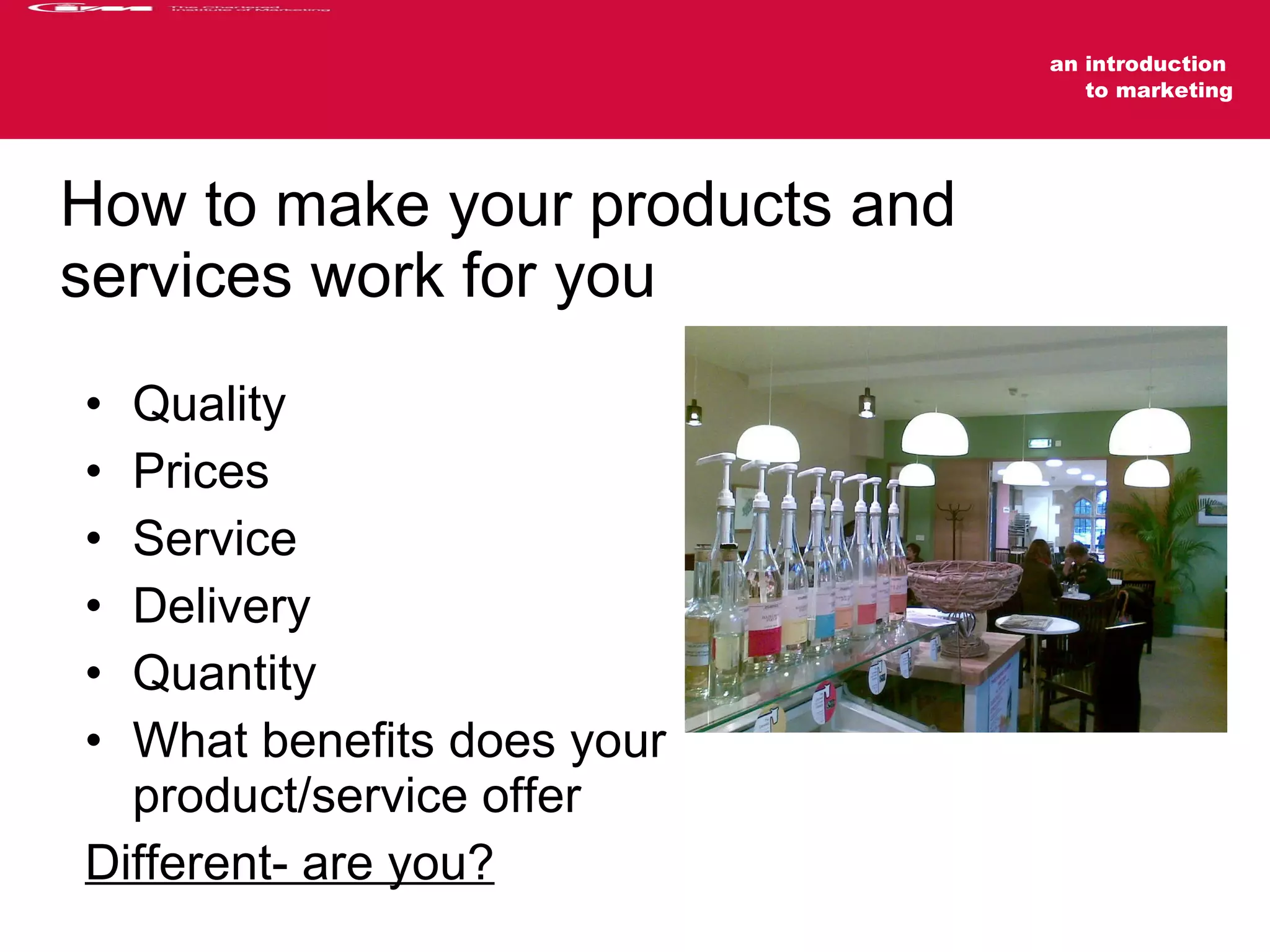
How to make your products and services work for you Quality Prices Service Delivery Quantity What benefits does your  product/service offer Different- are you?
2   Price Price is often the definer of market position- where does your product or service sit within  Value- what does it ‘feel’ like Too cheap might be worse than too expensive Differentiate the offer- get off the issue of price Provenance  ‘add-on’s’  Size etc.
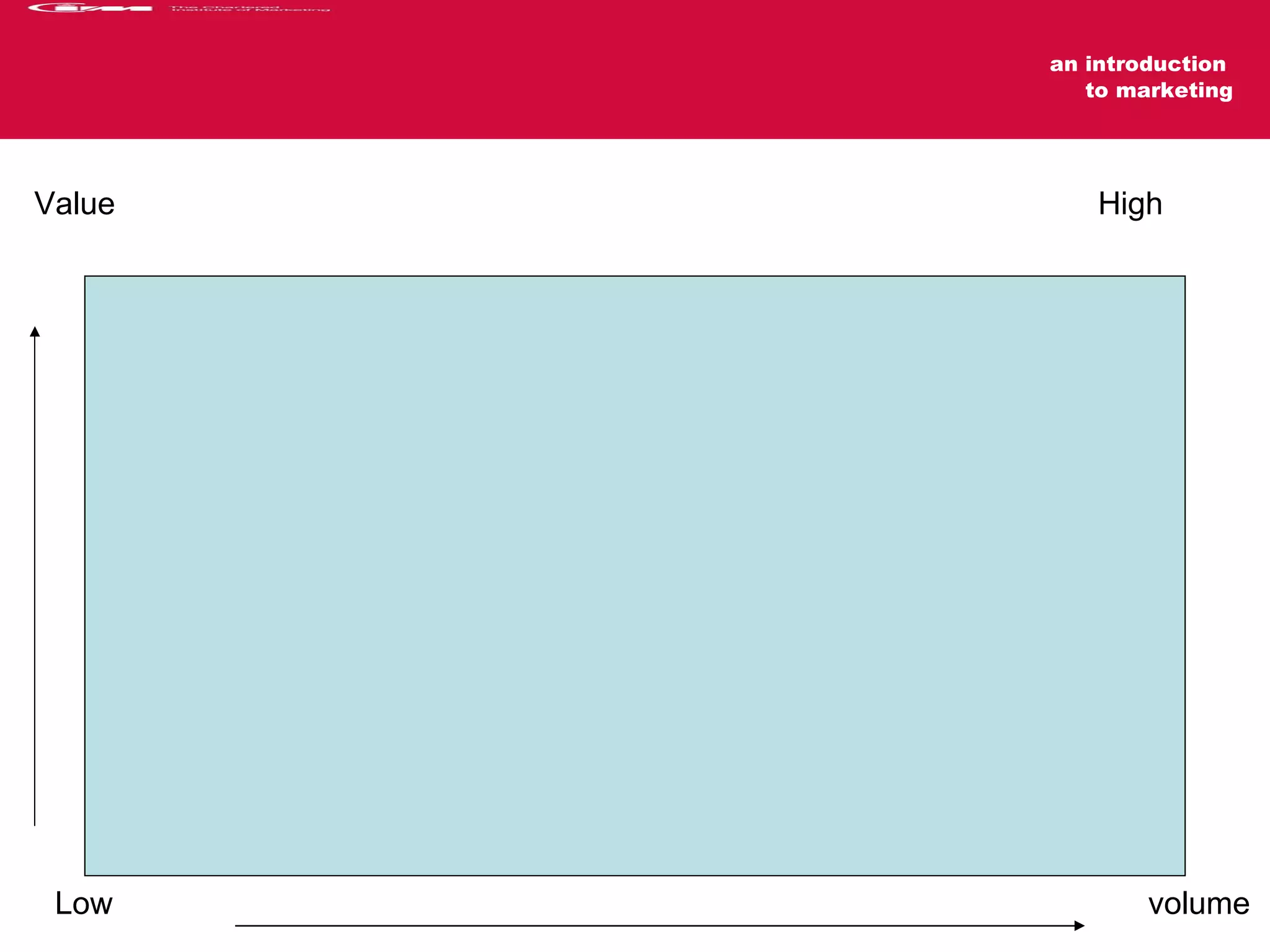
volume Value High Low
What customers will pay - v-  what it costs to produce Gross margin Product costs Net margins Do you know the difference between the following costs.. Sunk Fixed Variable
Value for you, the supplier    Which customers are profitable?  Price obtained vs; Cost of acquisition – how long before the ‘return’ Cost of retention – keeping them Cost of servicing – are they profitable?
3   Place The place where customers buy a product and the means of distributing your product to that place must be appropriate and convenient for the customer The product must be available in: The right place At the right time  In the right quantity  Restock- replenish – merchandising etc.
4   Promotion Communicate what you do and what you can offer to your customers It is designed to: Gain attention Be appealing Tell a consistent message (branding) Explain the benefits  Be a two-way communication
5   People Anyone in your company/organisation who comes into contact with your customers will make an impression, and they can have a profound effect – positive or negative – on  customer satisfaction The  reputation of your brand  rests in your people’s hands They must be appropriately  trained , well  motivated  and have the right  attitude
6   Process Process underpins  service Process is the  first experience  of a company that many customers have (handling an enquiry, obtaining a quote, quality of the follow-up etc) This ‘P’ could be a great source of  competitive advantage  if used wisely (check out how well your main competitor performs so you have a benchmark against which to judge your own capabilities) Customers only notice process when its not there!
7   Physical evidence A service needs to be  experienced Help potential customers to ‘ see ’ what they are buying Offer  case studies  and  customer testimonials Let new or potential customers  see your facilities  (if appropriate) e.g. invite them to your offices, show room, factory. Let them meet key contacts so they know who they speak to when ordering Did the product get delivered!
How to beat your competitors Who is/are your main competitor/s? What do they do that is different from you? Do you share customers or are they different. If so why? Is your product/service affected by changes in the political or general environment? Marketing provides simple models that test the thinking and keep you wise to customers and competitors
For more useful advice for small businesses wanting to build on their marketing knowledge www.cim.co.uk/sme   For more information about our Small-Business Community visit  www.cim.co.uk/sbc   Register at cim.co.uk for market interest groups and local meetings Find out more
To find out more contact your regional director or ambassador South West   Regional Director Christine Boswell-Munday [email_address]   Regional ambassador Richard Storey [email_address] Bristol & West Branch chair Jane Silk [email_address] South West   Regional Food & Drink Ambassador John Taylerson swfood&drink@cim.co.uk www.taylerson.co.uk www.malmesburysyrups.co.uk

Introduction to marketing for business link - John Taylerson

  • 1.
    An introduction to marketing John Taylerson, CM, DipM, MBA CIM South West Food & Drink Ambassador www.taylerson.co.uk www.malmesburysyrups.co.uk
  • 2.
    What is marketing?Marketing is ‘the management process responsible for identifying, anticipating and satisfying customer requirements profitably’ Customer demand management- The future of the business bit-
  • 3.
    What questions shouldI be asking myself about my business? What business am I in? (the real competition) Who are my customers? Who should be my customers? Who are my competitors, are they better than me, and, if so, why? Do I know where I am going? If not, how will I know if, and when, I get there?
  • 4.
    A different perceptionof ‘marketing’ Marketing is often seen by small businesses as equivalent to selling and marketing communications (brochures, promotional activity, advertising, PR, website) Marketing is about ensuring you have demand for your products and services now and in the future- and that you can match the demand- profitably!
  • 5.
    How can marketinghelp my business? Help you understand your customers Help you win new customers Help you understand your competitors Help you find opportunities and grow your business Tell you the ‘direction’ that the market (customers) is taking
  • 6.
    Where do Istart? Consider: Customer satisfaction Goals and objectives Marketing audit Resources 7 Ps an introduction to marketing
  • 7.
    Goals and objectivesGoal What type of company are you and where do you want your business to be in five years time? Objectives What do you want to achieve? Try to make yours SMART objectives Specific Measurable Achievable Relevant Timely
  • 8.
    1 Product What do customers want to buy? Can you deliver the right product or service to meet your customers’ needs? Can you deliver the right quality of service? Does your product or service provide value for the customer? Its not about selling what you make- its about making what people want to buy
  • 9.
    How to makeyour products and services work for you Quality Prices Service Delivery Quantity What benefits does your product/service offer Different- are you?
  • 10.
    2 Price Price is often the definer of market position- where does your product or service sit within Value- what does it ‘feel’ like Too cheap might be worse than too expensive Differentiate the offer- get off the issue of price Provenance ‘add-on’s’ Size etc.
  • 11.
  • 12.
    What customers willpay - v- what it costs to produce Gross margin Product costs Net margins Do you know the difference between the following costs.. Sunk Fixed Variable
  • 13.
    Value for you,the supplier Which customers are profitable? Price obtained vs; Cost of acquisition – how long before the ‘return’ Cost of retention – keeping them Cost of servicing – are they profitable?
  • 14.
    3 Place The place where customers buy a product and the means of distributing your product to that place must be appropriate and convenient for the customer The product must be available in: The right place At the right time In the right quantity Restock- replenish – merchandising etc.
  • 15.
    4 Promotion Communicate what you do and what you can offer to your customers It is designed to: Gain attention Be appealing Tell a consistent message (branding) Explain the benefits Be a two-way communication
  • 16.
    5 People Anyone in your company/organisation who comes into contact with your customers will make an impression, and they can have a profound effect – positive or negative – on customer satisfaction The reputation of your brand rests in your people’s hands They must be appropriately trained , well motivated and have the right attitude
  • 17.
    6 Process Process underpins service Process is the first experience of a company that many customers have (handling an enquiry, obtaining a quote, quality of the follow-up etc) This ‘P’ could be a great source of competitive advantage if used wisely (check out how well your main competitor performs so you have a benchmark against which to judge your own capabilities) Customers only notice process when its not there!
  • 18.
    7 Physical evidence A service needs to be experienced Help potential customers to ‘ see ’ what they are buying Offer case studies and customer testimonials Let new or potential customers see your facilities (if appropriate) e.g. invite them to your offices, show room, factory. Let them meet key contacts so they know who they speak to when ordering Did the product get delivered!
  • 19.
    How to beatyour competitors Who is/are your main competitor/s? What do they do that is different from you? Do you share customers or are they different. If so why? Is your product/service affected by changes in the political or general environment? Marketing provides simple models that test the thinking and keep you wise to customers and competitors
  • 20.
    For more usefuladvice for small businesses wanting to build on their marketing knowledge www.cim.co.uk/sme For more information about our Small-Business Community visit www.cim.co.uk/sbc Register at cim.co.uk for market interest groups and local meetings Find out more
  • 21.
    To find outmore contact your regional director or ambassador South West Regional Director Christine Boswell-Munday [email_address] Regional ambassador Richard Storey [email_address] Bristol & West Branch chair Jane Silk [email_address] South West Regional Food & Drink Ambassador John Taylerson swfood&drink@cim.co.uk www.taylerson.co.uk www.malmesburysyrups.co.uk

Editor's Notes

  • #3 This is the classical definition of marketing used by The Chartered Institute of Marketing. It highlights the fact that the customer is at the heart of business, and companies ignore this at their peril.
  • #8 Discussion or workshop session. Use SMART model
  • #9 Product There is no point in developing a product or service that no one wants to buy. Yet many businesses decide what to offer first, and then hope to find a market for it afterwards. The successful company, in contrast, will find out what customers need or want and then develop the right product - with the right level of quality to meet those needs now and in the future. • The perfect product must provide value for the customer. This value is in the eye of the beholder - we must give our customers what they want, not what we think they want • A product does not have to be tangible - an insurance policy can be a product • Ask yourself whether you have a system in place to regularly check what your customers think of your product, your supporting services etc, and what their needs are now and whether they see them changing • Beware going too far with product quality. Don't try to sell a Rolls-Royce when the customer really wants a Nissan Micra
  • #10 Discussion
  • #16 Promotion Promotion is the way a company communicates what it does and what it can offer to its customers. It includes activities such as branding, advertising, PR, corporate identity, sales management, special offers and exhibitions. It must gain attention, it must be appealing, it must tell a consistent message, and it must give the customer a reason to choose your product rather than someone else's. • Good promotion is not a one-way communication - it paves the way for a dialogue with customers. • Promotion should communicate the benefits that a customer obtains from a product and not just the features of that product • Whether your promotional material is just a single sheet or a more complex brochure, folder or catalogue, it must be grab the attention of your customers. It should be easy to read and enable the customer to identify why they should buy your product
  • #17 People Anyone who comes into contact with your customers will make an impression, and they can have a profound effect - positive or negative - on customer satisfaction. The reputation of your brand rests in your people's hands. They must therefore be appropriately trained, well motivated and have the right attitude. • It's essential to ensure that all employees who have contact with customers are not only properly trained, but also the right kind of people for the job • Many customers cannot separate the product or service from the staff member who provides it to them. This shows the importance of your people
  • #18 Process The process of giving a service and the behaviour of those who deliver it is crucial to customer satisfaction. Issues such as waiting times, the information that is given to customers and the helpfulness of staff are all vital to keep customers happy. • Customers are not interested in the detail of how your business runs. What matters to them is that the system works • Do customers have to wait? Are they kept informed? Are your people helpful? Is your service efficiently carried out? Do your people interact in a manner appropriate to your service? Process is one of the 'P's that is frequently overlooked. A customer trying to reach your company by phone is a vital source of income and returning value; but so often, customers have to stay on hold for several minutes, listening to a recorded message before they are able to get through. Many of these customers will give up, go elsewhere and tell their friends not to use your company - just because of the poor process that is in place. Even if they do get through, they will go away with a negative impression of the company. The reason for this is that the systems are not usually designed by marketers - they are designed for the company's benefit, not the customer's. This part of the process is the first experience of a company that many customers have. There's no value in making the rest of the company run perfectly if this part is faulty. As a consequence, this 'P' could be a great source of competitive advantage if used wisely.
  • #19 Physical evidence A service can't be experienced before it is delivered. This means that choosing to use a service can be perceived as a risky business because you are buying something intangible. This uncertainty can be reduced by helping potential customers to 'see' what they are buying. Case studies and testimonials can provide evidence that an organisation keeps its promises. Facilities such as a clean, tidy and well-decorated reception area can also help to reassure. If your premises aren't up to scratch, why would the customer think your service is? • The physical evidence demonstrated by an organisation must confirm the assumptions of the customer - a financial services product will need to be delivered in a formal setting, while a children's birthday entertainment company should adopt a more relaxed approach Although the customer cannot experience the service before purchase, he or she can talk to other people with experiences of the service. Their testimony is credible, because their views do not come from the company. Some companies engage these customers and ask for their feedback, so that they can develop reference materials. New customers can then see these testimonials and are more likely to purchase with confidence.