Map-Reduce Algorithms
Introduction to Map-Reduce
• MapReduce is a programming model used for efficient processing in
parallel over large data-sets in a distributed manner.
• The data is first split and then combined to produce the final result.
• The purpose of MapReduce in Hadoop is to Map each of the jobs and
then it will reduce it to equivalent tasks for providing less overhead
over the cluster network and to reduce the processing power.
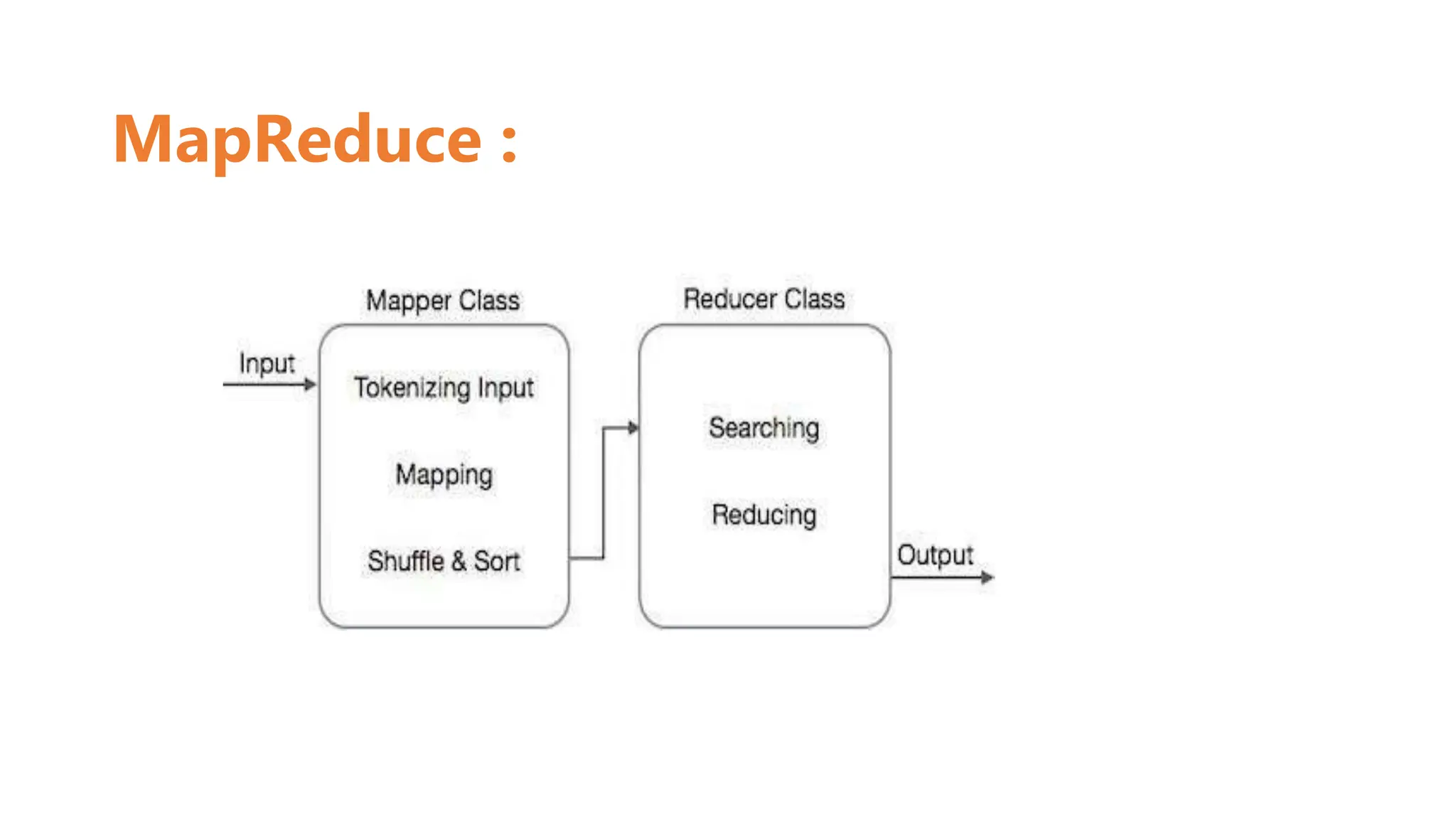
MapReduce :
Map phase and Reduce phase.
1. Map Phase:
1.As the name suggests its main use is to map the input data in
key-value pairs.
2.The input to the map may be a key-value pair where the key can
be the id of some kind of address and value is the actual value
that it keeps.
3.The Map() function will be executed in its memory repository on
each of these input key-value pairs and generates the
intermediate key-value pair which works as input for the Reducer
or Reduce() function.
2. Reduce Phase :
1. The intermediate key-value pairs that work as input for
Reducer are shuffled and sort and send to
the Reduce() function.
2. Reducer aggregate or group the data based on its key-value
pair as per the reducer algorithm written by the developer.
Example
Algorithms
MapReduce implements various mathematical algorithms to divide a task into small
parts and assign them to multiple systems. In technical terms, MapReduce algorithm
helps in sending the Map & Reduce tasks to appropriate servers in a cluster.
These mathematical algorithms may include the following −
•Sorting
•Searching
•Indexing
•TF-IDF
1. Sorting :-
Sorting is one of the basic MapReduce algorithms to process and analyze data. MapReduce
implements sorting algorithm to automatically sort the output key-value pairs from the mapper
by their keys.
Sorting methods are implemented in the mapper class itself.
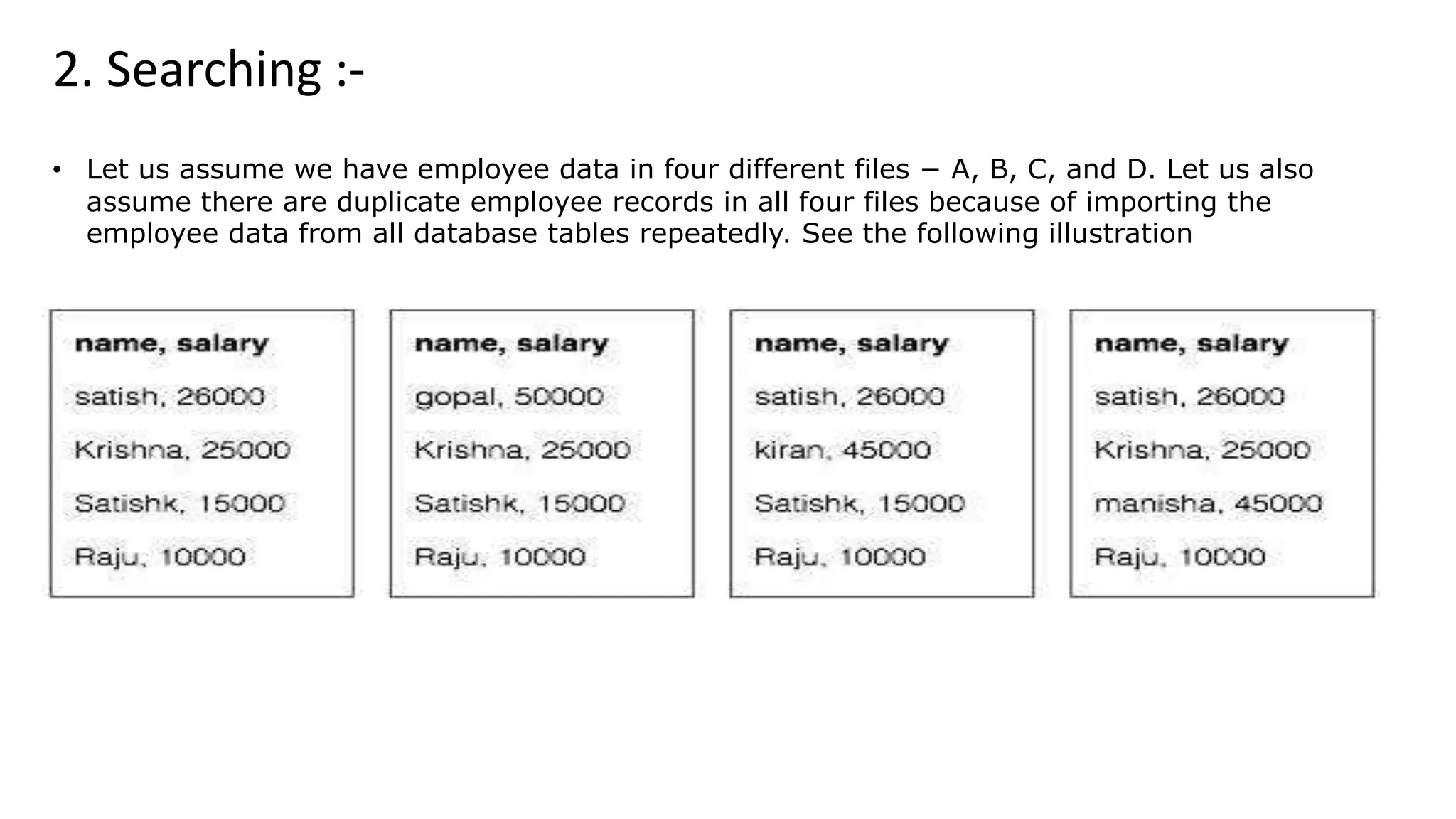
2. Searching :-
• Let us assume we have employee data in four different files − A, B, C, and D. Let us also
assume there are duplicate employee records in all four files because of importing the
employee data from all database tables repeatedly. See the following illustration
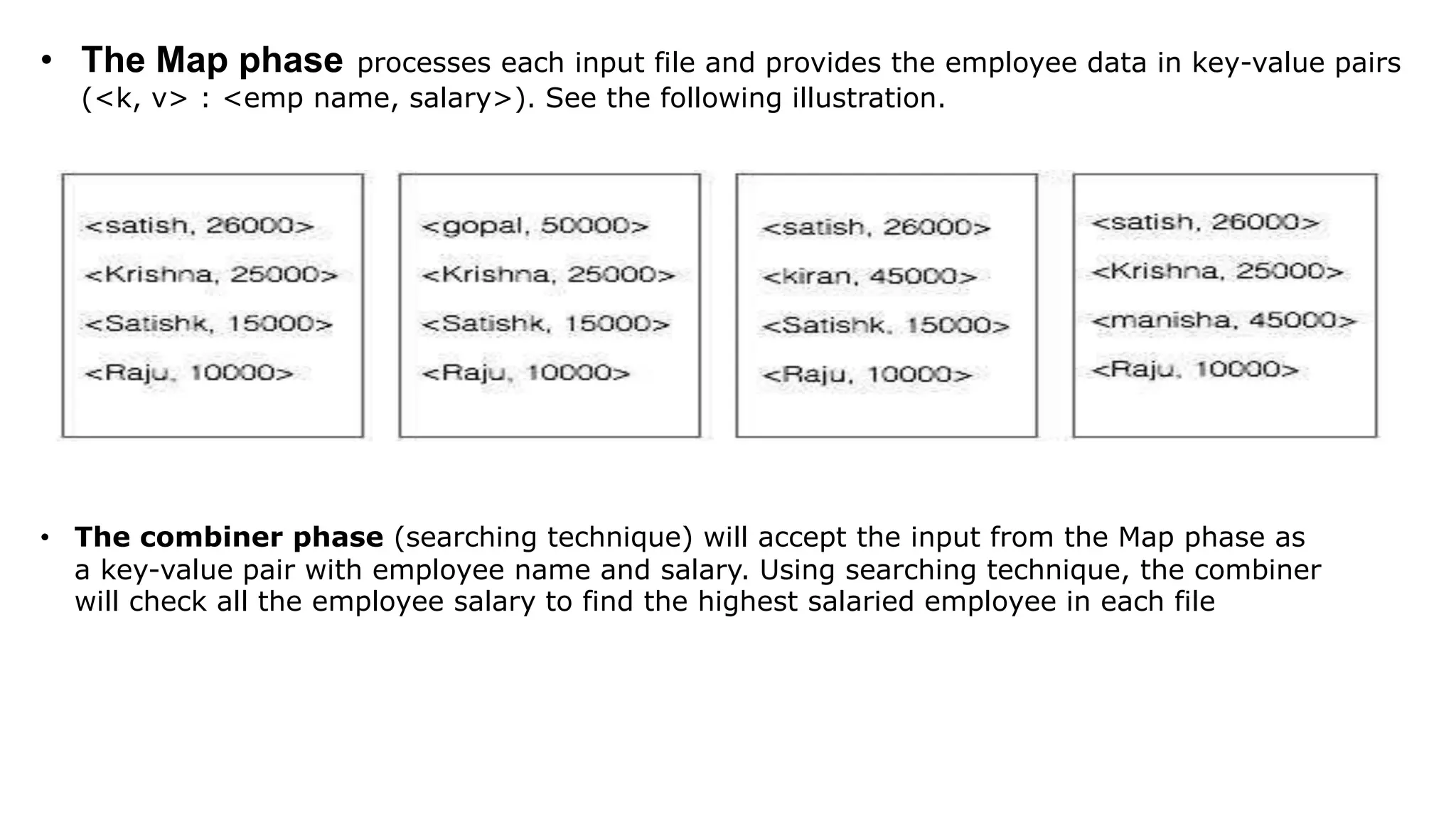
• The Map phase processes each input file and provides the employee data in key-value pairs
(<k, v> : <emp name, salary>). See the following illustration.
• The combiner phase (searching technique) will accept the input from the Map phase as
a key-value pair with employee name and salary. Using searching technique, the combiner
will check all the employee salary to find the highest salaried employee in each file
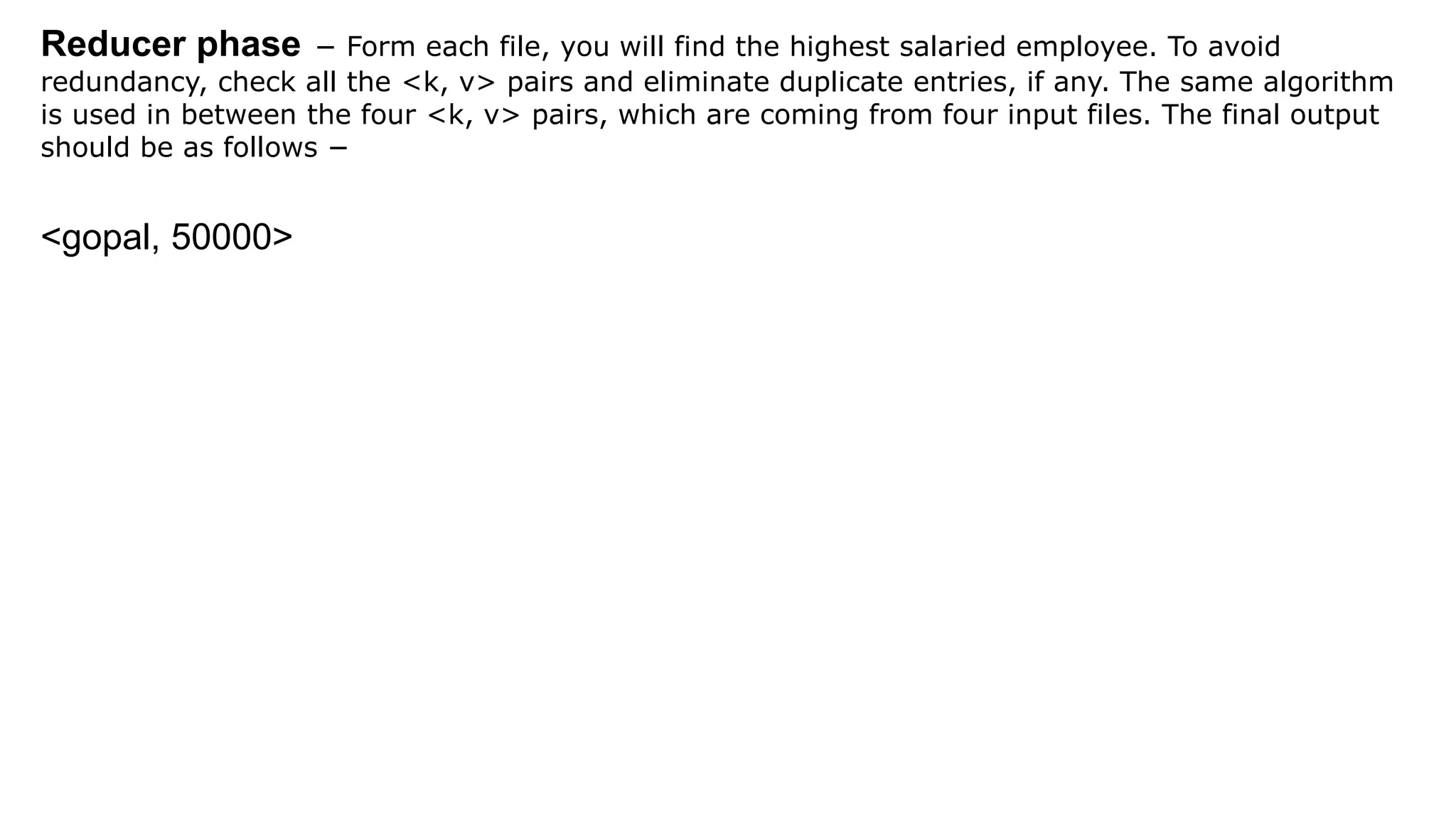
Reducer phase − Form each file, you will find the highest salaried employee. To avoid
redundancy, check all the <k, v> pairs and eliminate duplicate entries, if any. The same algorithm
is used in between the four <k, v> pairs, which are coming from four input files. The final output
should be as follows −
<gopal, 50000>
3. Indexing
:-
Normally indexing is used to point to a particular data and its address. It performs batch
indexing on the input files for a particular Mapper.
The following text is the input for inverted indexing. Here T[0], T[1], and t[2] are the file
names and their content are in double quotes.
T[0] = "it is what it is"
T[1] = "what is it"
T[2] = "it is a banana"
After applying the Indexing algorithm, we get the following output −
"a": {2}
"banana": {2}
"is": {0, 1, 2}
"it": {0, 1, 2}
"what": {0, 1}
4. TF-IDF :-
TF-IDF is a text processing algorithm which is short for Term Frequency − Inverse Document
Frequency. It is one of the common web analysis algorithms. Here, the term 'frequency' refers to
the number of times a term appears in a document.
1. Term Frequency (TF)
It measures how frequently a particular term occurs in a document. It is calculated by the
number of times a word appears in a document divided by the total number of words in that
document.
TF(the) = (Number of times term the ‘the’ appears in a document)
2. Inverse Document Frequency
It measures the importance of a term. It is calculated by the number of documents in
the text database divided by the number of documents where a specific term appears.
Consider a document containing 1000 words, wherein the word hive appears 50
times.
The TF for hive is then (50 / 1000) = 0.05.
Now, assume we have 10 million documents and the word hive appears in 1000 of
these.
Then, the IDF is calculated as log(10,000,000 / 1,000) = 4.
The TF-IDF weight is the product of these quantities − 0.05 × 4 = 0.20.
Thank You

Introduction to Map-Reduce in Hadoop.pptx

  • 1.
  • 2.
    Introduction to Map-Reduce •MapReduce is a programming model used for efficient processing in parallel over large data-sets in a distributed manner. • The data is first split and then combined to produce the final result. • The purpose of MapReduce in Hadoop is to Map each of the jobs and then it will reduce it to equivalent tasks for providing less overhead over the cluster network and to reduce the processing power.
  • 3.
  • 4.
    Map phase andReduce phase. 1. Map Phase: 1.As the name suggests its main use is to map the input data in key-value pairs. 2.The input to the map may be a key-value pair where the key can be the id of some kind of address and value is the actual value that it keeps. 3.The Map() function will be executed in its memory repository on each of these input key-value pairs and generates the intermediate key-value pair which works as input for the Reducer or Reduce() function.
  • 5.
    2. Reduce Phase: 1. The intermediate key-value pairs that work as input for Reducer are shuffled and sort and send to the Reduce() function. 2. Reducer aggregate or group the data based on its key-value pair as per the reducer algorithm written by the developer.
  • 6.
  • 7.
    Algorithms MapReduce implements variousmathematical algorithms to divide a task into small parts and assign them to multiple systems. In technical terms, MapReduce algorithm helps in sending the Map & Reduce tasks to appropriate servers in a cluster. These mathematical algorithms may include the following − •Sorting •Searching •Indexing •TF-IDF
  • 8.
    1. Sorting :- Sortingis one of the basic MapReduce algorithms to process and analyze data. MapReduce implements sorting algorithm to automatically sort the output key-value pairs from the mapper by their keys. Sorting methods are implemented in the mapper class itself.
  • 9.
    2. Searching :- •Let us assume we have employee data in four different files − A, B, C, and D. Let us also assume there are duplicate employee records in all four files because of importing the employee data from all database tables repeatedly. See the following illustration
  • 10.
    • The Mapphase processes each input file and provides the employee data in key-value pairs (<k, v> : <emp name, salary>). See the following illustration. • The combiner phase (searching technique) will accept the input from the Map phase as a key-value pair with employee name and salary. Using searching technique, the combiner will check all the employee salary to find the highest salaried employee in each file
  • 11.
    Reducer phase −Form each file, you will find the highest salaried employee. To avoid redundancy, check all the <k, v> pairs and eliminate duplicate entries, if any. The same algorithm is used in between the four <k, v> pairs, which are coming from four input files. The final output should be as follows − <gopal, 50000>
  • 12.
    3. Indexing :- Normally indexingis used to point to a particular data and its address. It performs batch indexing on the input files for a particular Mapper. The following text is the input for inverted indexing. Here T[0], T[1], and t[2] are the file names and their content are in double quotes. T[0] = "it is what it is" T[1] = "what is it" T[2] = "it is a banana" After applying the Indexing algorithm, we get the following output − "a": {2} "banana": {2} "is": {0, 1, 2} "it": {0, 1, 2} "what": {0, 1}
  • 13.
    4. TF-IDF :- TF-IDFis a text processing algorithm which is short for Term Frequency − Inverse Document Frequency. It is one of the common web analysis algorithms. Here, the term 'frequency' refers to the number of times a term appears in a document. 1. Term Frequency (TF) It measures how frequently a particular term occurs in a document. It is calculated by the number of times a word appears in a document divided by the total number of words in that document. TF(the) = (Number of times term the ‘the’ appears in a document)
  • 14.
    2. Inverse DocumentFrequency It measures the importance of a term. It is calculated by the number of documents in the text database divided by the number of documents where a specific term appears. Consider a document containing 1000 words, wherein the word hive appears 50 times. The TF for hive is then (50 / 1000) = 0.05. Now, assume we have 10 million documents and the word hive appears in 1000 of these. Then, the IDF is calculated as log(10,000,000 / 1,000) = 4. The TF-IDF weight is the product of these quantities − 0.05 × 4 = 0.20.
  • 15.