Exploring Enterprise Agile
Transformation Strategies
Mike Cottmeyer, Enterprise Agile Coach
LeadingAgile, LLC
Mike Cottmeyer
mike@leadingagile.com
404.312.1471

www.leadingagile.com
twitter.com/mcottmeyer
facebook.com/leadingagile
linkedin.com/in/cottmeyer
The Problem...
The Problem...
 Having lots of agile teams in an
 enterprise isn’t enterprise agility

   • Sometimes organizations fall into the trap of
       thinking that having agile teams means they
       have an agile organization
   •   Enterprise agility is when all the parts of the
       organization work together to create Agile
       outcomes
   •   The entire delivery capability of the
       enterprise has to be focused on agile
       principles and execution
The Problem...
 Focusing only at the team level can result
 in local optima within your organization

   • Sometimes a team can perform well at
       Scrum, but the business doesn’t see any
       incremental value from their investment
   •   Sometimes a high-performance team can
       disrupt other functions in the organization if
       the upstream and downstream processes are
       not able to work at the same pace
The Problem...
 Team level Agile practices are different
 from Agile practices at scale

   • The practices we put in place at the team
       level often don’t work when we apply them in
       larger organizations
   •   Practices have to adapted at scale to
       accommodate more diverse groups of
       stakeholders and more complicated value
       streams
The Problem...
 Agile at scale requires a broader set of
 tools and techniques

   • Scrum and XP at the team level
   • Kanban and Lean at the program and
       portfolio level
   •   RUP and Traditional Project Management at
       the Enterprise
We are just now starting to
put all the pieces together...
The Solution...
The Solution... Part One
 First... we do have to get team level agile right. We
 are going to talk about some of the things you can
 do that will lead to successful team-level Agile
 transformations.

  •   The fundamentals behind why Agile works
  •   Common challenges that cause Agile to fail
  •   What does it look like when things are really
      going well?
  •   What is different about an enterprise-level
      Agile transformation?
The Solution... Part Two
 Next we will explore a safe, pragmatic, iterative and
 incremental framework for transforming any sized
 organization...

  •   Define the organizational competencies
      required at all levels of the enterprise
  •   How to adapt agile competencies for scale
  •   How to adapt agile competencies for cadence
The Solution... Part Three
 We’ll discuss the three major areas you need to pay
 attention to in order to execute a safe and
 pragmatic enterprise Agile transformation...

  •   Establishing an agile org structure
  •   Introducing disciplined Agile practices
  •   Intentionally addressing people and culture
The Solution... Part Four
 Finally, as we begin to wrap-up the talk, we’ll explore
 a few things that will help you put all of this
 together...

  •   Overview of the model end-to-end
  •   If we have time... case studies
The Solution... Part One
How Does Agile Work
and Why Does it Fail?
What Makes Agile Work?
 Teams stay together and are highly
 engaged

   • Agile practices are built around cross-
       functional teams that have everything
       necessary to deliver an increment of value to
       the organization
   •   Teams that stay together over time tend to be
       more productive than teams that are
       constantly forming and reforming
   •   Empowered self-directed teams are able to
       own the solution and creatively solve
What Makes Agile Work?
 Teams are focused on a queue of projects
 or product enhancements

   • Rather than forming teams to deliver
       projects, agile methods leave teams together
       and funnel project through teams
   •   The project list is basically a prioritized
       backlog of work that a team is responsible for
       delivering
What Makes Agile Work?
 Minimize dependencies and strive for
 loose coupling between teams

   • The more coupling we have between teams,
       the more difficult it is to change direction
       when we learn something new about the
       emerging product
   •   Teams that have external dependencies are
       not able to make and meet commitments
       because they don’t have everything necessary
       to own the commitment
What Makes Agile Work?
 Fully engaged business partners

   • Many organizations are guilty of throwing ill-
       defined requirements over to the delivery
       teams, constantly changing direction through
       the life of the project, and holding teams
       accountable for on-time delivery
   •   Agile is geared for change, but requires close
       collaboration between stakeholders and
       teams to make real-time tradeoffs as the
       product is in development
What Makes Agile Work?
 Attention to getting done and completing
 work before new work is started

   • Delivering an increment of working, tested,
      potentially shippable software on regular time
      intervals assures that we can measure
      progress against real, measurable product
      outcomes
What Makes Agile Work?
 Technical excellence and continuous
 attention to product quality

   • The underlying health of the system is a
       critical success factor for running successful
       agile projects
   •   Defects and technical debt impact product
       delivery in unpredictable ways making it
       nearly impossible to reliably make and meet
       commitments
What Makes Agile Fail?
 Agile team is a local optimization and out
 of alignment with the rest of the business

   • Pilot teams are formed and given everything
       they need to be successful at the expense of
       the rest of the delivery organization
   •   Teams can deliver product faster than the
       organization can consume it
   •   Teams starve the requirements queue because
       Strategy and Product Management can’t keep
       up
What Makes Agile Fail?
 Project driven organizations or uneven
 investment across product lines

   • Very difficult to keep cross-functional teams
       together over time because the investment
       mix is constantly changing
   •   Organizations tend to want to matrix people
       across multiple teams at the same time
What Makes Agile Fail?
 Value is either too broadly defined or too
 narrowly defined

   • Overly vague requirements lead the
       development team to fill in the gaps based in
       their own knowledge and experience
   •   Overly specified requirements lead to an
       activity based mentality rather than a value
       based mentality
What Makes Agile Fail?
 Organizational structures and product
 architectures work against establishing
 cross functional teams

   • Matrix organizations and functional silos make
       it very challenging to create high-performing
       agile teams
   •   Tightly coupled legacy architectures make it
       difficult to organize teams around feature
       groups or components within the solution
       framework
What Makes Agile Fail?
 Overly political cultures and lack of trust

   • Command and control leadership
   • Micromanagement
   • Disempowering language
What Makes Agile Fail?
 Inability to balance capacity and demand

   • Invalid and inaccurate estimates
   • Inability to make and meet commitments
   • More work than the teams can possibly
      deliver in the timeframes expected
What Makes Agile Fail?
 Looking at agile as a process overlay
 rather than a transformative event in
 your organization

   • Agile is just something that the developers do
   • Not recognizing the broad organizational
      change necessary to make an agile
      transformation sustainable
A Well Formed Agile Organization
 Cross functional teams aligned directly to
 solve business problems

   •   Products
   •   Features
   •   Programs
   •   Components
   •   Services
   •   Business Capabilities
A Well Formed Agile Organization
 Clear voice of the business and a
 willingness to make tradeoffs to meet
 time and cost constraints

   • Highly engaged product ownership
   • Willingness to deal with reality
   • Focus on maximizing value and reducing risk
A Well Formed Agile Organization
 Individual empowerment and shared
 accountability for outcomes

   • Establish boundaries and ownership but
       empower within those boundaries
   •   Teams own outcomes not activities
A Well Formed Agile Organization
 Disciplined attention to technical
 excellence and product quality

   • Technical excellence stabilizes the
      requirements delivery function
A Well Formed Agile Organization
 Predictable, accountable, able to
 consistently make and meet
 commitments

   • Teams have the ability to consistently do what
       they say they are going to do
   •   Predictable agile teams are the foundational
       element of a predictable agile enterprise
Reinventing Agile
 Situationally specific strategies at scale to
 solve these problems and maintain
 business agility

   • How do team level competencies need to be
       adapted to take into consideration issues of
       scale and the different planning horizons
       required in larger enterprises
   •   How do you build the necessary organization,
       introduce new practices, and start shifting the
       culture in a way that leads to sustainable
       organizational change
The Solution... Part Two
Competencies,
Frequency, and Scale
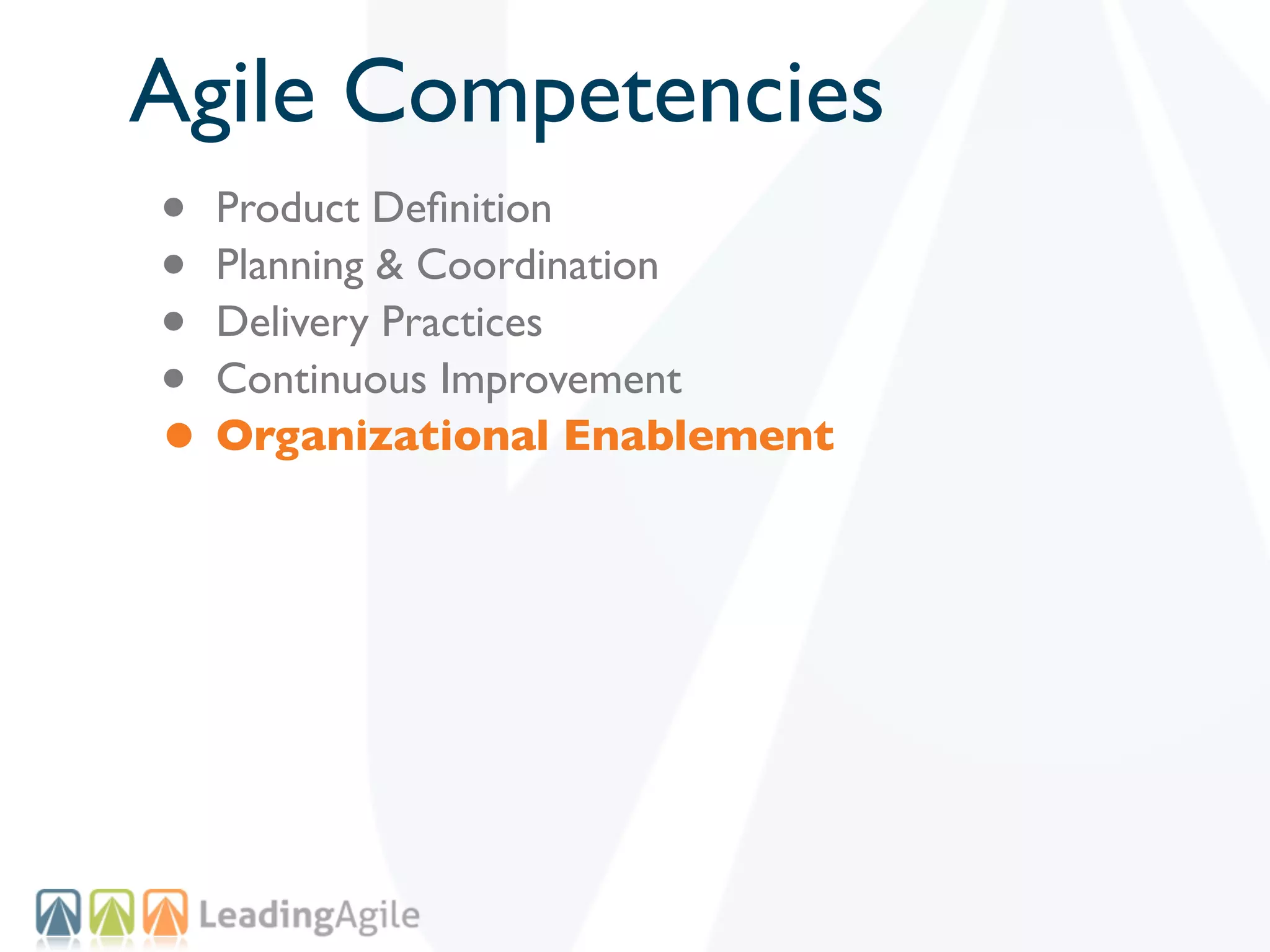
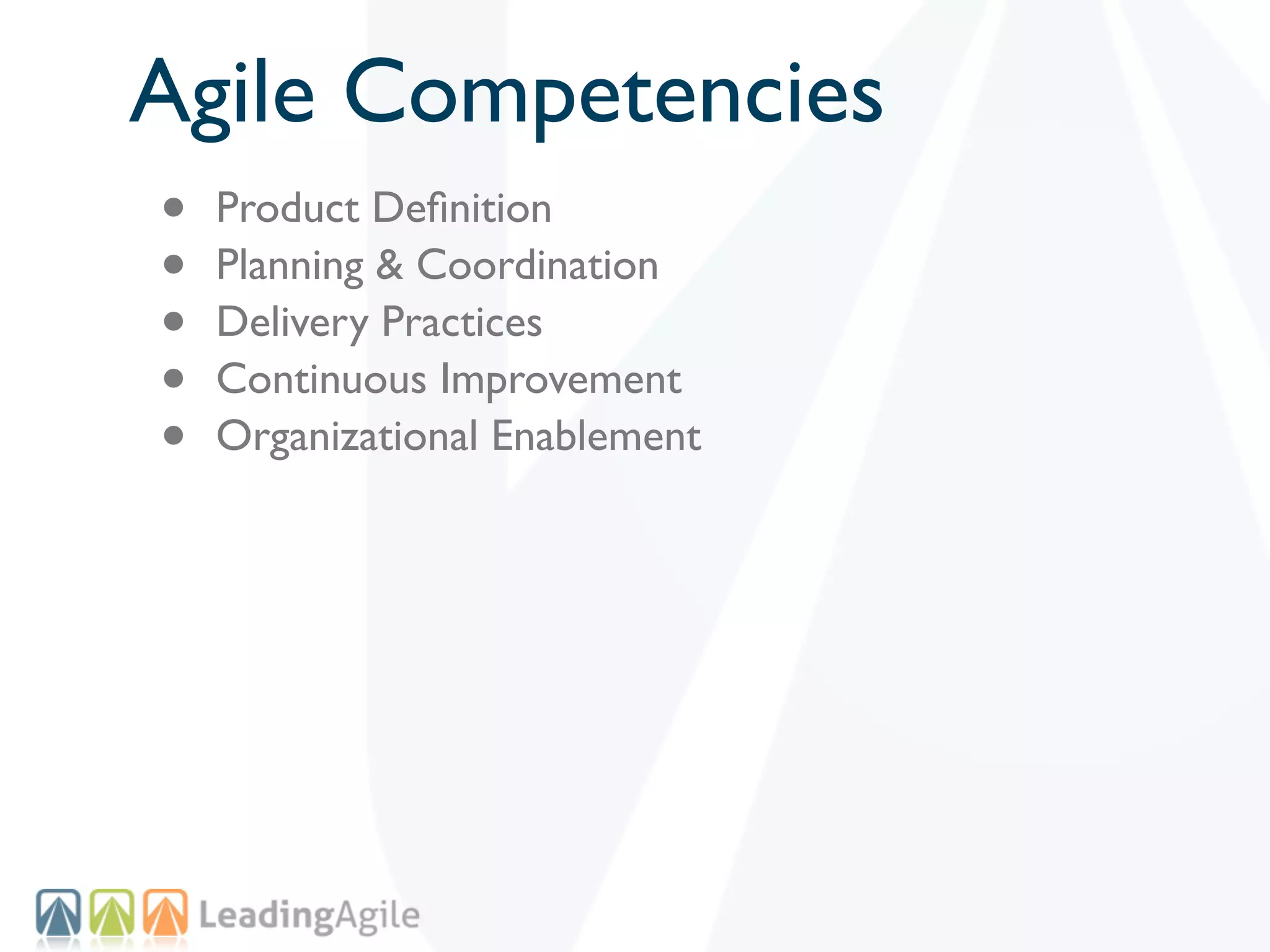
Agile Competencies
•   Product Definition
•   Planning & Coordination
•   Delivery Practices
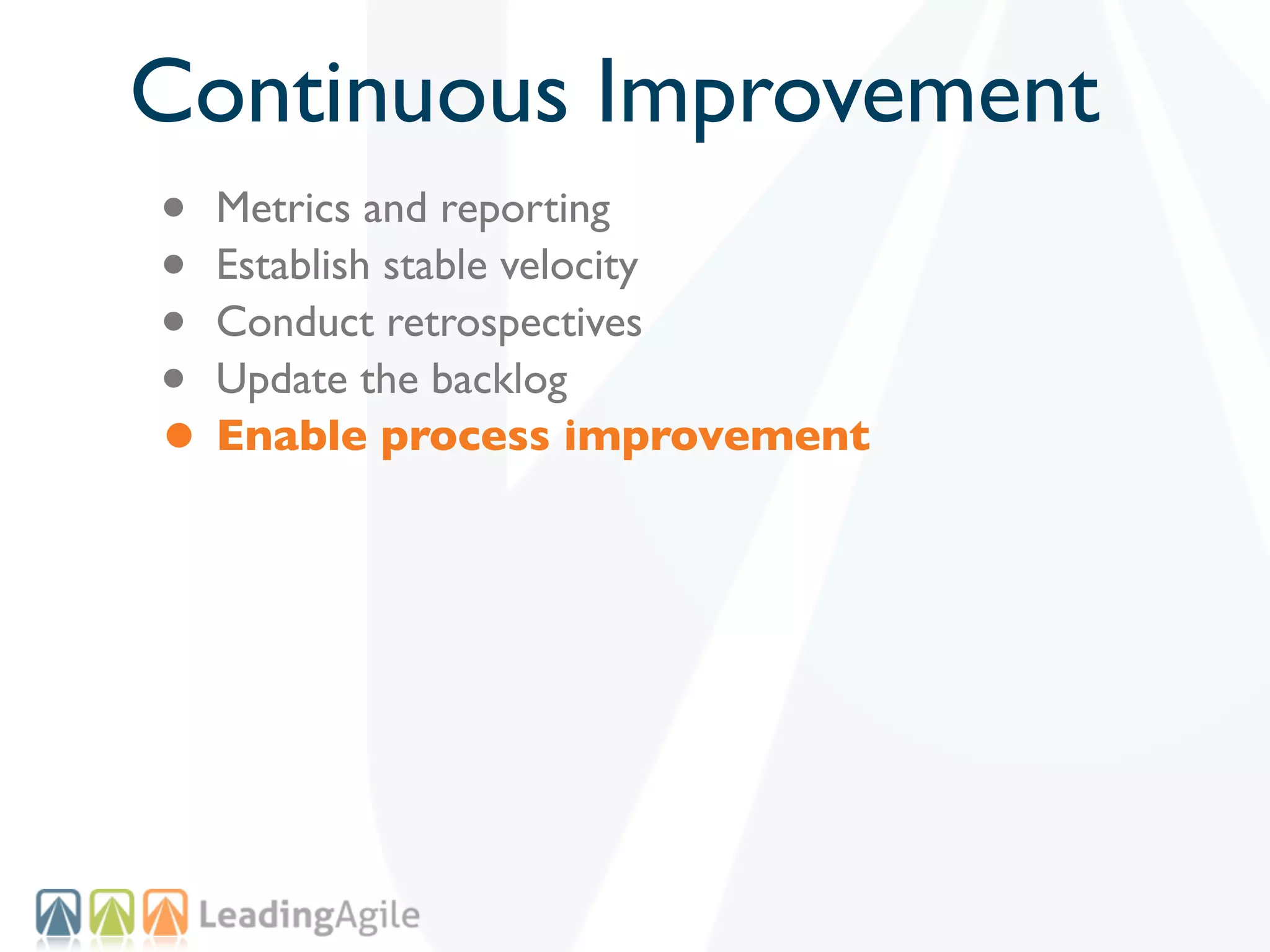
•   Continuous Improvement
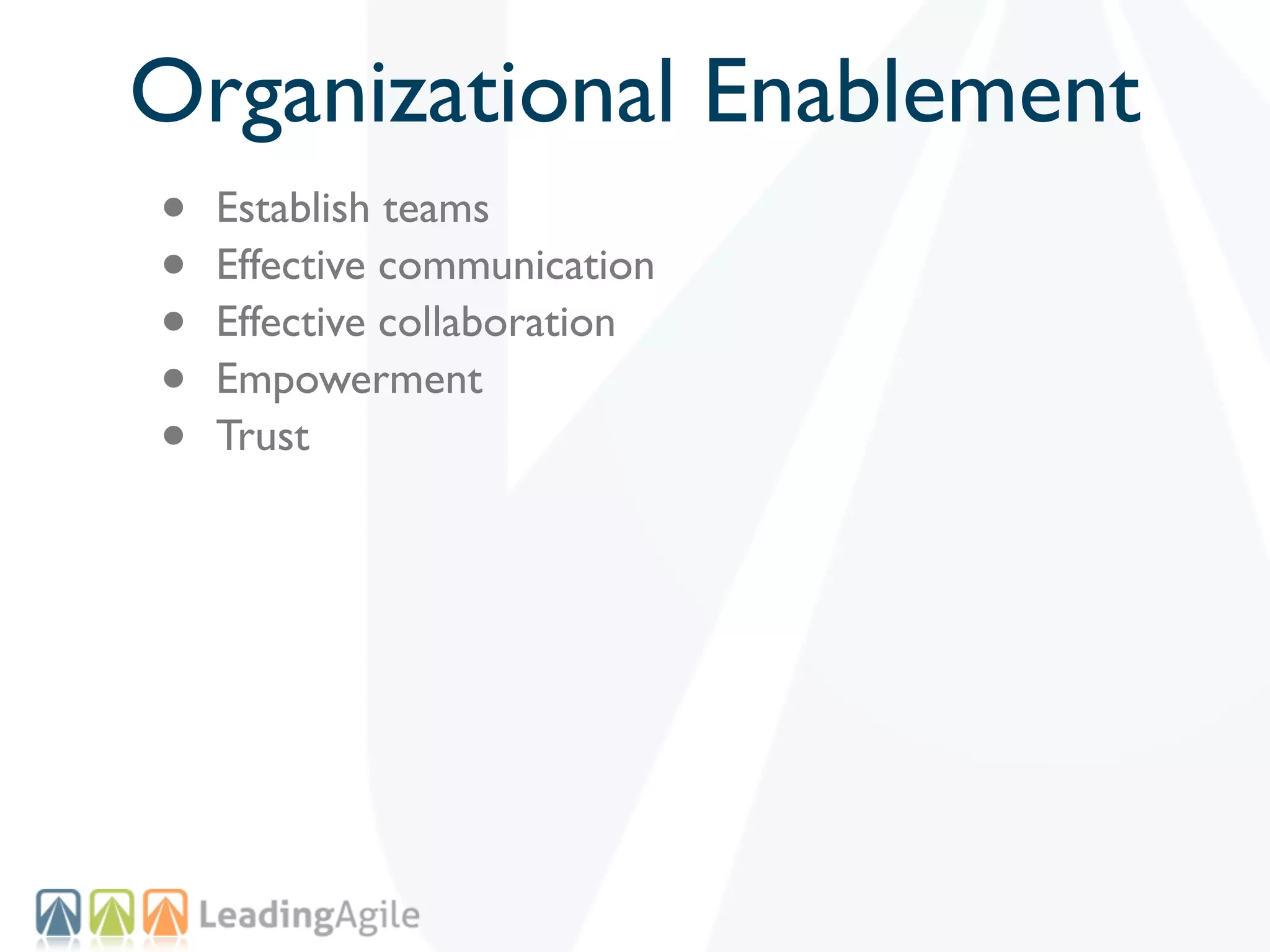
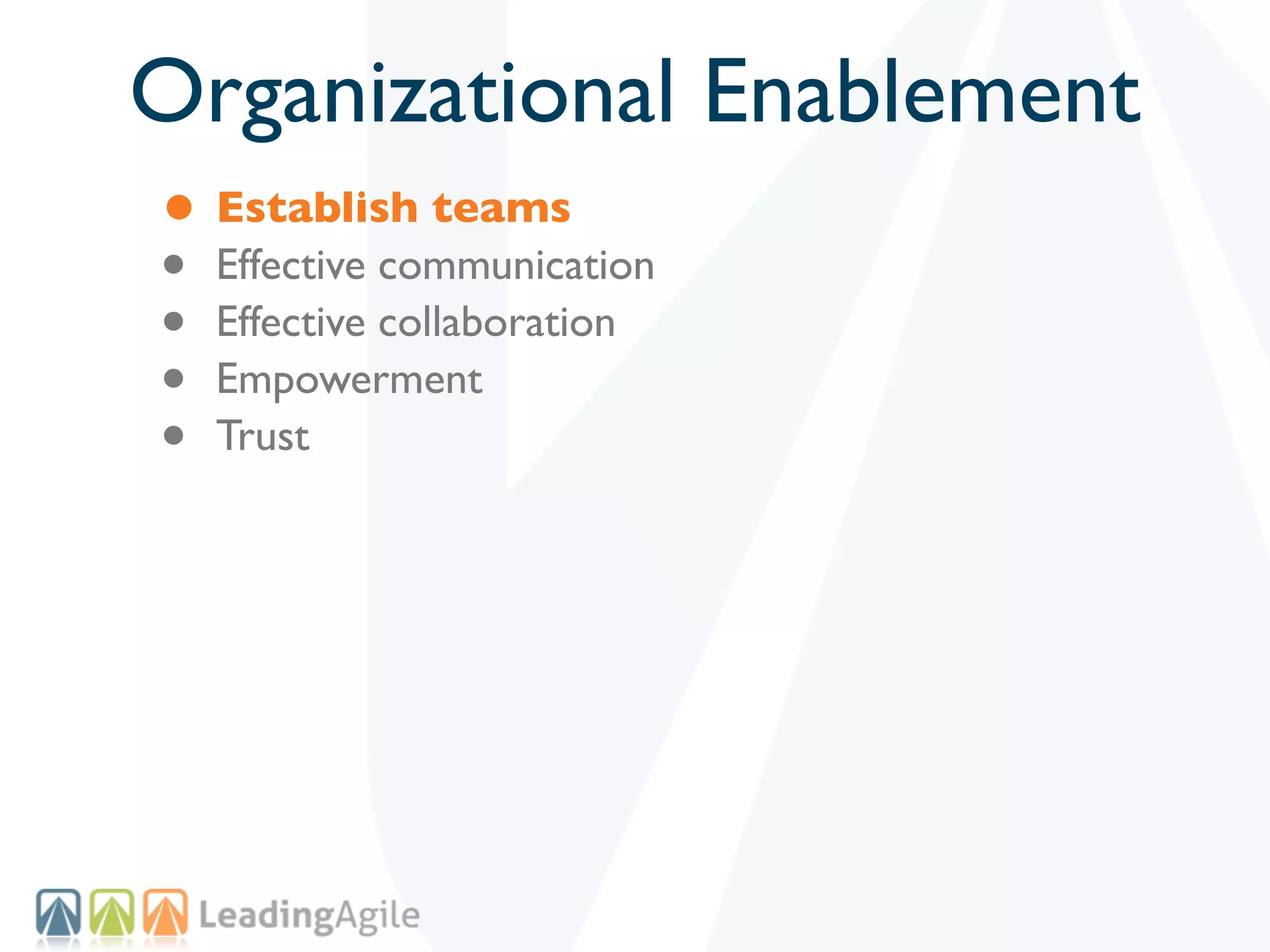
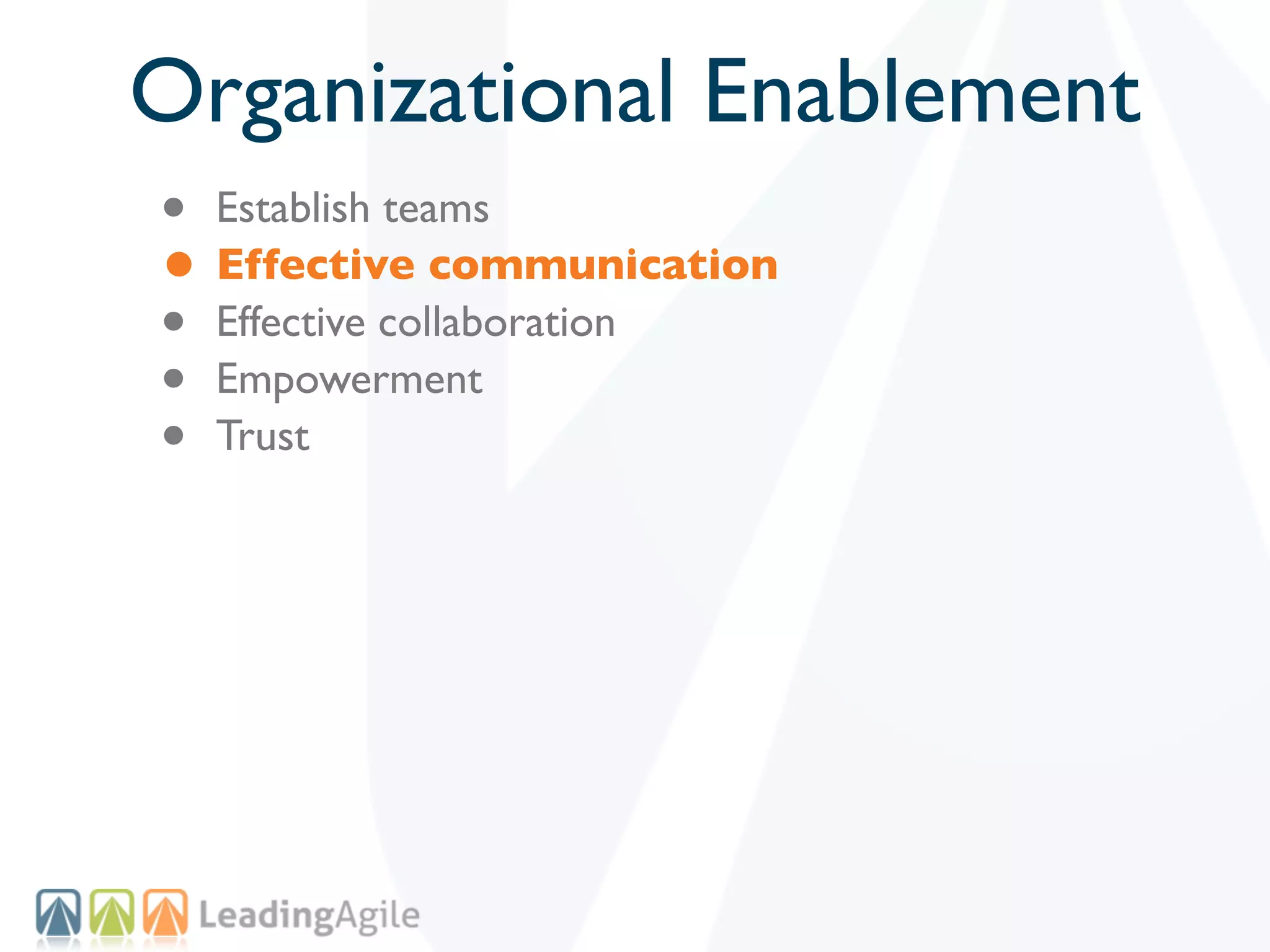
•   Organizational Enablement
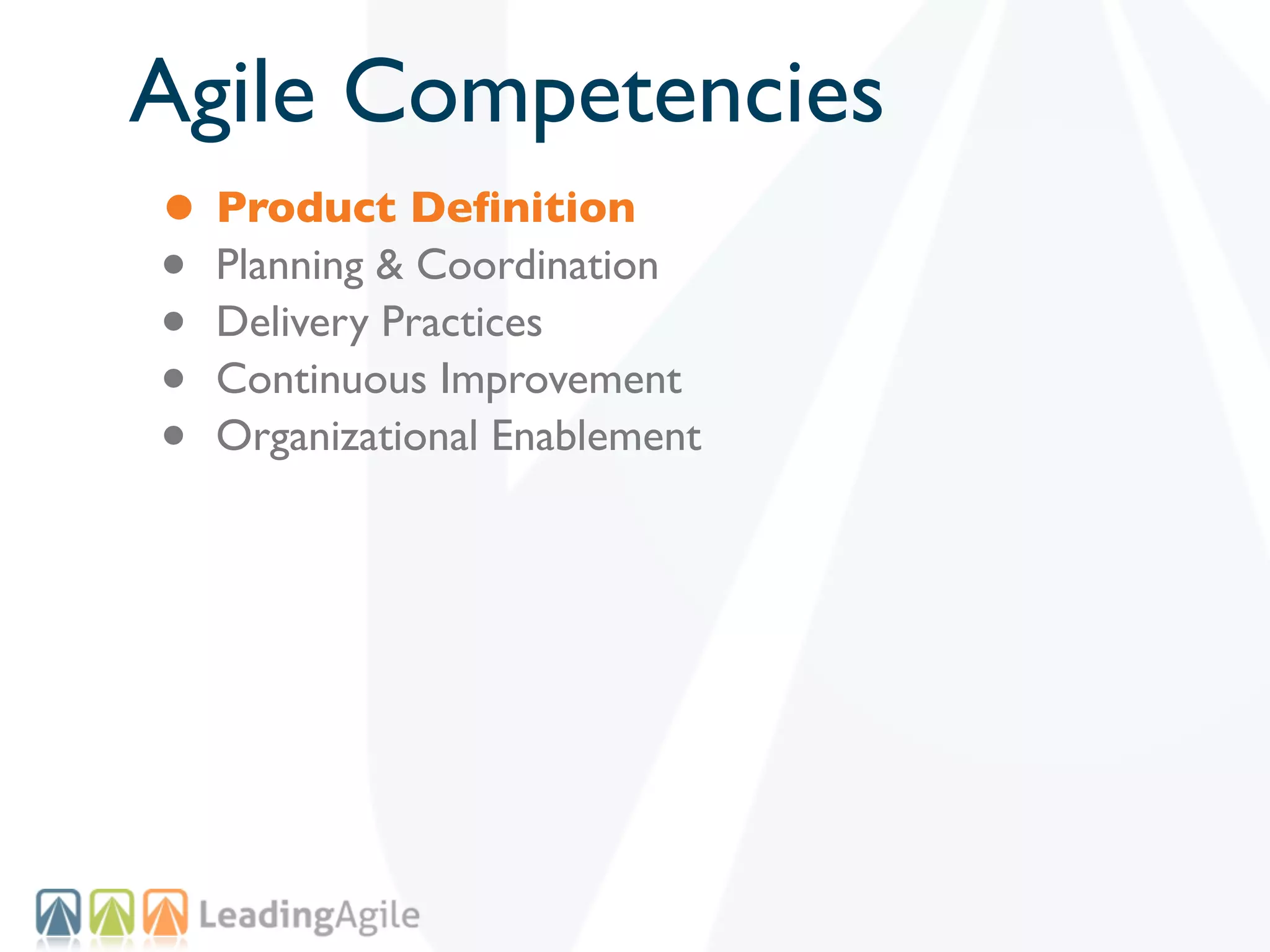
Agile Competencies
• Product Definition
• Planning & Coordination
• Delivery Practices
• Continuous Improvement
• Organizational Enablement
Agile Competencies
• Product Definition
• Planning & Coordination
• Delivery Practices
• Continuous Improvement
• Organizational Enablement
Agile Competencies
• Product Definition
• Planning & Coordination
• Delivery Practices
• Continuous Improvement
• Organizational Enablement
Agile Competencies
• Product Definition
• Planning & Coordination
• Delivery Practices
• Continuous Improvement
• Organizational Enablement
Agile Competencies
• Product Definition
• Planning & Coordination
• Delivery Practices
• Continuous Improvement
• Organizational Enablement
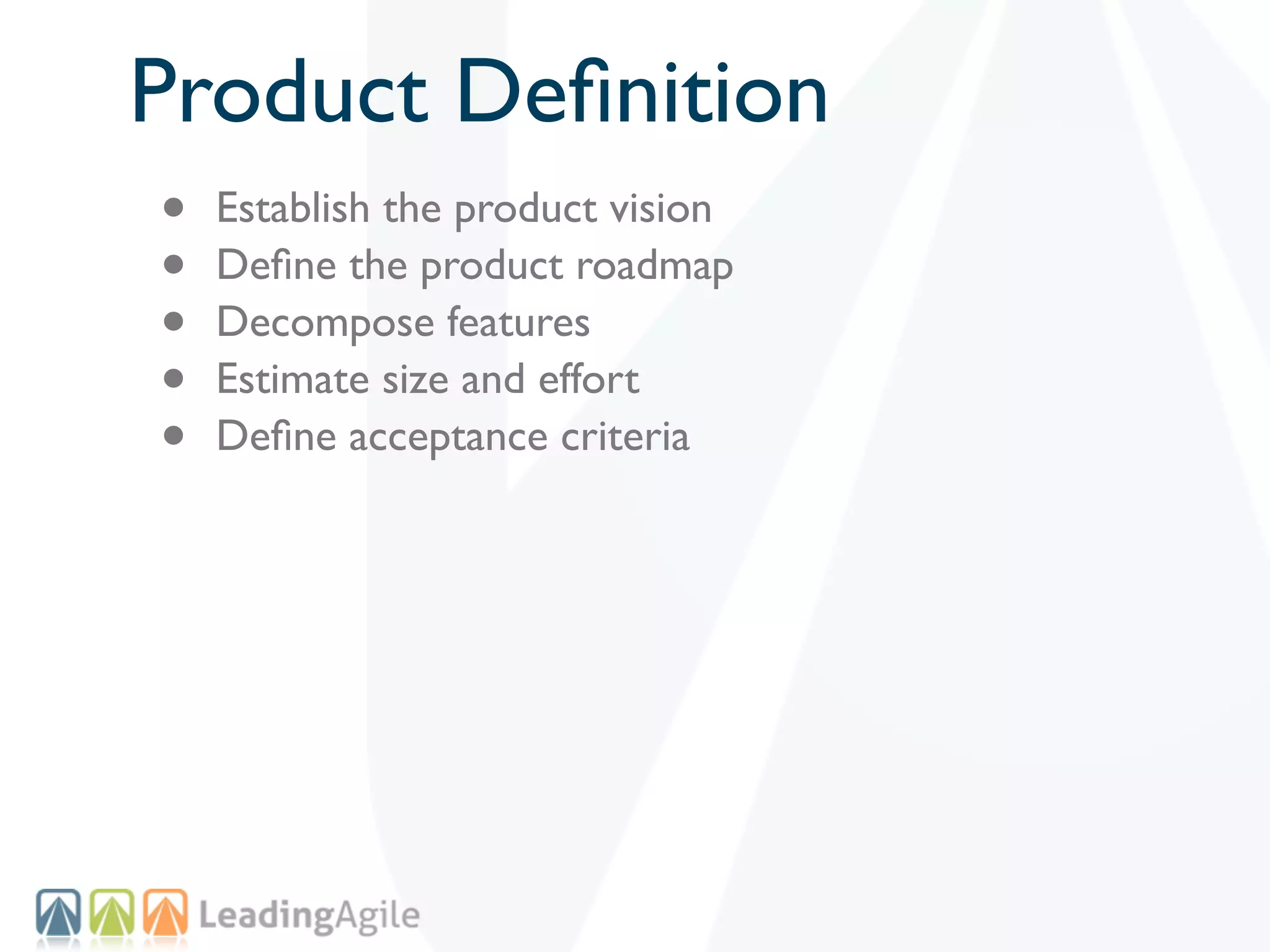
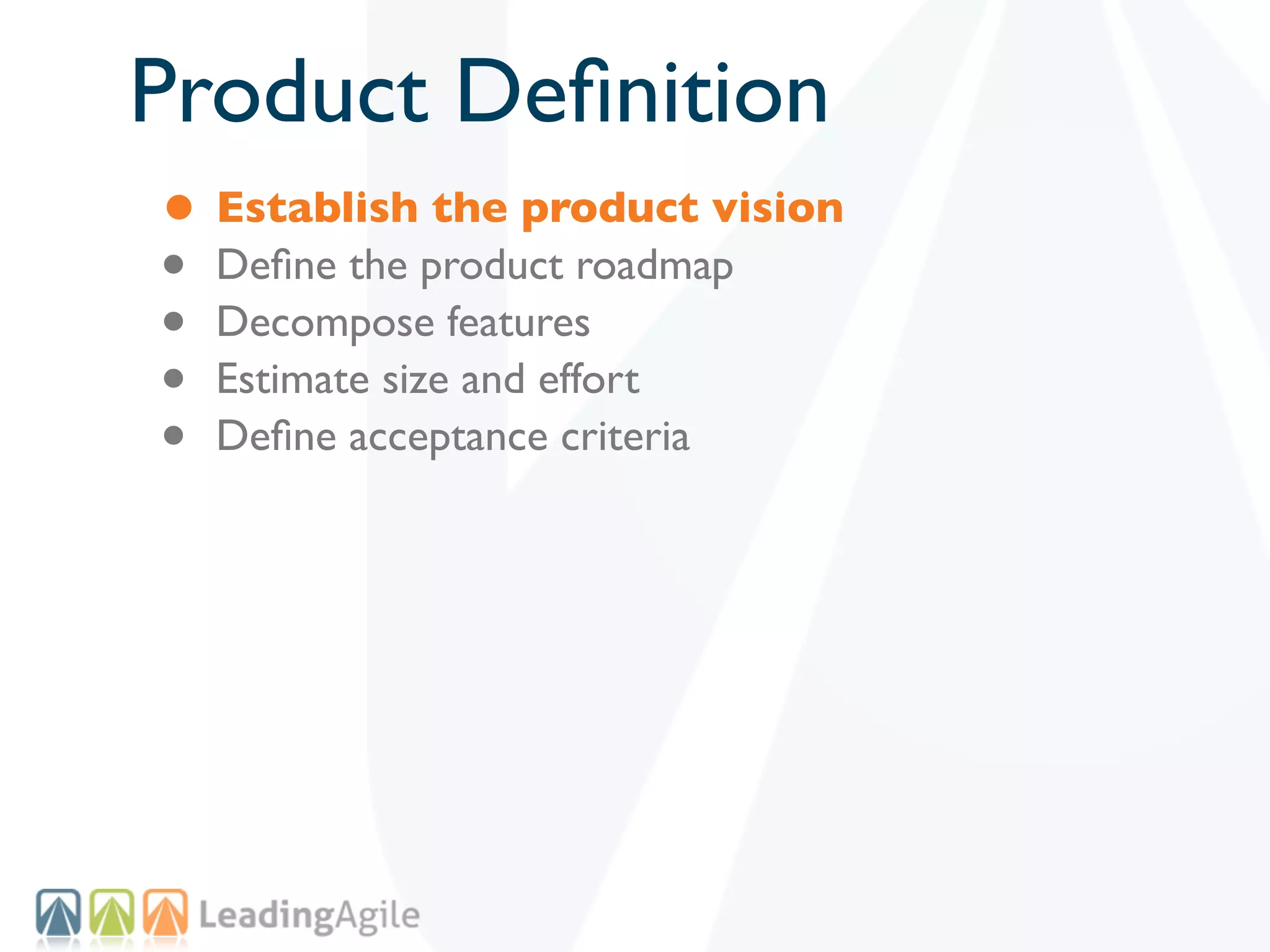
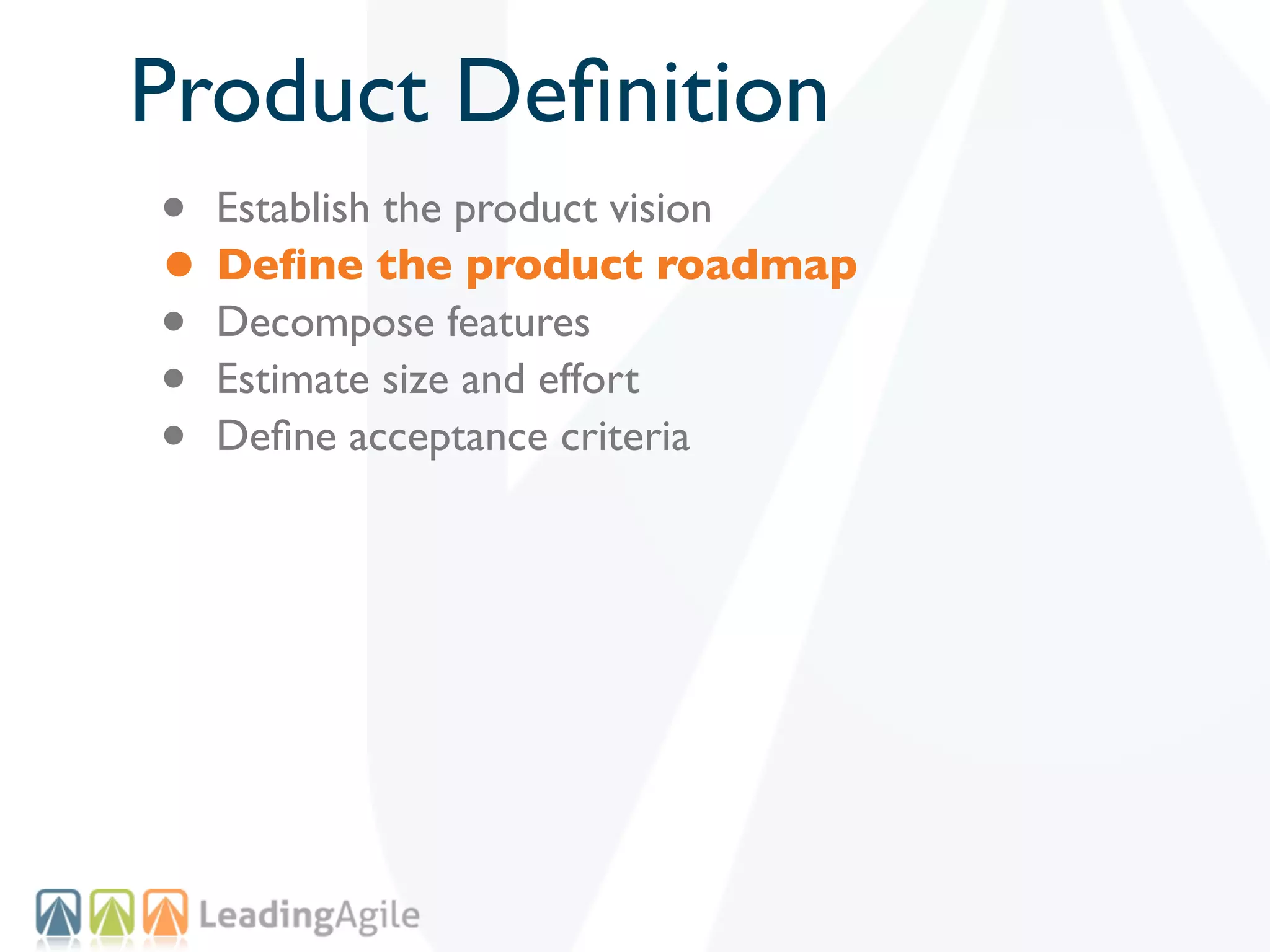
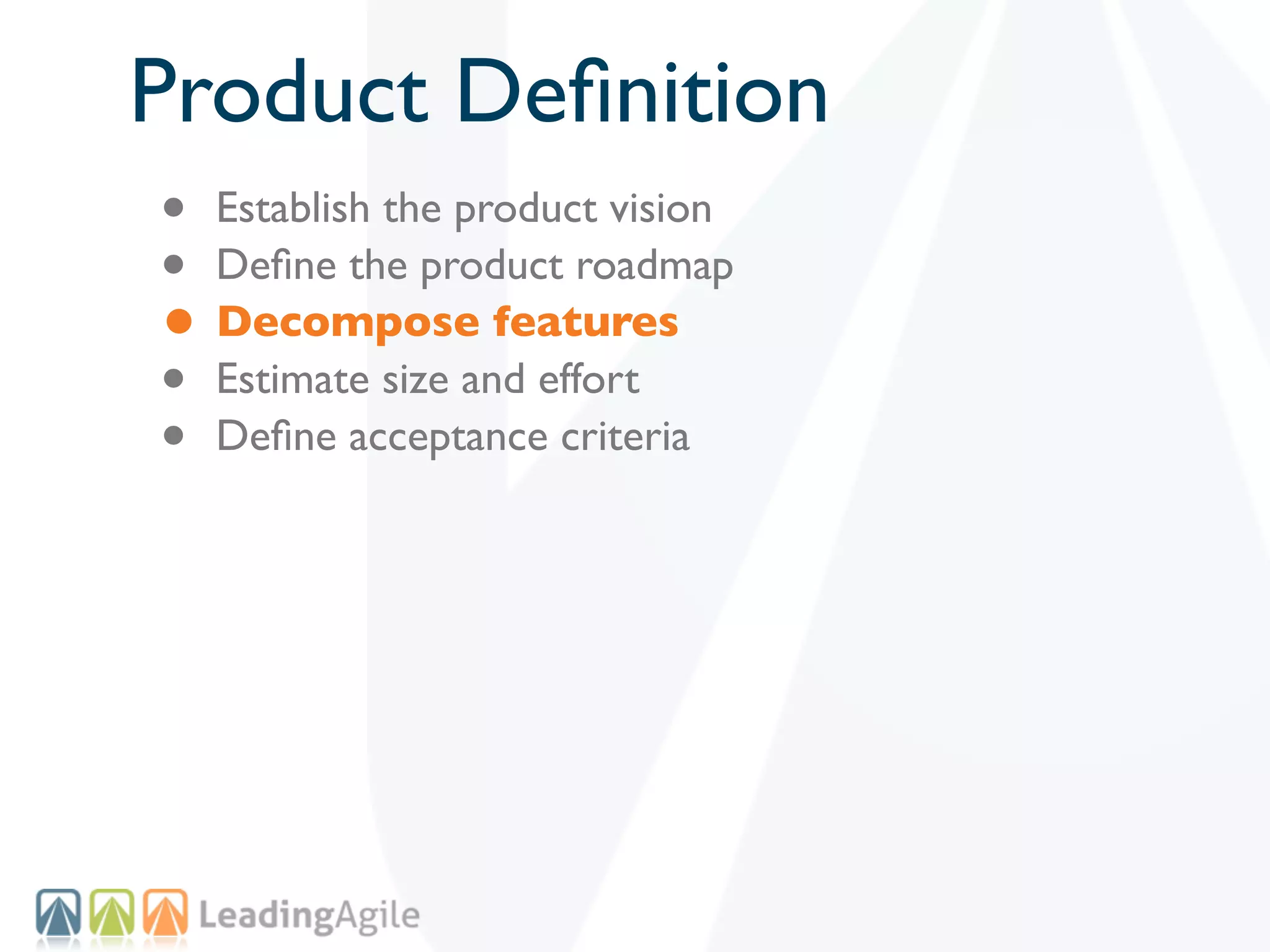
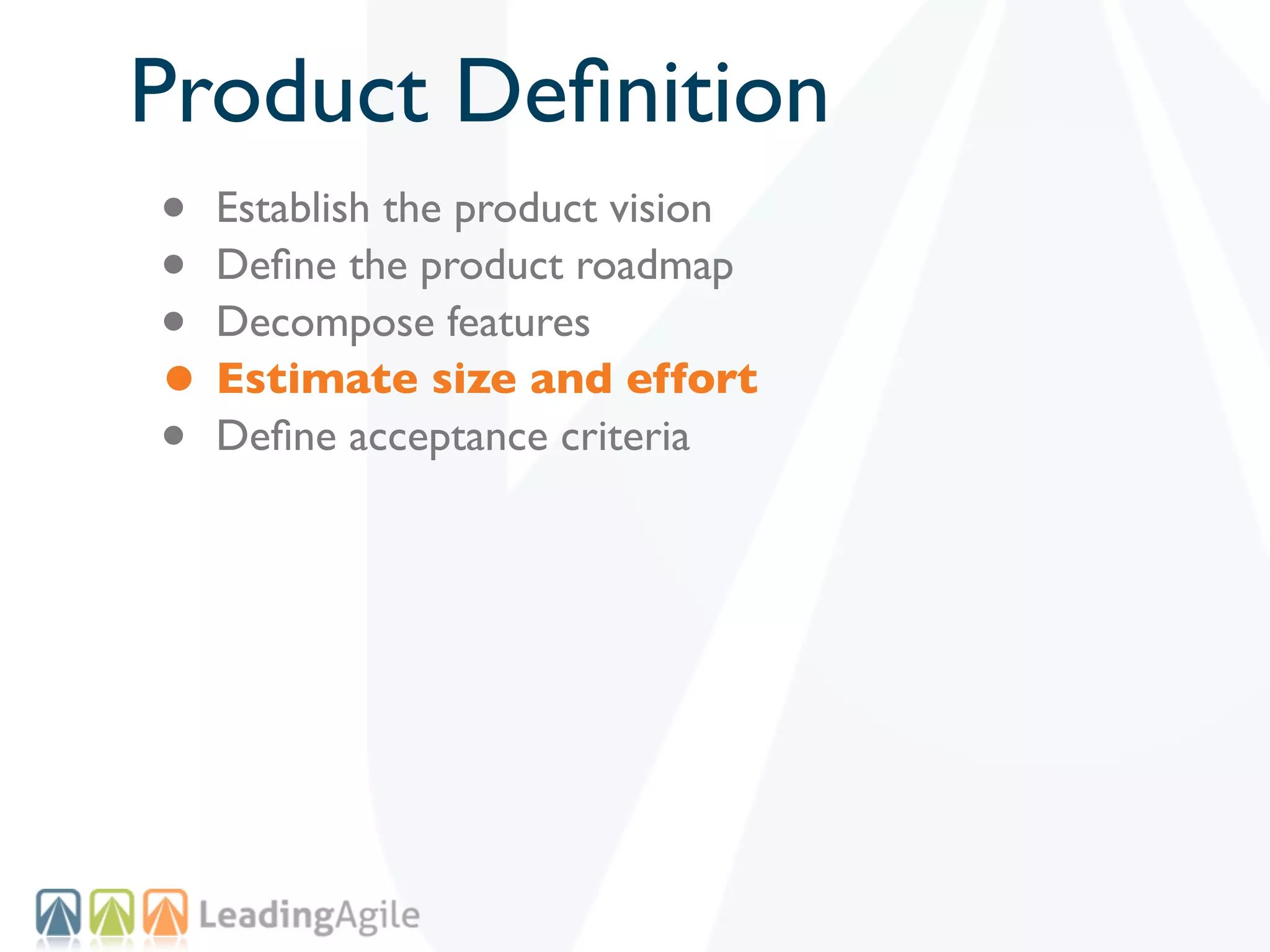
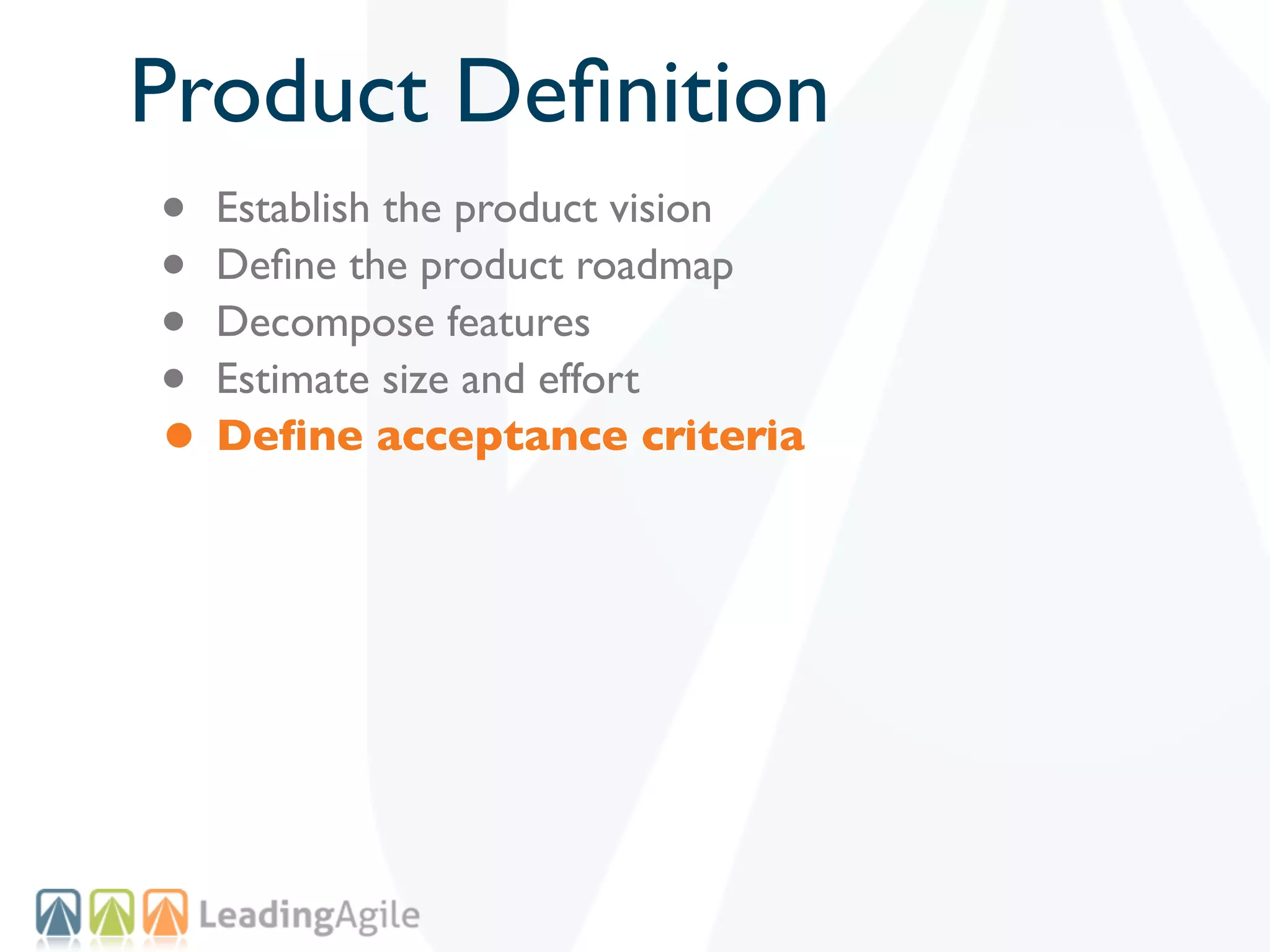
Product Definition
•   Establish the product vision
•   Define the product roadmap
•   Decompose features
•   Estimate size and effort
•   Define acceptance criteria
Product Definition
• Establish the product vision
• Define the product roadmap
• Decompose features
• Estimate size and effort
• Define acceptance criteria
Product Definition
• Establish the product vision
• Define the product roadmap
• Decompose features
• Estimate size and effort
• Define acceptance criteria
Product Definition
• Establish the product vision
• Define the product roadmap
• Decompose features
• Estimate size and effort
• Define acceptance criteria
Product Definition
• Establish the product vision
• Define the product roadmap
• Decompose features
• Estimate size and effort
• Define acceptance criteria
Product Definition
• Establish the product vision
• Define the product roadmap
• Decompose features
• Estimate size and effort
• Define acceptance criteria
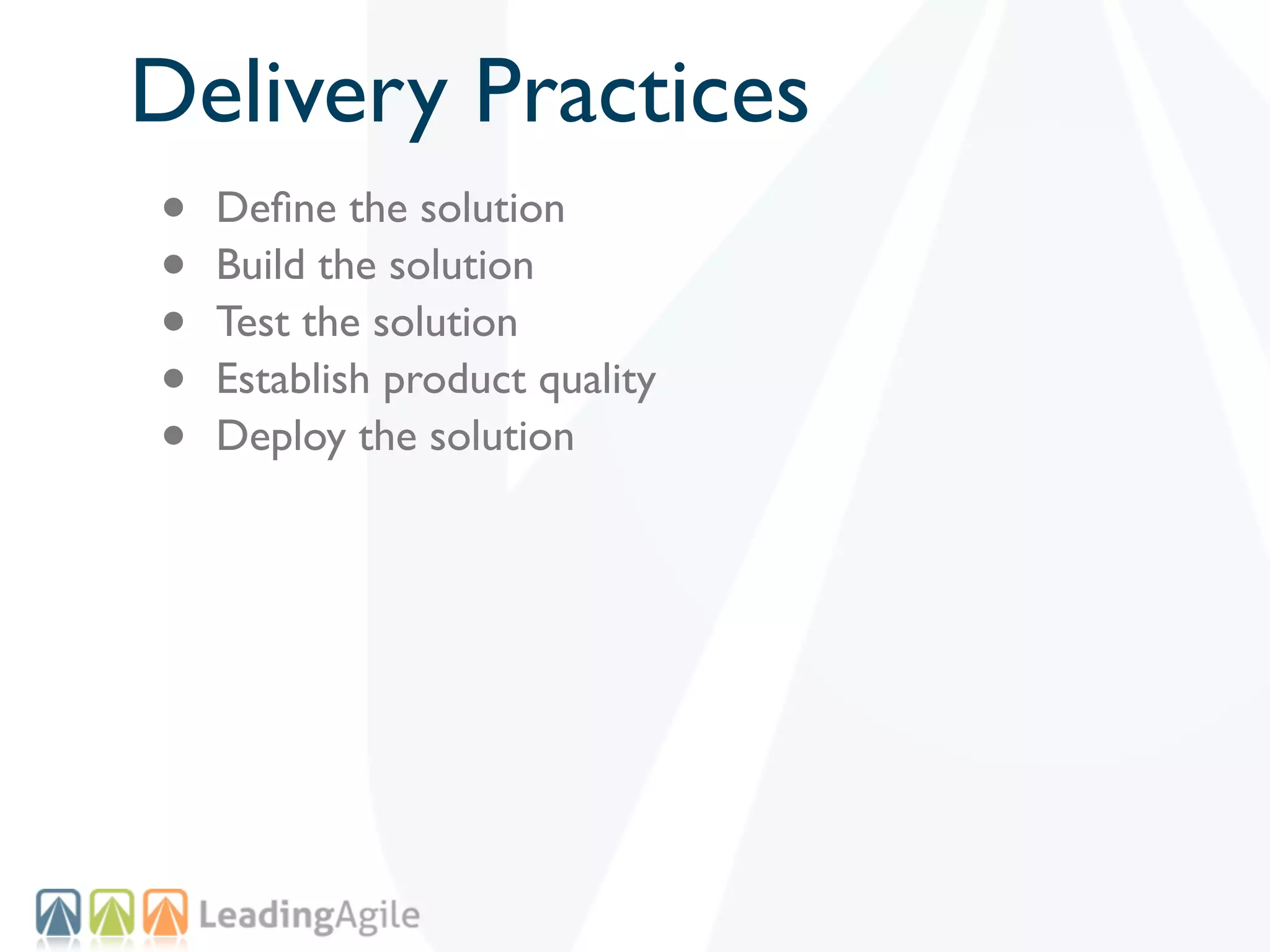
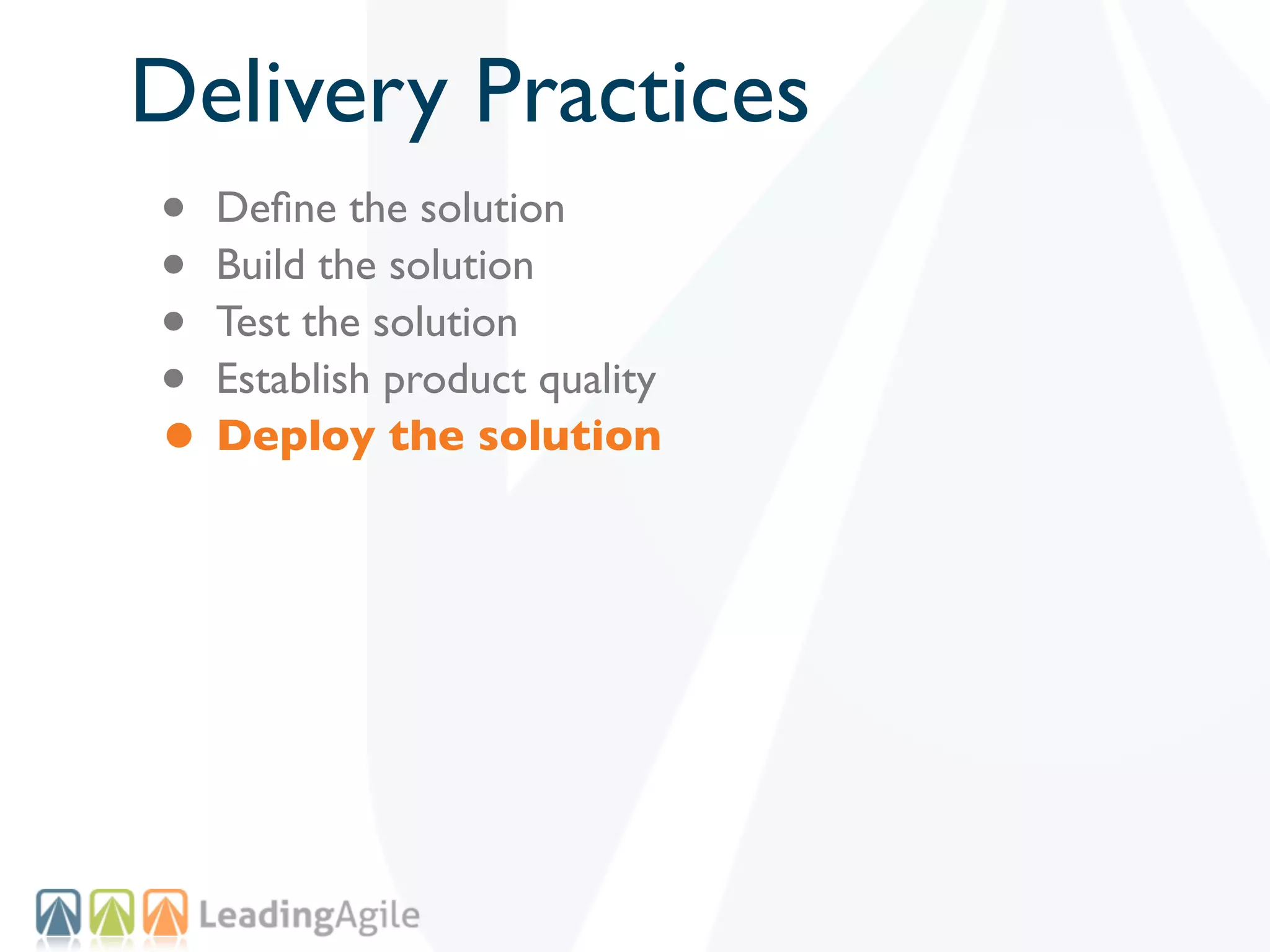
Delivery Practices
•   Define the solution
•   Build the solution
•   Test the solution
•   Establish product quality
•   Deploy the solution
Delivery Practices
• Define the solution
• Build the solution
• Test the solution
• Establish product quality
• Deploy the solution
Delivery Practices
• Define the solution
• Build the solution
• Test the solution
• Establish product quality
• Deploy the solution
Delivery Practices
• Define the solution
• Build the solution
• Test the solution
• Establish product quality
• Deploy the solution
Delivery Practices
• Define the solution
• Build the solution
• Test the solution
• Establish product quality
• Deploy the solution
Delivery Practices
• Define the solution
• Build the solution
• Test the solution
• Establish product quality
• Deploy the solution
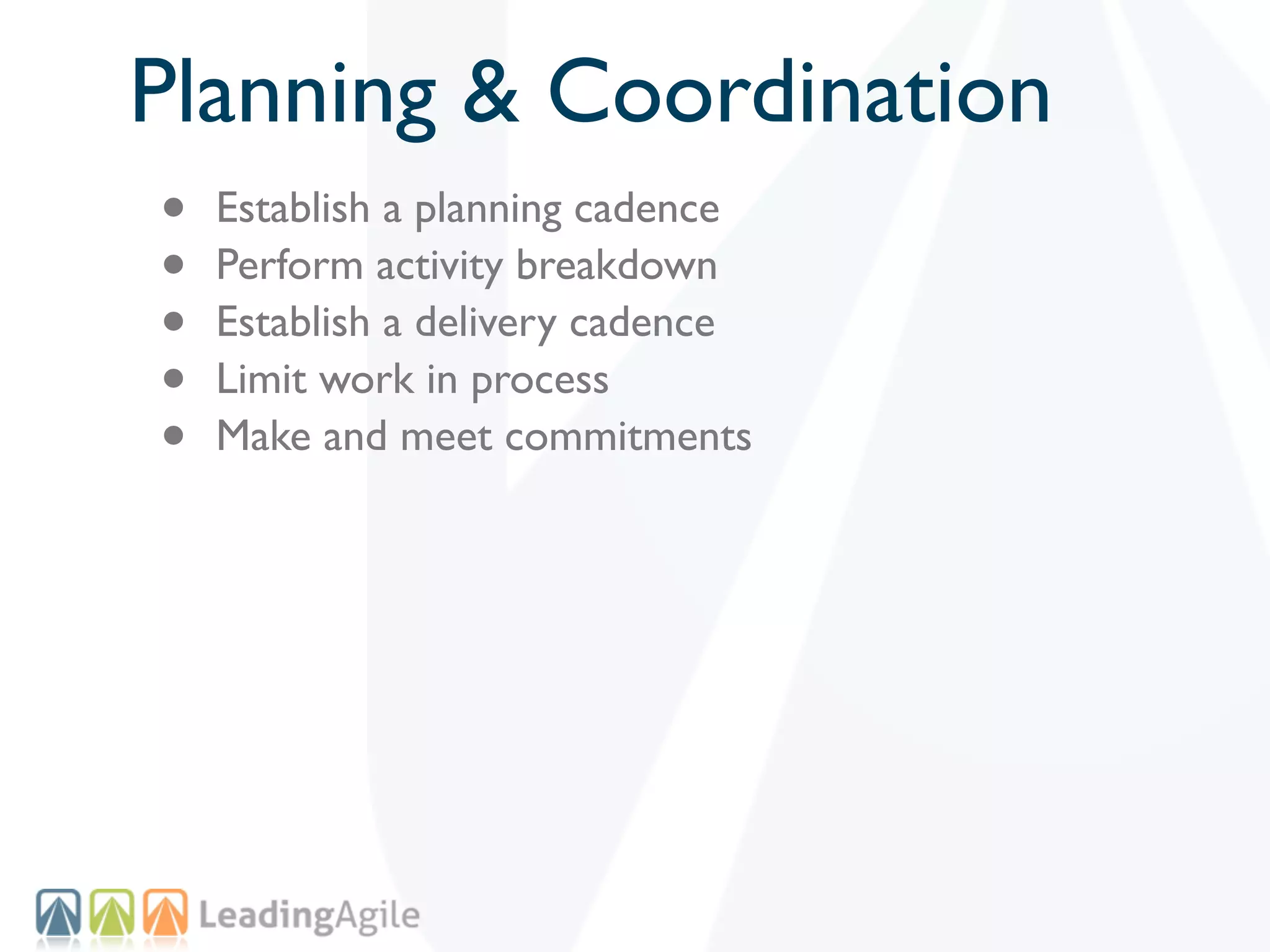
Planning & Coordination
•   Establish a planning cadence
•   Perform activity breakdown
•   Establish a delivery cadence
•   Limit work in process
•   Make and meet commitments
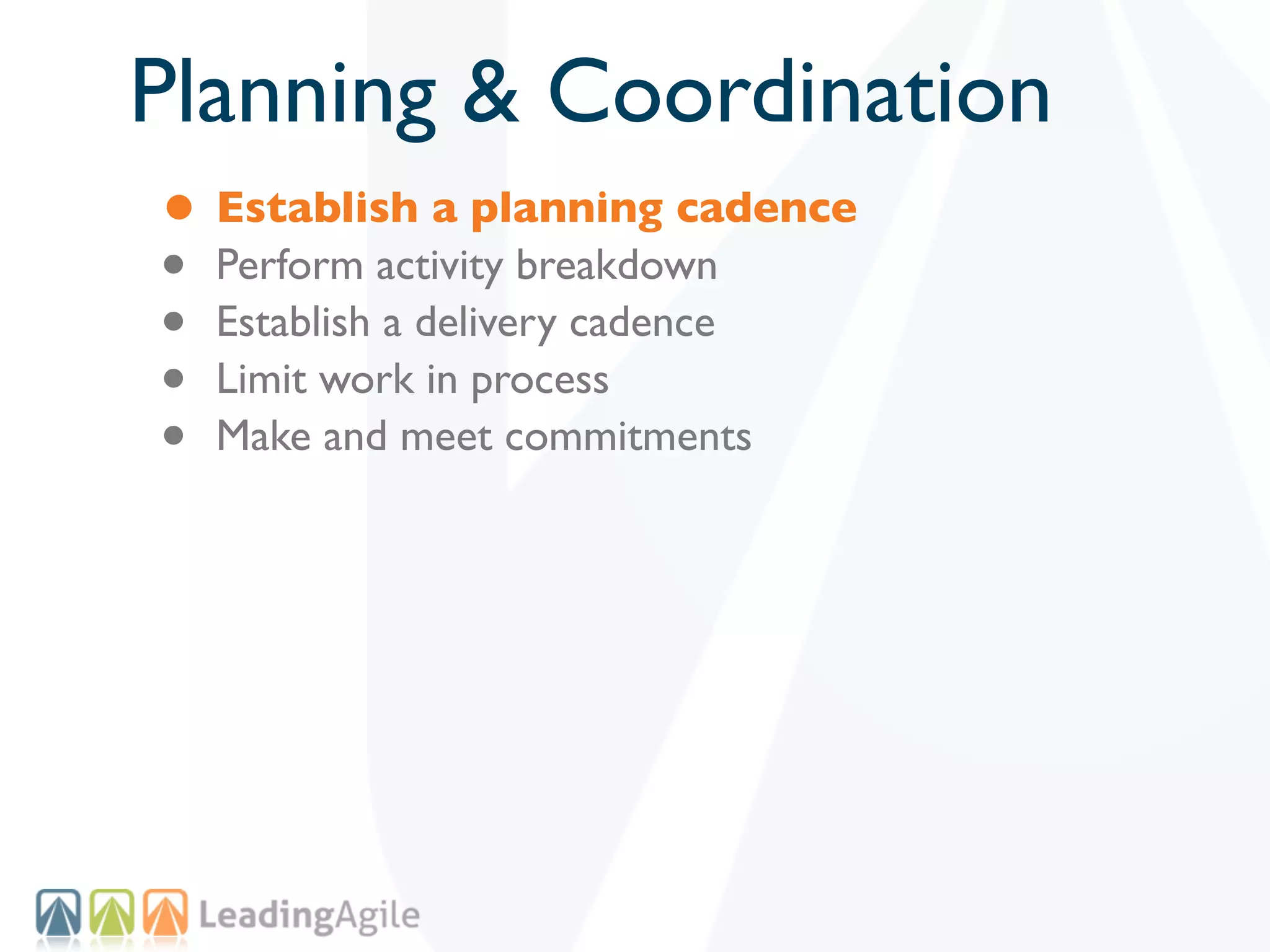
Planning & Coordination
• Establish a planning cadence
• Perform activity breakdown
• Establish a delivery cadence
• Limit work in process
• Make and meet commitments
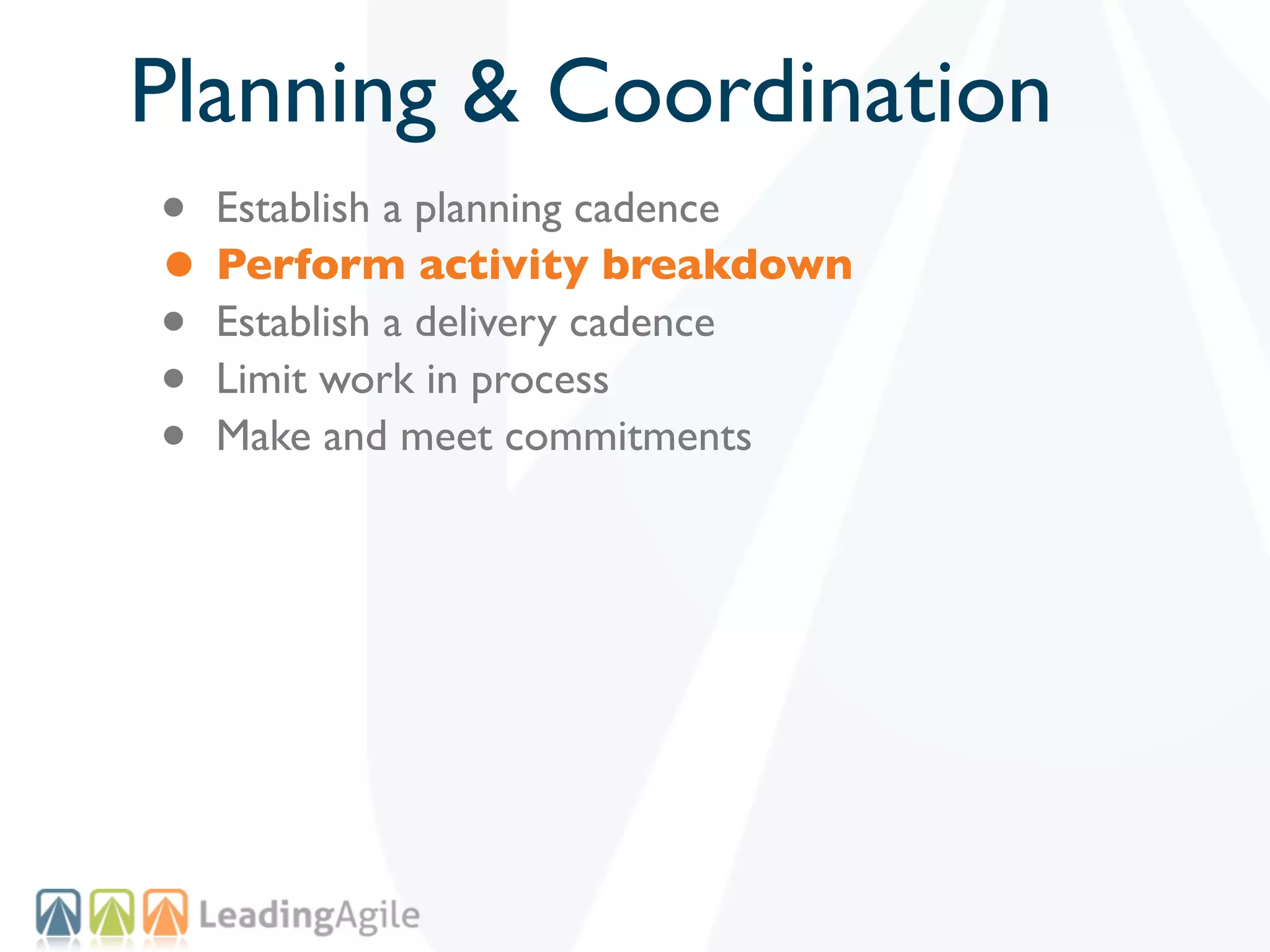
Planning & Coordination
• Establish a planning cadence
• Perform activity breakdown
• Establish a delivery cadence
• Limit work in process
• Make and meet commitments
Planning & Coordination
• Establish a planning cadence
• Perform activity breakdown
• Establish a delivery cadence
• Limit work in process
• Make and meet commitments
Planning & Coordination
• Establish a planning cadence
• Perform activity breakdown
• Establish a delivery cadence
• Limit work in process
• Make and meet commitments
Planning & Coordination
• Establish a planning cadence
• Perform activity breakdown
• Establish a delivery cadence
• Limit work in process
• Make and meet commitments
Continuous Improvement
•   Metrics and reporting
•   Establish stable velocity
•   Conduct retrospectives
•   Update the backlog
•   Enable process improvement
Continuous Improvement
• Metrics and reporting
• Establish stable velocity
• Conduct retrospectives
• Update the backlog
• Enable process improvement
Continuous Improvement
• Metrics and reporting
• Establish stable velocity
• Conduct retrospectives
• Update the backlog
• Enable process improvement
Continuous Improvement
• Metrics and reporting
• Establish stable velocity
• Conduct retrospectives
• Update the backlog
• Enable process improvement
Continuous Improvement
• Metrics and reporting
• Establish stable velocity
• Conduct retrospectives
• Update the backlog
• Enable process improvement
Continuous Improvement
• Metrics and reporting
• Establish stable velocity
• Conduct retrospectives
• Update the backlog
• Enable process improvement
Organizational Enablement
•   Establish teams
•   Effective communication
•   Effective collaboration
•   Empowerment
•   Trust
Organizational Enablement
• Establish teams
• Effective communication
• Effective collaboration
• Empowerment
• Trust
Organizational Enablement
• Establish teams
• Effective communication
• Effective collaboration
• Empowerment
• Trust
Organizational Enablement
• Establish teams
• Effective communication
• Effective collaboration
• Empowerment
• Trust
Organizational Enablement
• Establish teams
• Effective communication
• Effective collaboration
• Empowerment
• Trust
Organizational Enablement
• Establish teams
• Effective communication
• Effective collaboration
• Empowerment
• Trust
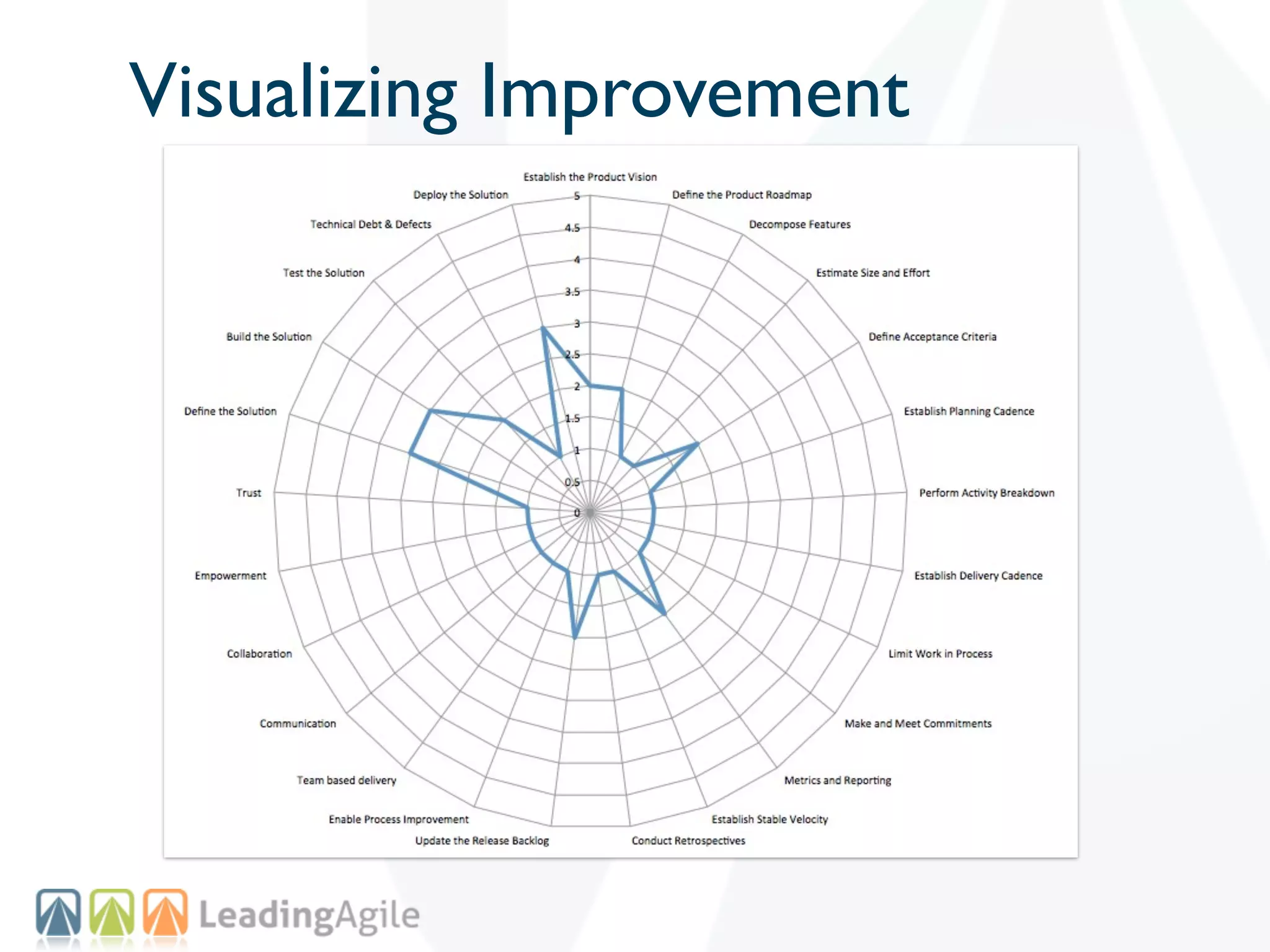
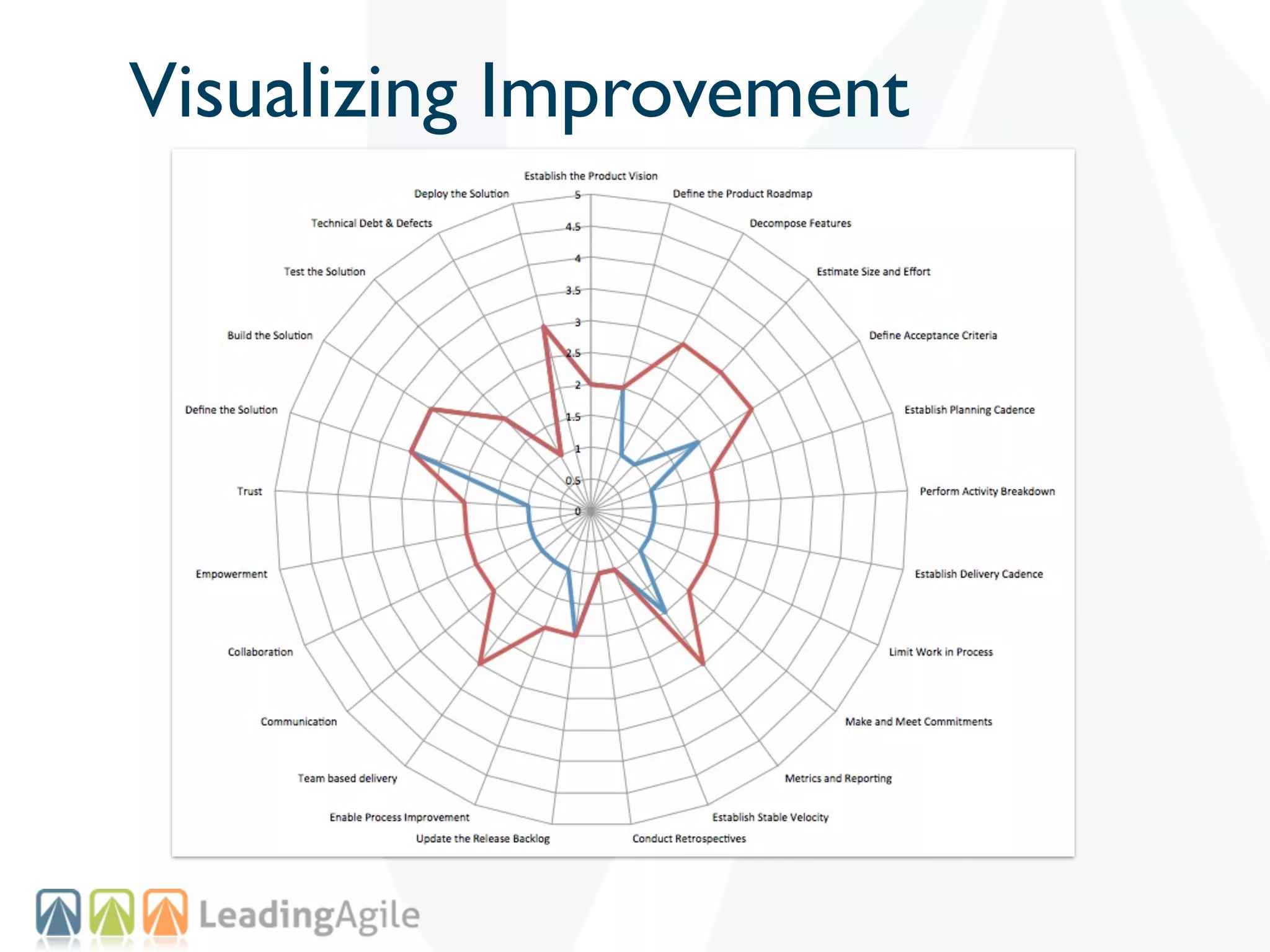
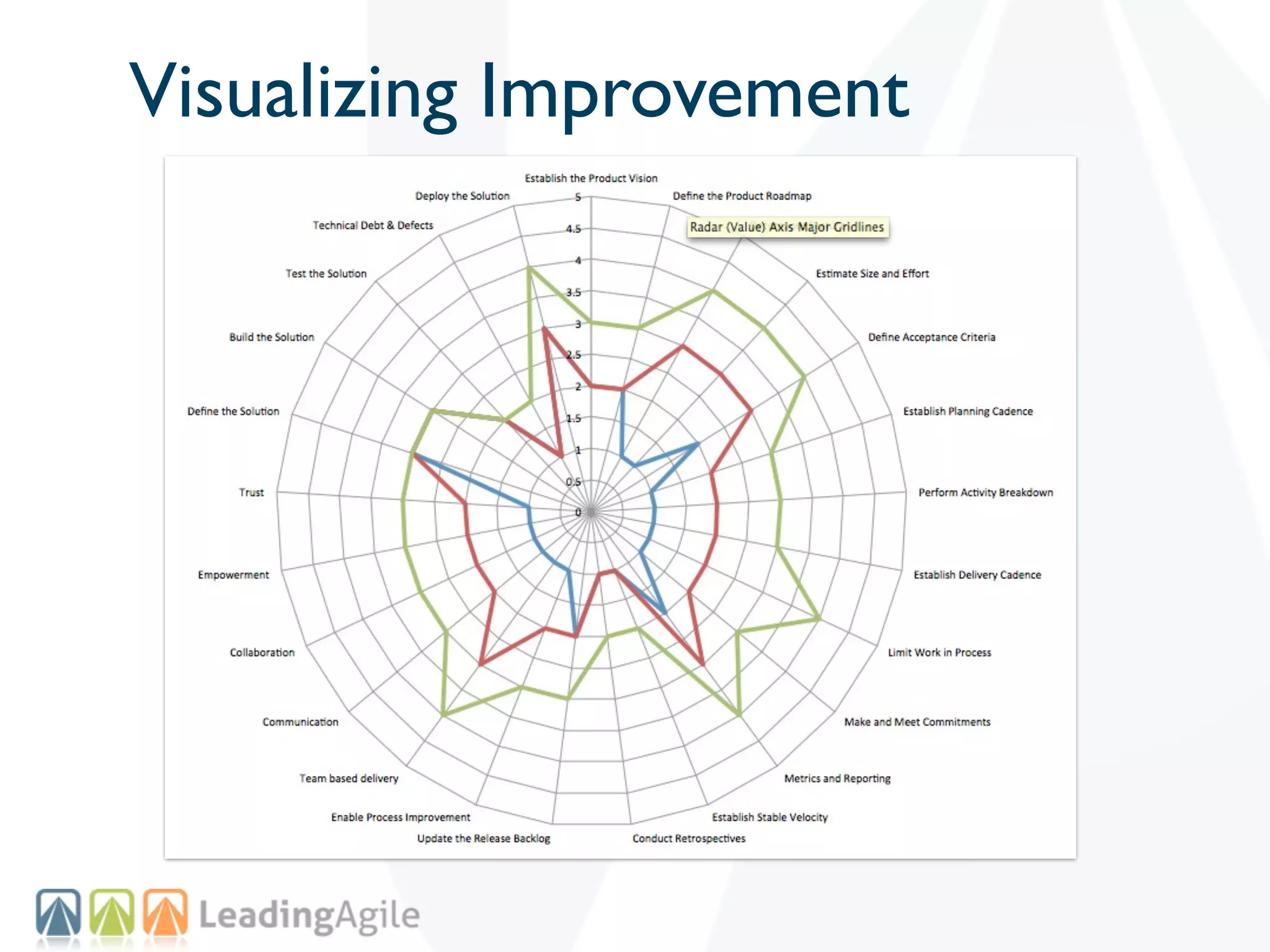
Visualizing Improvement
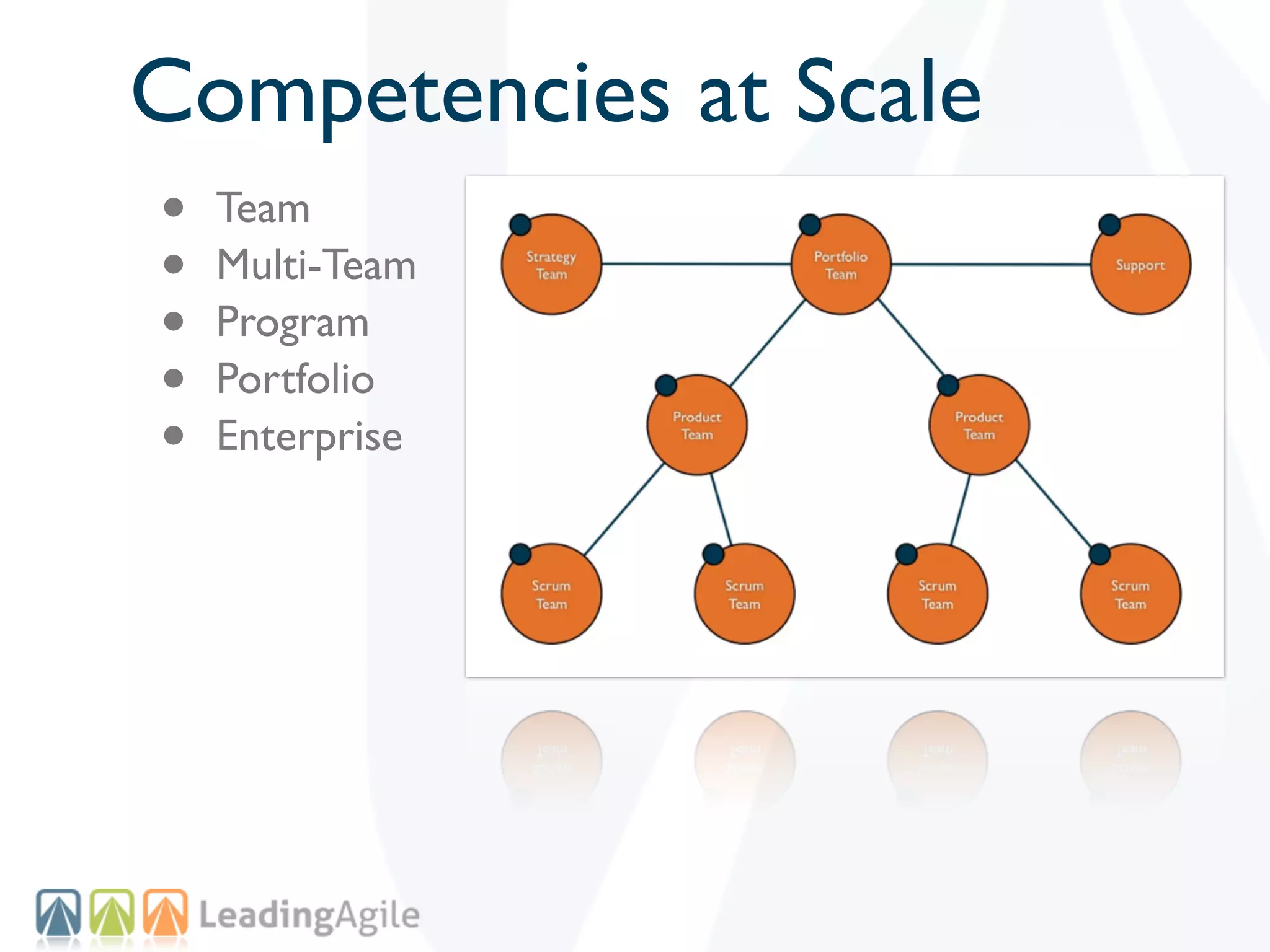
Competencies at Scale
•   Team
•   Multi-Team
•   Program
•   Portfolio
•   Enterprise
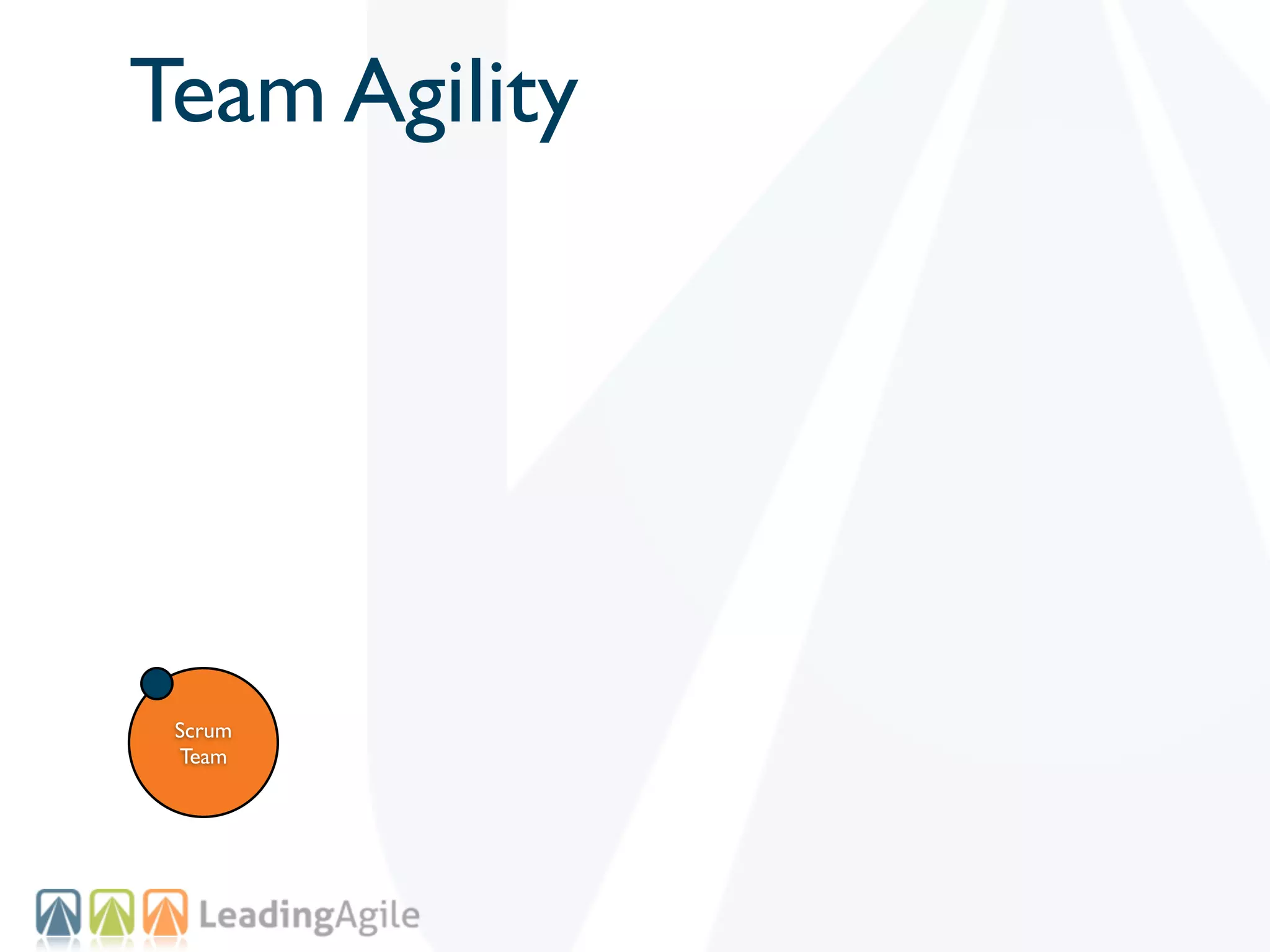
Team Agility


 Scrum
 Team
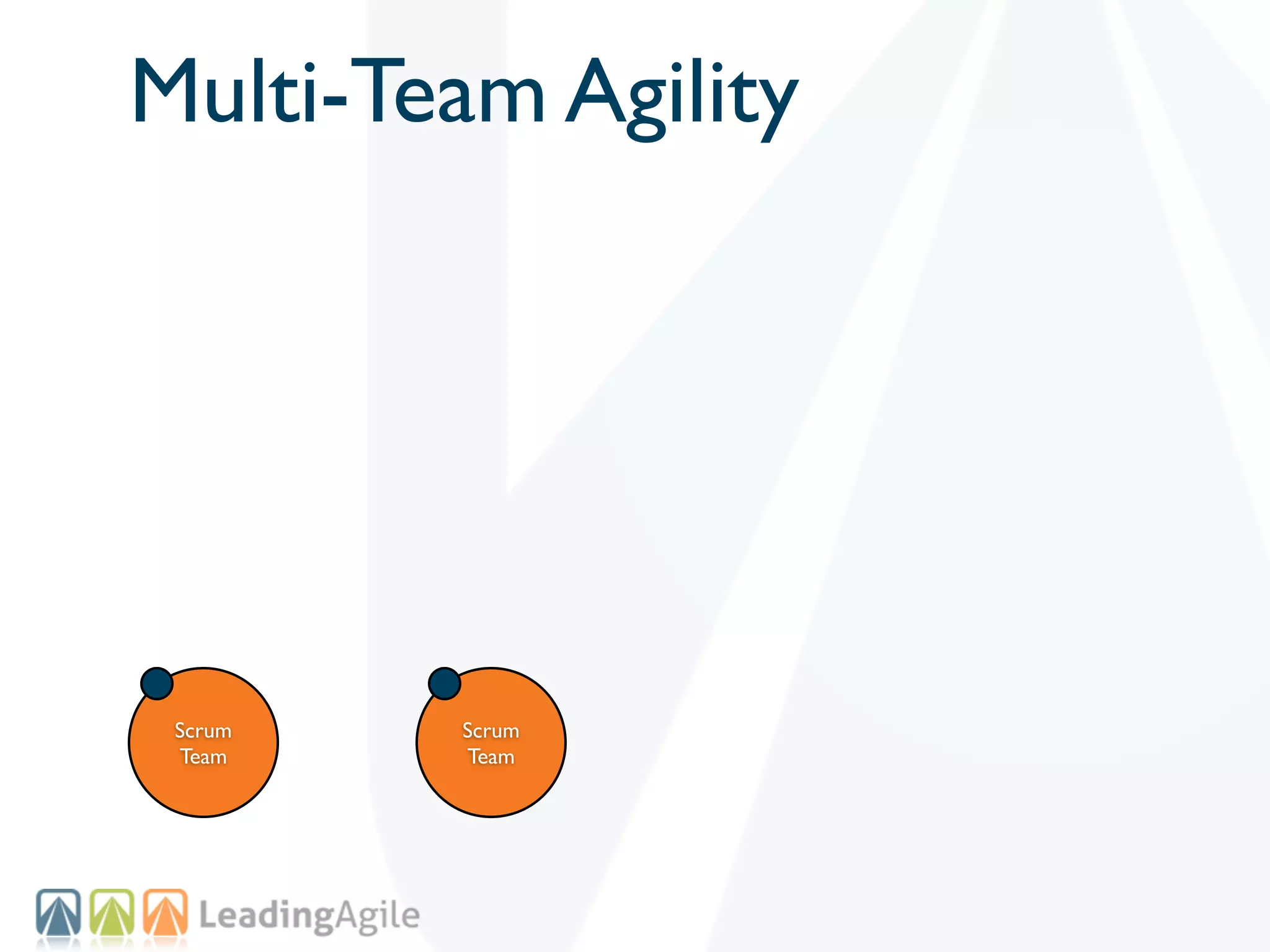
Multi-Team Agility


 Scrum   Scrum
 Team    Team
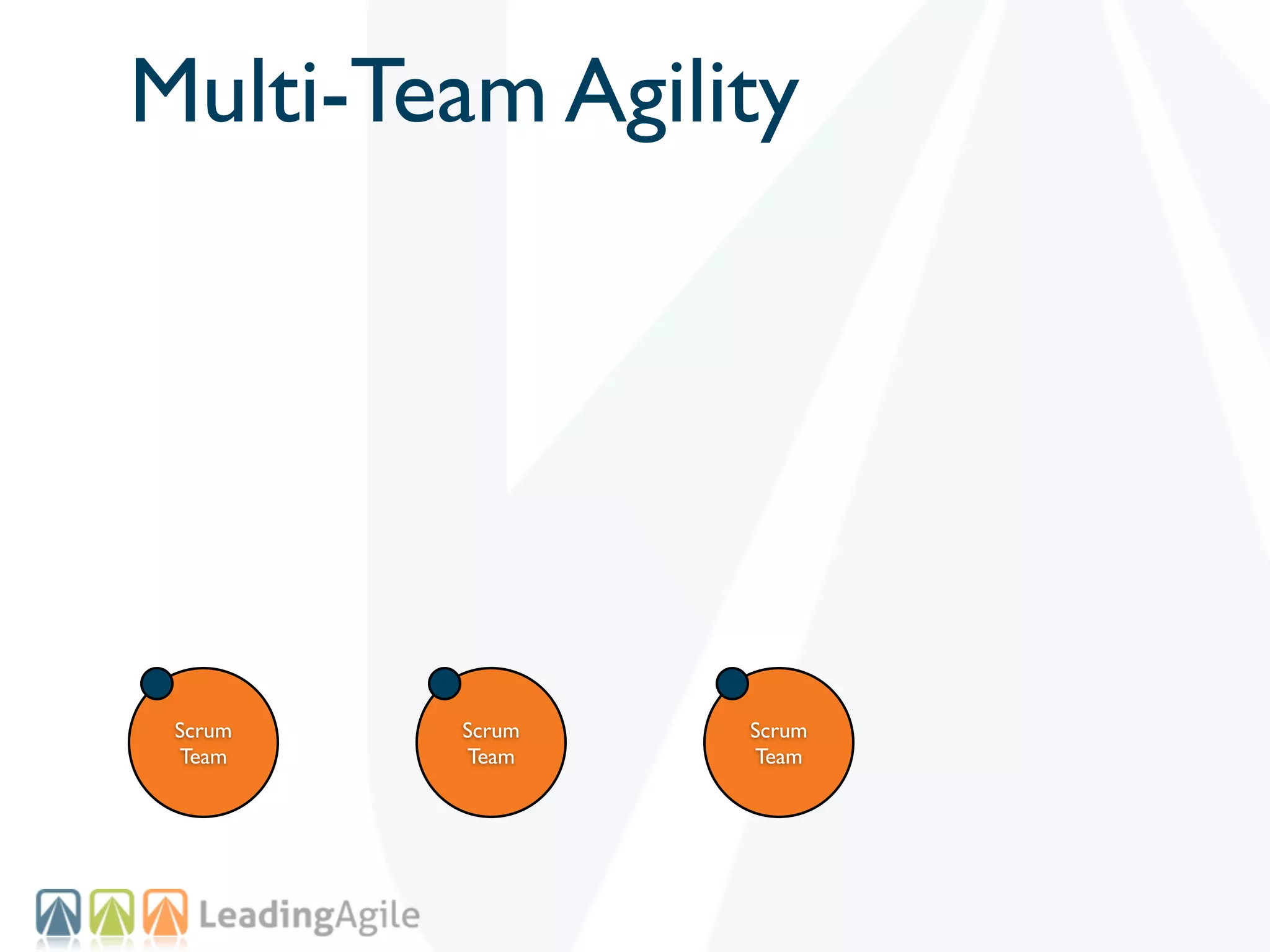
Multi-Team Agility


 Scrum   Scrum   Scrum
 Team    Team    Team
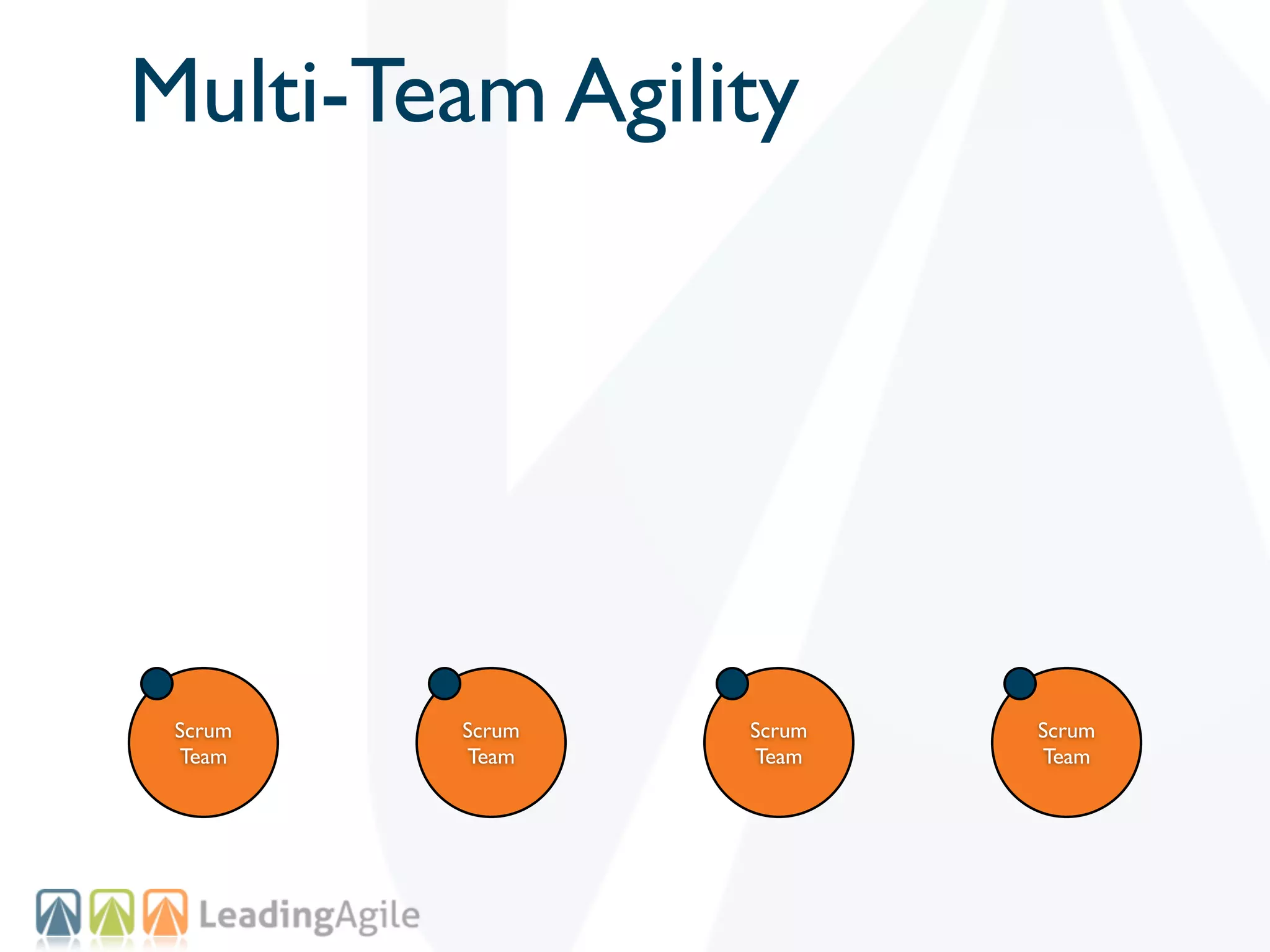
Multi-Team Agility


 Scrum   Scrum   Scrum   Scrum
 Team    Team    Team    Team
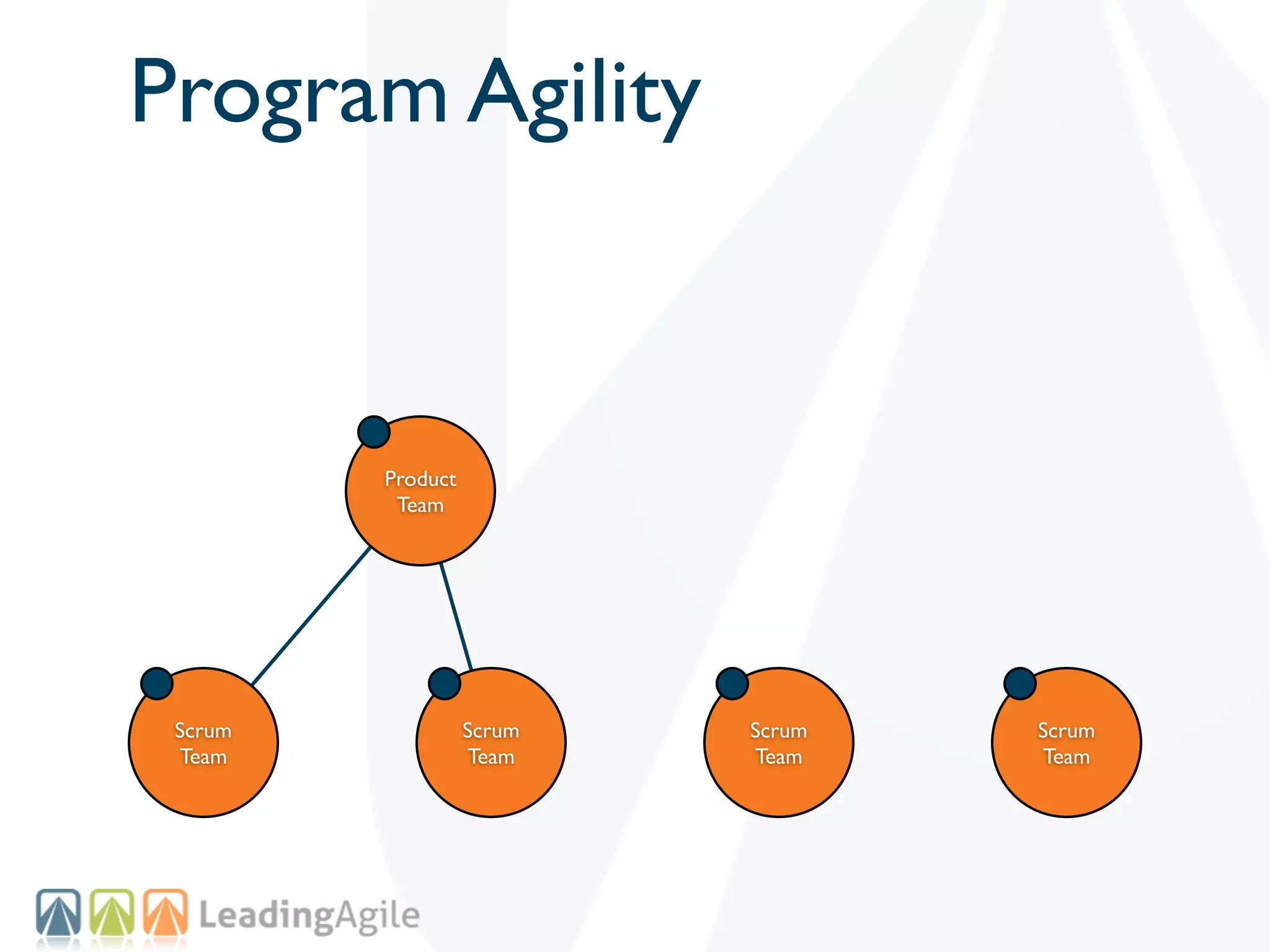
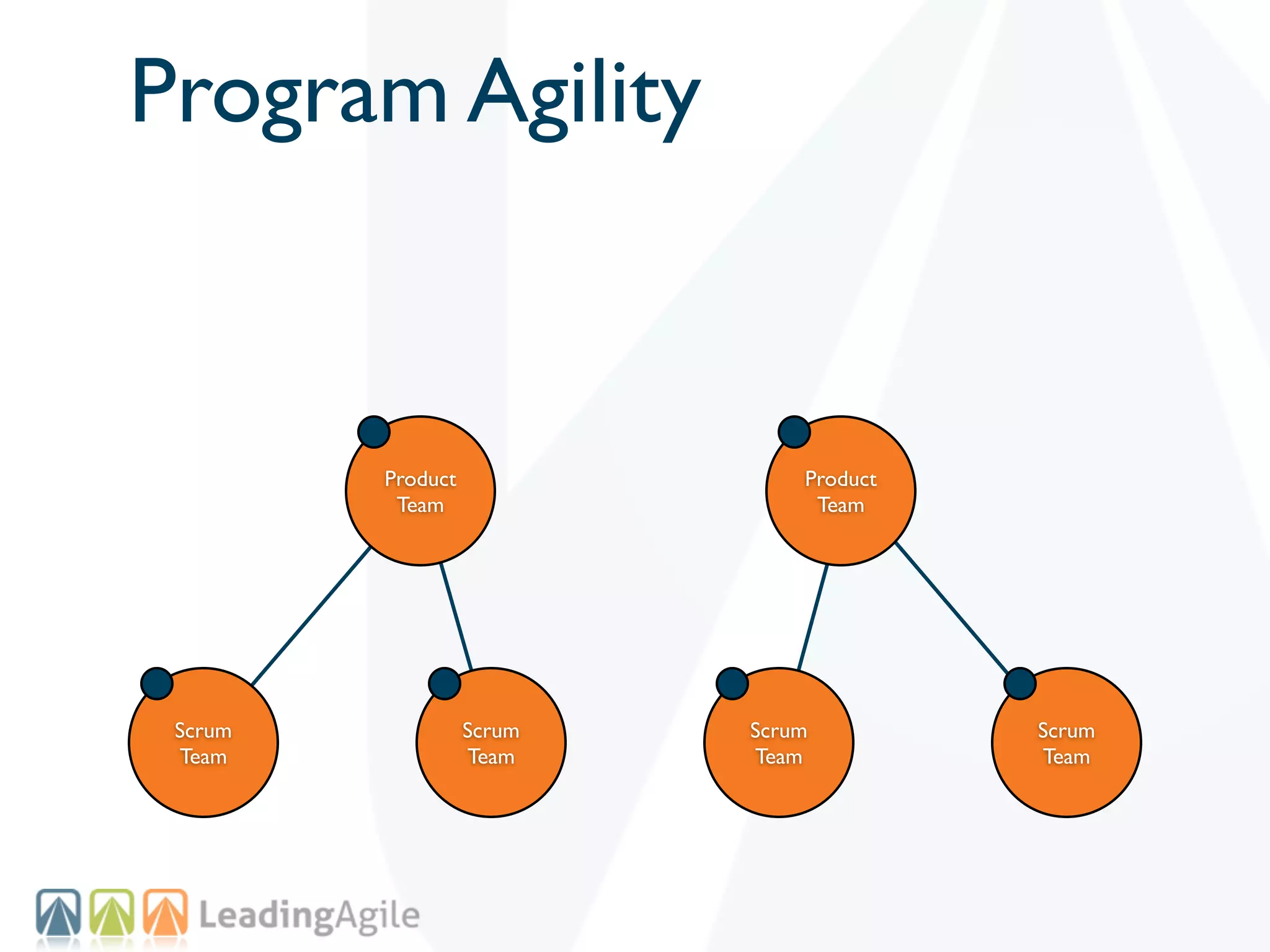
Program Agility


         Product
          Team


 Scrum             Scrum   Scrum   Scrum
 Team              Team    Team    Team
Program Agility


         Product               Product
          Team                  Team


 Scrum             Scrum   Scrum         Scrum
 Team              Team    Team          Team
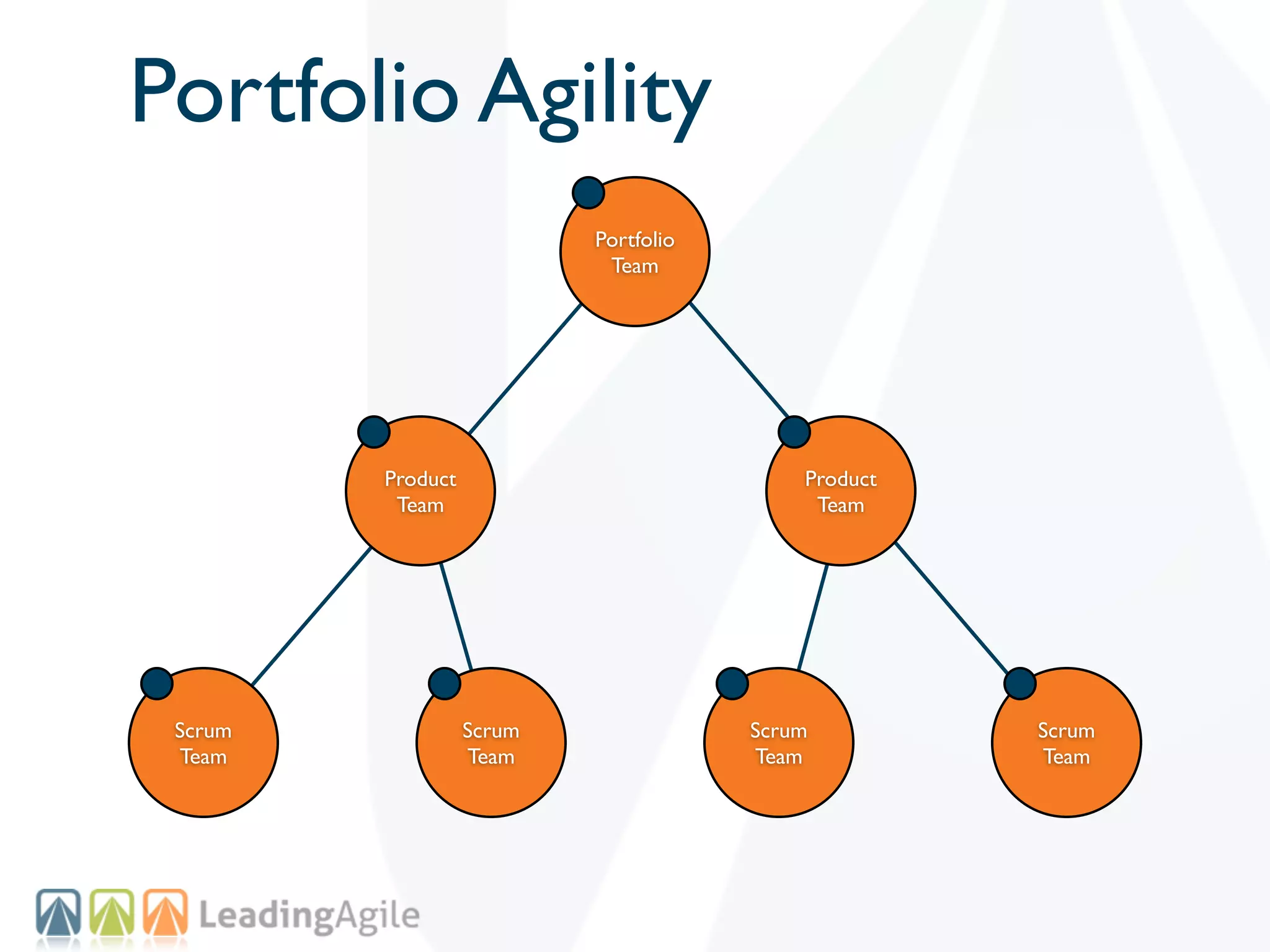
Portfolio Agility
                           Portfolio
                            Team


         Product                           Product
          Team                              Team


 Scrum             Scrum               Scrum         Scrum
 Team              Team                Team          Team
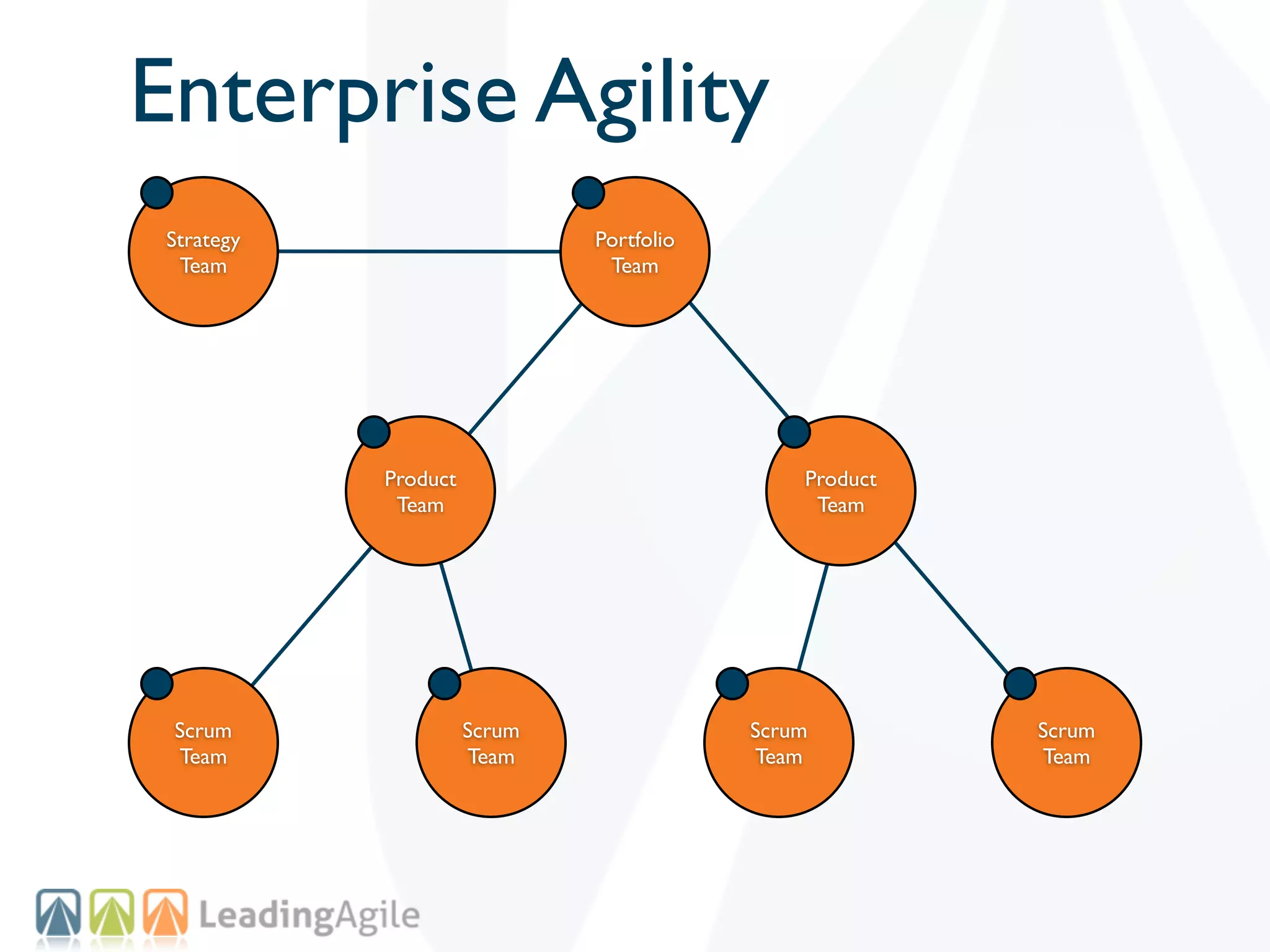
Enterprise Agility
 Strategy                     Portfolio
  Team                         Team


            Product                           Product
             Team                              Team


 Scrum                Scrum               Scrum         Scrum
 Team                 Team                Team          Team
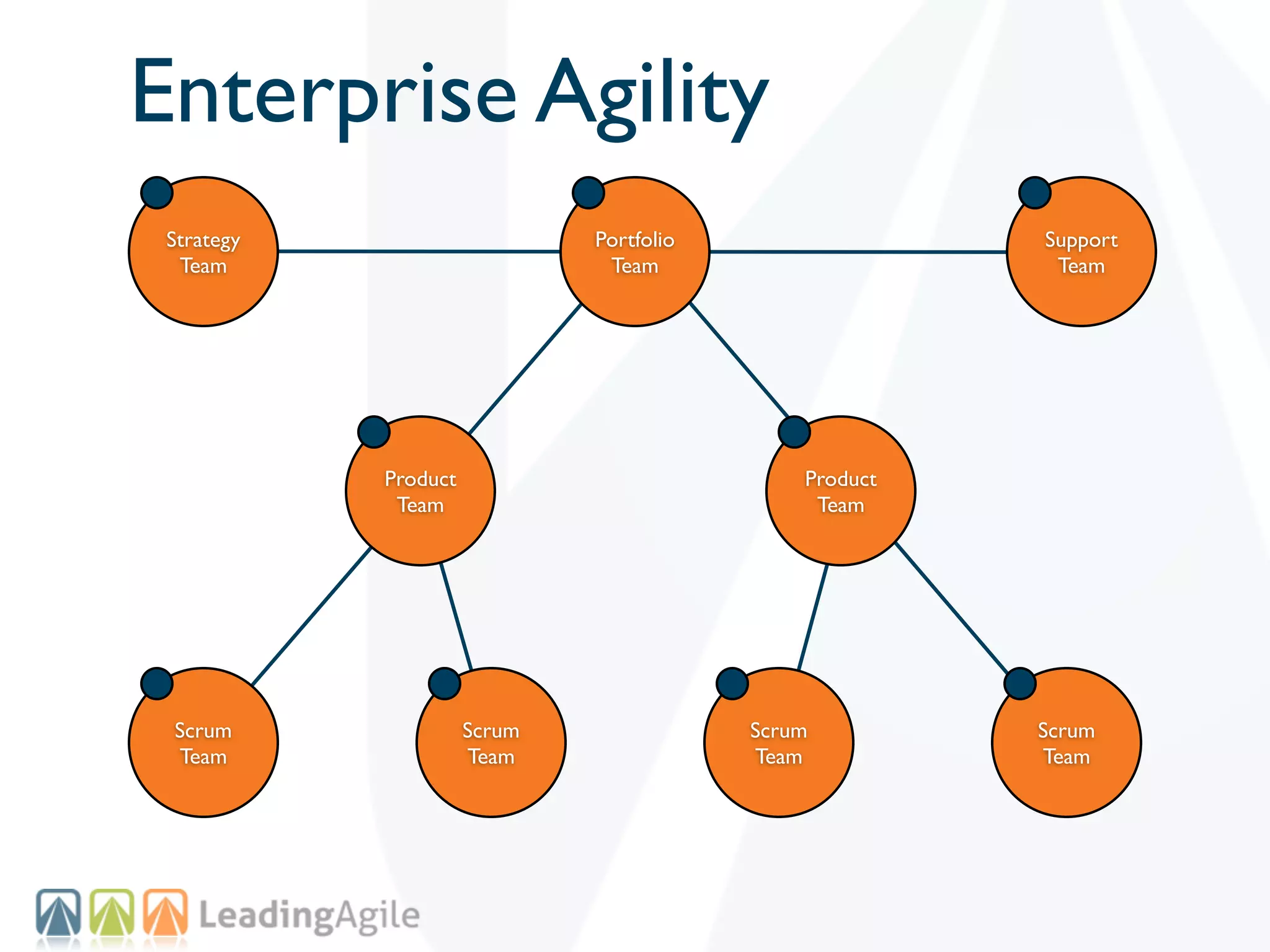
Enterprise Agility
 Strategy                     Portfolio                 Support
  Team                         Team                      Team


            Product                           Product
             Team                              Team


 Scrum                Scrum               Scrum         Scrum
 Team                 Team                Team          Team
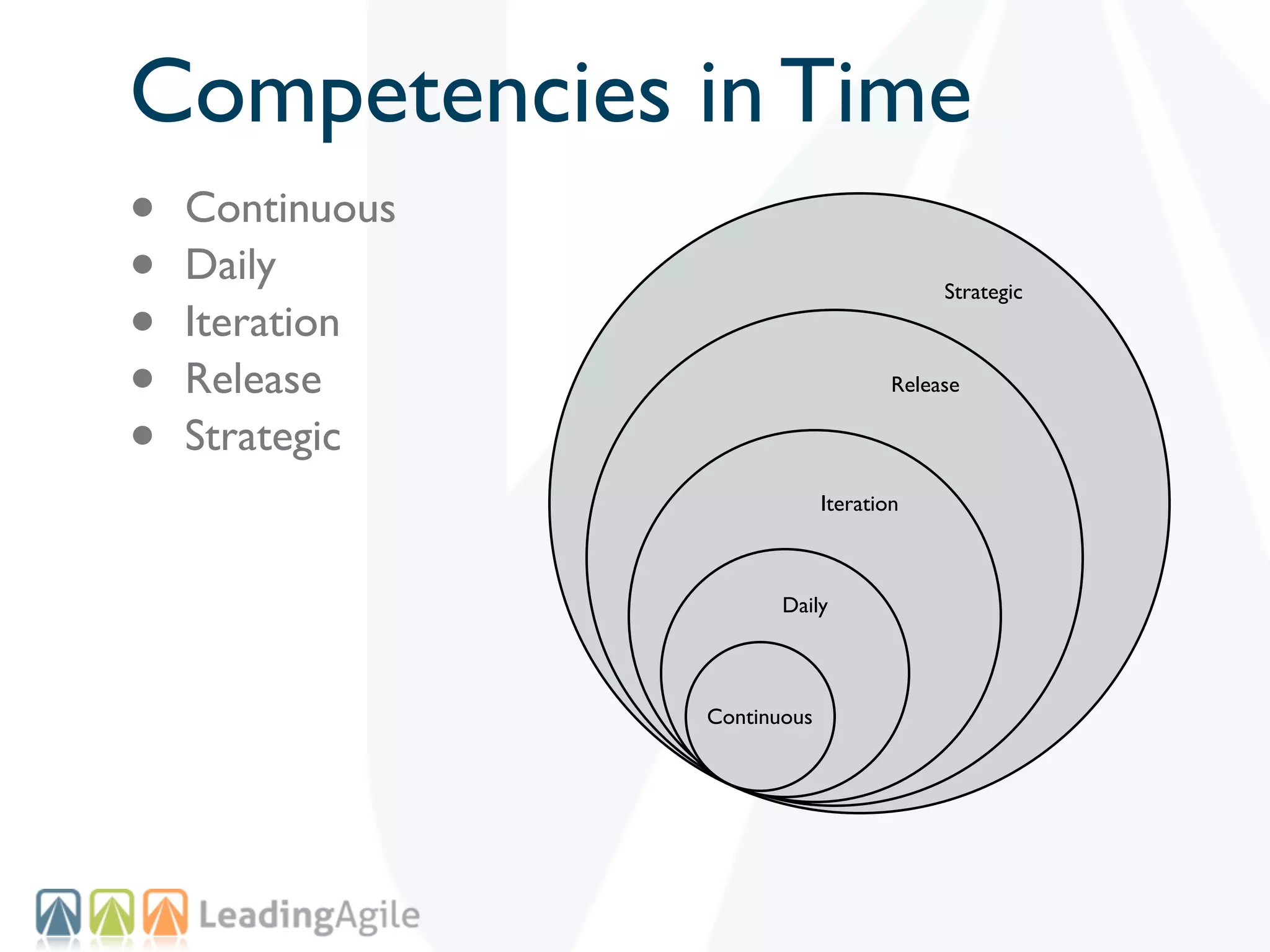
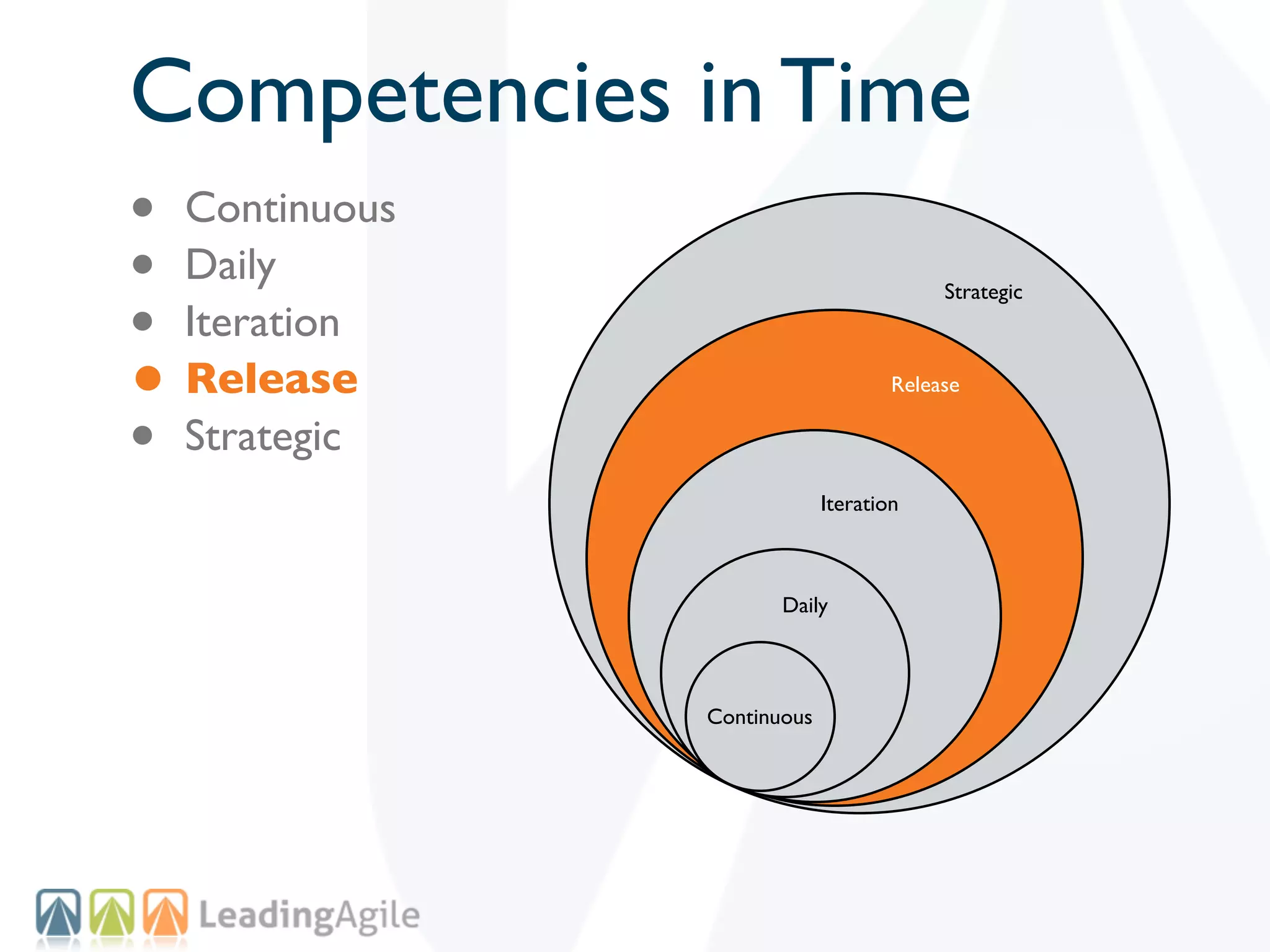
Competencies in Time
•   Continuous
•   Daily
•
                                           Strategic
    Iteration
•   Release                           Release


•   Strategic
                              Iteration


                        Daily


                 Continuous
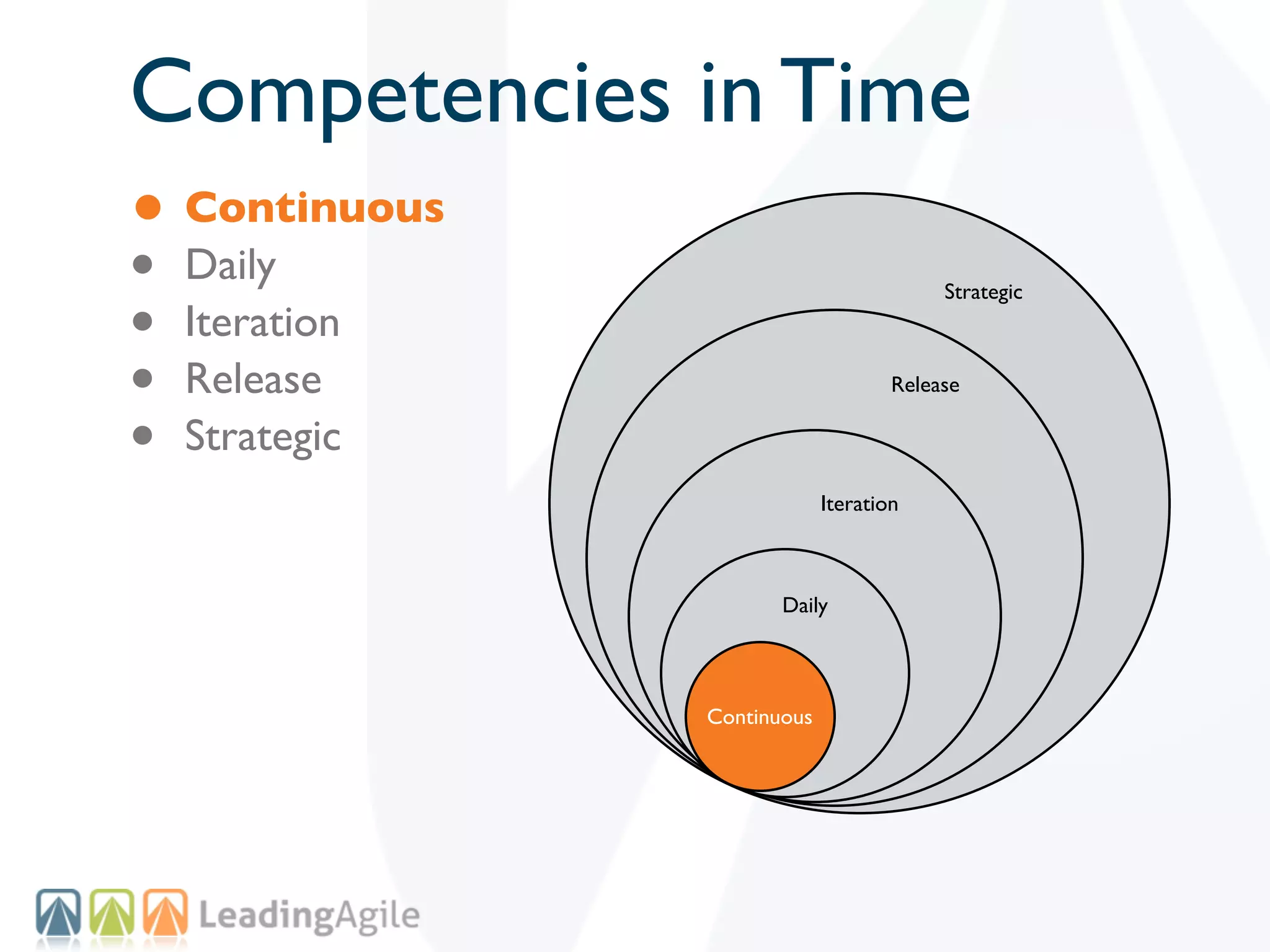
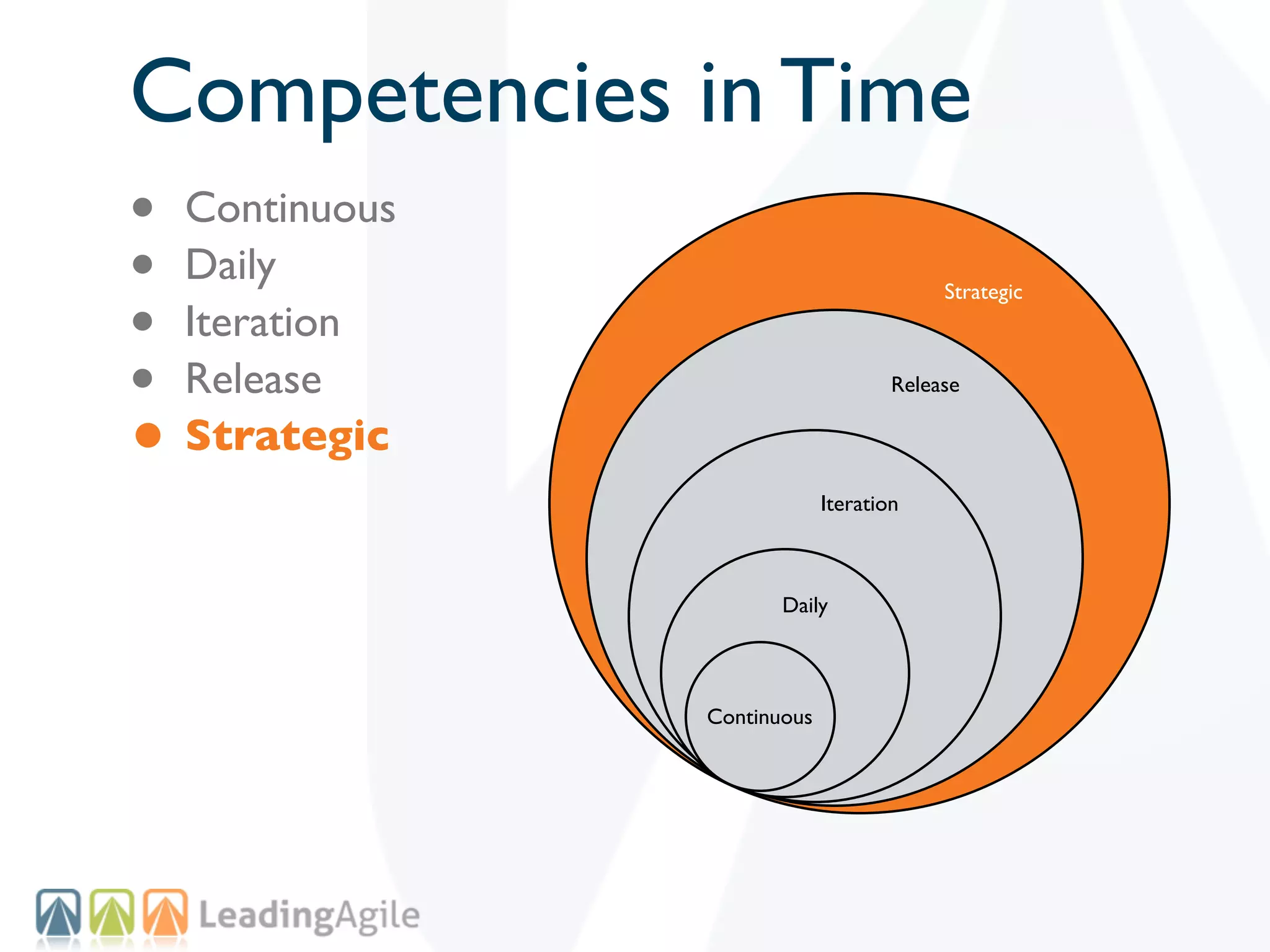
Competencies in Time
• Continuous
• Daily
• Iteration
                                         Strategic


• Release                           Release


• Strategic
                            Iteration


                      Daily


               Continuous
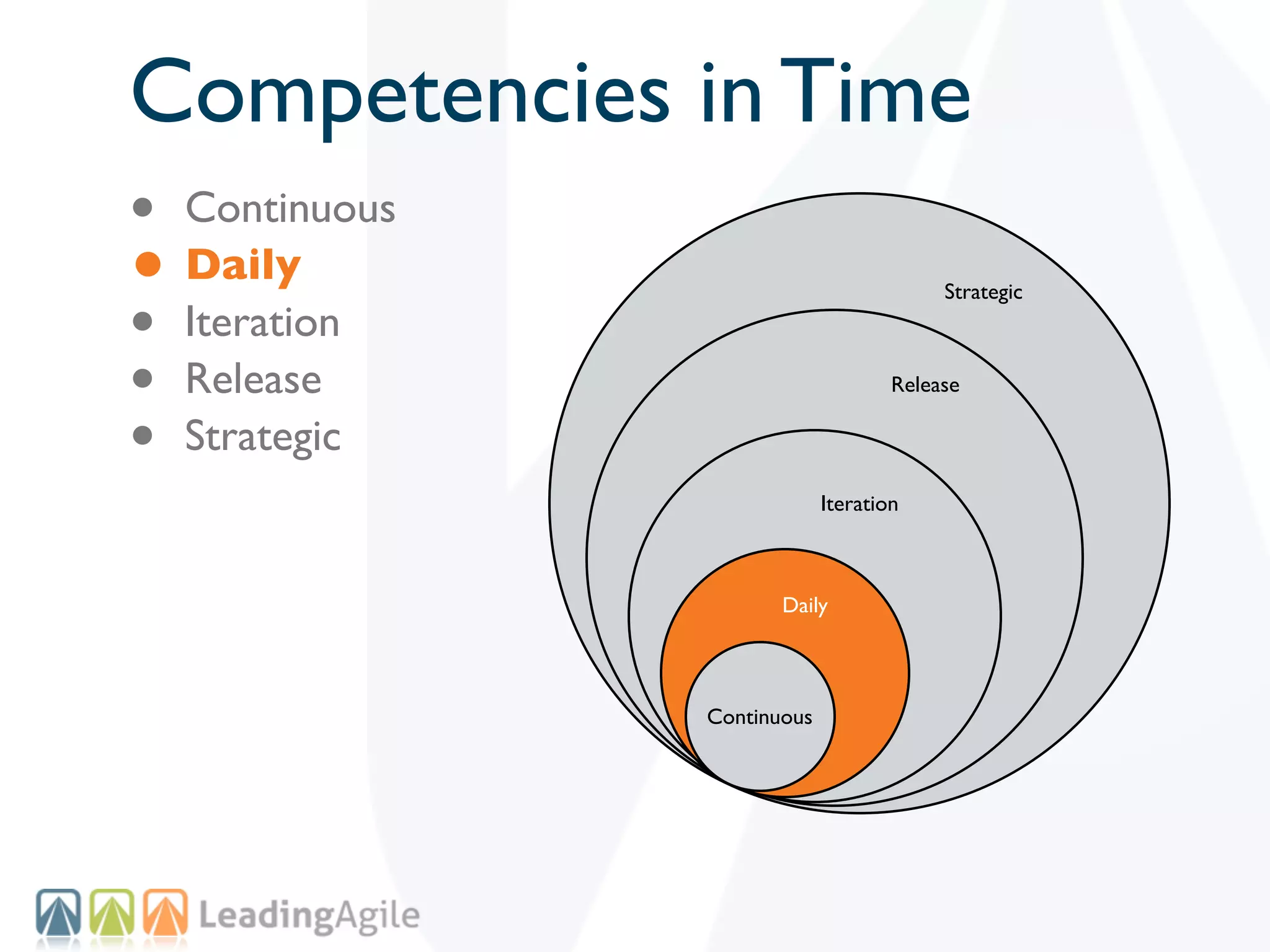
Competencies in Time
• Continuous
• Daily
• Iteration
                                         Strategic


• Release                           Release


• Strategic
                            Iteration


                      Daily


               Continuous
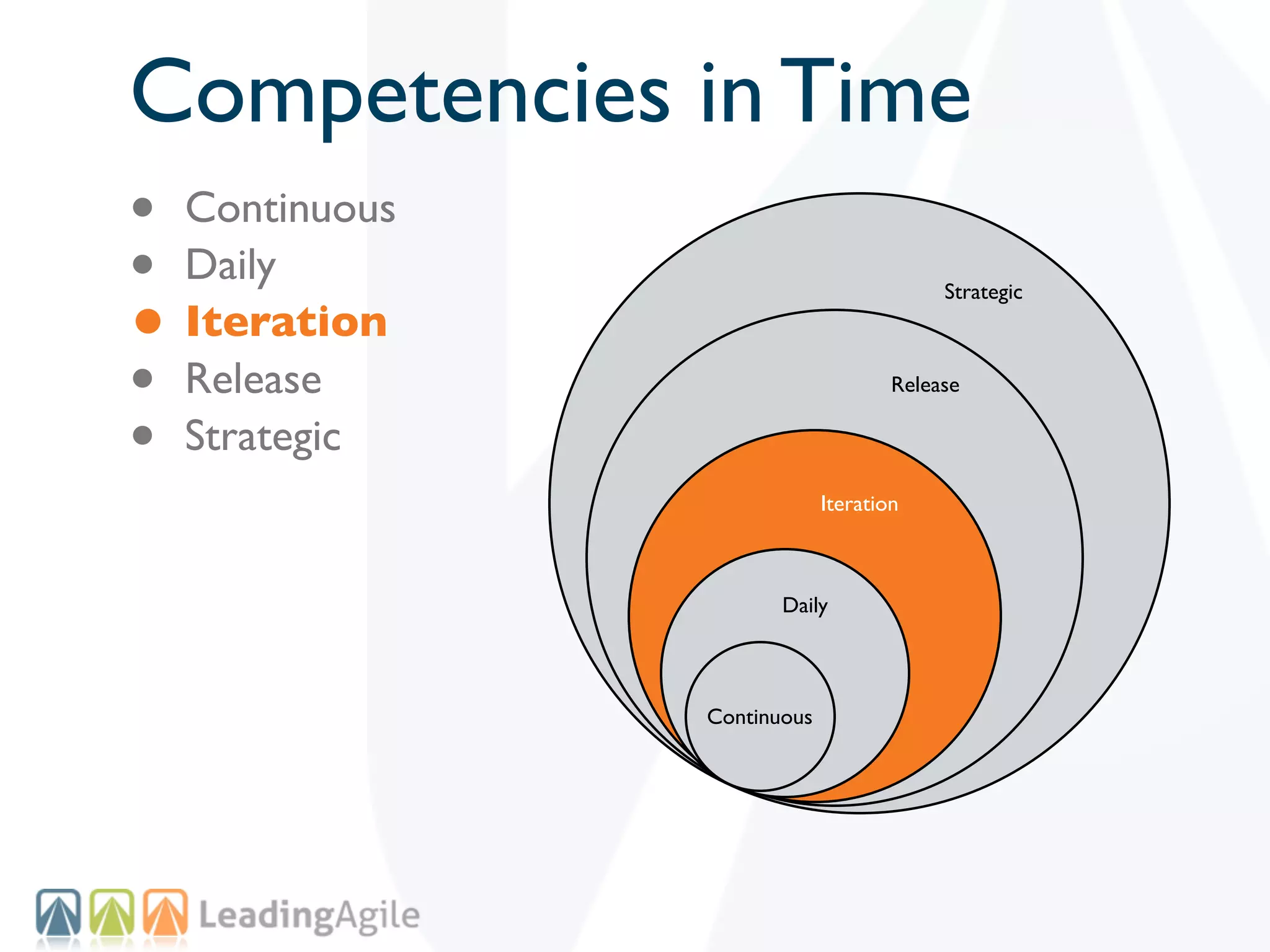
Competencies in Time
• Continuous
• Daily
• Iteration
                                         Strategic


• Release                           Release


• Strategic
                            Iteration


                      Daily


               Continuous
Competencies in Time
• Continuous
• Daily
• Iteration
                                         Strategic


• Release                           Release


• Strategic
                            Iteration


                      Daily


               Continuous
Competencies in Time
• Continuous
• Daily
• Iteration
                                         Strategic


• Release                           Release


• Strategic
                            Iteration


                      Daily


               Continuous
The Solution... Part Three
The Agile Adoption and
Transformation Lifecycle
Adoption vs. Transformation
 First... we want to untangle two words that
 sometimes can be used interchangeably

  •   Agile Adoption is about what you do...
      practices, tools, techniques, ceremonies, and
      habits
  •   Agile Transformation is about who you
      are... reflected in both the structure of the
      organization and who you are as people

 Long term results require both adoption and
 transformation to be successful
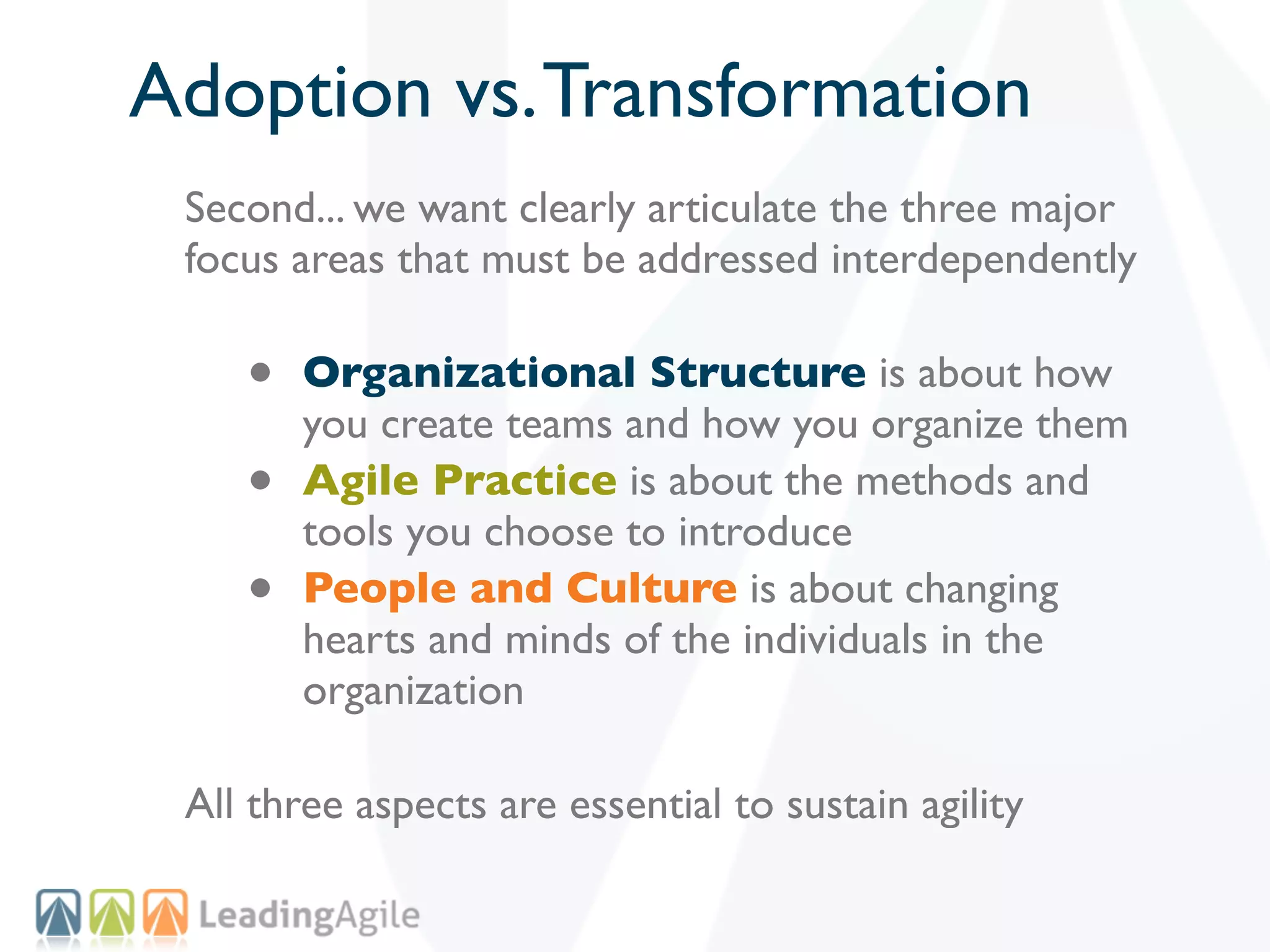
Adoption vs. Transformation
 Second... we want clearly articulate the three major
 focus areas that must be addressed interdependently

    •   Organizational Structure is about how
        you create teams and how you organize them
    •   Agile Practice is about the methods and
        tools you choose to introduce
    •   People and Culture is about changing
        hearts and minds of the individuals in the
        organization

 All three aspects are essential to sustain agility
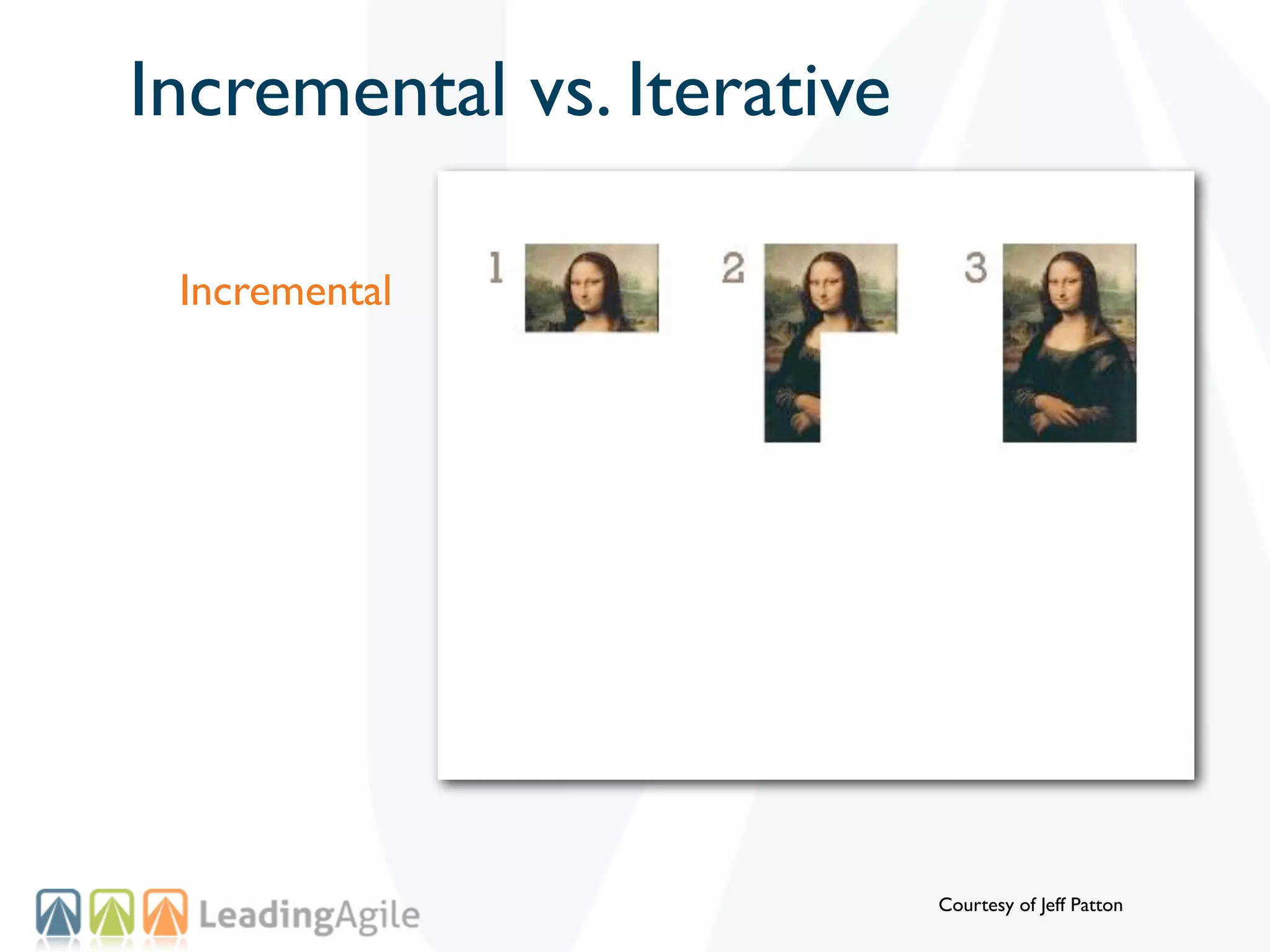
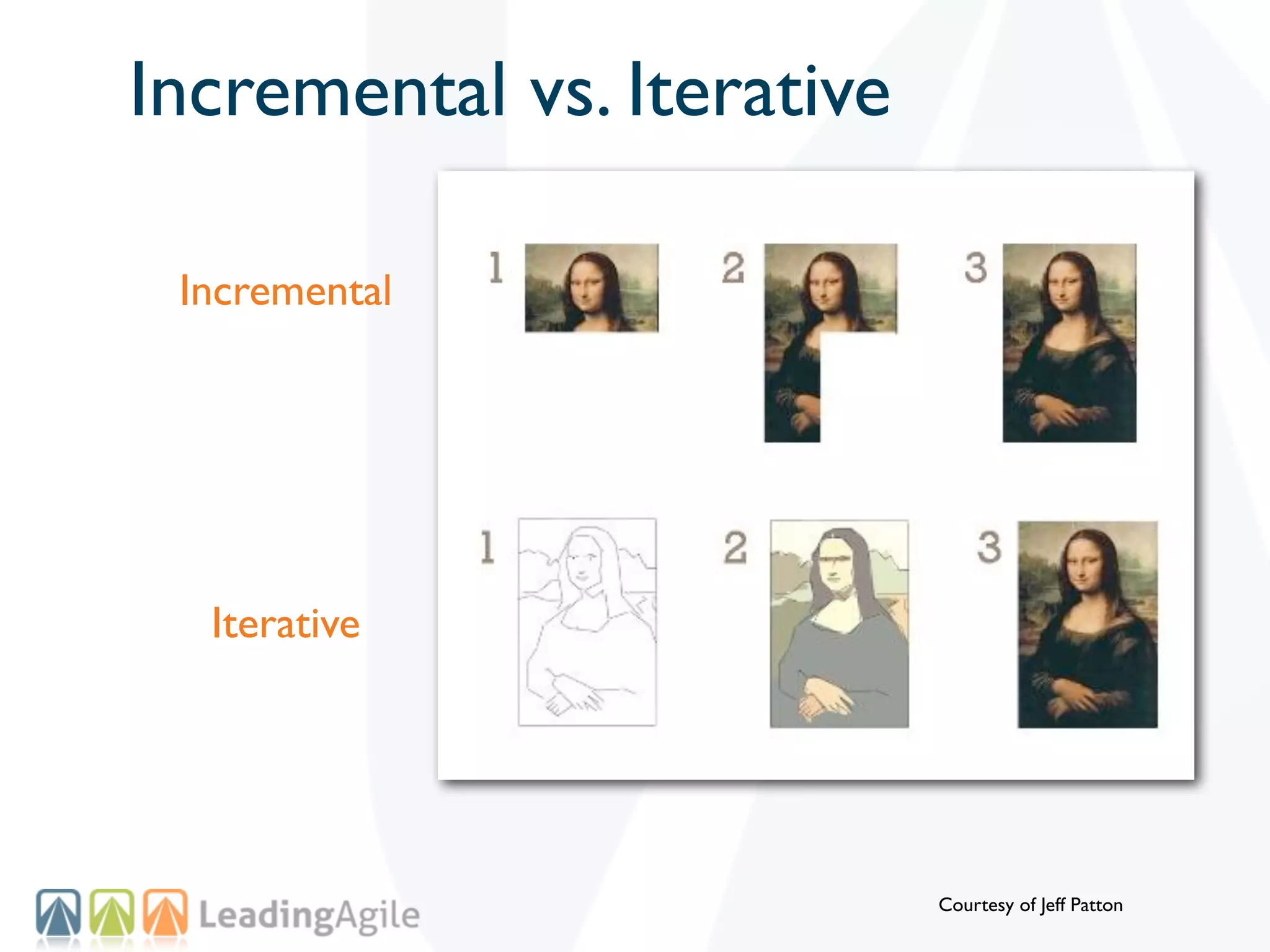
Incremental vs. Iterative
 Third... we want introduce the notion that introducing
 Agile is an iterative and incremental process for you
 organization

    •   Iterative is when parts of the system are
        developed at different times and integrated as
        they are completed
    •   Incremental is when you go back over parts
        of the system making improvements

 The strategy is to increment the organization by
 building teams and iterate the teams over time
Incremental vs. Iterative


                            Courtesy of Jeff Patton
Incremental vs. Iterative

 Incremental


                            Courtesy of Jeff Patton
Incremental vs. Iterative

 Incremental


  Iterative


                            Courtesy of Jeff Patton
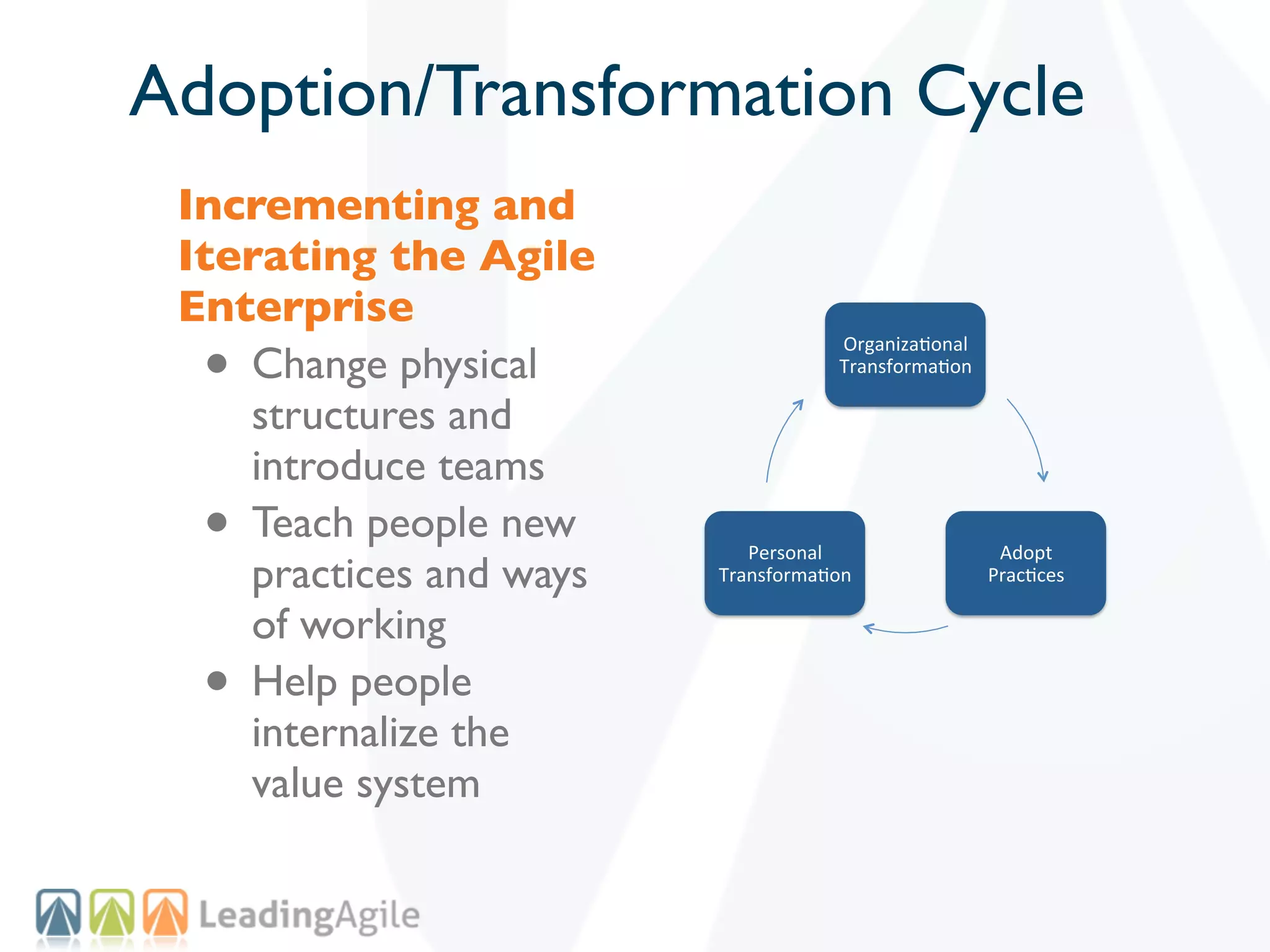
Adoption/Transformation Cycle
 Incrementing and
 Iterating the Agile
 Enterprise
  •
                                     Organiza(onal+
    Change physical                  Transforma(on+

    structures and
    introduce teams
  • Teach people new
                            Personal+                  Adopt++
    practices and ways   Transforma(on+               Prac(ces+

    of working
  • Help people
    internalize the
    value system
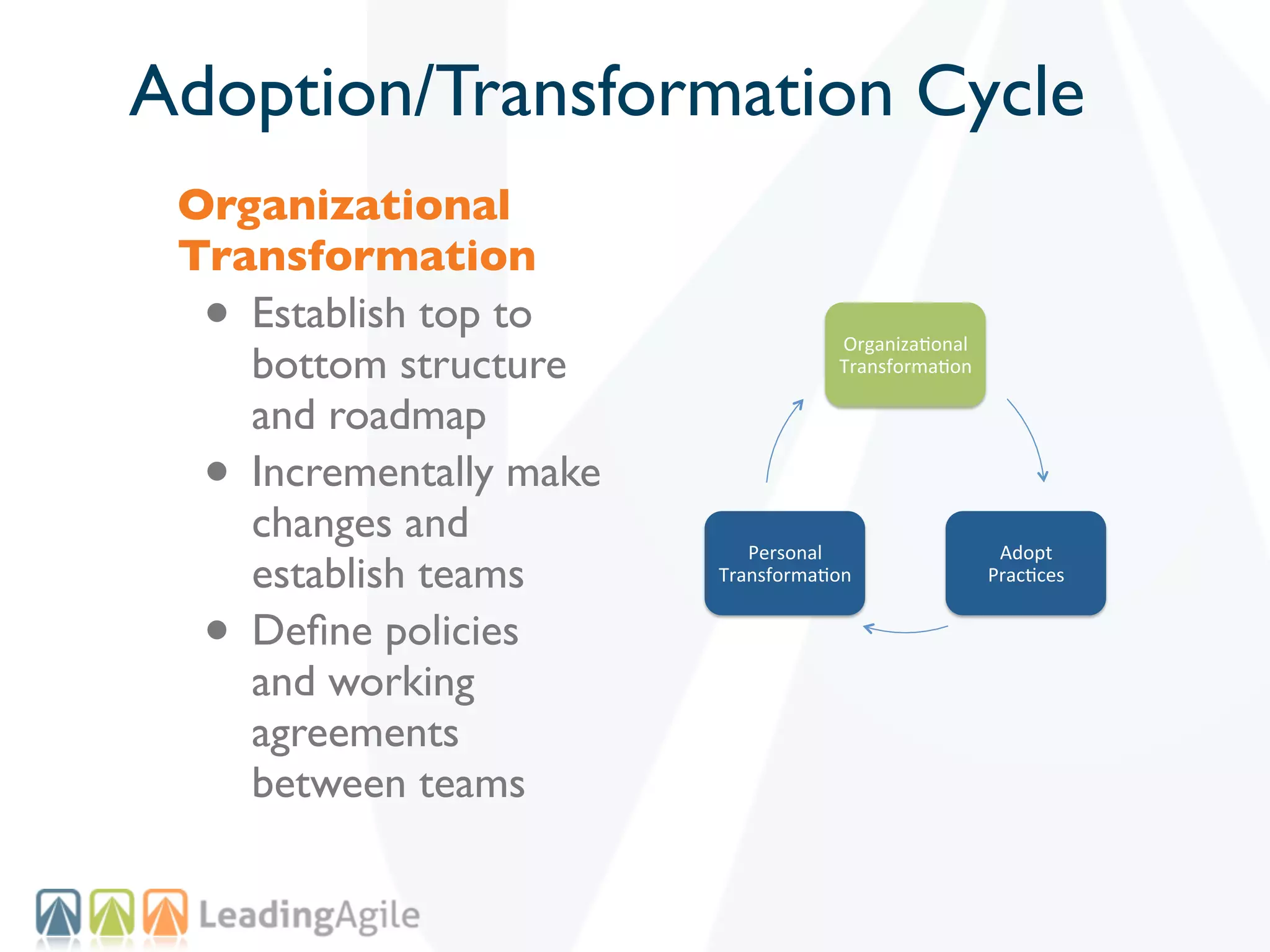
Adoption/Transformation Cycle
 Organizational
 Transformation
  • Establish top to
                                     Organiza(onal+
    bottom structure                 Transforma(on+

    and roadmap
  • Incrementally make
    changes and
                            Personal+                  Adopt++
    establish teams      Transforma(on+               Prac(ces+


  • Define policies
    and working
    agreements
    between teams
Adoption/Transformation Cycle
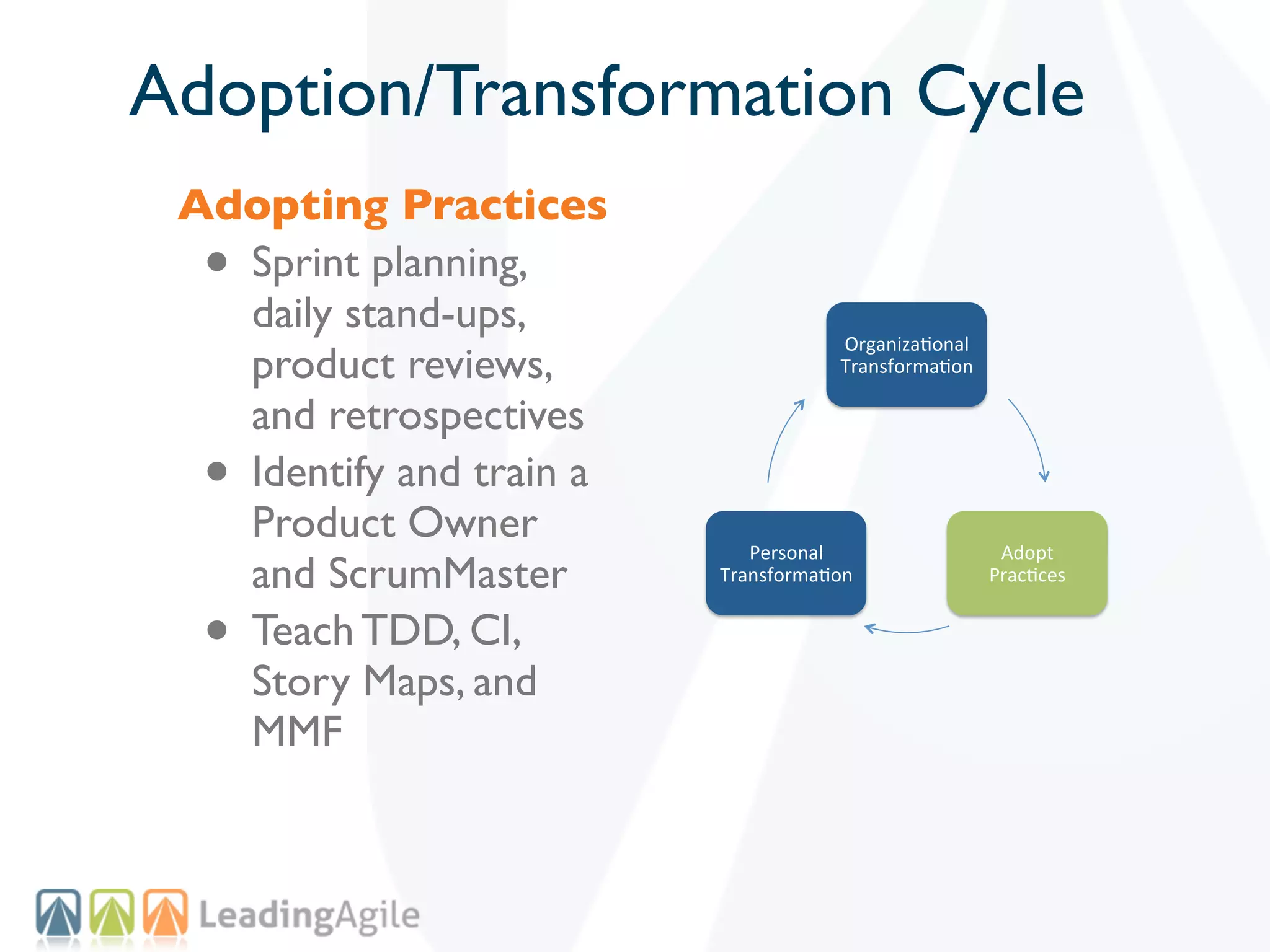
 Adopting Practices
  •Sprint planning,
   daily stand-ups,
                                      Organiza(onal+
   product reviews,                   Transforma(on+

   and retrospectives
  •Identify and train a
   Product Owner
                             Personal+                  Adopt++
   and ScrumMaster        Transforma(on+               Prac(ces+


  •Teach TDD, CI,
   Story Maps, and
   MMF
Adoption/Transformation Cycle
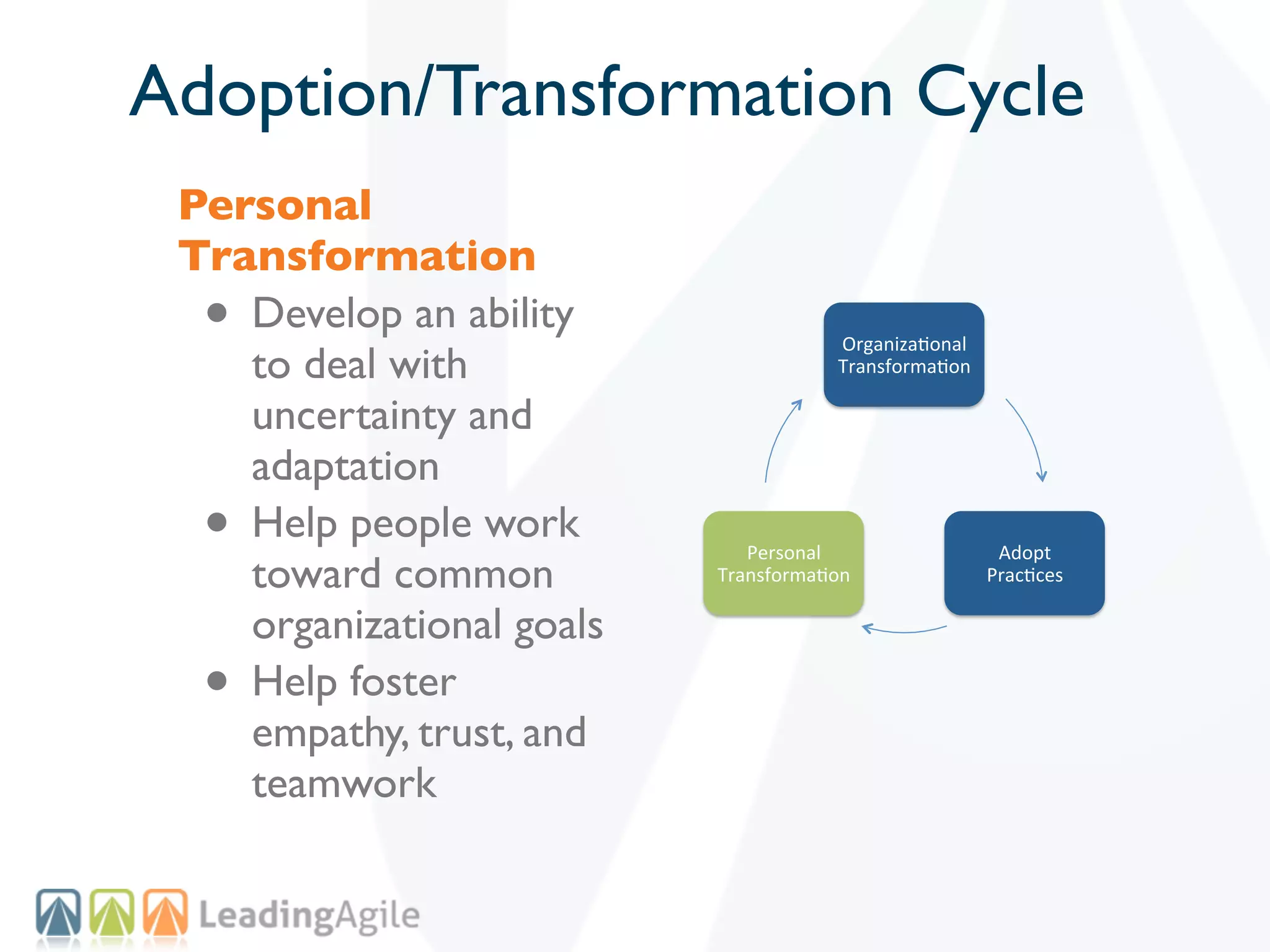
 Personal
 Transformation
  • Develop an ability
                                       Organiza(onal+
    to deal with                       Transforma(on+

    uncertainty and
    adaptation
  • Help people work
                              Personal+                  Adopt++
    toward common          Transforma(on+               Prac(ces+

    organizational goals
  • Help foster
    empathy, trust, and
    teamwork
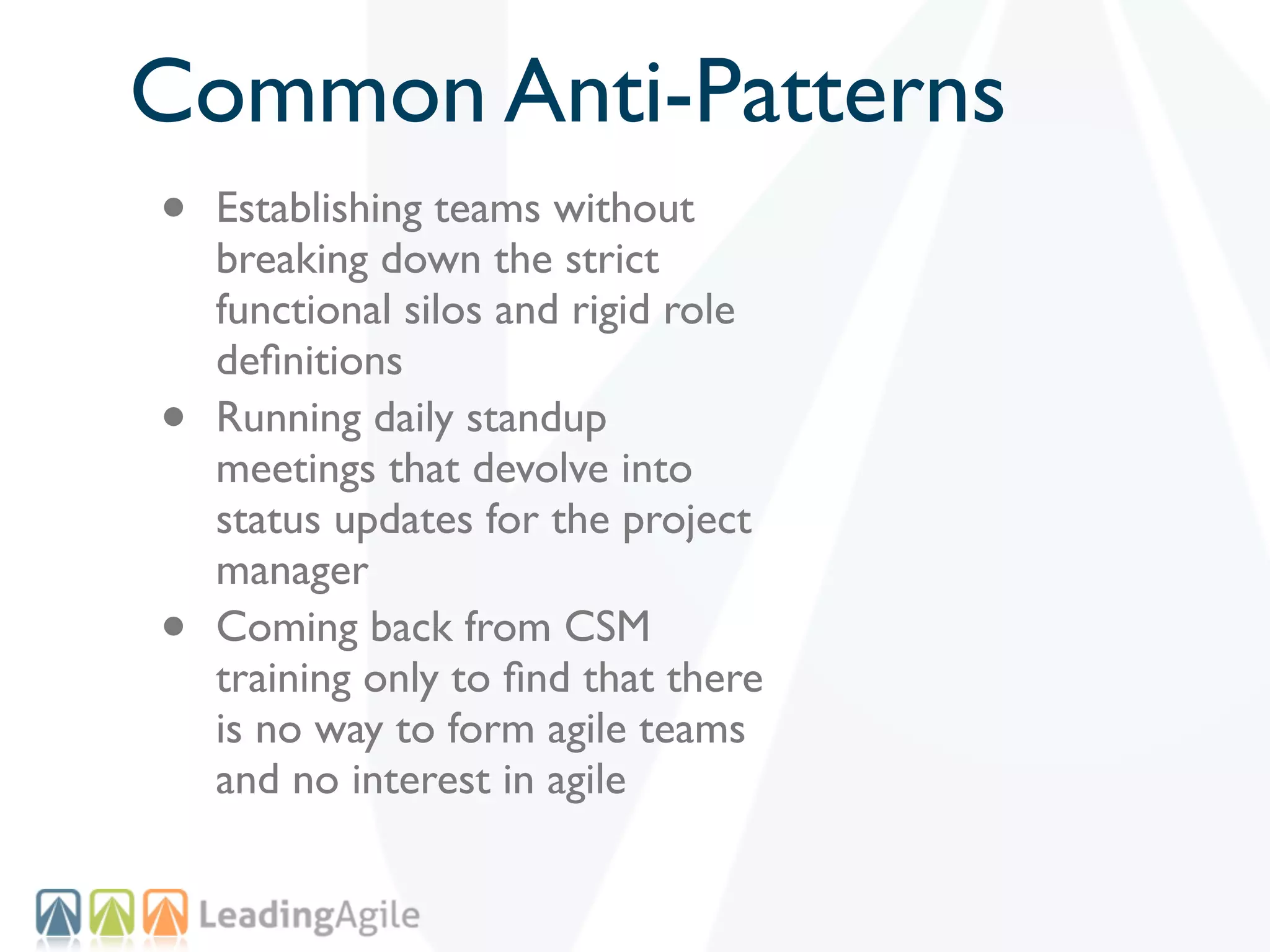
Common Anti-Patterns
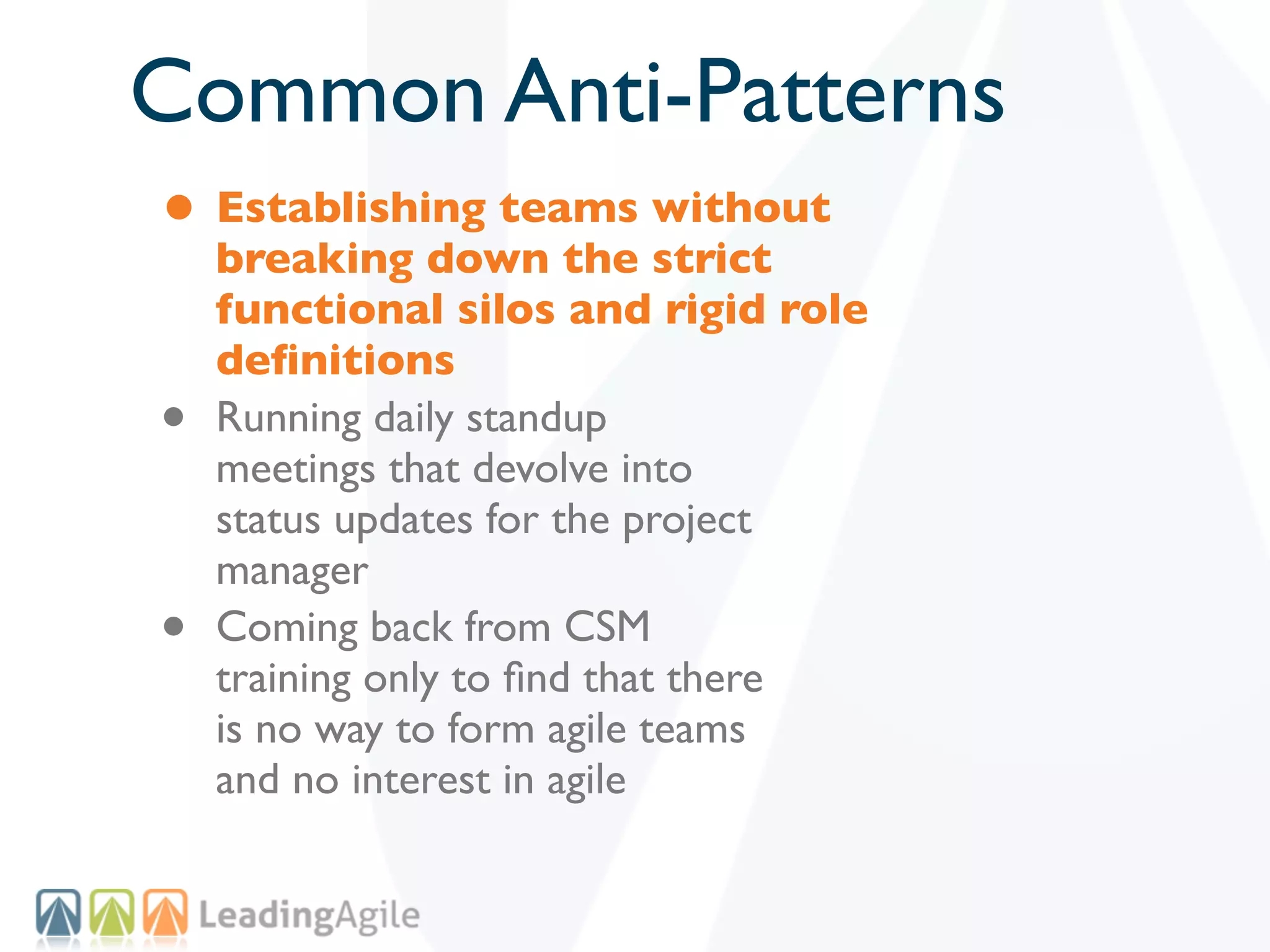
•   Establishing teams without
    breaking down the strict
    functional silos and rigid role
    definitions
•   Running daily standup
    meetings that devolve into
    status updates for the project
    manager
•   Coming back from CSM
    training only to find that there
    is no way to form agile teams
    and no interest in agile
Common Anti-Patterns
• Establishing teams without
    breaking down the strict
    functional silos and rigid role
    definitions
•   Running daily standup
    meetings that devolve into
    status updates for the project
    manager
•   Coming back from CSM
    training only to find that there
    is no way to form agile teams
    and no interest in agile
Common Anti-Patterns
•   Establishing teams without
    breaking down the strict
    functional silos and rigid role
    definitions
•   Running daily standup
    meetings that devolve into
    status updates for the project
    manager
•   Coming back from CSM
    training only to find that there
    is no way to form agile teams
    and no interest in agile
Common Anti-Patterns
•   Establishing teams without
    breaking down the strict
    functional silos and rigid role
    definitions
•   Running daily standup
    meetings that devolve into
    status updates for the project
    manager
•   Coming back from CSM
    training only to find that there
    is no way to form agile teams
    and no interest in agile
The Solution... Part Four
Exploring the
Integrated Framework
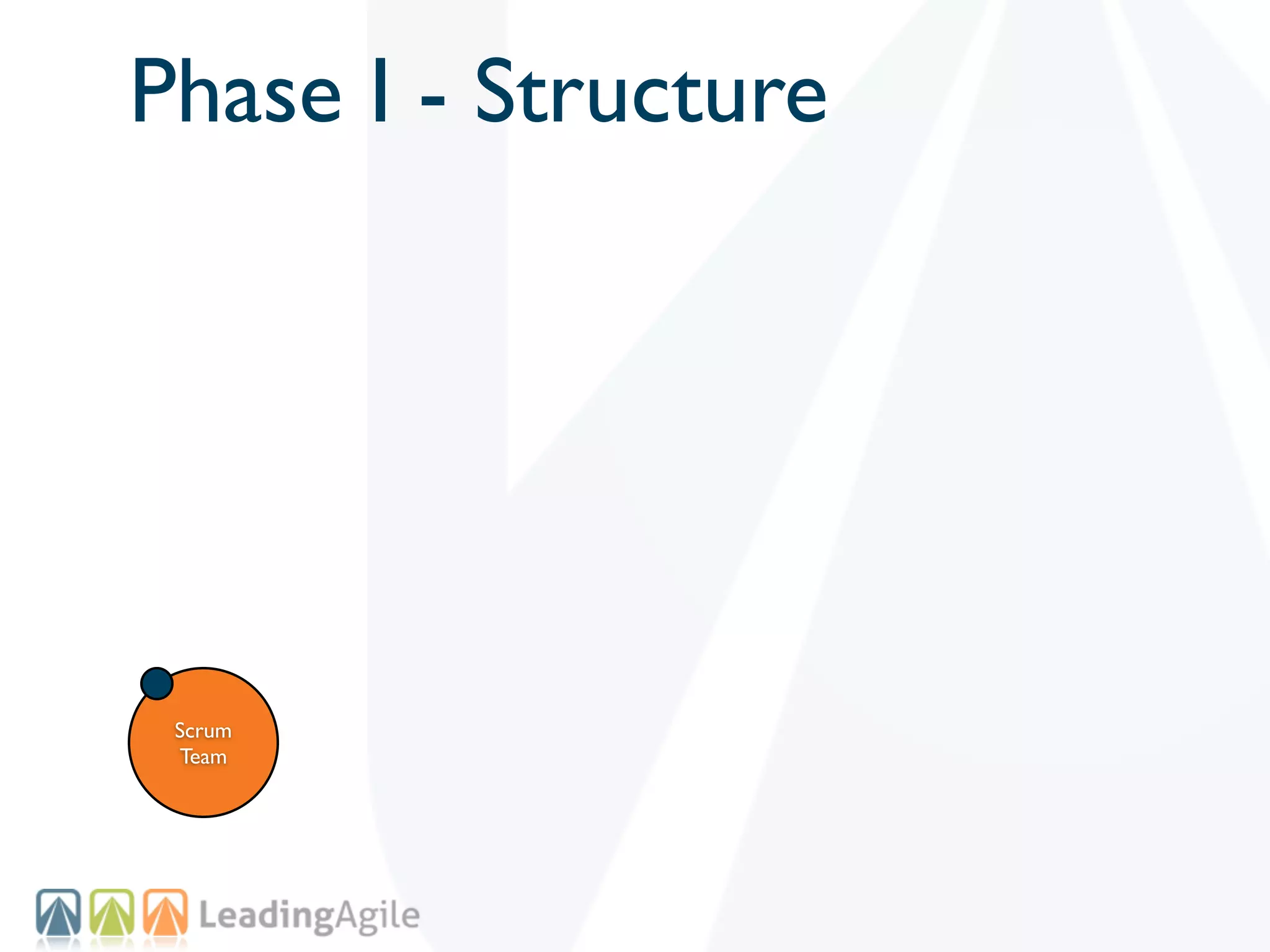
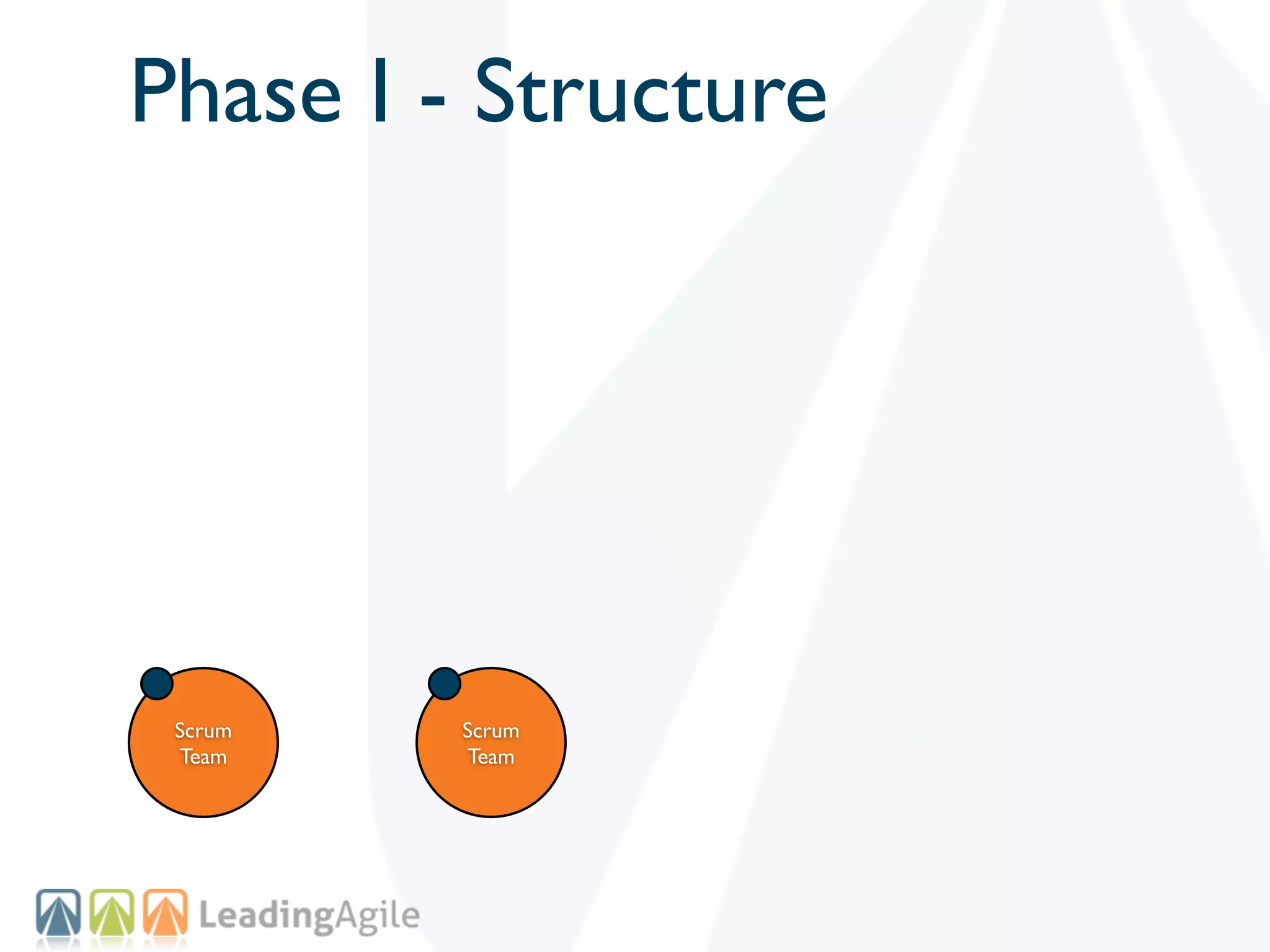
Phase I - Structure


 Scrum
 Team
Phase I - Structure


 Scrum   Scrum
 Team    Team
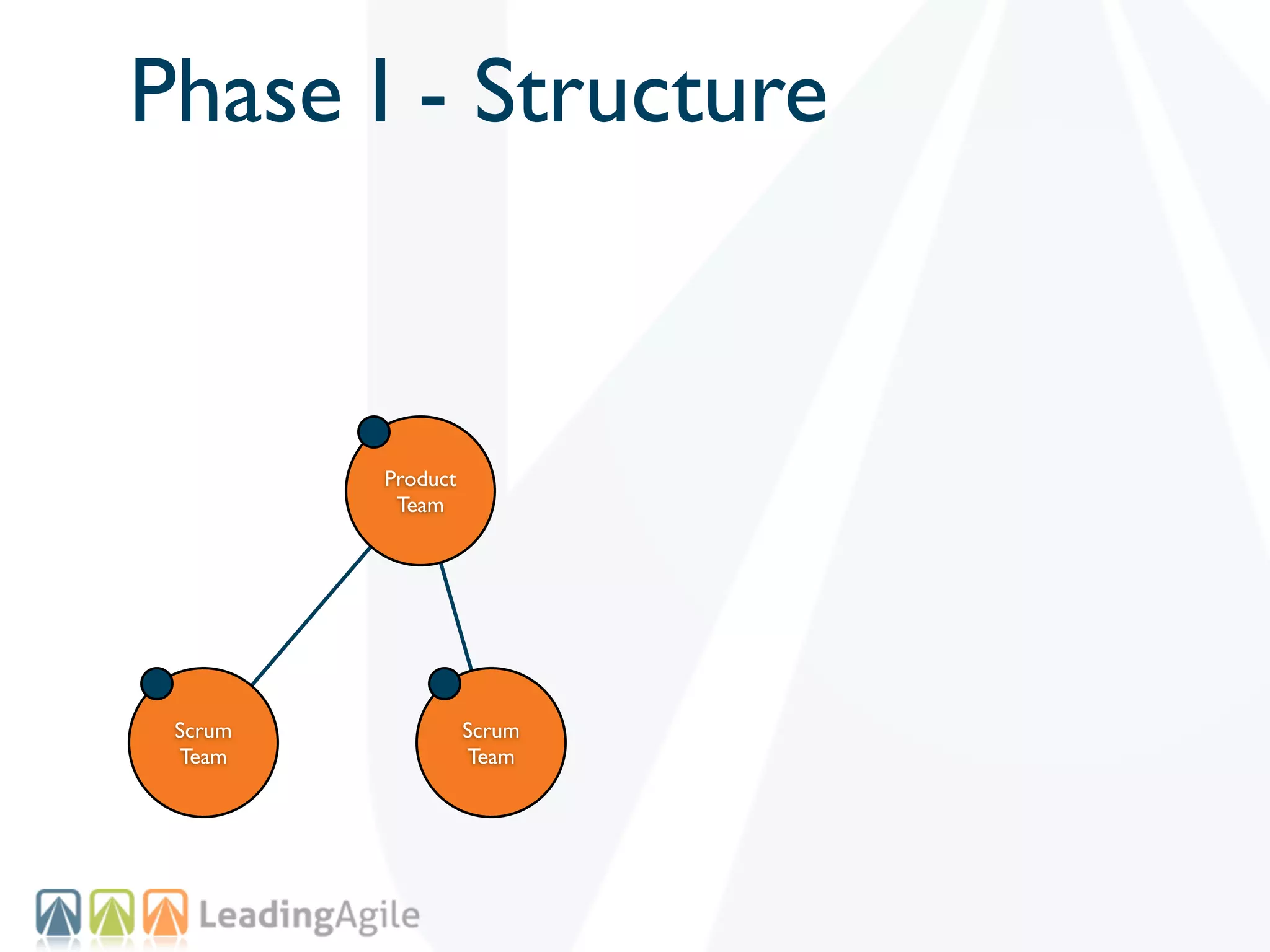
Phase I - Structure


         Product
          Team


 Scrum             Scrum
 Team              Team
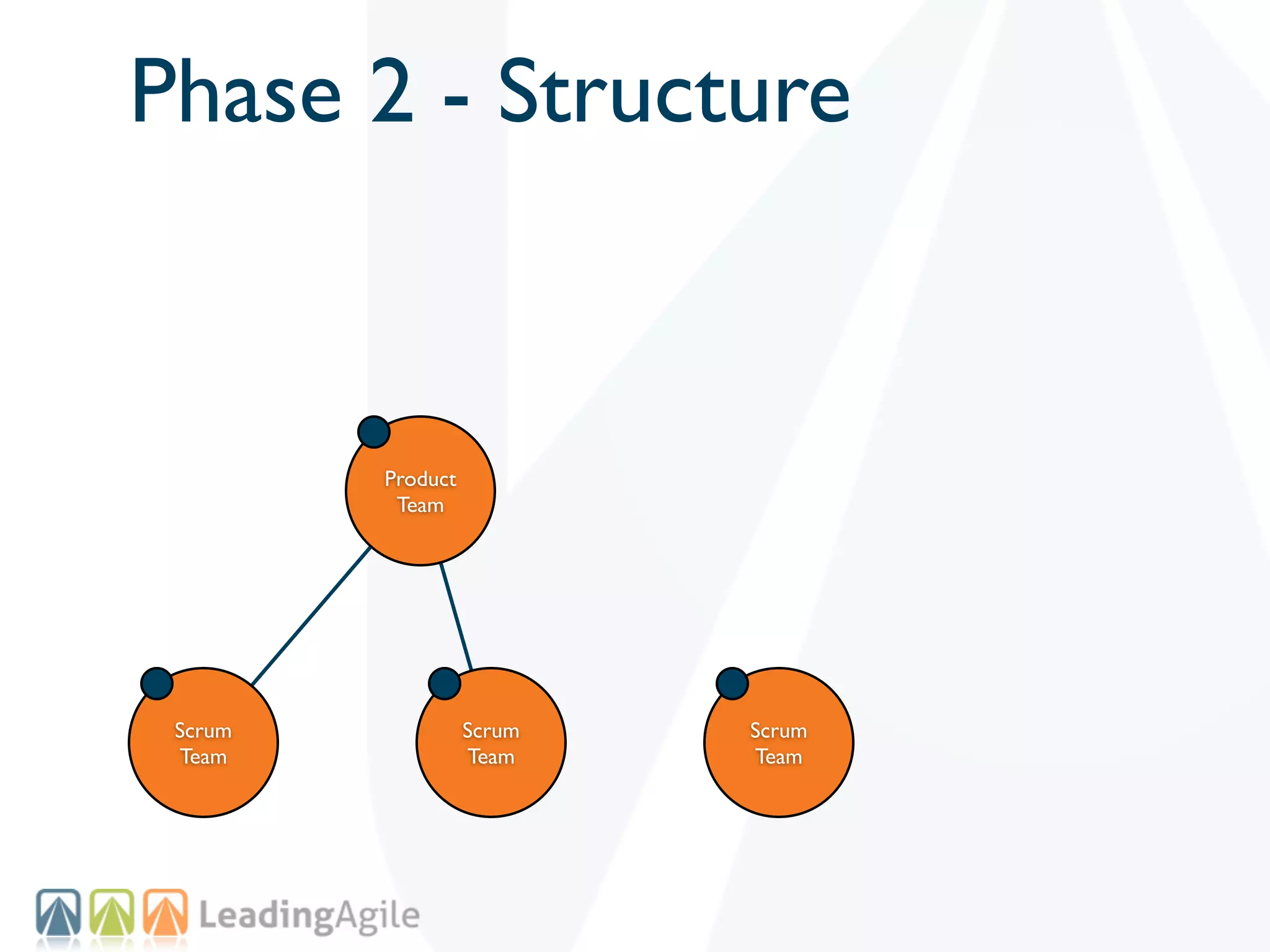
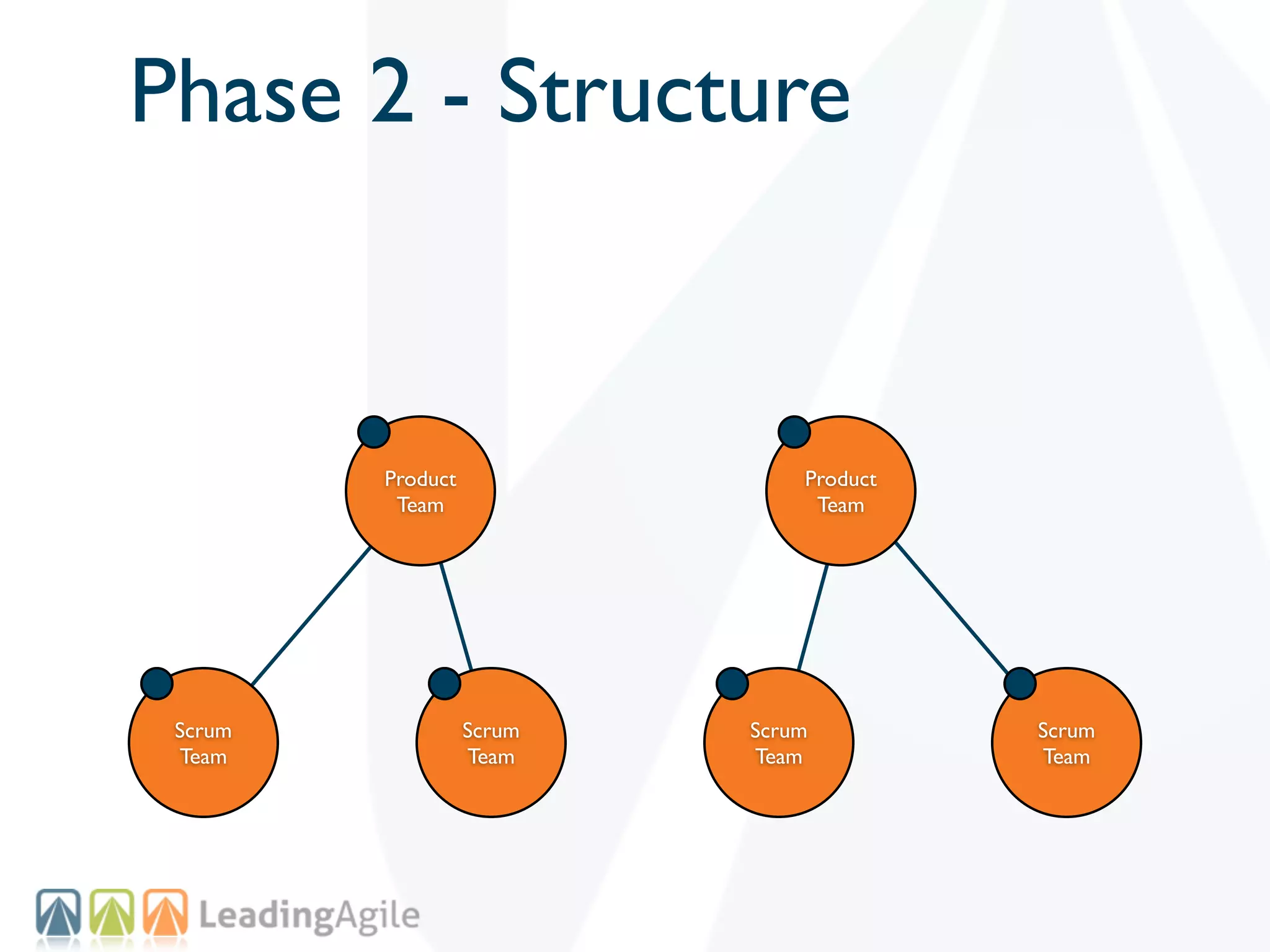
Phase 2 - Structure


         Product
          Team


 Scrum             Scrum   Scrum
 Team              Team    Team
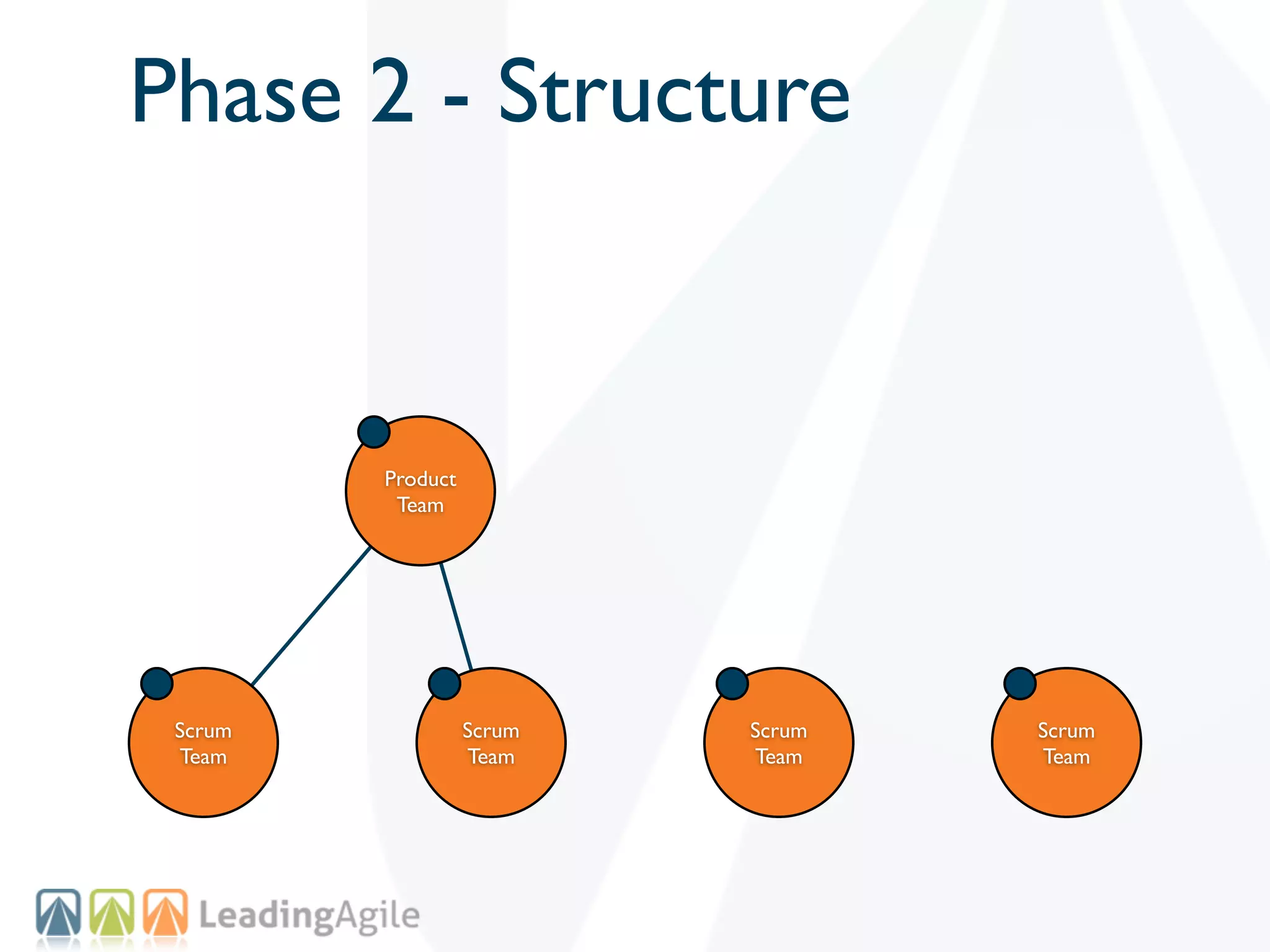
Phase 2 - Structure


         Product
          Team


 Scrum             Scrum   Scrum   Scrum
 Team              Team    Team    Team
Phase 2 - Structure


         Product               Product
          Team                  Team


 Scrum             Scrum   Scrum         Scrum
 Team              Team    Team          Team
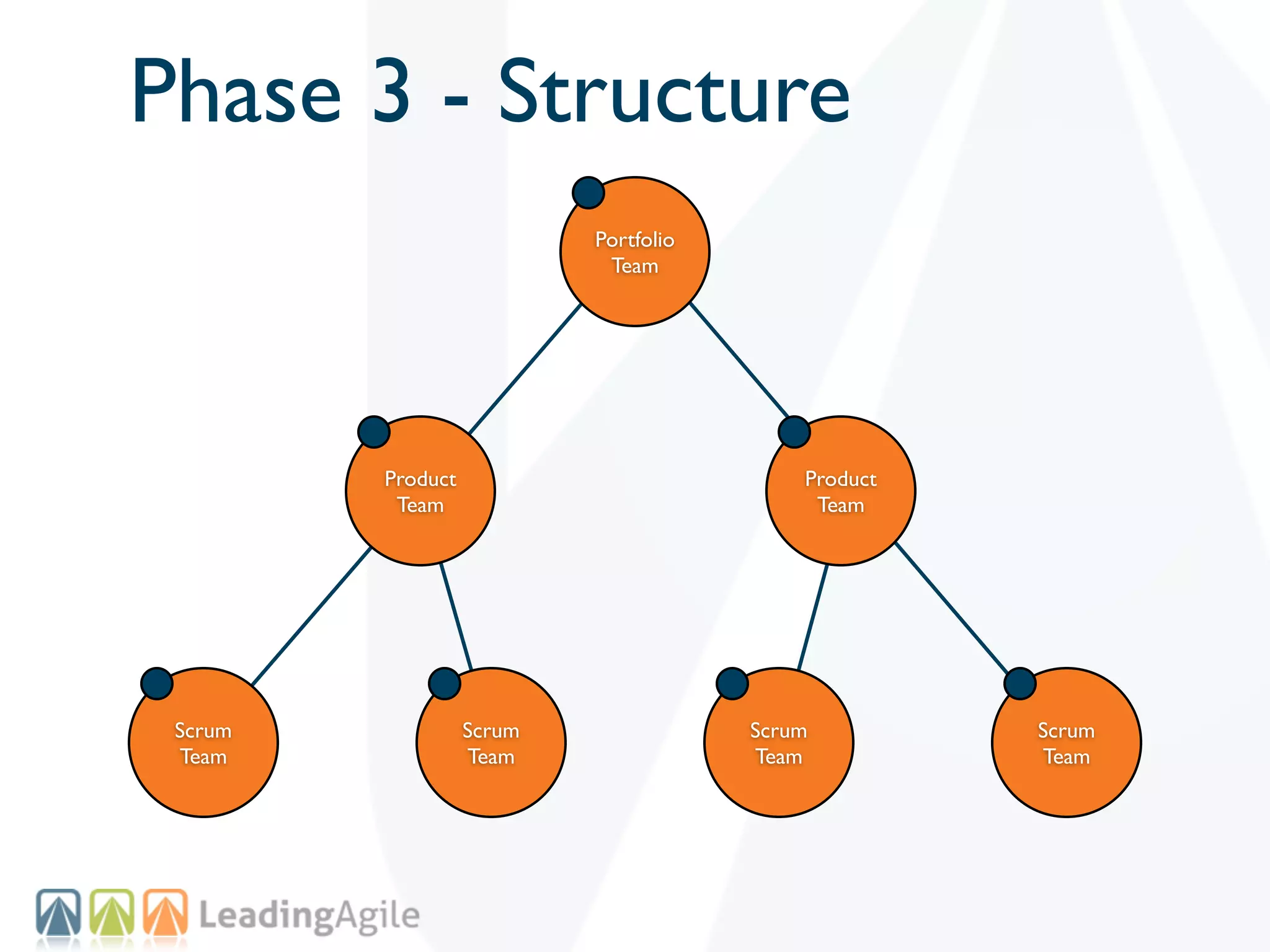
Phase 3 - Structure
                           Portfolio
                            Team


         Product                           Product
          Team                              Team


 Scrum             Scrum               Scrum         Scrum
 Team              Team                Team          Team
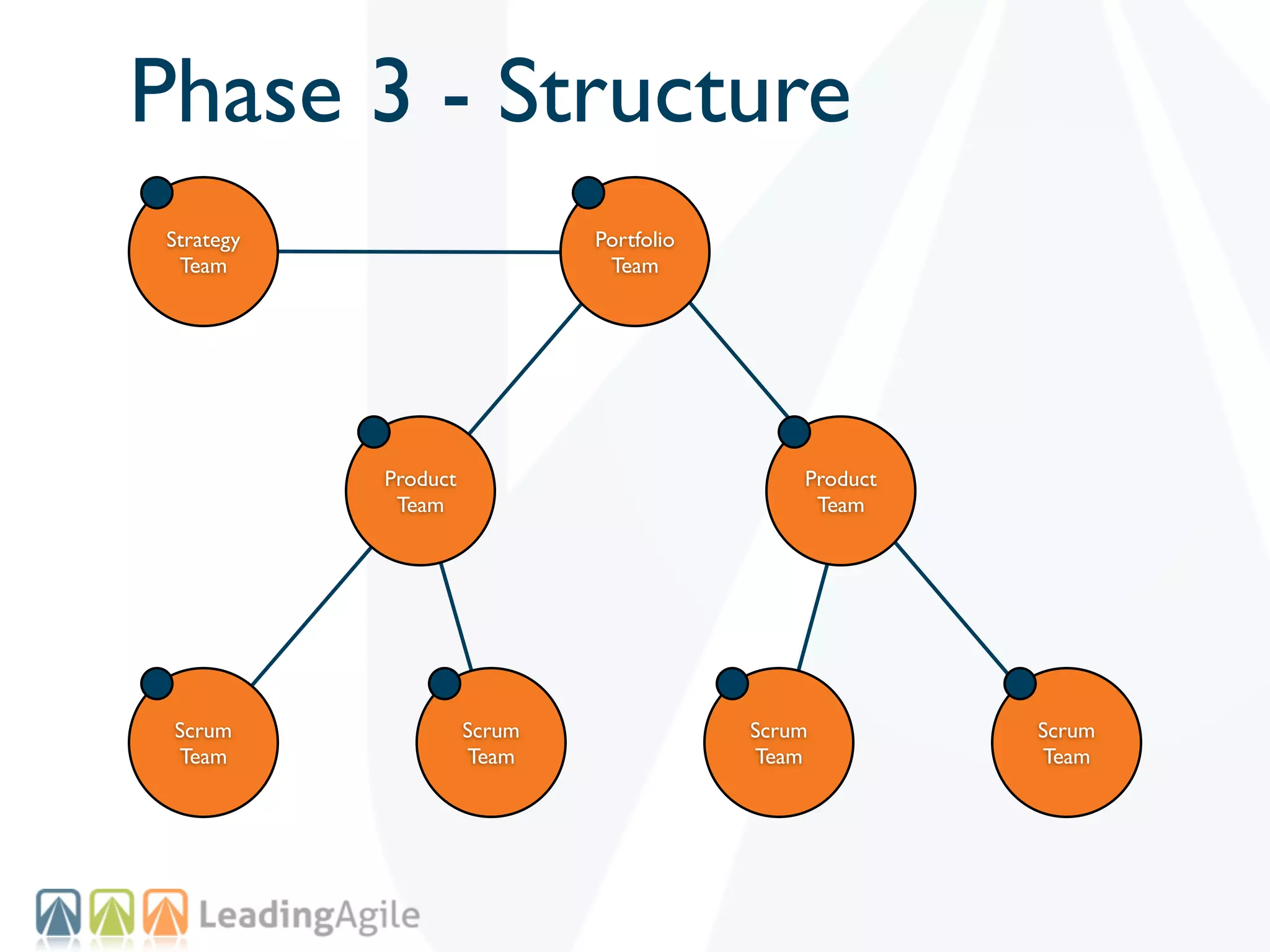
Phase 3 - Structure
Strategy                     Portfolio
 Team                         Team


           Product                           Product
            Team                              Team


 Scrum               Scrum               Scrum         Scrum
 Team                Team                Team          Team
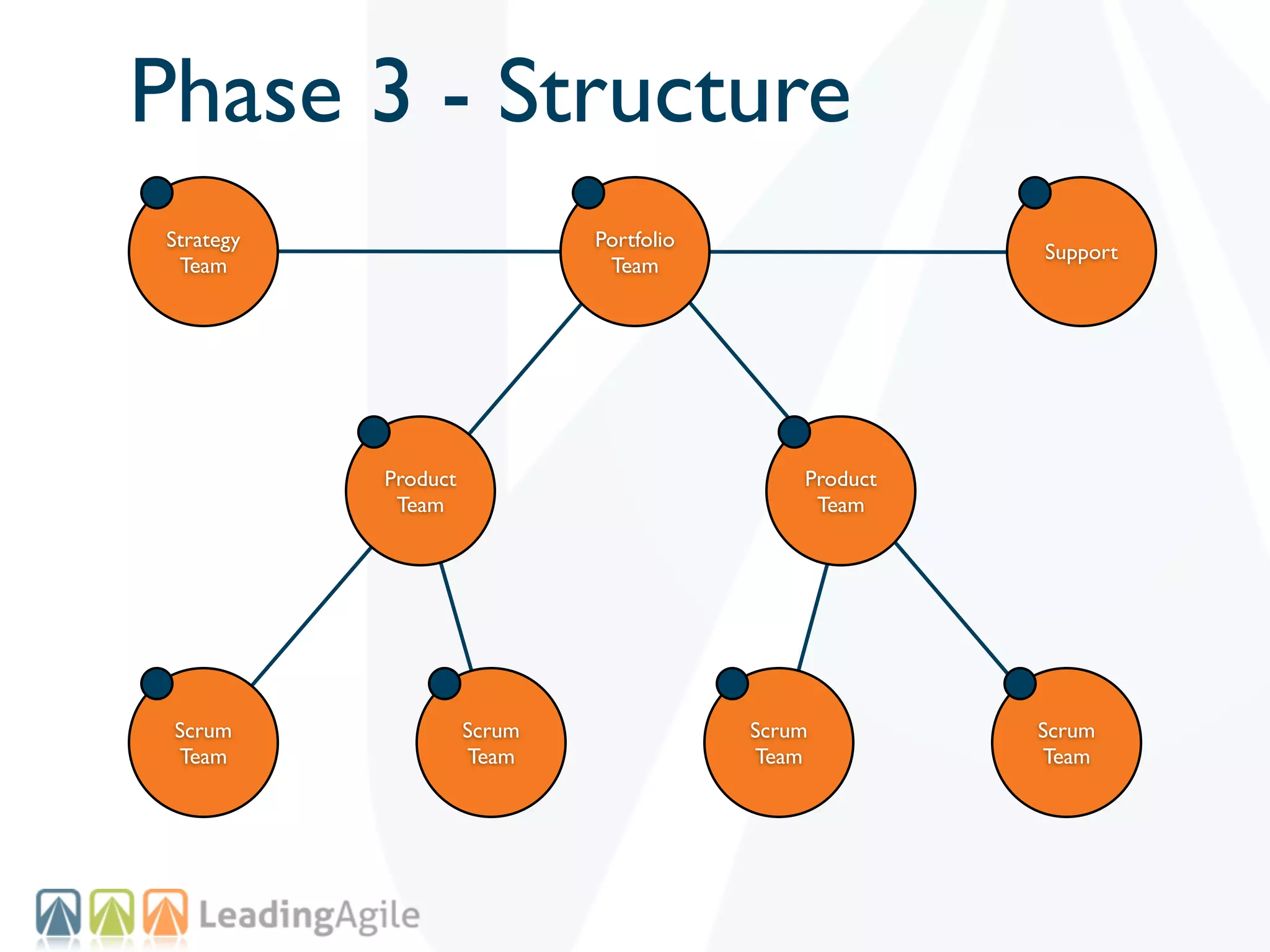
Phase 3 - Structure
Strategy                     Portfolio
                                                       Support
 Team                         Team


           Product                           Product
            Team                              Team


 Scrum               Scrum               Scrum         Scrum
 Team                Team                Team          Team
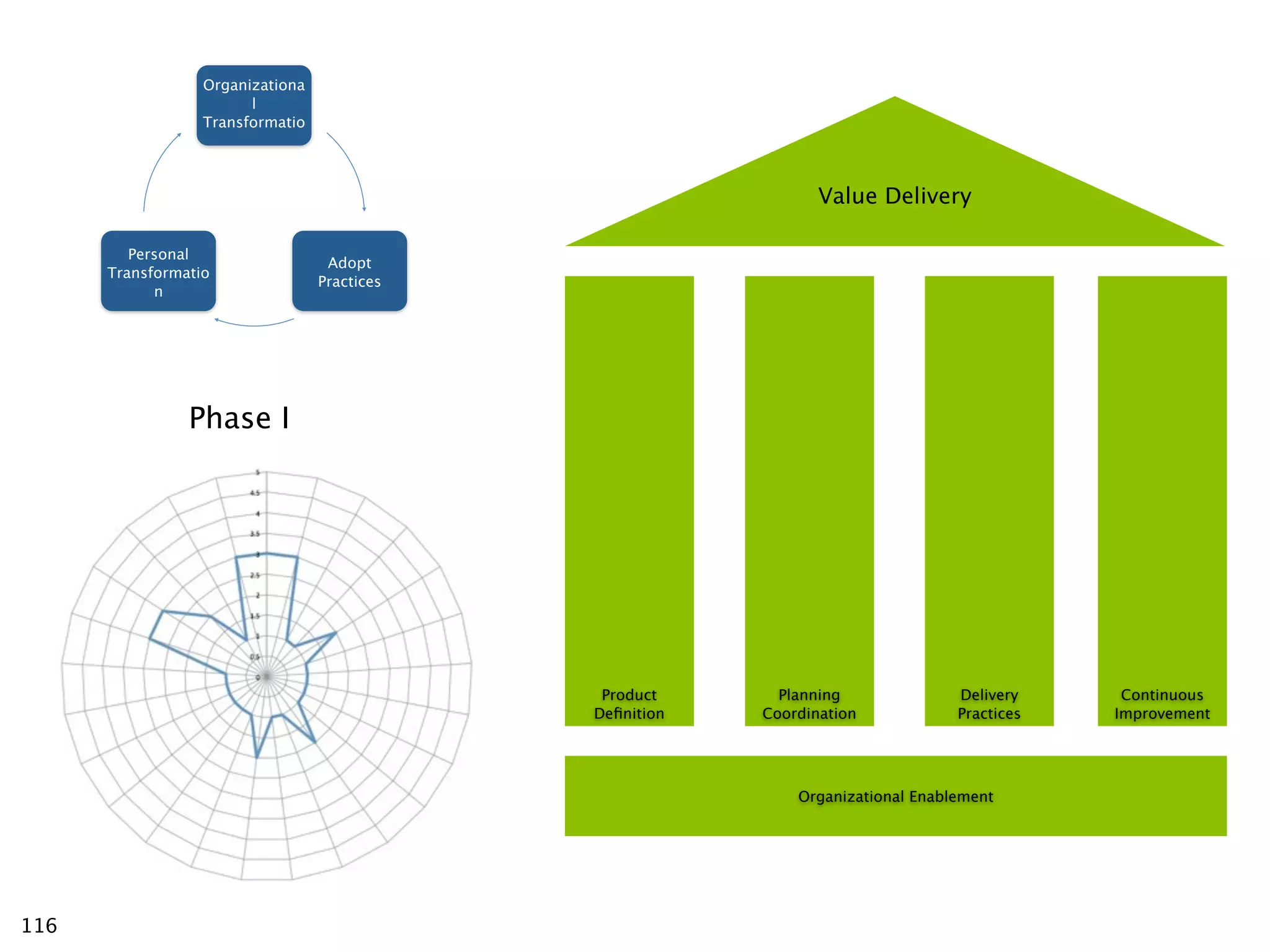
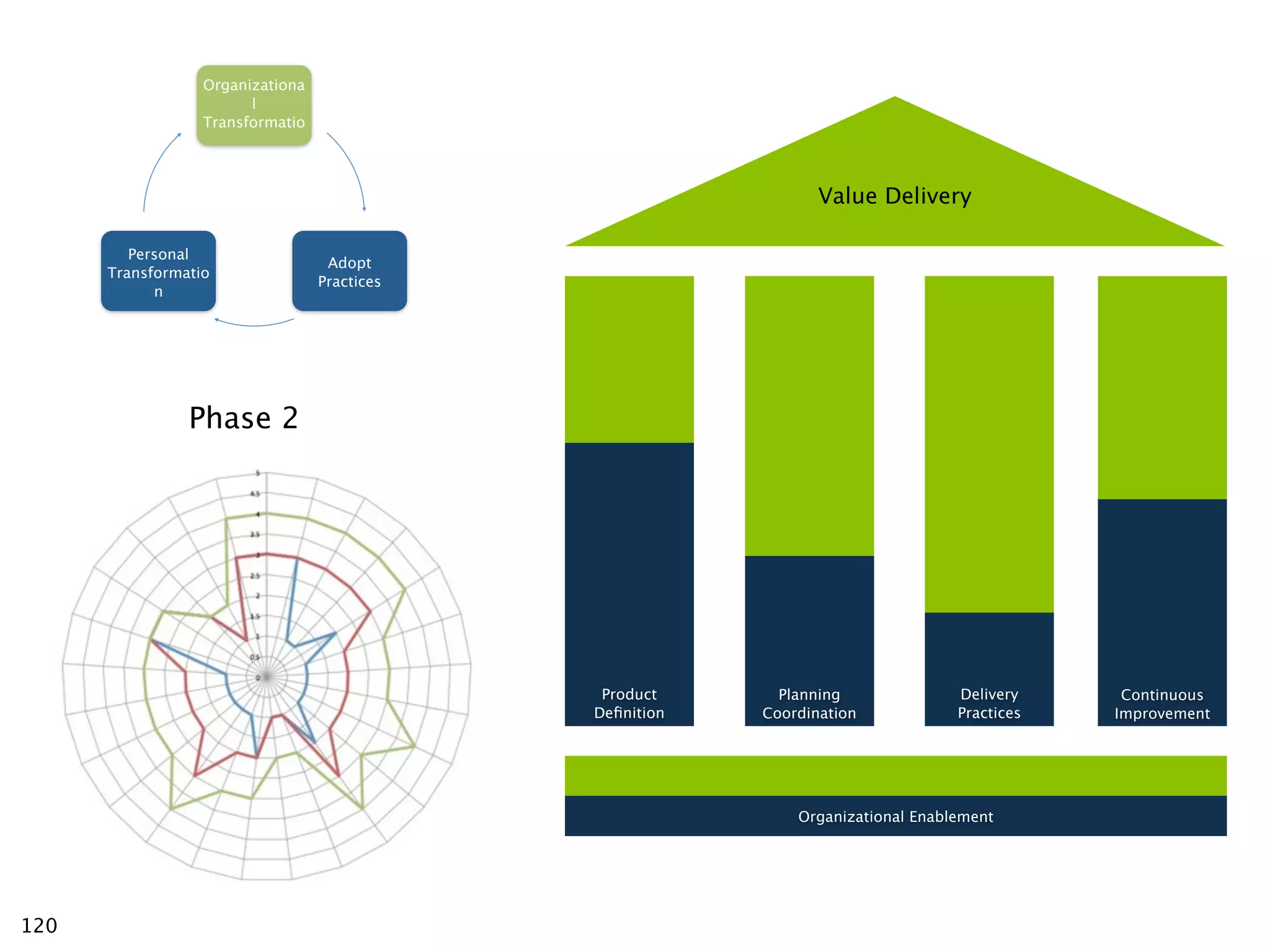
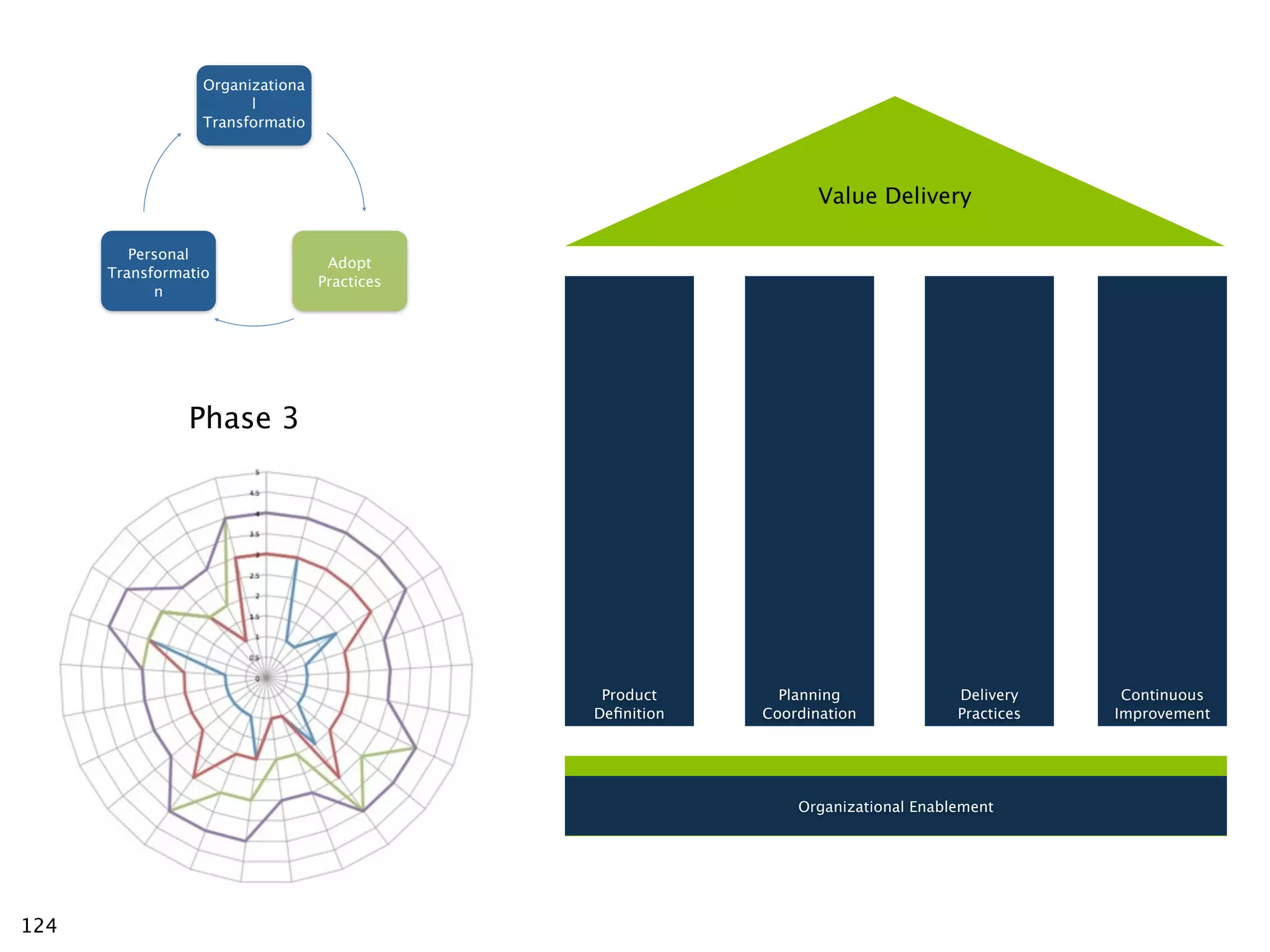
Organizationa
                        l
                  Transformatio


                                                                 Value Delivery

         Personal
                                   Adopt
      Transformatio
                                  Practices
            n


                Phase I


                                               Product      Planning           Delivery     Continuous
                                              Definition   Coordination         Practices   Improvement


                                                              OrganizationalFactors
                                                               Cultural Enablement


116
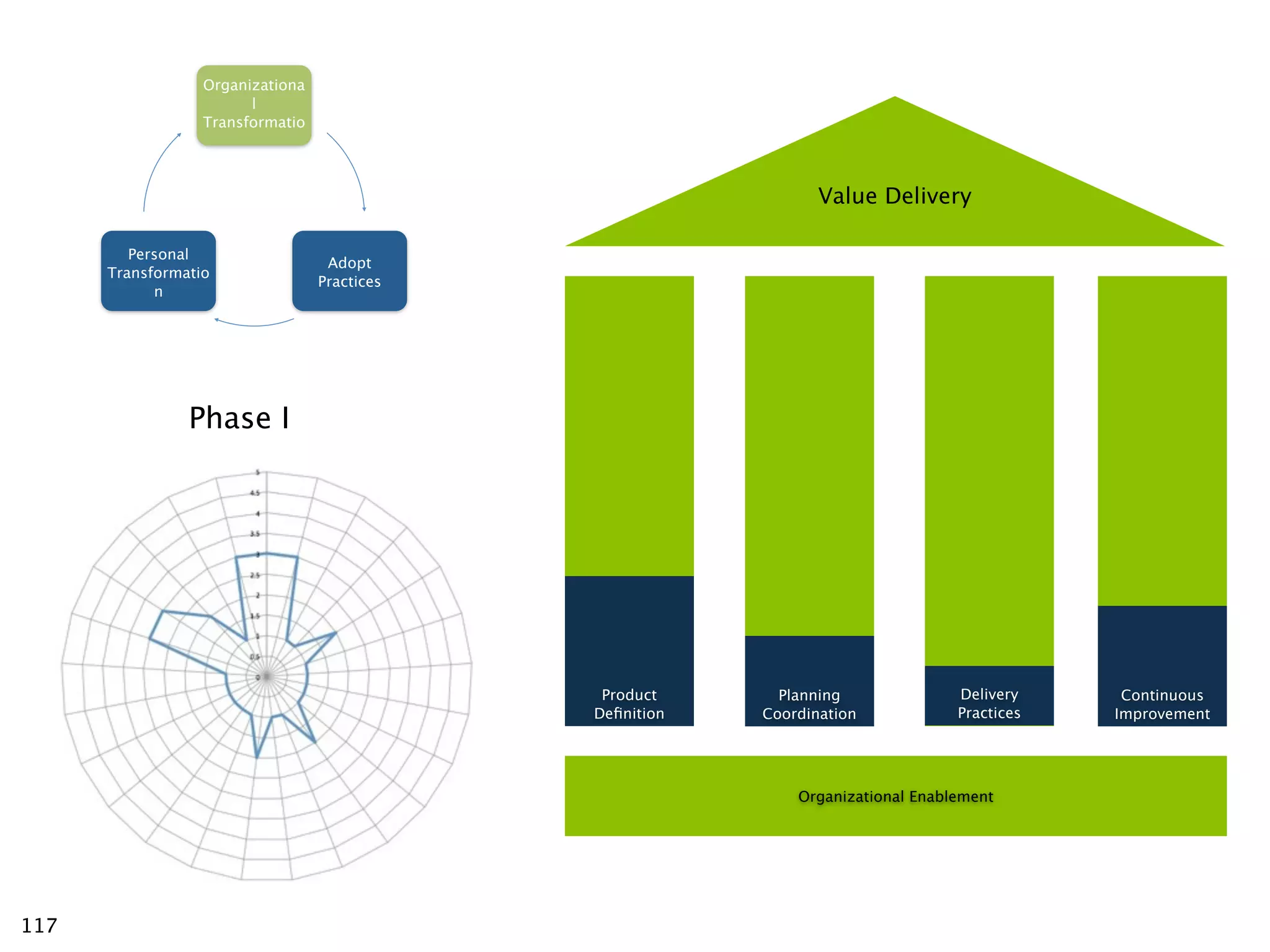
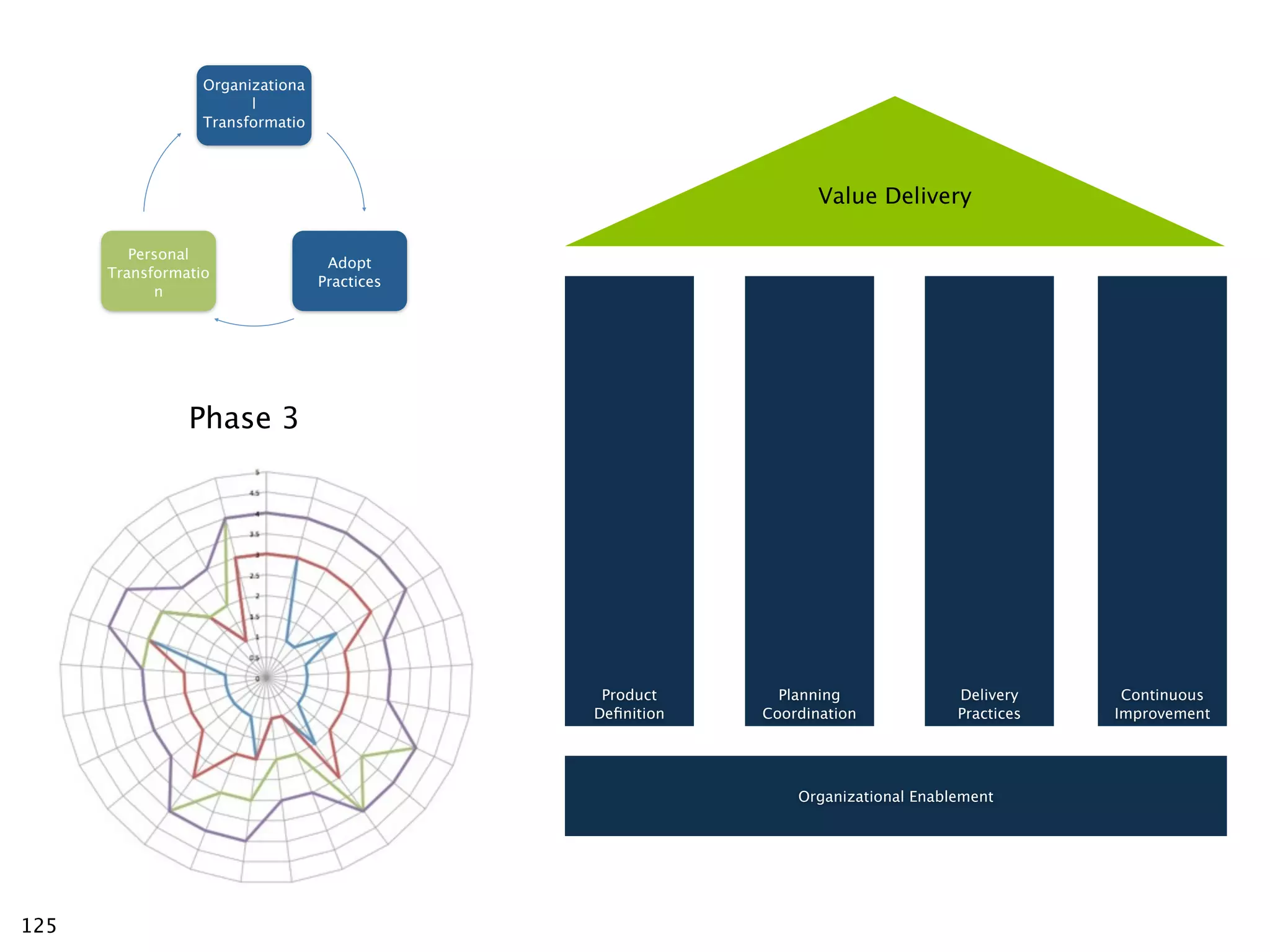
Organizationa
                        l
                  Transformatio


                                                                 Value Delivery

         Personal
                                   Adopt
      Transformatio
                                  Practices
            n


                Phase I


                                               Product      Planning              Delivery     Continuous
                                              Definition   Coordination            Practices   Improvement


                                                              Organizational Enablement


117
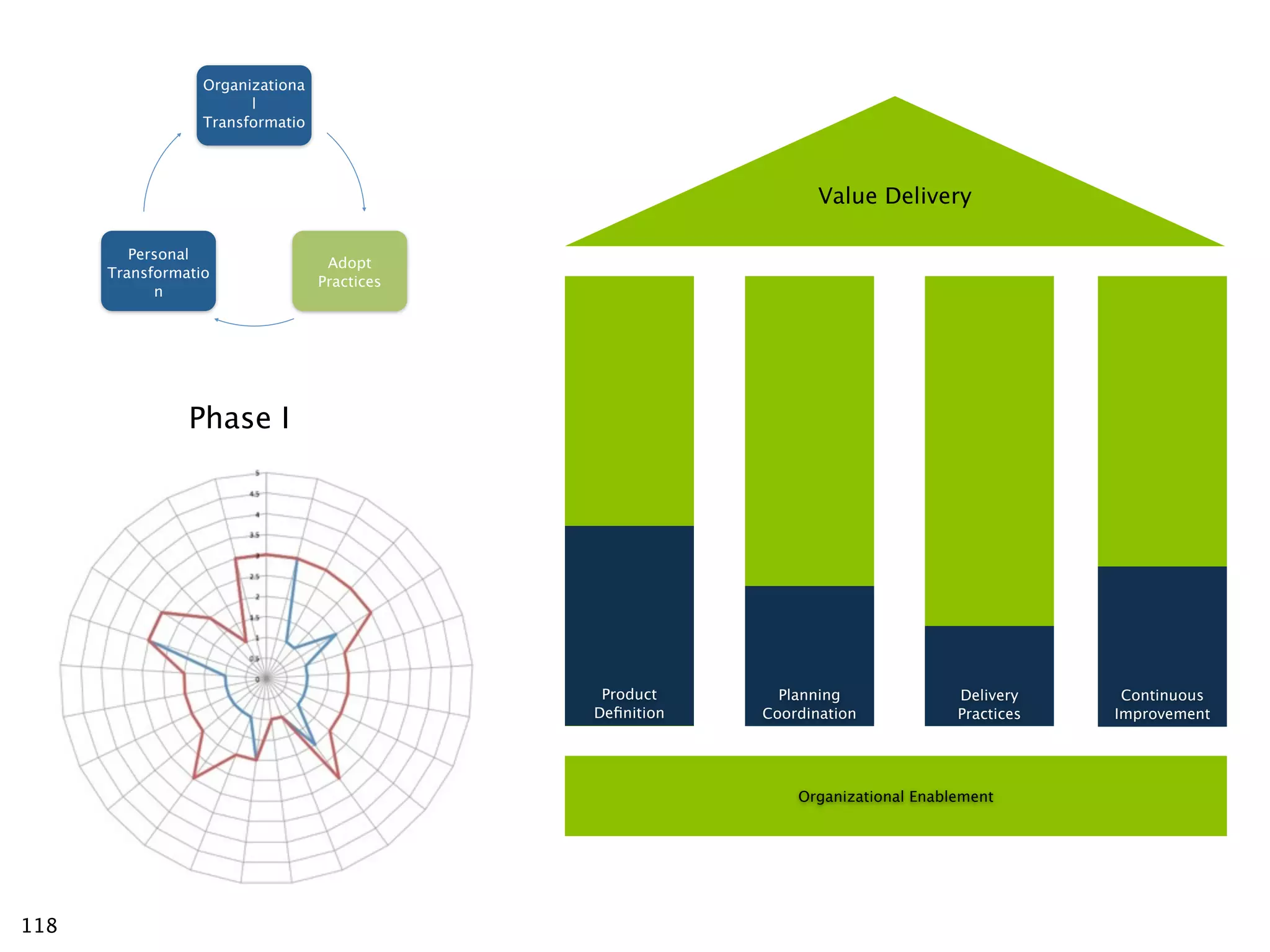
Organizationa
                        l
                  Transformatio


                                                                 Value Delivery

         Personal
                                   Adopt
      Transformatio
                                  Practices
            n


                Phase I


                                               Product      Planning              Delivery     Continuous
                                              Definition   Coordination            Practices   Improvement


                                                              Organizational Enablement


118
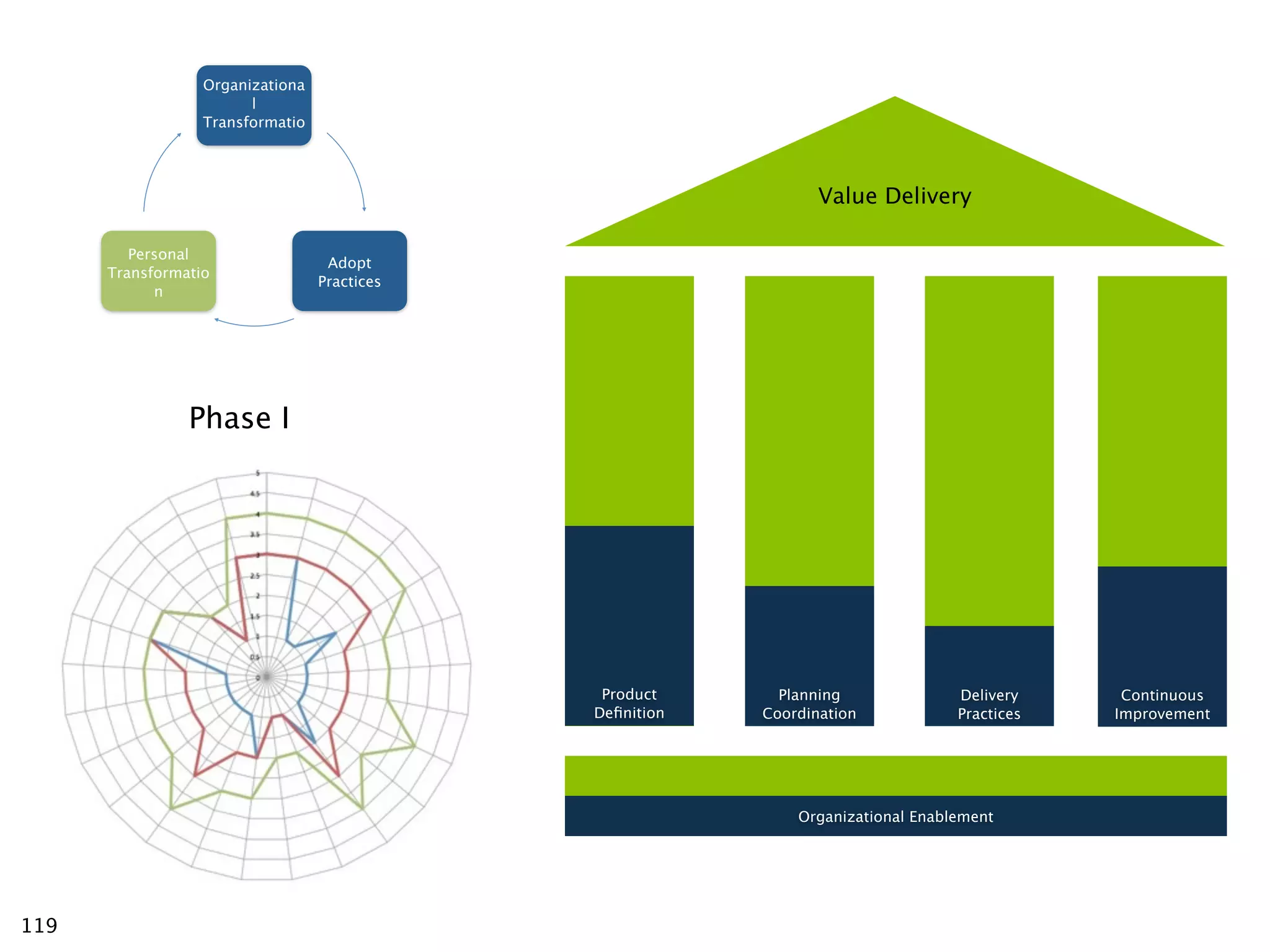
Organizationa
                        l
                  Transformatio


                                                                 Value Delivery

         Personal
                                   Adopt
      Transformatio
                                  Practices
            n


                Phase I


                                               Product      Planning              Delivery     Continuous
                                              Definition   Coordination            Practices   Improvement


                                                              Organizational Enablement


119
Organizationa
                        l
                  Transformatio


                                                                 Value Delivery

         Personal
                                   Adopt
      Transformatio
                                  Practices
            n


                Phase 2


                                               Product      Planning              Delivery     Continuous
                                              Definition   Coordination            Practices   Improvement


                                                              Organizational Enablement


120
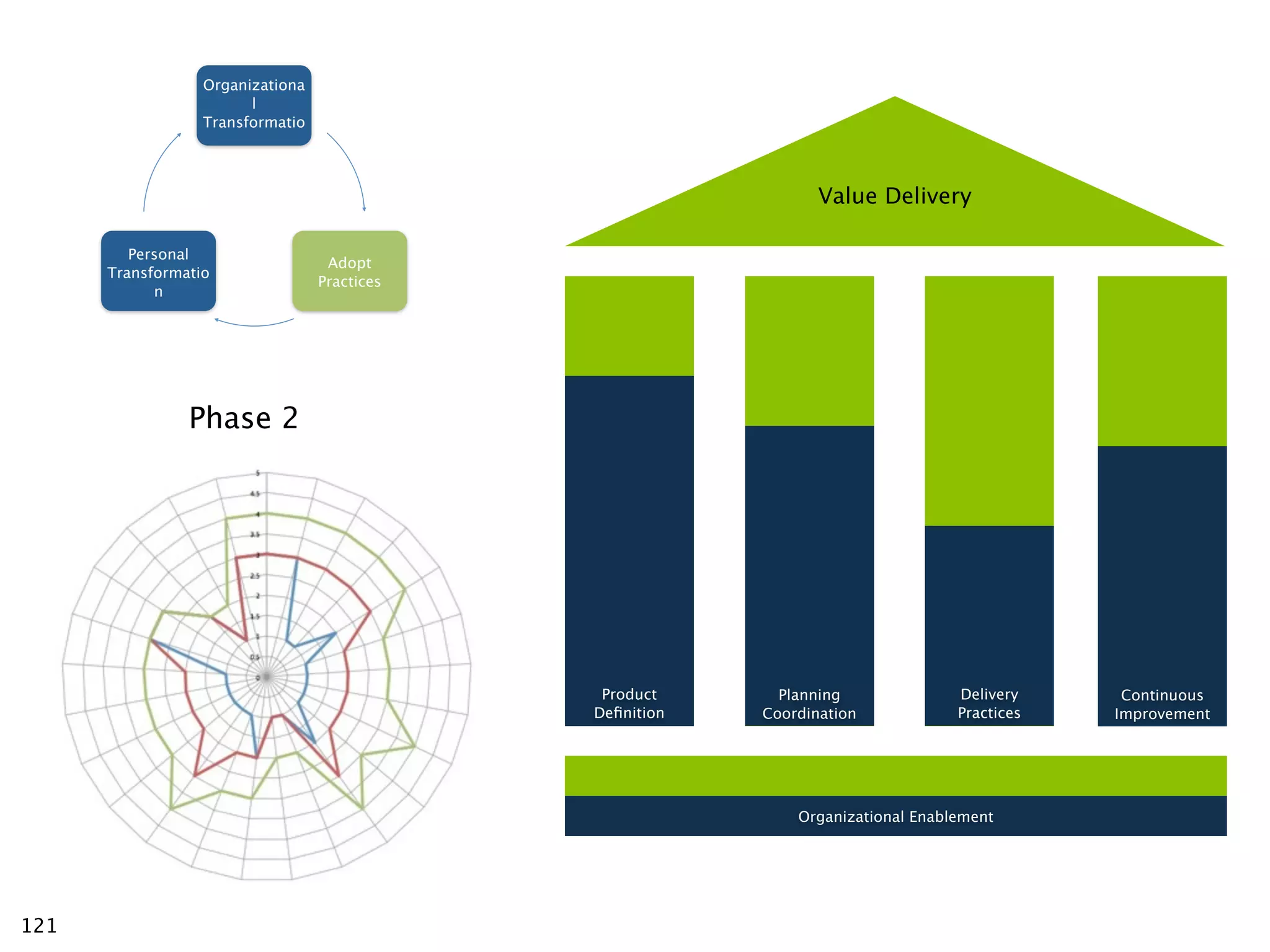
Organizationa
                        l
                  Transformatio


                                                                 Value Delivery

         Personal
                                   Adopt
      Transformatio
                                  Practices
            n


                Phase 2


                                               Product      Planning              Delivery     Continuous
                                              Definition   Coordination            Practices   Improvement


                                                              Organizational Enablement


121
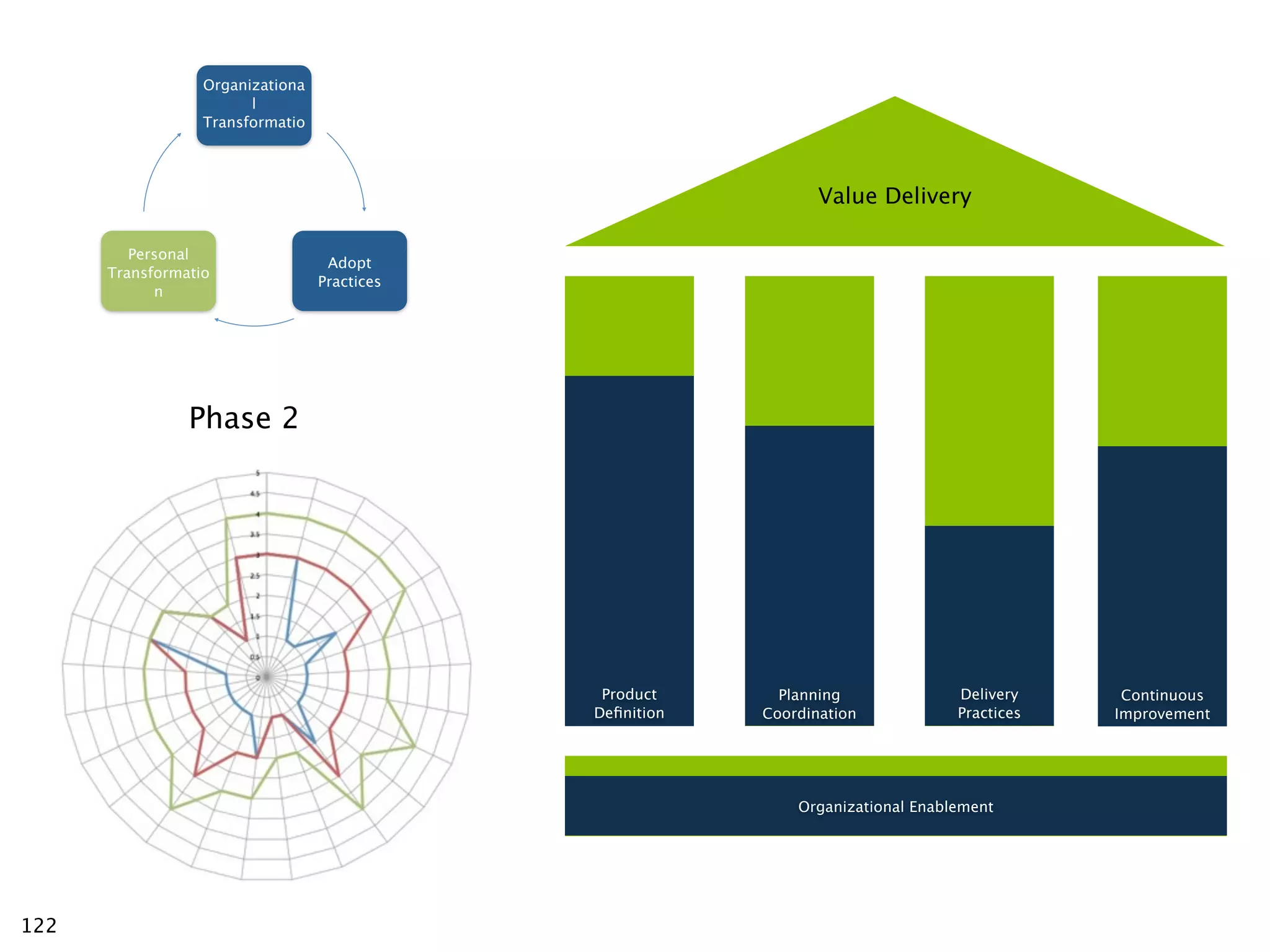
Organizationa
                        l
                  Transformatio


                                                                 Value Delivery

         Personal
                                   Adopt
      Transformatio
                                  Practices
            n


                Phase 2


                                               Product      Planning              Delivery     Continuous
                                              Definition   Coordination            Practices   Improvement


                                                              Organizational Enablement


122
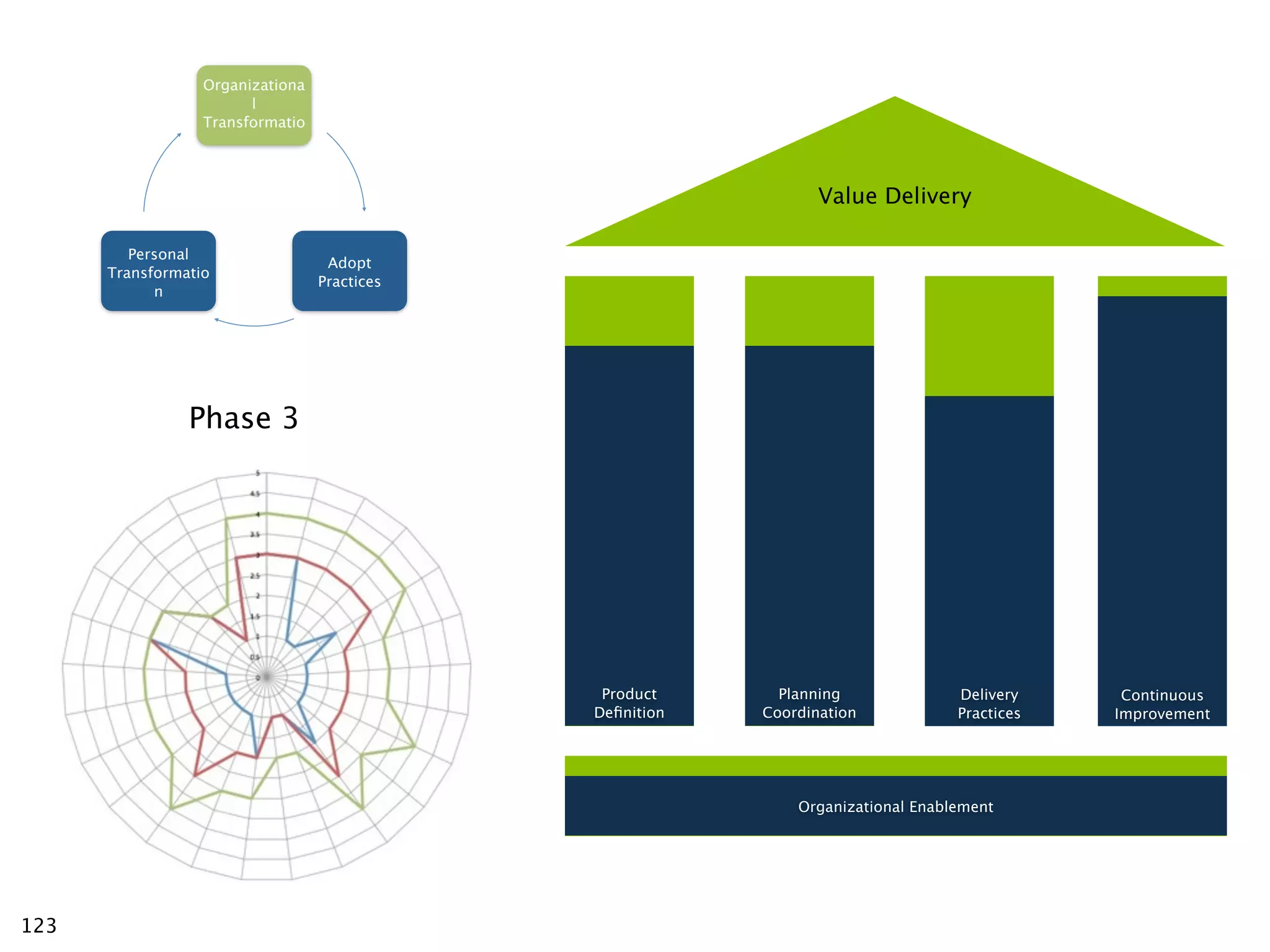
Organizationa
                        l
                  Transformatio


                                                                 Value Delivery

         Personal
                                   Adopt
      Transformatio
                                  Practices
            n


                Phase 3


                                               Product      Planning              Delivery     Continuous
                                              Definition   Coordination            Practices   Improvement


                                                              Organizational Enablement


123
Organizationa
                        l
                  Transformatio


                                                                 Value Delivery

         Personal
                                   Adopt
      Transformatio
                                  Practices
            n


                Phase 3


                                               Product      Planning              Delivery     Continuous
                                              Definition   Coordination            Practices   Improvement


                                                              Organizational Enablement


124
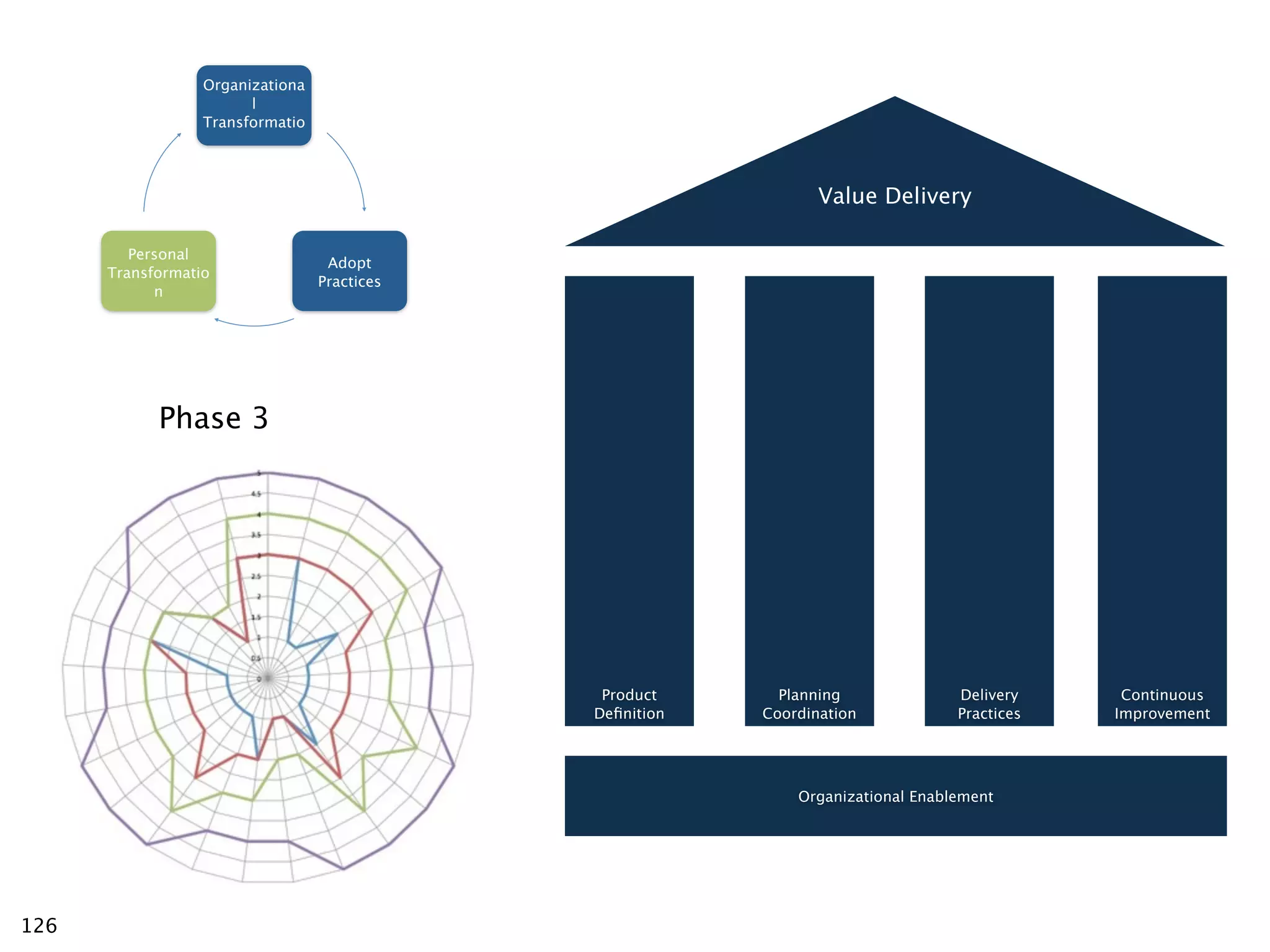
Organizationa
                        l
                  Transformatio


                                                                 Value Delivery

         Personal
                                   Adopt
      Transformatio
                                  Practices
            n


                Phase 3


                                               Product      Planning              Delivery     Continuous
                                              Definition   Coordination            Practices   Improvement


                                                              Organizational Enablement


125
Organizationa
                        l
                  Transformatio


                                                                 Value Delivery

         Personal
                                   Adopt
      Transformatio
                                  Practices
            n


            Phase 3


                                               Product      Planning              Delivery     Continuous
                                              Definition   Coordination            Practices   Improvement


                                                              Organizational Enablement


126
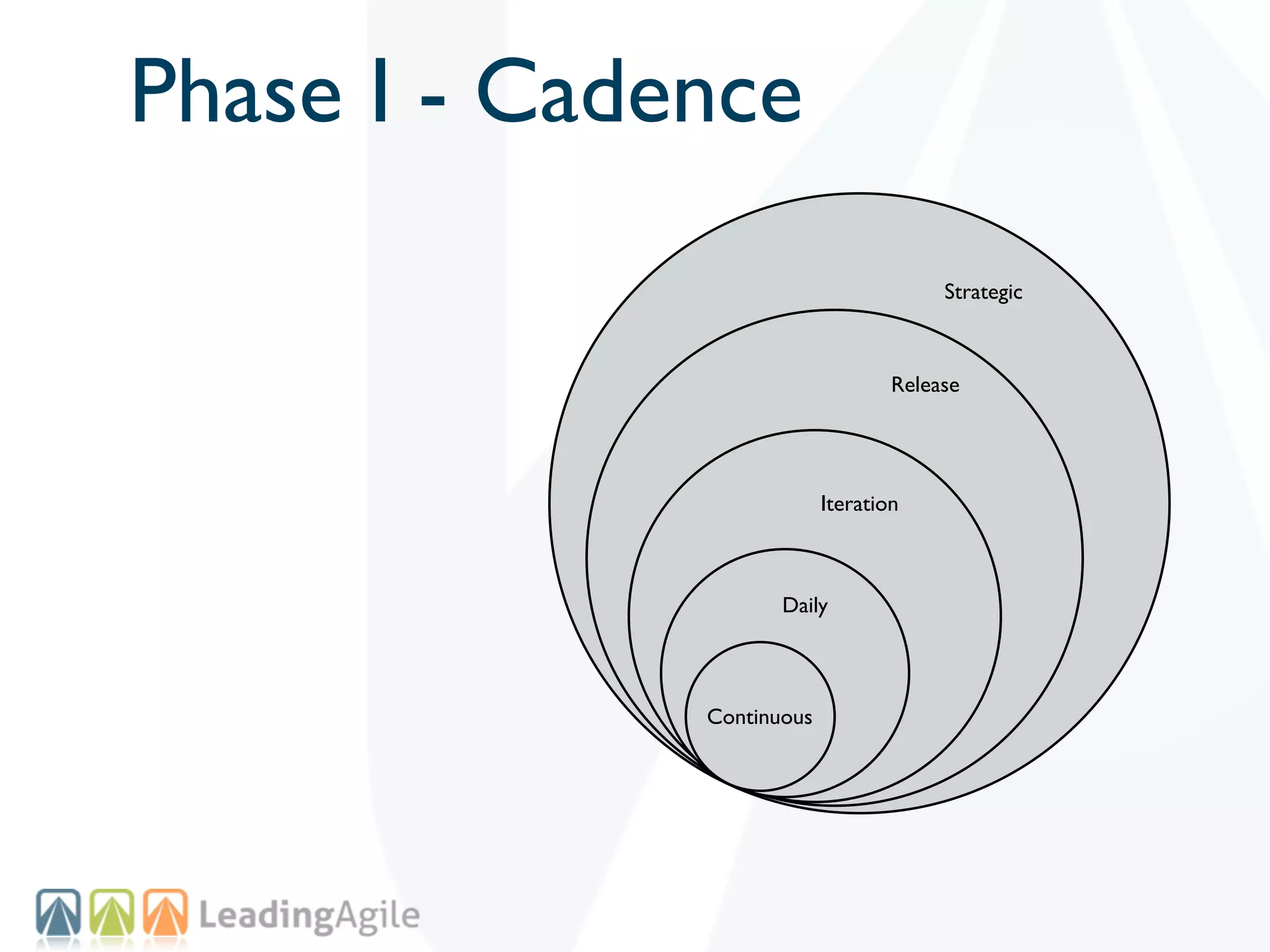
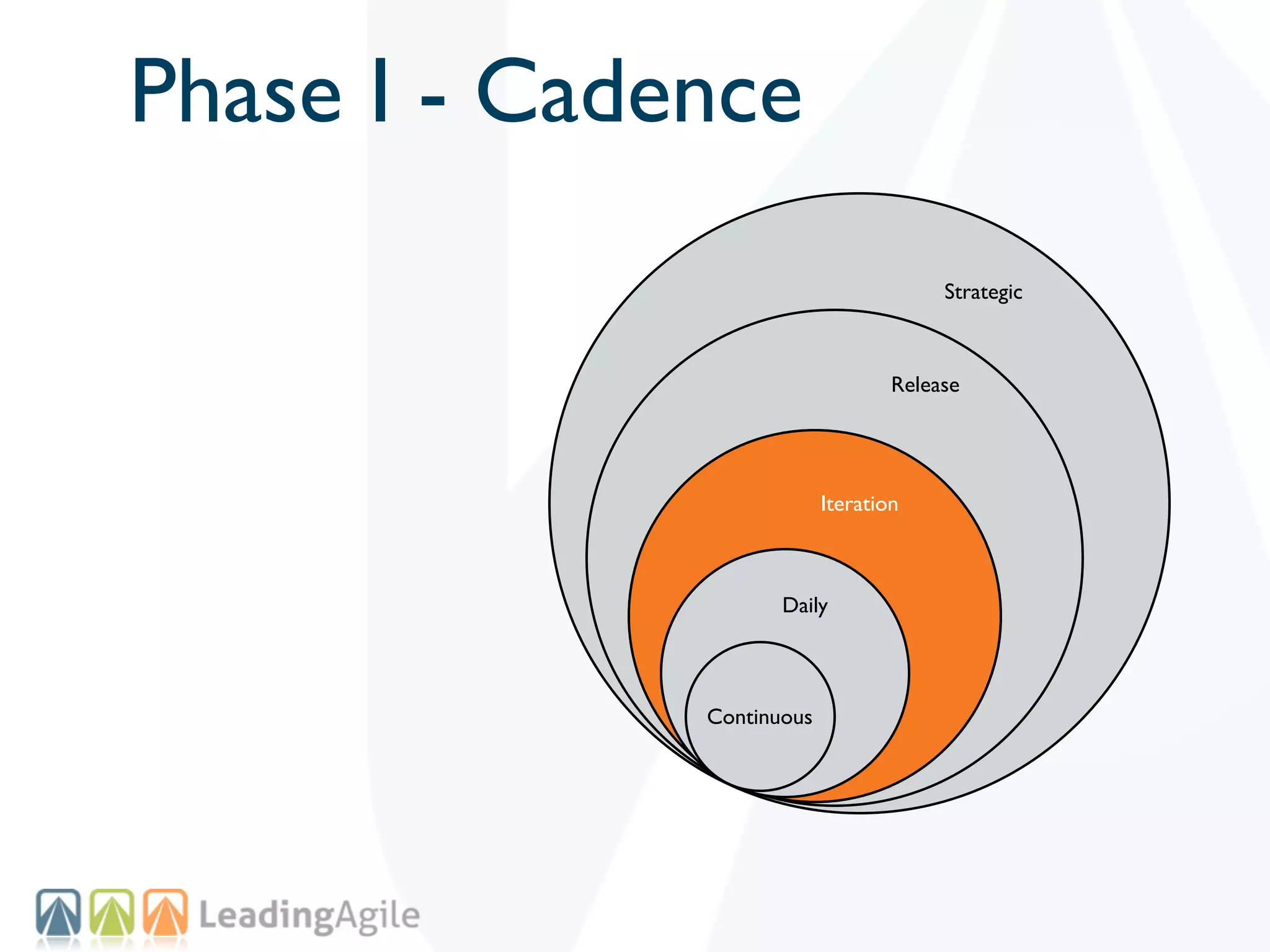
Phase I - Cadence
                                        Strategic


                                   Release


                           Iteration


                     Daily


              Continuous
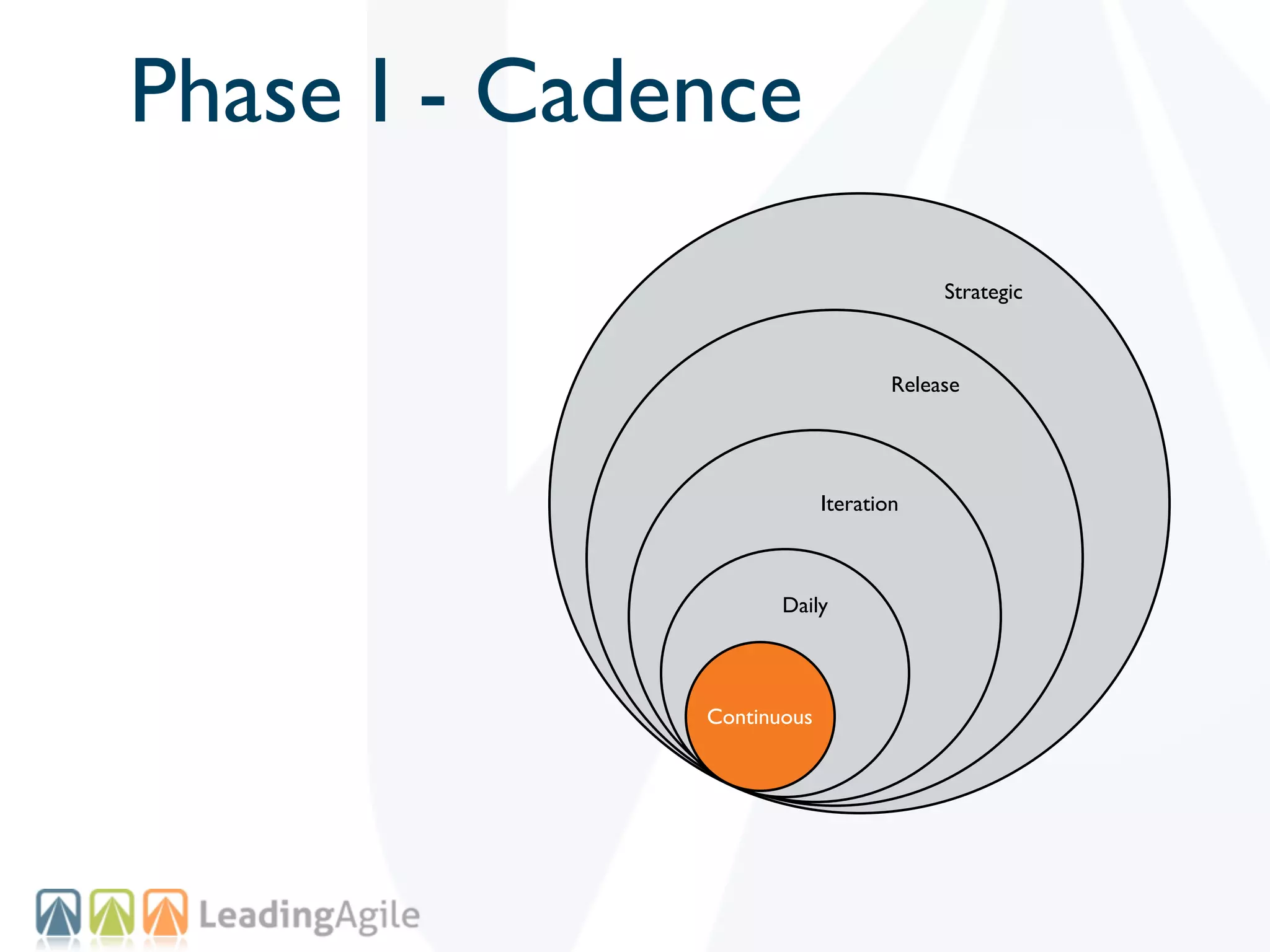
Phase I - Cadence
                                        Strategic


                                   Release


                           Iteration


                     Daily


              Continuous
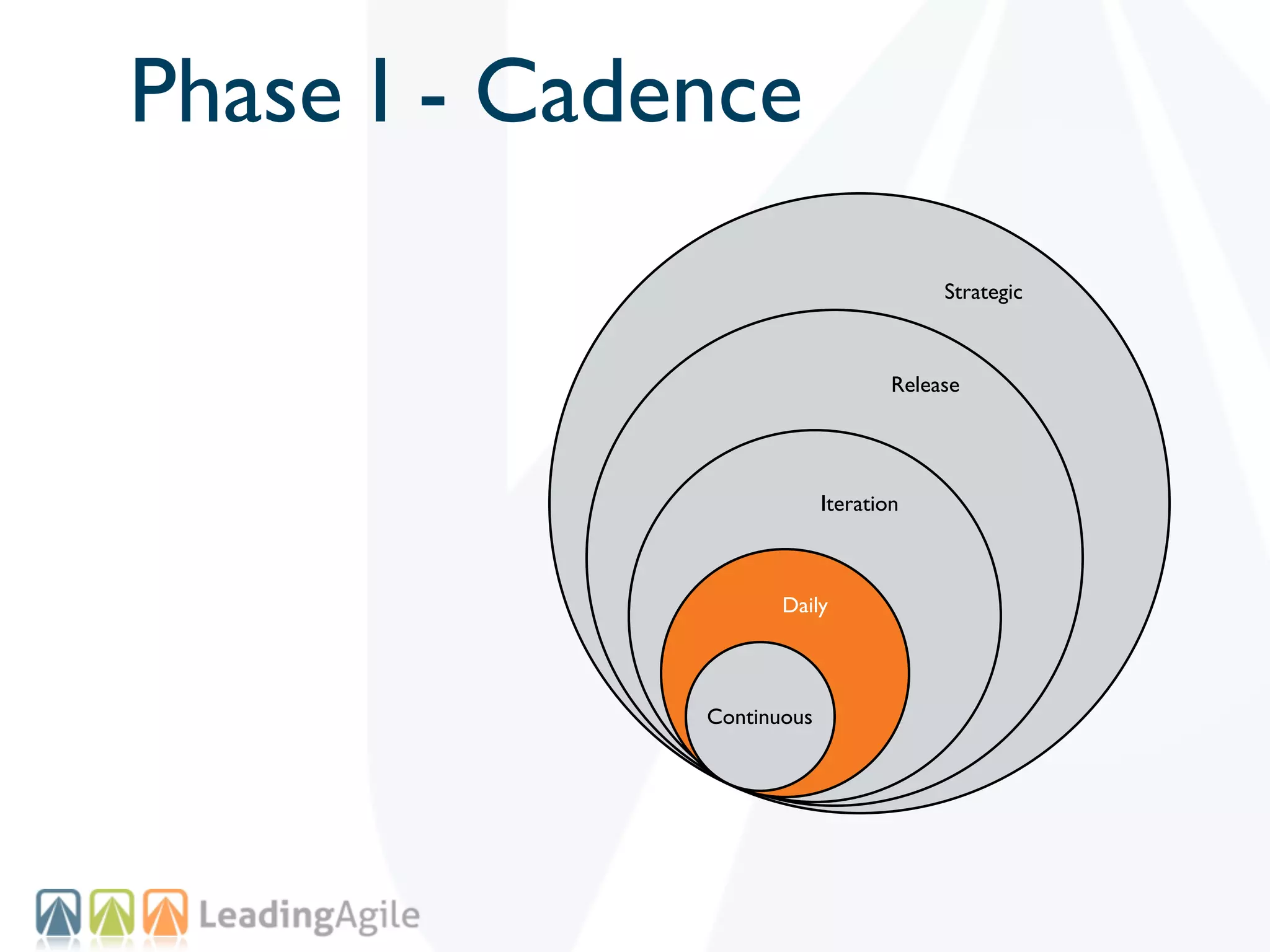
Phase I - Cadence
                                        Strategic


                                   Release


                           Iteration


                     Daily


              Continuous
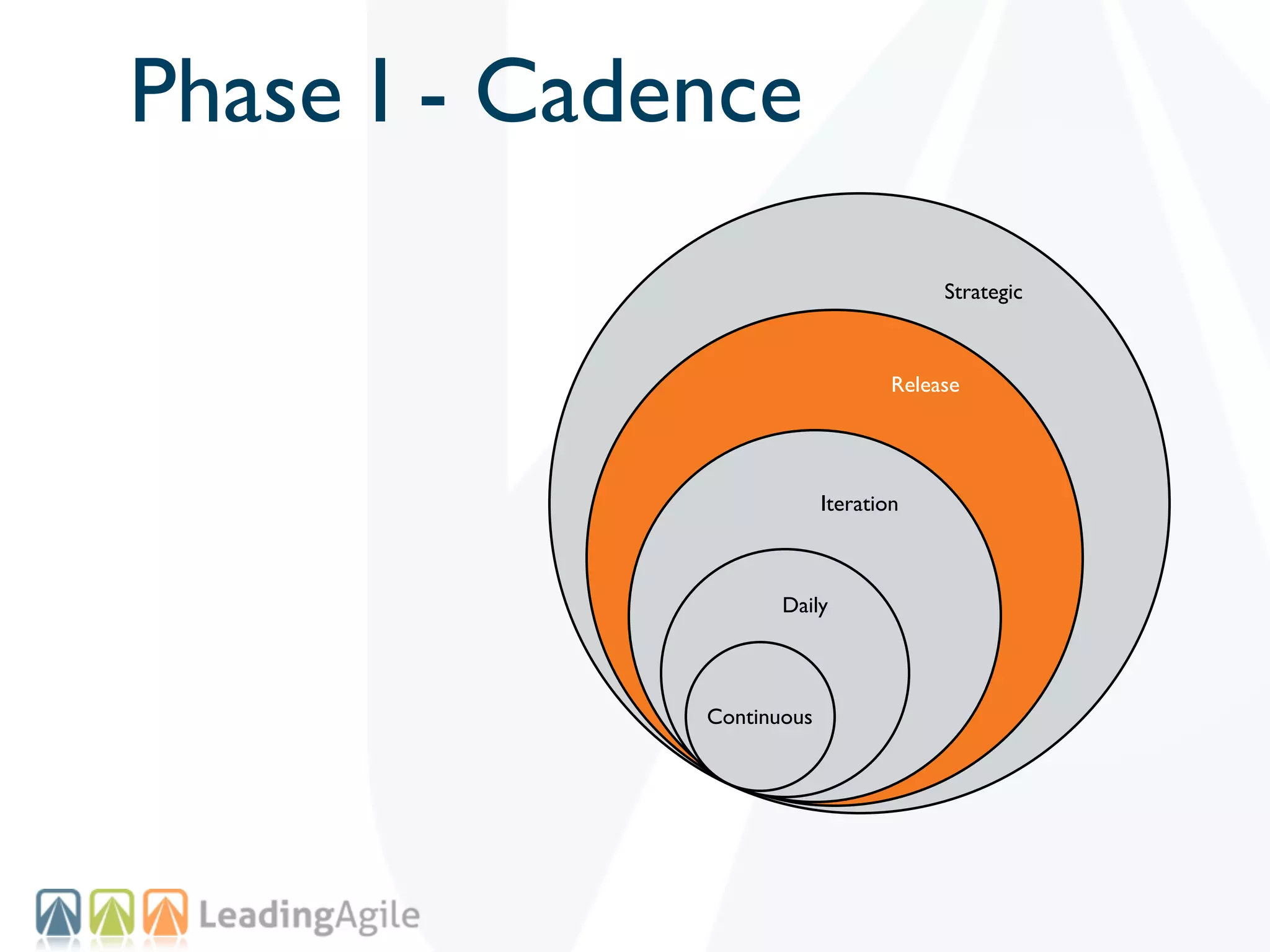
Phase I - Cadence
                                        Strategic


                                   Release


                           Iteration


                     Daily


              Continuous
Phase I - Cadence
                                        Strategic


                                   Release


                           Iteration


                     Daily


              Continuous
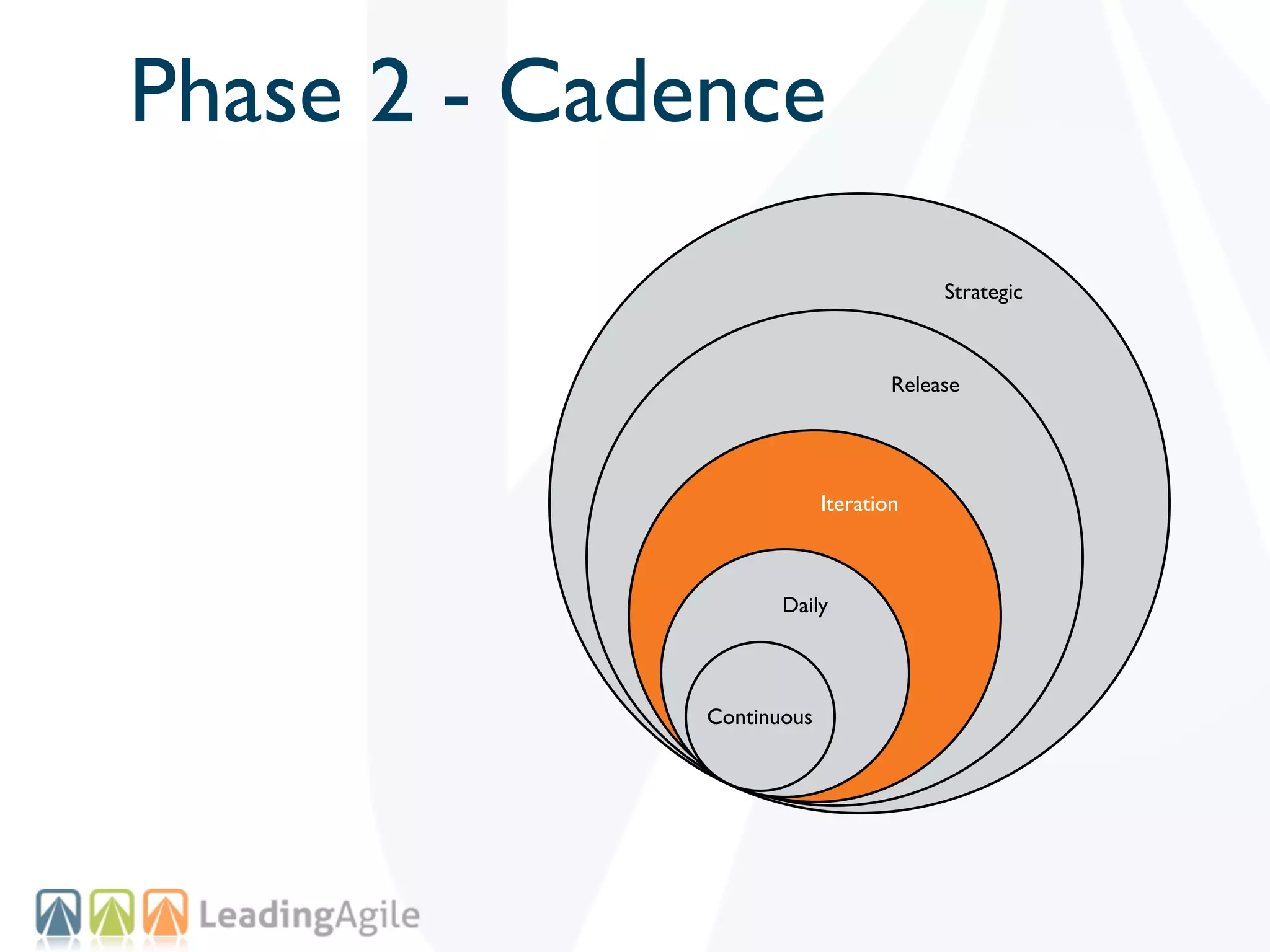
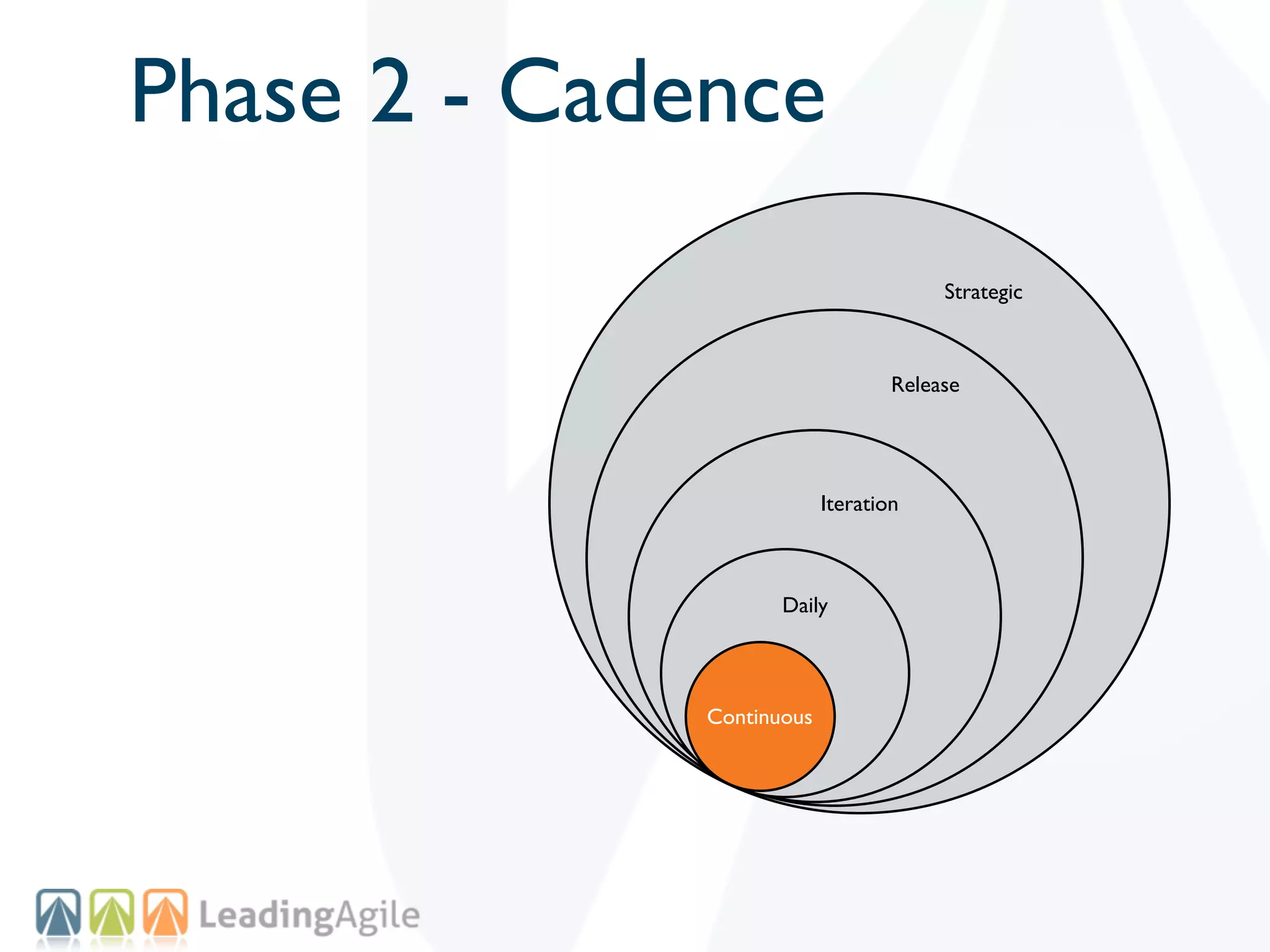
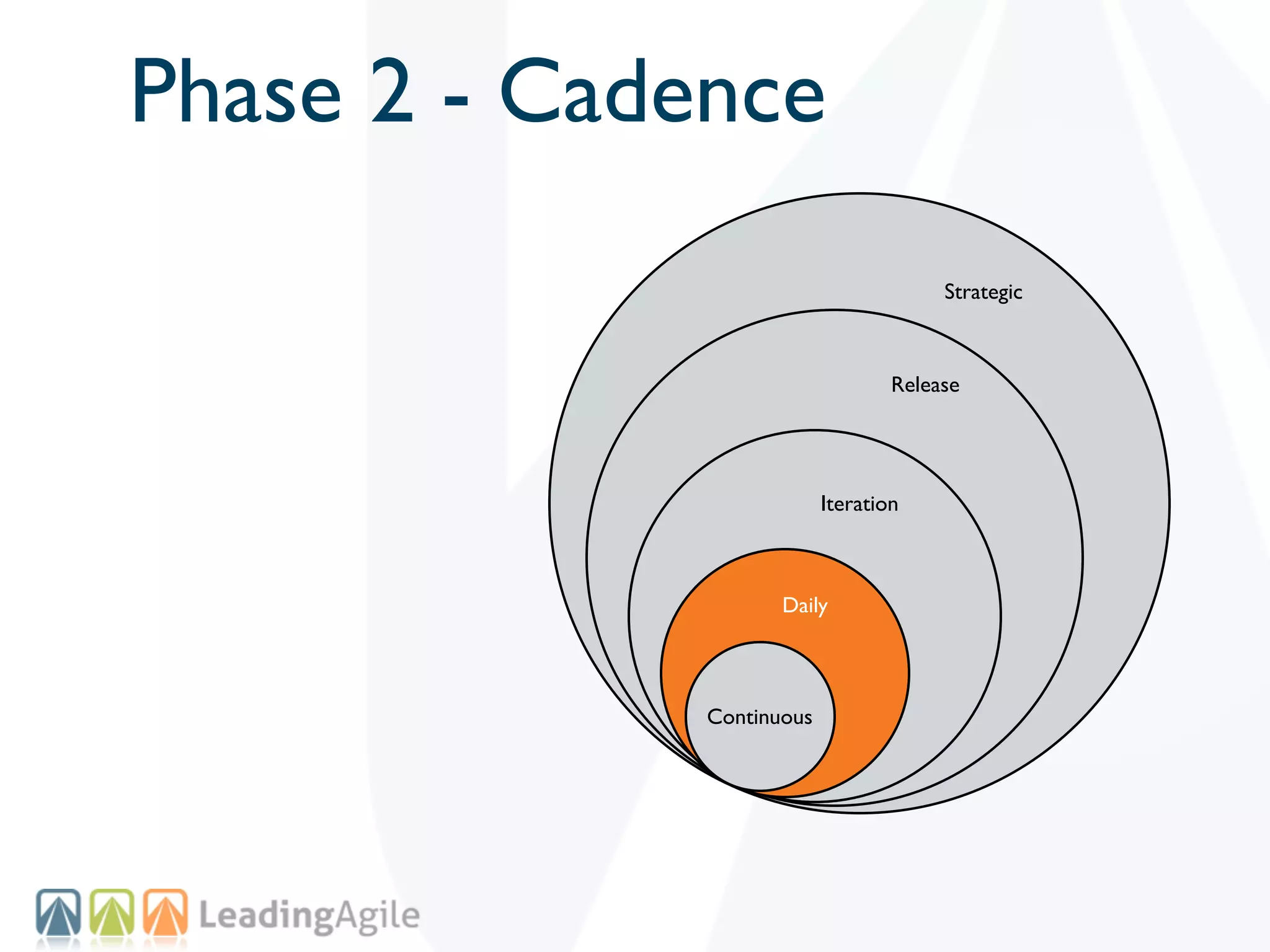
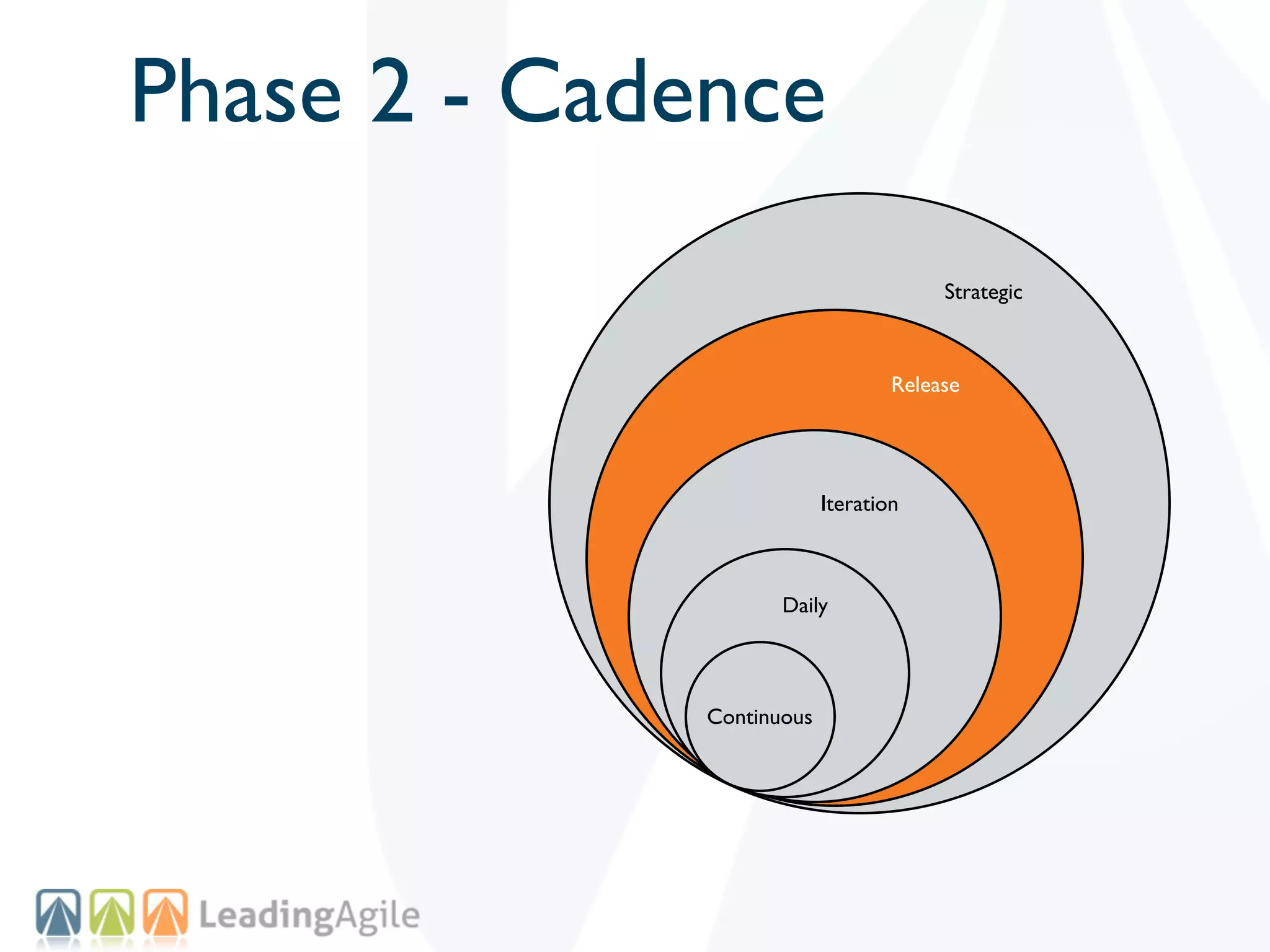
Phase 2 - Cadence
                                        Strategic


                                   Release


                           Iteration


                     Daily


              Continuous
Phase 2 - Cadence
                                        Strategic


                                   Release


                           Iteration


                     Daily


              Continuous
Phase 2 - Cadence
                                        Strategic


                                   Release


                           Iteration


                     Daily


              Continuous
Phase 2 - Cadence
                                        Strategic


                                   Release


                           Iteration


                     Daily


              Continuous
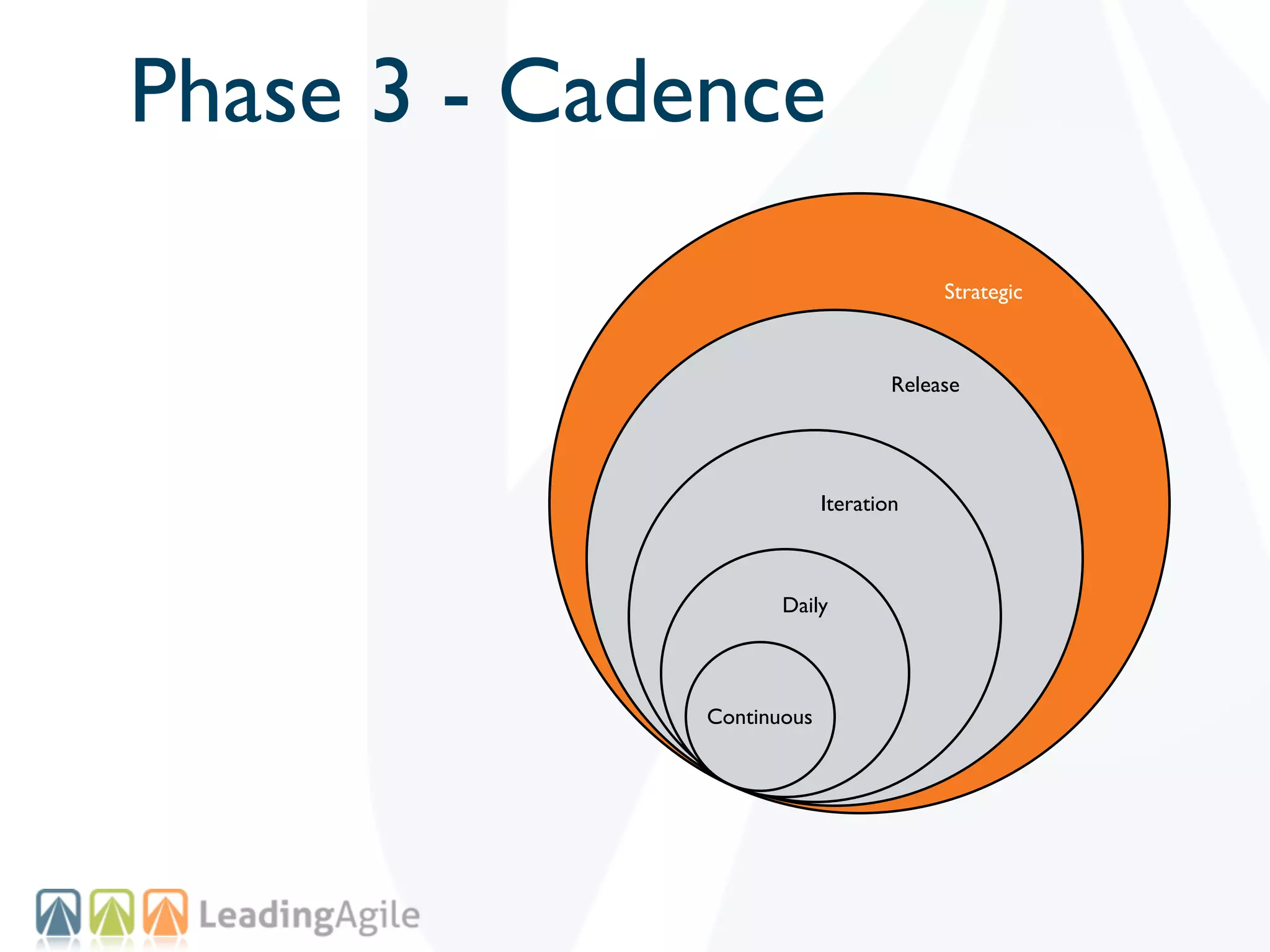
Phase 3 - Cadence
                                        Strategic


                                   Release


                           Iteration


                     Daily


              Continuous
A Few Scenarios
Single Team/Single Product
 Sub 25 person product company and a
 start-up

 •   Started with team level practices
 •   Lots of attention early to team culture
 •   Began engaging senior leaders on strategy and
     portfolio management
 •   Currently integrating marketing, sales, and
     support
Multi-Team/Single Product
 Sub-100 person product company. 10
 years old and privately owned.

 •   Program level first.. established a PO team
 •   3 tightly integrated Scrum teams
 •   Defined the portfolio governance layer
 •   Established the relationship between strategy
     and support
 •   Modeled the overall value stream and wrapped
     the Scrum process in a two-tiered Kanban
Multi-Team/Multi-Product
 Sub-300 person organization. 100 person
 development organization. 8 Scrum
 teams.

 •   Big-bang team-level adoption
 •   Teams aligned by products
 •   Product ownership by product
 •   Program and portfolio level views established
 •   Limiting projects in progress
 •   Solid release planning
 •   Integration with upstream and downstream
Multi-Team/Multi-Product
 Large multi-national organization. Scope
 is a 500 person development organization
 with 55 Scrum teams.

 • Started with a basic view of the portfolio layer
 • Portfolio level value stream mapping, RACI
 • Built out the program management layer with
     PO teams to develop a requirements
     management capability
 •   Program level value stream mapping, RACI,
     introduced agile tooling
 •   Introduced Scrum at the team level
Products of Products
 Large multi-national company.
 Geographically dispersed. Products of
 products.

 •   Scrum teams by product/component
 •   Product Owner teams established
 •   Portfolio level governance model
 •   Lean/TOC planning model
 •   Integration with a traditional PMO for metrics
     and reporting
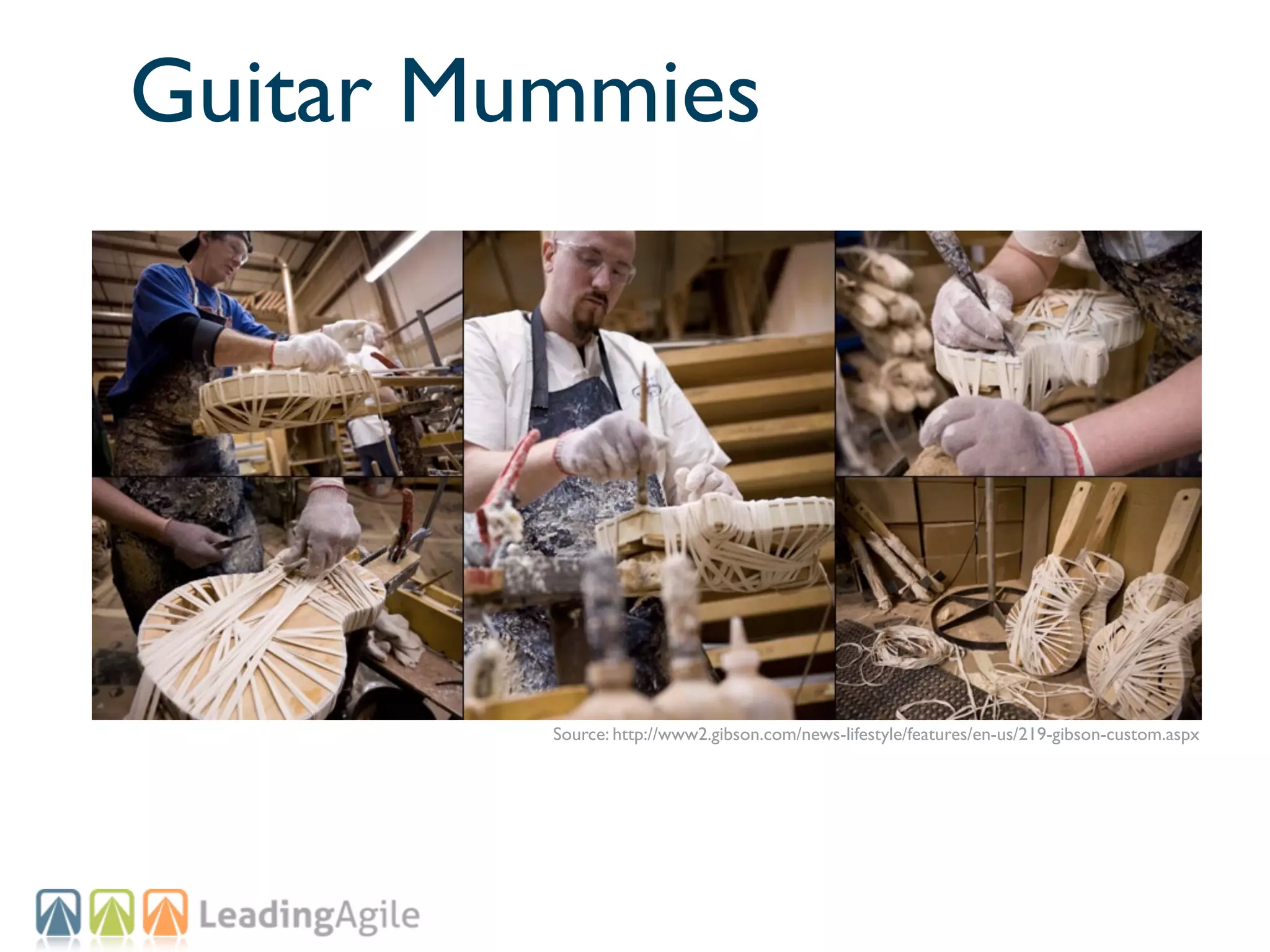
Guitar Mummies


         Source: http://www2.gibson.com/news-lifestyle/features/en-us/219-gibson-custom.aspx
Agile Program and
Portfolio Management
9:00 AM | Thursday | Austin 1-3 | Mike Cottmeyer
Mike Cottmeyer
mike@leadingagile.com
404.312.1471

www.leadingagile.com
twitter.com/mcottmeyer
facebook.com/leadingagile
linkedin.com/in/cottmeyer


            Slides at www.leadingagile.com

Enterprise Agile Transformation Strategies

  • 1.
    Exploring Enterprise Agile TransformationStrategies Mike Cottmeyer, Enterprise Agile Coach LeadingAgile, LLC
  • 2.
  • 3.
  • 4.
    The Problem... Havinglots of agile teams in an enterprise isn’t enterprise agility • Sometimes organizations fall into the trap of thinking that having agile teams means they have an agile organization • Enterprise agility is when all the parts of the organization work together to create Agile outcomes • The entire delivery capability of the enterprise has to be focused on agile principles and execution
  • 5.
    The Problem... Focusingonly at the team level can result in local optima within your organization • Sometimes a team can perform well at Scrum, but the business doesn’t see any incremental value from their investment • Sometimes a high-performance team can disrupt other functions in the organization if the upstream and downstream processes are not able to work at the same pace
  • 6.
    The Problem... Teamlevel Agile practices are different from Agile practices at scale • The practices we put in place at the team level often don’t work when we apply them in larger organizations • Practices have to adapted at scale to accommodate more diverse groups of stakeholders and more complicated value streams
  • 7.
    The Problem... Agileat scale requires a broader set of tools and techniques • Scrum and XP at the team level • Kanban and Lean at the program and portfolio level • RUP and Traditional Project Management at the Enterprise
  • 8.
    We are justnow starting to put all the pieces together...
  • 9.
  • 10.
    The Solution... PartOne First... we do have to get team level agile right. We are going to talk about some of the things you can do that will lead to successful team-level Agile transformations. • The fundamentals behind why Agile works • Common challenges that cause Agile to fail • What does it look like when things are really going well? • What is different about an enterprise-level Agile transformation?
  • 11.
    The Solution... PartTwo Next we will explore a safe, pragmatic, iterative and incremental framework for transforming any sized organization... • Define the organizational competencies required at all levels of the enterprise • How to adapt agile competencies for scale • How to adapt agile competencies for cadence
  • 12.
    The Solution... PartThree We’ll discuss the three major areas you need to pay attention to in order to execute a safe and pragmatic enterprise Agile transformation... • Establishing an agile org structure • Introducing disciplined Agile practices • Intentionally addressing people and culture
  • 13.
    The Solution... PartFour Finally, as we begin to wrap-up the talk, we’ll explore a few things that will help you put all of this together... • Overview of the model end-to-end • If we have time... case studies
  • 14.
    The Solution... PartOne How Does Agile Work and Why Does it Fail?
  • 15.
  • 16.
    What Makes AgileWork? Teams stay together and are highly engaged • Agile practices are built around cross- functional teams that have everything necessary to deliver an increment of value to the organization • Teams that stay together over time tend to be more productive than teams that are constantly forming and reforming • Empowered self-directed teams are able to own the solution and creatively solve
  • 17.
    What Makes AgileWork? Teams are focused on a queue of projects or product enhancements • Rather than forming teams to deliver projects, agile methods leave teams together and funnel project through teams • The project list is basically a prioritized backlog of work that a team is responsible for delivering
  • 18.
    What Makes AgileWork? Minimize dependencies and strive for loose coupling between teams • The more coupling we have between teams, the more difficult it is to change direction when we learn something new about the emerging product • Teams that have external dependencies are not able to make and meet commitments because they don’t have everything necessary to own the commitment
  • 19.
    What Makes AgileWork? Fully engaged business partners • Many organizations are guilty of throwing ill- defined requirements over to the delivery teams, constantly changing direction through the life of the project, and holding teams accountable for on-time delivery • Agile is geared for change, but requires close collaboration between stakeholders and teams to make real-time tradeoffs as the product is in development
  • 20.
    What Makes AgileWork? Attention to getting done and completing work before new work is started • Delivering an increment of working, tested, potentially shippable software on regular time intervals assures that we can measure progress against real, measurable product outcomes
  • 21.
    What Makes AgileWork? Technical excellence and continuous attention to product quality • The underlying health of the system is a critical success factor for running successful agile projects • Defects and technical debt impact product delivery in unpredictable ways making it nearly impossible to reliably make and meet commitments
  • 22.
  • 23.
    What Makes AgileFail? Agile team is a local optimization and out of alignment with the rest of the business • Pilot teams are formed and given everything they need to be successful at the expense of the rest of the delivery organization • Teams can deliver product faster than the organization can consume it • Teams starve the requirements queue because Strategy and Product Management can’t keep up
  • 24.
    What Makes AgileFail? Project driven organizations or uneven investment across product lines • Very difficult to keep cross-functional teams together over time because the investment mix is constantly changing • Organizations tend to want to matrix people across multiple teams at the same time
  • 25.
    What Makes AgileFail? Value is either too broadly defined or too narrowly defined • Overly vague requirements lead the development team to fill in the gaps based in their own knowledge and experience • Overly specified requirements lead to an activity based mentality rather than a value based mentality
  • 26.
    What Makes AgileFail? Organizational structures and product architectures work against establishing cross functional teams • Matrix organizations and functional silos make it very challenging to create high-performing agile teams • Tightly coupled legacy architectures make it difficult to organize teams around feature groups or components within the solution framework
  • 27.
    What Makes AgileFail? Overly political cultures and lack of trust • Command and control leadership • Micromanagement • Disempowering language
  • 28.
    What Makes AgileFail? Inability to balance capacity and demand • Invalid and inaccurate estimates • Inability to make and meet commitments • More work than the teams can possibly deliver in the timeframes expected
  • 29.
    What Makes AgileFail? Looking at agile as a process overlay rather than a transformative event in your organization • Agile is just something that the developers do • Not recognizing the broad organizational change necessary to make an agile transformation sustainable
  • 30.
    A Well FormedAgile Organization
  • 31.
    A Well FormedAgile Organization Cross functional teams aligned directly to solve business problems • Products • Features • Programs • Components • Services • Business Capabilities
  • 32.
    A Well FormedAgile Organization Clear voice of the business and a willingness to make tradeoffs to meet time and cost constraints • Highly engaged product ownership • Willingness to deal with reality • Focus on maximizing value and reducing risk
  • 33.
    A Well FormedAgile Organization Individual empowerment and shared accountability for outcomes • Establish boundaries and ownership but empower within those boundaries • Teams own outcomes not activities
  • 34.
    A Well FormedAgile Organization Disciplined attention to technical excellence and product quality • Technical excellence stabilizes the requirements delivery function
  • 35.
    A Well FormedAgile Organization Predictable, accountable, able to consistently make and meet commitments • Teams have the ability to consistently do what they say they are going to do • Predictable agile teams are the foundational element of a predictable agile enterprise
  • 36.
    Reinventing Agile Situationallyspecific strategies at scale to solve these problems and maintain business agility • How do team level competencies need to be adapted to take into consideration issues of scale and the different planning horizons required in larger enterprises • How do you build the necessary organization, introduce new practices, and start shifting the culture in a way that leads to sustainable organizational change
  • 37.
    The Solution... PartTwo Competencies, Frequency, and Scale
  • 38.
    Agile Competencies • Product Definition • Planning & Coordination • Delivery Practices • Continuous Improvement • Organizational Enablement
  • 39.
    Agile Competencies • ProductDefinition • Planning & Coordination • Delivery Practices • Continuous Improvement • Organizational Enablement
  • 40.
    Agile Competencies • ProductDefinition • Planning & Coordination • Delivery Practices • Continuous Improvement • Organizational Enablement
  • 41.
    Agile Competencies • ProductDefinition • Planning & Coordination • Delivery Practices • Continuous Improvement • Organizational Enablement
  • 42.
    Agile Competencies • ProductDefinition • Planning & Coordination • Delivery Practices • Continuous Improvement • Organizational Enablement
  • 43.
    Agile Competencies • ProductDefinition • Planning & Coordination • Delivery Practices • Continuous Improvement • Organizational Enablement
  • 44.
    Product Definition • Establish the product vision • Define the product roadmap • Decompose features • Estimate size and effort • Define acceptance criteria
  • 45.
    Product Definition • Establishthe product vision • Define the product roadmap • Decompose features • Estimate size and effort • Define acceptance criteria
  • 46.
    Product Definition • Establishthe product vision • Define the product roadmap • Decompose features • Estimate size and effort • Define acceptance criteria
  • 47.
    Product Definition • Establishthe product vision • Define the product roadmap • Decompose features • Estimate size and effort • Define acceptance criteria
  • 48.
    Product Definition • Establishthe product vision • Define the product roadmap • Decompose features • Estimate size and effort • Define acceptance criteria
  • 49.
    Product Definition • Establishthe product vision • Define the product roadmap • Decompose features • Estimate size and effort • Define acceptance criteria
  • 50.
    Delivery Practices • Define the solution • Build the solution • Test the solution • Establish product quality • Deploy the solution
  • 51.
    Delivery Practices • Definethe solution • Build the solution • Test the solution • Establish product quality • Deploy the solution
  • 52.
    Delivery Practices • Definethe solution • Build the solution • Test the solution • Establish product quality • Deploy the solution
  • 53.
    Delivery Practices • Definethe solution • Build the solution • Test the solution • Establish product quality • Deploy the solution
  • 54.
    Delivery Practices • Definethe solution • Build the solution • Test the solution • Establish product quality • Deploy the solution
  • 55.
    Delivery Practices • Definethe solution • Build the solution • Test the solution • Establish product quality • Deploy the solution
  • 56.
    Planning & Coordination • Establish a planning cadence • Perform activity breakdown • Establish a delivery cadence • Limit work in process • Make and meet commitments
  • 57.
    Planning & Coordination •Establish a planning cadence • Perform activity breakdown • Establish a delivery cadence • Limit work in process • Make and meet commitments
  • 58.
    Planning & Coordination •Establish a planning cadence • Perform activity breakdown • Establish a delivery cadence • Limit work in process • Make and meet commitments
  • 59.
    Planning & Coordination •Establish a planning cadence • Perform activity breakdown • Establish a delivery cadence • Limit work in process • Make and meet commitments
  • 60.
    Planning & Coordination •Establish a planning cadence • Perform activity breakdown • Establish a delivery cadence • Limit work in process • Make and meet commitments
  • 61.
    Planning & Coordination •Establish a planning cadence • Perform activity breakdown • Establish a delivery cadence • Limit work in process • Make and meet commitments
  • 62.
    Continuous Improvement • Metrics and reporting • Establish stable velocity • Conduct retrospectives • Update the backlog • Enable process improvement
  • 63.
    Continuous Improvement • Metricsand reporting • Establish stable velocity • Conduct retrospectives • Update the backlog • Enable process improvement
  • 64.
    Continuous Improvement • Metricsand reporting • Establish stable velocity • Conduct retrospectives • Update the backlog • Enable process improvement
  • 65.
    Continuous Improvement • Metricsand reporting • Establish stable velocity • Conduct retrospectives • Update the backlog • Enable process improvement
  • 66.
    Continuous Improvement • Metricsand reporting • Establish stable velocity • Conduct retrospectives • Update the backlog • Enable process improvement
  • 67.
    Continuous Improvement • Metricsand reporting • Establish stable velocity • Conduct retrospectives • Update the backlog • Enable process improvement
  • 68.
    Organizational Enablement • Establish teams • Effective communication • Effective collaboration • Empowerment • Trust
  • 69.
    Organizational Enablement • Establishteams • Effective communication • Effective collaboration • Empowerment • Trust
  • 70.
    Organizational Enablement • Establishteams • Effective communication • Effective collaboration • Empowerment • Trust
  • 71.
    Organizational Enablement • Establishteams • Effective communication • Effective collaboration • Empowerment • Trust
  • 72.
    Organizational Enablement • Establishteams • Effective communication • Effective collaboration • Empowerment • Trust
  • 73.
    Organizational Enablement • Establishteams • Effective communication • Effective collaboration • Empowerment • Trust
  • 74.
  • 75.
  • 76.
  • 77.
    Competencies at Scale • Team • Multi-Team • Program • Portfolio • Enterprise
  • 78.
  • 79.
    Multi-Team Agility Scrum Scrum Team Team
  • 80.
    Multi-Team Agility Scrum Scrum Scrum Team Team Team
  • 81.
    Multi-Team Agility Scrum Scrum Scrum Scrum Team Team Team Team
  • 82.
    Program Agility Product Team Scrum Scrum Scrum Scrum Team Team Team Team
  • 83.
    Program Agility Product Product Team Team Scrum Scrum Scrum Scrum Team Team Team Team
  • 84.
    Portfolio Agility Portfolio Team Product Product Team Team Scrum Scrum Scrum Scrum Team Team Team Team
  • 85.
    Enterprise Agility Strategy Portfolio Team Team Product Product Team Team Scrum Scrum Scrum Scrum Team Team Team Team
  • 86.
    Enterprise Agility Strategy Portfolio Support Team Team Team Product Product Team Team Scrum Scrum Scrum Scrum Team Team Team Team
  • 87.
    Competencies in Time • Continuous • Daily • Strategic Iteration • Release Release • Strategic Iteration Daily Continuous
  • 88.
    Competencies in Time •Continuous • Daily • Iteration Strategic • Release Release • Strategic Iteration Daily Continuous
  • 89.
    Competencies in Time •Continuous • Daily • Iteration Strategic • Release Release • Strategic Iteration Daily Continuous
  • 90.
    Competencies in Time •Continuous • Daily • Iteration Strategic • Release Release • Strategic Iteration Daily Continuous
  • 91.
    Competencies in Time •Continuous • Daily • Iteration Strategic • Release Release • Strategic Iteration Daily Continuous
  • 92.
    Competencies in Time •Continuous • Daily • Iteration Strategic • Release Release • Strategic Iteration Daily Continuous
  • 93.
    The Solution... PartThree The Agile Adoption and Transformation Lifecycle
  • 94.
    Adoption vs. Transformation First... we want to untangle two words that sometimes can be used interchangeably • Agile Adoption is about what you do... practices, tools, techniques, ceremonies, and habits • Agile Transformation is about who you are... reflected in both the structure of the organization and who you are as people Long term results require both adoption and transformation to be successful
  • 95.
    Adoption vs. Transformation Second... we want clearly articulate the three major focus areas that must be addressed interdependently • Organizational Structure is about how you create teams and how you organize them • Agile Practice is about the methods and tools you choose to introduce • People and Culture is about changing hearts and minds of the individuals in the organization All three aspects are essential to sustain agility
  • 96.
    Incremental vs. Iterative Third... we want introduce the notion that introducing Agile is an iterative and incremental process for you organization • Iterative is when parts of the system are developed at different times and integrated as they are completed • Incremental is when you go back over parts of the system making improvements The strategy is to increment the organization by building teams and iterate the teams over time
  • 97.
    Incremental vs. Iterative Courtesy of Jeff Patton
  • 98.
    Incremental vs. Iterative Incremental Courtesy of Jeff Patton
  • 99.
    Incremental vs. Iterative Incremental Iterative Courtesy of Jeff Patton
  • 100.
    Adoption/Transformation Cycle Incrementingand Iterating the Agile Enterprise • Organiza(onal+ Change physical Transforma(on+ structures and introduce teams • Teach people new Personal+ Adopt++ practices and ways Transforma(on+ Prac(ces+ of working • Help people internalize the value system
  • 101.
    Adoption/Transformation Cycle Organizational Transformation • Establish top to Organiza(onal+ bottom structure Transforma(on+ and roadmap • Incrementally make changes and Personal+ Adopt++ establish teams Transforma(on+ Prac(ces+ • Define policies and working agreements between teams
  • 102.
    Adoption/Transformation Cycle AdoptingPractices •Sprint planning, daily stand-ups, Organiza(onal+ product reviews, Transforma(on+ and retrospectives •Identify and train a Product Owner Personal+ Adopt++ and ScrumMaster Transforma(on+ Prac(ces+ •Teach TDD, CI, Story Maps, and MMF
  • 103.
    Adoption/Transformation Cycle Personal Transformation • Develop an ability Organiza(onal+ to deal with Transforma(on+ uncertainty and adaptation • Help people work Personal+ Adopt++ toward common Transforma(on+ Prac(ces+ organizational goals • Help foster empathy, trust, and teamwork
  • 104.
    Common Anti-Patterns • Establishing teams without breaking down the strict functional silos and rigid role definitions • Running daily standup meetings that devolve into status updates for the project manager • Coming back from CSM training only to find that there is no way to form agile teams and no interest in agile
  • 105.
    Common Anti-Patterns • Establishingteams without breaking down the strict functional silos and rigid role definitions • Running daily standup meetings that devolve into status updates for the project manager • Coming back from CSM training only to find that there is no way to form agile teams and no interest in agile
  • 106.
    Common Anti-Patterns • Establishing teams without breaking down the strict functional silos and rigid role definitions • Running daily standup meetings that devolve into status updates for the project manager • Coming back from CSM training only to find that there is no way to form agile teams and no interest in agile
  • 107.
    Common Anti-Patterns • Establishing teams without breaking down the strict functional silos and rigid role definitions • Running daily standup meetings that devolve into status updates for the project manager • Coming back from CSM training only to find that there is no way to form agile teams and no interest in agile
  • 108.
    The Solution... PartFour Exploring the Integrated Framework
  • 109.
    Phase I -Structure Scrum Team
  • 110.
    Phase I -Structure Scrum Scrum Team Team
  • 111.
    Phase I -Structure Product Team Scrum Scrum Team Team
  • 112.
    Phase 2 -Structure Product Team Scrum Scrum Scrum Team Team Team
  • 113.
    Phase 2 -Structure Product Team Scrum Scrum Scrum Scrum Team Team Team Team
  • 114.
    Phase 2 -Structure Product Product Team Team Scrum Scrum Scrum Scrum Team Team Team Team
  • 115.
    Phase 3 -Structure Portfolio Team Product Product Team Team Scrum Scrum Scrum Scrum Team Team Team Team
  • 116.
    Phase 3 -Structure Strategy Portfolio Team Team Product Product Team Team Scrum Scrum Scrum Scrum Team Team Team Team
  • 117.
    Phase 3 -Structure Strategy Portfolio Support Team Team Product Product Team Team Scrum Scrum Scrum Scrum Team Team Team Team
  • 118.
    Organizationa l Transformatio Value Delivery Personal Adopt Transformatio Practices n Phase I Product Planning Delivery Continuous Definition Coordination Practices Improvement OrganizationalFactors Cultural Enablement 116
  • 119.
    Organizationa l Transformatio Value Delivery Personal Adopt Transformatio Practices n Phase I Product Planning Delivery Continuous Definition Coordination Practices Improvement Organizational Enablement 117
  • 120.
    Organizationa l Transformatio Value Delivery Personal Adopt Transformatio Practices n Phase I Product Planning Delivery Continuous Definition Coordination Practices Improvement Organizational Enablement 118
  • 121.
    Organizationa l Transformatio Value Delivery Personal Adopt Transformatio Practices n Phase I Product Planning Delivery Continuous Definition Coordination Practices Improvement Organizational Enablement 119
  • 122.
    Organizationa l Transformatio Value Delivery Personal Adopt Transformatio Practices n Phase 2 Product Planning Delivery Continuous Definition Coordination Practices Improvement Organizational Enablement 120
  • 123.
    Organizationa l Transformatio Value Delivery Personal Adopt Transformatio Practices n Phase 2 Product Planning Delivery Continuous Definition Coordination Practices Improvement Organizational Enablement 121
  • 124.
    Organizationa l Transformatio Value Delivery Personal Adopt Transformatio Practices n Phase 2 Product Planning Delivery Continuous Definition Coordination Practices Improvement Organizational Enablement 122
  • 125.
    Organizationa l Transformatio Value Delivery Personal Adopt Transformatio Practices n Phase 3 Product Planning Delivery Continuous Definition Coordination Practices Improvement Organizational Enablement 123
  • 126.
    Organizationa l Transformatio Value Delivery Personal Adopt Transformatio Practices n Phase 3 Product Planning Delivery Continuous Definition Coordination Practices Improvement Organizational Enablement 124
  • 127.
    Organizationa l Transformatio Value Delivery Personal Adopt Transformatio Practices n Phase 3 Product Planning Delivery Continuous Definition Coordination Practices Improvement Organizational Enablement 125
  • 128.
    Organizationa l Transformatio Value Delivery Personal Adopt Transformatio Practices n Phase 3 Product Planning Delivery Continuous Definition Coordination Practices Improvement Organizational Enablement 126
  • 129.
    Phase I -Cadence Strategic Release Iteration Daily Continuous
  • 130.
    Phase I -Cadence Strategic Release Iteration Daily Continuous
  • 131.
    Phase I -Cadence Strategic Release Iteration Daily Continuous
  • 132.
    Phase I -Cadence Strategic Release Iteration Daily Continuous
  • 133.
    Phase I -Cadence Strategic Release Iteration Daily Continuous
  • 134.
    Phase 2 -Cadence Strategic Release Iteration Daily Continuous
  • 135.
    Phase 2 -Cadence Strategic Release Iteration Daily Continuous
  • 136.
    Phase 2 -Cadence Strategic Release Iteration Daily Continuous
  • 137.
    Phase 2 -Cadence Strategic Release Iteration Daily Continuous
  • 138.
    Phase 3 -Cadence Strategic Release Iteration Daily Continuous
  • 139.
  • 140.
    Single Team/Single Product Sub 25 person product company and a start-up • Started with team level practices • Lots of attention early to team culture • Began engaging senior leaders on strategy and portfolio management • Currently integrating marketing, sales, and support
  • 141.
    Multi-Team/Single Product Sub-100person product company. 10 years old and privately owned. • Program level first.. established a PO team • 3 tightly integrated Scrum teams • Defined the portfolio governance layer • Established the relationship between strategy and support • Modeled the overall value stream and wrapped the Scrum process in a two-tiered Kanban
  • 142.
    Multi-Team/Multi-Product Sub-300 personorganization. 100 person development organization. 8 Scrum teams. • Big-bang team-level adoption • Teams aligned by products • Product ownership by product • Program and portfolio level views established • Limiting projects in progress • Solid release planning • Integration with upstream and downstream
  • 143.
    Multi-Team/Multi-Product Large multi-nationalorganization. Scope is a 500 person development organization with 55 Scrum teams. • Started with a basic view of the portfolio layer • Portfolio level value stream mapping, RACI • Built out the program management layer with PO teams to develop a requirements management capability • Program level value stream mapping, RACI, introduced agile tooling • Introduced Scrum at the team level
  • 144.
    Products of Products Large multi-national company. Geographically dispersed. Products of products. • Scrum teams by product/component • Product Owner teams established • Portfolio level governance model • Lean/TOC planning model • Integration with a traditional PMO for metrics and reporting
  • 145.
    Guitar Mummies Source: http://www2.gibson.com/news-lifestyle/features/en-us/219-gibson-custom.aspx
  • 146.
    Agile Program and PortfolioManagement 9:00 AM | Thursday | Austin 1-3 | Mike Cottmeyer
  • 147.

Editor's Notes