Introduction
to
Java Interfaces
https://nareshit.com/courses/advanced-java-online-training
In the realm of Java programming, interfaces stand
as fundamental building blocks for crafting robust
and scalable applications. An interface is
essentially a blueprint of a class, outlining methods
without providing concrete implementations. This
abstract nature empowers developers to establish
contracts between classes, fostering code
reusability, polymorphism, and loose coupling.
Understanding Java Interfaces
Core Concepts of Java Interfaces
Method Signatures:
Interfaces exclusively define method signatures, comprising the method name, return type, and
parameter list. The actual implementation of these methods resides within classes that implement the
interface.
Constants:
Interfaces can declare constants, which are implicitly public, static, and final. These constants serve as
shared values across multiple classes.
No Method Bodies:
Unlike abstract classes, interfaces cannot contain method bodies. This restriction reinforces the concept
of abstraction.
Multiple Inheritance:
While Java prohibits multiple inheritance of classes, interfaces can be implemented by multiple classes,
effectively achieving a similar outcome.
Polymorphism:
Interfaces underpin polymorphism in Java. Different classes can implement the same interface, allowing
them to be treated as objects of that interface type.
Why Use Java Interfaces?
Achieving Abstraction: Interfaces encapsulate the essential
behavior of an object without revealing its implementation
details, promoting code modularity and maintainability.
Enforcing Standards: Interfaces define a standard contract
that classes must adhere to, ensuring consistency and
interoperability.
Supporting Polymorphism: Interfaces enable
polymorphic behavior, where objects of different
types can be treated as objects of the same
interface type.
Facilitating Loose Coupling: By decoupling
classes through interfaces, you enhance code
flexibility and reduce dependencies
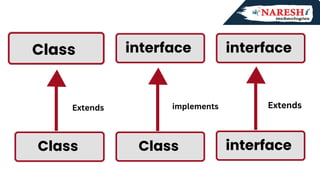
Class
Class interface
Extends Extends
implements
Class
interface
interface
Practical Applications of Java
Interfaces
Defining Contracts:
Interfaces are extensively used to define
contracts between components in complex
systems, ensuring seamless integration.
Interfaces allow for the creation of
interchangeable components, facilitating
customization and extensibility.
Creating Pluggable
Modules:
Designing Frameworks:
Many Java frameworks leverage interfaces
to provide a flexible foundation for building
applications.
Implementing Callback
Mechanisms:
Interfaces can be employed to implement callback
mechanisms, where one object invokes methods
on another object at a later point.
Advanced Topics in Java Interfaces
https://nareshit.com/courses/advanced-java-online-training
Default and Static Methods (Java 8+):
These features extend the capabilities of interfaces by providing
default implementations and static methods.
Functional Interfaces:
Interfaces with a single abstract method are known as
functional interfaces and form the basis for lambda
expressions.
Marker Interfaces:
Interfaces without any methods, such as Serializable and
Cloneable, are used to indicate specific capabilities of a class.
Thank you
Email
support@nareshit.com
2nd Floor, Durga Bhavani Plaza, Ameerpet, Hyderabad
+91 8179191999
https://nareshit.com/courses/advanced-java-online-training
Call us
Contact

Introduction to Java Interfaces: A Cornerstone of Advanced Java Programming

  • 1.
  • 2.
    In the realmof Java programming, interfaces stand as fundamental building blocks for crafting robust and scalable applications. An interface is essentially a blueprint of a class, outlining methods without providing concrete implementations. This abstract nature empowers developers to establish contracts between classes, fostering code reusability, polymorphism, and loose coupling. Understanding Java Interfaces
  • 3.
    Core Concepts ofJava Interfaces Method Signatures: Interfaces exclusively define method signatures, comprising the method name, return type, and parameter list. The actual implementation of these methods resides within classes that implement the interface. Constants: Interfaces can declare constants, which are implicitly public, static, and final. These constants serve as shared values across multiple classes. No Method Bodies: Unlike abstract classes, interfaces cannot contain method bodies. This restriction reinforces the concept of abstraction. Multiple Inheritance: While Java prohibits multiple inheritance of classes, interfaces can be implemented by multiple classes, effectively achieving a similar outcome. Polymorphism: Interfaces underpin polymorphism in Java. Different classes can implement the same interface, allowing them to be treated as objects of that interface type.
  • 4.
    Why Use JavaInterfaces? Achieving Abstraction: Interfaces encapsulate the essential behavior of an object without revealing its implementation details, promoting code modularity and maintainability. Enforcing Standards: Interfaces define a standard contract that classes must adhere to, ensuring consistency and interoperability. Supporting Polymorphism: Interfaces enable polymorphic behavior, where objects of different types can be treated as objects of the same interface type. Facilitating Loose Coupling: By decoupling classes through interfaces, you enhance code flexibility and reduce dependencies
  • 5.
  • 6.
    Practical Applications ofJava Interfaces Defining Contracts: Interfaces are extensively used to define contracts between components in complex systems, ensuring seamless integration. Interfaces allow for the creation of interchangeable components, facilitating customization and extensibility. Creating Pluggable Modules: Designing Frameworks: Many Java frameworks leverage interfaces to provide a flexible foundation for building applications. Implementing Callback Mechanisms: Interfaces can be employed to implement callback mechanisms, where one object invokes methods on another object at a later point.
  • 7.
    Advanced Topics inJava Interfaces https://nareshit.com/courses/advanced-java-online-training Default and Static Methods (Java 8+): These features extend the capabilities of interfaces by providing default implementations and static methods. Functional Interfaces: Interfaces with a single abstract method are known as functional interfaces and form the basis for lambda expressions. Marker Interfaces: Interfaces without any methods, such as Serializable and Cloneable, are used to indicate specific capabilities of a class.
  • 8.
    Thank you Email support@nareshit.com 2nd Floor,Durga Bhavani Plaza, Ameerpet, Hyderabad +91 8179191999 https://nareshit.com/courses/advanced-java-online-training Call us Contact