Interfaces
Interfaces
 In order to work with a class, you need to
understand the public methods
 methods, return types,…
 after you instantiate, what can you do with it?
 The implementation details are irrelevant to
using the class
 you don’t have to know how things are done
inside the class
Interfaces
 A Java interface is a collection of abstract methods
and constants
 An abstract method is a method header without a
method body
 An abstract method can be declared using the
modifier abstract, but because all methods in an
interface are abstract, usually it is left off
 An interface is used to establish a set of methods
that a class will implement
Interfaces
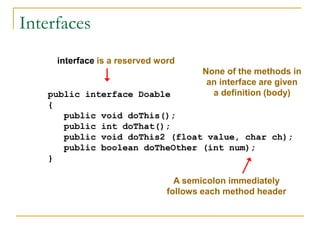
public interface Doable
{
public void doThis();
public int doThat();
public void doThis2 (float value, char ch);
public boolean doTheOther (int num);
}
interface is a reserved word
None of the methods in
an interface are given
a definition (body)
A semicolon immediately
follows each method header
Interfaces
 An interface cannot be instantiated
 Methods in an interface have public visibility by
default
 A class formally implements an interface by:
 stating so in the class header
 providing implementations for each abstract method in the
interface
 If a class asserts that it implements an interface, it
must define all methods in the interface
Interfaces
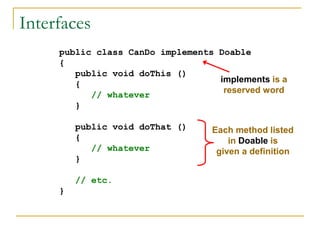
public class CanDo implements Doable
{
public void doThis ()
{
// whatever
}
public void doThat ()
{
// whatever
}
// etc.
}
implements is a
reserved word
Each method listed
in Doable is
given a definition
Interfaces
 A class that implements an interface can
implement other methods as well
 In addition to (or instead of) abstract
methods, an interface can contain
constants
 When a class implements an interface, it
gains access to all its constants
Comparison with Inheritance
 Interfaces don’t define any method actions…
you need to fill in all the details
 It essentially just gives a basic collection of
method names
 Not a strict hierarchy
 Important: can implement several Interfaces
 Can use this to “fake” multiple inheritance
Interfaces
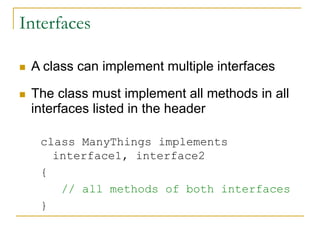
 A class can implement multiple interfaces
 The class must implement all methods in all
interfaces listed in the header
class ManyThings implements
interface1, interface2
{
// all methods of both interfaces
}
Example:The Comparable Interface
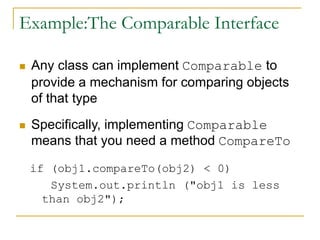
 Any class can implement Comparable to
provide a mechanism for comparing objects
of that type
 Specifically, implementing Comparable
means that you need a method CompareTo
if (obj1.compareTo(obj2) < 0)
System.out.println ("obj1 is less
than obj2");
The Comparable Interface
 It's up to the programmer to determine what
makes one object less than another
 For example, you may define the
compareTo method of an Employee class
to order employees by name (alphabetically)
or by employee number
 The implementation of the method can be as
straightforward or as complex as needed for
the situation
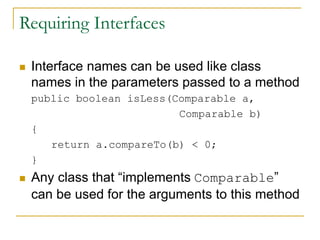
Requiring Interfaces
 Interface names can be used like class
names in the parameters passed to a method
public boolean isLess(Comparable a,
Comparable b)
{
return a.compareTo(b) < 0;
}
 Any class that “implements Comparable”
can be used for the arguments to this method
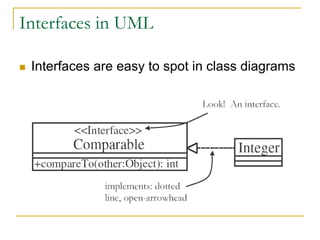
Interfaces in UML
 Interfaces are easy to spot in class diagrams
Interfaces
 You could write a class that implements certain
methods (such as compareTo) without formally
implementing the interface (Comparable)
 However, formally establishing the relationship
between a class and an interface allows Java to
deal with an object in certain ways
 Interfaces are a key aspect of object-oriented design
in Java
Built-in Interfaces
 The Java standard library includes lots more
built-in interfaces
 they are listed in the API with the classes
 Examples:
 Clonable – implements a clone() method
 Formattable – can be formatted with printf
The Iterator Interface
 As we discussed in Chapter 5, an iterator is an object that
provides a means of processing a collection of objects one at a
time
 An iterator is created formally by implementing the Iterator
interface, which contains three methods
 The hasNext method returns a boolean result – true if there are
items left to process
 The next method returns the next object in the iteration
 The remove method removes the object most recently returned
by the next method
The Iterator Interface
 By implementing the Iterator interface, a
class formally establishes that objects of that
type are iterators
 The programmer must decide how best to
implement the iterator functions
 Once established, the for-each version of the
for loop can be used to process the items in
the iterator
Collections
 Collection is a general interface for any
type that can store multiple values
 Any object c that implements Collections
has these methods
 c.add(e)
 c.remove(e)
 c.size()
Collection Sub-Interfaces
 Interfaces that are derived from Collection
 Set: unordered, can’t add the same object
twice
 List: ordered, adds new methods
 get(i): get the ith element
 set(i,e): set the ith element to e
Collection Implementations
 Also in the standard library: many good
implementations of these interfaces
 List: ArrayList, Stack, LinkedList
 Sets: HashSet, TreeSet
 Each implementation has some differences…
suitable for particular problems
 e.g. additional methods, different type restrictions,
etc.
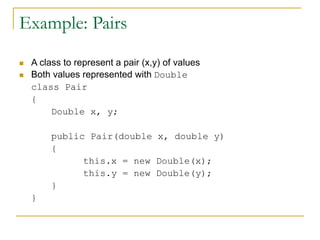
Example: Pairs
 A class to represent a pair (x,y) of values
 Both values represented with Double
class Pair
{
Double x, y;
public Pair(double x, double y)
{
this.x = new Double(x);
this.y = new Double(y);
}
}
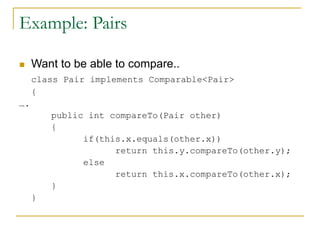
Example: Pairs
 Want to be able to compare..
class Pair implements Comparable<Pair>
{
….
public int compareTo(Pair other)
{
if(this.x.equals(other.x))
return this.y.compareTo(other.y);
else
return this.x.compareTo(other.x);
}
}
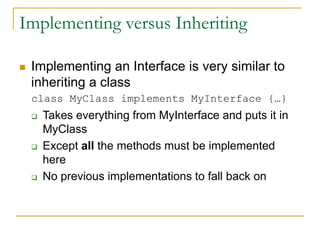
Implementing versus Inheriting
 Implementing an Interface is very similar to
inheriting a class
class MyClass implements MyInterface {…}
 Takes everything from MyInterface and puts it in
MyClass
 Except all the methods must be implemented
here
 No previous implementations to fall back on
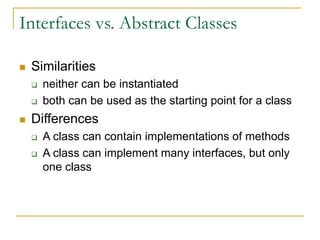
Interfaces vs. Abstract Classes
 Similarities
 neither can be instantiated
 both can be used as the starting point for a class
 Differences
 A class can contain implementations of methods
 A class can implement many interfaces, but only
one class
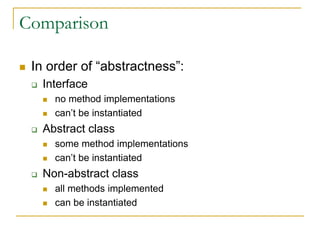
Comparison
 In order of “abstractness”:
 Interface
 no method implementations
 can’t be instantiated
 Abstract class
 some method implementations
 can’t be instantiated
 Non-abstract class
 all methods implemented
 can be instantiated

Interfaces.ppt

  • 1.
  • 2.
    Interfaces  In orderto work with a class, you need to understand the public methods  methods, return types,…  after you instantiate, what can you do with it?  The implementation details are irrelevant to using the class  you don’t have to know how things are done inside the class
  • 3.
    Interfaces  A Javainterface is a collection of abstract methods and constants  An abstract method is a method header without a method body  An abstract method can be declared using the modifier abstract, but because all methods in an interface are abstract, usually it is left off  An interface is used to establish a set of methods that a class will implement
  • 4.
    Interfaces public interface Doable { publicvoid doThis(); public int doThat(); public void doThis2 (float value, char ch); public boolean doTheOther (int num); } interface is a reserved word None of the methods in an interface are given a definition (body) A semicolon immediately follows each method header
  • 5.
    Interfaces  An interfacecannot be instantiated  Methods in an interface have public visibility by default  A class formally implements an interface by:  stating so in the class header  providing implementations for each abstract method in the interface  If a class asserts that it implements an interface, it must define all methods in the interface
  • 6.
    Interfaces public class CanDoimplements Doable { public void doThis () { // whatever } public void doThat () { // whatever } // etc. } implements is a reserved word Each method listed in Doable is given a definition
  • 7.
    Interfaces  A classthat implements an interface can implement other methods as well  In addition to (or instead of) abstract methods, an interface can contain constants  When a class implements an interface, it gains access to all its constants
  • 8.
    Comparison with Inheritance Interfaces don’t define any method actions… you need to fill in all the details  It essentially just gives a basic collection of method names  Not a strict hierarchy  Important: can implement several Interfaces  Can use this to “fake” multiple inheritance
  • 9.
    Interfaces  A classcan implement multiple interfaces  The class must implement all methods in all interfaces listed in the header class ManyThings implements interface1, interface2 { // all methods of both interfaces }
  • 10.
    Example:The Comparable Interface Any class can implement Comparable to provide a mechanism for comparing objects of that type  Specifically, implementing Comparable means that you need a method CompareTo if (obj1.compareTo(obj2) < 0) System.out.println ("obj1 is less than obj2");
  • 11.
    The Comparable Interface It's up to the programmer to determine what makes one object less than another  For example, you may define the compareTo method of an Employee class to order employees by name (alphabetically) or by employee number  The implementation of the method can be as straightforward or as complex as needed for the situation
  • 12.
    Requiring Interfaces  Interfacenames can be used like class names in the parameters passed to a method public boolean isLess(Comparable a, Comparable b) { return a.compareTo(b) < 0; }  Any class that “implements Comparable” can be used for the arguments to this method
  • 13.
    Interfaces in UML Interfaces are easy to spot in class diagrams
  • 14.
    Interfaces  You couldwrite a class that implements certain methods (such as compareTo) without formally implementing the interface (Comparable)  However, formally establishing the relationship between a class and an interface allows Java to deal with an object in certain ways  Interfaces are a key aspect of object-oriented design in Java
  • 15.
    Built-in Interfaces  TheJava standard library includes lots more built-in interfaces  they are listed in the API with the classes  Examples:  Clonable – implements a clone() method  Formattable – can be formatted with printf
  • 16.
    The Iterator Interface As we discussed in Chapter 5, an iterator is an object that provides a means of processing a collection of objects one at a time  An iterator is created formally by implementing the Iterator interface, which contains three methods  The hasNext method returns a boolean result – true if there are items left to process  The next method returns the next object in the iteration  The remove method removes the object most recently returned by the next method
  • 17.
    The Iterator Interface By implementing the Iterator interface, a class formally establishes that objects of that type are iterators  The programmer must decide how best to implement the iterator functions  Once established, the for-each version of the for loop can be used to process the items in the iterator
  • 18.
    Collections  Collection isa general interface for any type that can store multiple values  Any object c that implements Collections has these methods  c.add(e)  c.remove(e)  c.size()
  • 19.
    Collection Sub-Interfaces  Interfacesthat are derived from Collection  Set: unordered, can’t add the same object twice  List: ordered, adds new methods  get(i): get the ith element  set(i,e): set the ith element to e
  • 20.
    Collection Implementations  Alsoin the standard library: many good implementations of these interfaces  List: ArrayList, Stack, LinkedList  Sets: HashSet, TreeSet  Each implementation has some differences… suitable for particular problems  e.g. additional methods, different type restrictions, etc.
  • 21.
    Example: Pairs  Aclass to represent a pair (x,y) of values  Both values represented with Double class Pair { Double x, y; public Pair(double x, double y) { this.x = new Double(x); this.y = new Double(y); } }
  • 22.
    Example: Pairs  Wantto be able to compare.. class Pair implements Comparable<Pair> { …. public int compareTo(Pair other) { if(this.x.equals(other.x)) return this.y.compareTo(other.y); else return this.x.compareTo(other.x); } }
  • 23.
    Implementing versus Inheriting Implementing an Interface is very similar to inheriting a class class MyClass implements MyInterface {…}  Takes everything from MyInterface and puts it in MyClass  Except all the methods must be implemented here  No previous implementations to fall back on
  • 24.
    Interfaces vs. AbstractClasses  Similarities  neither can be instantiated  both can be used as the starting point for a class  Differences  A class can contain implementations of methods  A class can implement many interfaces, but only one class
  • 25.
    Comparison  In orderof “abstractness”:  Interface  no method implementations  can’t be instantiated  Abstract class  some method implementations  can’t be instantiated  Non-abstract class  all methods implemented  can be instantiated