How to Work with
https://nareshit.com/courses/advanced-java-online-training
Java Interfaces & Abstract Classes
Java is a powerful, object-oriented programming language widely used in
enterprise development. Two key concepts that often puzzle developers—
especially beginners—are interfaces and abstract classes. Both are used to
achieve abstraction, but they serve different purposes and behave differently.
In this article, you will learn what Java interfaces and abstract classes are,
how to use them, and when to choose one over the other.
Introduction
https://nareshit.com/courses/advanced-java-online-training
Understanding Abstraction in Java
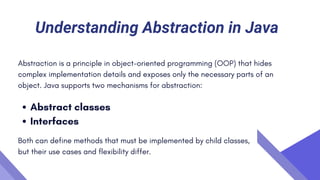
Abstraction is a principle in object-oriented programming (OOP) that hides
complex implementation details and exposes only the necessary parts of an
object. Java supports two mechanisms for abstraction:
Both can define methods that must be implemented by child classes,
but their use cases and flexibility differ.
Abstract classes
Interfaces
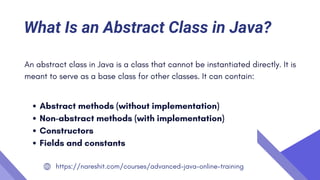
An abstract class in Java is a class that cannot be instantiated directly. It is
meant to serve as a base class for other classes. It can contain:
What Is an Abstract Class in Java?
Abstract methods (without implementation)
Non-abstract methods (with implementation)
Constructors
Fields and constants
https://nareshit.com/courses/advanced-java-online-training
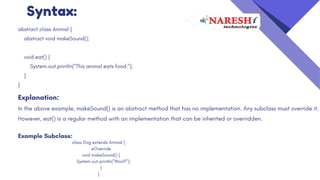
abstract class Animal {
abstract void makeSound();
void eat() {
System.out.println("This animal eats food.");
}
}
Syntax:
Explanation:
In the above example, makeSound() is an abstract method that has no implementation. Any subclass must override it.
However, eat() is a regular method with an implementation that can be inherited or overridden.
class Dog extends Animal {
@Override
void makeSound() {
System.out.println("Woof!");
}
}
Example Subclass:
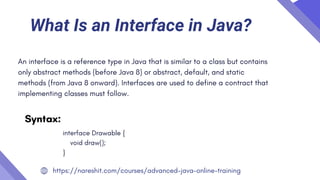
What Is an Interface in Java?
An interface is a reference type in Java that is similar to a class but contains
only abstract methods (before Java 8) or abstract, default, and static
methods (from Java 8 onward). Interfaces are used to define a contract that
implementing classes must follow.
Syntax:
interface Drawable {
void draw();
}
https://nareshit.com/courses/advanced-java-online-training
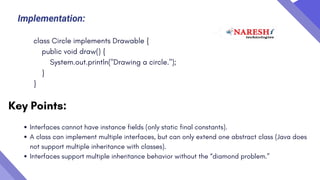
class Circle implements Drawable {
public void draw() {
System.out.println("Drawing a circle.");
}
}
Implementation:
Key Points:
Interfaces cannot have instance fields (only static final constants).
A class can implement multiple interfaces, but can only extend one abstract class (Java does
not support multiple inheritance with classes).
Interfaces support multiple inheritance behavior without the “diamond problem.”
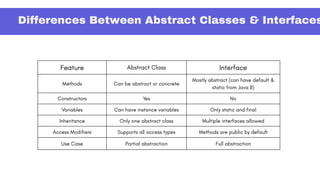
Feature Abstract Class Interface
Methods Can be abstract or concrete
Mostly abstract (can have default &
static from Java 8)
Constructors Yes No
Variables Can have instance variables Only static and final
Inheritance Only one abstract class Multiple interfaces allowed
Access Modifiers Supports all access types Methods are public by default
Use Case Partial abstraction Full abstraction
Differences Between Abstract Classes & Interfaces
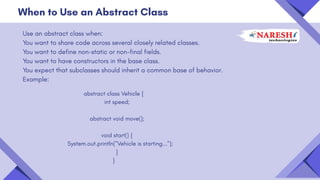
When to Use an Abstract Class
Use an abstract class when:
You want to share code across several closely related classes.
You want to define non-static or non-final fields.
You want to have constructors in the base class.
You expect that subclasses should inherit a common base of behavior.
Example:
abstract class Vehicle {
int speed;
abstract void move();
void start() {
System.out.println("Vehicle is starting...");
}
}
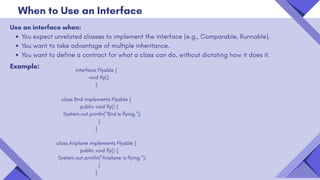
When to Use an Interface
Use an interface when:
You expect unrelated classes to implement the interface (e.g., Comparable, Runnable).
You want to take advantage of multiple inheritance.
You want to define a contract for what a class can do, without dictating how it does it.
interface Flyable {
void fly();
}
class Bird implements Flyable {
public void fly() {
System.out.println("Bird is flying.");
}
}
class Airplane implements Flyable {
public void fly() {
System.out.println("Airplane is flying.");
}
}
Example:
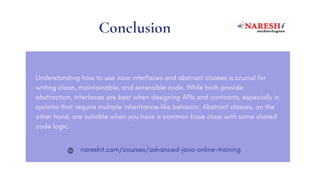
Understanding how to use Java interfaces and abstract classes is crucial for
writing clean, maintainable, and extensible code. While both provide
abstraction, interfaces are best when designing APIs and contracts, especially in
systems that require multiple inheritance-like behavior. Abstract classes, on the
other hand, are suitable when you have a common base class with some shared
code logic.
Conclusion
nareshit.com/courses/advanced-java-online-training
Thank You
nareshit.com/courses/advanced-java-online-training
Contact us
2nd Floor, Durga Bhavani Plaza, Ameerpet, Hyderabad, 500016
support@nareshit.com
+91 8179191999

How to Work with Java Interfaces and Abstract Classes

  • 1.
    How to Workwith https://nareshit.com/courses/advanced-java-online-training Java Interfaces & Abstract Classes
  • 2.
    Java is apowerful, object-oriented programming language widely used in enterprise development. Two key concepts that often puzzle developers— especially beginners—are interfaces and abstract classes. Both are used to achieve abstraction, but they serve different purposes and behave differently. In this article, you will learn what Java interfaces and abstract classes are, how to use them, and when to choose one over the other. Introduction https://nareshit.com/courses/advanced-java-online-training
  • 3.
    Understanding Abstraction inJava Abstraction is a principle in object-oriented programming (OOP) that hides complex implementation details and exposes only the necessary parts of an object. Java supports two mechanisms for abstraction: Both can define methods that must be implemented by child classes, but their use cases and flexibility differ. Abstract classes Interfaces
  • 4.
    An abstract classin Java is a class that cannot be instantiated directly. It is meant to serve as a base class for other classes. It can contain: What Is an Abstract Class in Java? Abstract methods (without implementation) Non-abstract methods (with implementation) Constructors Fields and constants https://nareshit.com/courses/advanced-java-online-training
  • 5.
    abstract class Animal{ abstract void makeSound(); void eat() { System.out.println("This animal eats food."); } } Syntax: Explanation: In the above example, makeSound() is an abstract method that has no implementation. Any subclass must override it. However, eat() is a regular method with an implementation that can be inherited or overridden. class Dog extends Animal { @Override void makeSound() { System.out.println("Woof!"); } } Example Subclass:
  • 6.
    What Is anInterface in Java? An interface is a reference type in Java that is similar to a class but contains only abstract methods (before Java 8) or abstract, default, and static methods (from Java 8 onward). Interfaces are used to define a contract that implementing classes must follow. Syntax: interface Drawable { void draw(); } https://nareshit.com/courses/advanced-java-online-training
  • 7.
    class Circle implementsDrawable { public void draw() { System.out.println("Drawing a circle."); } } Implementation: Key Points: Interfaces cannot have instance fields (only static final constants). A class can implement multiple interfaces, but can only extend one abstract class (Java does not support multiple inheritance with classes). Interfaces support multiple inheritance behavior without the “diamond problem.”
  • 8.
    Feature Abstract ClassInterface Methods Can be abstract or concrete Mostly abstract (can have default & static from Java 8) Constructors Yes No Variables Can have instance variables Only static and final Inheritance Only one abstract class Multiple interfaces allowed Access Modifiers Supports all access types Methods are public by default Use Case Partial abstraction Full abstraction Differences Between Abstract Classes & Interfaces
  • 9.
    When to Usean Abstract Class Use an abstract class when: You want to share code across several closely related classes. You want to define non-static or non-final fields. You want to have constructors in the base class. You expect that subclasses should inherit a common base of behavior. Example: abstract class Vehicle { int speed; abstract void move(); void start() { System.out.println("Vehicle is starting..."); } }
  • 10.
    When to Usean Interface Use an interface when: You expect unrelated classes to implement the interface (e.g., Comparable, Runnable). You want to take advantage of multiple inheritance. You want to define a contract for what a class can do, without dictating how it does it. interface Flyable { void fly(); } class Bird implements Flyable { public void fly() { System.out.println("Bird is flying."); } } class Airplane implements Flyable { public void fly() { System.out.println("Airplane is flying."); } } Example:
  • 11.
    Understanding how touse Java interfaces and abstract classes is crucial for writing clean, maintainable, and extensible code. While both provide abstraction, interfaces are best when designing APIs and contracts, especially in systems that require multiple inheritance-like behavior. Abstract classes, on the other hand, are suitable when you have a common base class with some shared code logic. Conclusion nareshit.com/courses/advanced-java-online-training
  • 12.
    Thank You nareshit.com/courses/advanced-java-online-training Contact us 2ndFloor, Durga Bhavani Plaza, Ameerpet, Hyderabad, 500016 support@nareshit.com +91 8179191999