THE ROLE OF C IN OPERATING
SYSTEM DEVELOPMENT
https://nareshit.com/courses/c-language-online-training
When it comes to developing operating systems, the C
programming language has remained a cornerstone
technology for decades. Despite the rise of modern
programming languages, C continues to dominate in the
field of low-level system programming, particularly in
operating system (OS) development. But why is C still so
relevant? Let’s explore the pivotal role it plays.
Introduction
https://nareshit.com/courses/c-language-online-training
Why Operating Systems Need Low-Level Control
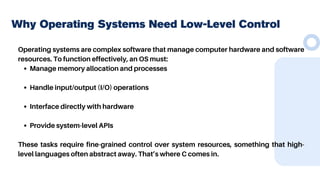
Operating systems are complex software that manage computer hardware and software
resources. To function effectively, an OS must:
Manage memory allocation and processes
Handle input/output (I/O) operations
Interface directly with hardware
Provide system-level APIs
These tasks require fine-grained control over system resources, something that high-
level languages often abstract away. That’s where C comes in.
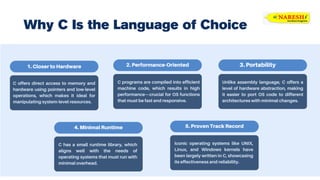
C offers direct access to memory and
hardware using pointers and low-level
operations, which makes it ideal for
manipulating system-level resources.
1. Closer to Hardware 2. Performance-Oriented
C programs are compiled into efficient
machine code, which results in high
performance—crucial for OS functions
that must be fast and responsive.
Why C Is the Language of Choice
3. Portability
Unlike assembly language, C offers a
level of hardware abstraction, making
it easier to port OS code to different
architectures with minimal changes.
5. Proven Track Record
Iconic operating systems like UNIX,
Linux, and Windows kernels have
been largely written in C, showcasing
its effectiveness and reliability.
4. Minimal Runtime
C has a small runtime library, which
aligns well with the needs of
operating systems that must run with
minimal overhead.
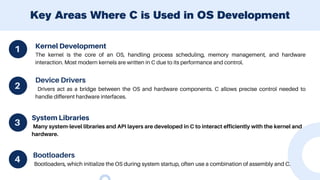
Kernel Development
The kernel is the core of an OS, handling process scheduling, memory management, and hardware
interaction. Most modern kernels are written in C due to its performance and control.
Key Areas Where C is Used in OS Development
1
4
2
3
Device Drivers
Drivers act as a bridge between the OS and hardware components. C allows precise control needed to
handle different hardware interfaces.
System Libraries
Many system-level libraries and API layers are developed in C to interact efficiently with the kernel and
hardware.
Bootloaders
Bootloaders, which initialize the OS during system startup, often use a combination of assembly and C.
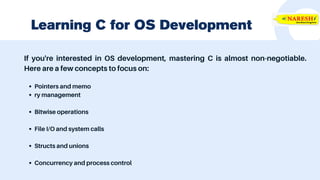
If you're interested in OS development, mastering C is almost non-negotiable.
Here are a few concepts to focus on:
Pointers and memo
ry management
Bitwise operations
File I/O and system calls
Structs and unions
Concurrency and process control
Learning C for OS Development
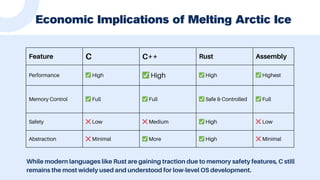
Feature C C++ Rust Assembly
Performance ✅High ✅High ✅High ✅Highest
Memory Control ✅Full ✅Full ✅Safe & Controlled ✅Full
Safety ❌Low ❌Medium ✅High ❌Low
Abstraction ❌Minimal ✅More ✅High ❌Minimal
Economic Implications of Melting Arctic Ice
While modern languages like Rust are gaining traction due to memory safety features, C still
remains the most widely used and understood for low-level OS development.
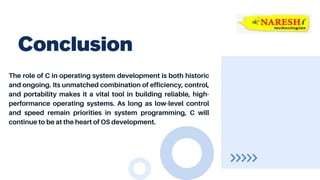
The role of C in operating system development is both historic
and ongoing. Its unmatched combination of efficiency, control,
and portability makes it a vital tool in building reliable, high-
performance operating systems. As long as low-level control
and speed remain priorities in system programming, C will
continue to be at the heart of OS development.
Conclusion
https://nareshit.com/courses/c-language-online-training
2nd Floor, Durga Bhavani Plaza, Ameerpet, Hyderabad, 500016
THANK YOU!
+91 8179191999
support@nareshit.com

The Role of C in Operating System Development

  • 1.
    THE ROLE OFC IN OPERATING SYSTEM DEVELOPMENT https://nareshit.com/courses/c-language-online-training
  • 2.
    When it comesto developing operating systems, the C programming language has remained a cornerstone technology for decades. Despite the rise of modern programming languages, C continues to dominate in the field of low-level system programming, particularly in operating system (OS) development. But why is C still so relevant? Let’s explore the pivotal role it plays. Introduction https://nareshit.com/courses/c-language-online-training
  • 3.
    Why Operating SystemsNeed Low-Level Control Operating systems are complex software that manage computer hardware and software resources. To function effectively, an OS must: Manage memory allocation and processes Handle input/output (I/O) operations Interface directly with hardware Provide system-level APIs These tasks require fine-grained control over system resources, something that high- level languages often abstract away. That’s where C comes in.
  • 4.
    C offers directaccess to memory and hardware using pointers and low-level operations, which makes it ideal for manipulating system-level resources. 1. Closer to Hardware 2. Performance-Oriented C programs are compiled into efficient machine code, which results in high performance—crucial for OS functions that must be fast and responsive. Why C Is the Language of Choice 3. Portability Unlike assembly language, C offers a level of hardware abstraction, making it easier to port OS code to different architectures with minimal changes. 5. Proven Track Record Iconic operating systems like UNIX, Linux, and Windows kernels have been largely written in C, showcasing its effectiveness and reliability. 4. Minimal Runtime C has a small runtime library, which aligns well with the needs of operating systems that must run with minimal overhead.
  • 5.
    Kernel Development The kernelis the core of an OS, handling process scheduling, memory management, and hardware interaction. Most modern kernels are written in C due to its performance and control. Key Areas Where C is Used in OS Development 1 4 2 3 Device Drivers Drivers act as a bridge between the OS and hardware components. C allows precise control needed to handle different hardware interfaces. System Libraries Many system-level libraries and API layers are developed in C to interact efficiently with the kernel and hardware. Bootloaders Bootloaders, which initialize the OS during system startup, often use a combination of assembly and C.
  • 6.
    If you're interestedin OS development, mastering C is almost non-negotiable. Here are a few concepts to focus on: Pointers and memo ry management Bitwise operations File I/O and system calls Structs and unions Concurrency and process control Learning C for OS Development
  • 7.
    Feature C C++Rust Assembly Performance ✅High ✅High ✅High ✅Highest Memory Control ✅Full ✅Full ✅Safe & Controlled ✅Full Safety ❌Low ❌Medium ✅High ❌Low Abstraction ❌Minimal ✅More ✅High ❌Minimal Economic Implications of Melting Arctic Ice While modern languages like Rust are gaining traction due to memory safety features, C still remains the most widely used and understood for low-level OS development.
  • 8.
    The role ofC in operating system development is both historic and ongoing. Its unmatched combination of efficiency, control, and portability makes it a vital tool in building reliable, high- performance operating systems. As long as low-level control and speed remain priorities in system programming, C will continue to be at the heart of OS development. Conclusion
  • 9.
    https://nareshit.com/courses/c-language-online-training 2nd Floor, DurgaBhavani Plaza, Ameerpet, Hyderabad, 500016 THANK YOU! +91 8179191999 support@nareshit.com