Foreign Direct InvestmentForeign Direct Investment
Wayne Lippman
Foreign Direct InvestmentForeign Direct Investment
 Why is FDI increasing in the world economy?
 Why do firms often prefer FDI to other market
entry strategies?
 Why do firms imitate competitors with FDI
strategies?
 Why are certain locations favored for FDI?
 How does political ideology affect government
FDI policy?
 What are key FDI related costs and benefits for
receiving and source countries?
Foreign Direct InvestmentForeign Direct Investment
 Foreign direct investment (FDI): a firm
invests directly in foreign facilities
 A firm that engages in FDI becomes a
multinational enterprise (MNE)
– Multinational = “more than one country”
 Factors which influence FDI are related to
factors that stimulate trade
Foreign Direct InvestmentForeign Direct Investment
 Involves ownership of entity abroad for
– production
– Marketing/service
– R&D
– Access of raw materials or other resource
 Parent has direct managerial control
– Depending on its extent of ownership and
– On other contractual terms of the FDI
 No managerial involvement = portfolio investment
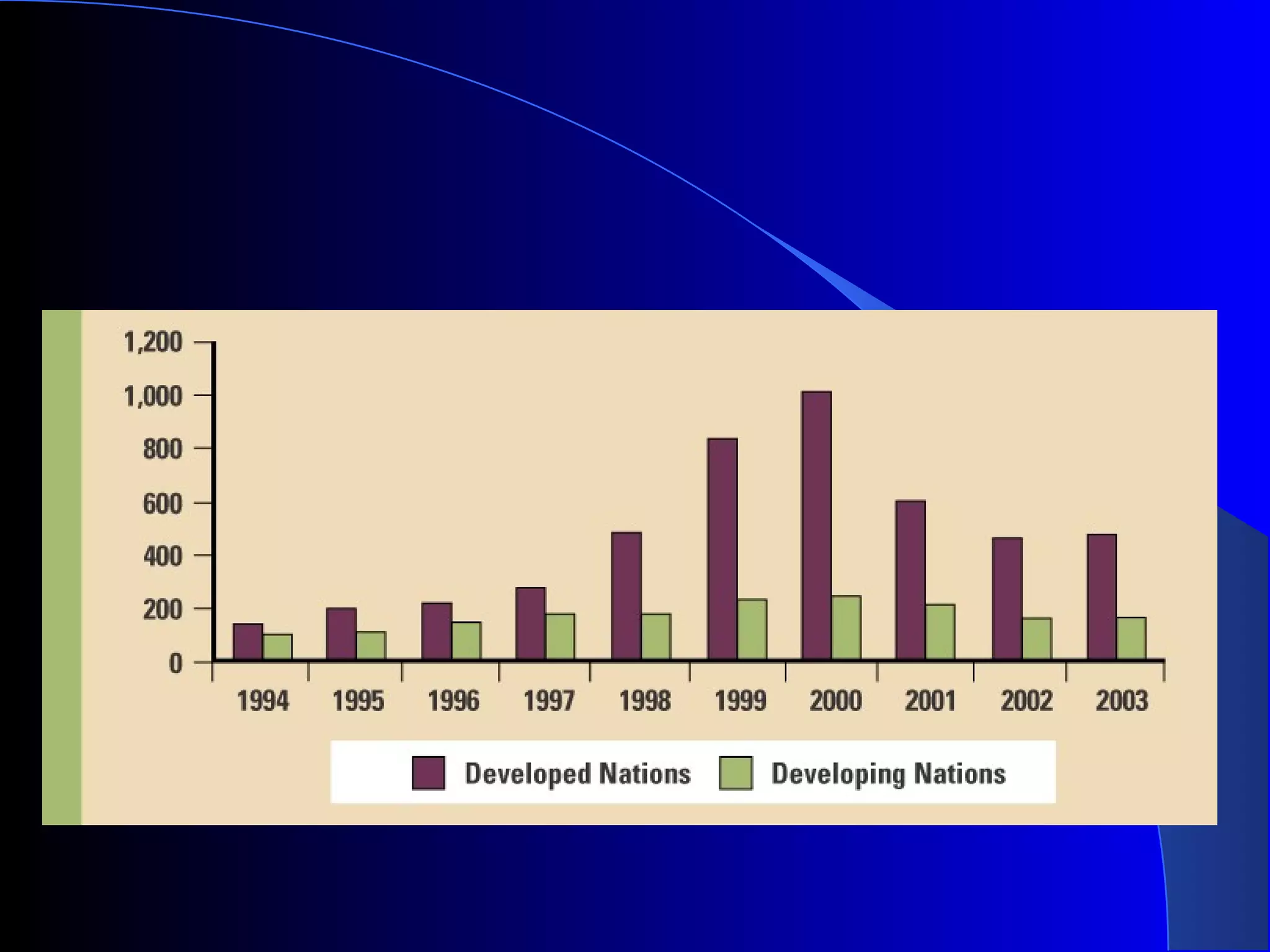
FDI Growth in the WorldFDI Growth in the World
EconomyEconomy
 FDI Outflow: $35 billion in ‘75 to $1.3 trillion in ‘00 to
$653 billion in ‘03
 FDI Flow (from all countries): from ‘92 to ‘02 up 292%,
compared to trade up 69% and world output up 28%
 FDI Stock: $3.5 trillion by ‘97 to > $7 trillion in ‘02
 In ‘02:
– 64,000 MNEs had:
 850,000 foreign affiliates
 53 million employees
 $17.7 trillion in sales
– $8 trillions global exports
 Conclusion:
FDI flow growing faster than world trade and world output
Direction and Source of FDIDirection and Source of FDI
 Most FDI flow has been to developed
countries from developed countries
– Much to the US from EU, Japan
 FDI increase to developing countries since
‘85
– Much to the emerging Asian and Latin
America economies
– Africa lagging
Forms of FDIForms of FDI
 FDI forms
– Purchase of assets: why? why not?
 Quick entry, local market know-how, local financing may be
possible, eliminate competitor, buying problems
– New investment: why? why not?
 No local entity is available for sale, local financial incentives, no
inherited problems, long lead time to generation of sales
– International joint-venture
 Shared ownership with local and/or other non-local partner
 Shared risk
Alternative Modes of Market EntryAlternative Modes of Market Entry
 FDI
– FDI - 100% ownership
– FDI < 100% ownership, International Joint
Venture
 Strategic Alliances (non-equity)
 Franchising
 Licensing
 Exports: Direct vs Indirect
Why FDI?Why FDI?
 FDI over exporting
– High transportation costs, trade barriers
 FDI over licensing or franchising
– Need to retain strategic control
– Need to protect technological know-how
– Capabilities not suitable for licensing/franchising
 Follow few main competitors
– Immediate strategic responses
Pattern of FDI ExplanationsPattern of FDI Explanations
 International product life-cycle (Ray Vernon)
– Trade theory similarity
 Eclectic paradigm of FDI (John Dunning)
– Combines ownership specific, location specific,
and internalization specific advantages
– Explains FDI decision over a decision to enter
through licensing or exports
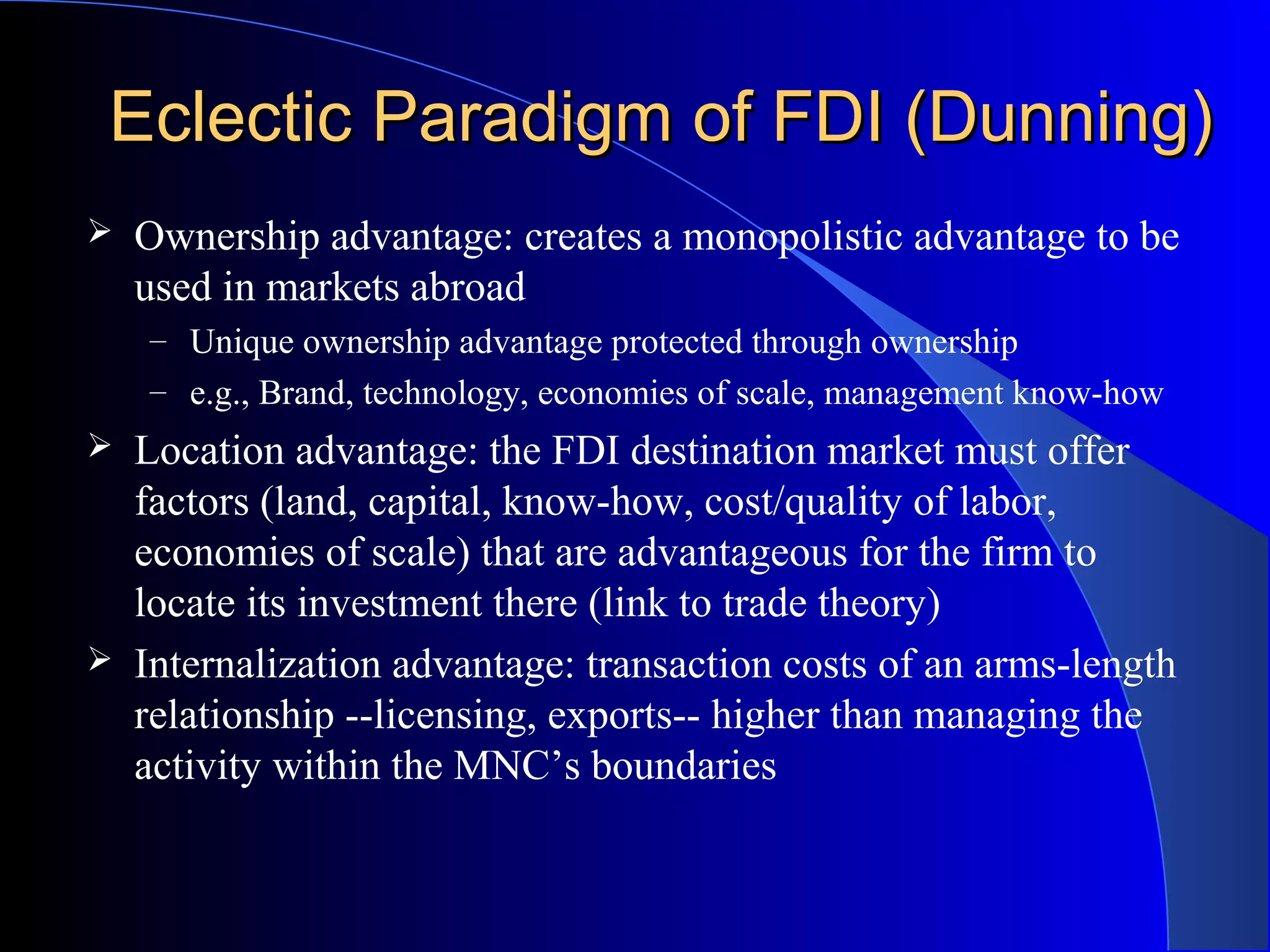
Eclectic Paradigm of FDI (Dunning)Eclectic Paradigm of FDI (Dunning)
 Ownership advantage: creates a monopolistic advantage to be
used in markets abroad
– Unique ownership advantage protected through ownership
– e.g., Brand, technology, economies of scale, management know-how
 Location advantage: the FDI destination market must offer
factors (land, capital, know-how, cost/quality of labor,
economies of scale) that are advantageous for the firm to
locate its investment there (link to trade theory)
 Internalization advantage: transaction costs of an arms-length
relationship --licensing, exports-- higher than managing the
activity within the MNC’s boundaries
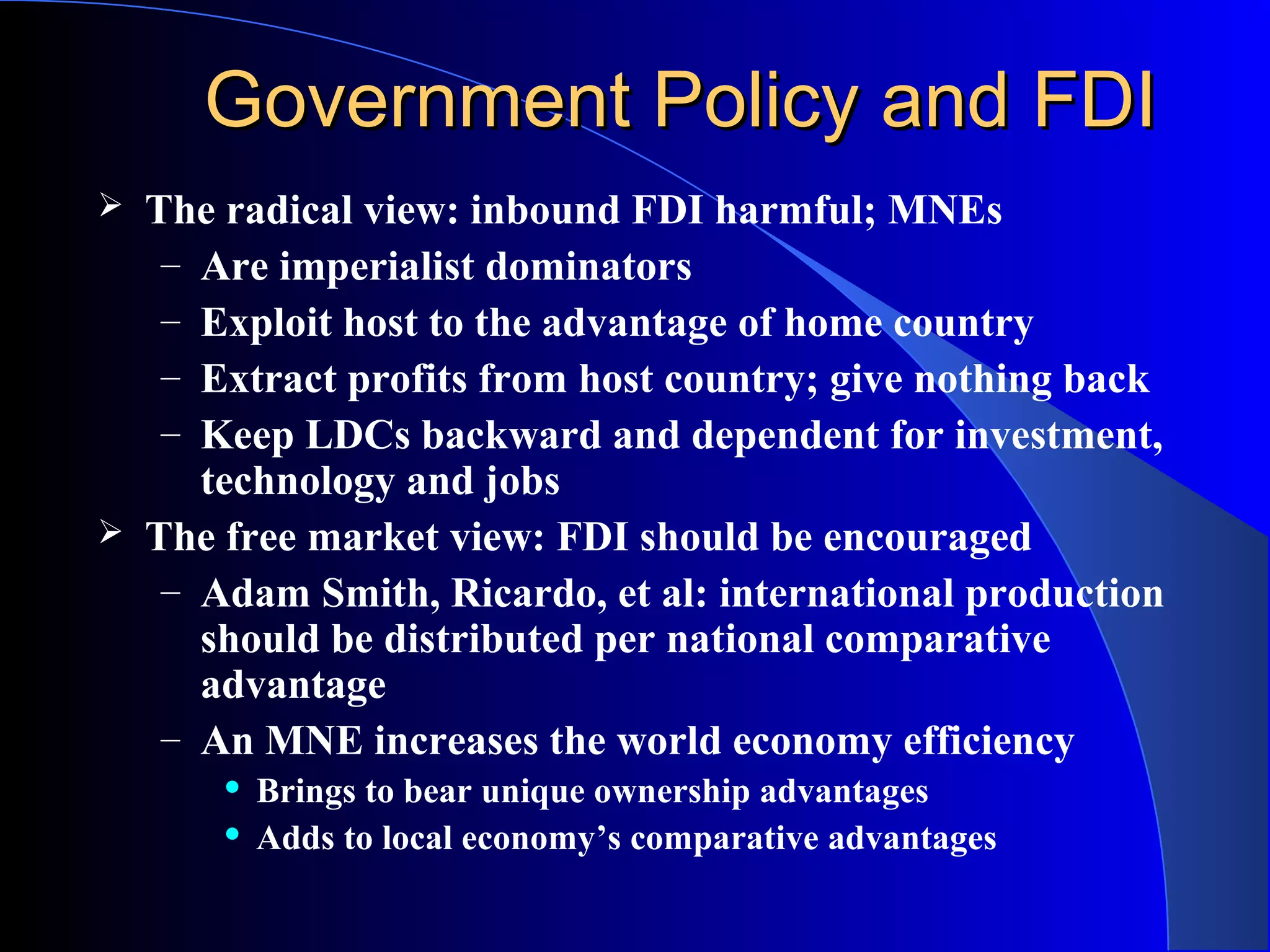
Government Policy and FDIGovernment Policy and FDI
 The radical view: inbound FDI harmful; MNEs
– Are imperialist dominators
– Exploit host to the advantage of home country
– Extract profits from host country; give nothing back
– Keep LDCs backward and dependent for investment,
technology and jobs
 The free market view: FDI should be encouraged
– Adam Smith, Ricardo, et al: international production
should be distributed per national comparative
advantage
– An MNE increases the world economy efficiency
 Brings to bear unique ownership advantages
 Adds to local economy’s comparative advantages
Host Country Effects of FDIHost Country Effects of FDI
Benefits
– Resource -transfer
– Employment
– Balance-of-payment (BOP)
 Import substitution
 Source of export increase
Costs
– Adverse effects on the BOP
 Capital inflow followed by capital outflow + profits
 Production input importation
– Threat to national sovereignty and autonomy
 Loss of economic independence
Government Policy and FDIGovernment Policy and FDI
Home country
– Outward FDI encouragement
 Risk reduction policies (financing, insurance, tax incentives)
– Outward FDI restrictions
 National security, BOP
Host country
– Inward FDI encouragement
 Investment incentives
 Job creation incentives
– Inward FDI restrictions
 Ownership extent restrictions (national security; local nationals
can safeguard host country’s interests
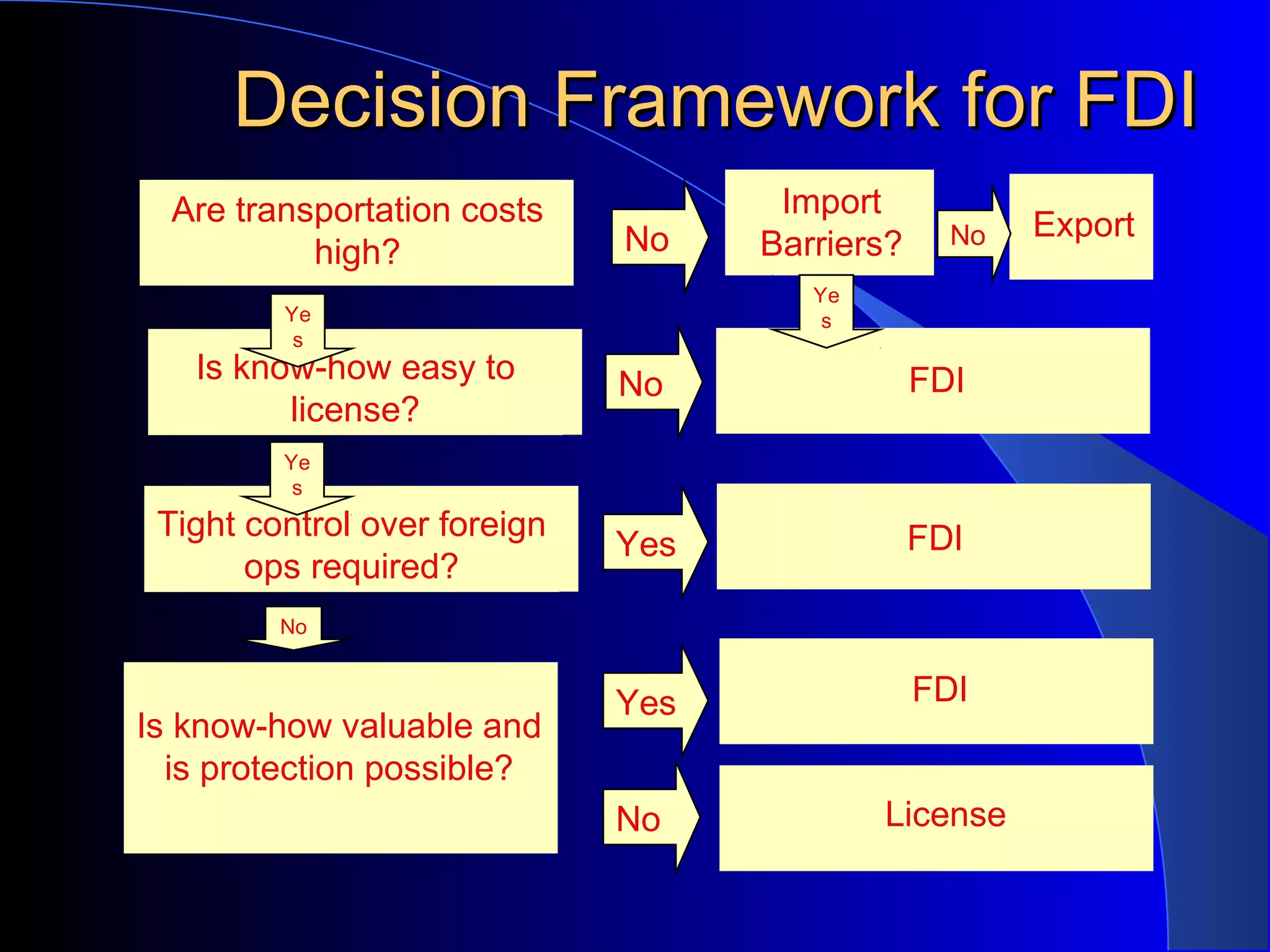
Decision Framework for FDIDecision Framework for FDI
Export
FDI
FDI
FDI
License
Yes
Import
Barriers?No
No
Yes
No
Are transportation costs
high?
Is know-how easy to
license?
Tight control over foreign
ops required?
Is know-how valuable and
is protection possible?
No
Ye
s
Ye
s
No
Ye
s
About Wayne Lippman
https://www.facebook.com/lippman
.associates.CPAs
https://www.facebook.com/lippman
.associates.CPAs
https://www.youtube.com/waynelippm
an
https://www.youtube.com/waynelippm
an
http://waynelippman.com
https://twitter.com/waynelippmanhttps://twitter.com/waynelippman
Wayne Lippman has forty years of
experience in public accounting
including twenty years with Price
Waterhouse, where he served as a tax
partner in the San Francisco and
Oakland offices. He was previously
Managing Tax Partner of the Walnut
Creek office of Price Waterhouse.
http://Waynelippman.wordpress.c
om

Foreign direct investment guide

  • 1.
    Foreign Direct InvestmentForeignDirect Investment Wayne Lippman
  • 3.
    Foreign Direct InvestmentForeignDirect Investment  Why is FDI increasing in the world economy?  Why do firms often prefer FDI to other market entry strategies?  Why do firms imitate competitors with FDI strategies?  Why are certain locations favored for FDI?  How does political ideology affect government FDI policy?  What are key FDI related costs and benefits for receiving and source countries?
  • 4.
    Foreign Direct InvestmentForeignDirect Investment  Foreign direct investment (FDI): a firm invests directly in foreign facilities  A firm that engages in FDI becomes a multinational enterprise (MNE) – Multinational = “more than one country”  Factors which influence FDI are related to factors that stimulate trade
  • 5.
    Foreign Direct InvestmentForeignDirect Investment  Involves ownership of entity abroad for – production – Marketing/service – R&D – Access of raw materials or other resource  Parent has direct managerial control – Depending on its extent of ownership and – On other contractual terms of the FDI  No managerial involvement = portfolio investment
  • 6.
    FDI Growth inthe WorldFDI Growth in the World EconomyEconomy  FDI Outflow: $35 billion in ‘75 to $1.3 trillion in ‘00 to $653 billion in ‘03  FDI Flow (from all countries): from ‘92 to ‘02 up 292%, compared to trade up 69% and world output up 28%  FDI Stock: $3.5 trillion by ‘97 to > $7 trillion in ‘02  In ‘02: – 64,000 MNEs had:  850,000 foreign affiliates  53 million employees  $17.7 trillion in sales – $8 trillions global exports  Conclusion: FDI flow growing faster than world trade and world output
  • 8.
    Direction and Sourceof FDIDirection and Source of FDI  Most FDI flow has been to developed countries from developed countries – Much to the US from EU, Japan  FDI increase to developing countries since ‘85 – Much to the emerging Asian and Latin America economies – Africa lagging
  • 10.
    Forms of FDIFormsof FDI  FDI forms – Purchase of assets: why? why not?  Quick entry, local market know-how, local financing may be possible, eliminate competitor, buying problems – New investment: why? why not?  No local entity is available for sale, local financial incentives, no inherited problems, long lead time to generation of sales – International joint-venture  Shared ownership with local and/or other non-local partner  Shared risk
  • 11.
    Alternative Modes ofMarket EntryAlternative Modes of Market Entry  FDI – FDI - 100% ownership – FDI < 100% ownership, International Joint Venture  Strategic Alliances (non-equity)  Franchising  Licensing  Exports: Direct vs Indirect
  • 12.
    Why FDI?Why FDI? FDI over exporting – High transportation costs, trade barriers  FDI over licensing or franchising – Need to retain strategic control – Need to protect technological know-how – Capabilities not suitable for licensing/franchising  Follow few main competitors – Immediate strategic responses
  • 14.
    Pattern of FDIExplanationsPattern of FDI Explanations  International product life-cycle (Ray Vernon) – Trade theory similarity  Eclectic paradigm of FDI (John Dunning) – Combines ownership specific, location specific, and internalization specific advantages – Explains FDI decision over a decision to enter through licensing or exports
  • 15.
    Eclectic Paradigm ofFDI (Dunning)Eclectic Paradigm of FDI (Dunning)  Ownership advantage: creates a monopolistic advantage to be used in markets abroad – Unique ownership advantage protected through ownership – e.g., Brand, technology, economies of scale, management know-how  Location advantage: the FDI destination market must offer factors (land, capital, know-how, cost/quality of labor, economies of scale) that are advantageous for the firm to locate its investment there (link to trade theory)  Internalization advantage: transaction costs of an arms-length relationship --licensing, exports-- higher than managing the activity within the MNC’s boundaries
  • 16.
    Government Policy andFDIGovernment Policy and FDI  The radical view: inbound FDI harmful; MNEs – Are imperialist dominators – Exploit host to the advantage of home country – Extract profits from host country; give nothing back – Keep LDCs backward and dependent for investment, technology and jobs  The free market view: FDI should be encouraged – Adam Smith, Ricardo, et al: international production should be distributed per national comparative advantage – An MNE increases the world economy efficiency  Brings to bear unique ownership advantages  Adds to local economy’s comparative advantages
  • 17.
    Host Country Effectsof FDIHost Country Effects of FDI Benefits – Resource -transfer – Employment – Balance-of-payment (BOP)  Import substitution  Source of export increase Costs – Adverse effects on the BOP  Capital inflow followed by capital outflow + profits  Production input importation – Threat to national sovereignty and autonomy  Loss of economic independence
  • 18.
    Government Policy andFDIGovernment Policy and FDI Home country – Outward FDI encouragement  Risk reduction policies (financing, insurance, tax incentives) – Outward FDI restrictions  National security, BOP Host country – Inward FDI encouragement  Investment incentives  Job creation incentives – Inward FDI restrictions  Ownership extent restrictions (national security; local nationals can safeguard host country’s interests
  • 19.
    Decision Framework forFDIDecision Framework for FDI Export FDI FDI FDI License Yes Import Barriers?No No Yes No Are transportation costs high? Is know-how easy to license? Tight control over foreign ops required? Is know-how valuable and is protection possible? No Ye s Ye s No Ye s
  • 21.
    About Wayne Lippman https://www.facebook.com/lippman .associates.CPAs https://www.facebook.com/lippman .associates.CPAs https://www.youtube.com/waynelippm an https://www.youtube.com/waynelippm an http://waynelippman.com https://twitter.com/waynelippmanhttps://twitter.com/waynelippman WayneLippman has forty years of experience in public accounting including twenty years with Price Waterhouse, where he served as a tax partner in the San Francisco and Oakland offices. He was previously Managing Tax Partner of the Walnut Creek office of Price Waterhouse. http://Waynelippman.wordpress.c om

Editor's Notes