Presented by
Navyashree V N
3/31/2022
Introduction to IC engines
1
Presentation on
“Introduction to IC Engines”
Contents
1. Basic Engine Components
2. Various Auxiliary System
3. Nomenclature
4. Applications
5. Specific Emission and Emission index
6. Engine flow through IC Engine
7. Performance Parameters.
3/31/2022
Introduction to IC engines
2
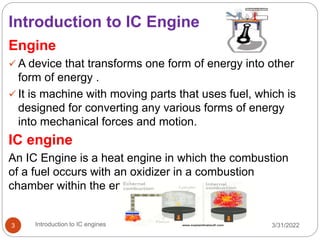
Introduction to IC Engine
Engine
 A device that transforms one form of energy into other
form of energy .
 It is machine with moving parts that uses fuel, which is
designed for converting any various forms of energy
into mechanical forces and motion.
IC engine
An IC Engine is a heat engine in which the combustion
of a fuel occurs with an oxidizer in a combustion
chamber within the engine .
3/31/2022
Introduction to IC engines
3
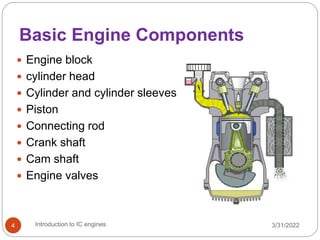
Basic Engine Components
 Engine block
 cylinder head
 Cylinder and cylinder sleeves
 Piston
 Connecting rod
 Crank shaft
 Cam shaft
 Engine valves
3/31/2022
Introduction to IC engines
4
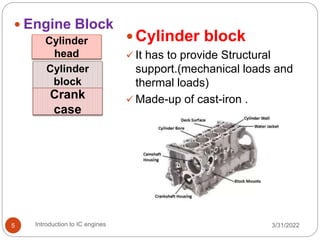
 Cylinder block
 It has to provide Structural
support.(mechanical loads and
thermal loads)
 Made-up of cast-iron .
 Engine Block
Cylinder
head
Cylinder
block
Crank
case
3/31/2022
Introduction to IC engines
5
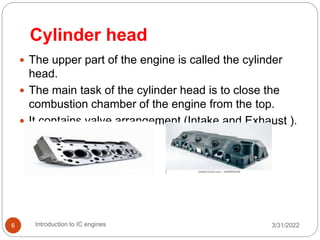
Cylinder head
 The upper part of the engine is called the cylinder
head.
 The main task of the cylinder head is to close the
combustion chamber of the engine from the top.
 It contains valve arrangement (Intake and Exhaust ).
3/31/2022
Introduction to IC engines
6
3/31/2022
Introduction to IC engines
7
Cylinder
 Engine cylinder is the space where fuel is admitted
(combustion chamber).
 Materials used steel alloys / aluminum
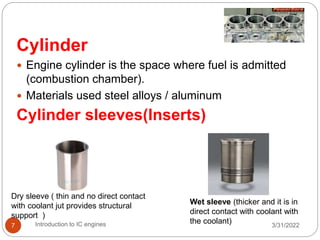
Cylinder sleeves(Inserts)
Dry sleeve ( thin and no direct contact
with coolant jut provides structural
support )
Wet sleeve (thicker and it is in
direct contact with coolant with
the coolant)
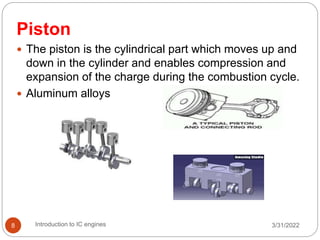
Piston
 The piston is the cylindrical part which moves up and
down in the cylinder and enables compression and
expansion of the charge during the combustion cycle.
 Aluminum alloys
3/31/2022
Introduction to IC engines
8
3/31/2022
Introduction to IC engines
9
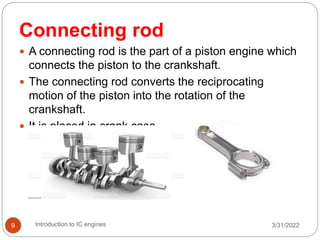
Connecting rod
 A connecting rod is the part of a piston engine which
connects the piston to the crankshaft.
 The connecting rod converts the reciprocating
motion of the piston into the rotation of the
crankshaft.
 It is placed in crank case
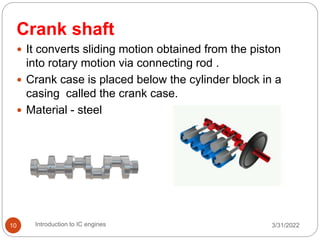
Crank shaft
 It converts sliding motion obtained from the piston
into rotary motion via connecting rod .
 Crank case is placed below the cylinder block in a
casing called the crank case.
 Material - steel
3/31/2022
Introduction to IC engines
10
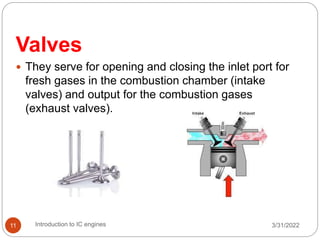
Valves
 They serve for opening and closing the inlet port for
fresh gases in the combustion chamber (intake
valves) and output for the combustion gases
(exhaust valves).
3/31/2022
Introduction to IC engines
11
3/31/2022
Introduction to IC engines
12
Camshaft
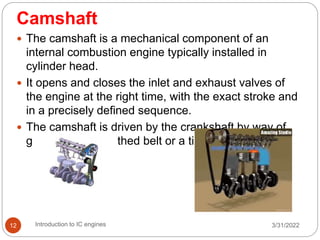
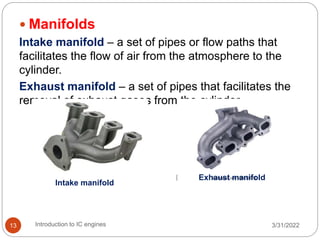
 The camshaft is a mechanical component of an
internal combustion engine typically installed in
cylinder head.
 It opens and closes the inlet and exhaust valves of
the engine at the right time, with the exact stroke and
in a precisely defined sequence.
 The camshaft is driven by the crankshaft by way of
gearwheels, a toothed belt or a timing chain.
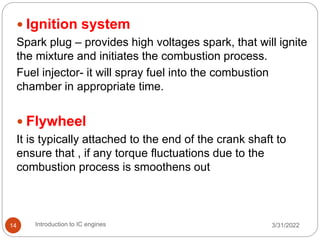
 Manifolds
Intake manifold – a set of pipes or flow paths that
facilitates the flow of air from the atmosphere to the
cylinder.
Exhaust manifold – a set of pipes that facilitates the
removal of exhaust gases from the cylinder.
3/31/2022
Introduction to IC engines
13
Intake manifold
Exhaust manifold
3/31/2022
Introduction to IC engines
14
 Ignition system
Spark plug – provides high voltages spark, that will ignite
the mixture and initiates the combustion process.
Fuel injector- it will spray fuel into the combustion
chamber in appropriate time.
 Flywheel
It is typically attached to the end of the crank shaft to
ensure that , if any torque fluctuations due to the
combustion process is smoothens out
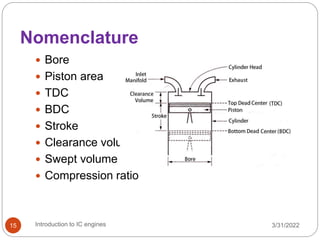
Nomenclature
 Bore
 Piston area
 TDC
 BDC
 Stroke
 Clearance volume
 Swept volume
 Compression ratio
3/31/2022
Introduction to IC engines
15
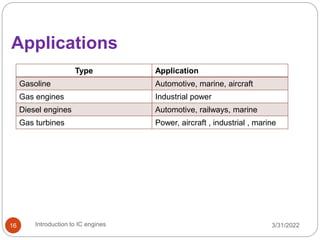
Applications
Type Application
Gasoline Automotive, marine, aircraft
Gas engines Industrial power
Diesel engines Automotive, railways, marine
Gas turbines Power, aircraft , industrial , marine
3/31/2022
Introduction to IC engines
16
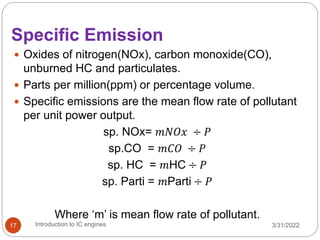
Specific Emission
 Oxides of nitrogen(NOx), carbon monoxide(CO),
unburned HC and particulates.
 Parts per million(ppm) or percentage volume.
 Specific emissions are the mean flow rate of pollutant
per unit power output.
sp. NOx= 𝑚𝑁𝑂𝑥 ÷ 𝑃
sp.CO = 𝑚𝐶𝑂 ÷ 𝑃
sp. HC = 𝑚HC ÷ 𝑃
sp. Parti = 𝑚Parti ÷ 𝑃
Where ‘m’ is mean flow rate of pollutant.
3/31/2022
Introduction to IC engines
17
Emission Index
 Emission rates can be normalized by fuel flow
rate i.e emission index.
EI (NOx) =[ m(NOx)÷ 𝑚(𝑓𝑢𝑒𝑙)]
EI (CO) =[ m(CO)÷ 𝑚(𝑓𝑢𝑒𝑙)]
Why it is ,
The total amount of a pollutant emitted from an
emission unit during a given time period.
3/31/2022
Introduction to IC engines
18
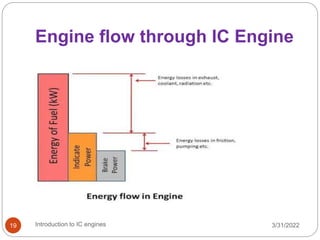
Engine flow through IC Engine
3/31/2022
Introduction to IC engines
19
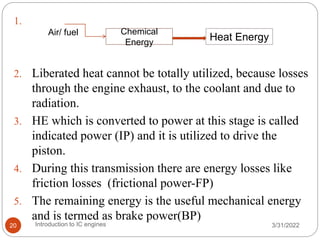
1.
2. Liberated heat cannot be totally utilized, because losses
through the engine exhaust, to the coolant and due to
radiation.
3. HE which is converted to power at this stage is called
indicated power (IP) and it is utilized to drive the
piston.
4. During this transmission there are energy losses like
friction losses (frictional power-FP)
5. The remaining energy is the useful mechanical energy
and is termed as brake power(BP)
Chemical
Energy
Heat Energy
Air/ fuel
3/31/2022
Introduction to IC engines
20
Performance Parameters
 Indicated power(IP)
Indicative of the energy from the fuel that can be
converted into work on the piston.
 Friction power (FP)
Indicative of the energy lost due to bearing friction,
pumping loss, energy spent to drive other devices and
etc.
 Brake power (BP)
Indicative of the energy obtained from the engine that
can used to drive the vehicle.
3/31/2022
Introduction to IC engines
21
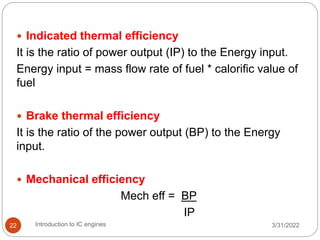
 Indicated thermal efficiency
It is the ratio of power output (IP) to the Energy input.
Energy input = mass flow rate of fuel * calorific value of
fuel
 Brake thermal efficiency
It is the ratio of the power output (BP) to the Energy
input.
 Mechanical efficiency
Mech eff = BP
IP
3/31/2022
Introduction to IC engines
22
 Relative efficiency
Actual thermal efficiency of the engine to the
corresponding air standard thermal efficiency .
 Volumetric efficiency
It is the ratio of the mass flow rate of air actually
taken into the cylinder through the intake system to
the rate at which air could be ideally taken into the
cylinder.
“Breathing ability”
3/31/2022
Introduction to IC engines
23
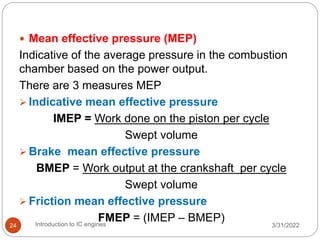
 Mean effective pressure (MEP)
Indicative of the average pressure in the combustion
chamber based on the power output.
There are 3 measures MEP
 Indicative mean effective pressure
IMEP = Work done on the piston per cycle
Swept volume
 Brake mean effective pressure
BMEP = Work output at the crankshaft per cycle
Swept volume
 Friction mean effective pressure
FMEP = (IMEP – BMEP)
3/31/2022
Introduction to IC engines
24
 Specific fuel consumption
SFC= fuel consumed per unit time
Power
 ISFC
 BSFC
 Fuel – air ratio
A mixture of fuel and air that has just enough air for
complete combustion of all fuel in the mixture
“Chemically correct mixture”
 Calorific value
it is the thermal energy released per unit quantity of the
fuel when it is burnt completely. 3/31/2022
Introduction to IC engines
25
THANK
YOU
3/31/2022
Introduction to IC engines
26

introduction to IC Engines .pptx

  • 1.
    Presented by Navyashree VN 3/31/2022 Introduction to IC engines 1 Presentation on “Introduction to IC Engines”
  • 2.
    Contents 1. Basic EngineComponents 2. Various Auxiliary System 3. Nomenclature 4. Applications 5. Specific Emission and Emission index 6. Engine flow through IC Engine 7. Performance Parameters. 3/31/2022 Introduction to IC engines 2
  • 3.
    Introduction to ICEngine Engine  A device that transforms one form of energy into other form of energy .  It is machine with moving parts that uses fuel, which is designed for converting any various forms of energy into mechanical forces and motion. IC engine An IC Engine is a heat engine in which the combustion of a fuel occurs with an oxidizer in a combustion chamber within the engine . 3/31/2022 Introduction to IC engines 3
  • 4.
    Basic Engine Components Engine block  cylinder head  Cylinder and cylinder sleeves  Piston  Connecting rod  Crank shaft  Cam shaft  Engine valves 3/31/2022 Introduction to IC engines 4
  • 5.
     Cylinder block It has to provide Structural support.(mechanical loads and thermal loads)  Made-up of cast-iron .  Engine Block Cylinder head Cylinder block Crank case 3/31/2022 Introduction to IC engines 5
  • 6.
    Cylinder head  Theupper part of the engine is called the cylinder head.  The main task of the cylinder head is to close the combustion chamber of the engine from the top.  It contains valve arrangement (Intake and Exhaust ). 3/31/2022 Introduction to IC engines 6
  • 7.
    3/31/2022 Introduction to ICengines 7 Cylinder  Engine cylinder is the space where fuel is admitted (combustion chamber).  Materials used steel alloys / aluminum Cylinder sleeves(Inserts) Dry sleeve ( thin and no direct contact with coolant jut provides structural support ) Wet sleeve (thicker and it is in direct contact with coolant with the coolant)
  • 8.
    Piston  The pistonis the cylindrical part which moves up and down in the cylinder and enables compression and expansion of the charge during the combustion cycle.  Aluminum alloys 3/31/2022 Introduction to IC engines 8
  • 9.
    3/31/2022 Introduction to ICengines 9 Connecting rod  A connecting rod is the part of a piston engine which connects the piston to the crankshaft.  The connecting rod converts the reciprocating motion of the piston into the rotation of the crankshaft.  It is placed in crank case
  • 10.
    Crank shaft  Itconverts sliding motion obtained from the piston into rotary motion via connecting rod .  Crank case is placed below the cylinder block in a casing called the crank case.  Material - steel 3/31/2022 Introduction to IC engines 10
  • 11.
    Valves  They servefor opening and closing the inlet port for fresh gases in the combustion chamber (intake valves) and output for the combustion gases (exhaust valves). 3/31/2022 Introduction to IC engines 11
  • 12.
    3/31/2022 Introduction to ICengines 12 Camshaft  The camshaft is a mechanical component of an internal combustion engine typically installed in cylinder head.  It opens and closes the inlet and exhaust valves of the engine at the right time, with the exact stroke and in a precisely defined sequence.  The camshaft is driven by the crankshaft by way of gearwheels, a toothed belt or a timing chain.
  • 13.
     Manifolds Intake manifold– a set of pipes or flow paths that facilitates the flow of air from the atmosphere to the cylinder. Exhaust manifold – a set of pipes that facilitates the removal of exhaust gases from the cylinder. 3/31/2022 Introduction to IC engines 13 Intake manifold Exhaust manifold
  • 14.
    3/31/2022 Introduction to ICengines 14  Ignition system Spark plug – provides high voltages spark, that will ignite the mixture and initiates the combustion process. Fuel injector- it will spray fuel into the combustion chamber in appropriate time.  Flywheel It is typically attached to the end of the crank shaft to ensure that , if any torque fluctuations due to the combustion process is smoothens out
  • 15.
    Nomenclature  Bore  Pistonarea  TDC  BDC  Stroke  Clearance volume  Swept volume  Compression ratio 3/31/2022 Introduction to IC engines 15
  • 16.
    Applications Type Application Gasoline Automotive,marine, aircraft Gas engines Industrial power Diesel engines Automotive, railways, marine Gas turbines Power, aircraft , industrial , marine 3/31/2022 Introduction to IC engines 16
  • 17.
    Specific Emission  Oxidesof nitrogen(NOx), carbon monoxide(CO), unburned HC and particulates.  Parts per million(ppm) or percentage volume.  Specific emissions are the mean flow rate of pollutant per unit power output. sp. NOx= 𝑚𝑁𝑂𝑥 ÷ 𝑃 sp.CO = 𝑚𝐶𝑂 ÷ 𝑃 sp. HC = 𝑚HC ÷ 𝑃 sp. Parti = 𝑚Parti ÷ 𝑃 Where ‘m’ is mean flow rate of pollutant. 3/31/2022 Introduction to IC engines 17
  • 18.
    Emission Index  Emissionrates can be normalized by fuel flow rate i.e emission index. EI (NOx) =[ m(NOx)÷ 𝑚(𝑓𝑢𝑒𝑙)] EI (CO) =[ m(CO)÷ 𝑚(𝑓𝑢𝑒𝑙)] Why it is , The total amount of a pollutant emitted from an emission unit during a given time period. 3/31/2022 Introduction to IC engines 18
  • 19.
    Engine flow throughIC Engine 3/31/2022 Introduction to IC engines 19
  • 20.
    1. 2. Liberated heatcannot be totally utilized, because losses through the engine exhaust, to the coolant and due to radiation. 3. HE which is converted to power at this stage is called indicated power (IP) and it is utilized to drive the piston. 4. During this transmission there are energy losses like friction losses (frictional power-FP) 5. The remaining energy is the useful mechanical energy and is termed as brake power(BP) Chemical Energy Heat Energy Air/ fuel 3/31/2022 Introduction to IC engines 20
  • 21.
    Performance Parameters  Indicatedpower(IP) Indicative of the energy from the fuel that can be converted into work on the piston.  Friction power (FP) Indicative of the energy lost due to bearing friction, pumping loss, energy spent to drive other devices and etc.  Brake power (BP) Indicative of the energy obtained from the engine that can used to drive the vehicle. 3/31/2022 Introduction to IC engines 21
  • 22.
     Indicated thermalefficiency It is the ratio of power output (IP) to the Energy input. Energy input = mass flow rate of fuel * calorific value of fuel  Brake thermal efficiency It is the ratio of the power output (BP) to the Energy input.  Mechanical efficiency Mech eff = BP IP 3/31/2022 Introduction to IC engines 22
  • 23.
     Relative efficiency Actualthermal efficiency of the engine to the corresponding air standard thermal efficiency .  Volumetric efficiency It is the ratio of the mass flow rate of air actually taken into the cylinder through the intake system to the rate at which air could be ideally taken into the cylinder. “Breathing ability” 3/31/2022 Introduction to IC engines 23
  • 24.
     Mean effectivepressure (MEP) Indicative of the average pressure in the combustion chamber based on the power output. There are 3 measures MEP  Indicative mean effective pressure IMEP = Work done on the piston per cycle Swept volume  Brake mean effective pressure BMEP = Work output at the crankshaft per cycle Swept volume  Friction mean effective pressure FMEP = (IMEP – BMEP) 3/31/2022 Introduction to IC engines 24
  • 25.
     Specific fuelconsumption SFC= fuel consumed per unit time Power  ISFC  BSFC  Fuel – air ratio A mixture of fuel and air that has just enough air for complete combustion of all fuel in the mixture “Chemically correct mixture”  Calorific value it is the thermal energy released per unit quantity of the fuel when it is burnt completely. 3/31/2022 Introduction to IC engines 25
  • 26.