1
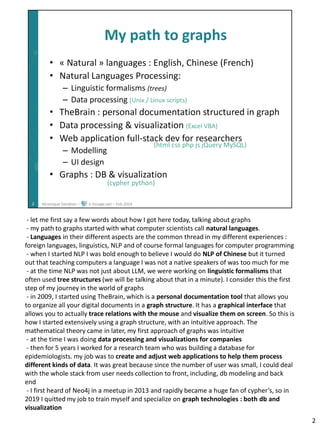
- let me first say a few words about how I got here today, talking about graphs
- my path to graphs started with what computer scientists call natural languages.
- Languages in their different aspects are the common thread in my different experiences :
foreign languages, linguistics, NLP and of course formal languages for computer programming
- when I started NLP I was bold enough to believe I would do NLP of Chinese but it turned
out that teaching computers a language I was not a native speakers of was too much for me
- at the time NLP was not just about LLM, we were working on linguistic formalisms that
often used tree structures (we will be talking about that in a minute). I consider this the first
step of my journey in the world of graphs
- in 2009, I started using TheBrain, which is a personal documentation tool that allows you
to organize all your digital documents in a graph structure. It has a graphical interface that
allows you to actually trace relations with the mouse and visualize them on screen. So this is
how I started extensively using a graph structure, with an intuitive approach. The
mathematical theory came in later, my first approach of graphs was intuitive
- at the time I was doing data processing and visualizations for companies
- then for 5 years I worked for a research team who was building a database for
epidemiologists. my job was to create and adjust web applications to help them process
different kinds of data. It was great because since the number of user was small, I could deal
with the whole stack from user needs collection to front, including, db modeling and back
end
- I first heard of Neo4j in a meetup in 2013 and rapidly became a huge fan of cypher’s, so in
2019 I quitted my job to train myself and specialize on graph technologies : both db and
visualization
2
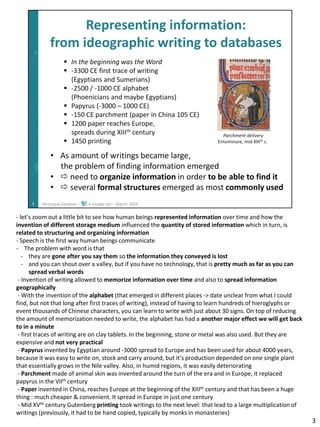
- let’s zoom out a little bit to see how human beings represented information over time and how the
invention of different storage medium influenced the quantity of stored information which in turn, is
related to structuring and organizing information
- Speech is the first way human beings communicate
- The problem with word is that
- they are gone after you say them so the information they conveyed is lost
- and you can shout over a valley, but if you have no technology, that is pretty much as far as you can
spread verbal words
- Invention of writing allowed to memorize information over time and also to spread information
geographically
- With the invention of the alphabet (that emerged in different places -> date unclear from what I could
find, but not that long after first traces of writing), instead of having to learn hundreds of hieroglyphs or
event thousands of Chinese characters, you can learn to write with just about 30 signs. On top of reducing
the amount of memorization needed to write, the alphabet has had a another major effect we will get back
to in a minute
- first traces of writing are on clay tablets. In the beginning, stone or metal was also used. But they are
expensive and not very practical
- Papyrus invented by Egyptian around -3000 spread to Europe and has been used for about 4000 years,
because it was easy to write on, stock and carry around, but it’s production depended on one single plant
that essentially grows in the Nile valley. Also, in humid regions, it was easily deteriorating
- Parchment made of animal skin was invented around the turn of the era and in Europe, it replaced
papyrus in the VIIth century
- Paper invented in China, reaches Europe at the beginning of the XIIIth century and that has been a huge
thing : much cheaper & convenient. It spread in Europe in just one century
- Mid XVth century Gutenberg printing took writings to the next level: that lead to a large multiplication of
writings (previously, it had to be hand copied, typically by monks in monasteries)
3
- Structure is about the arrangement of and the relations
between parts or element of something complex
- So let’s keep in mind that structure is about elements related to
other elements
4
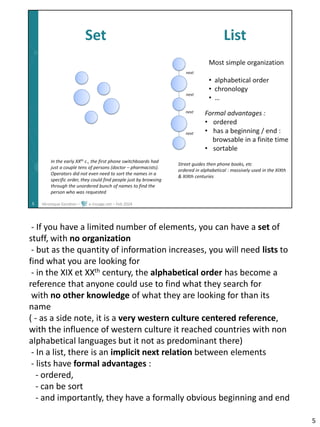
- If you have a limited number of elements, you can have a set of
stuff, with no organization
- but as the quantity of information increases, you will need lists to
find what you are looking for
- in the XIX et XXth century, the alphabetical order has become a
reference that anyone could use to find what they search for
with no other knowledge of what they are looking for than its
name
( - as a side note, it is a very western culture centered reference,
with the influence of western culture it reached countries with non
alphabetical languages but it not as predominant there)
- In a list, there is an implicit next relation between elements
- lists have formal advantages :
- ordered,
- can be sort
- and importantly, they have a formally obvious beginning and end
5
- When the list gets too long, instead of having everything in just
one list
- You probably want to classify your items, in order to be able to
find them
- For example, take those grey dots, that can have properties,
represented here by a red triangle, blue cross or green square
- A common representation of a classification is with sets, here,
the red, blue and green potato shapes
- But a classification can also be represented a graph structure
- [ graph def ]
6
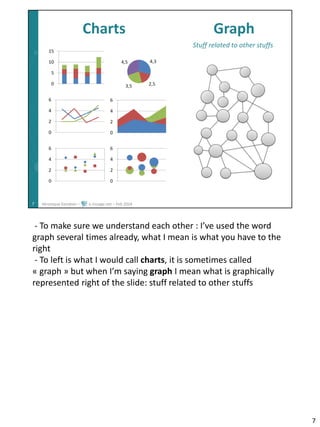
- To make sure we understand each other : I’ve used the word
graph several times already, what I mean is what you have to the
right
- To left is what I would call charts, it is sometimes called
« graph » but when I’m saying graph I mean what is graphically
represented right of the slide: stuff related to other stuffs
7
Back to the representation of classification
- you can represent the class by a node, here with the thick
border
- and the you represent the classification by linking items to the
class nodes
formally you are representing the same thing than with a set
representation
8
- Now if you have a lot of class, you’ll probably want to organize
those classes. This is often done with a hierarchy
- If you look at the top left typical representation of a tree, you
could say that it is about making a dark green and a red collection,
then putting them together to make the pink collection, then put
the pink with the light green and orange classes to build a blue
collection. that is a way of organizing collections.
- Let’s first focus on the formal constrains of what is called a tree :
it’s stuff related to other stuff, but with 2 constrains
- Must be connected : if you have several pieces, it is not a tree
- No cycle : what a cycle is is very easy to understand if you look
at the bottom right figure : in a tree, they can not be relations that
form a loop
9
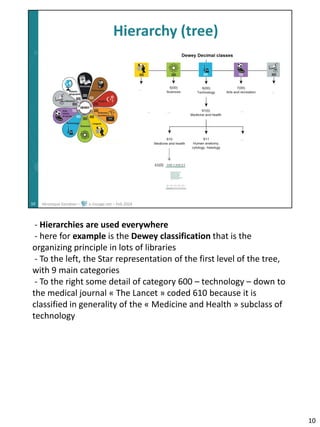
- Hierarchies are used everywhere
- here for example is the Dewey classification that is the
organizing principle in lots of libraries
- To the left, the Star representation of the first level of the tree,
with 9 main categories
- To the right some detail of category 600 – technology – down to
the medical journal « The Lancet » coded 610 because it is
classified in generality of the « Medicine and Health » subclass of
technology
10
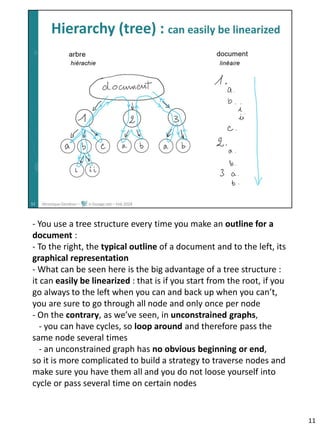
- You use a tree structure every time you make an outline for a
document :
- To the right, the typical outline of a document and to the left, its
graphical representation
- What can be seen here is the big advantage of a tree structure :
it can easily be linearized : that is if you start from the root, if you
go always to the left when you can and back up when you can’t,
you are sure to go through all node and only once per node
- On the contrary, as we’ve seen, in unconstrained graphs,
- you can have cycles, so loop around and therefore pass the
same node several times
- an unconstrained graph has no obvious beginning or end,
so it is more complicated to build a strategy to traverse nodes and
make sure you have them all and you do not loose yourself into
cycle or pass several time on certain nodes
11
- the last commonly used formal structure we will be talking
about is the table
- quick jump back in time, this is the earliest known trace of
writing. It is a clay tablet for administrative use to keep track of
stocks. So this looks like the ancestor of an Excel spread sheet to
me !
- Which shows the need for structuring information is very old,
because it is very much related to our cognitive processes : we
need to organize stuff, that is to relate them, to be able to think
and understand the world we live in. That is how we human
beings are
12
- fast forward to the beginning of computer science
- Until the 60-70s files contained information but files were
unrelated.
- in 1970, Edgar Codd came up with the idea of A Relational
Model which lead to the developing of relational db
- MySQL which is one very widely used kind of relational
database was created by a Swedish guy.
As you know, Neo4j was also created by Swedish guys.
You Swedish people are good at databases !
13
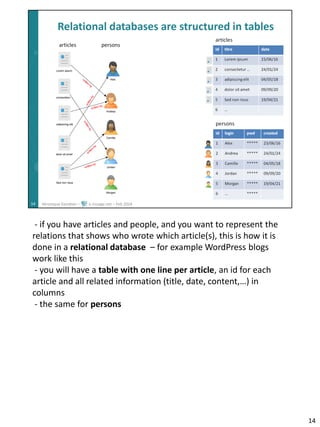
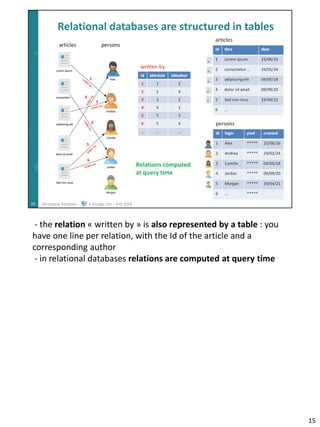
- if you have articles and people, and you want to represent the
relations that shows who wrote which article(s), this is how it is
done in a relational database – for example WordPress blogs
work like this
- you will have a table with one line per article, an id for each
article and all related information (title, date, content,…) in
columns
- the same for persons
14
- the relation « written by » is also represented by a table : you
have one line per relation, with the Id of the article and a
corresponding author
- in relational databases relations are computed at query time
15
- If this is how your data looks like, you do not want to use tables
- This a representation of 52 000 twitter accounts, links are RT
(who RT who). It is used by researchers who analyze the
structure and tactics the climate change denialist on twitter
- tables are not an appropriate representation if data is highly
connected and/or contains long chains of relation
16
- this slide is to give you an impression of the crazy increase in
information storage capacity, because as we said before, the
more information stock, the more you need efficient search
strategies to find what you need, when you need it
- Archbishop Boniface was a book lover. … how many books do
you think he had ?
- He had 50. more than the Pope and monasteries at the time
- in 1978, as I was learning my multiplication tables in primary
school, my father was using this computer, in the research lab he
worked for
- how much memory do you think it had ?
- 16 + 8 24 KB
- if you consider that back in 710, a book had maybe 200 pages of
500 char
- the 1978 computer my dad wrote his PhD on could not even
contain ¼ of a 710 books
17
- recent personal computers now have 700 000x more than this
very expensive research computer in 1978
- today, 1 tera is easily accessible to many people - 10 M° more
than what the riches guy in terms of books had in 710
18
- do not remember the exact figures, they are estimations that are
difficult to make in a meaningful way : I have not even taken into
account compression technics which makes the factor even bigger
- just want to give you an impression of the craziness in which the
capacity to store information raised.
- over our life times (i.e. over the 50 years of my lifetime and even
more rapidly over the last 20-30 years) it went exponential (i.e.
even more crazy…)
19
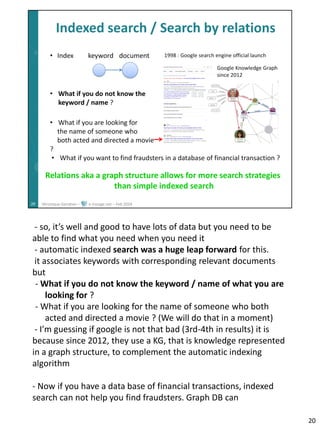
- so, it’s well and good to have lots of data but you need to be
able to find what you need when you need it
- automatic indexed search was a huge leap forward for this.
it associates keywords with corresponding relevant documents
but
- What if you do not know the keyword / name of what you are
looking for ?
- What if you are looking for the name of someone who both
acted and directed a movie ? (We will do that in a moment)
- I’m guessing if google is not that bad (3rd-4th in results) it is
because since 2012, they use a KG, that is knowledge represented
in a graph structure, to complement the automatic indexing
algorithm
- Now if you have a data base of financial transactions, indexed
search can not help you find fraudsters. Graph DB can
20
- let’s wrap up on this commonly used formal structures part
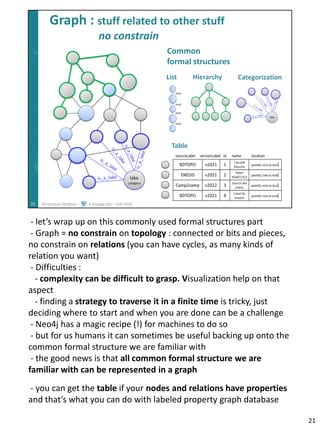
- Graph = no constrain on topology : connected or bits and pieces,
no constrain on relations (you can have cycles, as many kinds of
relation you want)
- Difficulties :
- complexity can be difficult to grasp. Visualization help on that
aspect
- finding a strategy to traverse it in a finite time is tricky, just
deciding where to start and when you are done can be a challenge
- Neo4j has a magic recipe (!) for machines to do so
- but for us humans it can sometimes be useful backing up onto the
common formal structure we are familiar with
- the good news is that all common formal structure we are
familiar with can be represented in a graph
- you can get the table if your nodes and relations have properties
and that’s what you can do with labeled property graph database
21
22
23
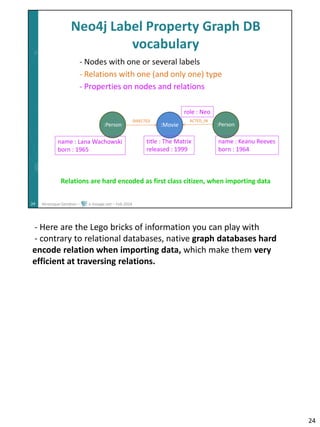
- Here are the Lego bricks of information you can play with
- contrary to relational databases, native graph databases hard
encode relation when importing data, which make them very
efficient at traversing relations.
24
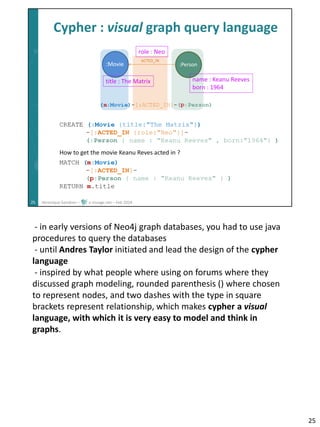
- in early versions of Neo4j graph databases, you had to use java
procedures to query the databases
- until Andres Taylor initiated and lead the design of the cypher
language
- inspired by what people where using on forums where they
discussed graph modeling, rounded parenthesis () where chosen
to represent nodes, and two dashes with the type in square
brackets represent relationship, which makes cypher a visual
language, with which it is very easy to model and think in
graphs.
25
26
27
28
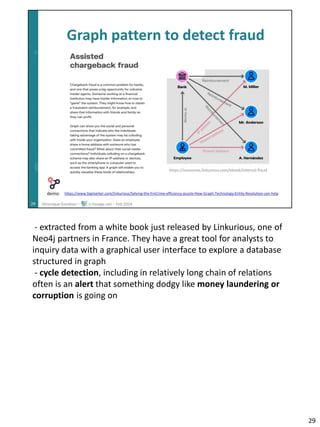
- extracted from a white book just released by Linkurious, one of
Neo4j partners in France. They have a great tool for analysts to
inquiry data with a graphical user interface to explore a database
structured in graph
- cycle detection, including in relatively long chain of relations
often is an alert that something dodgy like money laundering or
corruption is going on
29
- let’s wrap up by zooming out from what you’ve done today and
all that can be done with graphs
- local graph pattern matching like we have practiced today is
just one way to use graph structure.
- as we have briefly seen with the fraud detection example, graph
Graphical User Interface, with interaction functionalities and
layout algorithms help analysts explore graphs databases
- they are tens of Graph Data Science algorithms, that can
calculate for example node centrality (= importance), nodes
communities or similarities. GDS algorithms detect large scale
patterns
30
- there are different kinds of centrality (= importance) detection
algorithms for nodes in a graph.
- Betweenness centrality for example represents how important
a node is for transiting traffic. It is used in transportation and
supply chain industry, to visualize important nodes because of the
traffic that goes through them
- The figure captures this very well. It also made me laugh and I
believe it is because it relates two imaginary worlds that I’ve
always seen separate : the tech world with it’s very male base
imaginary (lot’s of pizza bier references…) and skin care, that is
more commonly associated to women world’s …
For the gender equal (tech) world to happen, we need more
representation like this one !
31
- the term Knowledge Graph is sometimes used as a synonym of
graph database, but most of times, Knowledge Graph means
there are some constrains on the graph, in term of relations
types and or node topology.
(i.g. (instance)-[:isA]->(subClass)-[:isSubClassOf]->(class) ).
Such constrains allow to compute new information with logical
inferences
(i.g. if (a)-[:isSubClassOf]->(b)-[:isSubClassOf]->(c) then (a)-
[:isSubClassOf]->(c) )
- a currently very hot topic is the use of graphs for Retrieval
Augmented Generation (RAG), in order to frame LLM
hallucinations with knowledge represented in a graph structure
- nodes embedding (= node vectorization) is used for machine
learning
- state machine are a way to represent the state of an automaton
with operation that will make states evolve. This is used to
monitor tickets in a IT system, to deal with issues or updates
32
- Computer scientists who have been trained in computer science
schools tend to think that a database is about stocking
information. Analysis and processing is supposed to happen
before or after, but not in the db.
- I’ve experienced it can be difficult to have them think outside
this box and realize that putting all available data in a graph
database is not just about stocking but above all about taking
advantage of a graph structure
- In graph database, the keyword is not database, it is graph
33
34
- attend general public tech gigs
- https://www.pinkprogramming.se/ is great (thanks for the invite
!) but at some point you need to leave it’s comfortable cocoon
and jump into the world !
- For the future to be a mixed society
You need to take your place in it
Take the floor !
35

Introduction to Graph query language Cypher

  • 1.
  • 2.
    - let mefirst say a few words about how I got here today, talking about graphs - my path to graphs started with what computer scientists call natural languages. - Languages in their different aspects are the common thread in my different experiences : foreign languages, linguistics, NLP and of course formal languages for computer programming - when I started NLP I was bold enough to believe I would do NLP of Chinese but it turned out that teaching computers a language I was not a native speakers of was too much for me - at the time NLP was not just about LLM, we were working on linguistic formalisms that often used tree structures (we will be talking about that in a minute). I consider this the first step of my journey in the world of graphs - in 2009, I started using TheBrain, which is a personal documentation tool that allows you to organize all your digital documents in a graph structure. It has a graphical interface that allows you to actually trace relations with the mouse and visualize them on screen. So this is how I started extensively using a graph structure, with an intuitive approach. The mathematical theory came in later, my first approach of graphs was intuitive - at the time I was doing data processing and visualizations for companies - then for 5 years I worked for a research team who was building a database for epidemiologists. my job was to create and adjust web applications to help them process different kinds of data. It was great because since the number of user was small, I could deal with the whole stack from user needs collection to front, including, db modeling and back end - I first heard of Neo4j in a meetup in 2013 and rapidly became a huge fan of cypher’s, so in 2019 I quitted my job to train myself and specialize on graph technologies : both db and visualization 2
  • 3.
    - let’s zoomout a little bit to see how human beings represented information over time and how the invention of different storage medium influenced the quantity of stored information which in turn, is related to structuring and organizing information - Speech is the first way human beings communicate - The problem with word is that - they are gone after you say them so the information they conveyed is lost - and you can shout over a valley, but if you have no technology, that is pretty much as far as you can spread verbal words - Invention of writing allowed to memorize information over time and also to spread information geographically - With the invention of the alphabet (that emerged in different places -> date unclear from what I could find, but not that long after first traces of writing), instead of having to learn hundreds of hieroglyphs or event thousands of Chinese characters, you can learn to write with just about 30 signs. On top of reducing the amount of memorization needed to write, the alphabet has had a another major effect we will get back to in a minute - first traces of writing are on clay tablets. In the beginning, stone or metal was also used. But they are expensive and not very practical - Papyrus invented by Egyptian around -3000 spread to Europe and has been used for about 4000 years, because it was easy to write on, stock and carry around, but it’s production depended on one single plant that essentially grows in the Nile valley. Also, in humid regions, it was easily deteriorating - Parchment made of animal skin was invented around the turn of the era and in Europe, it replaced papyrus in the VIIth century - Paper invented in China, reaches Europe at the beginning of the XIIIth century and that has been a huge thing : much cheaper & convenient. It spread in Europe in just one century - Mid XVth century Gutenberg printing took writings to the next level: that lead to a large multiplication of writings (previously, it had to be hand copied, typically by monks in monasteries) 3
  • 4.
    - Structure isabout the arrangement of and the relations between parts or element of something complex - So let’s keep in mind that structure is about elements related to other elements 4
  • 5.
    - If youhave a limited number of elements, you can have a set of stuff, with no organization - but as the quantity of information increases, you will need lists to find what you are looking for - in the XIX et XXth century, the alphabetical order has become a reference that anyone could use to find what they search for with no other knowledge of what they are looking for than its name ( - as a side note, it is a very western culture centered reference, with the influence of western culture it reached countries with non alphabetical languages but it not as predominant there) - In a list, there is an implicit next relation between elements - lists have formal advantages : - ordered, - can be sort - and importantly, they have a formally obvious beginning and end 5
  • 6.
    - When thelist gets too long, instead of having everything in just one list - You probably want to classify your items, in order to be able to find them - For example, take those grey dots, that can have properties, represented here by a red triangle, blue cross or green square - A common representation of a classification is with sets, here, the red, blue and green potato shapes - But a classification can also be represented a graph structure - [ graph def ] 6
  • 7.
    - To makesure we understand each other : I’ve used the word graph several times already, what I mean is what you have to the right - To left is what I would call charts, it is sometimes called « graph » but when I’m saying graph I mean what is graphically represented right of the slide: stuff related to other stuffs 7
  • 8.
    Back to therepresentation of classification - you can represent the class by a node, here with the thick border - and the you represent the classification by linking items to the class nodes formally you are representing the same thing than with a set representation 8
  • 9.
    - Now ifyou have a lot of class, you’ll probably want to organize those classes. This is often done with a hierarchy - If you look at the top left typical representation of a tree, you could say that it is about making a dark green and a red collection, then putting them together to make the pink collection, then put the pink with the light green and orange classes to build a blue collection. that is a way of organizing collections. - Let’s first focus on the formal constrains of what is called a tree : it’s stuff related to other stuff, but with 2 constrains - Must be connected : if you have several pieces, it is not a tree - No cycle : what a cycle is is very easy to understand if you look at the bottom right figure : in a tree, they can not be relations that form a loop 9
  • 10.
    - Hierarchies areused everywhere - here for example is the Dewey classification that is the organizing principle in lots of libraries - To the left, the Star representation of the first level of the tree, with 9 main categories - To the right some detail of category 600 – technology – down to the medical journal « The Lancet » coded 610 because it is classified in generality of the « Medicine and Health » subclass of technology 10
  • 11.
    - You usea tree structure every time you make an outline for a document : - To the right, the typical outline of a document and to the left, its graphical representation - What can be seen here is the big advantage of a tree structure : it can easily be linearized : that is if you start from the root, if you go always to the left when you can and back up when you can’t, you are sure to go through all node and only once per node - On the contrary, as we’ve seen, in unconstrained graphs, - you can have cycles, so loop around and therefore pass the same node several times - an unconstrained graph has no obvious beginning or end, so it is more complicated to build a strategy to traverse nodes and make sure you have them all and you do not loose yourself into cycle or pass several time on certain nodes 11
  • 12.
    - the lastcommonly used formal structure we will be talking about is the table - quick jump back in time, this is the earliest known trace of writing. It is a clay tablet for administrative use to keep track of stocks. So this looks like the ancestor of an Excel spread sheet to me ! - Which shows the need for structuring information is very old, because it is very much related to our cognitive processes : we need to organize stuff, that is to relate them, to be able to think and understand the world we live in. That is how we human beings are 12
  • 13.
    - fast forwardto the beginning of computer science - Until the 60-70s files contained information but files were unrelated. - in 1970, Edgar Codd came up with the idea of A Relational Model which lead to the developing of relational db - MySQL which is one very widely used kind of relational database was created by a Swedish guy. As you know, Neo4j was also created by Swedish guys. You Swedish people are good at databases ! 13
  • 14.
    - if youhave articles and people, and you want to represent the relations that shows who wrote which article(s), this is how it is done in a relational database – for example WordPress blogs work like this - you will have a table with one line per article, an id for each article and all related information (title, date, content,…) in columns - the same for persons 14
  • 15.
    - the relation« written by » is also represented by a table : you have one line per relation, with the Id of the article and a corresponding author - in relational databases relations are computed at query time 15
  • 16.
    - If thisis how your data looks like, you do not want to use tables - This a representation of 52 000 twitter accounts, links are RT (who RT who). It is used by researchers who analyze the structure and tactics the climate change denialist on twitter - tables are not an appropriate representation if data is highly connected and/or contains long chains of relation 16
  • 17.
    - this slideis to give you an impression of the crazy increase in information storage capacity, because as we said before, the more information stock, the more you need efficient search strategies to find what you need, when you need it - Archbishop Boniface was a book lover. … how many books do you think he had ? - He had 50. more than the Pope and monasteries at the time - in 1978, as I was learning my multiplication tables in primary school, my father was using this computer, in the research lab he worked for - how much memory do you think it had ? - 16 + 8 24 KB - if you consider that back in 710, a book had maybe 200 pages of 500 char - the 1978 computer my dad wrote his PhD on could not even contain ¼ of a 710 books 17
  • 18.
    - recent personalcomputers now have 700 000x more than this very expensive research computer in 1978 - today, 1 tera is easily accessible to many people - 10 M° more than what the riches guy in terms of books had in 710 18
  • 19.
    - do notremember the exact figures, they are estimations that are difficult to make in a meaningful way : I have not even taken into account compression technics which makes the factor even bigger - just want to give you an impression of the craziness in which the capacity to store information raised. - over our life times (i.e. over the 50 years of my lifetime and even more rapidly over the last 20-30 years) it went exponential (i.e. even more crazy…) 19
  • 20.
    - so, it’swell and good to have lots of data but you need to be able to find what you need when you need it - automatic indexed search was a huge leap forward for this. it associates keywords with corresponding relevant documents but - What if you do not know the keyword / name of what you are looking for ? - What if you are looking for the name of someone who both acted and directed a movie ? (We will do that in a moment) - I’m guessing if google is not that bad (3rd-4th in results) it is because since 2012, they use a KG, that is knowledge represented in a graph structure, to complement the automatic indexing algorithm - Now if you have a data base of financial transactions, indexed search can not help you find fraudsters. Graph DB can 20
  • 21.
    - let’s wrapup on this commonly used formal structures part - Graph = no constrain on topology : connected or bits and pieces, no constrain on relations (you can have cycles, as many kinds of relation you want) - Difficulties : - complexity can be difficult to grasp. Visualization help on that aspect - finding a strategy to traverse it in a finite time is tricky, just deciding where to start and when you are done can be a challenge - Neo4j has a magic recipe (!) for machines to do so - but for us humans it can sometimes be useful backing up onto the common formal structure we are familiar with - the good news is that all common formal structure we are familiar with can be represented in a graph - you can get the table if your nodes and relations have properties and that’s what you can do with labeled property graph database 21
  • 22.
  • 23.
  • 24.
    - Here arethe Lego bricks of information you can play with - contrary to relational databases, native graph databases hard encode relation when importing data, which make them very efficient at traversing relations. 24
  • 25.
    - in earlyversions of Neo4j graph databases, you had to use java procedures to query the databases - until Andres Taylor initiated and lead the design of the cypher language - inspired by what people where using on forums where they discussed graph modeling, rounded parenthesis () where chosen to represent nodes, and two dashes with the type in square brackets represent relationship, which makes cypher a visual language, with which it is very easy to model and think in graphs. 25
  • 26.
  • 27.
  • 28.
  • 29.
    - extracted froma white book just released by Linkurious, one of Neo4j partners in France. They have a great tool for analysts to inquiry data with a graphical user interface to explore a database structured in graph - cycle detection, including in relatively long chain of relations often is an alert that something dodgy like money laundering or corruption is going on 29
  • 30.
    - let’s wrapup by zooming out from what you’ve done today and all that can be done with graphs - local graph pattern matching like we have practiced today is just one way to use graph structure. - as we have briefly seen with the fraud detection example, graph Graphical User Interface, with interaction functionalities and layout algorithms help analysts explore graphs databases - they are tens of Graph Data Science algorithms, that can calculate for example node centrality (= importance), nodes communities or similarities. GDS algorithms detect large scale patterns 30
  • 31.
    - there aredifferent kinds of centrality (= importance) detection algorithms for nodes in a graph. - Betweenness centrality for example represents how important a node is for transiting traffic. It is used in transportation and supply chain industry, to visualize important nodes because of the traffic that goes through them - The figure captures this very well. It also made me laugh and I believe it is because it relates two imaginary worlds that I’ve always seen separate : the tech world with it’s very male base imaginary (lot’s of pizza bier references…) and skin care, that is more commonly associated to women world’s … For the gender equal (tech) world to happen, we need more representation like this one ! 31
  • 32.
    - the termKnowledge Graph is sometimes used as a synonym of graph database, but most of times, Knowledge Graph means there are some constrains on the graph, in term of relations types and or node topology. (i.g. (instance)-[:isA]->(subClass)-[:isSubClassOf]->(class) ). Such constrains allow to compute new information with logical inferences (i.g. if (a)-[:isSubClassOf]->(b)-[:isSubClassOf]->(c) then (a)- [:isSubClassOf]->(c) ) - a currently very hot topic is the use of graphs for Retrieval Augmented Generation (RAG), in order to frame LLM hallucinations with knowledge represented in a graph structure - nodes embedding (= node vectorization) is used for machine learning - state machine are a way to represent the state of an automaton with operation that will make states evolve. This is used to monitor tickets in a IT system, to deal with issues or updates 32
  • 33.
    - Computer scientistswho have been trained in computer science schools tend to think that a database is about stocking information. Analysis and processing is supposed to happen before or after, but not in the db. - I’ve experienced it can be difficult to have them think outside this box and realize that putting all available data in a graph database is not just about stocking but above all about taking advantage of a graph structure - In graph database, the keyword is not database, it is graph 33
  • 34.
  • 35.
    - attend generalpublic tech gigs - https://www.pinkprogramming.se/ is great (thanks for the invite !) but at some point you need to leave it’s comfortable cocoon and jump into the world ! - For the future to be a mixed society You need to take your place in it Take the floor ! 35