SEMIOTICS
Precious Gemima R. Palle
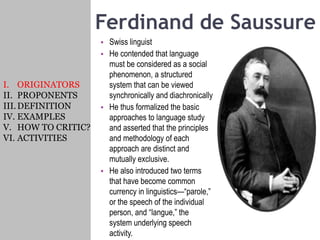
Ferdinand de Saussure
• Swiss linguist
• He contended that language
must be considered as a social
phenomenon, a structured
system that can be viewed
synchronically and diachronically
• He thus formalized the basic
approaches to language study
and asserted that the principles
and methodology of each
approach are distinct and
mutually exclusive.
• He also introduced two terms
that have become common
currency in linguistics—“parole,”
or the speech of the individual
person, and “langue,” the
system underlying speech
activity.
I. ORIGINATORS
II. PROPONENTS
III.DEFINITION
IV. EXAMPLES
V. HOW TO CRITIC?
VI. ACTIVITIES
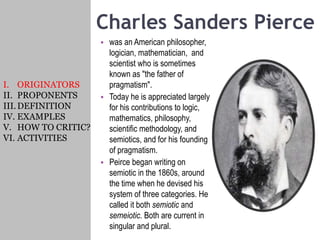
Charles Sanders Pierce
• was an American philosopher,
logician, mathematician, and
scientist who is sometimes
known as "the father of
pragmatism".
• Today he is appreciated largely
for his contributions to logic,
mathematics, philosophy,
scientific methodology, and
semiotics, and for his founding
of pragmatism.
• Peirce began writing on
semiotic in the 1860s, around
the time when he devised his
system of three categories. He
called it both semiotic and
semeiotic. Both are current in
singular and plural.
I. ORIGINATORS
II. PROPONENTS
III.DEFINITION
IV. EXAMPLES
V. HOW TO CRITIC?
VI. ACTIVITIES
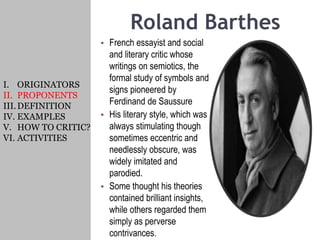
Roland Barthes
• French essayist and social
and literary critic whose
writings on semiotics, the
formal study of symbols and
signs pioneered by
Ferdinand de Saussure
• His literary style, which was
always stimulating though
sometimes eccentric and
needlessly obscure, was
widely imitated and
parodied.
• Some thought his theories
contained brilliant insights,
while others regarded them
simply as perverse
contrivances.
I. ORIGINATORS
II. PROPONENTS
III.DEFINITION
IV. EXAMPLES
V. HOW TO CRITIC?
VI. ACTIVITIES
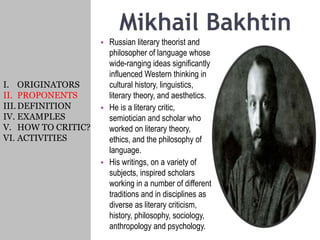
Mikhail Bakhtin
• Russian literary theorist and
philosopher of language whose
wide-ranging ideas significantly
influenced Western thinking in
cultural history, linguistics,
literary theory, and aesthetics.
• He is a literary critic,
semiotician and scholar who
worked on literary theory,
ethics, and the philosophy of
language.
• His writings, on a variety of
subjects, inspired scholars
working in a number of different
traditions and in disciplines as
diverse as literary criticism,
history, philosophy, sociology,
anthropology and psychology.
I. ORIGINATORS
II. PROPONENTS
III.DEFINITION
IV. EXAMPLES
V. HOW TO CRITIC?
VI. ACTIVITIES
SEMIOTICS
• By Charles Sanders Peirce:
Peirce began writing on semiotic in the 1860s,
around the time when he devised his system of three
categories. He called it both semiotic and semeiotic.
Both are current in singular and plural. He based it on
the conception of a triadic sign relation, and defined
semiosis as "action, or influence, which is, or involves, a
cooperation of three subjects, such as a sign, its object,
and its interpretant, this tri-relative influence not being in
any way resolvable into actions between pairs".
“To say, therefore, that thought cannot happen in an
instant, but requires a time, is but another way of saying
that every thought must be interpreted in another, or
that all thought is in signs.”
— Peirce 1868
I. ORIGINATORS
II. PROPONENTS
III.DEFINITION
IV. EXAMPLES
V. HOW TO CRITIC?
VI. ACTIVITIES
SEMIOTICS
• By Ferdinand de Saussure :
However, founded his semiotics, which he called
semiology, in the social sciences:
“It is... possible to conceive of a science which studies the
role of signs as part of social life. It would form part of
social psychology, and hence of general psychology.
We shall call it semiology . It would investigate the
nature of signs and the laws governing them. Since it
does not yet exist, one cannot say for certain that it will
exist. But it has a right to exist, a place ready for it in
advance. Linguistics is only one branch of this general
science. The laws which semiology will discover will be
laws applicable in linguistics, and linguistics will thus be
assigned to a clearly defined place in the field of human
knowledge.
- Ferdinand
I. ORIGINATORS
II. PROPONENTS
III.DEFINITION
IV. EXAMPLES
V. HOW TO CRITIC?
VI. ACTIVITIES
SEMIOTICS
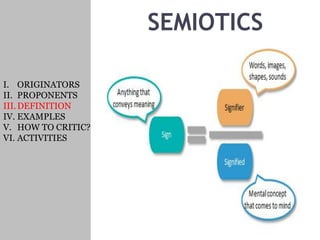
• While the Saussurean semiotic is dyadic
(sign/syntax, signal/semantics), the
Peircean semiotic is triadic (sign, object,
interpretant).
• Semiotics is the study of how people make
meaning through both linguistic and non-
linguistic ways. It is a philosophical theory
concerned with understanding how people
use signs and symbols in meaning-making
I. ORIGINATORS
II. PROPONENTS
III.DEFINITION
IV. EXAMPLES
V. HOW TO CRITIC?
VI. ACTIVITIES
SEMIOTICS
I. ORIGINATORS
II. PROPONENTS
III.DEFINITION
IV. EXAMPLES
V. HOW TO CRITIC?
VI. ACTIVITIES
EXAMPLES BY MEANING
• A tree, for example. (The favorite example
for Ferdie and his friends, by the way.) So, if
the signifier is the word “tree,” then the
signified isn’t an actual tree; instead, it’s the
image of a trunk and bark and leaves (or
fronds, if you're tropical) that pops into our
mind when we see the word “tree.”
• For example, the word “house” refers to a
structure designed for people to live within
only because a culture uses it in this way.
How this meaning of “house” came to be is
what those who study and research
semiotics are interested in.
I. ORIGINATORS
II. PROPONENTS
III.DEFINITION
IV. EXAMPLES
V. HOW TO CRITIC?
VI. ACTIVITIES
EXAMPLES IN A LITERARY
"Stephen closed his eyes to hear his boots crush crackling
wrack and shells. You are walking through it
howsomever. I am, a stride at a time. A very short space
of time through very short times of space. Five, six: the
nacheinander. Exactly: and that is the ineluctable
modality of the audible. Open your eyes. No. Jesus! If I
fell over a cliff that beetles o'er his base, fell through the
nebeneinander ineluctably. I am getting on nicely in the
dark. My ash sword hangs at my side. Tap with it: they
do. My two feet in his boots are at the end of his legs,
nebeneinander. Sounds solid: made by the mallet of Los
Demiurgos. Am I walking into eternity along
Sandymount strand? Crush, crack, crick, crick. Wild sea
money. Dominie Deasy kens them a'.“
http://thecrackedlookingglass.com/60-stephen-closed-his-eyes-
to-hear-his-boots-crush-crackling-wrack-and-shells/
I. ORIGINATORS
II. PROPONENTS
III.DEFINITION
IV. EXAMPLES
V. HOW TO CRITIC?
VI. ACTIVITIES
HOW?
• Read the assigned literary to you
As a student of the study of symbols and signs,
you need to dig deeper, searching for motifs or
themes beyond the obvious.
• Summarize your sign to align the breadth of
your study with the assigned essay length.
Think of the signs that catches your attention in
the text. Narrow the scope to your essay specific
and tight.
• Brainstorm about possible understanding of
your sign.
Think deeply understand the better meaning for
the sign
I. ORIGINATORS
II. PROPONENTS
III.DEFINITION
IV. EXAMPLES
V. HOW TO CRITIC?
VI. ACTIVITIES
HOW?
• Write the introduction of your essay,
Name your particular sign and set it up for your
reader in a relevant literary. Make a conclusion of
your opening section with a thesis that alludes to
your understanding of the literary or cultural signifier
under study.
• Build the body of your essay using three to five of
your interpretations of the sign under study.
Each sign interpretation gets its own paragraph.
Don’t be redundant bur think deeper, think for the
best explanation that will be relevant to your literary
• Make a conclusion of your semiotic essay with an
illustration
Illustration of the significance of your symbols. State
why it is significant and take point of the importance
of your theories
I. ORIGINATORS
II. PROPONENTS
III.DEFINITION
IV. EXAMPLES
V. HOW TO CRITIC?
VI. ACTIVITIES
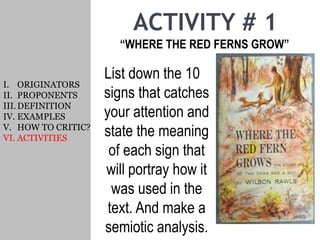
ACTIVITY # 1
“WHERE THE RED FERNS GROW”
I. ORIGINATORS
II. PROPONENTS
III.DEFINITION
IV. EXAMPLES
V. HOW TO CRITIC?
VI. ACTIVITIES
List down the 10
signs that catches
your attention and
state the meaning
of each sign that
will portray how it
was used in the
text. And make a
semiotic analysis.
ACTIVITY # 2
• Find a friend or a partner
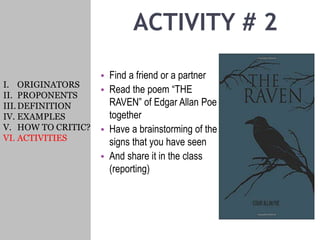
• Read the poem “THE
RAVEN” of Edgar Allan Poe
together
• Have a brainstorming of the
signs that you have seen
• And share it in the class
(reporting)
I. ORIGINATORS
II. PROPONENTS
III.DEFINITION
IV. EXAMPLES
V. HOW TO CRITIC?
VI. ACTIVITIES
ACTIVITY # 3
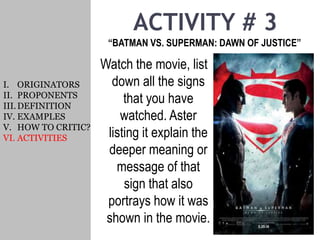
“BATMAN VS. SUPERMAN: DAWN OF JUSTICE”
I. ORIGINATORS
II. PROPONENTS
III.DEFINITION
IV. EXAMPLES
V. HOW TO CRITIC?
VI. ACTIVITIES
Watch the movie, list
down all the signs
that you have
watched. Aster
listing it explain the
deeper meaning or
message of that
sign that also
portrays how it was
shown in the movie.

Semiotics

  • 1.
  • 2.
    Ferdinand de Saussure •Swiss linguist • He contended that language must be considered as a social phenomenon, a structured system that can be viewed synchronically and diachronically • He thus formalized the basic approaches to language study and asserted that the principles and methodology of each approach are distinct and mutually exclusive. • He also introduced two terms that have become common currency in linguistics—“parole,” or the speech of the individual person, and “langue,” the system underlying speech activity. I. ORIGINATORS II. PROPONENTS III.DEFINITION IV. EXAMPLES V. HOW TO CRITIC? VI. ACTIVITIES
  • 3.
    Charles Sanders Pierce •was an American philosopher, logician, mathematician, and scientist who is sometimes known as "the father of pragmatism". • Today he is appreciated largely for his contributions to logic, mathematics, philosophy, scientific methodology, and semiotics, and for his founding of pragmatism. • Peirce began writing on semiotic in the 1860s, around the time when he devised his system of three categories. He called it both semiotic and semeiotic. Both are current in singular and plural. I. ORIGINATORS II. PROPONENTS III.DEFINITION IV. EXAMPLES V. HOW TO CRITIC? VI. ACTIVITIES
  • 4.
    Roland Barthes • Frenchessayist and social and literary critic whose writings on semiotics, the formal study of symbols and signs pioneered by Ferdinand de Saussure • His literary style, which was always stimulating though sometimes eccentric and needlessly obscure, was widely imitated and parodied. • Some thought his theories contained brilliant insights, while others regarded them simply as perverse contrivances. I. ORIGINATORS II. PROPONENTS III.DEFINITION IV. EXAMPLES V. HOW TO CRITIC? VI. ACTIVITIES
  • 5.
    Mikhail Bakhtin • Russianliterary theorist and philosopher of language whose wide-ranging ideas significantly influenced Western thinking in cultural history, linguistics, literary theory, and aesthetics. • He is a literary critic, semiotician and scholar who worked on literary theory, ethics, and the philosophy of language. • His writings, on a variety of subjects, inspired scholars working in a number of different traditions and in disciplines as diverse as literary criticism, history, philosophy, sociology, anthropology and psychology. I. ORIGINATORS II. PROPONENTS III.DEFINITION IV. EXAMPLES V. HOW TO CRITIC? VI. ACTIVITIES
  • 6.
    SEMIOTICS • By CharlesSanders Peirce: Peirce began writing on semiotic in the 1860s, around the time when he devised his system of three categories. He called it both semiotic and semeiotic. Both are current in singular and plural. He based it on the conception of a triadic sign relation, and defined semiosis as "action, or influence, which is, or involves, a cooperation of three subjects, such as a sign, its object, and its interpretant, this tri-relative influence not being in any way resolvable into actions between pairs". “To say, therefore, that thought cannot happen in an instant, but requires a time, is but another way of saying that every thought must be interpreted in another, or that all thought is in signs.” — Peirce 1868 I. ORIGINATORS II. PROPONENTS III.DEFINITION IV. EXAMPLES V. HOW TO CRITIC? VI. ACTIVITIES
  • 7.
    SEMIOTICS • By Ferdinandde Saussure : However, founded his semiotics, which he called semiology, in the social sciences: “It is... possible to conceive of a science which studies the role of signs as part of social life. It would form part of social psychology, and hence of general psychology. We shall call it semiology . It would investigate the nature of signs and the laws governing them. Since it does not yet exist, one cannot say for certain that it will exist. But it has a right to exist, a place ready for it in advance. Linguistics is only one branch of this general science. The laws which semiology will discover will be laws applicable in linguistics, and linguistics will thus be assigned to a clearly defined place in the field of human knowledge. - Ferdinand I. ORIGINATORS II. PROPONENTS III.DEFINITION IV. EXAMPLES V. HOW TO CRITIC? VI. ACTIVITIES
  • 8.
    SEMIOTICS • While theSaussurean semiotic is dyadic (sign/syntax, signal/semantics), the Peircean semiotic is triadic (sign, object, interpretant). • Semiotics is the study of how people make meaning through both linguistic and non- linguistic ways. It is a philosophical theory concerned with understanding how people use signs and symbols in meaning-making I. ORIGINATORS II. PROPONENTS III.DEFINITION IV. EXAMPLES V. HOW TO CRITIC? VI. ACTIVITIES
  • 9.
    SEMIOTICS I. ORIGINATORS II. PROPONENTS III.DEFINITION IV.EXAMPLES V. HOW TO CRITIC? VI. ACTIVITIES
  • 10.
    EXAMPLES BY MEANING •A tree, for example. (The favorite example for Ferdie and his friends, by the way.) So, if the signifier is the word “tree,” then the signified isn’t an actual tree; instead, it’s the image of a trunk and bark and leaves (or fronds, if you're tropical) that pops into our mind when we see the word “tree.” • For example, the word “house” refers to a structure designed for people to live within only because a culture uses it in this way. How this meaning of “house” came to be is what those who study and research semiotics are interested in. I. ORIGINATORS II. PROPONENTS III.DEFINITION IV. EXAMPLES V. HOW TO CRITIC? VI. ACTIVITIES
  • 11.
    EXAMPLES IN ALITERARY "Stephen closed his eyes to hear his boots crush crackling wrack and shells. You are walking through it howsomever. I am, a stride at a time. A very short space of time through very short times of space. Five, six: the nacheinander. Exactly: and that is the ineluctable modality of the audible. Open your eyes. No. Jesus! If I fell over a cliff that beetles o'er his base, fell through the nebeneinander ineluctably. I am getting on nicely in the dark. My ash sword hangs at my side. Tap with it: they do. My two feet in his boots are at the end of his legs, nebeneinander. Sounds solid: made by the mallet of Los Demiurgos. Am I walking into eternity along Sandymount strand? Crush, crack, crick, crick. Wild sea money. Dominie Deasy kens them a'.“ http://thecrackedlookingglass.com/60-stephen-closed-his-eyes- to-hear-his-boots-crush-crackling-wrack-and-shells/ I. ORIGINATORS II. PROPONENTS III.DEFINITION IV. EXAMPLES V. HOW TO CRITIC? VI. ACTIVITIES
  • 12.
    HOW? • Read theassigned literary to you As a student of the study of symbols and signs, you need to dig deeper, searching for motifs or themes beyond the obvious. • Summarize your sign to align the breadth of your study with the assigned essay length. Think of the signs that catches your attention in the text. Narrow the scope to your essay specific and tight. • Brainstorm about possible understanding of your sign. Think deeply understand the better meaning for the sign I. ORIGINATORS II. PROPONENTS III.DEFINITION IV. EXAMPLES V. HOW TO CRITIC? VI. ACTIVITIES
  • 13.
    HOW? • Write theintroduction of your essay, Name your particular sign and set it up for your reader in a relevant literary. Make a conclusion of your opening section with a thesis that alludes to your understanding of the literary or cultural signifier under study. • Build the body of your essay using three to five of your interpretations of the sign under study. Each sign interpretation gets its own paragraph. Don’t be redundant bur think deeper, think for the best explanation that will be relevant to your literary • Make a conclusion of your semiotic essay with an illustration Illustration of the significance of your symbols. State why it is significant and take point of the importance of your theories I. ORIGINATORS II. PROPONENTS III.DEFINITION IV. EXAMPLES V. HOW TO CRITIC? VI. ACTIVITIES
  • 14.
    ACTIVITY # 1 “WHERETHE RED FERNS GROW” I. ORIGINATORS II. PROPONENTS III.DEFINITION IV. EXAMPLES V. HOW TO CRITIC? VI. ACTIVITIES List down the 10 signs that catches your attention and state the meaning of each sign that will portray how it was used in the text. And make a semiotic analysis.
  • 15.
    ACTIVITY # 2 •Find a friend or a partner • Read the poem “THE RAVEN” of Edgar Allan Poe together • Have a brainstorming of the signs that you have seen • And share it in the class (reporting) I. ORIGINATORS II. PROPONENTS III.DEFINITION IV. EXAMPLES V. HOW TO CRITIC? VI. ACTIVITIES
  • 16.
    ACTIVITY # 3 “BATMANVS. SUPERMAN: DAWN OF JUSTICE” I. ORIGINATORS II. PROPONENTS III.DEFINITION IV. EXAMPLES V. HOW TO CRITIC? VI. ACTIVITIES Watch the movie, list down all the signs that you have watched. Aster listing it explain the deeper meaning or message of that sign that also portrays how it was shown in the movie.