© 2016 HL7 ® Int’l. Licensed under Creative Commons. HL7, Health Level Seven, FHIR & flame logo are registered trademarks of Health Level Seven International. Reg. U.S. TM Office.
®
FHIR for
Architects
Lloyd McKenzie
Sept. 20, 2016
© 2016 HL7 ® Int’l. Licensed under Creative Commons. HL7, Health Level Seven, FHIR & flame logo are registered trademarks of Health Level Seven International. Reg. U.S. TM Office.
®
Who am I?
 Name: Lloyd McKenzie
 Company: Gevity
 Background:
 One of FHIR’s 3 initial editors
 Co-chair FMG & FHIR Infrastructure
 Co-chair HL7 Modeling & Methodology
 Heavily involved in HL7 and healthcare exchange
for last 16 years (v2, v3, CDA, etc.)
 lmckenzie@gevityinc.com
2
© 2016 HL7 ® Int’l. Licensed under Creative Commons. HL7, Health Level Seven, FHIR & flame logo are registered trademarks of Health Level Seven International. Reg. U.S. TM Office.
®
This presentation
 Can be downloaded here:
 http://gforge.hl7.org/svn/fhir/trunk/presentations/2016-
09%20Webinars/FHIR%20for%20Architects.pptx
 Use “anonymous” and email address to logon
 Is licensed for use under the Creative Commons,
specifically:
 Creative Commons Attribution 3.0 Unported License
 (Do with it as you wish, so long as you give
credit)
© 2016 HL7 ® Int’l. Licensed under Creative Commons. HL7, Health Level Seven, FHIR & flame logo are registered trademarks of Health Level Seven International. Reg. U.S. TM Office.
®
Tutorial Objectives
 You should know
 FHIR’s interoperability paradigms (and where to use)
 Where FHIR can fit in the architectural stack
 FHIR architectural considerations and how to address
them
 Where and how Profiles fit into an architectural
solution
 If, when and how FHIR might be used within your
own organization
4
© 2016 HL7 ® Int’l. Licensed under Creative Commons. HL7, Health Level Seven, FHIR & flame logo are registered trademarks of Health Level Seven International. Reg. U.S. TM Office.
®
Level Setting
 Should be familiar with basics of FHIR – from
Introduction to FHIR or equivalent presentation or
experience
 This presentation won’t drill into the hands on
details of messaging, documents, XML or JSON
syntax, etc.
 Focus will be high level architecture
considerations – will get through as much as we
can . . .
5
© 2016 HL7 ® Int’l. Licensed under Creative Commons. HL7, Health Level Seven, FHIR & flame logo are registered trademarks of Health Level Seven International. Reg. U.S. TM Office.
®
Agenda
 Paradigms & Architecture approaches
 FHIR Features & Architecture decision
 Additional considerations, Profiles & Next
steps
6
© 2016 HL7 ® Int’l. Licensed under Creative Commons. HL7, Health Level Seven, FHIR & flame logo are registered trademarks of Health Level Seven International. Reg. U.S. TM Office.
®
WHAT PARADIGM
© 2016 HL7 ® Int’l. Licensed under Creative Commons. HL7, Health Level Seven, FHIR & flame logo are registered trademarks of Health Level Seven International. Reg. U.S. TM Office.
®
Paradigms
 FHIR supports 4 interoperability paradigms
8
REST Documents
Messages Services
What should
you use when?
© 2016 HL7 ® Int’l. Licensed under Creative Commons. HL7, Health Level Seven, FHIR & flame logo are registered trademarks of Health Level Seven International. Reg. U.S. TM Office.
®
REST
 Simple, out-of-the-box interoperability
 Leverage HTTP: GET, POST, etc.
 Pre-defined operations
 Create, Read, Update, Delete
 Also: History, Read Version, Search, Updates,
Validate, Conformance & Batch
9
Rest
© 2016 HL7 ® Int’l. Licensed under Creative Commons. HL7, Health Level Seven, FHIR & flame logo are registered trademarks of Health Level Seven International. Reg. U.S. TM Office.
®
FHIR Resource URLs
Template Description Example Operations
[base] Server URL http://fhir.com GET, OPTIONS,
POST
[base]/[type] Collection
Manager
http://fhir.com/Patient GET, POST
[base]/[type]/[id] URL for a
resource
http://fhir.com/Patient
/23
GET, PUT,
DELETE
[base]/([type]/([i
d]/)?)?$[name]
Operation
(server
action)
http://fhir.com/Patient
/23/$everything
GET, POST
[base]/[type]/[id]
/_history/[vid]
Past version http://fhir.com/Patient/23
/_history/2
GET
© 2016 HL7 ® Int’l. Licensed under Creative Commons. HL7, Health Level Seven, FHIR & flame logo are registered trademarks of Health Level Seven International. Reg. U.S. TM Office.
®
When to use REST?
 Want low coupling between systems
 In theory, very little up-front negotiation required
 Small, light-weight exchanges
 Focus is CRUD operations
 Also for publish/subscribe
 Client-driven client-server orchestration
 Server endpoint has fixed location
 Well-suited for Mobile, PHR, Registries
11
Rest
© 2016 HL7 ® Int’l. Licensed under Creative Commons. HL7, Health Level Seven, FHIR & flame logo are registered trademarks of Health Level Seven International. Reg. U.S. TM Office.
®
When to avoid REST?
 Complex or server-driven orchestration
 Order of operations matters (e.g. complex decision
support)
 Unit of work != resource
 “Transaction” may be an option
 No natural “server” or no fixed network
location
 Lack of trust in the client for audit, etc.
12
Rest
© 2016 HL7 ® Int’l. Licensed under Creative Commons. HL7, Health Level Seven, FHIR & flame logo are registered trademarks of Health Level Seven International. Reg. U.S. TM Office.
®
Documents
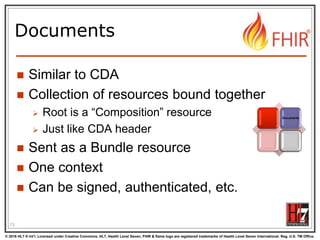
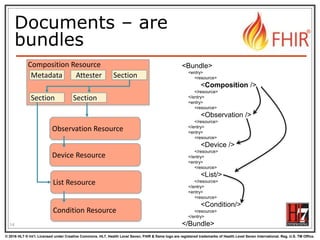
 Similar to CDA
 Collection of resources bound together
 Root is a “Composition” resource
 Just like CDA header
 Sent as a Bundle resource
 One context
 Can be signed, authenticated, etc.
13
Documents
© 2016 HL7 ® Int’l. Licensed under Creative Commons. HL7, Health Level Seven, FHIR & flame logo are registered trademarks of Health Level Seven International. Reg. U.S. TM Office.
®
Documents – are
bundles
14
Observation Resource
Composition Resource
Section
Device Resource
Condition Resource
List Resource
<Bundle>
<entry>
<resource>
<Composition />
</resource>
</entry>
<entry>
<resource>
<Observation />
</resource>
</entry>
<entry>
<resource>
<Device />
</resource>
</entry>
<entry>
<resource>
<List/>
</resource>
</entry>
<entry>
<resource>
<Condition/>
<resource>
</entry>
</Bundle>
Attester
Metadata Section
Section
© 2016 HL7 ® Int’l. Licensed under Creative Commons. HL7, Health Level Seven, FHIR & flame logo are registered trademarks of Health Level Seven International. Reg. U.S. TM Office.
®
When to use
Documents?
 Focus is on persistence
 No workflow involved
 other than post/retrieve document
 Need tight rules over authenticated content
 Want to communicate multiple resources
with control over how data is presented
 Data spans multiple resources
15
Documents
© 2016 HL7 ® Int’l. Licensed under Creative Commons. HL7, Health Level Seven, FHIR & flame logo are registered trademarks of Health Level Seven International. Reg. U.S. TM Office.
®
When to avoid
Documents?
 Need for workflow
 Request/response, decision support
 Data is dynamic
 I.e. want view of data now, not at time of
authorship
 Multiple contributors over time
 Resources need to be
accessed/manipulated independently
16
Documents
© 2016 HL7 ® Int’l. Licensed under Creative Commons. HL7, Health Level Seven, FHIR & flame logo are registered trademarks of Health Level Seven International. Reg. U.S. TM Office.
®
Messages
 Similar to v2 and v3 messaging
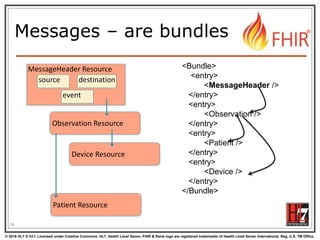
 Also a collection of resources as a Bundle
resource
 Allows request/response behavior with
bundles for both request and response
 Event-driven
 E.g. Send lab order, get back result
 Can be asynchronous
17
Messages
© 2016 HL7 ® Int’l. Licensed under Creative Commons. HL7, Health Level Seven, FHIR & flame logo are registered trademarks of Health Level Seven International. Reg. U.S. TM Office.
®
Messages – are bundles
18
Observation Resource
MessageHeader Resource
source destination
Device Resource
Patient Resource
<Bundle>
<entry>
<MessageHeader />
</entry>
<entry>
<Observation />
</entry>
<entry>
<Patient />
</entry>
<entry>
<Device />
</entry>
</Bundle>
event
© 2016 HL7 ® Int’l. Licensed under Creative Commons. HL7, Health Level Seven, FHIR & flame logo are registered trademarks of Health Level Seven International. Reg. U.S. TM Office.
®
When to use Messaging?
 Request/response workflow
 Need to drive behaviors more complex than
CRUD on a single resource
 E.g. merge, complex queries
 Need for asynchronous communications
 Need to communicate information about
many resources but want to minimize
exchanges
 No “identity” for many resources
19
Messages
© 2016 HL7 ® Int’l. Licensed under Creative Commons. HL7, Health Level Seven, FHIR & flame logo are registered trademarks of Health Level Seven International. Reg. U.S. TM Office.
®
When to avoid
Messaging?
 Precise control required on how data gets
persisted/displayed to humans
 Need for lightweight communications
 Want to avoid pre-negotiations on behavior
20
Messages
© 2016 HL7 ® Int’l. Licensed under Creative Commons. HL7, Health Level Seven, FHIR & flame logo are registered trademarks of Health Level Seven International. Reg. U.S. TM Office.
®
Service Oriented
Architecture (SOA)
 Do whatever you like
 (based on SOA principles)
 Ultra complex workflows
 Ultra simple workflows
 Individual resources or collections (in Bundles or
other formats)
 Use HTTP or use something else
 Only constraint is that you’re passing around FHIR
resources in some shape or manner
21
Services
© 2016 HL7 ® Int’l. Licensed under Creative Commons. HL7, Health Level Seven, FHIR & flame logo are registered trademarks of Health Level Seven International. Reg. U.S. TM Office.
®
Example services
22
© 2016 HL7 ® Int’l. Licensed under Creative Commons. HL7, Health Level Seven, FHIR & flame logo are registered trademarks of Health Level Seven International. Reg. U.S. TM Office.
®
When to use Services?
 All previous paradigms are a type of services
interface
 Use a custom service when capabilities of
other paradigms don’t fit requirement
 Operations other than CRUD on a resource (e.g.
decision support)
 Workflow more complex than simple
request/response
 Need to mix document persistence with
behavior
23
Services
© 2016 HL7 ® Int’l. Licensed under Creative Commons. HL7, Health Level Seven, FHIR & flame logo are registered trademarks of Health Level Seven International. Reg. U.S. TM Office.
®
When not to use
services?
 When something else will do the job as well
 I.e. Don’t define a custom service for something
that already naturally is handled by REST,
messaging, etc.
24
Services
© 2016 HL7 ® Int’l. Licensed under Creative Commons. HL7, Health Level Seven, FHIR & flame logo are registered trademarks of Health Level Seven International. Reg. U.S. TM Office.
®
Paradigm guidance
 No absolutes
 Consider a “when to avoid” as a note of caution
 Capabilities/architecture of legacy will often drive
approach, particularly initially
 E.g. If v2 back end, messaging
 Architectures will be driven by legacy
requirements, architectural preferences, enterprise
architecture commitments, etc.
25
© 2016 HL7 ® Int’l. Licensed under Creative Commons. HL7, Health Level Seven, FHIR & flame logo are registered trademarks of Health Level Seven International. Reg. U.S. TM Office.
®
Combining paradigms
 No requirement for a system to only support
one paradigm
 E.g. hospital may be primarily messaging, but use
documents for discharge summaries and reports
and expose registries and appointments via REST
with a few custom services for decision support or
specialized workflow
 Data (generally) shared easily across
paradigm boundaries
26
© 2016 HL7 ® Int’l. Licensed under Creative Commons. HL7, Health Level Seven, FHIR & flame logo are registered trademarks of Health Level Seven International. Reg. U.S. TM Office.
®
Caveats with combining
paradigms
 If updates come in via document, message
or service, RESTful version id still needs to
increment
 Documents should typically be persisted
whole, not reconstituted from parts
 Ensures signature validity
 Legacy messaging systems may not provide
the metadata to easily expose or manipulate
discrete resources via REST
27
© 2016 HL7 ® Int’l. Licensed under Creative Commons. HL7, Health Level Seven, FHIR & flame logo are registered trademarks of Health Level Seven International. Reg. U.S. TM Office.
®
Apply it
 What paradigm(s) are you like to use in your
organization and why?
28
© 2016 HL7 ® Int’l. Licensed under Creative Commons. HL7, Health Level Seven, FHIR & flame logo are registered trademarks of Health Level Seven International. Reg. U.S. TM Office.
®
FHIR ARCHITECTURE
APPROACHES
© 2016 HL7 ® Int’l. Licensed under Creative Commons. HL7, Health Level Seven, FHIR & flame logo are registered trademarks of Health Level Seven International. Reg. U.S. TM Office.
®
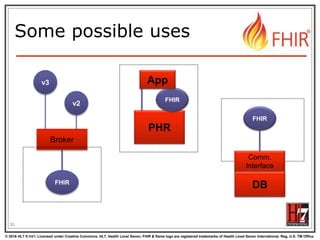
Some possible uses
30
FHIR
Broker
v3
v2
PHR
FHIR
App
Comm.
Interface
DB
FHIR
© 2016 HL7 ® Int’l. Licensed under Creative Commons. HL7, Health Level Seven, FHIR & flame logo are registered trademarks of Health Level Seven International. Reg. U.S. TM Office.
®
Repository model
Vendor Neutral Repository
FHIR
HIS LIMS PACS SystemX Gateway
FHIR FHIR
FHIR
FHIR
© 2016 HL7 ® Int’l. Licensed under Creative Commons. HL7, Health Level Seven, FHIR & flame logo are registered trademarks of Health Level Seven International. Reg. U.S. TM Office.
®
Beyond exchange
32
v3
v2
Other
X12
Broker
v3
v2
FHIR
Repository
Decision
Support
FHIR
FHIR
Other
© 2016 HL7 ® Int’l. Licensed under Creative Commons. HL7, Health Level Seven, FHIR & flame logo are registered trademarks of Health Level Seven International. Reg. U.S. TM Office.
®
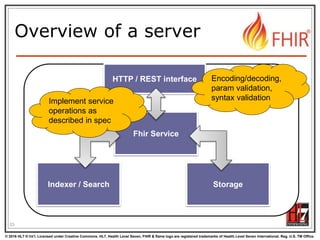
Overview of a server
33
HTTP / REST interface Encoding/decoding,
param validation,
syntax validation
Fhir Service
Indexer / Search Storage
Implement service
operations as
described in spec
© 2016 HL7 ® Int’l. Licensed under Creative Commons. HL7, Health Level Seven, FHIR & flame logo are registered trademarks of Health Level Seven International. Reg. U.S. TM Office.
®
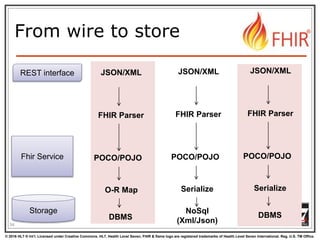
From wire to store
Storage
Fhir Service
REST interface JSON/XML
POCO/POJO
DBMS
O-R Map
FHIR Parser
34
JSON/XML
POCO/POJO
Serialize
FHIR Parser
NoSql
(Xml/Json)
JSON/XML
POCO/POJO
DBMS
Serialize
FHIR Parser
© 2016 HL7 ® Int’l. Licensed under Creative Commons. HL7, Health Level Seven, FHIR & flame logo are registered trademarks of Health Level Seven International. Reg. U.S. TM Office.
®
Architectures
 FHIR makes no assumptions about the
architectural design of systems
 You can use it for
 Light or heavy clients
 Central server or peer-to-peer sharing
 Push or pull
 Query or publish/subscribe
 Loosely coupled or tightly coupled environments
 With history tracking or without
35
© 2016 HL7 ® Int’l. Licensed under Creative Commons. HL7, Health Level Seven, FHIR & flame logo are registered trademarks of Health Level Seven International. Reg. U.S. TM Office.
®
Bottom Line
 FHIR is a set of tools
 Defined resources
 Extensibility mechanism
 Set of standard interfaces
 Primary purpose is interoperable data
exchange
 However, it can be leveraged in many ways
 Many we haven’t even thought of yet . . .
36
© 2016 HL7 ® Int’l. Licensed under Creative Commons. HL7, Health Level Seven, FHIR & flame logo are registered trademarks of Health Level Seven International. Reg. U.S. TM Office.
®
FHIR FEATURES
And the architecture decisions that go with them
© 2016 HL7 ® Int’l. Licensed under Creative Commons. HL7, Health Level Seven, FHIR & flame logo are registered trademarks of Health Level Seven International. Reg. U.S. TM Office.
®
FHIR Features
 Narrative
 Extensions
 Modifier Extensions
 Versions
 Tags
 Syntaxes
 Signatures
 Reference Libraries
 Conformance
Resources
 Bundles
© 2016 HL7 ® Int’l. Licensed under Creative Commons. HL7, Health Level Seven, FHIR & flame logo are registered trademarks of Health Level Seven International. Reg. U.S. TM Office.
®
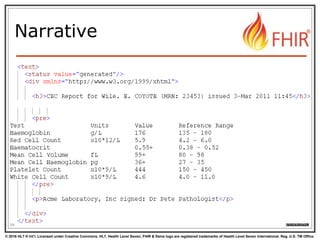
Narrative
39
© 2016 HL7 ® Int’l. Licensed under Creative Commons. HL7, Health Level Seven, FHIR & flame logo are registered trademarks of Health Level Seven International. Reg. U.S. TM Office.
®
Narrative
 All resources are expected to have narrative
except in narrow circumstances
 May be generated or manually edited
 Decisions
 Should narrative be generated or human-entered?
 Generated simplifies processing for receivers
 Some text will need to human entered
 In some cases, there may be minimal discrete data
© 2016 HL7 ® Int’l. Licensed under Creative Commons. HL7, Health Level Seven, FHIR & flame logo are registered trademarks of Health Level Seven International. Reg. U.S. TM Office.
®
Narrative decisions
(cont’d)
 If generated, which elements should be included?
How should they be rendered?
 all content needed for a human to understand the
essential clinical and business information otherwise
encoded within the resource
 Will generally include modifierExtensions
 May include other extensions
 Best to seek clinician and other review of content,
order of presentation & rendering
 Consider that content may be rendered on mobile
devices, so don’t get too fancy with markup
41
© 2016 HL7 ® Int’l. Licensed under Creative Commons. HL7, Health Level Seven, FHIR & flame logo are registered trademarks of Health Level Seven International. Reg. U.S. TM Office.
®
Narrative decisions
(cont’d)
 Should narrative be displayed to users?
 Driven by Narrative.status
 Business requirements (e.g. Document attestation)
may drive need to render regardless
42
© 2016 HL7 ® Int’l. Licensed under Creative Commons. HL7, Health Level Seven, FHIR & flame logo are registered trademarks of Health Level Seven International. Reg. U.S. TM Office.
®
Extensions
43
© 2016 HL7 ® Int’l. Licensed under Creative Commons. HL7, Health Level Seven, FHIR & flame logo are registered trademarks of Health Level Seven International. Reg. U.S. TM Office.
®
Extensions (cont’d)
 In FHIR, extensions are “normal”
 Consequence of the 80% rule – keep the simple
stuff simple
 Extensions can exist anywhere
 Yes, even inside boolean or date
 Systems shouldn’t reject instances just because
they contain unrecognized extensions
44
© 2016 HL7 ® Int’l. Licensed under Creative Commons. HL7, Health Level Seven, FHIR & flame logo are registered trademarks of Health Level Seven International. Reg. U.S. TM Office.
®
Extension decisions
 Should unrecognized extensions be
persisted? How?
 Throwing away extensions = loss of potentially useful
information to downstream systems
 Therefore: Keep extensions if you can
 Can capture them in a blob or a generic “slot” structure
 Could, with location tagging, capture all “unknown”
extensions for a resource in a single blob
 Some legacy systems won’t be able to
 When data is updated, some extensions must be
dropped
45
© 2016 HL7 ® Int’l. Licensed under Creative Commons. HL7, Health Level Seven, FHIR & flame logo are registered trademarks of Health Level Seven International. Reg. U.S. TM Office.
®
Extension decisions
(cont’d)
 Should you display unrecognized extensions?
 Extensions are identified by URL and have a known
data type. Can resolve the URL, look up the name and
display
 Cost/benefit question – some extensions will have little
value, others may have a lot
 Might want to let users configure what gets displayed
 If you do query, look at caching extension definitions to
minimize performance issues
46
© 2016 HL7 ® Int’l. Licensed under Creative Commons. HL7, Health Level Seven, FHIR & flame logo are registered trademarks of Health Level Seven International. Reg. U.S. TM Office.
®
Extension decisions
(cont’d)
 What should you expose as an extension?
 If data can be exposed using core structures, it should
be
 Can still send the same data in an extension
 e.g. with more/less granularity, alternate coding, different data
type
 Look for existing extensions before defining your own
 Extensions, if used, should be generic to encourage
re-use (and thus broad recognition)
 Extension should be on the element described by the
extension
47
© 2016 HL7 ® Int’l. Licensed under Creative Commons. HL7, Health Level Seven, FHIR & flame logo are registered trademarks of Health Level Seven International. Reg. U.S. TM Office.
®
Extension decisions
(cont’d)
 Where to register extensions
 Considerations:
 What’s the scope? For local extensions, a local
registry may make more sense
 Is there a need for restricted access?
 In general, broad registration = discoverable =
broader uptake = broader recognition
48
© 2016 HL7 ® Int’l. Licensed under Creative Commons. HL7, Health Level Seven, FHIR & flame logo are registered trademarks of Health Level Seven International. Reg. U.S. TM Office.
®
Modifier Extensions
 Also a core part of FHIR
 Needed because some extensions can’t be safely
ignored
 Can’t compute on an element containing an
unrecognized modifier extension. However, can:
 Reject instance
 Remove element containing unrecognized modifier
extension
 Just display narrative
 Retrieve definition & seek human review
49
© 2016 HL7 ® Int’l. Licensed under Creative Commons. HL7, Health Level Seven, FHIR & flame logo are registered trademarks of Health Level Seven International. Reg. U.S. TM Office.
®
Modifier Extension
decisions
 When should you introduce them?
 modifierExtension breaks interoperability so:
 If you can accomplish your objective without one, do
that
 Consider a new resource or Basic
 Could requirement be met by an element that
doesn’t change other element interpretations?
 Best used when already part of existing practice,
but in too narrow an area to justify being part of
core
50
© 2016 HL7 ® Int’l. Licensed under Creative Commons. HL7, Health Level Seven, FHIR & flame logo are registered trademarks of Health Level Seven International. Reg. U.S. TM Office.
®
Versions
51
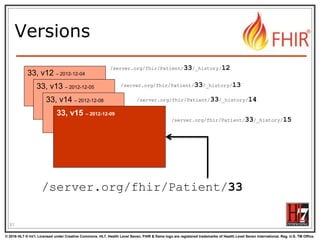
33, v12 – 2012-12-04
33, v13 – 2012-12-05
33, v14 – 2012-12-08
33, v15 – 2012-12-09
/server.org/fhir/Patient/33/_history/12
/server.org/fhir/Patient/33
/server.org/fhir/Patient/33/_history/13
/server.org/fhir/Patient/33/_history/14
/server.org/fhir/Patient/33/_history/15
© 2016 HL7 ® Int’l. Licensed under Creative Commons. HL7, Health Level Seven, FHIR & flame logo are registered trademarks of Health Level Seven International. Reg. U.S. TM Office.
®
Versions (cont’d)
 FHIR allows versions to be tracked and
retrieved
 Do you want to support versioning?
 May be difficult or impossible with some legacy
data stores
 Will still need to have unique version id (UUID,
timestamp)
 Provides useful collision-detection mechanism
52
© 2016 HL7 ® Int’l. Licensed under Creative Commons. HL7, Health Level Seven, FHIR & flame logo are registered trademarks of Health Level Seven International. Reg. U.S. TM Office.
®
Pop Quiz
 Where can extensions appear?
 When must a receiver process an
extension?
53
© 2016 HL7 ® Int’l. Licensed under Creative Commons. HL7, Health Level Seven, FHIR & flame logo are registered trademarks of Health Level Seven International. Reg. U.S. TM Office.
®
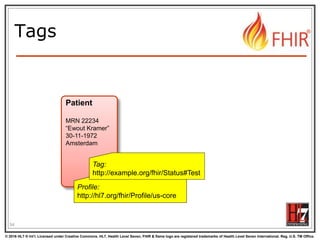
Tags
54
Patient
MRN 22234
“Ewout Kramer”
30-11-1972
Amsterdam
Profile:
http://hl7.org/fhir/Profile/us-core
Tag:
http://example.org/fhir/Status#Test
© 2016 HL7 ® Int’l. Licensed under Creative Commons. HL7, Health Level Seven, FHIR & flame logo are registered trademarks of Health Level Seven International. Reg. U.S. TM Office.
®
Tags (cont’d)
 Allow data to be attached to a resource
“outside” the resource
 Doesn’t break signature when added/changed
 3 types:
 Security
 Profile
 General (workflow, etc.)
 Require business agreement
 Can’t search by tag if authors don’t include them
• And populate the same way . . .
55
© 2016 HL7 ® Int’l. Licensed under Creative Commons. HL7, Health Level Seven, FHIR & flame logo are registered trademarks of Health Level Seven International. Reg. U.S. TM Office.
®
Tag decisions
 Tag vs. extension?
 Use extension if:
 Element is associated with the business object
rather than electronic record
 Part of attested content of resource
 Should be included in narrative
 Change should force new version
56
© 2016 HL7 ® Int’l. Licensed under Creative Commons. HL7, Health Level Seven, FHIR & flame logo are registered trademarks of Health Level Seven International. Reg. U.S. TM Office.
®
Syntaxes
Xml
<XXX xmlns=“urn:foo”>
<B a=“c” />
<C>One</C>
<C>Two</C>
<D>One</D>
<div>Not <b>so</b>
easy</div>
</XXX>
JSON
{ “B”: { “a” : “c” },
“C”: [ “One”, “Two” ],
“D” : [ “One” ],
“div” : {
“text-before”:“Not ”,
b:“so”,
“text-after”:“easy”}
}
57
© 2016 HL7 ® Int’l. Licensed under Creative Commons. HL7, Health Level Seven, FHIR & flame logo are registered trademarks of Health Level Seven International. Reg. U.S. TM Office.
®
Syntaxes (cont’d)
 Multiple representations
 XML or JSON
 RDF in progress
 Reference implementations support both
and conversion between
 Maximizes interoperability
 Inter-conversion isn’t (yet) robust enough for digital
signatures (whitespace is an issue)
58
© 2016 HL7 ® Int’l. Licensed under Creative Commons. HL7, Health Level Seven, FHIR & flame logo are registered trademarks of Health Level Seven International. Reg. U.S. TM Office.
®
Syntax decisions
 What syntax should be used when?
 XML used to be required for servers
 Now implementer’s choice
 XML provides broader tools
 XSLT, schema, XPath
 JSON uses less bandwidth, more natural for mobile
 RDF is niche
 ideally, servers support all
 maximum interoperability
59
© 2016 HL7 ® Int’l. Licensed under Creative Commons. HL7, Health Level Seven, FHIR & flame logo are registered trademarks of Health Level Seven International. Reg. U.S. TM Office.
®
Signatures
 Three ways to digitally sign content
 Sign bundle (Message or Document)
 Sign resource version using Provenance resource
 Limited to data integrity
 Extension (for more complete signature)
 No requirement to sign content
 Signatures are just one mechanism of ensuring data
integrity and/or non-repudiation
 Signatures may not hold when converting
between different syntaxes
60
© 2016 HL7 ® Int’l. Licensed under Creative Commons. HL7, Health Level Seven, FHIR & flame logo are registered trademarks of Health Level Seven International. Reg. U.S. TM Office.
®
Reference libraries
 Currently 5:
 C#, Java, Pascal (Delphi), Javascript, Swift
 More to come?
 Handle parsing, serialization, validation, etc.
 Also open source servers, basic clients
61
© 2016 HL7 ® Int’l. Licensed under Creative Commons. HL7, Health Level Seven, FHIR & flame logo are registered trademarks of Health Level Seven International. Reg. U.S. TM Office.
®
Reference library
decisions
 Use a reference library vs. build your own?
 Same criteria as any other “build vs. reuse”
 Build costs more, but more tuned
 At minimum, consult reference implementations to
ensure you don’t miss nuances of specification
 How often to update?
 Reference libraries changing frequently
 Will need to manage updates, especially given that
custom code is likely resting on top
62
© 2016 HL7 ® Int’l. Licensed under Creative Commons. HL7, Health Level Seven, FHIR & flame logo are registered trademarks of Health Level Seven International. Reg. U.S. TM Office.
®
Conformance resources
 Conformance, ValueSet, NamingSystem,
ConceptMap & StructureDefinition
 Provide “metadata” for operation of systems
 Allow for “dynamic” configuration
 E.g. Rather than having hard-coded rules for
allowed codes, required elements, look it up in
ValueSet or Profile resource
 Can be hosted anywhere
 Do you require a local copy for performance
reasons? Perhaps synchronized copy via
publish subscribe?
63
© 2016 HL7 ® Int’l. Licensed under Creative Commons. HL7, Health Level Seven, FHIR & flame logo are registered trademarks of Health Level Seven International. Reg. U.S. TM Office.
®
Conformance resources
(cont’d)
 Often arranged in cascading hierarchy
 E.g. International value set, national value set,
local value set
 Need to consider timeframe and mechanism for
propagating changes from higher levels in the
hierarchy
64
© 2016 HL7 ® Int’l. Licensed under Creative Commons. HL7, Health Level Seven, FHIR & flame logo are registered trademarks of Health Level Seven International. Reg. U.S. TM Office.
®
Bundles
65
© 2016 HL7 ® Int’l. Licensed under Creative Commons. HL7, Health Level Seven, FHIR & flame logo are registered trademarks of Health Level Seven International. Reg. U.S. TM Office.
®
Bundles (cont’d)
 Mechanism for messages, documents,
transactions, query responses
 In theory, could regenerate a document from
constituent parts, but:
 No clear boundary on what’s part of document vs.
not
 No way to guarantee order of entries
 Thus: recommend storing as a binary
66
© 2016 HL7 ® Int’l. Licensed under Creative Commons. HL7, Health Level Seven, FHIR & flame logo are registered trademarks of Health Level Seven International. Reg. U.S. TM Office.
®
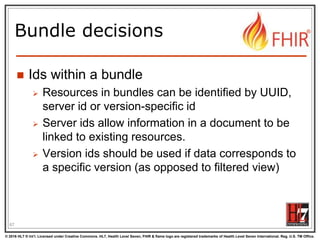
Bundle decisions
 Ids within a bundle
 Resources in bundles can be identified by UUID,
server id or version-specific id
 Server ids allow information in a document to be
linked to existing resources.
 Version ids should be used if data corresponds to
a specific version (as opposed to filtered view)
67
© 2016 HL7 ® Int’l. Licensed under Creative Commons. HL7, Health Level Seven, FHIR & flame logo are registered trademarks of Health Level Seven International. Reg. U.S. TM Office.
®
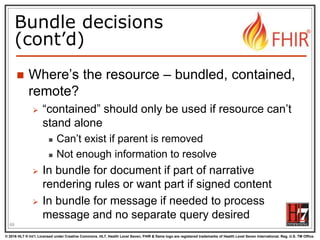
Bundle decisions
(cont’d)
 Where’s the resource – bundled, contained,
remote?
 “contained” should only be used if resource can’t
stand alone
 Can’t exist if parent is removed
 Not enough information to resolve
 In bundle for document if part of narrative
rendering rules or want part if signed content
 In bundle for message if needed to process
message and no separate query desired
68
© 2016 HL7 ® Int’l. Licensed under Creative Commons. HL7, Health Level Seven, FHIR & flame logo are registered trademarks of Health Level Seven International. Reg. U.S. TM Office.
®
Apply it
 Which of the previous FHIR considerations
are you going to pay particular attention to in
your implementation?
69
© 2016 HL7 ® Int’l. Licensed under Creative Commons. HL7, Health Level Seven, FHIR & flame logo are registered trademarks of Health Level Seven International. Reg. U.S. TM Office.
®
ADDITIONAL
CONSIDERATIONS
© 2016 HL7 ® Int’l. Licensed under Creative Commons. HL7, Health Level Seven, FHIR & flame logo are registered trademarks of Health Level Seven International. Reg. U.S. TM Office.
®
Additional
Considerations
 Resolving identity
 Missing data
 Looping
 Variable server capabilities
 Prohibiting data elements
 Interoperating with legacy
© 2016 HL7 ® Int’l. Licensed under Creative Commons. HL7, Health Level Seven, FHIR & flame logo are registered trademarks of Health Level Seven International. Reg. U.S. TM Office.
®
Resolving identity
 Resource is electronic representation of real-
world object
 Can have multiple resource instances for same
real-world object
 Different servers or sometimes even same server
 Ids for same resource on different servers can be
completely different
 Data on different servers can also vary
 One resource multiple sites (with different ids)
 Available data may vary
© 2016 HL7 ® Int’l. Licensed under Creative Commons. HL7, Health Level Seven, FHIR & flame logo are registered trademarks of Health Level Seven International. Reg. U.S. TM Office.
®
Resolving identity
(cont’d)
 Matching resources within and across
servers is generally accomplished by
business id (“identifier”)
 May also have business “version”
 Rules over changing business version are domain-
dependent.
 Where old versions my be maintained, each
version might be distinct instance
73
© 2016 HL7 ® Int’l. Licensed under Creative Commons. HL7, Health Level Seven, FHIR & flame logo are registered trademarks of Health Level Seven International. Reg. U.S. TM Office.
®
Missing data
 Extremely few resource or data type
elements are required (minOccurs > 0)
 Resources and data types are context
independent
 Extensions might supersede core elements
 Therefore
 Don’t assume data will be present
 Always check for element/@value, not just element
 May need to validate to a profile to enforce
requirements
© 2016 HL7 ® Int’l. Licensed under Creative Commons. HL7, Health Level Seven, FHIR & flame logo are registered trademarks of Health Level Seven International. Reg. U.S. TM Office.
®
Looping
 FHIR resources are interrelated in a
network, not a hierarchy
 Direct and indirect looping relationships are
possible
 In resource definitions & instances
 Even if not possible with core elements, may occur
with extensions
 Parsing and processing algorithms must deal with
this possibility
75
© 2016 HL7 ® Int’l. Licensed under Creative Commons. HL7, Health Level Seven, FHIR & flame logo are registered trademarks of Health Level Seven International. Reg. U.S. TM Office.
®
Variable Server
capabilities
 FHIR defines a number of mechanisms to give
clients control of queries
 Paging, many filters, _include, _summary,
compartments
 However, these are all optional . . .
 What should a server do?
 Cost/benefit trade-off
 More you support, more clients will work with you
 Some capabilities may be very expensive in some architectures
 Do as much as you can, “within reason”
76
© 2016 HL7 ® Int’l. Licensed under Creative Commons. HL7, Health Level Seven, FHIR & flame logo are registered trademarks of Health Level Seven International. Reg. U.S. TM Office.
®
Variable Server
capabilities (cont’d)
 What should a client do?
 Take advantage of desired capabilities, work with
narrow set of servers
 Works well in closed environments
 Use minimal capabilities, work in most/all
environments
 Use advanced features where available, fallback to
client processing where needed
 More efficient but more complex client
77
© 2016 HL7 ® Int’l. Licensed under Creative Commons. HL7, Health Level Seven, FHIR & flame logo are registered trademarks of Health Level Seven International. Reg. U.S. TM Office.
®
Prohibiting data
elements
 In FHIR, you shouldn’t prohibit unknown
extensions or unsupported data elements
 You can set a maxOccurs=0 for data
elements
 This forces clients to customize what they send
you – bad practice
 Better to accept and ignore
 In limited cases, may be liability issues with ignoring
data, so rejecting is necessary
78
© 2016 HL7 ® Int’l. Licensed under Creative Commons. HL7, Health Level Seven, FHIR & flame logo are registered trademarks of Health Level Seven International. Reg. U.S. TM Office.
®
Interoperating with
legacy
 How do you make FHIR play nicely with v2,
v3, CDA?
 Not enough time to cover here
 Look at
 http://hl7.org/fhir/comparison.html
 https://healthlevelseven.desk.com
• (members only)
79
© 2016 HL7 ® Int’l. Licensed under Creative Commons. HL7, Health Level Seven, FHIR & flame logo are registered trademarks of Health Level Seven International. Reg. U.S. TM Office.
®
PROFILED FHIR
© 2016 HL7 ® Int’l. Licensed under Creative Commons. HL7, Health Level Seven, FHIR & flame logo are registered trademarks of Health Level Seven International. Reg. U.S. TM Office.
®
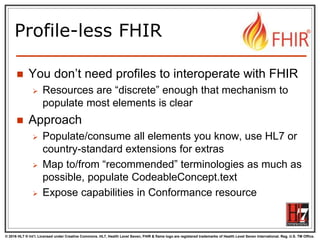
Profile-less FHIR
 You don’t need profiles to interoperate with FHIR
 Resources are “discrete” enough that mechanism to
populate most elements is clear
 Approach
 Populate/consume all elements you know, use HL7 or
country-standard extensions for extras
 Map to/from “recommended” terminologies as much as
possible, populate CodeableConcept.text
 Expose capabilities in Conformance resource
© 2016 HL7 ® Int’l. Licensed under Creative Commons. HL7, Health Level Seven, FHIR & flame logo are registered trademarks of Health Level Seven International. Reg. U.S. TM Office.
®
Data Access Framework
(DAF) vs.
82
© 2016 HL7 ® Int’l. Licensed under Creative Commons. HL7, Health Level Seven, FHIR & flame logo are registered trademarks of Health Level Seven International. Reg. U.S. TM Office.
®
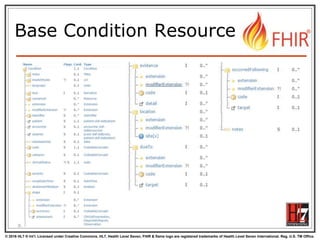
Base Condition Resource
83
© 2016 HL7 ® Int’l. Licensed under Creative Commons. HL7, Health Level Seven, FHIR & flame logo are registered trademarks of Health Level Seven International. Reg. U.S. TM Office.
®
Profile Uses
 Profiles are still quite useful
 Define documents and messages
 Define extensions, search parameters
 Set interoperability expectations in a particular
context
 National standards, types of care, business patterns
 Clinical practice guidelines / detailed clinical
models
 Document system capabilities
84
© 2016 HL7 ® Int’l. Licensed under Creative Commons. HL7, Health Level Seven, FHIR & flame logo are registered trademarks of Health Level Seven International. Reg. U.S. TM Office.
®
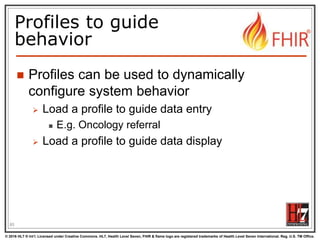
Profiles to guide
behavior
 Profiles can be used to dynamically
configure system behavior
 Load a profile to guide data entry
 E.g. Oncology referral
 Load a profile to guide data display
85
© 2016 HL7 ® Int’l. Licensed under Creative Commons. HL7, Health Level Seven, FHIR & flame logo are registered trademarks of Health Level Seven International. Reg. U.S. TM Office.
®
Simultaneous profiles
 Multiple profiles can apply to an instance at
the same time
 Different codings for different value sets
 Include the union of all needed elements
 Works best when profiles don’t constrain max
occurrences
86
© 2016 HL7 ® Int’l. Licensed under Creative Commons. HL7, Health Level Seven, FHIR & flame logo are registered trademarks of Health Level Seven International. Reg. U.S. TM Office.
®
Declaring profiles
 Instances can identify what profiles they
support using tags
 Considerations:
 Is declaration version-specific?
 Do you trust the declaration to be accurate?
 Will all clients declare the profiles of interest on
submissions?
 What about profiles of interest defined after data is
received?
87
© 2016 HL7 ® Int’l. Licensed under Creative Commons. HL7, Health Level Seven, FHIR & flame logo are registered trademarks of Health Level Seven International. Reg. U.S. TM Office.
®
WHAT NOW?
© 2016 HL7 ® Int’l. Licensed under Creative Commons. HL7, Health Level Seven, FHIR & flame logo are registered trademarks of Health Level Seven International. Reg. U.S. TM Office.
®
Dealing with STU
 FHIR is a “standard for trial use”
 Anything can change – no compatibility promised
 Changes driven by implementation feedback
 Most changes expected in resources
 Already significant implementation experience through
reference implementations, connectathons
 Some needed resources aren’t yet defined
 BillingItem, ClinicalTrial, Outbreak, etc.
 At least one more STU, possibly more before content
becomes normative
 What goes normative when will depend on
degree of implementation
© 2016 HL7 ® Int’l. Licensed under Creative Commons. HL7, Health Level Seven, FHIR & flame logo are registered trademarks of Health Level Seven International. Reg. U.S. TM Office.
®
STU Strategies
 If multiple STU versions could be in play
 Distinguish using tags or distinct endpoints
 Be prepared to transform between versions to
move/rename elements or handle syntax changes
 For missing resources
 Use Basic
 Create your own custom resource
 Non-conformant, but ok during STU in closed
community
90
© 2016 HL7 ® Int’l. Licensed under Creative Commons. HL7, Health Level Seven, FHIR & flame logo are registered trademarks of Health Level Seven International. Reg. U.S. TM Office.
®
FHIR adoption
approaches
 Low hanging fruit
 Registries
 Terminology
 MHD (XDS)
 CCDA interface
 Patient Portals / Mobile Health
 Others?
91
© 2016 HL7 ® Int’l. Licensed under Creative Commons. HL7, Health Level Seven, FHIR & flame logo are registered trademarks of Health Level Seven International. Reg. U.S. TM Office.
®
FHIR adoption
approaches (cont’d)
 Trial & experiment
 Green-field
 Pilots
 “good fit” solutions (mobile, social media)
 Elements not standardized elsewhere
 Questionnaire, ConceptMap, etc.
92
© 2016 HL7 ® Int’l. Licensed under Creative Commons. HL7, Health Level Seven, FHIR & flame logo are registered trademarks of Health Level Seven International. Reg. U.S. TM Office.
®
FHIR adoption
approaches (cont’d)
 Deep dive
 For the brave
 May be premature during STU period, given that
specification is likely to change
 Ability to adapt to change is essential
93
© 2016 HL7 ® Int’l. Licensed under Creative Commons. HL7, Health Level Seven, FHIR & flame logo are registered trademarks of Health Level Seven International. Reg. U.S. TM Office.
®
FHIR adoption
approaches (cont’d)
 Monitor
 Wait for next STU, normative, jurisdictional
direction (e.g. meaningful use)
 Wait for stability in reference implementations
 Wait to see more implementation experience
 Ignore
 FHIR isn’t relevant to my environment now and is
unlikely to ever be
94
© 2016 HL7 ® Int’l. Licensed under Creative Commons. HL7, Health Level Seven, FHIR & flame logo are registered trademarks of Health Level Seven International. Reg. U.S. TM Office.
®
Estimating
 How much will implementing a FHIR solution
cost?
 Considerations
 Reference implementations help
 Learning curve is lower
• Still a curve if unfamiliar with XML / JSON / REST
 Faster to “drive by” interoperability
 Can’t speed consensus
 Tools to help with mapping to internal codes and structures,
still takes time
 Anecdotal is “faster” to “significantly faster” to implement
95
© 2016 HL7 ® Int’l. Licensed under Creative Commons. HL7, Health Level Seven, FHIR & flame logo are registered trademarks of Health Level Seven International. Reg. U.S. TM Office.
®
Skill requirements
 To implement a FHIR solution, you’ll need:
 Knowledge of XML and/or JSON
 Some degree of familiarity with HTTP (assuming
REST)
 Likely someone knowledgeable in HTTP security
and possibly OAuth
96
© 2016 HL7 ® Int’l. Licensed under Creative Commons. HL7, Health Level Seven, FHIR & flame logo are registered trademarks of Health Level Seven International. Reg. U.S. TM Office.
®
Considerations
 What’s giving you pain now?
 How could FHIR address those pain points?
 What worries you about using FHIR?
97
© 2016 HL7 ® Int’l. Licensed under Creative Commons. HL7, Health Level Seven, FHIR & flame logo are registered trademarks of Health Level Seven International. Reg. U.S. TM Office.
®
Time-points for
re-evaluation
 Dec. 2016: STU 3.0 published??
 2017/18: First Normative specification
 Additional releases every 18-24 months
98
© 2016 HL7 ® Int’l. Licensed under Creative Commons. HL7, Health Level Seven, FHIR & flame logo are registered trademarks of Health Level Seven International. Reg. U.S. TM Office.
®
Resources
wiki.hl7.org/?title=FHIR
99
© 2016 HL7 ® Int’l. Licensed under Creative Commons. HL7, Health Level Seven, FHIR & flame logo are registered trademarks of Health Level Seven International. Reg. U.S. TM Office.
®
Next Steps for you
 Attend other FHIR tutorials
 Developers, Profiles, Deep Dive
 Read the spec: http://hl7.org/fhir
 Comment in the discussion areas
 Follow #FHIR on Twitter
 Shape the specification:
 Join the FHIR track at this WGM
 Feedback – discussion, tracker, list server
 Try implementing it
 Come to a Connectathon!
100
© 2016 HL7 ® Int’l. Licensed under Creative Commons. HL7, Health Level Seven, FHIR & flame logo are registered trademarks of Health Level Seven International. Reg. U.S. TM Office.
®
Education opportunities
 Attend a Working Group Meeting
 Tutorials, Connectathons
 Jan 13-20 San Antonio
 May 5-12 Madrid
 Attend an Implementation Workshop
 Intensive tutorials, hands-on
 Nov. 7-11?
 FHIR Institute Webinars
 Oct 24-28
 Dec 5-9
 Custom education available
101
© 2016 HL7 ® Int’l. Licensed under Creative Commons. HL7, Health Level Seven, FHIR & flame logo are registered trademarks of Health Level Seven International. Reg. U.S. TM Office.
®
102
International HL7 FHIR Developer Days
November 16-18, 2016 in Amsterdam
 Education
 12 speakers
 16 tutorials/presentations
 18 tracks
 Connectathon
 Meet fellow developers
 Put FHIR to the test
 Networking
 FHIR experts and authors on hand
http://fhir.furore.com/devdays
© 2016 HL7 ® Int’l. Licensed under Creative Commons. HL7, Health Level Seven, FHIR & flame logo are registered trademarks of Health Level Seven International. Reg. U.S. TM Office.
®
Questions?
http://hl7.org/fhir lmckenzie@gevityinc.com
103

FHIR for Architects.pptx

  • 1.
    © 2016 HL7® Int’l. Licensed under Creative Commons. HL7, Health Level Seven, FHIR & flame logo are registered trademarks of Health Level Seven International. Reg. U.S. TM Office. ® FHIR for Architects Lloyd McKenzie Sept. 20, 2016
  • 2.
    © 2016 HL7® Int’l. Licensed under Creative Commons. HL7, Health Level Seven, FHIR & flame logo are registered trademarks of Health Level Seven International. Reg. U.S. TM Office. ® Who am I?  Name: Lloyd McKenzie  Company: Gevity  Background:  One of FHIR’s 3 initial editors  Co-chair FMG & FHIR Infrastructure  Co-chair HL7 Modeling & Methodology  Heavily involved in HL7 and healthcare exchange for last 16 years (v2, v3, CDA, etc.)  lmckenzie@gevityinc.com 2
  • 3.
    © 2016 HL7® Int’l. Licensed under Creative Commons. HL7, Health Level Seven, FHIR & flame logo are registered trademarks of Health Level Seven International. Reg. U.S. TM Office. ® This presentation  Can be downloaded here:  http://gforge.hl7.org/svn/fhir/trunk/presentations/2016- 09%20Webinars/FHIR%20for%20Architects.pptx  Use “anonymous” and email address to logon  Is licensed for use under the Creative Commons, specifically:  Creative Commons Attribution 3.0 Unported License  (Do with it as you wish, so long as you give credit)
  • 4.
    © 2016 HL7® Int’l. Licensed under Creative Commons. HL7, Health Level Seven, FHIR & flame logo are registered trademarks of Health Level Seven International. Reg. U.S. TM Office. ® Tutorial Objectives  You should know  FHIR’s interoperability paradigms (and where to use)  Where FHIR can fit in the architectural stack  FHIR architectural considerations and how to address them  Where and how Profiles fit into an architectural solution  If, when and how FHIR might be used within your own organization 4
  • 5.
    © 2016 HL7® Int’l. Licensed under Creative Commons. HL7, Health Level Seven, FHIR & flame logo are registered trademarks of Health Level Seven International. Reg. U.S. TM Office. ® Level Setting  Should be familiar with basics of FHIR – from Introduction to FHIR or equivalent presentation or experience  This presentation won’t drill into the hands on details of messaging, documents, XML or JSON syntax, etc.  Focus will be high level architecture considerations – will get through as much as we can . . . 5
  • 6.
    © 2016 HL7® Int’l. Licensed under Creative Commons. HL7, Health Level Seven, FHIR & flame logo are registered trademarks of Health Level Seven International. Reg. U.S. TM Office. ® Agenda  Paradigms & Architecture approaches  FHIR Features & Architecture decision  Additional considerations, Profiles & Next steps 6
  • 7.
    © 2016 HL7® Int’l. Licensed under Creative Commons. HL7, Health Level Seven, FHIR & flame logo are registered trademarks of Health Level Seven International. Reg. U.S. TM Office. ® WHAT PARADIGM
  • 8.
    © 2016 HL7® Int’l. Licensed under Creative Commons. HL7, Health Level Seven, FHIR & flame logo are registered trademarks of Health Level Seven International. Reg. U.S. TM Office. ® Paradigms  FHIR supports 4 interoperability paradigms 8 REST Documents Messages Services What should you use when?
  • 9.
    © 2016 HL7® Int’l. Licensed under Creative Commons. HL7, Health Level Seven, FHIR & flame logo are registered trademarks of Health Level Seven International. Reg. U.S. TM Office. ® REST  Simple, out-of-the-box interoperability  Leverage HTTP: GET, POST, etc.  Pre-defined operations  Create, Read, Update, Delete  Also: History, Read Version, Search, Updates, Validate, Conformance & Batch 9 Rest
  • 10.
    © 2016 HL7® Int’l. Licensed under Creative Commons. HL7, Health Level Seven, FHIR & flame logo are registered trademarks of Health Level Seven International. Reg. U.S. TM Office. ® FHIR Resource URLs Template Description Example Operations [base] Server URL http://fhir.com GET, OPTIONS, POST [base]/[type] Collection Manager http://fhir.com/Patient GET, POST [base]/[type]/[id] URL for a resource http://fhir.com/Patient /23 GET, PUT, DELETE [base]/([type]/([i d]/)?)?$[name] Operation (server action) http://fhir.com/Patient /23/$everything GET, POST [base]/[type]/[id] /_history/[vid] Past version http://fhir.com/Patient/23 /_history/2 GET
  • 11.
    © 2016 HL7® Int’l. Licensed under Creative Commons. HL7, Health Level Seven, FHIR & flame logo are registered trademarks of Health Level Seven International. Reg. U.S. TM Office. ® When to use REST?  Want low coupling between systems  In theory, very little up-front negotiation required  Small, light-weight exchanges  Focus is CRUD operations  Also for publish/subscribe  Client-driven client-server orchestration  Server endpoint has fixed location  Well-suited for Mobile, PHR, Registries 11 Rest
  • 12.
    © 2016 HL7® Int’l. Licensed under Creative Commons. HL7, Health Level Seven, FHIR & flame logo are registered trademarks of Health Level Seven International. Reg. U.S. TM Office. ® When to avoid REST?  Complex or server-driven orchestration  Order of operations matters (e.g. complex decision support)  Unit of work != resource  “Transaction” may be an option  No natural “server” or no fixed network location  Lack of trust in the client for audit, etc. 12 Rest
  • 13.
    © 2016 HL7® Int’l. Licensed under Creative Commons. HL7, Health Level Seven, FHIR & flame logo are registered trademarks of Health Level Seven International. Reg. U.S. TM Office. ® Documents  Similar to CDA  Collection of resources bound together  Root is a “Composition” resource  Just like CDA header  Sent as a Bundle resource  One context  Can be signed, authenticated, etc. 13 Documents
  • 14.
    © 2016 HL7® Int’l. Licensed under Creative Commons. HL7, Health Level Seven, FHIR & flame logo are registered trademarks of Health Level Seven International. Reg. U.S. TM Office. ® Documents – are bundles 14 Observation Resource Composition Resource Section Device Resource Condition Resource List Resource <Bundle> <entry> <resource> <Composition /> </resource> </entry> <entry> <resource> <Observation /> </resource> </entry> <entry> <resource> <Device /> </resource> </entry> <entry> <resource> <List/> </resource> </entry> <entry> <resource> <Condition/> <resource> </entry> </Bundle> Attester Metadata Section Section
  • 15.
    © 2016 HL7® Int’l. Licensed under Creative Commons. HL7, Health Level Seven, FHIR & flame logo are registered trademarks of Health Level Seven International. Reg. U.S. TM Office. ® When to use Documents?  Focus is on persistence  No workflow involved  other than post/retrieve document  Need tight rules over authenticated content  Want to communicate multiple resources with control over how data is presented  Data spans multiple resources 15 Documents
  • 16.
    © 2016 HL7® Int’l. Licensed under Creative Commons. HL7, Health Level Seven, FHIR & flame logo are registered trademarks of Health Level Seven International. Reg. U.S. TM Office. ® When to avoid Documents?  Need for workflow  Request/response, decision support  Data is dynamic  I.e. want view of data now, not at time of authorship  Multiple contributors over time  Resources need to be accessed/manipulated independently 16 Documents
  • 17.
    © 2016 HL7® Int’l. Licensed under Creative Commons. HL7, Health Level Seven, FHIR & flame logo are registered trademarks of Health Level Seven International. Reg. U.S. TM Office. ® Messages  Similar to v2 and v3 messaging  Also a collection of resources as a Bundle resource  Allows request/response behavior with bundles for both request and response  Event-driven  E.g. Send lab order, get back result  Can be asynchronous 17 Messages
  • 18.
    © 2016 HL7® Int’l. Licensed under Creative Commons. HL7, Health Level Seven, FHIR & flame logo are registered trademarks of Health Level Seven International. Reg. U.S. TM Office. ® Messages – are bundles 18 Observation Resource MessageHeader Resource source destination Device Resource Patient Resource <Bundle> <entry> <MessageHeader /> </entry> <entry> <Observation /> </entry> <entry> <Patient /> </entry> <entry> <Device /> </entry> </Bundle> event
  • 19.
    © 2016 HL7® Int’l. Licensed under Creative Commons. HL7, Health Level Seven, FHIR & flame logo are registered trademarks of Health Level Seven International. Reg. U.S. TM Office. ® When to use Messaging?  Request/response workflow  Need to drive behaviors more complex than CRUD on a single resource  E.g. merge, complex queries  Need for asynchronous communications  Need to communicate information about many resources but want to minimize exchanges  No “identity” for many resources 19 Messages
  • 20.
    © 2016 HL7® Int’l. Licensed under Creative Commons. HL7, Health Level Seven, FHIR & flame logo are registered trademarks of Health Level Seven International. Reg. U.S. TM Office. ® When to avoid Messaging?  Precise control required on how data gets persisted/displayed to humans  Need for lightweight communications  Want to avoid pre-negotiations on behavior 20 Messages
  • 21.
    © 2016 HL7® Int’l. Licensed under Creative Commons. HL7, Health Level Seven, FHIR & flame logo are registered trademarks of Health Level Seven International. Reg. U.S. TM Office. ® Service Oriented Architecture (SOA)  Do whatever you like  (based on SOA principles)  Ultra complex workflows  Ultra simple workflows  Individual resources or collections (in Bundles or other formats)  Use HTTP or use something else  Only constraint is that you’re passing around FHIR resources in some shape or manner 21 Services
  • 22.
    © 2016 HL7® Int’l. Licensed under Creative Commons. HL7, Health Level Seven, FHIR & flame logo are registered trademarks of Health Level Seven International. Reg. U.S. TM Office. ® Example services 22
  • 23.
    © 2016 HL7® Int’l. Licensed under Creative Commons. HL7, Health Level Seven, FHIR & flame logo are registered trademarks of Health Level Seven International. Reg. U.S. TM Office. ® When to use Services?  All previous paradigms are a type of services interface  Use a custom service when capabilities of other paradigms don’t fit requirement  Operations other than CRUD on a resource (e.g. decision support)  Workflow more complex than simple request/response  Need to mix document persistence with behavior 23 Services
  • 24.
    © 2016 HL7® Int’l. Licensed under Creative Commons. HL7, Health Level Seven, FHIR & flame logo are registered trademarks of Health Level Seven International. Reg. U.S. TM Office. ® When not to use services?  When something else will do the job as well  I.e. Don’t define a custom service for something that already naturally is handled by REST, messaging, etc. 24 Services
  • 25.
    © 2016 HL7® Int’l. Licensed under Creative Commons. HL7, Health Level Seven, FHIR & flame logo are registered trademarks of Health Level Seven International. Reg. U.S. TM Office. ® Paradigm guidance  No absolutes  Consider a “when to avoid” as a note of caution  Capabilities/architecture of legacy will often drive approach, particularly initially  E.g. If v2 back end, messaging  Architectures will be driven by legacy requirements, architectural preferences, enterprise architecture commitments, etc. 25
  • 26.
    © 2016 HL7® Int’l. Licensed under Creative Commons. HL7, Health Level Seven, FHIR & flame logo are registered trademarks of Health Level Seven International. Reg. U.S. TM Office. ® Combining paradigms  No requirement for a system to only support one paradigm  E.g. hospital may be primarily messaging, but use documents for discharge summaries and reports and expose registries and appointments via REST with a few custom services for decision support or specialized workflow  Data (generally) shared easily across paradigm boundaries 26
  • 27.
    © 2016 HL7® Int’l. Licensed under Creative Commons. HL7, Health Level Seven, FHIR & flame logo are registered trademarks of Health Level Seven International. Reg. U.S. TM Office. ® Caveats with combining paradigms  If updates come in via document, message or service, RESTful version id still needs to increment  Documents should typically be persisted whole, not reconstituted from parts  Ensures signature validity  Legacy messaging systems may not provide the metadata to easily expose or manipulate discrete resources via REST 27
  • 28.
    © 2016 HL7® Int’l. Licensed under Creative Commons. HL7, Health Level Seven, FHIR & flame logo are registered trademarks of Health Level Seven International. Reg. U.S. TM Office. ® Apply it  What paradigm(s) are you like to use in your organization and why? 28
  • 29.
    © 2016 HL7® Int’l. Licensed under Creative Commons. HL7, Health Level Seven, FHIR & flame logo are registered trademarks of Health Level Seven International. Reg. U.S. TM Office. ® FHIR ARCHITECTURE APPROACHES
  • 30.
    © 2016 HL7® Int’l. Licensed under Creative Commons. HL7, Health Level Seven, FHIR & flame logo are registered trademarks of Health Level Seven International. Reg. U.S. TM Office. ® Some possible uses 30 FHIR Broker v3 v2 PHR FHIR App Comm. Interface DB FHIR
  • 31.
    © 2016 HL7® Int’l. Licensed under Creative Commons. HL7, Health Level Seven, FHIR & flame logo are registered trademarks of Health Level Seven International. Reg. U.S. TM Office. ® Repository model Vendor Neutral Repository FHIR HIS LIMS PACS SystemX Gateway FHIR FHIR FHIR FHIR
  • 32.
    © 2016 HL7® Int’l. Licensed under Creative Commons. HL7, Health Level Seven, FHIR & flame logo are registered trademarks of Health Level Seven International. Reg. U.S. TM Office. ® Beyond exchange 32 v3 v2 Other X12 Broker v3 v2 FHIR Repository Decision Support FHIR FHIR Other
  • 33.
    © 2016 HL7® Int’l. Licensed under Creative Commons. HL7, Health Level Seven, FHIR & flame logo are registered trademarks of Health Level Seven International. Reg. U.S. TM Office. ® Overview of a server 33 HTTP / REST interface Encoding/decoding, param validation, syntax validation Fhir Service Indexer / Search Storage Implement service operations as described in spec
  • 34.
    © 2016 HL7® Int’l. Licensed under Creative Commons. HL7, Health Level Seven, FHIR & flame logo are registered trademarks of Health Level Seven International. Reg. U.S. TM Office. ® From wire to store Storage Fhir Service REST interface JSON/XML POCO/POJO DBMS O-R Map FHIR Parser 34 JSON/XML POCO/POJO Serialize FHIR Parser NoSql (Xml/Json) JSON/XML POCO/POJO DBMS Serialize FHIR Parser
  • 35.
    © 2016 HL7® Int’l. Licensed under Creative Commons. HL7, Health Level Seven, FHIR & flame logo are registered trademarks of Health Level Seven International. Reg. U.S. TM Office. ® Architectures  FHIR makes no assumptions about the architectural design of systems  You can use it for  Light or heavy clients  Central server or peer-to-peer sharing  Push or pull  Query or publish/subscribe  Loosely coupled or tightly coupled environments  With history tracking or without 35
  • 36.
    © 2016 HL7® Int’l. Licensed under Creative Commons. HL7, Health Level Seven, FHIR & flame logo are registered trademarks of Health Level Seven International. Reg. U.S. TM Office. ® Bottom Line  FHIR is a set of tools  Defined resources  Extensibility mechanism  Set of standard interfaces  Primary purpose is interoperable data exchange  However, it can be leveraged in many ways  Many we haven’t even thought of yet . . . 36
  • 37.
    © 2016 HL7® Int’l. Licensed under Creative Commons. HL7, Health Level Seven, FHIR & flame logo are registered trademarks of Health Level Seven International. Reg. U.S. TM Office. ® FHIR FEATURES And the architecture decisions that go with them
  • 38.
    © 2016 HL7® Int’l. Licensed under Creative Commons. HL7, Health Level Seven, FHIR & flame logo are registered trademarks of Health Level Seven International. Reg. U.S. TM Office. ® FHIR Features  Narrative  Extensions  Modifier Extensions  Versions  Tags  Syntaxes  Signatures  Reference Libraries  Conformance Resources  Bundles
  • 39.
    © 2016 HL7® Int’l. Licensed under Creative Commons. HL7, Health Level Seven, FHIR & flame logo are registered trademarks of Health Level Seven International. Reg. U.S. TM Office. ® Narrative 39
  • 40.
    © 2016 HL7® Int’l. Licensed under Creative Commons. HL7, Health Level Seven, FHIR & flame logo are registered trademarks of Health Level Seven International. Reg. U.S. TM Office. ® Narrative  All resources are expected to have narrative except in narrow circumstances  May be generated or manually edited  Decisions  Should narrative be generated or human-entered?  Generated simplifies processing for receivers  Some text will need to human entered  In some cases, there may be minimal discrete data
  • 41.
    © 2016 HL7® Int’l. Licensed under Creative Commons. HL7, Health Level Seven, FHIR & flame logo are registered trademarks of Health Level Seven International. Reg. U.S. TM Office. ® Narrative decisions (cont’d)  If generated, which elements should be included? How should they be rendered?  all content needed for a human to understand the essential clinical and business information otherwise encoded within the resource  Will generally include modifierExtensions  May include other extensions  Best to seek clinician and other review of content, order of presentation & rendering  Consider that content may be rendered on mobile devices, so don’t get too fancy with markup 41
  • 42.
    © 2016 HL7® Int’l. Licensed under Creative Commons. HL7, Health Level Seven, FHIR & flame logo are registered trademarks of Health Level Seven International. Reg. U.S. TM Office. ® Narrative decisions (cont’d)  Should narrative be displayed to users?  Driven by Narrative.status  Business requirements (e.g. Document attestation) may drive need to render regardless 42
  • 43.
    © 2016 HL7® Int’l. Licensed under Creative Commons. HL7, Health Level Seven, FHIR & flame logo are registered trademarks of Health Level Seven International. Reg. U.S. TM Office. ® Extensions 43
  • 44.
    © 2016 HL7® Int’l. Licensed under Creative Commons. HL7, Health Level Seven, FHIR & flame logo are registered trademarks of Health Level Seven International. Reg. U.S. TM Office. ® Extensions (cont’d)  In FHIR, extensions are “normal”  Consequence of the 80% rule – keep the simple stuff simple  Extensions can exist anywhere  Yes, even inside boolean or date  Systems shouldn’t reject instances just because they contain unrecognized extensions 44
  • 45.
    © 2016 HL7® Int’l. Licensed under Creative Commons. HL7, Health Level Seven, FHIR & flame logo are registered trademarks of Health Level Seven International. Reg. U.S. TM Office. ® Extension decisions  Should unrecognized extensions be persisted? How?  Throwing away extensions = loss of potentially useful information to downstream systems  Therefore: Keep extensions if you can  Can capture them in a blob or a generic “slot” structure  Could, with location tagging, capture all “unknown” extensions for a resource in a single blob  Some legacy systems won’t be able to  When data is updated, some extensions must be dropped 45
  • 46.
    © 2016 HL7® Int’l. Licensed under Creative Commons. HL7, Health Level Seven, FHIR & flame logo are registered trademarks of Health Level Seven International. Reg. U.S. TM Office. ® Extension decisions (cont’d)  Should you display unrecognized extensions?  Extensions are identified by URL and have a known data type. Can resolve the URL, look up the name and display  Cost/benefit question – some extensions will have little value, others may have a lot  Might want to let users configure what gets displayed  If you do query, look at caching extension definitions to minimize performance issues 46
  • 47.
    © 2016 HL7® Int’l. Licensed under Creative Commons. HL7, Health Level Seven, FHIR & flame logo are registered trademarks of Health Level Seven International. Reg. U.S. TM Office. ® Extension decisions (cont’d)  What should you expose as an extension?  If data can be exposed using core structures, it should be  Can still send the same data in an extension  e.g. with more/less granularity, alternate coding, different data type  Look for existing extensions before defining your own  Extensions, if used, should be generic to encourage re-use (and thus broad recognition)  Extension should be on the element described by the extension 47
  • 48.
    © 2016 HL7® Int’l. Licensed under Creative Commons. HL7, Health Level Seven, FHIR & flame logo are registered trademarks of Health Level Seven International. Reg. U.S. TM Office. ® Extension decisions (cont’d)  Where to register extensions  Considerations:  What’s the scope? For local extensions, a local registry may make more sense  Is there a need for restricted access?  In general, broad registration = discoverable = broader uptake = broader recognition 48
  • 49.
    © 2016 HL7® Int’l. Licensed under Creative Commons. HL7, Health Level Seven, FHIR & flame logo are registered trademarks of Health Level Seven International. Reg. U.S. TM Office. ® Modifier Extensions  Also a core part of FHIR  Needed because some extensions can’t be safely ignored  Can’t compute on an element containing an unrecognized modifier extension. However, can:  Reject instance  Remove element containing unrecognized modifier extension  Just display narrative  Retrieve definition & seek human review 49
  • 50.
    © 2016 HL7® Int’l. Licensed under Creative Commons. HL7, Health Level Seven, FHIR & flame logo are registered trademarks of Health Level Seven International. Reg. U.S. TM Office. ® Modifier Extension decisions  When should you introduce them?  modifierExtension breaks interoperability so:  If you can accomplish your objective without one, do that  Consider a new resource or Basic  Could requirement be met by an element that doesn’t change other element interpretations?  Best used when already part of existing practice, but in too narrow an area to justify being part of core 50
  • 51.
    © 2016 HL7® Int’l. Licensed under Creative Commons. HL7, Health Level Seven, FHIR & flame logo are registered trademarks of Health Level Seven International. Reg. U.S. TM Office. ® Versions 51 33, v12 – 2012-12-04 33, v13 – 2012-12-05 33, v14 – 2012-12-08 33, v15 – 2012-12-09 /server.org/fhir/Patient/33/_history/12 /server.org/fhir/Patient/33 /server.org/fhir/Patient/33/_history/13 /server.org/fhir/Patient/33/_history/14 /server.org/fhir/Patient/33/_history/15
  • 52.
    © 2016 HL7® Int’l. Licensed under Creative Commons. HL7, Health Level Seven, FHIR & flame logo are registered trademarks of Health Level Seven International. Reg. U.S. TM Office. ® Versions (cont’d)  FHIR allows versions to be tracked and retrieved  Do you want to support versioning?  May be difficult or impossible with some legacy data stores  Will still need to have unique version id (UUID, timestamp)  Provides useful collision-detection mechanism 52
  • 53.
    © 2016 HL7® Int’l. Licensed under Creative Commons. HL7, Health Level Seven, FHIR & flame logo are registered trademarks of Health Level Seven International. Reg. U.S. TM Office. ® Pop Quiz  Where can extensions appear?  When must a receiver process an extension? 53
  • 54.
    © 2016 HL7® Int’l. Licensed under Creative Commons. HL7, Health Level Seven, FHIR & flame logo are registered trademarks of Health Level Seven International. Reg. U.S. TM Office. ® Tags 54 Patient MRN 22234 “Ewout Kramer” 30-11-1972 Amsterdam Profile: http://hl7.org/fhir/Profile/us-core Tag: http://example.org/fhir/Status#Test
  • 55.
    © 2016 HL7® Int’l. Licensed under Creative Commons. HL7, Health Level Seven, FHIR & flame logo are registered trademarks of Health Level Seven International. Reg. U.S. TM Office. ® Tags (cont’d)  Allow data to be attached to a resource “outside” the resource  Doesn’t break signature when added/changed  3 types:  Security  Profile  General (workflow, etc.)  Require business agreement  Can’t search by tag if authors don’t include them • And populate the same way . . . 55
  • 56.
    © 2016 HL7® Int’l. Licensed under Creative Commons. HL7, Health Level Seven, FHIR & flame logo are registered trademarks of Health Level Seven International. Reg. U.S. TM Office. ® Tag decisions  Tag vs. extension?  Use extension if:  Element is associated with the business object rather than electronic record  Part of attested content of resource  Should be included in narrative  Change should force new version 56
  • 57.
    © 2016 HL7® Int’l. Licensed under Creative Commons. HL7, Health Level Seven, FHIR & flame logo are registered trademarks of Health Level Seven International. Reg. U.S. TM Office. ® Syntaxes Xml <XXX xmlns=“urn:foo”> <B a=“c” /> <C>One</C> <C>Two</C> <D>One</D> <div>Not <b>so</b> easy</div> </XXX> JSON { “B”: { “a” : “c” }, “C”: [ “One”, “Two” ], “D” : [ “One” ], “div” : { “text-before”:“Not ”, b:“so”, “text-after”:“easy”} } 57
  • 58.
    © 2016 HL7® Int’l. Licensed under Creative Commons. HL7, Health Level Seven, FHIR & flame logo are registered trademarks of Health Level Seven International. Reg. U.S. TM Office. ® Syntaxes (cont’d)  Multiple representations  XML or JSON  RDF in progress  Reference implementations support both and conversion between  Maximizes interoperability  Inter-conversion isn’t (yet) robust enough for digital signatures (whitespace is an issue) 58
  • 59.
    © 2016 HL7® Int’l. Licensed under Creative Commons. HL7, Health Level Seven, FHIR & flame logo are registered trademarks of Health Level Seven International. Reg. U.S. TM Office. ® Syntax decisions  What syntax should be used when?  XML used to be required for servers  Now implementer’s choice  XML provides broader tools  XSLT, schema, XPath  JSON uses less bandwidth, more natural for mobile  RDF is niche  ideally, servers support all  maximum interoperability 59
  • 60.
    © 2016 HL7® Int’l. Licensed under Creative Commons. HL7, Health Level Seven, FHIR & flame logo are registered trademarks of Health Level Seven International. Reg. U.S. TM Office. ® Signatures  Three ways to digitally sign content  Sign bundle (Message or Document)  Sign resource version using Provenance resource  Limited to data integrity  Extension (for more complete signature)  No requirement to sign content  Signatures are just one mechanism of ensuring data integrity and/or non-repudiation  Signatures may not hold when converting between different syntaxes 60
  • 61.
    © 2016 HL7® Int’l. Licensed under Creative Commons. HL7, Health Level Seven, FHIR & flame logo are registered trademarks of Health Level Seven International. Reg. U.S. TM Office. ® Reference libraries  Currently 5:  C#, Java, Pascal (Delphi), Javascript, Swift  More to come?  Handle parsing, serialization, validation, etc.  Also open source servers, basic clients 61
  • 62.
    © 2016 HL7® Int’l. Licensed under Creative Commons. HL7, Health Level Seven, FHIR & flame logo are registered trademarks of Health Level Seven International. Reg. U.S. TM Office. ® Reference library decisions  Use a reference library vs. build your own?  Same criteria as any other “build vs. reuse”  Build costs more, but more tuned  At minimum, consult reference implementations to ensure you don’t miss nuances of specification  How often to update?  Reference libraries changing frequently  Will need to manage updates, especially given that custom code is likely resting on top 62
  • 63.
    © 2016 HL7® Int’l. Licensed under Creative Commons. HL7, Health Level Seven, FHIR & flame logo are registered trademarks of Health Level Seven International. Reg. U.S. TM Office. ® Conformance resources  Conformance, ValueSet, NamingSystem, ConceptMap & StructureDefinition  Provide “metadata” for operation of systems  Allow for “dynamic” configuration  E.g. Rather than having hard-coded rules for allowed codes, required elements, look it up in ValueSet or Profile resource  Can be hosted anywhere  Do you require a local copy for performance reasons? Perhaps synchronized copy via publish subscribe? 63
  • 64.
    © 2016 HL7® Int’l. Licensed under Creative Commons. HL7, Health Level Seven, FHIR & flame logo are registered trademarks of Health Level Seven International. Reg. U.S. TM Office. ® Conformance resources (cont’d)  Often arranged in cascading hierarchy  E.g. International value set, national value set, local value set  Need to consider timeframe and mechanism for propagating changes from higher levels in the hierarchy 64
  • 65.
    © 2016 HL7® Int’l. Licensed under Creative Commons. HL7, Health Level Seven, FHIR & flame logo are registered trademarks of Health Level Seven International. Reg. U.S. TM Office. ® Bundles 65
  • 66.
    © 2016 HL7® Int’l. Licensed under Creative Commons. HL7, Health Level Seven, FHIR & flame logo are registered trademarks of Health Level Seven International. Reg. U.S. TM Office. ® Bundles (cont’d)  Mechanism for messages, documents, transactions, query responses  In theory, could regenerate a document from constituent parts, but:  No clear boundary on what’s part of document vs. not  No way to guarantee order of entries  Thus: recommend storing as a binary 66
  • 67.
    © 2016 HL7® Int’l. Licensed under Creative Commons. HL7, Health Level Seven, FHIR & flame logo are registered trademarks of Health Level Seven International. Reg. U.S. TM Office. ® Bundle decisions  Ids within a bundle  Resources in bundles can be identified by UUID, server id or version-specific id  Server ids allow information in a document to be linked to existing resources.  Version ids should be used if data corresponds to a specific version (as opposed to filtered view) 67
  • 68.
    © 2016 HL7® Int’l. Licensed under Creative Commons. HL7, Health Level Seven, FHIR & flame logo are registered trademarks of Health Level Seven International. Reg. U.S. TM Office. ® Bundle decisions (cont’d)  Where’s the resource – bundled, contained, remote?  “contained” should only be used if resource can’t stand alone  Can’t exist if parent is removed  Not enough information to resolve  In bundle for document if part of narrative rendering rules or want part if signed content  In bundle for message if needed to process message and no separate query desired 68
  • 69.
    © 2016 HL7® Int’l. Licensed under Creative Commons. HL7, Health Level Seven, FHIR & flame logo are registered trademarks of Health Level Seven International. Reg. U.S. TM Office. ® Apply it  Which of the previous FHIR considerations are you going to pay particular attention to in your implementation? 69
  • 70.
    © 2016 HL7® Int’l. Licensed under Creative Commons. HL7, Health Level Seven, FHIR & flame logo are registered trademarks of Health Level Seven International. Reg. U.S. TM Office. ® ADDITIONAL CONSIDERATIONS
  • 71.
    © 2016 HL7® Int’l. Licensed under Creative Commons. HL7, Health Level Seven, FHIR & flame logo are registered trademarks of Health Level Seven International. Reg. U.S. TM Office. ® Additional Considerations  Resolving identity  Missing data  Looping  Variable server capabilities  Prohibiting data elements  Interoperating with legacy
  • 72.
    © 2016 HL7® Int’l. Licensed under Creative Commons. HL7, Health Level Seven, FHIR & flame logo are registered trademarks of Health Level Seven International. Reg. U.S. TM Office. ® Resolving identity  Resource is electronic representation of real- world object  Can have multiple resource instances for same real-world object  Different servers or sometimes even same server  Ids for same resource on different servers can be completely different  Data on different servers can also vary  One resource multiple sites (with different ids)  Available data may vary
  • 73.
    © 2016 HL7® Int’l. Licensed under Creative Commons. HL7, Health Level Seven, FHIR & flame logo are registered trademarks of Health Level Seven International. Reg. U.S. TM Office. ® Resolving identity (cont’d)  Matching resources within and across servers is generally accomplished by business id (“identifier”)  May also have business “version”  Rules over changing business version are domain- dependent.  Where old versions my be maintained, each version might be distinct instance 73
  • 74.
    © 2016 HL7® Int’l. Licensed under Creative Commons. HL7, Health Level Seven, FHIR & flame logo are registered trademarks of Health Level Seven International. Reg. U.S. TM Office. ® Missing data  Extremely few resource or data type elements are required (minOccurs > 0)  Resources and data types are context independent  Extensions might supersede core elements  Therefore  Don’t assume data will be present  Always check for element/@value, not just element  May need to validate to a profile to enforce requirements
  • 75.
    © 2016 HL7® Int’l. Licensed under Creative Commons. HL7, Health Level Seven, FHIR & flame logo are registered trademarks of Health Level Seven International. Reg. U.S. TM Office. ® Looping  FHIR resources are interrelated in a network, not a hierarchy  Direct and indirect looping relationships are possible  In resource definitions & instances  Even if not possible with core elements, may occur with extensions  Parsing and processing algorithms must deal with this possibility 75
  • 76.
    © 2016 HL7® Int’l. Licensed under Creative Commons. HL7, Health Level Seven, FHIR & flame logo are registered trademarks of Health Level Seven International. Reg. U.S. TM Office. ® Variable Server capabilities  FHIR defines a number of mechanisms to give clients control of queries  Paging, many filters, _include, _summary, compartments  However, these are all optional . . .  What should a server do?  Cost/benefit trade-off  More you support, more clients will work with you  Some capabilities may be very expensive in some architectures  Do as much as you can, “within reason” 76
  • 77.
    © 2016 HL7® Int’l. Licensed under Creative Commons. HL7, Health Level Seven, FHIR & flame logo are registered trademarks of Health Level Seven International. Reg. U.S. TM Office. ® Variable Server capabilities (cont’d)  What should a client do?  Take advantage of desired capabilities, work with narrow set of servers  Works well in closed environments  Use minimal capabilities, work in most/all environments  Use advanced features where available, fallback to client processing where needed  More efficient but more complex client 77
  • 78.
    © 2016 HL7® Int’l. Licensed under Creative Commons. HL7, Health Level Seven, FHIR & flame logo are registered trademarks of Health Level Seven International. Reg. U.S. TM Office. ® Prohibiting data elements  In FHIR, you shouldn’t prohibit unknown extensions or unsupported data elements  You can set a maxOccurs=0 for data elements  This forces clients to customize what they send you – bad practice  Better to accept and ignore  In limited cases, may be liability issues with ignoring data, so rejecting is necessary 78
  • 79.
    © 2016 HL7® Int’l. Licensed under Creative Commons. HL7, Health Level Seven, FHIR & flame logo are registered trademarks of Health Level Seven International. Reg. U.S. TM Office. ® Interoperating with legacy  How do you make FHIR play nicely with v2, v3, CDA?  Not enough time to cover here  Look at  http://hl7.org/fhir/comparison.html  https://healthlevelseven.desk.com • (members only) 79
  • 80.
    © 2016 HL7® Int’l. Licensed under Creative Commons. HL7, Health Level Seven, FHIR & flame logo are registered trademarks of Health Level Seven International. Reg. U.S. TM Office. ® PROFILED FHIR
  • 81.
    © 2016 HL7® Int’l. Licensed under Creative Commons. HL7, Health Level Seven, FHIR & flame logo are registered trademarks of Health Level Seven International. Reg. U.S. TM Office. ® Profile-less FHIR  You don’t need profiles to interoperate with FHIR  Resources are “discrete” enough that mechanism to populate most elements is clear  Approach  Populate/consume all elements you know, use HL7 or country-standard extensions for extras  Map to/from “recommended” terminologies as much as possible, populate CodeableConcept.text  Expose capabilities in Conformance resource
  • 82.
    © 2016 HL7® Int’l. Licensed under Creative Commons. HL7, Health Level Seven, FHIR & flame logo are registered trademarks of Health Level Seven International. Reg. U.S. TM Office. ® Data Access Framework (DAF) vs. 82
  • 83.
    © 2016 HL7® Int’l. Licensed under Creative Commons. HL7, Health Level Seven, FHIR & flame logo are registered trademarks of Health Level Seven International. Reg. U.S. TM Office. ® Base Condition Resource 83
  • 84.
    © 2016 HL7® Int’l. Licensed under Creative Commons. HL7, Health Level Seven, FHIR & flame logo are registered trademarks of Health Level Seven International. Reg. U.S. TM Office. ® Profile Uses  Profiles are still quite useful  Define documents and messages  Define extensions, search parameters  Set interoperability expectations in a particular context  National standards, types of care, business patterns  Clinical practice guidelines / detailed clinical models  Document system capabilities 84
  • 85.
    © 2016 HL7® Int’l. Licensed under Creative Commons. HL7, Health Level Seven, FHIR & flame logo are registered trademarks of Health Level Seven International. Reg. U.S. TM Office. ® Profiles to guide behavior  Profiles can be used to dynamically configure system behavior  Load a profile to guide data entry  E.g. Oncology referral  Load a profile to guide data display 85
  • 86.
    © 2016 HL7® Int’l. Licensed under Creative Commons. HL7, Health Level Seven, FHIR & flame logo are registered trademarks of Health Level Seven International. Reg. U.S. TM Office. ® Simultaneous profiles  Multiple profiles can apply to an instance at the same time  Different codings for different value sets  Include the union of all needed elements  Works best when profiles don’t constrain max occurrences 86
  • 87.
    © 2016 HL7® Int’l. Licensed under Creative Commons. HL7, Health Level Seven, FHIR & flame logo are registered trademarks of Health Level Seven International. Reg. U.S. TM Office. ® Declaring profiles  Instances can identify what profiles they support using tags  Considerations:  Is declaration version-specific?  Do you trust the declaration to be accurate?  Will all clients declare the profiles of interest on submissions?  What about profiles of interest defined after data is received? 87
  • 88.
    © 2016 HL7® Int’l. Licensed under Creative Commons. HL7, Health Level Seven, FHIR & flame logo are registered trademarks of Health Level Seven International. Reg. U.S. TM Office. ® WHAT NOW?
  • 89.
    © 2016 HL7® Int’l. Licensed under Creative Commons. HL7, Health Level Seven, FHIR & flame logo are registered trademarks of Health Level Seven International. Reg. U.S. TM Office. ® Dealing with STU  FHIR is a “standard for trial use”  Anything can change – no compatibility promised  Changes driven by implementation feedback  Most changes expected in resources  Already significant implementation experience through reference implementations, connectathons  Some needed resources aren’t yet defined  BillingItem, ClinicalTrial, Outbreak, etc.  At least one more STU, possibly more before content becomes normative  What goes normative when will depend on degree of implementation
  • 90.
    © 2016 HL7® Int’l. Licensed under Creative Commons. HL7, Health Level Seven, FHIR & flame logo are registered trademarks of Health Level Seven International. Reg. U.S. TM Office. ® STU Strategies  If multiple STU versions could be in play  Distinguish using tags or distinct endpoints  Be prepared to transform between versions to move/rename elements or handle syntax changes  For missing resources  Use Basic  Create your own custom resource  Non-conformant, but ok during STU in closed community 90
  • 91.
    © 2016 HL7® Int’l. Licensed under Creative Commons. HL7, Health Level Seven, FHIR & flame logo are registered trademarks of Health Level Seven International. Reg. U.S. TM Office. ® FHIR adoption approaches  Low hanging fruit  Registries  Terminology  MHD (XDS)  CCDA interface  Patient Portals / Mobile Health  Others? 91
  • 92.
    © 2016 HL7® Int’l. Licensed under Creative Commons. HL7, Health Level Seven, FHIR & flame logo are registered trademarks of Health Level Seven International. Reg. U.S. TM Office. ® FHIR adoption approaches (cont’d)  Trial & experiment  Green-field  Pilots  “good fit” solutions (mobile, social media)  Elements not standardized elsewhere  Questionnaire, ConceptMap, etc. 92
  • 93.
    © 2016 HL7® Int’l. Licensed under Creative Commons. HL7, Health Level Seven, FHIR & flame logo are registered trademarks of Health Level Seven International. Reg. U.S. TM Office. ® FHIR adoption approaches (cont’d)  Deep dive  For the brave  May be premature during STU period, given that specification is likely to change  Ability to adapt to change is essential 93
  • 94.
    © 2016 HL7® Int’l. Licensed under Creative Commons. HL7, Health Level Seven, FHIR & flame logo are registered trademarks of Health Level Seven International. Reg. U.S. TM Office. ® FHIR adoption approaches (cont’d)  Monitor  Wait for next STU, normative, jurisdictional direction (e.g. meaningful use)  Wait for stability in reference implementations  Wait to see more implementation experience  Ignore  FHIR isn’t relevant to my environment now and is unlikely to ever be 94
  • 95.
    © 2016 HL7® Int’l. Licensed under Creative Commons. HL7, Health Level Seven, FHIR & flame logo are registered trademarks of Health Level Seven International. Reg. U.S. TM Office. ® Estimating  How much will implementing a FHIR solution cost?  Considerations  Reference implementations help  Learning curve is lower • Still a curve if unfamiliar with XML / JSON / REST  Faster to “drive by” interoperability  Can’t speed consensus  Tools to help with mapping to internal codes and structures, still takes time  Anecdotal is “faster” to “significantly faster” to implement 95
  • 96.
    © 2016 HL7® Int’l. Licensed under Creative Commons. HL7, Health Level Seven, FHIR & flame logo are registered trademarks of Health Level Seven International. Reg. U.S. TM Office. ® Skill requirements  To implement a FHIR solution, you’ll need:  Knowledge of XML and/or JSON  Some degree of familiarity with HTTP (assuming REST)  Likely someone knowledgeable in HTTP security and possibly OAuth 96
  • 97.
    © 2016 HL7® Int’l. Licensed under Creative Commons. HL7, Health Level Seven, FHIR & flame logo are registered trademarks of Health Level Seven International. Reg. U.S. TM Office. ® Considerations  What’s giving you pain now?  How could FHIR address those pain points?  What worries you about using FHIR? 97
  • 98.
    © 2016 HL7® Int’l. Licensed under Creative Commons. HL7, Health Level Seven, FHIR & flame logo are registered trademarks of Health Level Seven International. Reg. U.S. TM Office. ® Time-points for re-evaluation  Dec. 2016: STU 3.0 published??  2017/18: First Normative specification  Additional releases every 18-24 months 98
  • 99.
    © 2016 HL7® Int’l. Licensed under Creative Commons. HL7, Health Level Seven, FHIR & flame logo are registered trademarks of Health Level Seven International. Reg. U.S. TM Office. ® Resources wiki.hl7.org/?title=FHIR 99
  • 100.
    © 2016 HL7® Int’l. Licensed under Creative Commons. HL7, Health Level Seven, FHIR & flame logo are registered trademarks of Health Level Seven International. Reg. U.S. TM Office. ® Next Steps for you  Attend other FHIR tutorials  Developers, Profiles, Deep Dive  Read the spec: http://hl7.org/fhir  Comment in the discussion areas  Follow #FHIR on Twitter  Shape the specification:  Join the FHIR track at this WGM  Feedback – discussion, tracker, list server  Try implementing it  Come to a Connectathon! 100
  • 101.
    © 2016 HL7® Int’l. Licensed under Creative Commons. HL7, Health Level Seven, FHIR & flame logo are registered trademarks of Health Level Seven International. Reg. U.S. TM Office. ® Education opportunities  Attend a Working Group Meeting  Tutorials, Connectathons  Jan 13-20 San Antonio  May 5-12 Madrid  Attend an Implementation Workshop  Intensive tutorials, hands-on  Nov. 7-11?  FHIR Institute Webinars  Oct 24-28  Dec 5-9  Custom education available 101
  • 102.
    © 2016 HL7® Int’l. Licensed under Creative Commons. HL7, Health Level Seven, FHIR & flame logo are registered trademarks of Health Level Seven International. Reg. U.S. TM Office. ® 102 International HL7 FHIR Developer Days November 16-18, 2016 in Amsterdam  Education  12 speakers  16 tutorials/presentations  18 tracks  Connectathon  Meet fellow developers  Put FHIR to the test  Networking  FHIR experts and authors on hand http://fhir.furore.com/devdays
  • 103.
    © 2016 HL7® Int’l. Licensed under Creative Commons. HL7, Health Level Seven, FHIR & flame logo are registered trademarks of Health Level Seven International. Reg. U.S. TM Office. ® Questions? http://hl7.org/fhir lmckenzie@gevityinc.com 103

Editor's Notes

  • #5 Have < 3 hours so focus is more on “identifying considerations” than deeply exploring options
  • #9 Temperature check – how many people feel they’ve got a good handle on the paradigms and when they’d use them vs. not. (This isn’t really FHIR-specific)
  • #10 Review
  • #11 URL (http://myhospital.org/) you are invoking in first column, and operations at right OPTIONS - Return available HTTP methods and other options
  • #12 Not talking about REST in general, but rather FHIR’s implementation of REST
  • #13 Todo: more specifics from Grahame.
  • #15 A Document, no matter how nested, is flattened to a list of entries, the Document’s header being the first. The document header (and any other the other resources) refer to each other using normal references to reflect the document’s nesting. Of course, there may be a digital signature (on the whole Bundle) to attest to the content of the document.
  • #19 A Message is similar, refers (amongst others) to its author, and contains information about the source, destination and the event that triggered it. A message contains 1 “data” resource, which is the root of the payload of the message. This is just a normal resource, which in its turn can refer to other related resources.
  • #22 With REST you have to use HTTP - for SOA, you can use SOAP or whatever infrastructure you lik Could pass individual data types Only constraint is data you are passing is valid against FHIR schema
  • #24 Services make sense when the other options don't work Rather then request response, you want to send one set of information to A and another to B, and they are going to coordinate with System C for an answer to communicate with B/C to get your answer Maybe you need to mix behaviors
  • #27 Consider multiple paradigms when creating instances – don’t want to have to re-craft the narrative because you want to use a resource now in a document instead of a message
  • #31 You’re a message broker routing and translating between v2, v3 and FHIR Your app interfaces with a PHR using FHIR natively Your application can communicate using FHIR, but your software uses a proprietary RDBMS Use FHIR as the common language for a Vendor Neutral Archive …Or a combination…. You might see data as a nested structure of XML, a series of tables with keys, class-diagrams….
  • #33 FHIR can be your shared persistence layer – nice granularity for storage, extensions for handling “extra” stuff easily FHIR can be the common model for your mapping layer FHIR can be the logical model used for decision support, both to expose your data to the decision support engine as well as to define rules (work in progress with vMR-CDS and CQI)
  • #34 -HTTP front end – knows how to encode/decode parameters, valid syntax and parse headers – most likely able to find off the shelf for your language of choice -FHIR Aware – need something that /patient and /observation mean something different. And what type of operations are permitted. -Persistent layer – sometimes you put into one, or you have a secondary repository for search. Index layer is important because FHIR defines search paramters – expect case-insensitive and no accents. If you are querying against quantity and you want it normalized for unit of measures, or diagnoses that handle subsumption testing…this works because FHIR has a defined set of search query.
  • #35 Data starts at restful interface. Parser – with reference implentation or your custom parser. Don’t have to do it. Can manipulate JSON/XML directly, but conversion to object model is helpful. -Plain Old Java Object -Plain Old CLR Object  -- Common Language Runtime is used for .NET -- Receive in whatever format then map And parse to your object model and then decided how to persist 3 approaches we have seen Object relational-map - use a tool, something like hibernate to map form internal model and database tables NoSQL - couchdb where you are storing JSON/XML directly or trimming to triple store Relational structure, but you don't break into individual columns, you store as blob in your database and build the index. And this works because you have index repo that does all searching and when you retrieve date you are providing resource, not individual columns. Some systems will store both full and summary in blob so you don't have to create on fly. -- (object reltFirst scenario is most common for existing databases: you have to map the FHIR structure (as POCO’s) onto your (existing) databases tables. Lot’s of mappings to support our nesting, cardinalities, data types Second scenario uses the parsers to create POCO’s then use a NoSql driver’s serialization possibilities to store the structure-as-is in NoSql Third scenario uses POCO’s and DBMS, but instead of mapping FHIR to tables, stores the data as-is into blob storage in a DBMS
  • #38 10:00
  • #43 If “generated” and system renders all core elements deemed “essential” human/business understanding, then no need to display narrative If “extensions”, then can only suppress if all received extensions are understood and system renders all received core elements & extensions needed for human/business understanding If “additional”, must always make narrative available to view
  • #52 * Note that you have two ways (at one moment) to reach version 15
  • #58 We tried to find a way to automatically convert between the two so you could round-trip… But discovered you’d need additional metadata to do that, or vendor-specific solutions Decided not to introduce these: result was weird Xml or weird Json Reference platform contains tools to interconvert (these use model definition metadata)
  • #64 Server that is FHIR compliant Must support. Declares which messages a server supports, which documents "Clients can dynamically configure, adjust user interface and capabilities accordingly.' A client needs to be able to provide one if you want to claim fhir conformance You coul
  • #65 May have a profile defined by IHE, and then narrow defined by ONC, and then narrower of hospital. Need to have a process in place to update your own profile when profiles higher in hierarchy chnage
  • #66 Note that the id of the resource is kept outside the resource itself Bundle has many other meta-data items (not shown), which we will discuss later.
  • #68 -reference by a few different ways – used UUID when there is no RESTful reference for a element -server specific id, but version independent, so if practitioner previleges/licensing/contact information is updated
  • #69 Contained isn’t a packaging method – used when resource isn’t stand alone. Say you want to record a prescription for Aspirin, you don’t want to create a medication resource for Aspirin when you don’t have dose/strength --- you would have 10k rows just medication. So we allow you to embed medication resource inside order if you don’t have a stand alone, and can’t reasonable make one. Part of document Remote – query for resource if not critical for processing message.
  • #71 10:00
  • #76 -folks often think of healthcare in a hierarchy – all hanging off in a patient. That is NOT how things are setup in FHIR. -you have a mesh, various records within an EHR record link to each other – when traversing the links, you may find loops, so need to build code so you don’t get stuck in an endless loop. Important when parsing records for import, or display, or etc. E.g. Patient might update their own demographics. Organization might issue an identifier to itself, etc.
  • #81 10:00
  • #82 With profile, they can interoperate ‘ok’.
  • #89 10:00
  • #95 If you think you’re in the last category, would love to chat with you
  • #96 If I had a guaranteed answer, I’d be too busy to teach this course . . .