An Introduction to Environmental Science
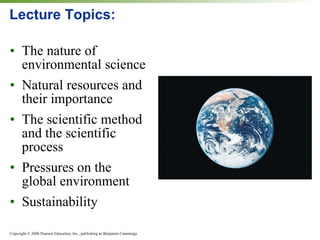
Lecture Topics: The nature of environmental science Natural resources and their importance The scientific method and the scientific process Pressures on the global environment Sustainability
The “environment” Consists of both: Biotic factors  (living things) and Abiotic factors  (nonliving things) that surround us and with which we interact.
Humans and the environment We humans exist within the environment and are a part of the natural world. Like all other species, we depend for our survival on a properly functioning planet. Thus, our interactions with our environment matter a great deal. Environmental science  is the study of how the natural world works, how our environment affects us, and how we affect our environment.
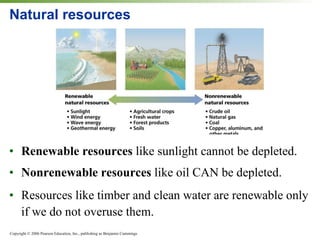
Natural resources Renewable resources  like sunlight cannot be depleted. Nonrenewable resources  like oil CAN be depleted. Resources like timber and clean water are renewable only if we do not overuse them.
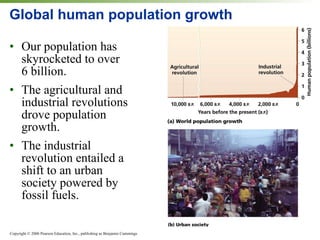
Global human population growth Our population has skyrocketed to over  6 billion. The agricultural and industrial revolutions drove population growth. The industrial revolution entailed a shift to an urban society powered by fossil fuels.
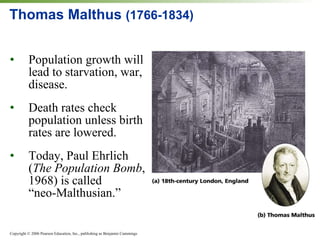
Thomas Malthus  (1766-1834) Population growth will lead to starvation, war, disease. Death rates check population unless birth rates are lowered. Today, Paul Ehrlich  ( The Population Bomb , 1968) is called  “neo-Malthusian.”
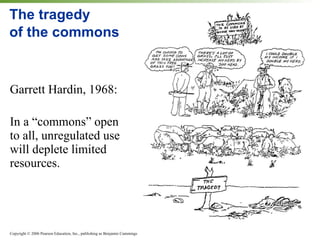
The tragedy of the commons Garrett Hardin, 1968: In a “commons” open to all, unregulated use will deplete limited resources.
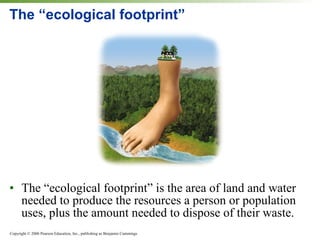
The “ecological footprint” The “ecological footprint” is the area of land and water needed to produce the resources a person or population uses, plus the amount needed to dispose of their waste.
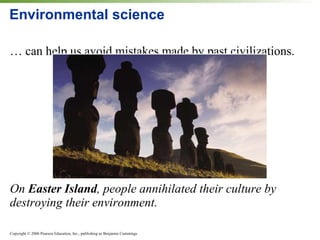
Environmental science … can help us avoid mistakes made by past civilizations. On  Easter Island , people annihilated their culture by destroying their environment.
Environmental science How does the natural world work? How does our environment affect us? How do we affect our environment? Applied goal:  Developing solutions to environmental problems.
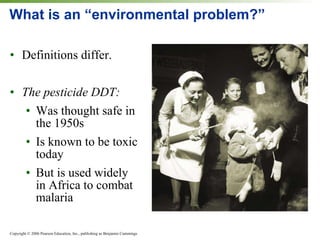
What is an “environmental problem?” Definitions differ. The pesticide DDT: Was thought safe in the 1950s Is known to be toxic today But is used widely in Africa to combat malaria
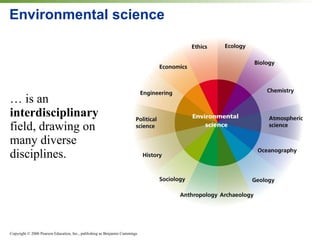
Environmental science … is an  interdisciplinary  field, drawing on many diverse disciplines.
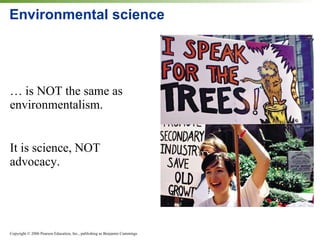
Environmental science … is NOT the same as environmentalism. It is science, NOT advocacy.
The nature of science A systematic process for learning about the world and testing our understanding of it A dynamic process of observation, testing, and discovery And the accumulated body of knowledge that results from this process
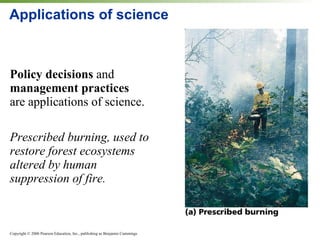
Applications of science Policy decisions  and  management practices   are applications of science. Prescribed burning, used to restore forest ecosystems altered by human suppression of fire.
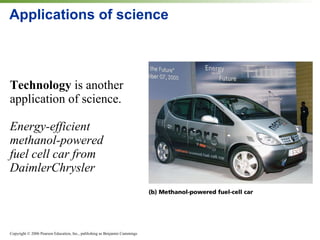
Applications of science Technology  is another application of science. Energy-efficient  methanol-powered  fuel cell car from  DaimlerChrysler
Scientific method: Assumptions Fixed natural laws govern how the universe works. All events arise from causes, and cause other events. We can use our senses and reason to detect and describe nature’s laws.
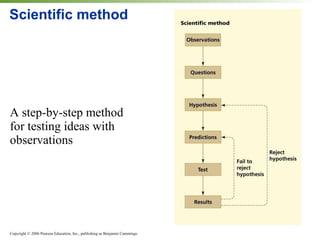
Scientific method A step-by-step method for testing ideas with observations
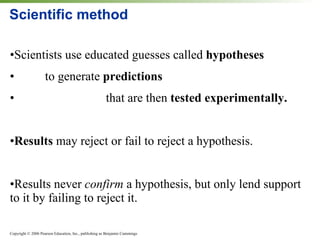
Scientific method Scientists use educated guesses called  hypotheses  to generate  predictions that are then  tested experimentally. Results  may reject or fail to reject a hypothesis. Results never  confirm  a hypothesis, but only lend support to it by failing to reject it.
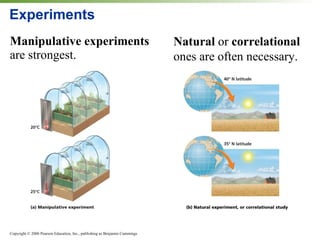
Experiments Manipulative experiments  are strongest. Natural  or  correlational  ones are often necessary.
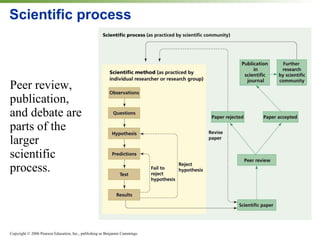
Scientific process Peer review, publication, and debate are parts of the larger scientific process.
Hypothesis, theory, and paradigm Hypothesis  = an educated guess, to be tested Theory  = a well-tested and widely accepted explanation, validated by much previous research Paradigm  = a dominant view; may shift if new results show old results or assumptions to be wrong
Ex. DEET  Mechanism of action DEET was historically believed to work by blocking insect  olfactory receptors  for  1-octen-3-ol , a  volatile  substance that is contained in human  sweat  and  breath . The prevailing theory was that DEET effectively "blinds" the insect's senses so that the biting/feeding  instinct  is not triggered by humans or animals which produce these chemicals. DEET does not appear to affect the insect's ability to smell  carbon dioxide , as had been suspected earlier. [1] [2]
However, more recent evidence shows that DEET acts as a true repellant that acts because it is unpleasant to the insect: A type of  olfactory receptor neurons  in special  antennal  sensilla of mosquitoes has been identified that is activated by DEET as well as other known insect repellants such as  eucalyptol ,  linalool , and  thujone . Moreover, in a behavioral test DEET had a strong repellant activity in the absence of  body odor  attractants such as  1-octen-3-ol ,  lactic acid , or  carbon dioxide  and female and male mosquitoes showed the same response. [3] [4]   (PARADIGM SHIFT)
The state of the world: Population Human population growth exacerbates all environmental problems The rate of growth has slowed, but we still add over 200,000 people to the planet each day
The state of the world: Agriculture One of humanity’s greatest achievements … but has profoundly altered our environment. We have converted nearly half of Earth’s land surface for farming, grazing, and timber production.
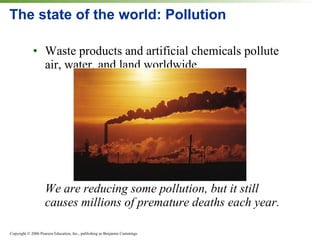
The state of the world: Pollution Waste products and artificial chemicals pollute air, water, and land worldwide. We are reducing some pollution, but it still causes millions of premature deaths each year.
The state of the world: Climate Global climate change may be our most pressing pollution challenge.  It  likely contributes to glacial melting, sea-level rise, impacts on wildlife and crops, and increased destructive weather. Since the industrial revolution, atmospheric carbon dioxide concentrations have risen by 31% to a level not seen in over 400,000 years.
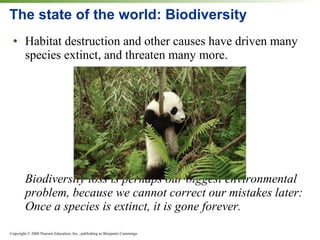
The state of the world: Biodiversity Habitat destruction and other causes have driven many species extinct, and threaten many more. Biodiversity loss is perhaps our biggest environmental problem, because we cannot correct our mistakes later: Once a species is extinct, it is gone forever.
Solutions must be global and sustainable Globalization  is influencing the nature of most environmental issues. The  Millennium Ecosystem Assessment , the most comprehensive scientific assessment of the world’s current ecological problems, documents this challenge. Our increased global interconnectedness sets the stage for novel and effective solutions.
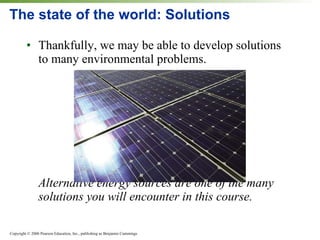
The state of the world: Solutions Thankfully, we may be able to develop solutions to many environmental problems. Alternative energy sources are one of the many solutions you will encounter in this course.
Sustainability The key concept for our future: Limiting human impact on the natural world so that our civilization can continue to exist
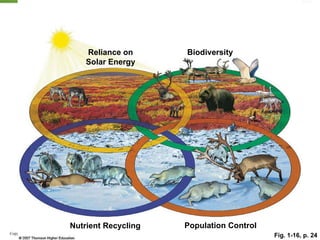
Four Scientific Principles of Sustainability Nature has sustained itself for billions of years by using solar energy, biodiversity, population control, and nutrient cycling- lessons from nature that we can apply to our lifestyles and economies. Reliance on Solar Energy Biodiversity Nutrient Cycling Population Control
Fig. 1-16, p. 24 Reliance on Solar Energy Population Control Nutrient Recycling Biodiversity
Conclusion Environmental science helps us understand our relationship with the environment and informs our attempts to solve and prevent problems. Identifying a problem is the first step in solving it. This book balances discussion of problems with a focus on solutions and the creation of a better world.

Introduction to environmetnal science

  • 1.
    An Introduction toEnvironmental Science
  • 2.
    Lecture Topics: Thenature of environmental science Natural resources and their importance The scientific method and the scientific process Pressures on the global environment Sustainability
  • 3.
    The “environment” Consistsof both: Biotic factors (living things) and Abiotic factors (nonliving things) that surround us and with which we interact.
  • 4.
    Humans and theenvironment We humans exist within the environment and are a part of the natural world. Like all other species, we depend for our survival on a properly functioning planet. Thus, our interactions with our environment matter a great deal. Environmental science is the study of how the natural world works, how our environment affects us, and how we affect our environment.
  • 5.
    Natural resources Renewableresources like sunlight cannot be depleted. Nonrenewable resources like oil CAN be depleted. Resources like timber and clean water are renewable only if we do not overuse them.
  • 6.
    Global human populationgrowth Our population has skyrocketed to over 6 billion. The agricultural and industrial revolutions drove population growth. The industrial revolution entailed a shift to an urban society powered by fossil fuels.
  • 7.
    Thomas Malthus (1766-1834) Population growth will lead to starvation, war, disease. Death rates check population unless birth rates are lowered. Today, Paul Ehrlich ( The Population Bomb , 1968) is called “neo-Malthusian.”
  • 8.
    The tragedy ofthe commons Garrett Hardin, 1968: In a “commons” open to all, unregulated use will deplete limited resources.
  • 9.
    The “ecological footprint”The “ecological footprint” is the area of land and water needed to produce the resources a person or population uses, plus the amount needed to dispose of their waste.
  • 10.
    Environmental science …can help us avoid mistakes made by past civilizations. On Easter Island , people annihilated their culture by destroying their environment.
  • 11.
    Environmental science Howdoes the natural world work? How does our environment affect us? How do we affect our environment? Applied goal: Developing solutions to environmental problems.
  • 12.
    What is an“environmental problem?” Definitions differ. The pesticide DDT: Was thought safe in the 1950s Is known to be toxic today But is used widely in Africa to combat malaria
  • 13.
    Environmental science …is an interdisciplinary field, drawing on many diverse disciplines.
  • 14.
    Environmental science …is NOT the same as environmentalism. It is science, NOT advocacy.
  • 15.
    The nature ofscience A systematic process for learning about the world and testing our understanding of it A dynamic process of observation, testing, and discovery And the accumulated body of knowledge that results from this process
  • 16.
    Applications of sciencePolicy decisions and management practices are applications of science. Prescribed burning, used to restore forest ecosystems altered by human suppression of fire.
  • 17.
    Applications of scienceTechnology is another application of science. Energy-efficient methanol-powered fuel cell car from DaimlerChrysler
  • 18.
    Scientific method: AssumptionsFixed natural laws govern how the universe works. All events arise from causes, and cause other events. We can use our senses and reason to detect and describe nature’s laws.
  • 19.
    Scientific method Astep-by-step method for testing ideas with observations
  • 20.
    Scientific method Scientistsuse educated guesses called hypotheses to generate predictions that are then tested experimentally. Results may reject or fail to reject a hypothesis. Results never confirm a hypothesis, but only lend support to it by failing to reject it.
  • 21.
    Experiments Manipulative experiments are strongest. Natural or correlational ones are often necessary.
  • 22.
    Scientific process Peerreview, publication, and debate are parts of the larger scientific process.
  • 23.
    Hypothesis, theory, andparadigm Hypothesis = an educated guess, to be tested Theory = a well-tested and widely accepted explanation, validated by much previous research Paradigm = a dominant view; may shift if new results show old results or assumptions to be wrong
  • 24.
    Ex. DEET Mechanism of action DEET was historically believed to work by blocking insect olfactory receptors for 1-octen-3-ol , a volatile substance that is contained in human sweat and breath . The prevailing theory was that DEET effectively "blinds" the insect's senses so that the biting/feeding instinct is not triggered by humans or animals which produce these chemicals. DEET does not appear to affect the insect's ability to smell carbon dioxide , as had been suspected earlier. [1] [2]
  • 25.
    However, more recentevidence shows that DEET acts as a true repellant that acts because it is unpleasant to the insect: A type of olfactory receptor neurons in special antennal sensilla of mosquitoes has been identified that is activated by DEET as well as other known insect repellants such as eucalyptol , linalool , and thujone . Moreover, in a behavioral test DEET had a strong repellant activity in the absence of body odor attractants such as 1-octen-3-ol , lactic acid , or carbon dioxide and female and male mosquitoes showed the same response. [3] [4] (PARADIGM SHIFT)
  • 26.
    The state ofthe world: Population Human population growth exacerbates all environmental problems The rate of growth has slowed, but we still add over 200,000 people to the planet each day
  • 27.
    The state ofthe world: Agriculture One of humanity’s greatest achievements … but has profoundly altered our environment. We have converted nearly half of Earth’s land surface for farming, grazing, and timber production.
  • 28.
    The state ofthe world: Pollution Waste products and artificial chemicals pollute air, water, and land worldwide. We are reducing some pollution, but it still causes millions of premature deaths each year.
  • 29.
    The state ofthe world: Climate Global climate change may be our most pressing pollution challenge. It likely contributes to glacial melting, sea-level rise, impacts on wildlife and crops, and increased destructive weather. Since the industrial revolution, atmospheric carbon dioxide concentrations have risen by 31% to a level not seen in over 400,000 years.
  • 30.
    The state ofthe world: Biodiversity Habitat destruction and other causes have driven many species extinct, and threaten many more. Biodiversity loss is perhaps our biggest environmental problem, because we cannot correct our mistakes later: Once a species is extinct, it is gone forever.
  • 31.
    Solutions must beglobal and sustainable Globalization is influencing the nature of most environmental issues. The Millennium Ecosystem Assessment , the most comprehensive scientific assessment of the world’s current ecological problems, documents this challenge. Our increased global interconnectedness sets the stage for novel and effective solutions.
  • 32.
    The state ofthe world: Solutions Thankfully, we may be able to develop solutions to many environmental problems. Alternative energy sources are one of the many solutions you will encounter in this course.
  • 33.
    Sustainability The keyconcept for our future: Limiting human impact on the natural world so that our civilization can continue to exist
  • 34.
    Four Scientific Principlesof Sustainability Nature has sustained itself for billions of years by using solar energy, biodiversity, population control, and nutrient cycling- lessons from nature that we can apply to our lifestyles and economies. Reliance on Solar Energy Biodiversity Nutrient Cycling Population Control
  • 35.
    Fig. 1-16, p.24 Reliance on Solar Energy Population Control Nutrient Recycling Biodiversity
  • 36.
    Conclusion Environmental sciencehelps us understand our relationship with the environment and informs our attempts to solve and prevent problems. Identifying a problem is the first step in solving it. This book balances discussion of problems with a focus on solutions and the creation of a better world.

Editor's Notes

  • #36 Figure 1.16 Four scientific principles of sustainability: these four interconnected principles of sustainability are derived from learning how nature has sustained a variety of life on the earth for about 3.7 billion years. The top left oval shows sunlight stimulating the production of vegetation in the Arctic tundra during its brief summer ( solar energy ) and the top right oval shows some of the diversity of species found there during the summer ( biodiversity ). The bottom right oval shows Arctic gray wolves stalking a caribou during the long cold winter ( population control ). The bottom left oval shows Arctic gray wolves feeding on their kill. This plus huge numbers of tiny decomposers that convert dead matter to soil nutrients recycle the nutrients needed to support the plant growth shown in the top left and right ovals ( nutrient recycling ).