Galgotias University 3
Atthe end of this session students will beS Students will be able
to:
Optimize solutions using
Dynamic Programming.
Analyze the complexity of the
solutions.
4.
Dynamic Programming?
• Dynamicprogramming (DP) is a problem-solving approach
that
1. breaks down a complex problem into smaller,
overlapping subproblems.
2. it then solves each subproblem once and
3. stores the results to avoid redundant calculations,
leading to efficient solutions, especially for optimization
problems and those with a recursive structure.
5.
Subproblem?
• A sub-problemis a smaller version of the original problem.
• It is created by breaking the original problem down into
smaller and smaller pieces until it is no longer possible to
break it down any further.
6.
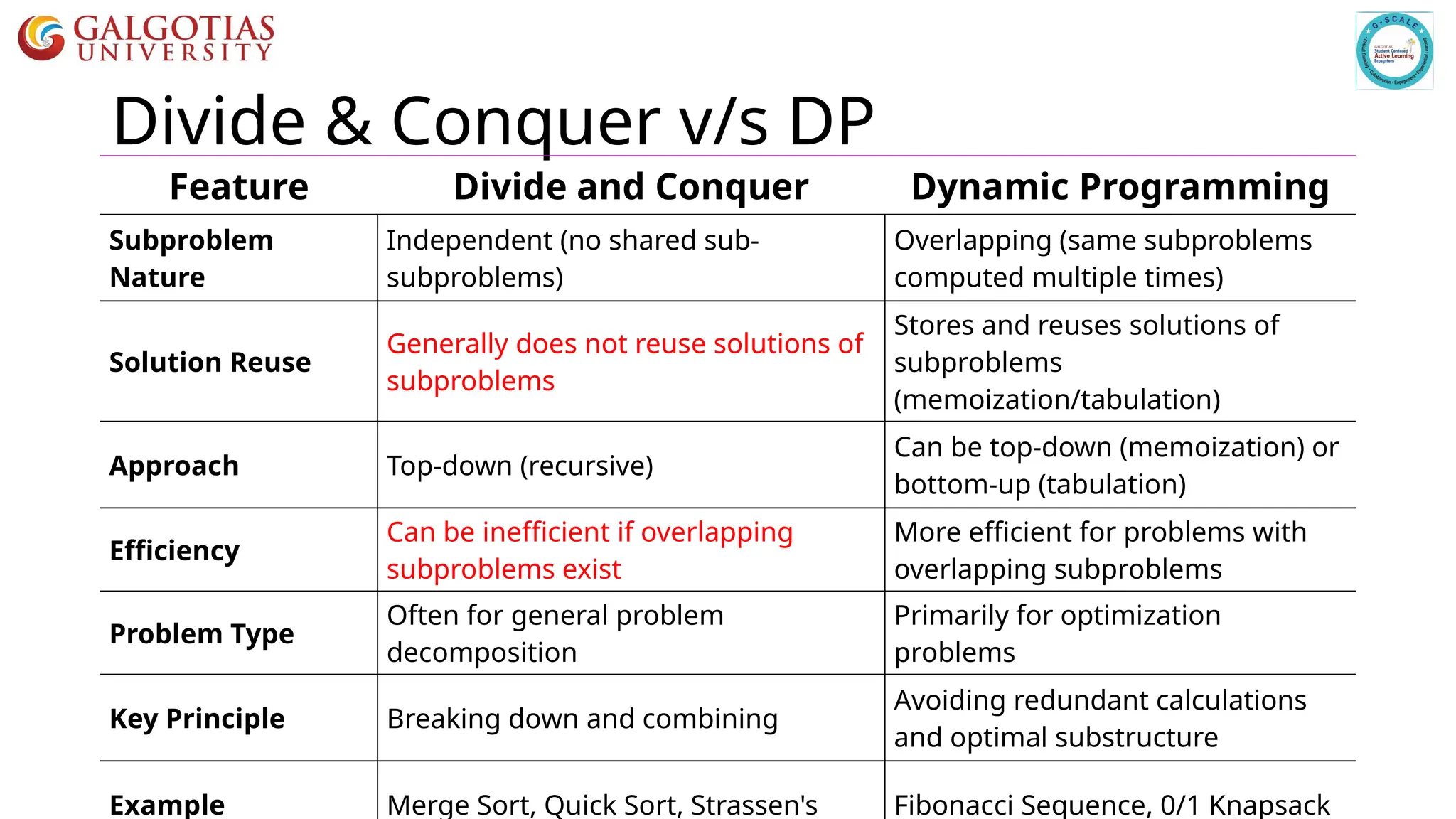
Divide & Conquerv/s DP
Feature Divide and Conquer Dynamic Programming
Subproblem
Nature
Independent (no shared sub-
subproblems)
Overlapping (same subproblems
computed multiple times)
Solution Reuse
Generally does not reuse solutions of
subproblems
Stores and reuses solutions of
subproblems
(memoization/tabulation)
Approach Top-down (recursive)
Can be top-down (memoization) or
bottom-up (tabulation)
Efficiency
Can be inefficient if overlapping
subproblems exist
More efficient for problems with
overlapping subproblems
Problem Type
Often for general problem
decomposition
Primarily for optimization
problems
Key Principle Breaking down and combining
Avoiding redundant calculations
and optimal substructure
Example Merge Sort, Quick Sort, Strassen's Fibonacci Sequence, 0/1 Knapsack
7.
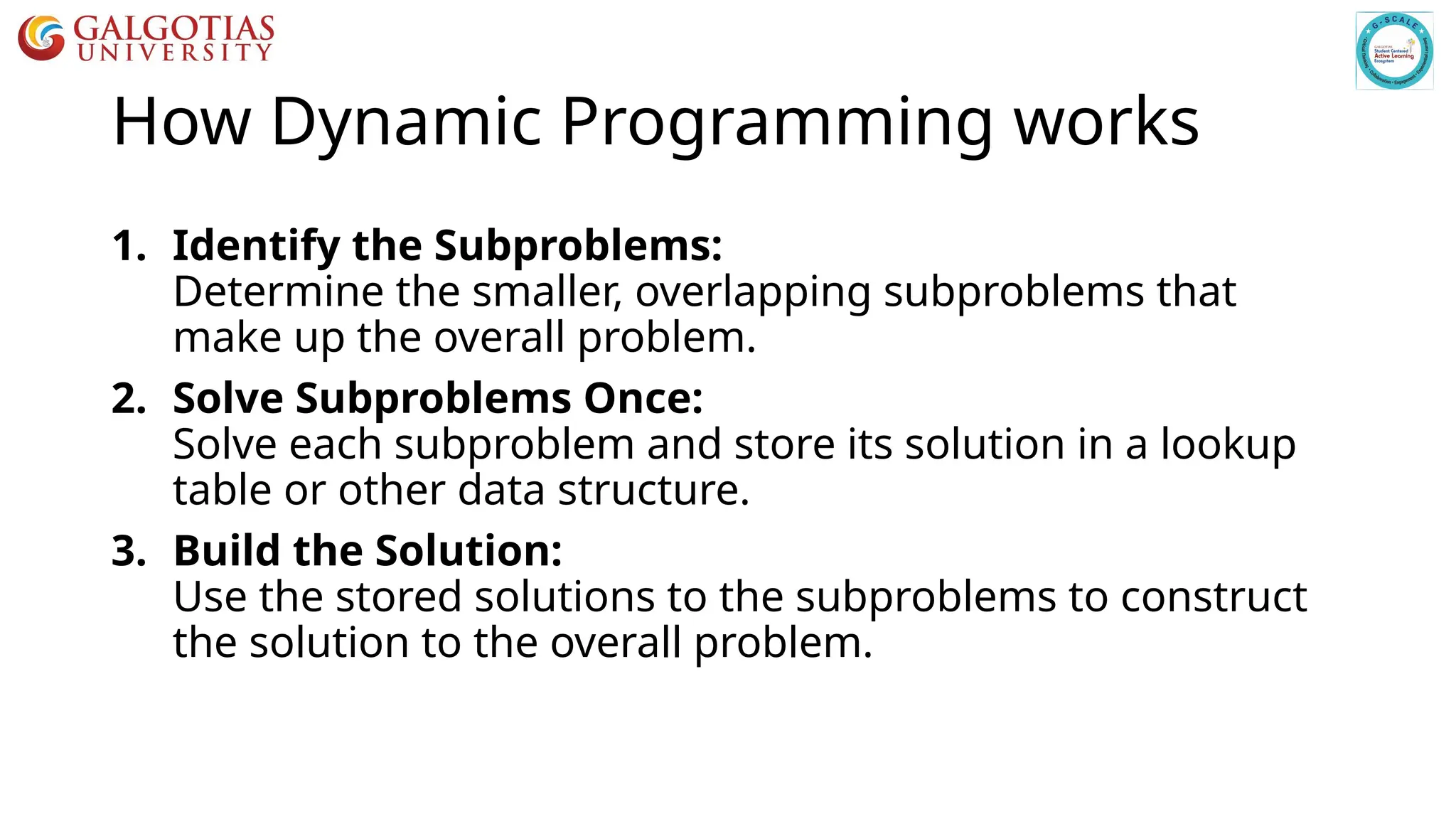
How Dynamic Programmingworks
1. Identify the Subproblems:
Determine the smaller, overlapping subproblems that
make up the overall problem.
2. Solve Subproblems Once:
Solve each subproblem and store its solution in a lookup
table or other data structure.
3. Build the Solution:
Use the stored solutions to the subproblems to construct
the solution to the overall problem.
8.
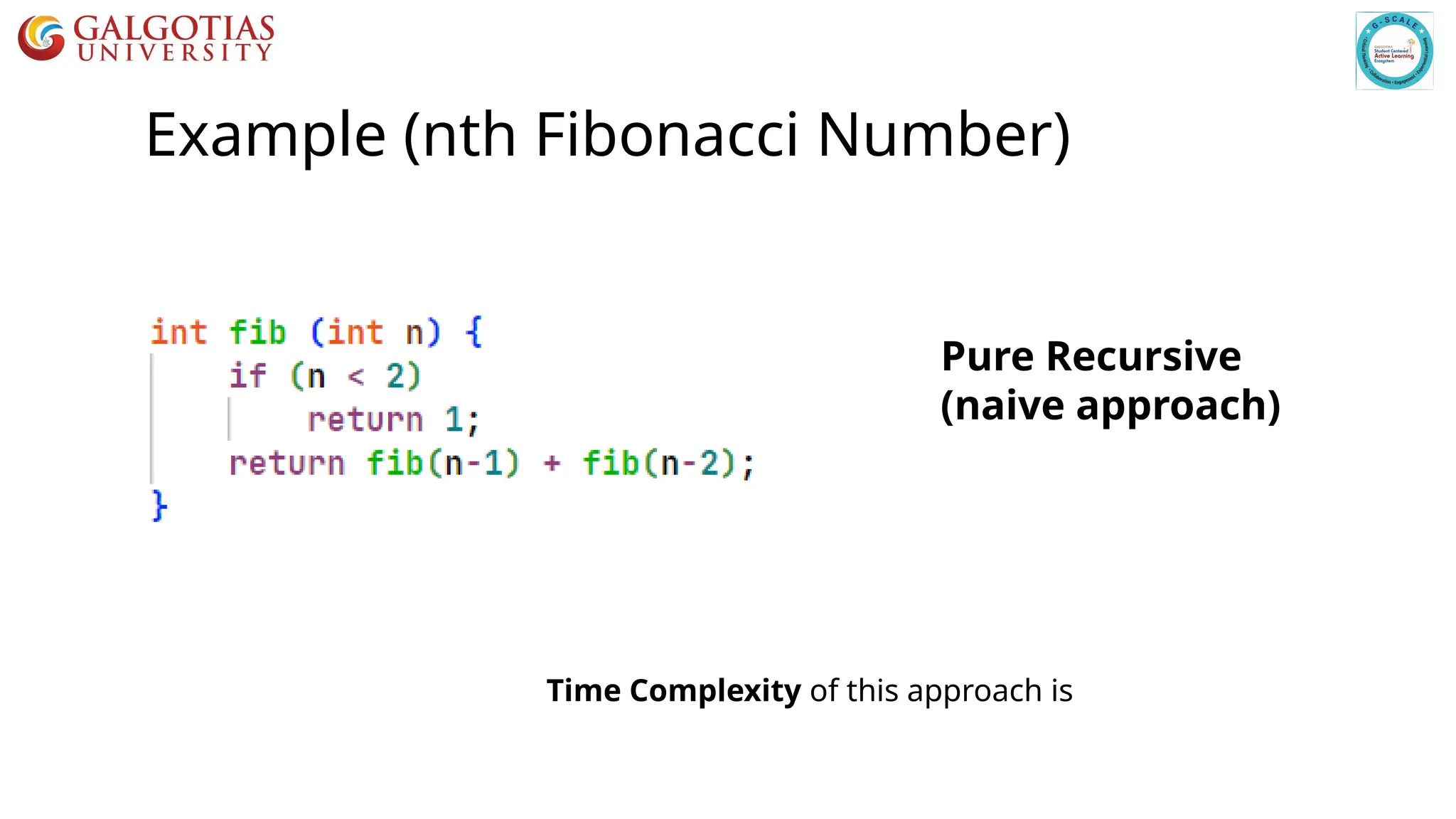
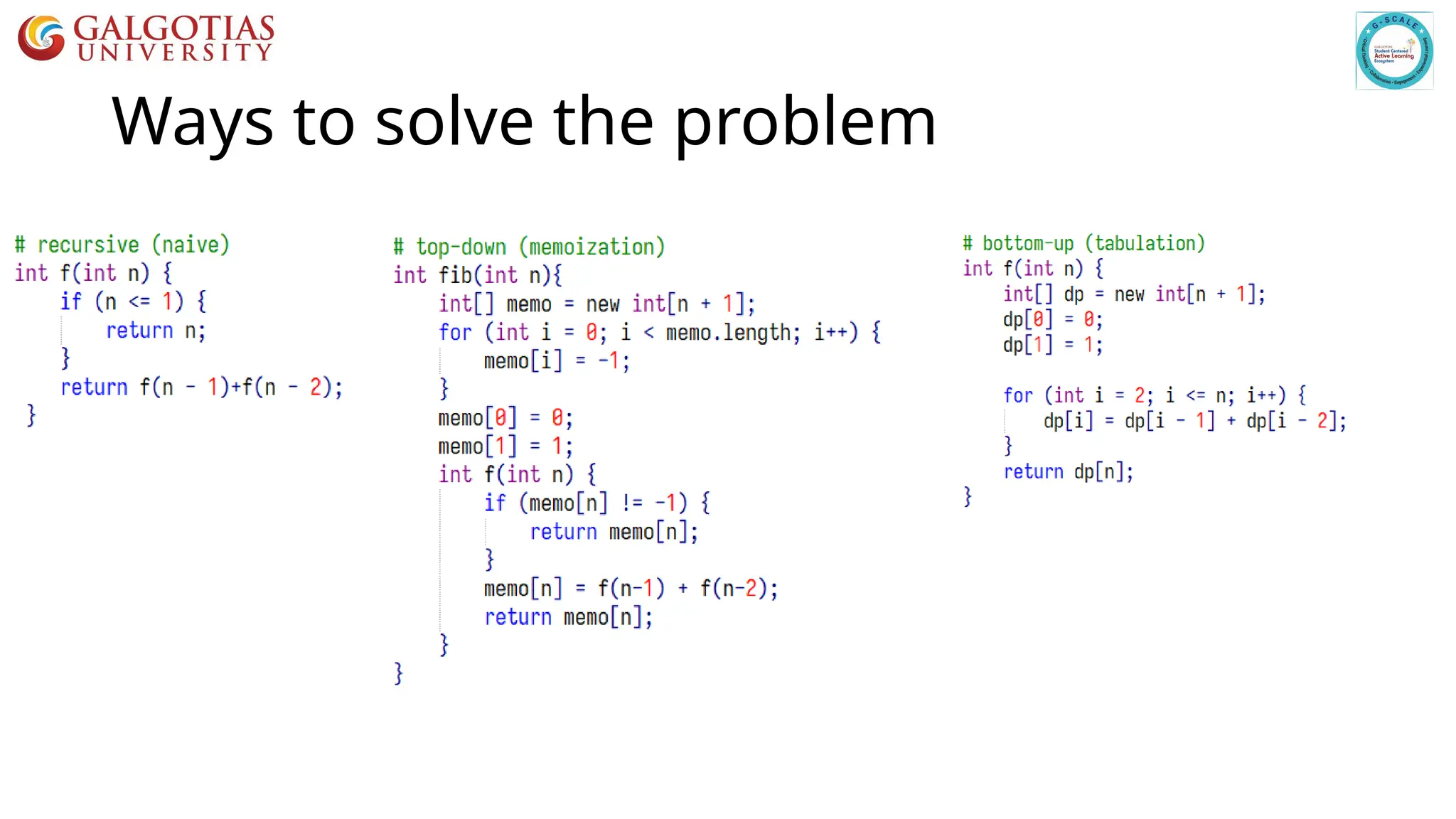
Example (nth FibonacciNumber)
Pure Recursive
(naive approach)
Time Complexity of this approach is
Steps to designDP solutions
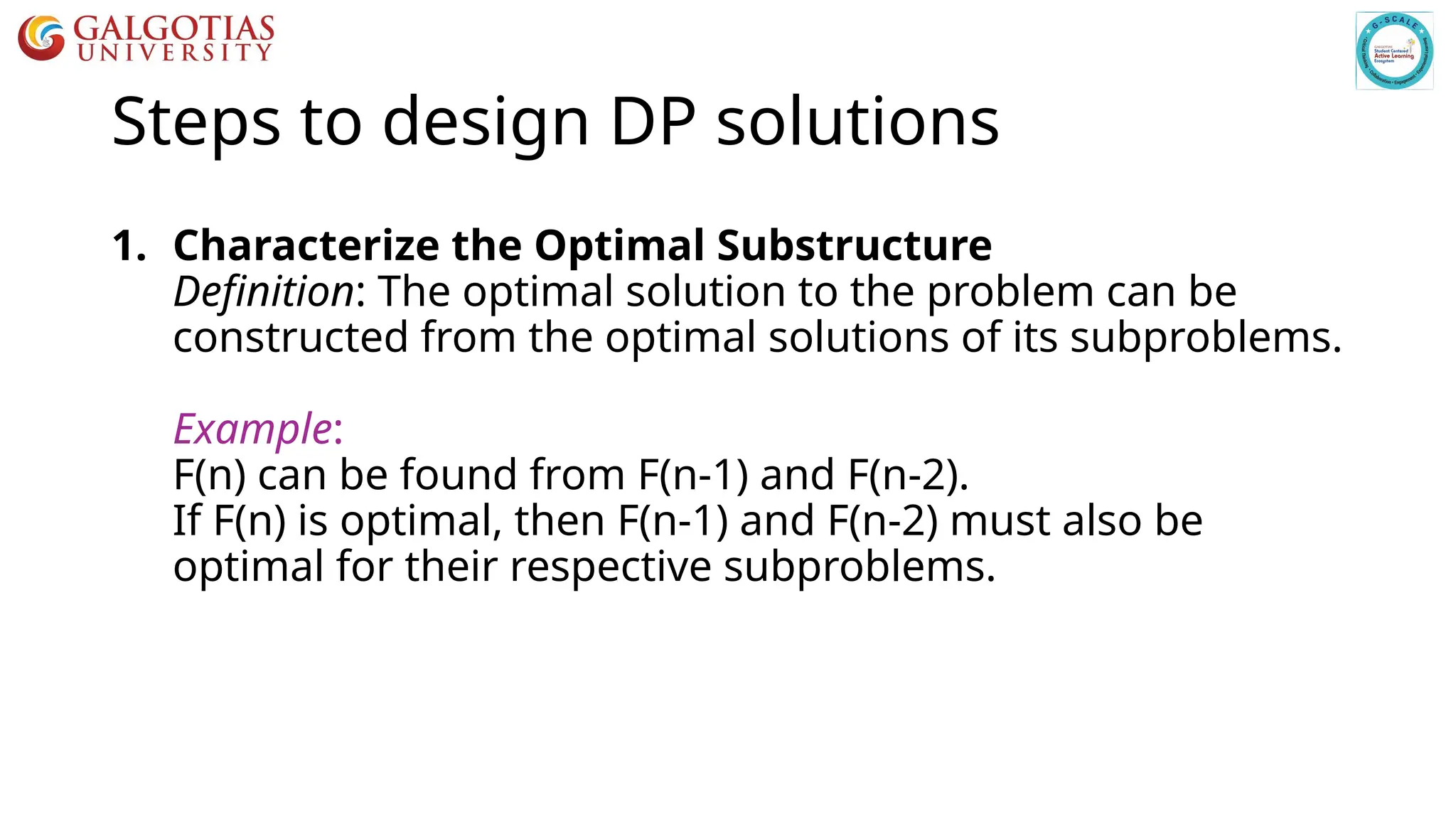
1. Characterize the Optimal Substructure
Definition: The optimal solution to the problem can be
constructed from the optimal solutions of its subproblems.
Example:
F(n) can be found from F(n-1) and F(n-2).
If F(n) is optimal, then F(n-1) and F(n-2) must also be
optimal for their respective subproblems.
12.
Steps to designDP solutions
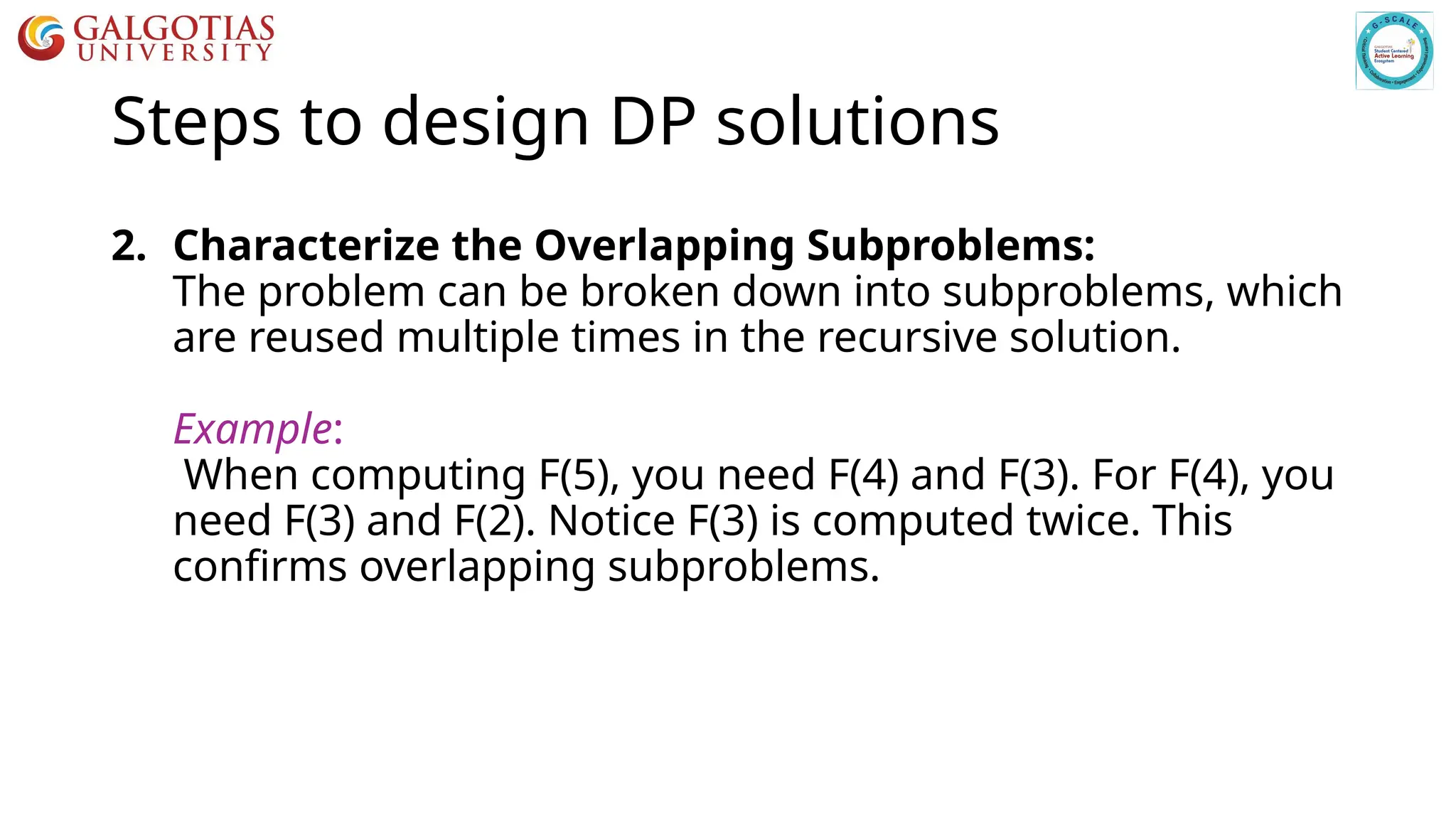
2. Characterize the Overlapping Subproblems:
The problem can be broken down into subproblems, which
are reused multiple times in the recursive solution.
Example:
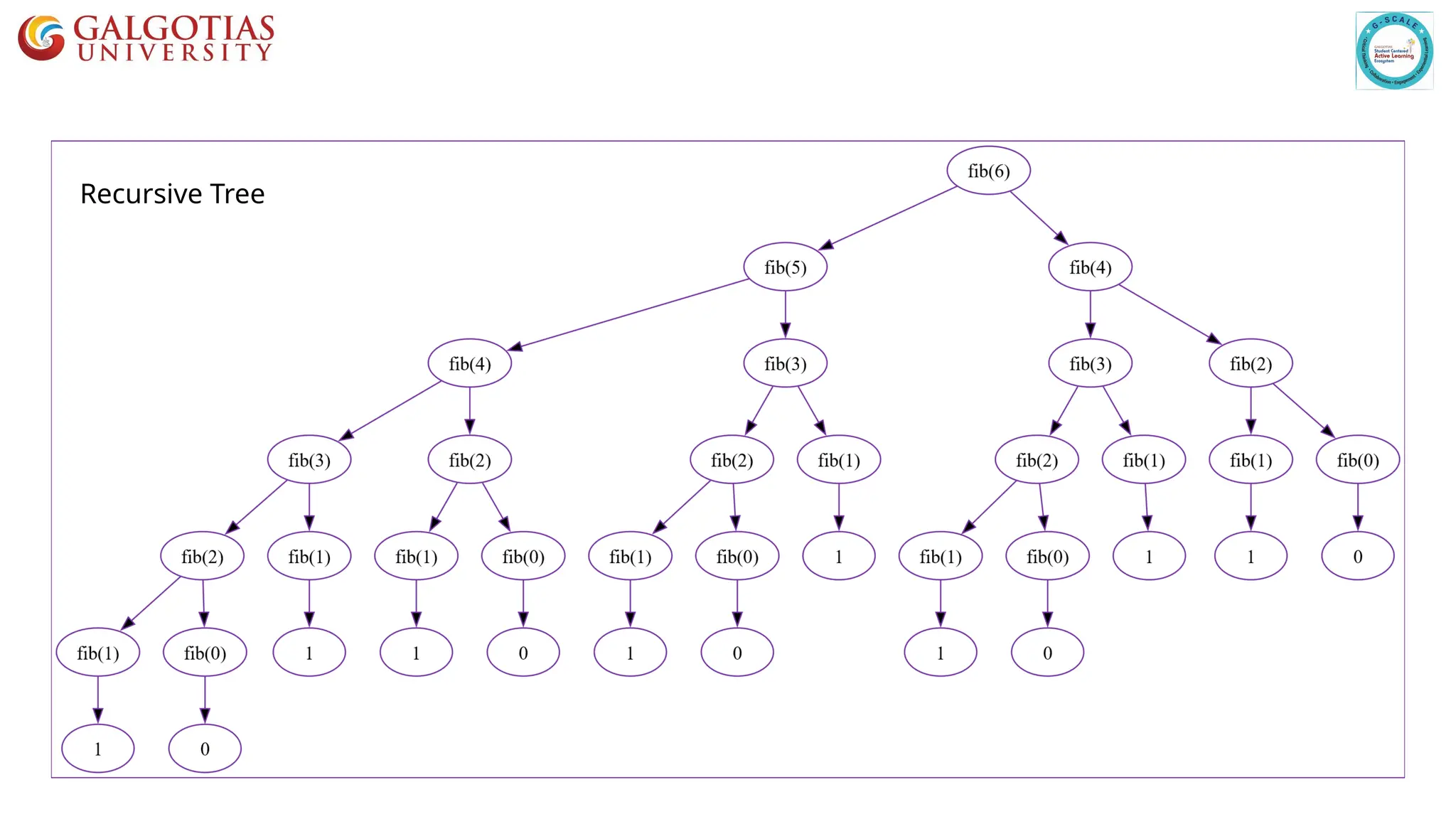
When computing F(5), you need F(4) and F(3). For F(4), you
need F(3) and F(2). Notice F(3) is computed twice. This
confirms overlapping subproblems.
13.
Steps to designDP solutions
3. Define the DP State:
What information do you need to store to solve a
subproblem? This forms the "state" of your DP table.
Example:
dp[i] will represent the i-th Fibonacci number.
14.
Steps to designDP solutions
4. Formulate the Recurrence Relation:
It's an equation that shows how to compute the solution
for a larger subproblem using the solutions of smaller
subproblems.
Example (Fibonacci):
F(n) = F(n-1) + F(n-2) with base cases F(0) = 0, F(1) = 1.
15.
Memoization (Top-Down Approach)
•Memoization is an optimization technique used in dynamic
programming that involves storing the results of expensive
function calls and reusing them when the same inputs occur
again.
• Storage: Uses data structures like dictionaries, arrays, or
hash maps to store results of subproblems.
• Recursive Approach: Implemented in a top-down manner,
where the function checks for stored results before
computing new ones.
• Efficiency: Reduces redundant calculations, significantly
lowering time complexity (often from exponential to
polynomial).
16.
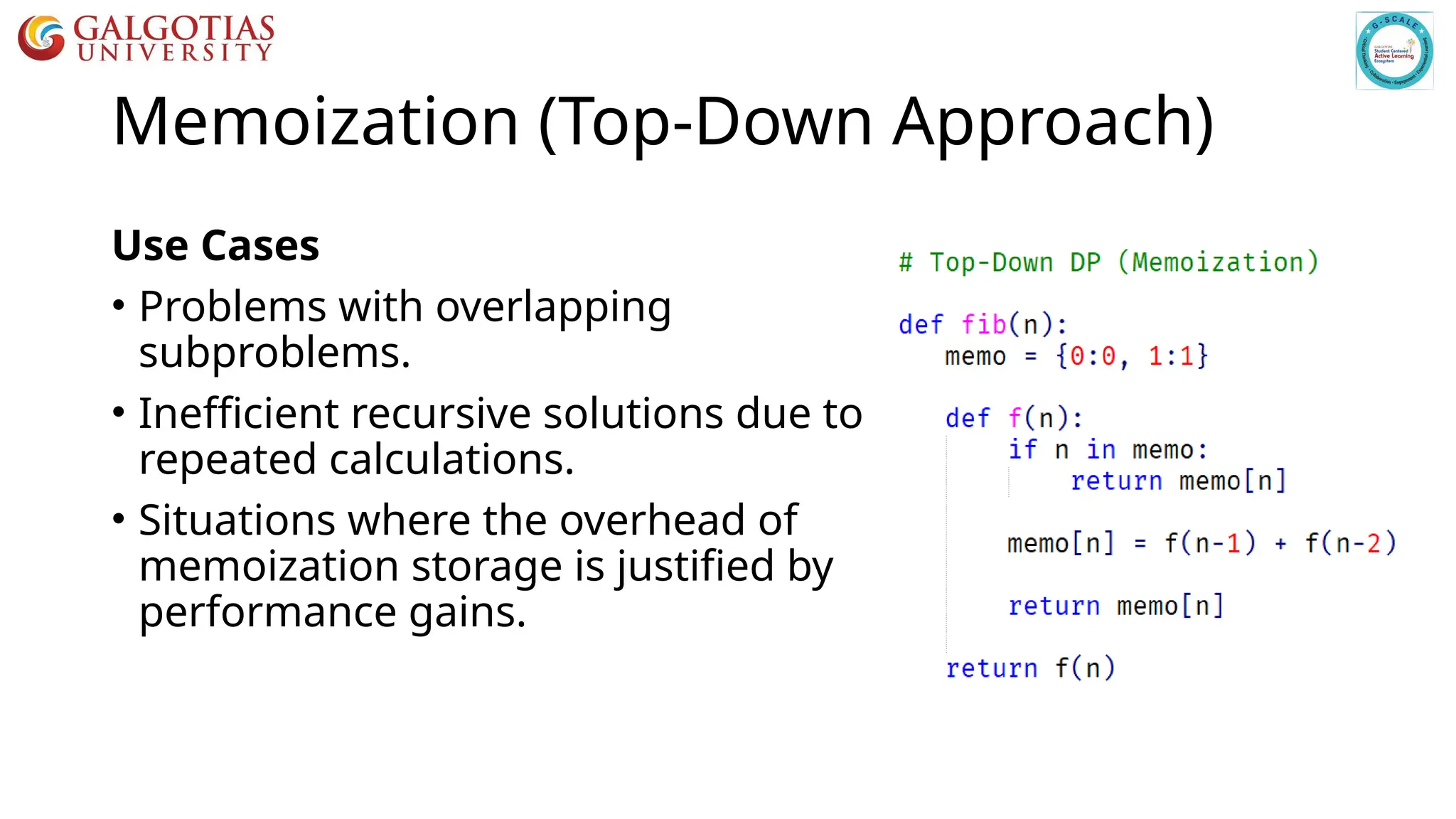
Memoization (Top-Down Approach)
UseCases
• Problems with overlapping
subproblems.
• Inefficient recursive solutions due to
repeated calculations.
• Situations where the overhead of
memoization storage is justified by
performance gains.
17.
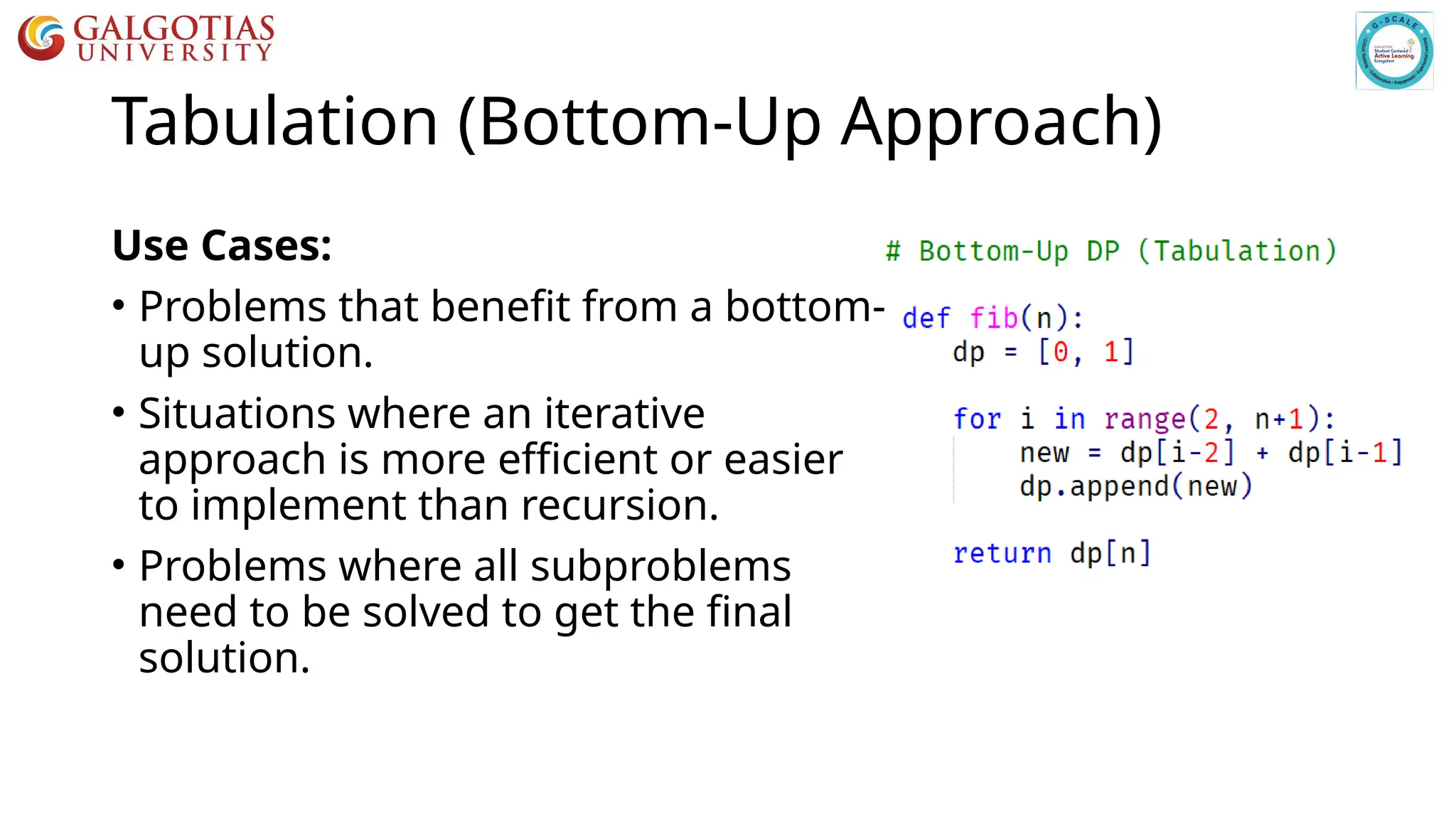
Tabulation (Bottom-Up Approach)
•Tabulation is an optimization technique in dynamic
programming that involves solving problems by filling up a
table (usually an array) iteratively, starting from the base
cases and building up to the desired solution.
• Table Structure: Typically uses arrays or matrices to store
results of subproblems.
• Iterative Approach: Uses a bottom-up approach, solving all
subproblems and storing their results in a table.
• Efficiency: Directly builds the solution by iterating through
all possible subproblems, reducing time complexity.
18.
Tabulation (Bottom-Up Approach)
UseCases:
• Problems that benefit from a bottom-
up solution.
• Situations where an iterative
approach is more efficient or easier
to implement than recursion.
• Problems where all subproblems
need to be solved to get the final
solution.
19.
Bottom-Up DP withoutExplicit Memory
• Bottom-up dynamic programming without explicit memory
optimization involves solving problems iteratively, starting
from the base cases and progressing to the final solution,
while minimizing the use of additional storage.
• Iterative Approach: Uses a bottom-up method to solve
subproblems iteratively.
• Memory Optimization: Minimizes or avoids extra storage
by only keeping track of the necessary current and previous
states.
• Efficiency: Reduces both time and space complexity,
making the algorithm more efficient.
Post Session Activity
•You need to attempt the post assessment activity on the
LMS.
• Give your feedback for this session your LMS by the end of
the day.
• Next session: "0/1 Knapsack Problem"
• Read the pre-class study materials for the next session.
![Steps to design DP solutions
3. Define the DP State:
What information do you need to store to solve a
subproblem? This forms the "state" of your DP table.
Example:
dp[i] will represent the i-th Fibonacci number.](https://image.slidesharecdn.com/introductionofdynamicprogramming-251008013623-951bdf14/75/introduction-of_dynamic_programming-pptx-13-2048.jpg)