DYNAMIC PROGRAMMING
•Presented By Group : 4
•Group Members :
•Md.Nazmus Shakib -220320852
•Tanvin Sadik Dhrubo -220320860
•Khan Waziur Rahman -220320861
•Arghya Saha -200120456
INTRODUCTION TO
DYNAMIC PROGRAMMING
• Dynamic Programming is a method for
solving complex problems by breaking
them down into simpler sub problems. It is
applicable where the problem can be
divided into overlapping subproblems and
has optimal substructure. It is also known
as divide and conquer technique
Why We Choose Dynamic Programming Over Greedy
Method?
Dynamic programming (DP) is often preferred over the greedy method for solving
optimization problems where future decisions are affected by earlier ones. In
greedy algorithms, the approach is to make the locally optimal choice at each stage
in hopes of finding the global optimum. However, this doesn't always lead to the
best solution for all problems, as greedy methods may miss key subproblems or fail
to consider how earlier decisions affect the later ones.
DYNAMIC
PROGRAMMING
APPROACHES
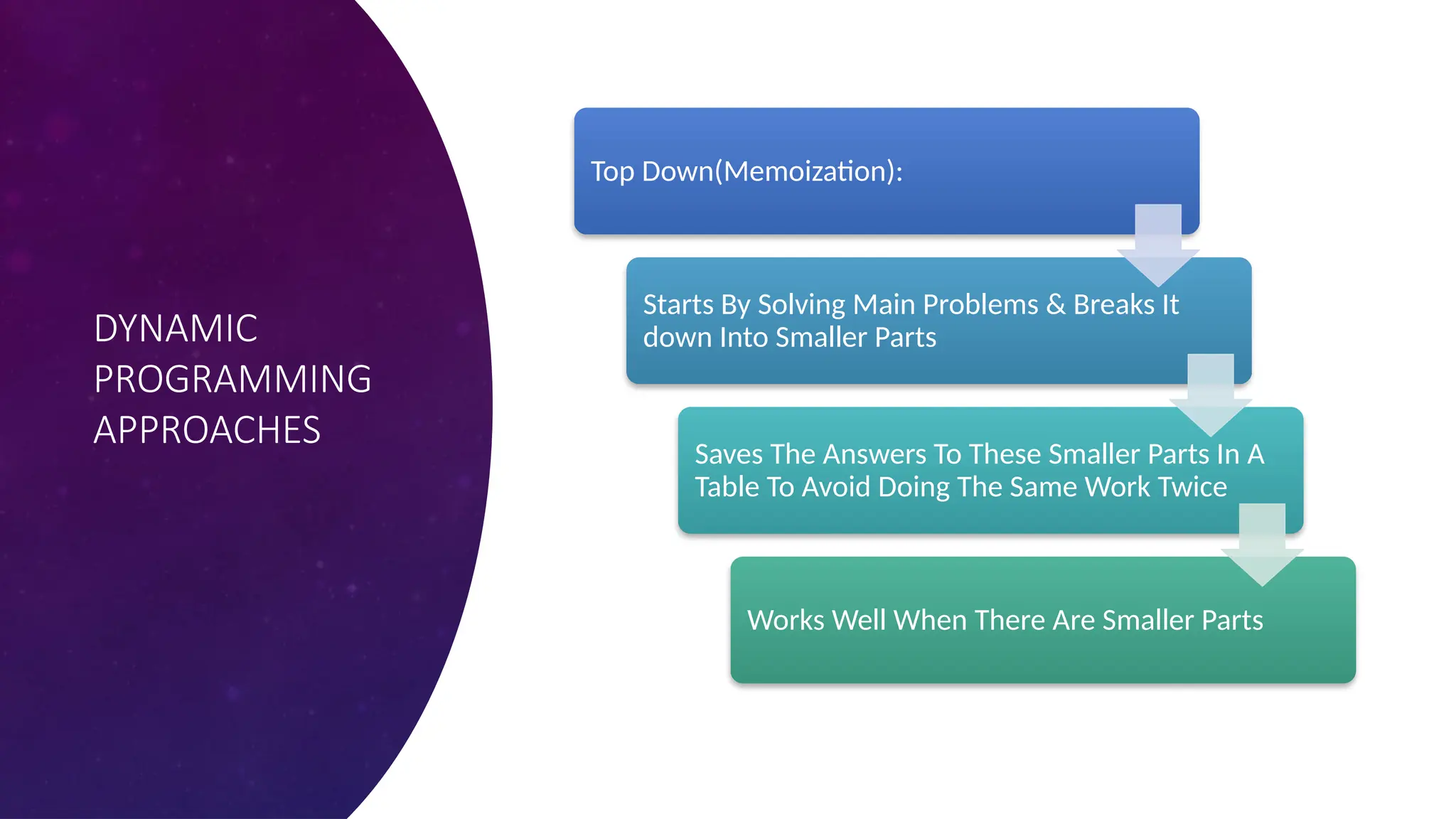
Top Down(Memoization):
Starts By Solving Main Problems & Breaks It
down Into Smaller Parts
Saves The Answers To These Smaller Parts In A
Table To Avoid Doing The Same Work Twice
Works Well When There Are Smaller Parts
DYNAMIC PROGRAMMING APPROACHES
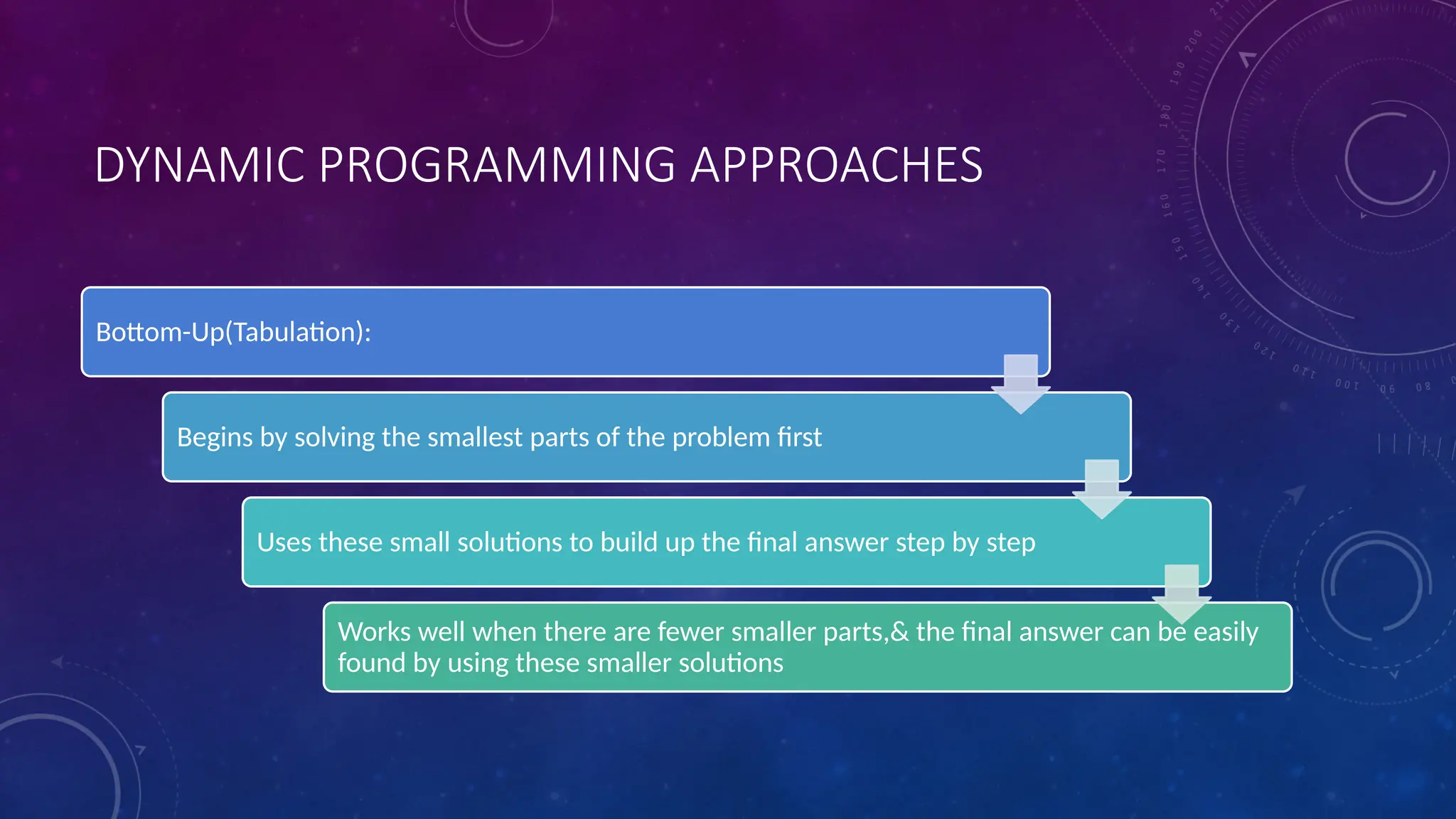
Bottom-Up(Tabulation):
Begins by solving the smallest parts of the problem first
Uses these small solutions to build up the final answer step by step
Works well when there are fewer smaller parts,& the final answer can be easily
found by using these smaller solutions
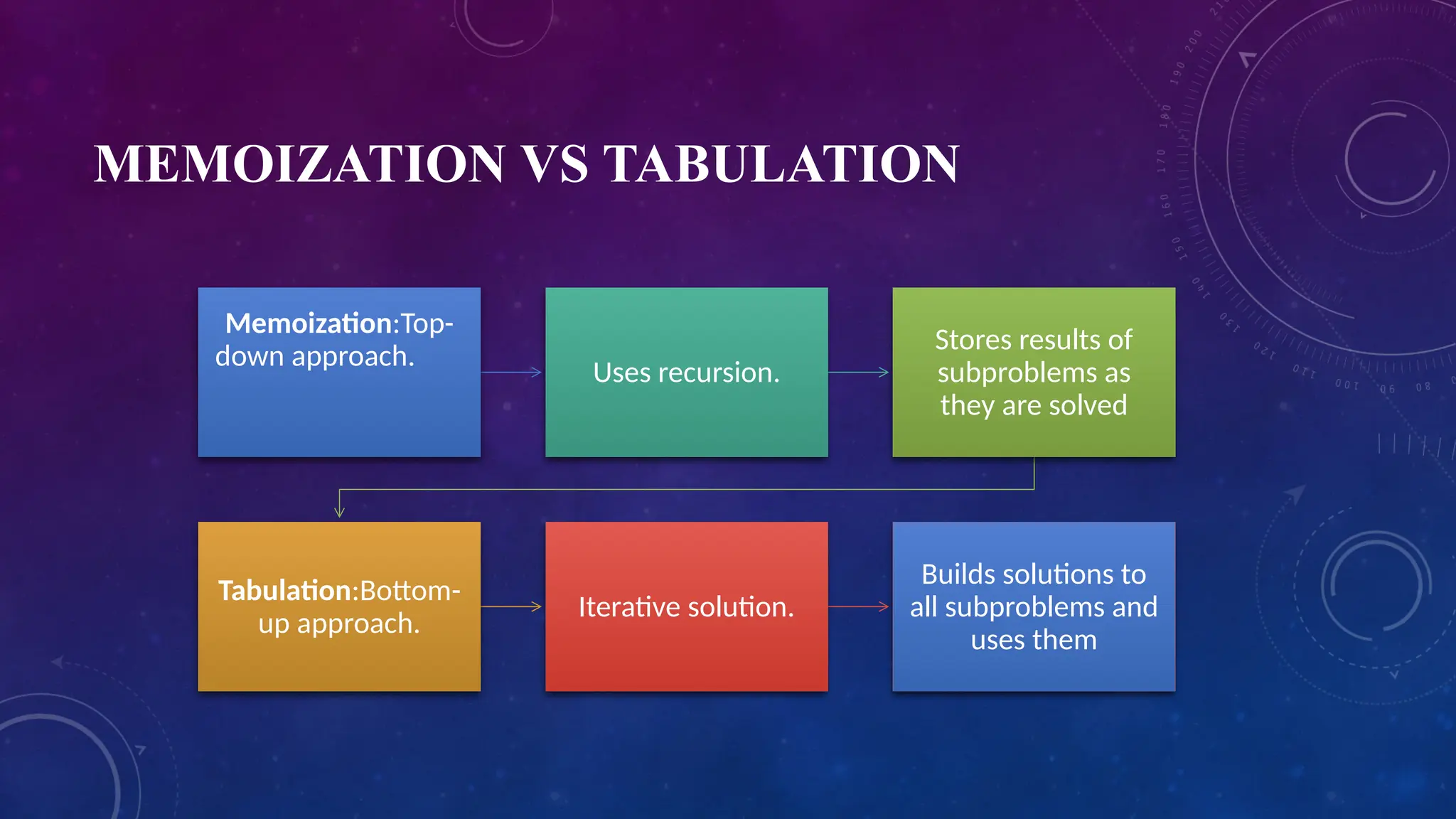
MEMOIZATION VS TABULATION
Memoization:Top-
down approach.
Uses recursion.
Stores results of
subproblems as
they are solved
Tabulation:Bottom-
up approach.
Iterative solution.
Builds solutions to
all subproblems and
uses them
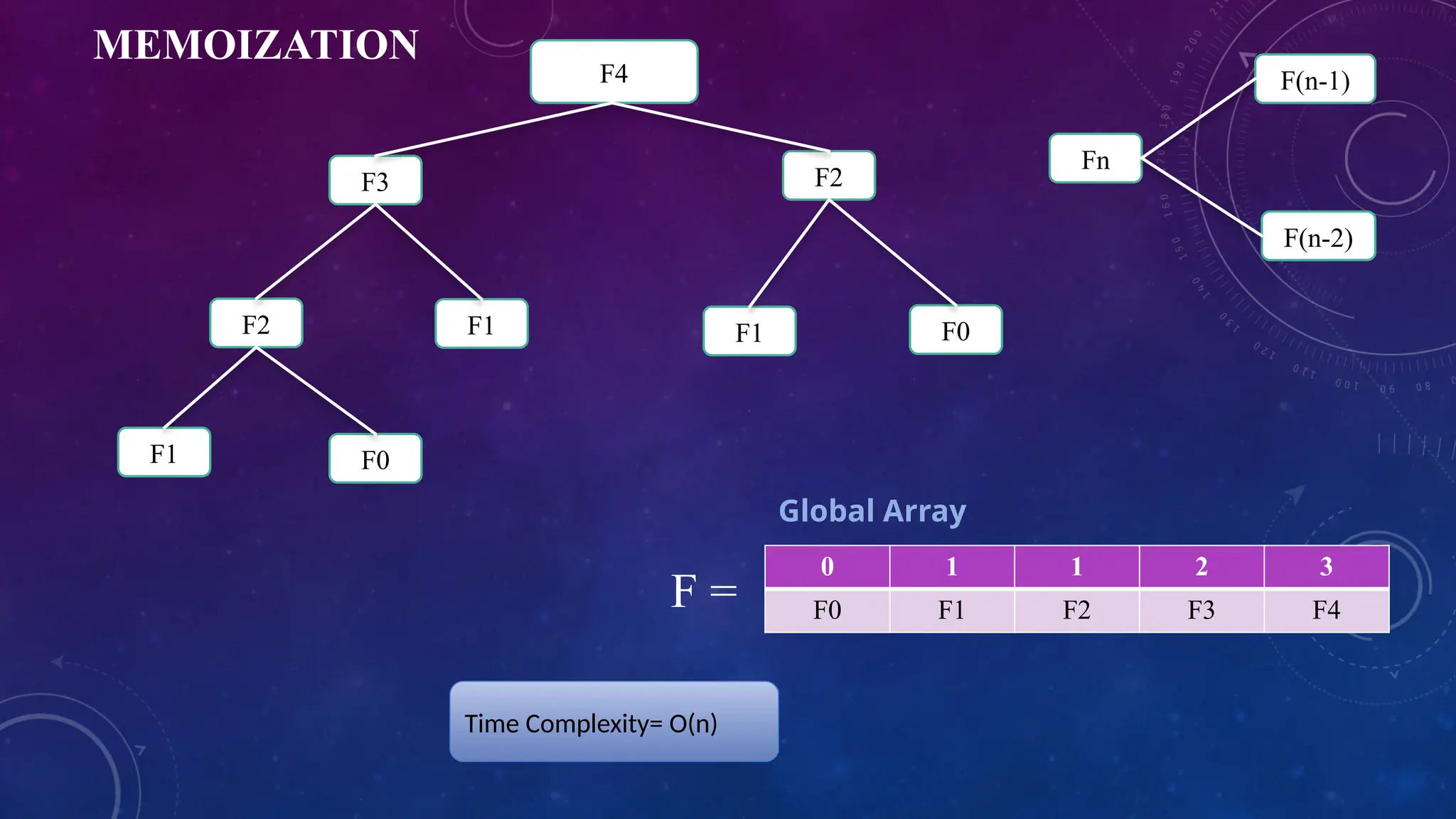
MEMOIZATION
F4
F2
F1 F0
F1 F1 F0
F2
F3
0 1 1 2 3
F0 F1 F2 F3 F4
F =
Time Complexity= O(n)
Fn
F(n-2)
F(n-1)
Global Array
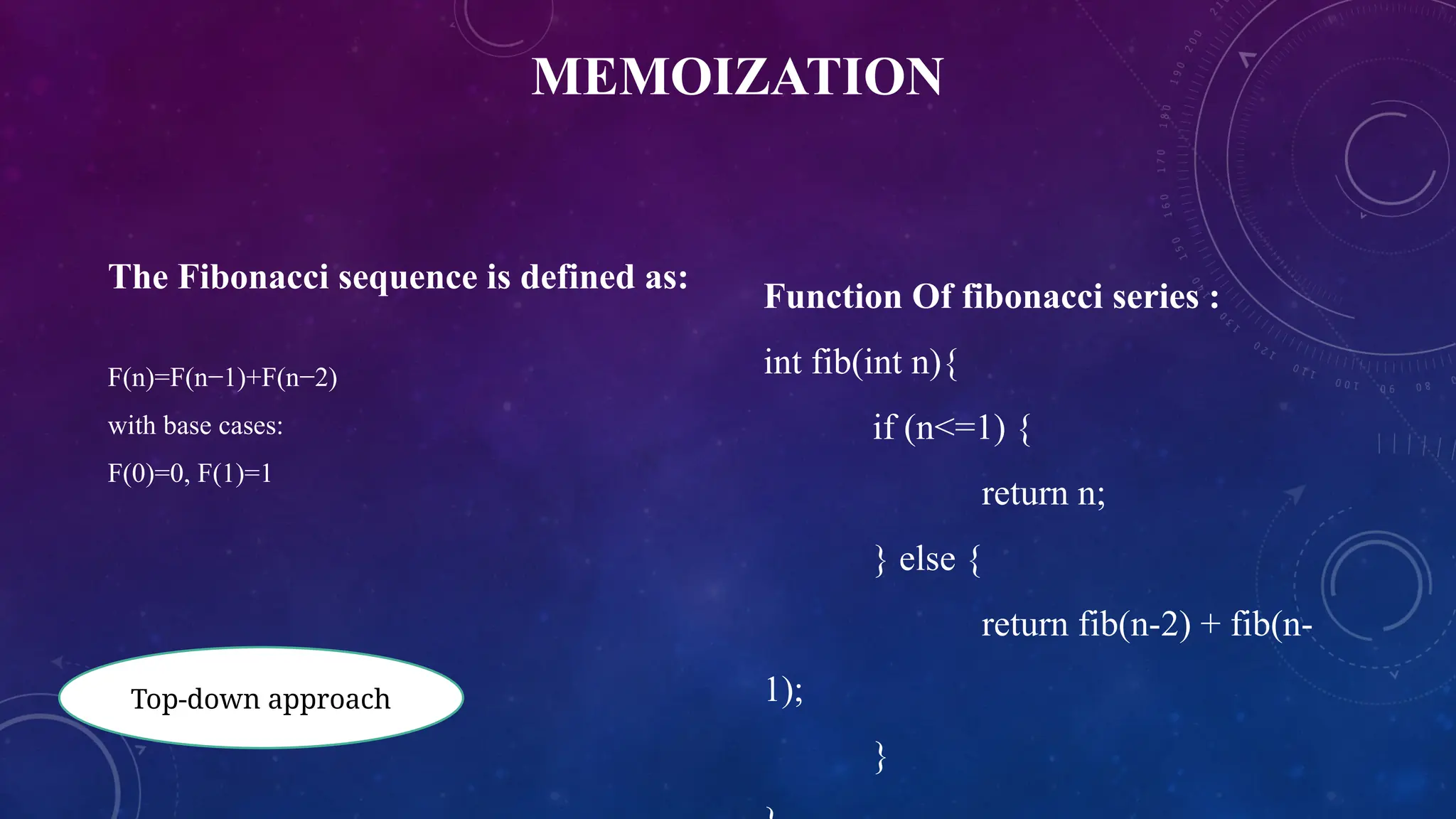
MEMOIZATION
The Fibonacci sequence is defined as:
F(n)=F(n−1)+F(n−2)
with base cases:
F(0)=0, F(1)=1
Function Of fibonacci series :
int fib(int n){
if (n<=1) {
return n;
} else {
return fib(n-2) + fib(n-
1);
}
Top-down approach
TABULATION
Function Of fibonacci series:
int fib(int n){
if (n<=1) {
return n;
F[0]=0;F[1]=1;
}
for(int i=2; i<=n; i++){
F[i] = F[i-2]+F[i-1];
}
return F[n];
}
0 1 1 2 3
F0 F1 F2 F3 F4
F =
Time Complexity= O(n)
Global Array
Bottom-up
approach
F1 F0
F2
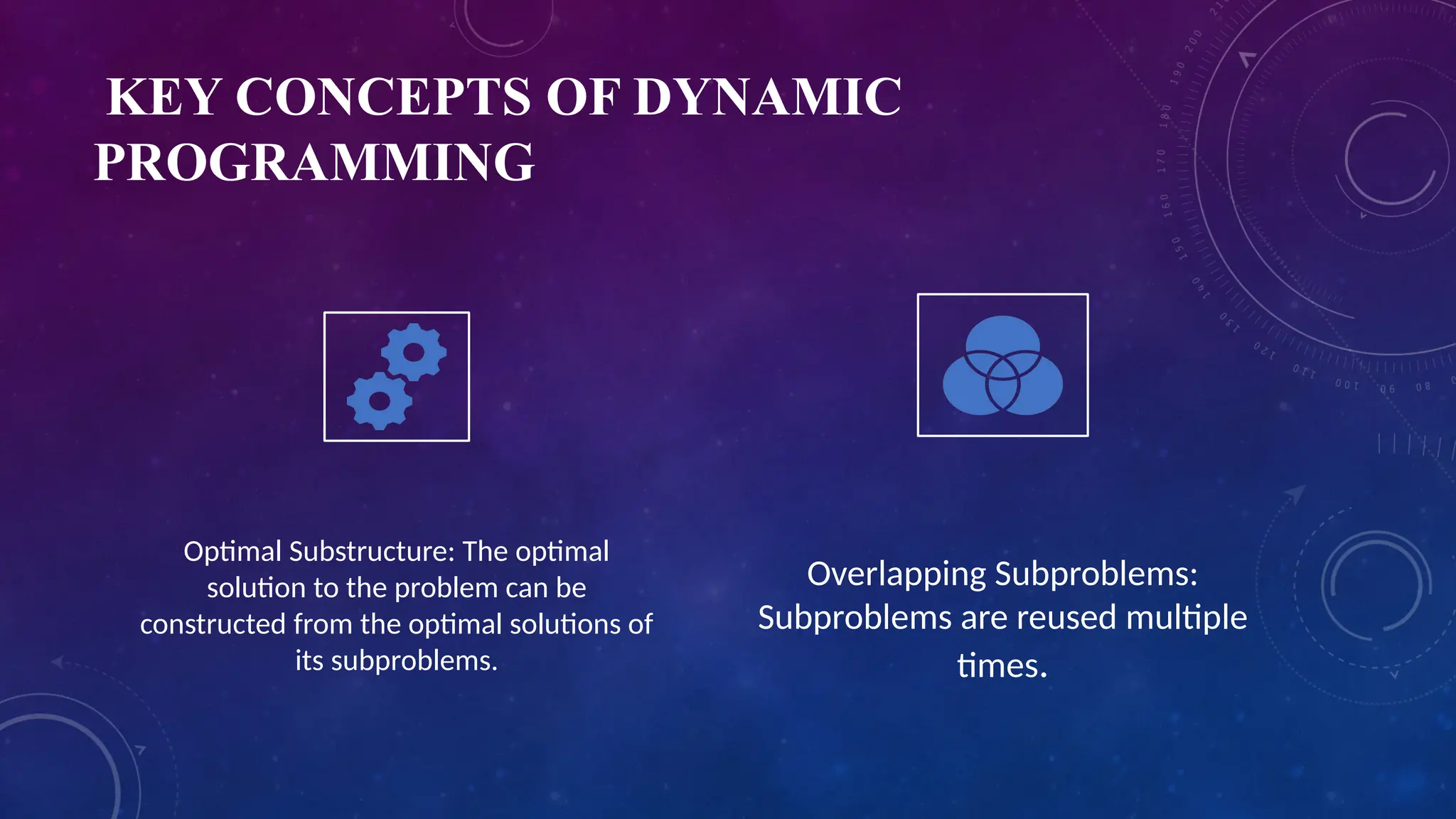
KEY CONCEPTS OF DYNAMIC
PROGRAMMING
Optimal Substructure: The optimal
solution to the problem can be
constructed from the optimal solutions of
its subproblems.
Overlapping Subproblems:
Subproblems are reused multiple
times.
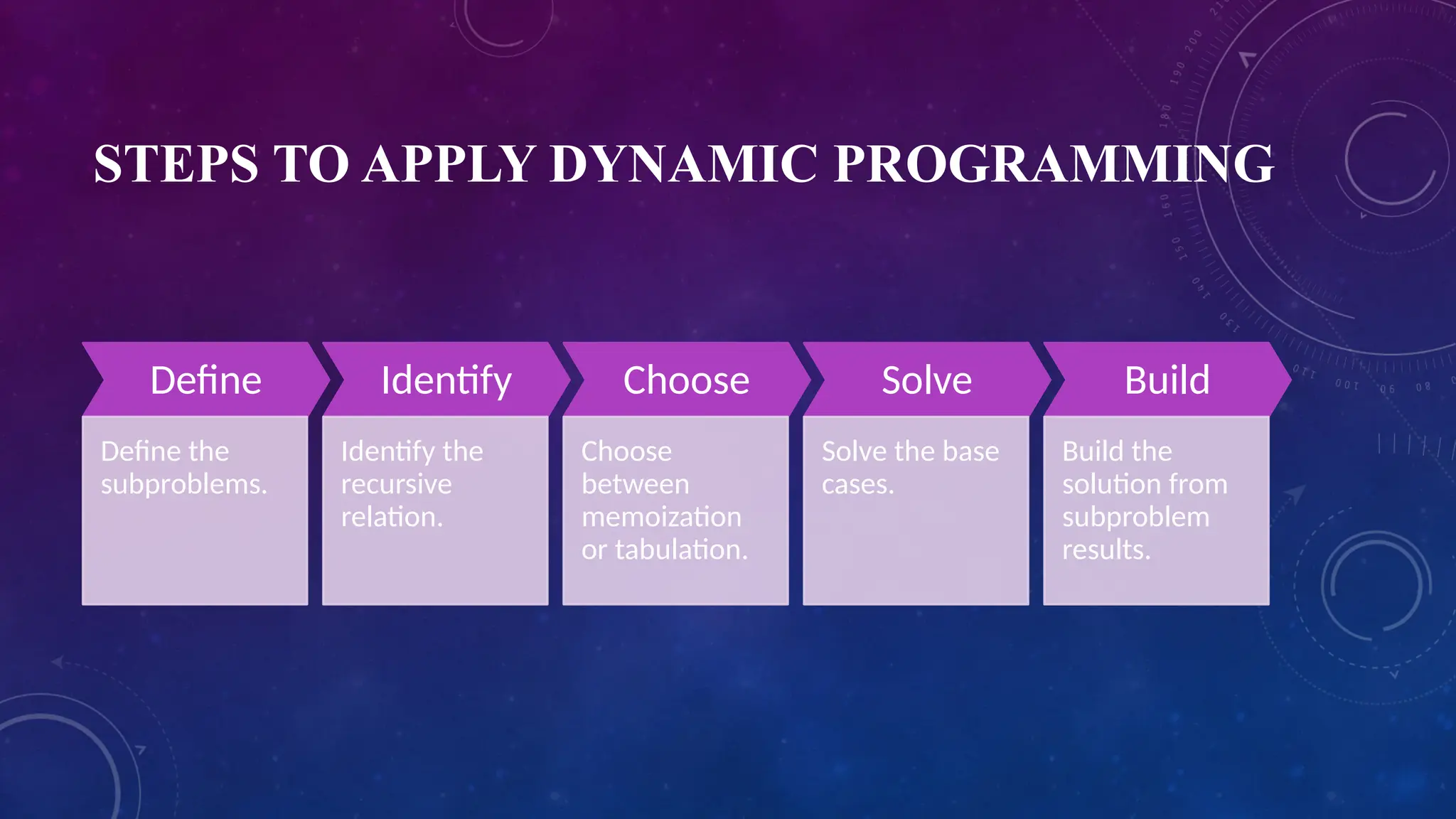
STEPS TO APPLY DYNAMIC PROGRAMMING
Define
Define the
subproblems.
Identify
Identify the
recursive
relation.
Choose
Choose
between
memoization
or tabulation.
Solve
Solve the base
cases.
Build
Build the
solution from
subproblem
results.
ADVANTAGES OF DYNAMIC
PROGRAMMING
EFFICIENT FOR SOLVING
OPTIMIZATION PROBLEMS.
REDUCES TIME COMPLEXITY BY
STORING INTERMEDIATE
RESULTS.
HELPS AVOID REDUNDANT
CALCULATIONS.
DISADVANTAGES
May require a lot of memory.
Requires identifying overlapping
subproblems and optimal substructure,
which may not be straightforward
THANK YOU!

DYNAMIC_________________________PROGRAMMING.pptx

  • 1.
    DYNAMIC PROGRAMMING •Presented ByGroup : 4 •Group Members : •Md.Nazmus Shakib -220320852 •Tanvin Sadik Dhrubo -220320860 •Khan Waziur Rahman -220320861 •Arghya Saha -200120456
  • 2.
    INTRODUCTION TO DYNAMIC PROGRAMMING •Dynamic Programming is a method for solving complex problems by breaking them down into simpler sub problems. It is applicable where the problem can be divided into overlapping subproblems and has optimal substructure. It is also known as divide and conquer technique
  • 3.
    Why We ChooseDynamic Programming Over Greedy Method? Dynamic programming (DP) is often preferred over the greedy method for solving optimization problems where future decisions are affected by earlier ones. In greedy algorithms, the approach is to make the locally optimal choice at each stage in hopes of finding the global optimum. However, this doesn't always lead to the best solution for all problems, as greedy methods may miss key subproblems or fail to consider how earlier decisions affect the later ones.
  • 4.
    DYNAMIC PROGRAMMING APPROACHES Top Down(Memoization): Starts BySolving Main Problems & Breaks It down Into Smaller Parts Saves The Answers To These Smaller Parts In A Table To Avoid Doing The Same Work Twice Works Well When There Are Smaller Parts
  • 5.
    DYNAMIC PROGRAMMING APPROACHES Bottom-Up(Tabulation): Beginsby solving the smallest parts of the problem first Uses these small solutions to build up the final answer step by step Works well when there are fewer smaller parts,& the final answer can be easily found by using these smaller solutions
  • 6.
    MEMOIZATION VS TABULATION Memoization:Top- downapproach. Uses recursion. Stores results of subproblems as they are solved Tabulation:Bottom- up approach. Iterative solution. Builds solutions to all subproblems and uses them
  • 7.
    MEMOIZATION F4 F2 F1 F0 F1 F1F0 F2 F3 0 1 1 2 3 F0 F1 F2 F3 F4 F = Time Complexity= O(n) Fn F(n-2) F(n-1) Global Array
  • 8.
    MEMOIZATION The Fibonacci sequenceis defined as: F(n)=F(n−1)+F(n−2) with base cases: F(0)=0, F(1)=1 Function Of fibonacci series : int fib(int n){ if (n<=1) { return n; } else { return fib(n-2) + fib(n- 1); } Top-down approach
  • 9.
    TABULATION Function Of fibonacciseries: int fib(int n){ if (n<=1) { return n; F[0]=0;F[1]=1; } for(int i=2; i<=n; i++){ F[i] = F[i-2]+F[i-1]; } return F[n]; } 0 1 1 2 3 F0 F1 F2 F3 F4 F = Time Complexity= O(n) Global Array Bottom-up approach F1 F0 F2
  • 10.
    KEY CONCEPTS OFDYNAMIC PROGRAMMING Optimal Substructure: The optimal solution to the problem can be constructed from the optimal solutions of its subproblems. Overlapping Subproblems: Subproblems are reused multiple times.
  • 11.
    STEPS TO APPLYDYNAMIC PROGRAMMING Define Define the subproblems. Identify Identify the recursive relation. Choose Choose between memoization or tabulation. Solve Solve the base cases. Build Build the solution from subproblem results.
  • 12.
    ADVANTAGES OF DYNAMIC PROGRAMMING EFFICIENTFOR SOLVING OPTIMIZATION PROBLEMS. REDUCES TIME COMPLEXITY BY STORING INTERMEDIATE RESULTS. HELPS AVOID REDUNDANT CALCULATIONS.
  • 13.
    DISADVANTAGES May require alot of memory. Requires identifying overlapping subproblems and optimal substructure, which may not be straightforward
  • 14.