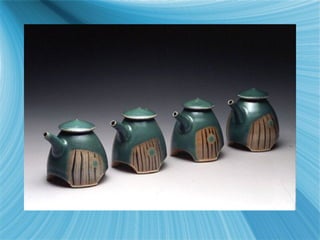
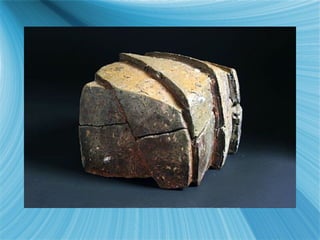
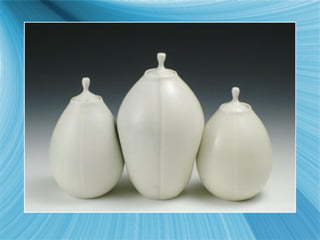
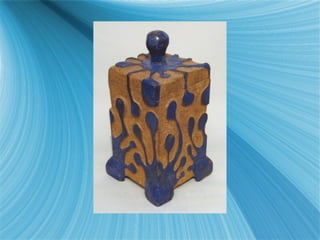
Ceramics
Creating Pinch Pots
Clay
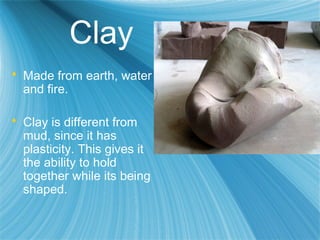
 Made from earth, water
and fire.
 Clay is different from
mud, since it has
plasticity. This gives it
the ability to hold
together while its being
shaped.
Basic Terms
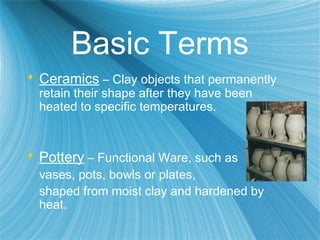
 Ceramics – Clay objects that permanently
retain their shape after they have been
heated to specific temperatures.
 Pottery – Functional Ware, such as
vases, pots, bowls or plates,
shaped from moist clay and hardened by
heat.
Basic Terms cont.
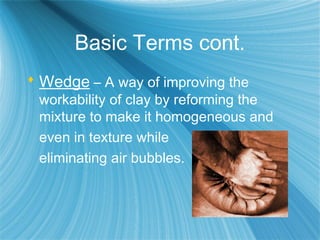
 Wedge – A way of improving the
workability of clay by reforming the
mixture to make it homogeneous and
even in texture while
eliminating air bubbles.
Basic Terms cont.
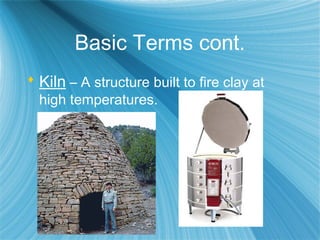
 Kiln – A structure built to fire clay at
high temperatures.
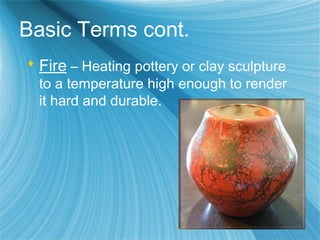
 Fire – Heating pottery or clay sculpture
to a temperature high enough to render
it hard and durable.
Basic Terms cont.
Construction
 Hand built Methods
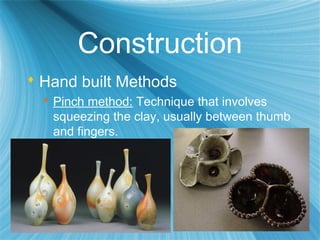
 Pinch method: Technique that involves
squeezing the clay, usually between thumb
and fingers.
Construction
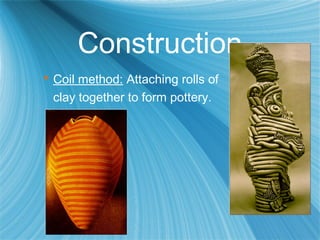
 Coil method: Attaching rolls of
clay together to form pottery.
Construction
 Slab method: Technique that involves
shaping clay into a broad, flat, thick piece.
Clay Stages
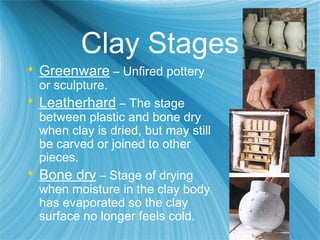
 Greenware – Unfired pottery
or sculpture.
 Leatherhard – The stage
between plastic and bone dry
when clay is dried, but may still
be carved or joined to other
pieces.
 Bone dry – Stage of drying
when moisture in the clay body
has evaporated so the clay
surface no longer feels cold.
Clay Stages cont.
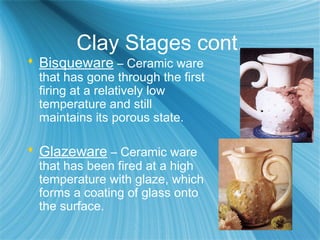
 Bisqueware – Ceramic ware
that has gone through the first
firing at a relatively low
temperature and still
maintains its porous state.
 Glazeware – Ceramic ware
that has been fired at a high
temperature with glaze, which
forms a coating of glass onto
the surface.
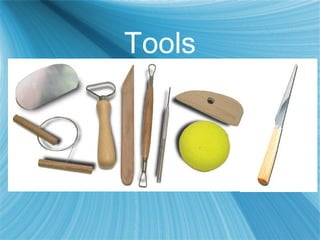
Tools
 Fettling knife – A long tapered knife
used for cutting and trimming clay.
 Loop tool – A small loop with a handle
used to carve clay away.
Joining Techniques
 Score – Scratching the edges of clay
before joining them together.
 Slip – A fluid suspension of clay in
water used in joining clay pieces and for
surface decoration.
 Bond – A mix made from clay slip of
the same type of clay as the clay piece.
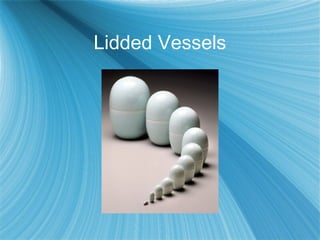
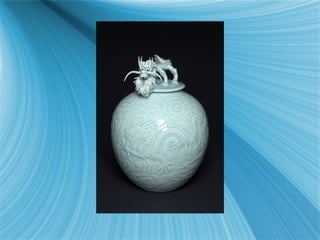
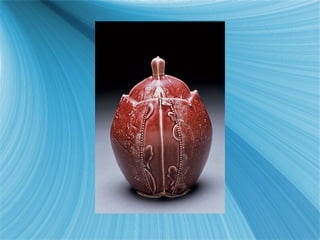
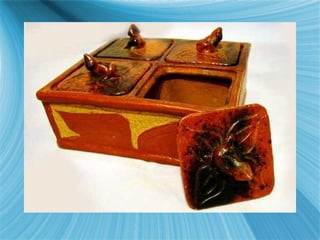
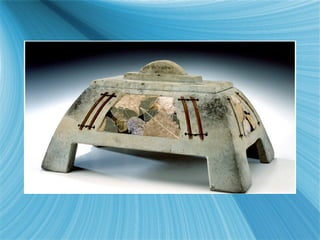
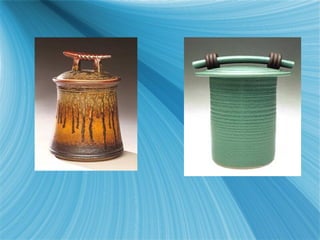
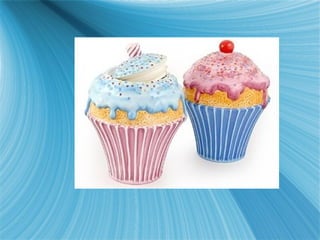
Lidded Vessels
Intro. ceramics powerpoint

Intro. ceramics powerpoint

  • 1.
  • 2.
    Clay  Made fromearth, water and fire.  Clay is different from mud, since it has plasticity. This gives it the ability to hold together while its being shaped.
  • 3.
    Basic Terms  Ceramics– Clay objects that permanently retain their shape after they have been heated to specific temperatures.  Pottery – Functional Ware, such as vases, pots, bowls or plates, shaped from moist clay and hardened by heat.
  • 4.
    Basic Terms cont. Wedge – A way of improving the workability of clay by reforming the mixture to make it homogeneous and even in texture while eliminating air bubbles.
  • 5.
    Basic Terms cont. Kiln – A structure built to fire clay at high temperatures.
  • 6.
     Fire –Heating pottery or clay sculpture to a temperature high enough to render it hard and durable. Basic Terms cont.
  • 7.
    Construction  Hand builtMethods  Pinch method: Technique that involves squeezing the clay, usually between thumb and fingers.
  • 8.
    Construction  Coil method:Attaching rolls of clay together to form pottery.
  • 9.
    Construction  Slab method:Technique that involves shaping clay into a broad, flat, thick piece.
  • 10.
    Clay Stages  Greenware– Unfired pottery or sculpture.  Leatherhard – The stage between plastic and bone dry when clay is dried, but may still be carved or joined to other pieces.  Bone dry – Stage of drying when moisture in the clay body has evaporated so the clay surface no longer feels cold.
  • 11.
    Clay Stages cont. Bisqueware – Ceramic ware that has gone through the first firing at a relatively low temperature and still maintains its porous state.  Glazeware – Ceramic ware that has been fired at a high temperature with glaze, which forms a coating of glass onto the surface.
  • 12.
    Tools  Fettling knife– A long tapered knife used for cutting and trimming clay.  Loop tool – A small loop with a handle used to carve clay away.
  • 13.
    Joining Techniques  Score– Scratching the edges of clay before joining them together.  Slip – A fluid suspension of clay in water used in joining clay pieces and for surface decoration.  Bond – A mix made from clay slip of the same type of clay as the clay piece.
  • 14.