Buddhism is areligion to about 300
million people around the world. The
word comes from 'budhi', 'to awaken'.
It has its origins about 2,500 years
ago when Siddhartha Gotama, known
as the Buddha, was himself
awakened (enlightened) at the age of
35.
What is Buddhism?
3.
Buddhism explains apurpose
to life, it explains apparent
injustice and inequality around
the world, and it provides a
code of practice or way of life
that leads to true happiness.
4.
• Buddhism originatedin India around 500
BCE.
• About 6% of the world’s population today is
Buddhist.
• Buddhism is the fourth largest religion in
the world, though its largest numbers of
followers are found in Southern and
Eastern Asia.
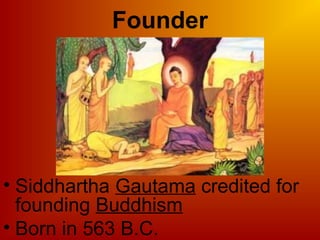
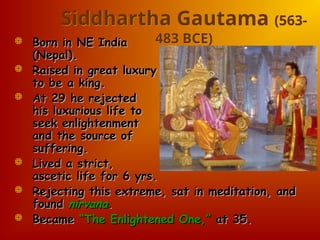
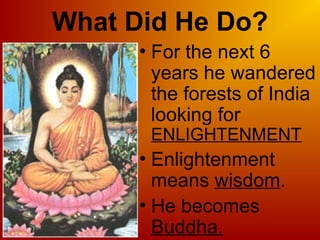
Siddhartha Gautama (563-
483BCE)
Born in NE India
Born in NE India
(Nepal).
(Nepal).
Raised in great luxury
Raised in great luxury
to be a king.
to be a king.
At 29 he rejected
At 29 he rejected
his luxurious life to
his luxurious life to
seek enlightenment
seek enlightenment
and the source of
and the source of
suffering.
suffering.
Lived a strict,
Lived a strict,
ascetic life for 6 yrs.
ascetic life for 6 yrs.
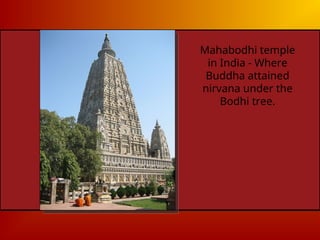
Rejecting this extreme, sat in meditation, and
Rejecting this extreme, sat in meditation, and
found
found nirvana
nirvana.
.
Became
Became “The Enlightened One,”
“The Enlightened One,” at 35.
at 35.
7.
Was the Buddhaa God?
He was not, nor did he claim to
be. He was a man who taught a
path to enlightenment from his
own experience.
8.
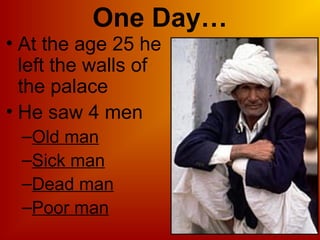
One Day…
• Atthe age 25 he
left the walls of
the palace
• He saw 4 men
–Old man
–Sick man
–Dead man
–Poor man
9.
What Did ItMean?
• This made him understand
that every living thing
experiences old age,
sickness and death
•BUT! ONLY religious life can
save someone from suffering
10.
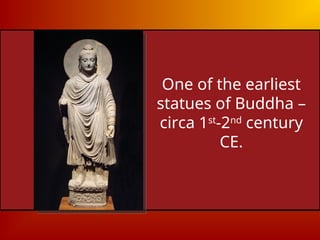
One of theearliest
statues of Buddha –
circa 1st
-2nd
century
CE.
• Buddha taughtthat there were Four Noble Truths in life
(basic instructions that teach suffering exists in the world
and humans much reach enlightenment to rise above it).
• Nirvana is the ultimate goal of Buddhists.
• It is a state of enlightenment where one can have
happiness and peace.
• In order to achieve Nirvana, a person must follow The
Middle Way (Eightfold Path – 8 rules for conduct).
• Buddhists also believe in reincarnation, a cycle of birth and
rebirth, where one’s behavior in this life determines what
one becomes in the next life.
18.
1. Try torecognize the truth
2. Try to avoid evil actions and bad people
3. Do not say things that hurt others
4. Respect other people and their belongings
5. Choose a job that does no harm to others
6. Do not think evil thoughts
7. Avoid excitement or anger
8. Work at meditation, thinking carefully about what
matters in life
• Buddha did not recognize gods because he felt man
alone could change evil into good if he followed the
Eightfold Path of the Middle Way.
19.
• The Buddhists’holy book is called the
Tripitaka.
• It contains all of Buddha’s teachings.
• Buddhists do not worship a god but rather
Buddha by thanking him for his teachings
and reading the Tripitaka to become more
enlightened.
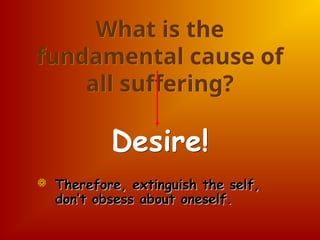
What is the
fundamentalcause of
all suffering?
Desire!
Therefore, extinguish the self,
Therefore, extinguish the self,
don’t obsess about oneself.
don’t obsess about oneself.
24.
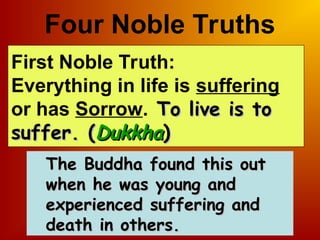
Four Noble Truths
FirstNoble Truth:
Everything in life is suffering
or has Sorrow. To live is to
To live is to
suffer.
suffer. (
(Dukkha
Dukkha)
)
The Buddha found this out
The Buddha found this out
when he was young and
when he was young and
experienced suffering and
experienced suffering and
death in others.
death in others.
25.
Second Noble Truth
•What causes
suffering is
people’s
desire for
material
things(
(Tanha
Tanha)
)
26.
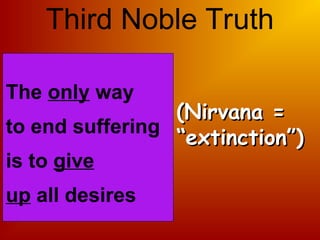
The only way
toend suffering
is to give
up all desires
Third Noble Truth
(Nirvana =
(Nirvana =
“extinction”)
“extinction”)
28.
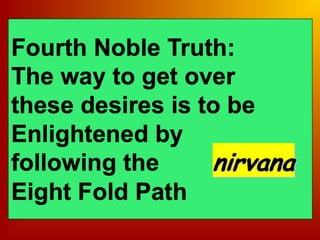
* Steps youmust take in order to reach
NIRVANA
• Nirvana – Release from all selfishness and
pain
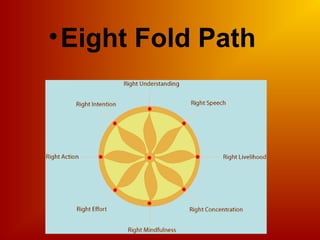
• Eightfold Path:
–Right view - Right action
–Right intention - Right effort
–Right speech - Right mindfulness
–Right livelihood - Right concentration
Eight Fold Path
Reincarnation
• Buddhists believein reincarnation
• Different from Hindu belief:
–Buddhists may be reincarnated as many
times as it takes until Enlightenment and
Nirvana are reached.
–Hindus believe in reincarnation as a
means of rising up the caste to reach
moksha. There is the risk of being
reincarnated in a lower caste.
31.
Eightfold Path
Nirvana
Nirvana
Theunion with the ultimate
The union with the ultimate
spiritual reality.
spiritual reality.
Escape from the cycle of
Escape from the cycle of
rebirth.
rebirth.
Types of
Buddhism
TherevadaBuddhism
Therevada Buddhism
Mahayana Buddhism
Mahayana Buddhism
Tibetan Buddhism
Tibetan Buddhism
Zen Buddhism
Zen Buddhism
34.
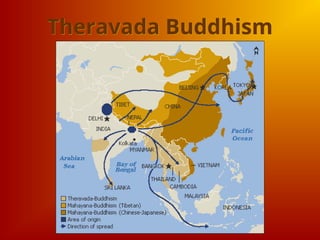
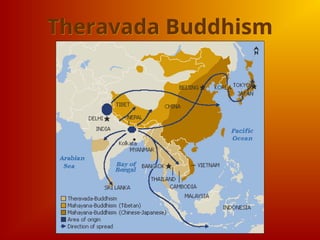
Theravada Buddhism
Theoldest school of Buddhism.
The oldest school of Buddhism.
The “Way of the Elders” or the “Small
The “Way of the Elders” or the “Small
Vehicle.”
Vehicle.”
followed the Buddha’s teachings exactly.
followed the Buddha’s teachings exactly.
Found in southern Asia.
Found in southern Asia.
The monastic life is the best way
The monastic life is the best way
to achieve
to achieve nirvana.
nirvana.
Focus on wisdom and meditation.
Focus on wisdom and meditation.
Goal is to become a
Goal is to become a “Buddha
“Buddha,” or
,” or “Enlightened
“Enlightened
One.”
One.”
Over 100,000,000 followers today.
Over 100,000,000 followers today.
Mahayana
Buddhism
The “GreatVehicle.”
The “Great Vehicle.”
Founded in northern Asia (China, Japan).
Founded in northern Asia (China, Japan).
Buddhism “for the masses.”
Buddhism “for the masses.”
believed that individual interpretation was
believed that individual interpretation was
important.
important.
Seek guidance from
Seek guidance from Boddhisatvas
Boddhisatvas, wise
, wise
beings.
beings.
Goal
Goal: Not just individual escape from the
: Not just individual escape from the
wheel, but the salvation of all humanity
wheel, but the salvation of all humanity
through self-sacrifice of those enlightened
through self-sacrifice of those enlightened
few.
few.
Tibetan Buddhism
The“Diamond Vehicle.” [
The “Diamond Vehicle.” [Vajrayana
Vajrayana]
]
Developed in Tibet in the
Developed in Tibet in the
7c CE.
7c CE.
A mix of Theravada and Mahayana.
A mix of Theravada and Mahayana.
Boddhisatvas
Boddhisatvas include
include
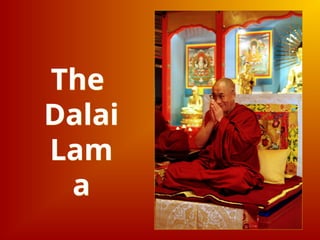
Lamas, like the
Lamas, like the
Dalai Lama
Dalai Lama.
.
The
The Tibetan Book
Tibetan Book
of the Dead
of the Dead
[
[Bardo Thodol
Bardo Thodol].
].
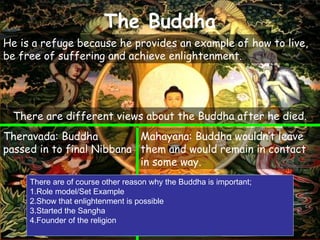
The Buddha
He isa refuge because he provides an example of how to live,
be free of suffering and achieve enlightenment.
There are different views about the Buddha after he died.
Mahayana: Buddha wouldn’t leave
them and would remain in contact
in some way.
Theravada: Buddha
passed in to final Nibbana
There are of course other reason why the Buddha is important;
1.Role model/Set Example
2.Show that enlightenment is possible
3.Started the Sangha
4.Founder of the religion
43.
Dhamma
Theravada – Theybelieve
that they adhere most
closely to the teaching of
the Buddha. They stress
the importance of the
Tripitaka, the three
baskets which contain
important parts of the
Dhamma.
Mahayana’s believe in
the Tripitaka too, but
they also accept
teaching’s which
didn’t come straight
from the Buddha.
1.Life today is full of desire so need to know how to let go
2.Suffering still a problem – so gives path to Nibbana
3. Dhamma is universal and can be discovered by anyone
4.Without Dhamma – no point in Buddha or Sangha
44.
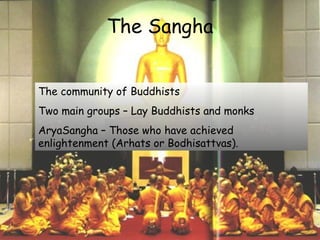
The Sangha
The communityof Buddhists
Two main groups – Lay Buddhists and monks
AryaSangha – Those who have achieved
enlightenment (Arhats or Bodhisattvas).
45.
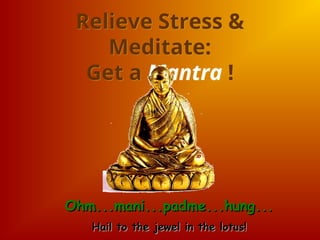
Relieve Stress &
Meditate:
Geta Mantra !
Ohm...mani...padme...hung...
Ohm...mani...padme...hung...
Hail to the jewel in the lotus!
Hail to the jewel in the lotus!





![Tibetan Buddhism
The “Diamond Vehicle.” [
The “Diamond Vehicle.” [Vajrayana
Vajrayana]
]
Developed in Tibet in the
Developed in Tibet in the
7c CE.
7c CE.
A mix of Theravada and Mahayana.
A mix of Theravada and Mahayana.
Boddhisatvas
Boddhisatvas include
include
Lamas, like the
Lamas, like the
Dalai Lama
Dalai Lama.
.
The
The Tibetan Book
Tibetan Book
of the Dead
of the Dead
[
[Bardo Thodol
Bardo Thodol].
].](https://image.slidesharecdn.com/459435210-buddhism-powerpoint-ppt-250930230714-234c35d0/85/459435210-Buddhism-powerpoint-presentation-38-320.jpg)
![Zen Buddhism
The “Meditation School.”
The “Meditation School.”
Seeks sudden enlightenment [
Seeks sudden enlightenment [satori
satori]
]
through meditation, arriving at
through meditation, arriving at
emptiness [
emptiness [sunyata
sunyata].
].
Use of meditation masters [
Use of meditation masters [Roshi
Roshi].
].
Beauty, art, and aesthetics:
Beauty, art, and aesthetics:
Gardens.
Gardens.
Archery.
Archery.
Tea ceremony.
Tea ceremony.
Calligraphy.
Calligraphy.](https://image.slidesharecdn.com/459435210-buddhism-powerpoint-ppt-250930230714-234c35d0/85/459435210-Buddhism-powerpoint-presentation-40-320.jpg)


![Buddhist concepts.pptx [autosaved]](https://cdn.slidesharecdn.com/ss_thumbnails/buddhistconcepts-pptxautosaved-120624045431-phpapp02-thumbnail.jpg?width=640&height=640&fit=bounds)


