
Introduction of
Biopharmaceutics
Presented by
Mr. Sujit Kakade
Assistant Professor
Pune District Education Association’s
Shankarrao Ursal College of Pharmaceutical Sciences
& Research Centre, Kharadi, Pune.
Need of Biopharmaceutics Discipline
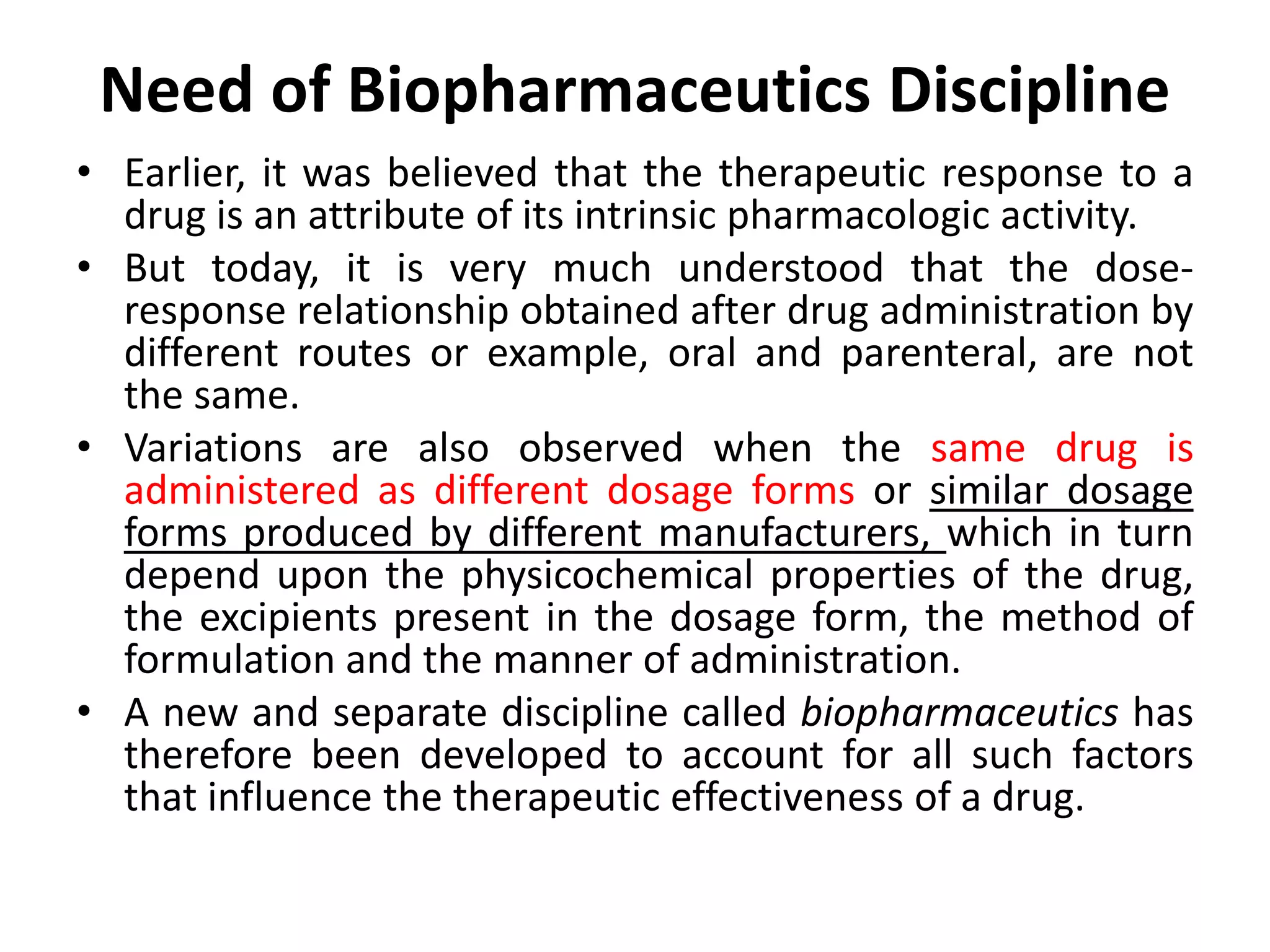
• Earlier, it was believed that the therapeutic response to a
drug is an attribute of its intrinsic pharmacologic activity.
• But today, it is very much understood that the dose-
response relationship obtained after drug administration by
different routes or example, oral and parenteral, are not
the same.
• Variations are also observed when the same drug is
administered as different dosage forms or similar dosage
forms produced by different manufacturers, which in turn
depend upon the physicochemical properties of the drug,
the excipients present in the dosage form, the method of
formulation and the manner of administration.
• A new and separate discipline called biopharmaceutics has
therefore been developed to account for all such factors
that influence the therapeutic effectiveness of a drug.
Applications of Biopharmaceutics
• Explain difference in drug effect
• Design of generic drug
• Design drug delivery system
Definition of Biopharmaceutics :
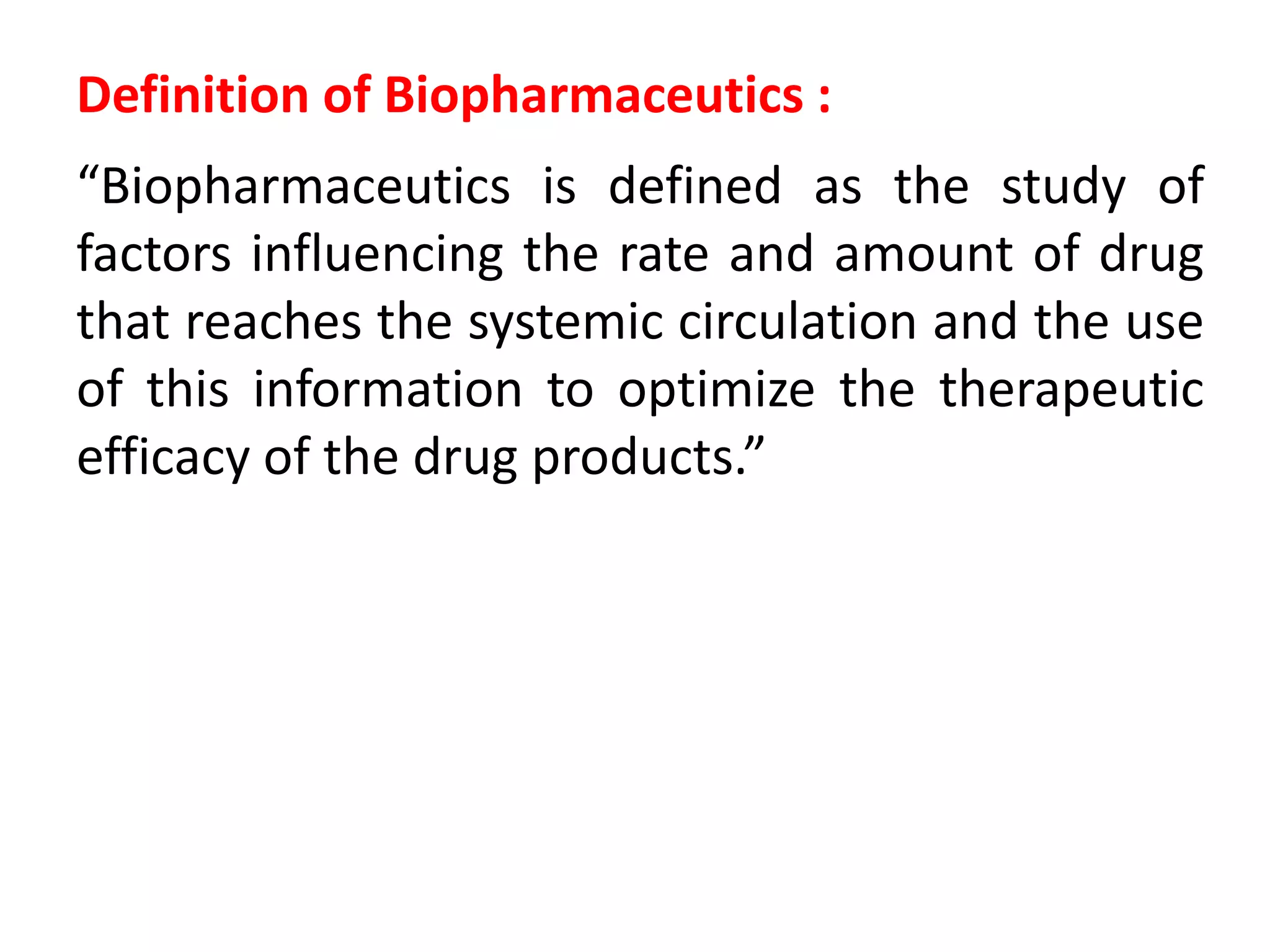
“Biopharmaceutics is defined as the study of
factors influencing the rate and amount of drug
that reaches the systemic circulation and the use
of this information to optimize the therapeutic
efficacy of the drug products.”
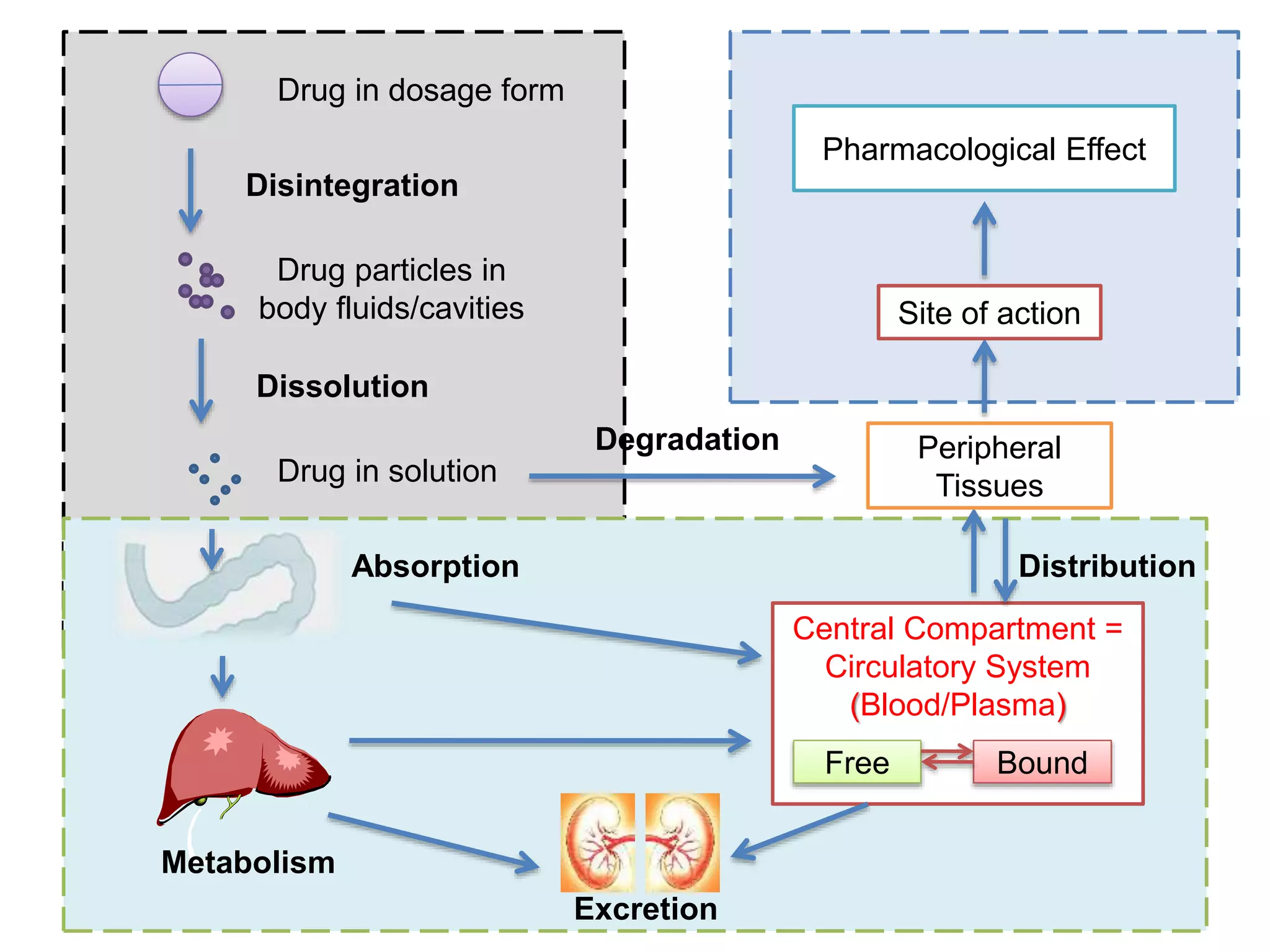
Drug in dosage form
Drug particles in
body fluids/cavities
Drug in solution
Absorption
Central Compartment =
Circulatory System
(Blood/Plasma)
Free Bound
Peripheral
Tissues
Site of action
Pharmacological Effect
Disintegration
Dissolution
Metabolism
Distribution
Excretion
Degradation
Drug absorption
Drug absorption is defined as the process of movement
of unchanged drug from the site of administration to
systemic circulation.
Distribution
Distribution is defined as the reversible transfer of a drug
between one compartment and another.
Biotransformation / Metabolism
Biotransformation of drugs is defined as the conversion
from one chemical form to another.
The term is used synonymously with metabolism.
Excretion
Excretion is defined as the process whereby drugs
and/or their metabolites are irreversibly transferred
from internal to external environment.
Excretion of unchanged drug is important in the
termination of its pharmacologic action.
The principal organs of excretion are kidneys.
Excretion by organs other than kidneys such as lungs,
biliary system, intestine, salivary glands and sweat
glands is known as nonrenal excretion.
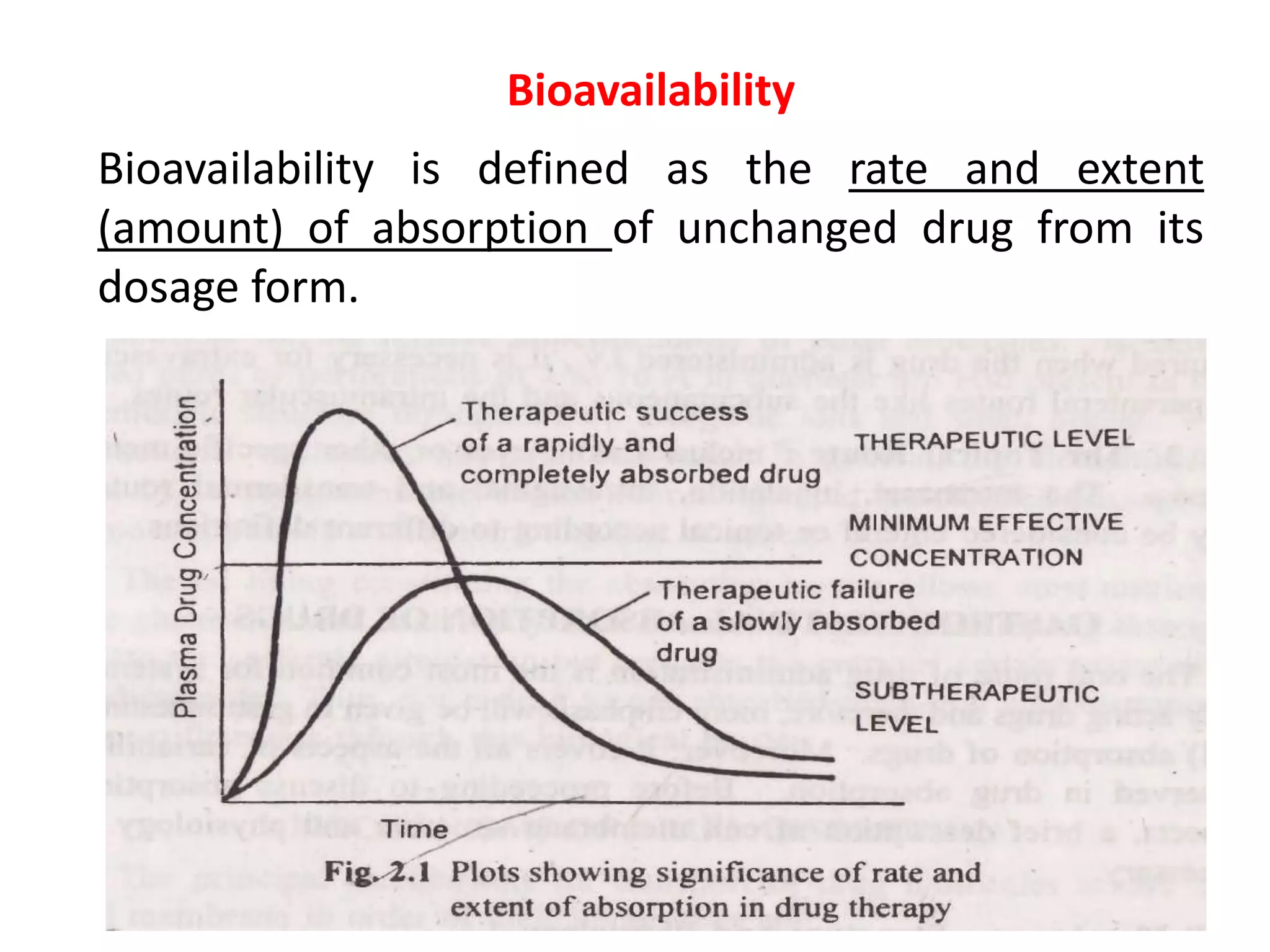
Bioavailability
Bioavailability is defined as the rate and extent
(amount) of absorption of unchanged drug from its
dosage form.
For a drug to be 100%
bioavailable…
• The drug must be:
– completely released from the dosage form
– fully dissolved in the gastrointestinal fluids
– stable in solution in the gastrointestinal fluids
– pass through the gastrointestinal barrier into
the mesenteric circulation without being
metabolized
– pass through the liver into the systemic
circulation unchanged
• Equivalence : It is a relative term that compares drug
products with respect to a specific characteristic or function
or to a defined set of standards.
• There are several types of equivalences.
• Chemical Equivalence : It indicates that two or more drug
products contain the same labeled chemical substance as an
active ingredient in the same amount.
• Pharmaceutical Equivalence : This term implies that two or
more drug products are identical in strength, quality, purity,
content uniformity and disintegration and dissolution
characteristics; they may however differ in containing
different excipients.
• Therapeutic Equivalence : This term indicates that two or
more drug products that contain the same therapeutically
active ingredient, elicit identical pharmacological effects and
can control the disease to the same extent.
• Bioequivalence :
It is a relative term which denotes that the
drug substance in two or more identical
dosage forms, reaches the systemic circulation
at the same relative rate and to the same
relative extent.
i.e. their plasma concentration-time profiles
will be identical without significant statistical
differences.
Pharmacokinetics
• The study and characterization of the time course
of drug absorption, distribution, metabolism and
excretion (ADME) & their relationship with
therapeutic & toxic effect of drug.
• Clinical Pharmacokinetics: The use of
pharmacokinetics principals in optimizing the
drug dosage to suit individual patient needs &
achieving maximum therapeutic utility is called
clinical pharmacokinetics.
• What the body does to the drug
Pharmacodynamics
• The study of the relation of the drug concentration
at the site of action (receptor) and intensity of its
pharmacologic response as a function of time.
• It is concerned with the biochemical &
physiological effects of the drug & its mechanism
of action.
• What the drugs does to the body
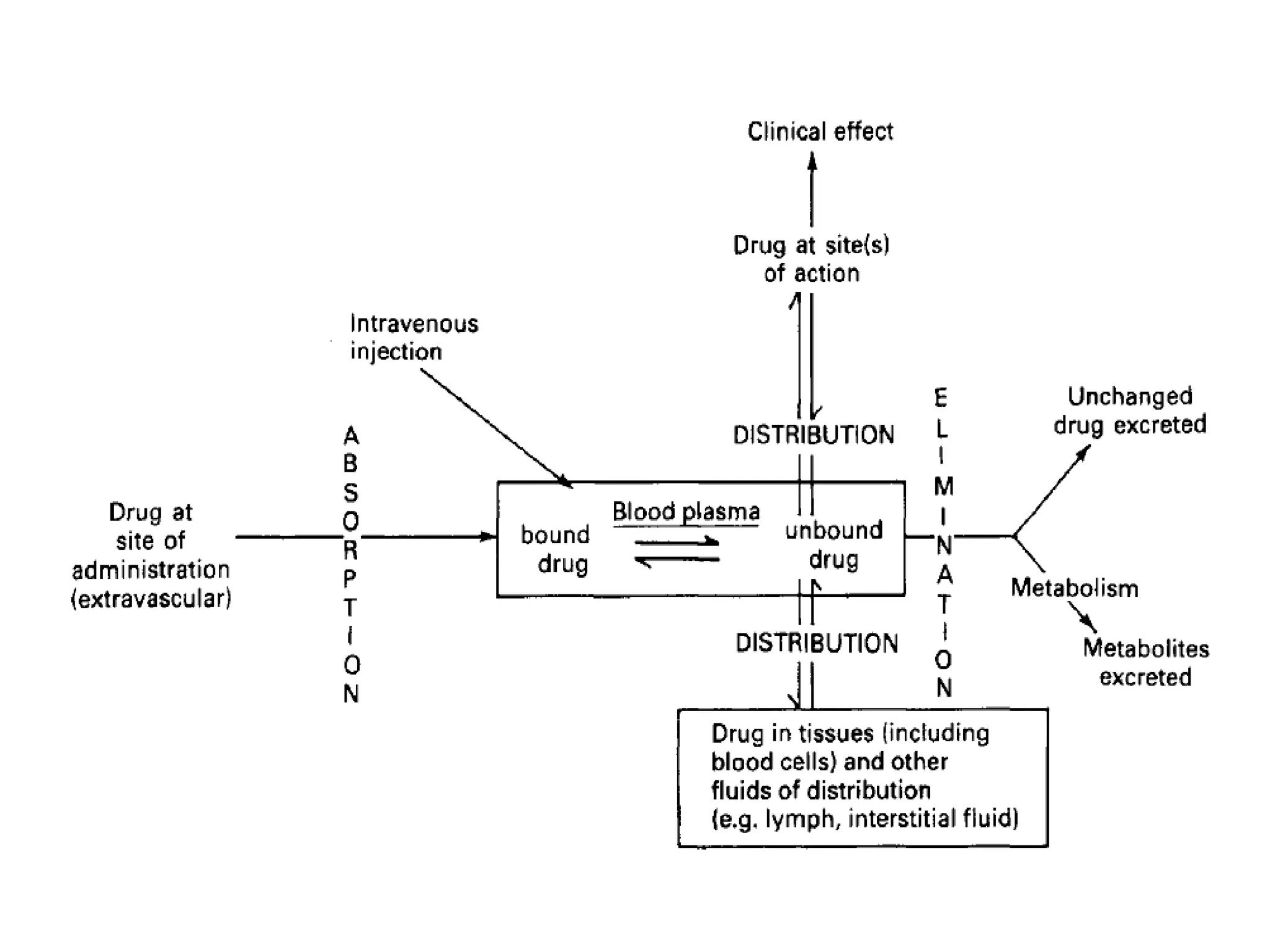
Schematic representation of the processes involved in
drug therapeutics
Plasma Concentration-Time Profile
This Profile is generated by obtaining the drug concentration in plasma
samples taken at various time intervals after a drug is administered.
Pharmacokinetic Parameters
1. Peak plasma concentration (C max)
2. Time for peak plasma concentration (t max)
3. Area under the curve (AUC)
Pharmacodynamic parameters
1. Minimum Effective Concentration (MEC)
2. Maximum Safe Concentration (MSC)
3. Onset of Action
4. Onset Time
5. Duration of Action
6 . Intensity of Action
7. Therapeutic Range
8. Therapeutic Window
Plasma Concentration-Time Profile
Introduction to Biopharmaceutics

Introduction to Biopharmaceutics

  • 1.
    Introduction of Biopharmaceutics Presented by Mr.Sujit Kakade Assistant Professor Pune District Education Association’s Shankarrao Ursal College of Pharmaceutical Sciences & Research Centre, Kharadi, Pune.
  • 2.
    Need of BiopharmaceuticsDiscipline • Earlier, it was believed that the therapeutic response to a drug is an attribute of its intrinsic pharmacologic activity. • But today, it is very much understood that the dose- response relationship obtained after drug administration by different routes or example, oral and parenteral, are not the same. • Variations are also observed when the same drug is administered as different dosage forms or similar dosage forms produced by different manufacturers, which in turn depend upon the physicochemical properties of the drug, the excipients present in the dosage form, the method of formulation and the manner of administration. • A new and separate discipline called biopharmaceutics has therefore been developed to account for all such factors that influence the therapeutic effectiveness of a drug.
  • 3.
    Applications of Biopharmaceutics •Explain difference in drug effect • Design of generic drug • Design drug delivery system
  • 4.
    Definition of Biopharmaceutics: “Biopharmaceutics is defined as the study of factors influencing the rate and amount of drug that reaches the systemic circulation and the use of this information to optimize the therapeutic efficacy of the drug products.”
  • 5.
    Drug in dosageform Drug particles in body fluids/cavities Drug in solution Absorption Central Compartment = Circulatory System (Blood/Plasma) Free Bound Peripheral Tissues Site of action Pharmacological Effect Disintegration Dissolution Metabolism Distribution Excretion Degradation
  • 7.
    Drug absorption Drug absorptionis defined as the process of movement of unchanged drug from the site of administration to systemic circulation. Distribution Distribution is defined as the reversible transfer of a drug between one compartment and another. Biotransformation / Metabolism Biotransformation of drugs is defined as the conversion from one chemical form to another. The term is used synonymously with metabolism.
  • 8.
    Excretion Excretion is definedas the process whereby drugs and/or their metabolites are irreversibly transferred from internal to external environment. Excretion of unchanged drug is important in the termination of its pharmacologic action. The principal organs of excretion are kidneys. Excretion by organs other than kidneys such as lungs, biliary system, intestine, salivary glands and sweat glands is known as nonrenal excretion.
  • 9.
    Bioavailability Bioavailability is definedas the rate and extent (amount) of absorption of unchanged drug from its dosage form.
  • 10.
    For a drugto be 100% bioavailable… • The drug must be: – completely released from the dosage form – fully dissolved in the gastrointestinal fluids – stable in solution in the gastrointestinal fluids – pass through the gastrointestinal barrier into the mesenteric circulation without being metabolized – pass through the liver into the systemic circulation unchanged
  • 11.
    • Equivalence :It is a relative term that compares drug products with respect to a specific characteristic or function or to a defined set of standards. • There are several types of equivalences. • Chemical Equivalence : It indicates that two or more drug products contain the same labeled chemical substance as an active ingredient in the same amount. • Pharmaceutical Equivalence : This term implies that two or more drug products are identical in strength, quality, purity, content uniformity and disintegration and dissolution characteristics; they may however differ in containing different excipients. • Therapeutic Equivalence : This term indicates that two or more drug products that contain the same therapeutically active ingredient, elicit identical pharmacological effects and can control the disease to the same extent.
  • 12.
    • Bioequivalence : Itis a relative term which denotes that the drug substance in two or more identical dosage forms, reaches the systemic circulation at the same relative rate and to the same relative extent. i.e. their plasma concentration-time profiles will be identical without significant statistical differences.
  • 13.
    Pharmacokinetics • The studyand characterization of the time course of drug absorption, distribution, metabolism and excretion (ADME) & their relationship with therapeutic & toxic effect of drug. • Clinical Pharmacokinetics: The use of pharmacokinetics principals in optimizing the drug dosage to suit individual patient needs & achieving maximum therapeutic utility is called clinical pharmacokinetics. • What the body does to the drug
  • 14.
    Pharmacodynamics • The studyof the relation of the drug concentration at the site of action (receptor) and intensity of its pharmacologic response as a function of time. • It is concerned with the biochemical & physiological effects of the drug & its mechanism of action. • What the drugs does to the body
  • 15.
    Schematic representation ofthe processes involved in drug therapeutics
  • 16.
    Plasma Concentration-Time Profile ThisProfile is generated by obtaining the drug concentration in plasma samples taken at various time intervals after a drug is administered.
  • 17.
    Pharmacokinetic Parameters 1. Peakplasma concentration (C max) 2. Time for peak plasma concentration (t max) 3. Area under the curve (AUC)
  • 18.
    Pharmacodynamic parameters 1. MinimumEffective Concentration (MEC) 2. Maximum Safe Concentration (MSC) 3. Onset of Action 4. Onset Time 5. Duration of Action 6 . Intensity of Action 7. Therapeutic Range 8. Therapeutic Window
  • 19.

Editor's Notes

  • #6 Once the drug reaches the bloodstream it partitions between the plasma and the red blood cells, the erythrocytes. Drug in the plasma partitions between the plasma proteins (mainly albumin) and the plasma water. It is this free or unbound drug in plasma water, and not the drug bound to the proteins, that can pass out of the plasma through the capillary endothelium and reach other body fluids and tissues and hence the site(s) of action.
  • #14 The study of the time course of drug movement in the body during absorption, distribution, and elimination (excretion and biotransformation).