FINANCIAL ACCOUNTING AND
ANALYSIS:(KMBN-103)
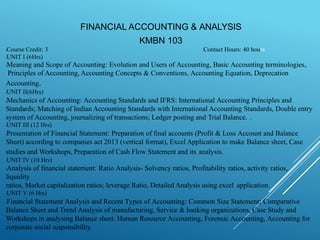
FINANCIAL ACCOUNTING & ANALYSIS
KMBN 103
Contact Hours: 40 hours
lCourse Credit: 3
lUNIT I (6Hrs)
lMeaning and Scope of Accounting: Evolution and Users of Accounting, Basic Accounting terminologies,
Principles of Accounting, Accounting Concepts & Conventions, Accounting Equation, Deprecation
Accounting.
lUNIT II(6Hrs)
lMechanics of Accounting: Accounting Standards and IFRS: International Accounting Principles and
Standards; Matching of Indian Accounting Standards with International Accounting Standards, Double entry
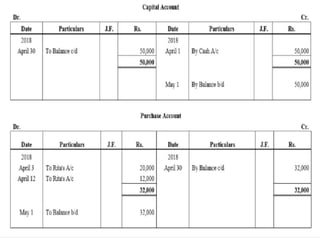
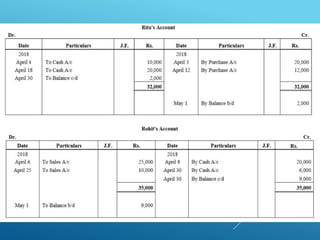
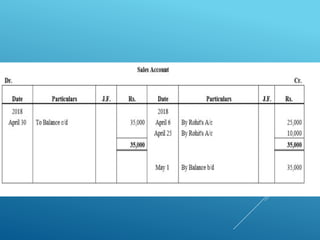
system of Accounting, journalizing of transactions; Ledger posting and Trial Balance. .
lUNIT III (12 Hrs)
lPresentation of Financial Statement: Preparation of final accounts (Profit & Loss Account and Balance
Sheet) according to companies act 2013 (vertical format), Excel Application to make Balance sheet, Case
studies and Workshops, Preparation of Cash Flow Statement and its analysis.
lUNIT IV (10 Hrs)
lAnalysis of financial statement: Ratio Analysis- Solvency ratios, Profitability ratios, activity ratios,
liquidity
ratios, Market capitalization ratios; leverage Ratio, Detailed Analysis using excel application.
lUNIT V (6 Hrs)
lFinancial Statement Analysis and Recent Types of Accounting: Common Size Statement; Comparative
Balance Sheet and Trend Analysis of manufacturing, Service & banking organizations, Case Study and
Workshops in analysing Balance sheet. Human Resource Accounting, Forensic Accounting, Accounting for
corporate social responsibility.
FINANCIAL ACCOUNTING
Unit-1
Overview of Business
Accounting
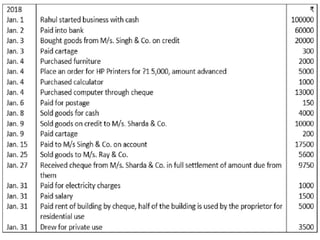
Principles of Accounting
Accounting Equation
Overview to Deprecation
OVERVIEW
1. Introduction
2. Origin and Growth of Accounting.
3. Meaning of Accounting.
4. Distinction between Book-Keeping and
Accounting.
5. Objectives of Accounting.
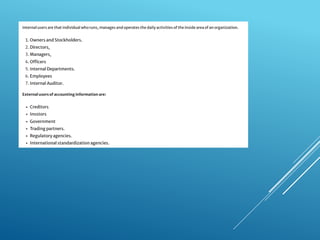
6. Users of Accounting Information.
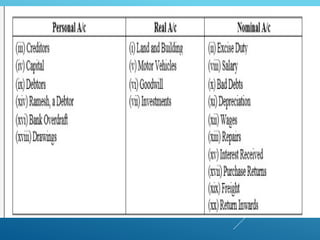
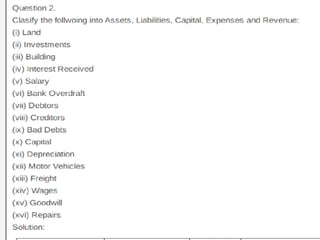
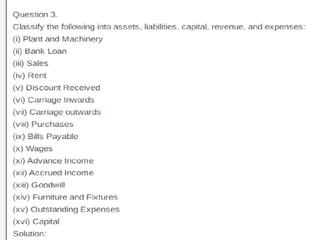
7. Branches of Accounting.
8. Limitations of Accounting.
9. Systems of Accounting.
INTRODUCTION
Accounting has rightly been termed as the language of the business.
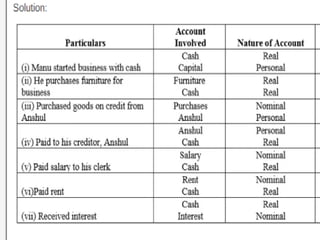
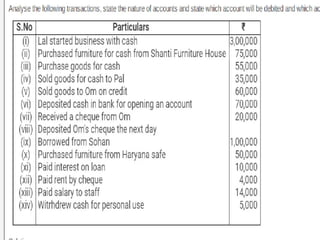
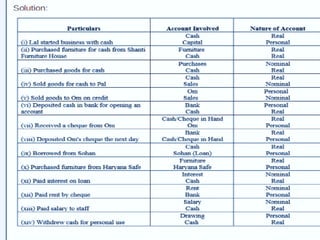
The basic function of a language is to serve as a means of
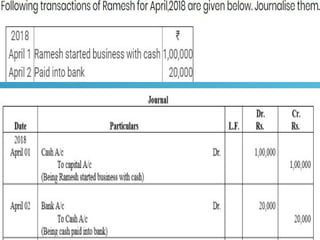
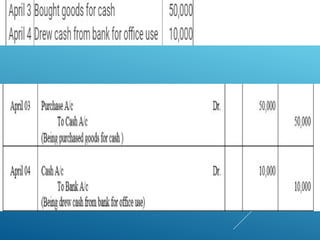
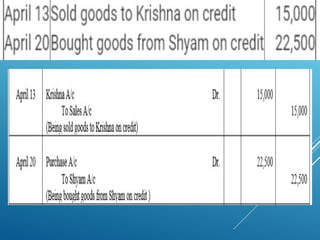
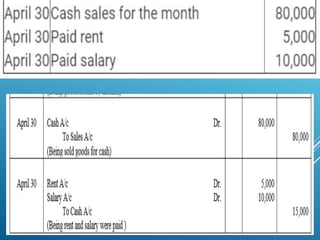
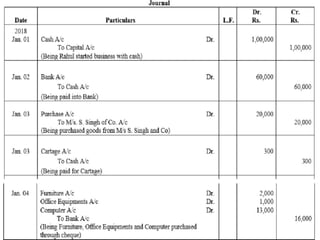
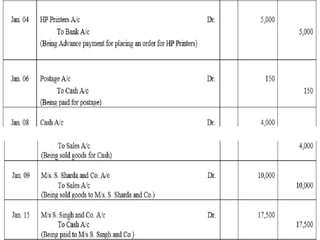
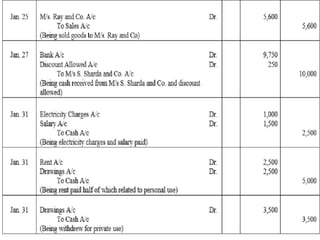
communication Accounting also serves this function. It
communicates the results of business operations to various parties
who have some stake in the business viz., the proprietor, creditors,
investors, Government and other agencies. Though accounting is
generally associated with business but it is not only business which
makes use of accounting. Persons like housewives, Government and
other individuals also make use of a accounting. For example, a
housewife has to keep a record of the money received and spent by
her during a particular period. She can record her receipts of money
on one page of her "household diary" while payments for different
items such as milk, food, clothing, house, education etc.
ORIGIN AND GROWTH OF ACCOUNTING
 the act of accounting was not as developed as it is today because in the
early stages of civilisation, the number of transactions to be recorded
were so small that each businessman was able to record and check
for himself all his transactions. Accounting was practised in India
twenty three centuries ago as is clear from the book named
"Arthashastra“ written by Kautilya, King Chandragupta's minister. This
book not only relates to politics and economics, but also explain the art
of proper keeping of accounts. However, the modern system of
accounting based on the principles of double entry system owes it
origin to Luco Pacioli who first published the principles of Double
Entry System in 1494 at Venice in Italy. Thus, the art of accounting has
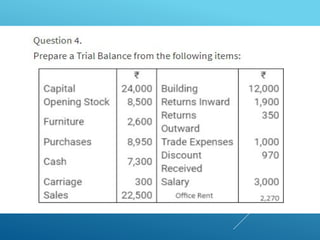
been practised for centuries but it is only in the late thirties that the
study of the subject 'accounting' has been taken up seriously.
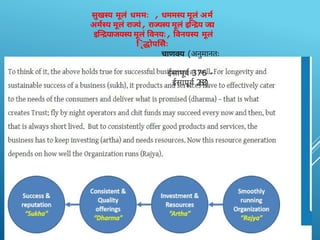
सुखस्य मूलं धममः , धममस्य मूलं अर्म
अर्मस्य मूलं राज्यं , राज्यस्य मूलं इन्द्रिय ज
य
ः
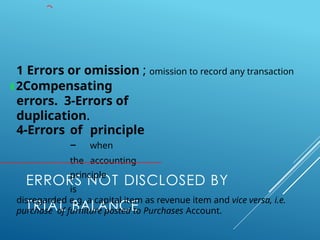
इन्द्रियाजयस्य मूलं विनयः , विनयस्य मूलं
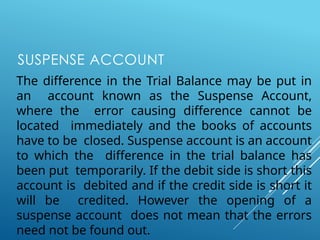
िृद्धोपसेिः
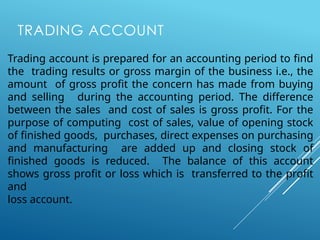
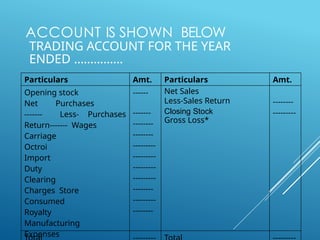
चाणक्य (अनुमानतः
ईसापूर्व 376 -
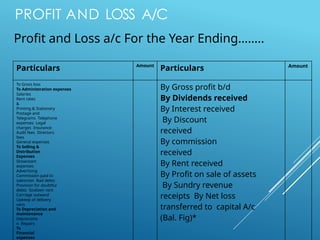
ईसापूर्व 2
8
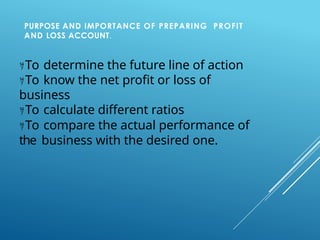
3
)
MEANING OF ACCOUNTING
The main purpose of accounting is to ascertain profit or loss
during a specified period, to show financial condition of the
business on a particular date and to have control over the
firm's property.
The American Institute of Certified Public Accountants has
defined the Financial Accounting as "the art of recording,
classifying and summarising in as significant manner and in
terms of money transactions and events which in part, at
least of a financial character, and interpreting the results
thereof"
STEPS OF ACCOUNTING
(1)Recording: Recording all the transactions in subsidiary
books for purpose of future record or
reference. It is referred to as
"Journal."
(2)Classifying: All recorded transactions in subsidiary books
are classified and posted to the main book of accounts. It
is known
as "Ledger."
(3) Summarizing: All recorded transactions in main books will
be
summarized for the preparation of Trail
Balance, Profit and Loss Account and Balance Sheet.
(4) Interpreting: Interpreting refers to the explanationof
the
meaning and significance of the result of financial accounts
BOOK-KEEPING V/S ACCOUNTING
Book-keeping is a part of accounting and is
concerned with the recording of transactions
which is often routine and clerical in nature,
whereas accounting performs other functions as
well, viz., measurement and communication,
besides recording. An accountant is required to
have a much higher level of knowledge,
conceptual understanding and analytical skill than
is required of the book-keeper
.
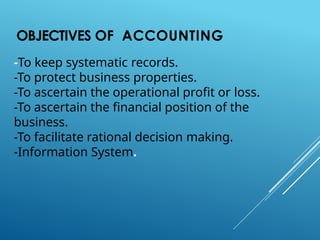
OBJECTIVES OF ACCOUNTING
-To keep systematic records.
-To protect business properties.
-To ascertain the operational profit or loss.
-To ascertain the financial position of the
business.
-To facilitate rational decision making.
-Information System.
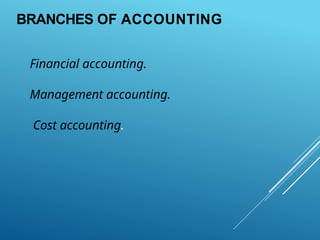
BRANCHES OF ACCOUNTING
Financial accounting.
Management accounting.
Cost accounting.
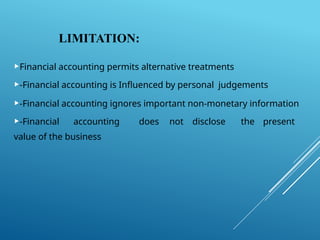
LIMITATION:
Financial accounting permits alternative treatments
-Financial accounting is Influenced by personal judgements
-Financial accounting ignores important non-monetary information
-Financial accounting does not disclose the present
value of the business
SYSTEMS OF ACCOUNTING
-
Cash System. Under this system, actual cash receipts and
actual cash payments are recorded. Credit transactions
are not recorded at all until the cash in actually received
or paid. The Receipts and Payments Account prepared in
case of non- trading concerns such as a charitable
institution, a club, a school, a college, etc. and
professional men like a lawyer, a doctor, a chartered
accountant etc.
-Mercantile (Accrual) system. Under this system all
transactions relating to a period are recorded in the books
of account i.e., in addition to actual receipts and
payments of cash income receivable and expenses
payable are also recorded.
ACCOUNTING PRINCIPLES
In order to maintain uniformity and
consistency in preparing and maintaining
books of accounts, certain rules or
principles have been evolved. These
rules/principles are classified as concepts
and conventions. These are foundations of
preparing and maintaining accounting
records.
ACCOUNTING CONCEPTS
Accounting concept refers to the
basic
assumptions and rules and principles
which work as the basis of recording of
business transactions and preparing
accounts.
ACCOUNTING CONCEPTS
Business entity concept
Money measurement
concept
Going concern concept
 Accounting period concept
Accounting cost concept
Duality aspect concept
Realisation concept
 Accrual concept
Matching concept
ACCOUNTING CONVENTIONS
The term "accountingconventions"refer to
the customs or traditions, which are used as a
guide in the preparation of meaningful
financial
records in the form of
the statement(Profit and Loss
Account)
incom
e and
the
position statement (Balance
Sheet).
ACCOUNTING CONVENTIONS
 Conservatis
m
Consistency
Disclosure
Materiality
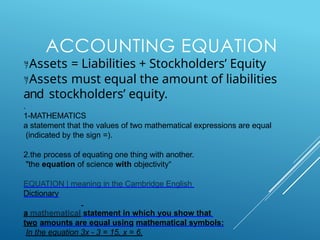
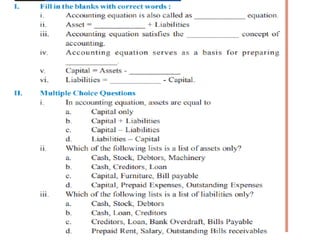
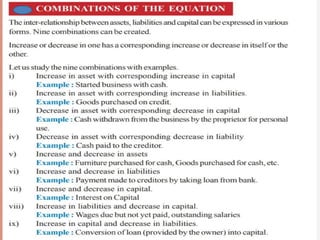
ACCOUNTING EQUATION
Assets = Liabilities + Stockholders’ Equity
Assets must equal the amount of liabilities
and stockholders’ equity.
.
1-MATHEMATICS
a statement that the values of two mathematical expressions are equal
(indicated by the sign =).
2.the process of equating one thing with another.
"the equation of science with objectivity“
EQUATION | meaning in the Cambridge English
Dictionary
a mathematical statement in which you show that
two amounts are equal using mathematical symbols:
In the equation 3x - 3 = 15, x = 6.
WHAT IS AN ASSET
An asset is a resource that the company owns
and expects will benefit them in the future.
Assets are cash, Inventory, Accounts
Receivable, and Fixed Assets that are also
known as Plant,
Property and Equipment.
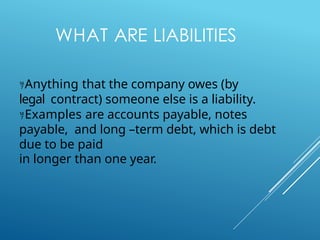
WHAT ARE LIABILITIES
Anything that the company owes (by
legal contract) someone else is a liability.
Examples are accounts payable, notes
payable, and long –term debt, which is debt
due to be paid
in longer than one year.
Equity shareholders:
Stockholders’ Equity is divided into Paid –in
Capital and Retained Earnings.
Paid –In Capital is stocks issued by the
company that are purchased by others.
Retained Earnings are the amount of money
that
is maintained in the company.
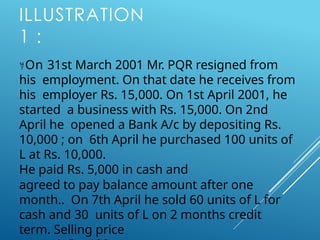
ILLUSTRATION
1 :
On 31st March 2001 Mr. PQR resigned from
his employment. On that date he receives from
his employer Rs. 15,000. On 1st April 2001, he
started a business with Rs. 15,000. On 2nd
April he opened a Bank A/c by depositing Rs.
10,000 ; on 6th April he purchased 100 units of
L at Rs. 10,000.
He paid Rs. 5,000 in cash and
agreed to pay balance amount after one
month.. On 7th April he sold 60 units of L for
cash and 30 units of L on 2 months credit
term. Selling price
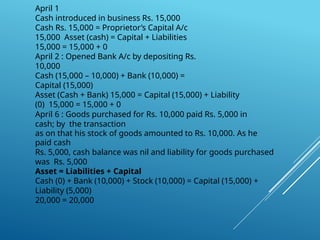
April 1
Cash introduced in business Rs. 15,000
Cash Rs. 15,000 = Proprietor’s Capital A/c
15,000 Asset (cash) = Capital + Liabilities
15,000 = 15,000 + 0
April 2 : Opened Bank A/c by depositing Rs.
10,000
Cash (15,000 – 10,000) + Bank (10,000) =
Capital (15,000)
Asset (Cash + Bank) 15,000 = Capital (15,000) + Liability
(0) 15,000 = 15,000 + 0
April 6 : Goods purchased for Rs. 10,000 paid Rs. 5,000 in
cash; by the transaction
as on that his stock of goods amounted to Rs. 10,000. As he
paid cash
Rs. 5,000, cash balance was nil and liability for goods purchased
was Rs. 5,000
Asset = Liabilities + Capital
Cash (0) + Bank (10,000) + Stock (10,000) = Capital (15,000) +
Liability (5,000)
20,000 = 20,000
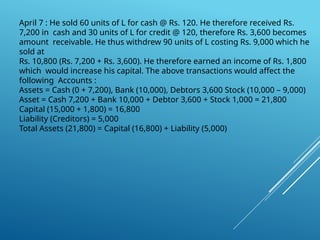
April 7 : He sold 60 units of L for cash @ Rs. 120. He therefore received Rs.
7,200 in cash and 30 units of L for credit @ 120, therefore Rs. 3,600 becomes
amount receivable. He thus withdrew 90 units of L costing Rs. 9,000 which he
sold at
Rs. 10,800 (Rs. 7,200 + Rs. 3,600). He therefore earned an income of Rs. 1,800
which would increase his capital. The above transactions would affect the
following Accounts :
Assets = Cash (0 + 7,200), Bank (10,000), Debtors 3,600 Stock (10,000 – 9,000)
Asset = Cash 7,200 + Bank 10,000 + Debtor 3,600 + Stock 1,000 = 21,800
Capital (15,000 + 1,800) = 16,800
Liability (Creditors) = 5,000
Total Assets (21,800) = Capital (16,800) + Liability (5,000)
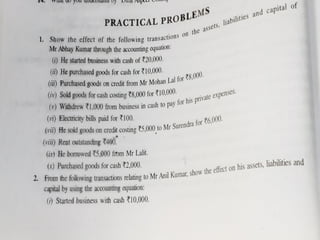
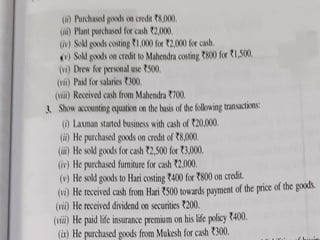
QUESTIO
N
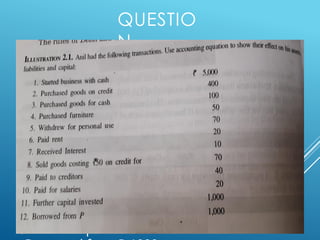
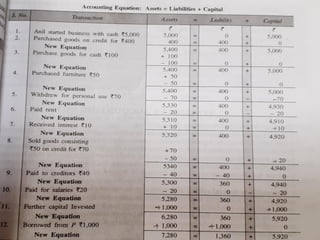
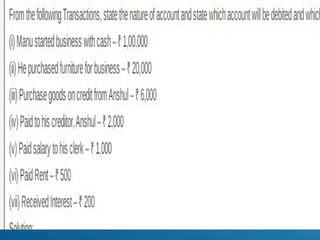
Anil has the fallowing
Transactions:
Started business with cash-5000
Purchases goods-400(credit)
Purchases goods on cash-400
Withdrew for personal use-70
Paid rent-20
Received interest-10
Sold goods-50 on credit for-70
Paid to creditors-40
Paid for salaries-20
Further capital invested-1000
Double Entry
System of
Accounting
System of Accounting
1. Single Entry
System.
2. Double Entry
System
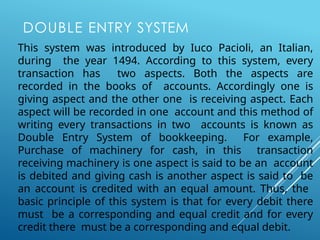
DOUBLE ENTRY SYSTEM
This system was introduced by Iuco Pacioli, an Italian,
during the year 1494. According to this system, every
transaction has two aspects. Both the aspects are
recorded in the books of accounts. Accordingly one is
giving aspect and the other one is receiving aspect. Each
aspect will be recorded in one account and this method of
writing every transactions in two accounts is known as
Double Entry System of bookkeeping. For example,
Purchase of machinery for cash, in this transaction
receiving machinery is one aspect is said to be an account
is debited and giving cash is another aspect is said to be
an account is credited with an equal amount. Thus, the
basic principle of this system is that for every debit there
must be a corresponding and equal credit and for every
credit there must be a corresponding and equal debit.
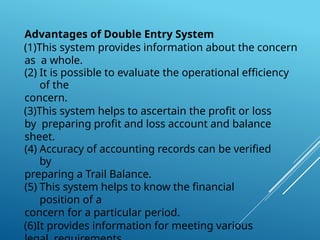
Advantages of Double Entry System
(1)This system provides information about the concern
as a whole.
(2) It is possible to evaluate the operational efficiency
of the
concern.
(3)This system helps to ascertain the profit or loss
by preparing profit and loss account and balance
sheet.
(4) Accuracy of accounting records can be verified
by
preparing a Trail Balance.
(5) This system helps to know the financial
position of a
concern for a particular period.
(6)It provides information for meeting various
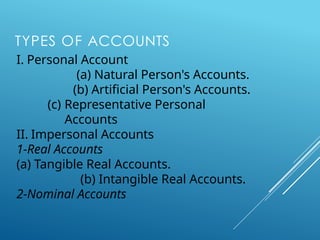
TYPES OF ACCOUNTS
I. Personal Account
(a) Natural Person's Accounts.
(b) Artificial Person's Accounts.
(c) Representative Personal
Accounts
II. Impersonal Accounts
1-Real Accounts
(a) Tangible Real Accounts.
(b) Intangible Real Accounts.
2-Nominal Accounts
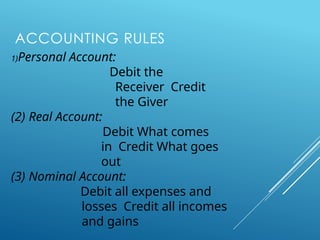
ACCOUNTING RULES
1)Personal Account:
Debit the
Receiver Credit
the Giver
(2) Real Account:
Debit What comes
in Credit What goes
out
(3) Nominal Account:
Debit all expenses and
losses Credit all incomes
and gains
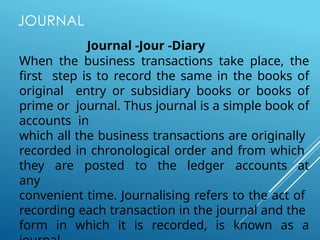
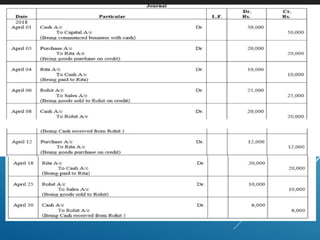
JOURNAL
Journal -Jour -Diary
When the business transactions take place, the
first step is to record the same in the books of
original entry or subsidiary books or books of
prime or journal. Thus journal is a simple book of
accounts in
which all the business transactions are originally
recorded in chronological order and from which
they are posted to the ledger accounts at
any
convenient time. Journalising refers to the act of
recording each transaction in the journal and the
form in which it is recorded, is known as a
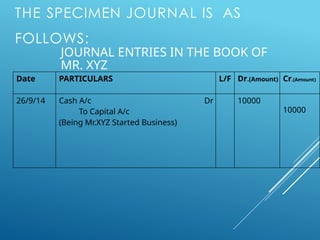
THE SPECIMEN JOURNAL IS AS
FOLLOWS:
JOURNAL ENTRIES IN THE BOOK OF
MR. XYZ
Date PARTICULARS L/F Dr.(Amount) Cr.(Amount)
26/9/14 Cash A/c Dr
To Capital A/c
(Being Mr.XYZ Started Business)
10000
10000
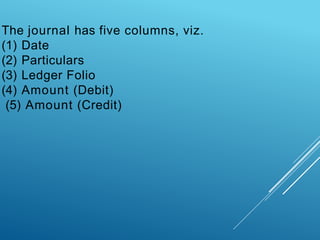
The journal has five columns, viz.
(1) Date
(2) Particulars
(3) Ledger Folio
(4) Amount (Debit)
(5) Amount (Credit)
SUB-DIVISION OF JOURNAL
1. Sales Day Book- to record all credit sales.
2. Purchases Day Book- to record all credit purchases.
3. Cash Book- to record all cash transactions of receipts as well
as
payments.
4.Sales Returns Day Book- to record the return of goods
sold to customers
on credit.
5.Purchases Returns Day Book- to record the return of
goods purchased from suppliers on credit.
6. Bills Receivable Book- to record the details of all the
bills
received.
7. Bills Payable Book- to record the details of all the bills
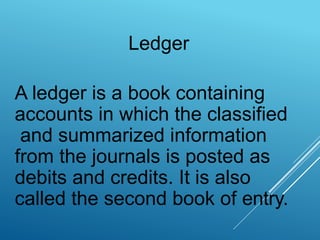
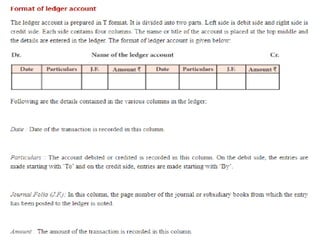
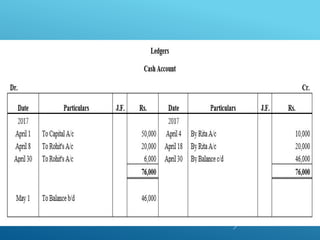
Ledger
A ledger is a book containing
accounts in which the classified
and summarized information
from the journals is posted as
debits and credits. It is also
called the second book of entry.
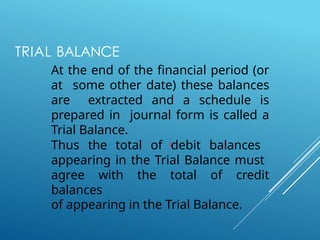
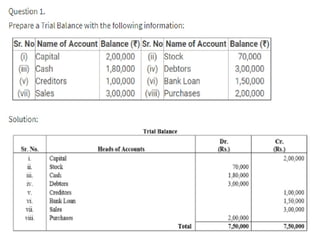
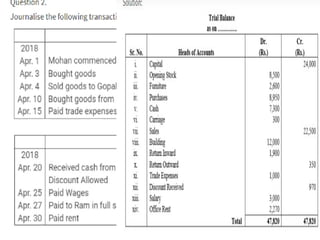
TRIAL BALANCE
At the end of the financial period (or
at some other date) these balances
are extracted and a schedule is
prepared in journal form is called a
Trial Balance.
Thus the total of debit balances
appearing in the Trial Balance must
agree with the total of credit
balances
of appearing in the Trial Balance.
OBJECTS OF PREPARING
TRIAL BALANCE :
1.It forms the very basic on which final
accounts are prepared.
2.Ithelps in knowing the balance on any
particular account in the ledger.
3. It is used as a test of arithmetical accuracy.
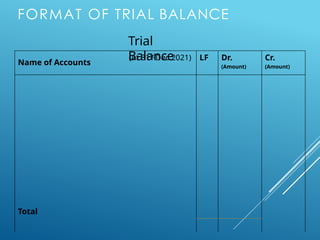
FORMAT OF TRIAL BALANCE
Trial
Balance
Name of Accounts
(At 31st Dec 2021) LF Dr.
(Amount)
Cr.
(Amount)
Total
ERRORS NOT DISCLOSED BY
TRIAL BALANCE
1 Errors or omission ; omission to record any transaction
2Compensating
errors. 3-Errors of
duplication.
4-Errors of principle
– when
the accounting
principle
is
disregarded e.g. a capital item as revenue item and vice versa, i.e.
purchase of furniture posted to Purchases Account.
SUSPENSE ACCOUNT
The difference in the Trial Balance may be put in
an account known as the Suspense Account,
where the error causing difference cannot be
located immediately and the books of accounts
have to be closed. Suspense account is an account
to which the difference in the trial balance has
been put temporarily. If the debit side is short this
account is debited and if the credit side is short it
will be credited. However the opening of a
suspense account does not mean that the errors
need not be found out.
TRADING ACCOUNT
Trading account is prepared for an accounting period to find
the trading results or gross margin of the business i.e., the
amount of gross profit the concern has made from buying
and selling during the accounting period. The difference
between the sales and cost of sales is gross profit. For the
purpose of computing cost of sales, value of opening stock
of finished goods, purchases, direct expenses on purchasing
and manufacturing are added up and closing stock of
finished goods is reduced. The balance of this account
shows gross profit or loss which is transferred to the profit
and
loss account.
ACCOUNT IS SHOWN BELOW
TRADING ACCOUNT FOR THE YEAR
ENDED ……………
Particulars Amt. Particulars Amt.
Opening stock
Net Purchases
------- Less- Purchases
Return------- Wages
Carriage
Octroi
Import
Duty
Clearing
Charges Store
Consumed
Royalty
Manufacturing
Expenses
------
-------
--------
--------
---------
---------
---------
---------
--------
---------
--------
Net Sales
Less-Sales Return
Closing Stock
Gross Loss*
--------
---------
PROFIT AND LOSS ACCOUNT
In the words of Prof. Carter “Profit and loss account is
an account into which all gains and losses are collected in
order to ascertain the excess of gains over the losses or vice
versa.” Profit and loss account starts with gross profit brought
down from trading account on the credit side. (If gross loss, on
the debit side). All the indirect expenses are debited and all the
revenue incomes are credited to the profit and loss account
and then net profit or loss is calculated. If incomes or credit is
more, than the expenses or debit, the difference is net profit. On
the other hand if the expenses or debit side is more, the
difference is net loss.
PROFIT AND LOSS A/C
Profit and Loss a/c For the Year Ending……..
Particulars Amount
Particulars Amount
To Gross loss
To Administration expenses
Salaries
Rent rates
&
Printing & Stationery
Postage and
Telegrams Telephone
expenses Legal
charges Insurance
Audit fees Directors
fees
General expenses
To Selling &
Distribution
Expenses
Showroom
expenses
Advertising
Commission paid to
salesmen Bad debts
Provision for doubtful
debts Godown rent
Carriage outward
Upkeep of delivery
vans
To Depreciation and
maintenance
Depreciatio
n Repairs
To
Financial
expenses
By Gross profit b/d
By Dividends received
By Interest received
By Discount
received
By commission
received
By Rent received
By Profit on sale of assets
By Sundry revenue
receipts By Net loss
transferred to capital A/c
(Bal. Fig)*
PURPOSE AND IMPORTANCE OF PREPARING PROFIT
AND LOSS ACCOUNT.
To determine the future line of action
To know the net profit or loss of
business
To calculate different ratios
To compare the actual performance of
the business with the desired one.
RULES:
1. Only revenue receipts should be entered
2.Only revenue expenses together with losses should be taken
into account.
3. Expenses and incomes relating only to the period for which
the
accounts are being prepared should be considered.
4.All expenses and income relating to the period concerned
should be considered even if the expense has not yet been paid
in cash or the
income has not yet been received in cash.
5. All personal expenses of the proprietor and partners must be
debited
to the capital or drawings accounts and must not be debited to the
profit and loss account. Similarly any income has been earned
from the private assets of the proprietor which is received by firm,
it must be credited to the capital or drawings account.
BALANCE SHEET
The Balance sheet comprises of lists of assets, liabilities
and capital fund on a given date. It presents
the financial position of a concern as revealed
by the accounting records. It reflects the assets owned
by the concern and the sources of funds used in the
acquisition of those assets. In simple language it is
prepared in such a way that true
financial position is revealed in a form easily readable
and more rapidly understood than would be possible
from a view of the detailed information
contained in the accounting records prepared during
the currency of the accounting period. Balance
sheet may be called a ‘statement of equality’ in
which equality is established by representing values of
assets on one side and values of liabilities and owners'
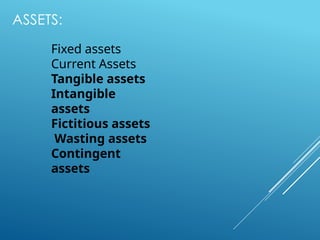
ASSETS:
Fixed assets
Current Assets
Tangible assets
Intangible
assets
Fictitious assets
Wasting assets
Contingent
assets
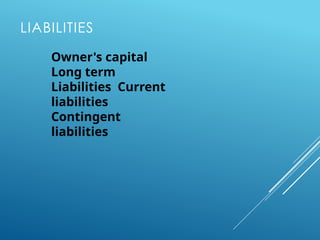
LIABILITIES
Owner's capital
Long term
Liabilities Current
liabilities
Contingent
liabilities
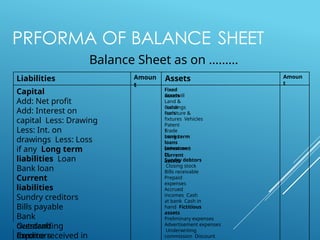
PRFORMA OF BALANCE SHEET
Balance Sheet as on ………
Amoun
t
Liabilities Assets Amoun
t
Capital
Add: Net profit
Add: Interest on
capital Less: Drawing
Less: Int. on
drawings Less: Loss
if any Long term
liabilities Loan
Bank loan
Current
liabilities
Sundry creditors
Bills payable
Bank
overdraft
Creditors
Outstanding
exp.
Income received in
Fixed
assets
Goodwill
Land &
Buildings
Loose
tools
Furniture &
fixtures Vehicles
Patent
s
Trade
marks
Long term
loans
(advances )
Investmen
ts
Current
assets
Sundry debtors
Closing stock
Bills receivable
Prepaid
expenses
Accrued
incomes Cash
at bank Cash in
hand Fictitious
assets
Preliminary expenses
Advertisement expenses
Underwriting
commission Discount
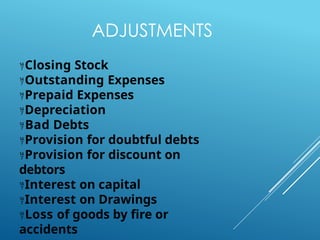
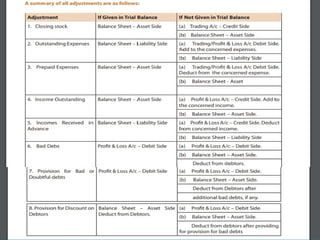
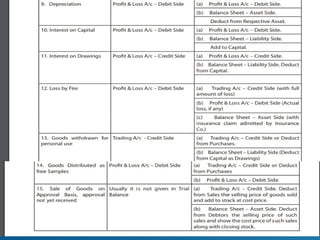
ADJUSTMENTS
Closing Stock
Outstanding Expenses
Prepaid Expenses
Depreciation
Bad Debts
Provision for doubtful debts
Provision for discount on
debtors
Interest on capital
Interest on Drawings
Loss of goods by fire or
accidents
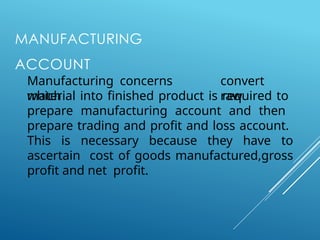
MANUFACTURING
ACCOUNT
Manufacturing concerns
which
convert
raw
material into finished product is required to
prepare manufacturing account and then
prepare trading and profit and loss account.
This is necessary because they have to
ascertain cost of goods manufactured,gross
profit and net profit.
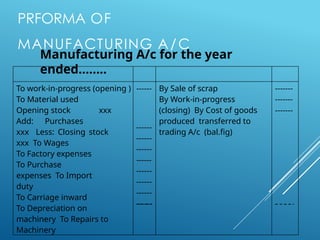
PRFORMA OF
MANUFACTURING A/C
Manufacturing A/c for the year
ended……..
To work-in-progress (opening )
To Material used
Opening stock xxx
Add: Purchases
xxx Less: Closing stock
xxx To Wages
To Factory expenses
To Purchase
expenses To Import
duty
To Carriage inward
To Depreciation on
machinery To Repairs to
Machinery
------
------
------
------
------
------
------
------
------
By Sale of scrap
By Work-in-progress
(closing) By Cost of goods
produced transferred to
trading A/c (bal.fig)
-------
-------
-------
P&L appropriation a/c:
Profit and loss account shows only the net
profit or net loss from operation of business
but profit and loss appropriation accounts
shows all non- operational adjustment which
is needed for proper distribution of net profit
between shareholders and company for
future growth.
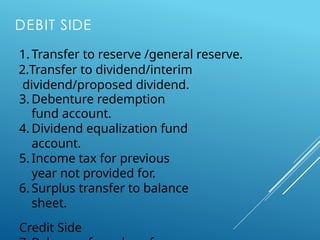
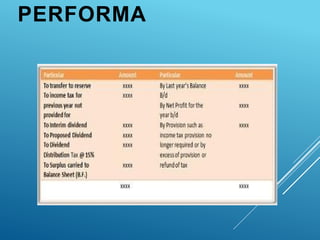
DEBIT SIDE
1. Transfer to reserve /general reserve.
2.Transfer to dividend/interim
dividend/proposed dividend.
3. Debenture redemption
fund account.
4. Dividend equalization fund
account.
5. Income tax for previous
year not provided for.
6. Surplus transfer to balance
sheet.
Credit Side
PERFORMA
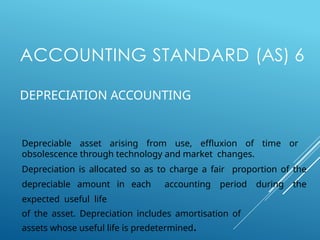
ACCOUNTING STANDARD (AS) 6
DEPRECIATION ACCOUNTING
Depreciable asset arising from use, effluxion of time or
obsolescence through technology and market changes.
Depreciation is allocated so as to charge a fair proportion of the
depreciable amount in each accounting period during the
expected useful life
of the asset. Depreciation includes amortisation of
assets whose useful life is predetermined.
FOLLOWING ASSETS ARE
EXCLUDED FROM
DEPRECIATION
(i)forests, plantations and similar
regenerative natural resources;
(ii)wasting assets including expenditure on
the exploration for and extraction of
minerals, oils,
natural gas and similar non-regenerative
resources;
(iii) expenditure on research and
development;
(iv) goodwill and other intangible assets;
(v) live stock

FINANCIAL ACCOUNTING PRESENTATION DOCUMENT

  • 1.
  • 2.
    FINANCIAL ACCOUNTING &ANALYSIS KMBN 103 Contact Hours: 40 hours lCourse Credit: 3 lUNIT I (6Hrs) lMeaning and Scope of Accounting: Evolution and Users of Accounting, Basic Accounting terminologies, Principles of Accounting, Accounting Concepts & Conventions, Accounting Equation, Deprecation Accounting. lUNIT II(6Hrs) lMechanics of Accounting: Accounting Standards and IFRS: International Accounting Principles and Standards; Matching of Indian Accounting Standards with International Accounting Standards, Double entry system of Accounting, journalizing of transactions; Ledger posting and Trial Balance. . lUNIT III (12 Hrs) lPresentation of Financial Statement: Preparation of final accounts (Profit & Loss Account and Balance Sheet) according to companies act 2013 (vertical format), Excel Application to make Balance sheet, Case studies and Workshops, Preparation of Cash Flow Statement and its analysis. lUNIT IV (10 Hrs) lAnalysis of financial statement: Ratio Analysis- Solvency ratios, Profitability ratios, activity ratios, liquidity ratios, Market capitalization ratios; leverage Ratio, Detailed Analysis using excel application. lUNIT V (6 Hrs) lFinancial Statement Analysis and Recent Types of Accounting: Common Size Statement; Comparative Balance Sheet and Trend Analysis of manufacturing, Service & banking organizations, Case Study and Workshops in analysing Balance sheet. Human Resource Accounting, Forensic Accounting, Accounting for corporate social responsibility.
  • 5.
    FINANCIAL ACCOUNTING Unit-1 Overview ofBusiness Accounting Principles of Accounting Accounting Equation Overview to Deprecation
  • 6.
    OVERVIEW 1. Introduction 2. Originand Growth of Accounting. 3. Meaning of Accounting. 4. Distinction between Book-Keeping and Accounting. 5. Objectives of Accounting. 6. Users of Accounting Information. 7. Branches of Accounting. 8. Limitations of Accounting. 9. Systems of Accounting.
  • 7.
    INTRODUCTION Accounting has rightlybeen termed as the language of the business. The basic function of a language is to serve as a means of communication Accounting also serves this function. It communicates the results of business operations to various parties who have some stake in the business viz., the proprietor, creditors, investors, Government and other agencies. Though accounting is generally associated with business but it is not only business which makes use of accounting. Persons like housewives, Government and other individuals also make use of a accounting. For example, a housewife has to keep a record of the money received and spent by her during a particular period. She can record her receipts of money on one page of her "household diary" while payments for different items such as milk, food, clothing, house, education etc.
  • 8.
    ORIGIN AND GROWTHOF ACCOUNTING  the act of accounting was not as developed as it is today because in the early stages of civilisation, the number of transactions to be recorded were so small that each businessman was able to record and check for himself all his transactions. Accounting was practised in India twenty three centuries ago as is clear from the book named "Arthashastra“ written by Kautilya, King Chandragupta's minister. This book not only relates to politics and economics, but also explain the art of proper keeping of accounts. However, the modern system of accounting based on the principles of double entry system owes it origin to Luco Pacioli who first published the principles of Double Entry System in 1494 at Venice in Italy. Thus, the art of accounting has been practised for centuries but it is only in the late thirties that the study of the subject 'accounting' has been taken up seriously.
  • 9.
    सुखस्य मूलं धममः, धममस्य मूलं अर्म अर्मस्य मूलं राज्यं , राज्यस्य मूलं इन्द्रिय ज य ः इन्द्रियाजयस्य मूलं विनयः , विनयस्य मूलं िृद्धोपसेिः चाणक्य (अनुमानतः ईसापूर्व 376 - ईसापूर्व 2 8 3 )
  • 10.
    MEANING OF ACCOUNTING Themain purpose of accounting is to ascertain profit or loss during a specified period, to show financial condition of the business on a particular date and to have control over the firm's property. The American Institute of Certified Public Accountants has defined the Financial Accounting as "the art of recording, classifying and summarising in as significant manner and in terms of money transactions and events which in part, at least of a financial character, and interpreting the results thereof"
  • 11.
    STEPS OF ACCOUNTING (1)Recording:Recording all the transactions in subsidiary books for purpose of future record or reference. It is referred to as "Journal." (2)Classifying: All recorded transactions in subsidiary books are classified and posted to the main book of accounts. It is known as "Ledger." (3) Summarizing: All recorded transactions in main books will be summarized for the preparation of Trail Balance, Profit and Loss Account and Balance Sheet. (4) Interpreting: Interpreting refers to the explanationof the meaning and significance of the result of financial accounts
  • 12.
    BOOK-KEEPING V/S ACCOUNTING Book-keepingis a part of accounting and is concerned with the recording of transactions which is often routine and clerical in nature, whereas accounting performs other functions as well, viz., measurement and communication, besides recording. An accountant is required to have a much higher level of knowledge, conceptual understanding and analytical skill than is required of the book-keeper .
  • 13.
    OBJECTIVES OF ACCOUNTING -Tokeep systematic records. -To protect business properties. -To ascertain the operational profit or loss. -To ascertain the financial position of the business. -To facilitate rational decision making. -Information System.
  • 15.
    BRANCHES OF ACCOUNTING Financialaccounting. Management accounting. Cost accounting.
  • 16.
    LIMITATION: Financial accounting permitsalternative treatments -Financial accounting is Influenced by personal judgements -Financial accounting ignores important non-monetary information -Financial accounting does not disclose the present value of the business
  • 17.
    SYSTEMS OF ACCOUNTING - CashSystem. Under this system, actual cash receipts and actual cash payments are recorded. Credit transactions are not recorded at all until the cash in actually received or paid. The Receipts and Payments Account prepared in case of non- trading concerns such as a charitable institution, a club, a school, a college, etc. and professional men like a lawyer, a doctor, a chartered accountant etc. -Mercantile (Accrual) system. Under this system all transactions relating to a period are recorded in the books of account i.e., in addition to actual receipts and payments of cash income receivable and expenses payable are also recorded.
  • 18.
    ACCOUNTING PRINCIPLES In orderto maintain uniformity and consistency in preparing and maintaining books of accounts, certain rules or principles have been evolved. These rules/principles are classified as concepts and conventions. These are foundations of preparing and maintaining accounting records.
  • 19.
    ACCOUNTING CONCEPTS Accounting conceptrefers to the basic assumptions and rules and principles which work as the basis of recording of business transactions and preparing accounts.
  • 20.
    ACCOUNTING CONCEPTS Business entityconcept Money measurement concept Going concern concept  Accounting period concept Accounting cost concept Duality aspect concept Realisation concept  Accrual concept Matching concept
  • 21.
    ACCOUNTING CONVENTIONS The term"accountingconventions"refer to the customs or traditions, which are used as a guide in the preparation of meaningful financial records in the form of the statement(Profit and Loss Account) incom e and the position statement (Balance Sheet).
  • 22.
  • 23.
    ACCOUNTING EQUATION Assets =Liabilities + Stockholders’ Equity Assets must equal the amount of liabilities and stockholders’ equity. . 1-MATHEMATICS a statement that the values of two mathematical expressions are equal (indicated by the sign =). 2.the process of equating one thing with another. "the equation of science with objectivity“ EQUATION | meaning in the Cambridge English Dictionary a mathematical statement in which you show that two amounts are equal using mathematical symbols: In the equation 3x - 3 = 15, x = 6.
  • 24.
    WHAT IS ANASSET An asset is a resource that the company owns and expects will benefit them in the future. Assets are cash, Inventory, Accounts Receivable, and Fixed Assets that are also known as Plant, Property and Equipment.
  • 25.
    WHAT ARE LIABILITIES Anythingthat the company owes (by legal contract) someone else is a liability. Examples are accounts payable, notes payable, and long –term debt, which is debt due to be paid in longer than one year.
  • 26.
    Equity shareholders: Stockholders’ Equityis divided into Paid –in Capital and Retained Earnings. Paid –In Capital is stocks issued by the company that are purchased by others. Retained Earnings are the amount of money that is maintained in the company.
  • 28.
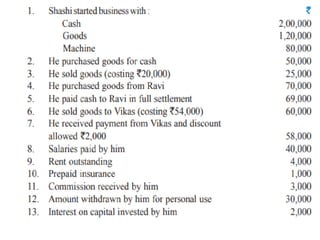
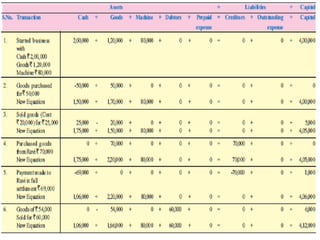
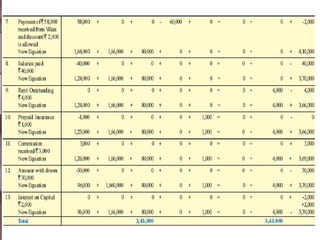
    ILLUSTRATION 1 : On 31stMarch 2001 Mr. PQR resigned from his employment. On that date he receives from his employer Rs. 15,000. On 1st April 2001, he started a business with Rs. 15,000. On 2nd April he opened a Bank A/c by depositing Rs. 10,000 ; on 6th April he purchased 100 units of L at Rs. 10,000. He paid Rs. 5,000 in cash and agreed to pay balance amount after one month.. On 7th April he sold 60 units of L for cash and 30 units of L on 2 months credit term. Selling price
  • 29.
    April 1 Cash introducedin business Rs. 15,000 Cash Rs. 15,000 = Proprietor’s Capital A/c 15,000 Asset (cash) = Capital + Liabilities 15,000 = 15,000 + 0 April 2 : Opened Bank A/c by depositing Rs. 10,000 Cash (15,000 – 10,000) + Bank (10,000) = Capital (15,000) Asset (Cash + Bank) 15,000 = Capital (15,000) + Liability (0) 15,000 = 15,000 + 0 April 6 : Goods purchased for Rs. 10,000 paid Rs. 5,000 in cash; by the transaction as on that his stock of goods amounted to Rs. 10,000. As he paid cash Rs. 5,000, cash balance was nil and liability for goods purchased was Rs. 5,000 Asset = Liabilities + Capital Cash (0) + Bank (10,000) + Stock (10,000) = Capital (15,000) + Liability (5,000) 20,000 = 20,000
  • 30.
    April 7 :He sold 60 units of L for cash @ Rs. 120. He therefore received Rs. 7,200 in cash and 30 units of L for credit @ 120, therefore Rs. 3,600 becomes amount receivable. He thus withdrew 90 units of L costing Rs. 9,000 which he sold at Rs. 10,800 (Rs. 7,200 + Rs. 3,600). He therefore earned an income of Rs. 1,800 which would increase his capital. The above transactions would affect the following Accounts : Assets = Cash (0 + 7,200), Bank (10,000), Debtors 3,600 Stock (10,000 – 9,000) Asset = Cash 7,200 + Bank 10,000 + Debtor 3,600 + Stock 1,000 = 21,800 Capital (15,000 + 1,800) = 16,800 Liability (Creditors) = 5,000 Total Assets (21,800) = Capital (16,800) + Liability (5,000)
  • 31.
    QUESTIO N Anil has thefallowing Transactions: Started business with cash-5000 Purchases goods-400(credit) Purchases goods on cash-400 Withdrew for personal use-70 Paid rent-20 Received interest-10 Sold goods-50 on credit for-70 Paid to creditors-40 Paid for salaries-20 Further capital invested-1000
  • 39.
    Double Entry System of Accounting Systemof Accounting 1. Single Entry System. 2. Double Entry System
  • 40.
    DOUBLE ENTRY SYSTEM Thissystem was introduced by Iuco Pacioli, an Italian, during the year 1494. According to this system, every transaction has two aspects. Both the aspects are recorded in the books of accounts. Accordingly one is giving aspect and the other one is receiving aspect. Each aspect will be recorded in one account and this method of writing every transactions in two accounts is known as Double Entry System of bookkeeping. For example, Purchase of machinery for cash, in this transaction receiving machinery is one aspect is said to be an account is debited and giving cash is another aspect is said to be an account is credited with an equal amount. Thus, the basic principle of this system is that for every debit there must be a corresponding and equal credit and for every credit there must be a corresponding and equal debit.
  • 41.
    Advantages of DoubleEntry System (1)This system provides information about the concern as a whole. (2) It is possible to evaluate the operational efficiency of the concern. (3)This system helps to ascertain the profit or loss by preparing profit and loss account and balance sheet. (4) Accuracy of accounting records can be verified by preparing a Trail Balance. (5) This system helps to know the financial position of a concern for a particular period. (6)It provides information for meeting various
  • 42.
    TYPES OF ACCOUNTS I.Personal Account (a) Natural Person's Accounts. (b) Artificial Person's Accounts. (c) Representative Personal Accounts II. Impersonal Accounts 1-Real Accounts (a) Tangible Real Accounts. (b) Intangible Real Accounts. 2-Nominal Accounts
  • 47.
    ACCOUNTING RULES 1)Personal Account: Debitthe Receiver Credit the Giver (2) Real Account: Debit What comes in Credit What goes out (3) Nominal Account: Debit all expenses and losses Credit all incomes and gains
  • 48.
    JOURNAL Journal -Jour -Diary Whenthe business transactions take place, the first step is to record the same in the books of original entry or subsidiary books or books of prime or journal. Thus journal is a simple book of accounts in which all the business transactions are originally recorded in chronological order and from which they are posted to the ledger accounts at any convenient time. Journalising refers to the act of recording each transaction in the journal and the form in which it is recorded, is known as a
  • 49.
    THE SPECIMEN JOURNALIS AS FOLLOWS: JOURNAL ENTRIES IN THE BOOK OF MR. XYZ Date PARTICULARS L/F Dr.(Amount) Cr.(Amount) 26/9/14 Cash A/c Dr To Capital A/c (Being Mr.XYZ Started Business) 10000 10000
  • 50.
    The journal hasfive columns, viz. (1) Date (2) Particulars (3) Ledger Folio (4) Amount (Debit) (5) Amount (Credit)
  • 63.
    SUB-DIVISION OF JOURNAL 1.Sales Day Book- to record all credit sales. 2. Purchases Day Book- to record all credit purchases. 3. Cash Book- to record all cash transactions of receipts as well as payments. 4.Sales Returns Day Book- to record the return of goods sold to customers on credit. 5.Purchases Returns Day Book- to record the return of goods purchased from suppliers on credit. 6. Bills Receivable Book- to record the details of all the bills received. 7. Bills Payable Book- to record the details of all the bills
  • 64.
    Ledger A ledger isa book containing accounts in which the classified and summarized information from the journals is posted as debits and credits. It is also called the second book of entry.
  • 71.
    TRIAL BALANCE At theend of the financial period (or at some other date) these balances are extracted and a schedule is prepared in journal form is called a Trial Balance. Thus the total of debit balances appearing in the Trial Balance must agree with the total of credit balances of appearing in the Trial Balance.
  • 72.
    OBJECTS OF PREPARING TRIALBALANCE : 1.It forms the very basic on which final accounts are prepared. 2.Ithelps in knowing the balance on any particular account in the ledger. 3. It is used as a test of arithmetical accuracy.
  • 73.
    FORMAT OF TRIALBALANCE Trial Balance Name of Accounts (At 31st Dec 2021) LF Dr. (Amount) Cr. (Amount) Total
  • 77.
    ERRORS NOT DISCLOSEDBY TRIAL BALANCE 1 Errors or omission ; omission to record any transaction 2Compensating errors. 3-Errors of duplication. 4-Errors of principle – when the accounting principle is disregarded e.g. a capital item as revenue item and vice versa, i.e. purchase of furniture posted to Purchases Account.
  • 78.
    SUSPENSE ACCOUNT The differencein the Trial Balance may be put in an account known as the Suspense Account, where the error causing difference cannot be located immediately and the books of accounts have to be closed. Suspense account is an account to which the difference in the trial balance has been put temporarily. If the debit side is short this account is debited and if the credit side is short it will be credited. However the opening of a suspense account does not mean that the errors need not be found out.
  • 79.
    TRADING ACCOUNT Trading accountis prepared for an accounting period to find the trading results or gross margin of the business i.e., the amount of gross profit the concern has made from buying and selling during the accounting period. The difference between the sales and cost of sales is gross profit. For the purpose of computing cost of sales, value of opening stock of finished goods, purchases, direct expenses on purchasing and manufacturing are added up and closing stock of finished goods is reduced. The balance of this account shows gross profit or loss which is transferred to the profit and loss account.
  • 80.
    ACCOUNT IS SHOWNBELOW TRADING ACCOUNT FOR THE YEAR ENDED …………… Particulars Amt. Particulars Amt. Opening stock Net Purchases ------- Less- Purchases Return------- Wages Carriage Octroi Import Duty Clearing Charges Store Consumed Royalty Manufacturing Expenses ------ ------- -------- -------- --------- --------- --------- --------- -------- --------- -------- Net Sales Less-Sales Return Closing Stock Gross Loss* -------- ---------
  • 81.
    PROFIT AND LOSSACCOUNT In the words of Prof. Carter “Profit and loss account is an account into which all gains and losses are collected in order to ascertain the excess of gains over the losses or vice versa.” Profit and loss account starts with gross profit brought down from trading account on the credit side. (If gross loss, on the debit side). All the indirect expenses are debited and all the revenue incomes are credited to the profit and loss account and then net profit or loss is calculated. If incomes or credit is more, than the expenses or debit, the difference is net profit. On the other hand if the expenses or debit side is more, the difference is net loss.
  • 82.
    PROFIT AND LOSSA/C Profit and Loss a/c For the Year Ending…….. Particulars Amount Particulars Amount To Gross loss To Administration expenses Salaries Rent rates & Printing & Stationery Postage and Telegrams Telephone expenses Legal charges Insurance Audit fees Directors fees General expenses To Selling & Distribution Expenses Showroom expenses Advertising Commission paid to salesmen Bad debts Provision for doubtful debts Godown rent Carriage outward Upkeep of delivery vans To Depreciation and maintenance Depreciatio n Repairs To Financial expenses By Gross profit b/d By Dividends received By Interest received By Discount received By commission received By Rent received By Profit on sale of assets By Sundry revenue receipts By Net loss transferred to capital A/c (Bal. Fig)*
  • 83.
    PURPOSE AND IMPORTANCEOF PREPARING PROFIT AND LOSS ACCOUNT. To determine the future line of action To know the net profit or loss of business To calculate different ratios To compare the actual performance of the business with the desired one.
  • 84.
    RULES: 1. Only revenuereceipts should be entered 2.Only revenue expenses together with losses should be taken into account. 3. Expenses and incomes relating only to the period for which the accounts are being prepared should be considered. 4.All expenses and income relating to the period concerned should be considered even if the expense has not yet been paid in cash or the income has not yet been received in cash. 5. All personal expenses of the proprietor and partners must be debited to the capital or drawings accounts and must not be debited to the profit and loss account. Similarly any income has been earned from the private assets of the proprietor which is received by firm, it must be credited to the capital or drawings account.
  • 85.
    BALANCE SHEET The Balancesheet comprises of lists of assets, liabilities and capital fund on a given date. It presents the financial position of a concern as revealed by the accounting records. It reflects the assets owned by the concern and the sources of funds used in the acquisition of those assets. In simple language it is prepared in such a way that true financial position is revealed in a form easily readable and more rapidly understood than would be possible from a view of the detailed information contained in the accounting records prepared during the currency of the accounting period. Balance sheet may be called a ‘statement of equality’ in which equality is established by representing values of assets on one side and values of liabilities and owners'
  • 86.
    ASSETS: Fixed assets Current Assets Tangibleassets Intangible assets Fictitious assets Wasting assets Contingent assets
  • 87.
    LIABILITIES Owner's capital Long term LiabilitiesCurrent liabilities Contingent liabilities
  • 88.
    PRFORMA OF BALANCESHEET Balance Sheet as on ……… Amoun t Liabilities Assets Amoun t Capital Add: Net profit Add: Interest on capital Less: Drawing Less: Int. on drawings Less: Loss if any Long term liabilities Loan Bank loan Current liabilities Sundry creditors Bills payable Bank overdraft Creditors Outstanding exp. Income received in Fixed assets Goodwill Land & Buildings Loose tools Furniture & fixtures Vehicles Patent s Trade marks Long term loans (advances ) Investmen ts Current assets Sundry debtors Closing stock Bills receivable Prepaid expenses Accrued incomes Cash at bank Cash in hand Fictitious assets Preliminary expenses Advertisement expenses Underwriting commission Discount
  • 89.
    ADJUSTMENTS Closing Stock Outstanding Expenses PrepaidExpenses Depreciation Bad Debts Provision for doubtful debts Provision for discount on debtors Interest on capital Interest on Drawings Loss of goods by fire or accidents
  • 92.
    MANUFACTURING ACCOUNT Manufacturing concerns which convert raw material intofinished product is required to prepare manufacturing account and then prepare trading and profit and loss account. This is necessary because they have to ascertain cost of goods manufactured,gross profit and net profit.
  • 93.
    PRFORMA OF MANUFACTURING A/C ManufacturingA/c for the year ended…….. To work-in-progress (opening ) To Material used Opening stock xxx Add: Purchases xxx Less: Closing stock xxx To Wages To Factory expenses To Purchase expenses To Import duty To Carriage inward To Depreciation on machinery To Repairs to Machinery ------ ------ ------ ------ ------ ------ ------ ------ ------ By Sale of scrap By Work-in-progress (closing) By Cost of goods produced transferred to trading A/c (bal.fig) ------- ------- -------
  • 94.
    P&L appropriation a/c: Profitand loss account shows only the net profit or net loss from operation of business but profit and loss appropriation accounts shows all non- operational adjustment which is needed for proper distribution of net profit between shareholders and company for future growth.
  • 95.
    DEBIT SIDE 1. Transferto reserve /general reserve. 2.Transfer to dividend/interim dividend/proposed dividend. 3. Debenture redemption fund account. 4. Dividend equalization fund account. 5. Income tax for previous year not provided for. 6. Surplus transfer to balance sheet. Credit Side
  • 96.
  • 97.
    ACCOUNTING STANDARD (AS)6 DEPRECIATION ACCOUNTING Depreciable asset arising from use, effluxion of time or obsolescence through technology and market changes. Depreciation is allocated so as to charge a fair proportion of the depreciable amount in each accounting period during the expected useful life of the asset. Depreciation includes amortisation of assets whose useful life is predetermined.
  • 98.
    FOLLOWING ASSETS ARE EXCLUDEDFROM DEPRECIATION (i)forests, plantations and similar regenerative natural resources; (ii)wasting assets including expenditure on the exploration for and extraction of minerals, oils, natural gas and similar non-regenerative resources; (iii) expenditure on research and development; (iv) goodwill and other intangible assets; (v) live stock