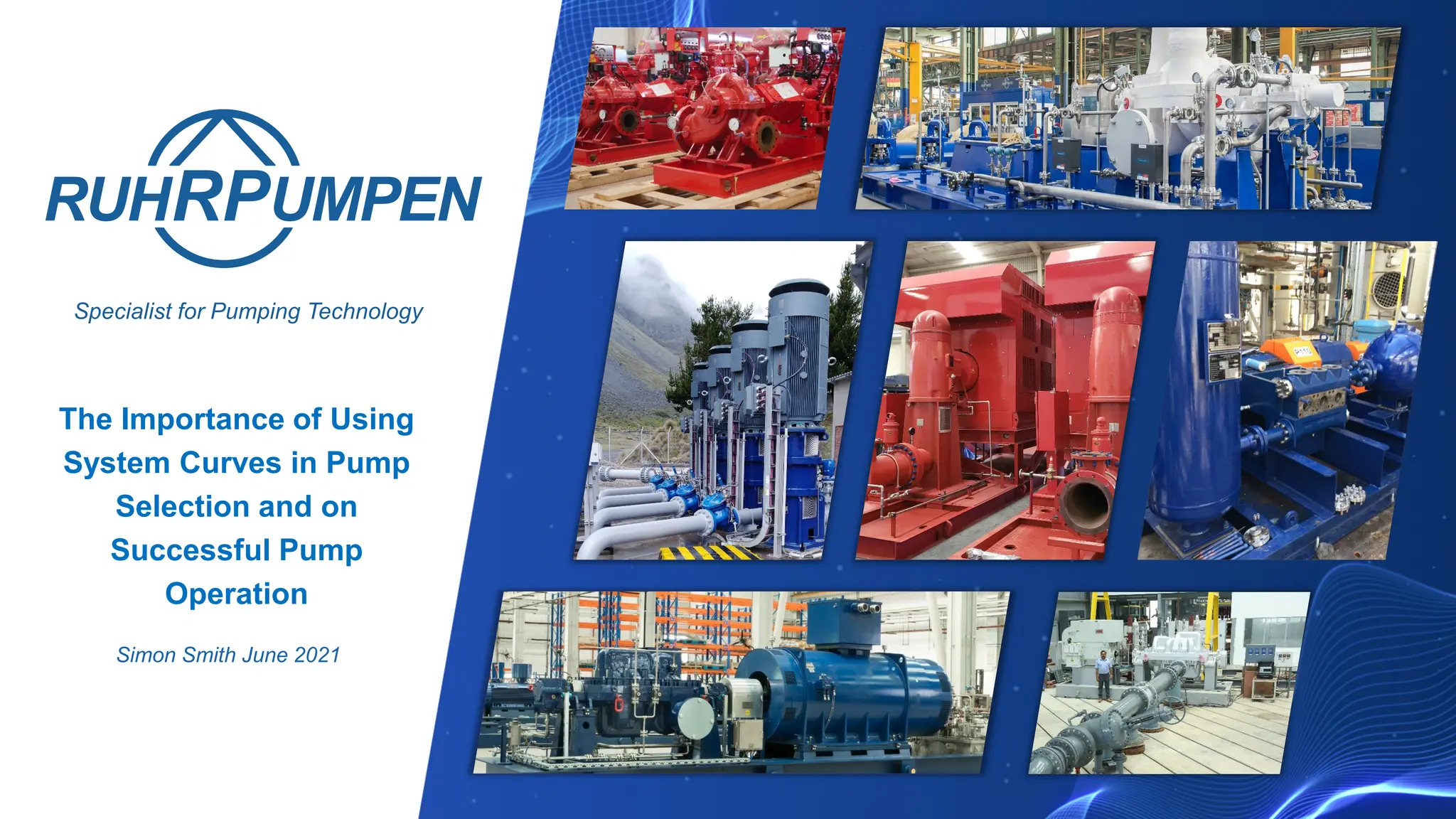
Specialist for Pumping Technology
The Importance of Using
System Curves in Pump
Selection and on
Successful Pump
Operation
Simon Smith June 2021
Simon graduated with an honours degree in
Chemical Engineering from the University of
Surrey in 1978 and began a long career in
the engineered pump industry spanning 40
years (so far!) with Peerless Pump, BW/IP
International / Flowserve, SPP Pumps,
Ruhrpumpen and Ebara Cryodynamics.
Over his long career he has filled various
roles as Applications Engineer / Manager,
Project Manager, Key Account Specialist,
Vertical Pump Product Specialist,
International Sales Engineer / Manager /
Director and he has considerable experience
in Training & Mentoring young engineers.
www.ruhrpumpen.com
Presenter Profile – Simon Smith
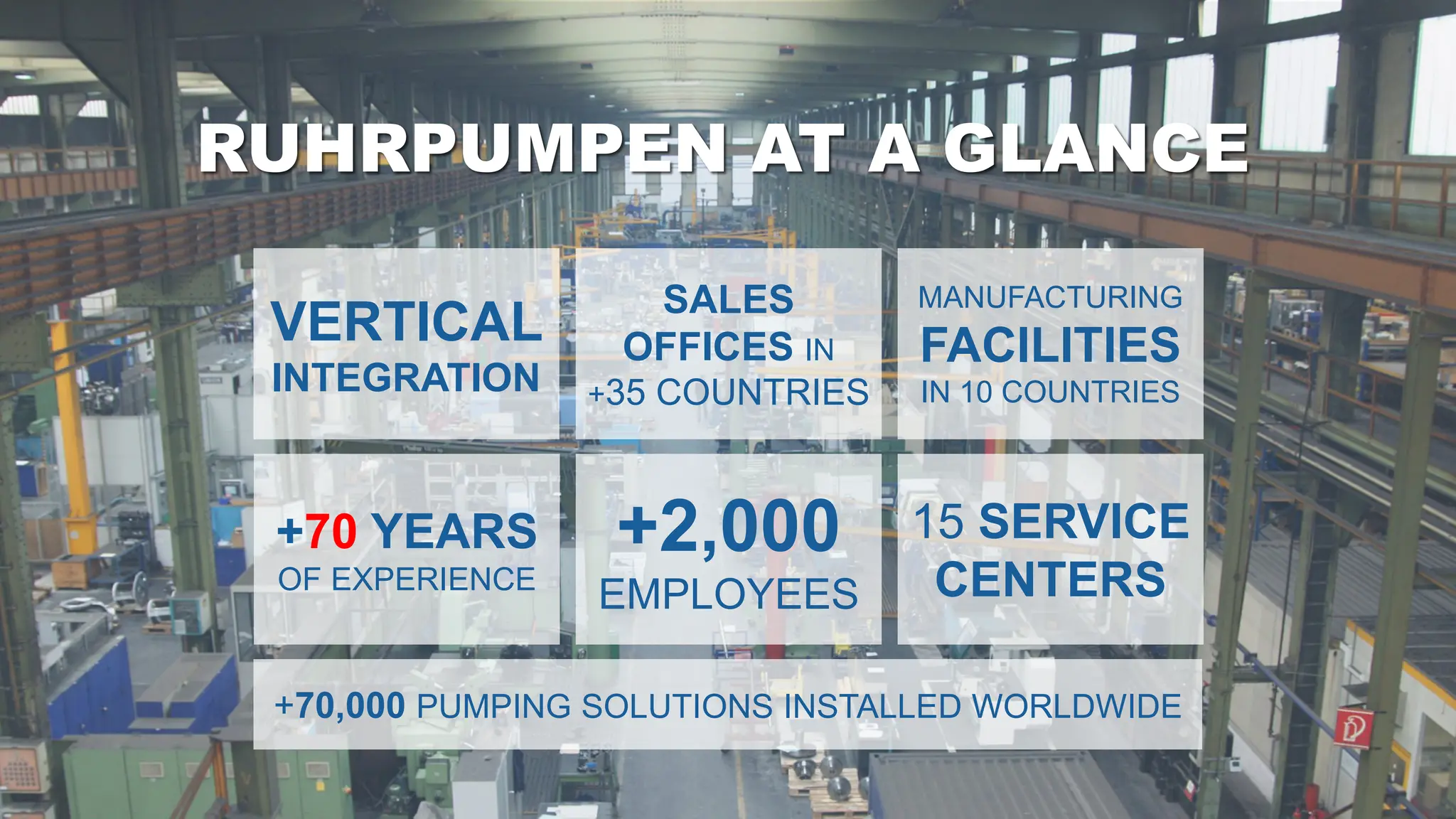
RUHRPUMPEN AT A GLANCE
VERTICAL
INTEGRATION
+70 YEARS
OF EXPERIENCE
SALES
OFFICES IN
+35 COUNTRIES
+2,000
EMPLOYEES
MANUFACTURING
FACILITIES
IN 10 COUNTRIES
15 SERVICE
CENTERS
+70,000 PUMPING SOLUTIONS INSTALLED WORLDWIDE
A GLOBAL COMPANY
MANUFACTURING FACILITIES
 USA [Tulsa]
 Germany [Witten]
 Mexico [Monterrey]
 Brazil [Rio de Janeiro]
 Argentina [Buenos Aires]
 Egypt [Suez]
 India [Chennai]
 China [Changzhou]
 Russia [Moscow]
 United Kingdom [Lancing]
Manufacturing facility
& Service center
Service center
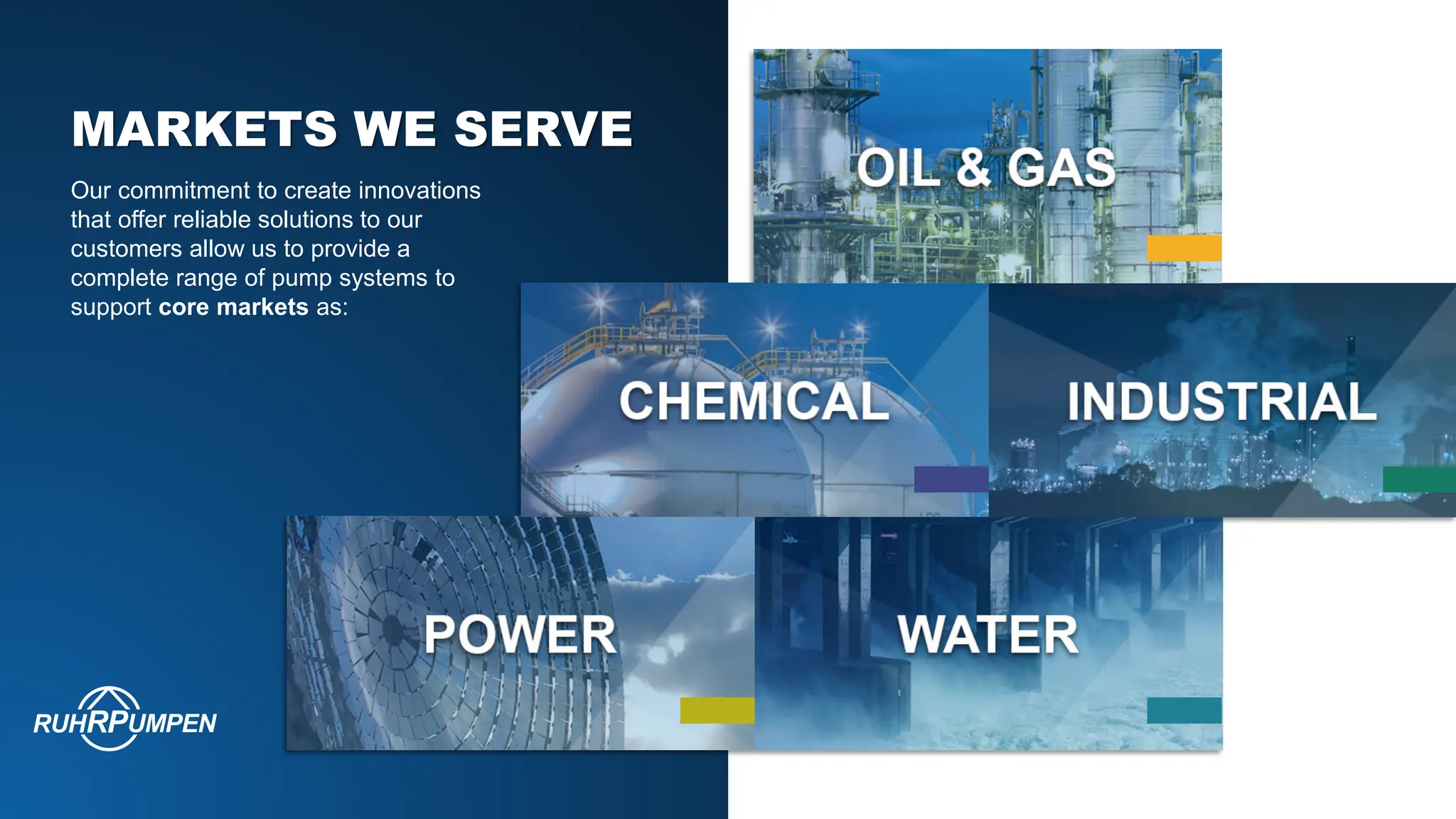
MARKETS WE SERVE
Our commitment to create innovations
that offer reliable solutions to our
customers allow us to provide a
complete range of pump systems to
support core markets as:
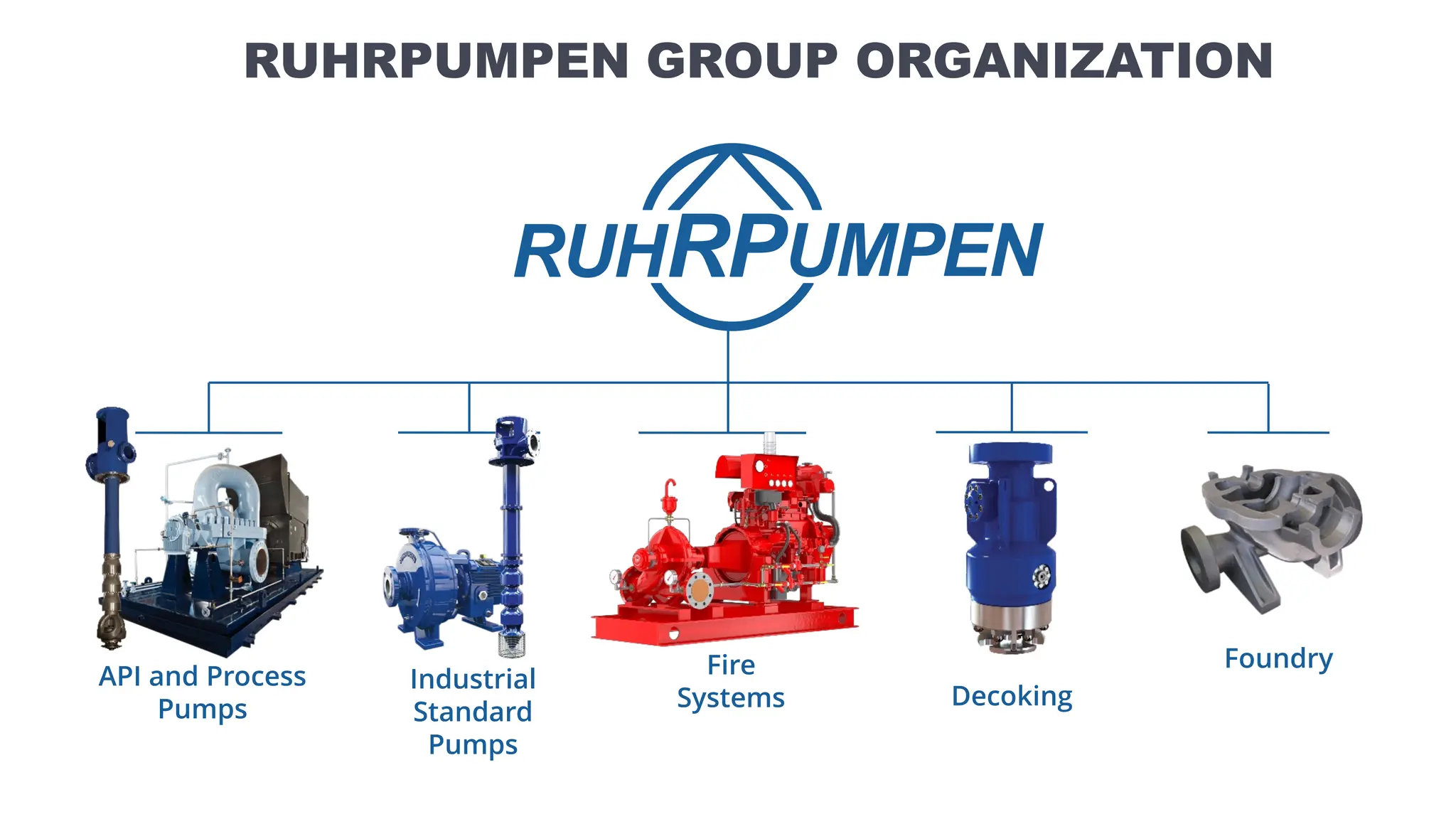
RUHRPUMPEN GROUP ORGANIZATION
API and Process
Pumps
Industrial
Standard
Pumps
Fire
Systems Decoking
Foundry
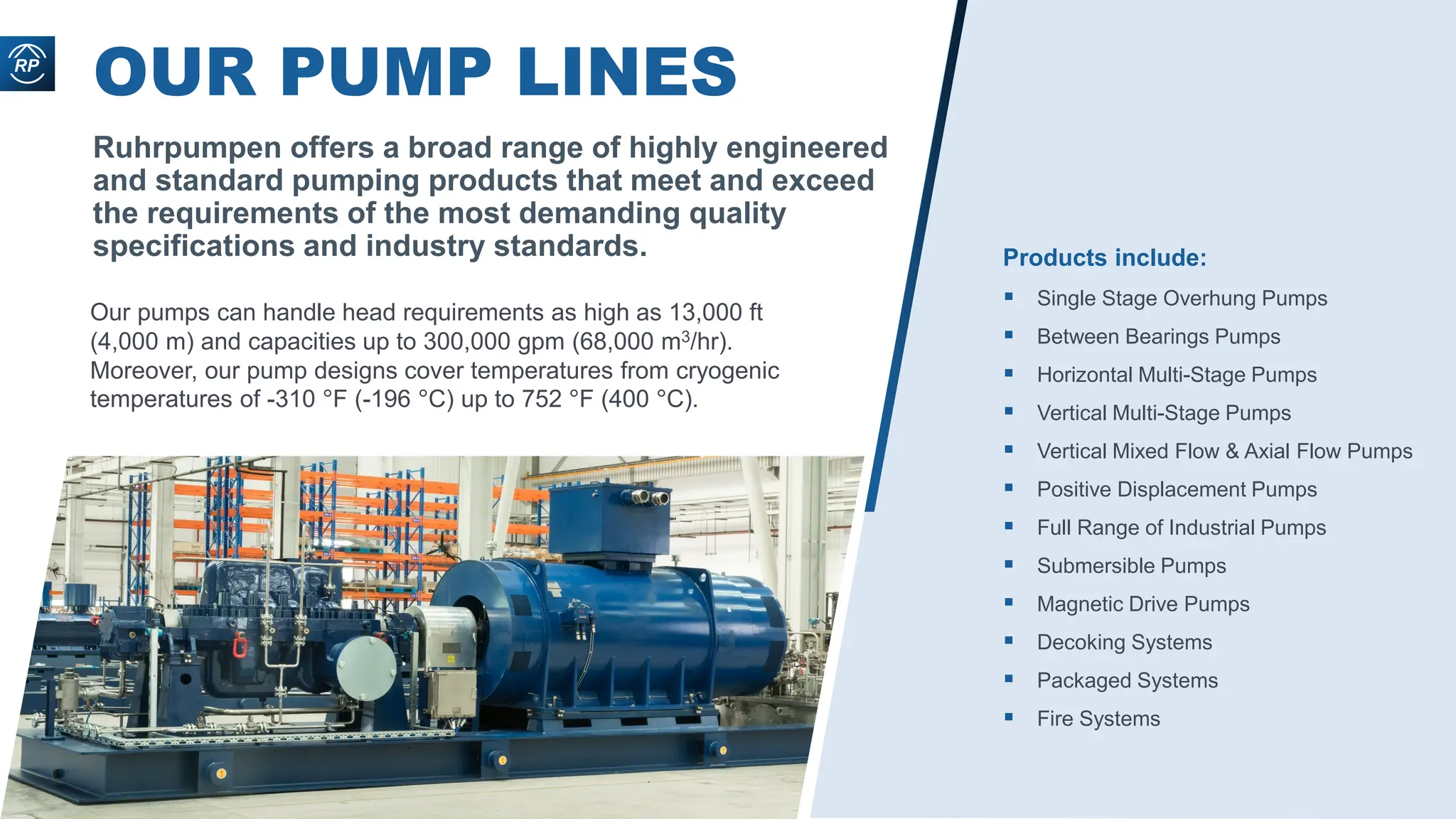
OUR PUMP LINES
Ruhrpumpen offers a broad range of highly engineered
and standard pumping products that meet and exceed
the requirements of the most demanding quality
specifications and industry standards.
Our pumps can handle head requirements as high as 13,000 ft
(4,000 m) and capacities up to 300,000 gpm (68,000 m3/hr).
Moreover, our pump designs cover temperatures from cryogenic
temperatures of -310 °F (-196 °C) up to 752 °F (400 °C).
Products include:
 Single Stage Overhung Pumps
 Between Bearings Pumps
 Horizontal Multi-Stage Pumps
 Vertical Multi-Stage Pumps
 Vertical Mixed Flow & Axial Flow Pumps
 Positive Displacement Pumps
 Full Range of Industrial Pumps
 Submersible Pumps
 Magnetic Drive Pumps
 Decoking Systems
 Packaged Systems
 Fire Systems
www.ruhrpumpen.com
“The Importance of Using System Curves in
Pump Selection and on Successful Pump
Operation”
www.ruhrpumpen.com
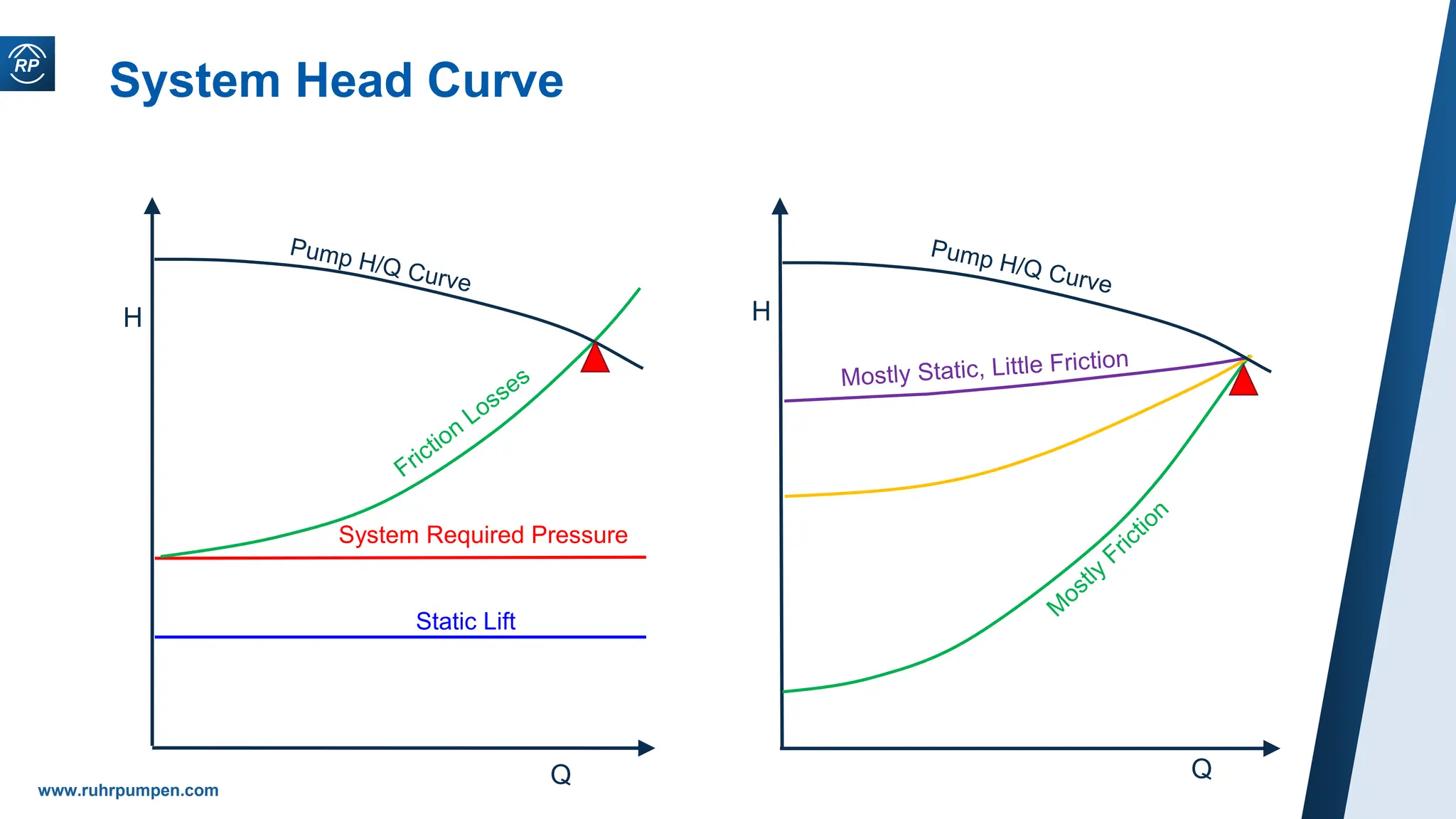
System Head Curve
Q
H
Static Lift
System Required Pressure
Q
H
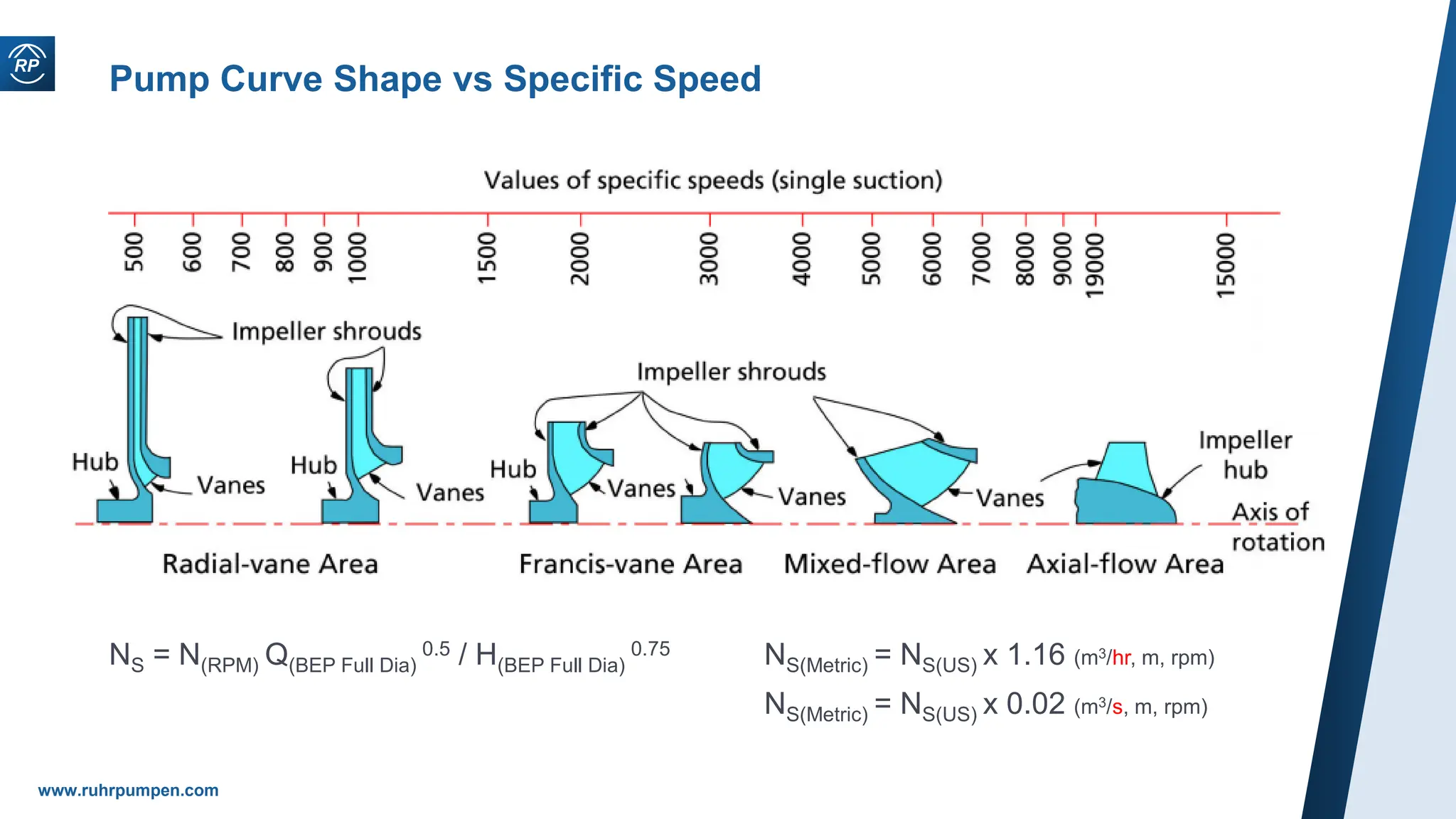
NS = N(RPM) Q(BEP Full Dia)
0.5 / H(BEP Full Dia)
0.75 NS(Metric) = NS(US) x 1.16 (m3/hr, m, rpm)
NS(Metric) = NS(US) x 0.02 (m3/s, m, rpm)
www.ruhrpumpen.com
Pump Curve Shape vs Specific Speed
www.ruhrpumpen.com
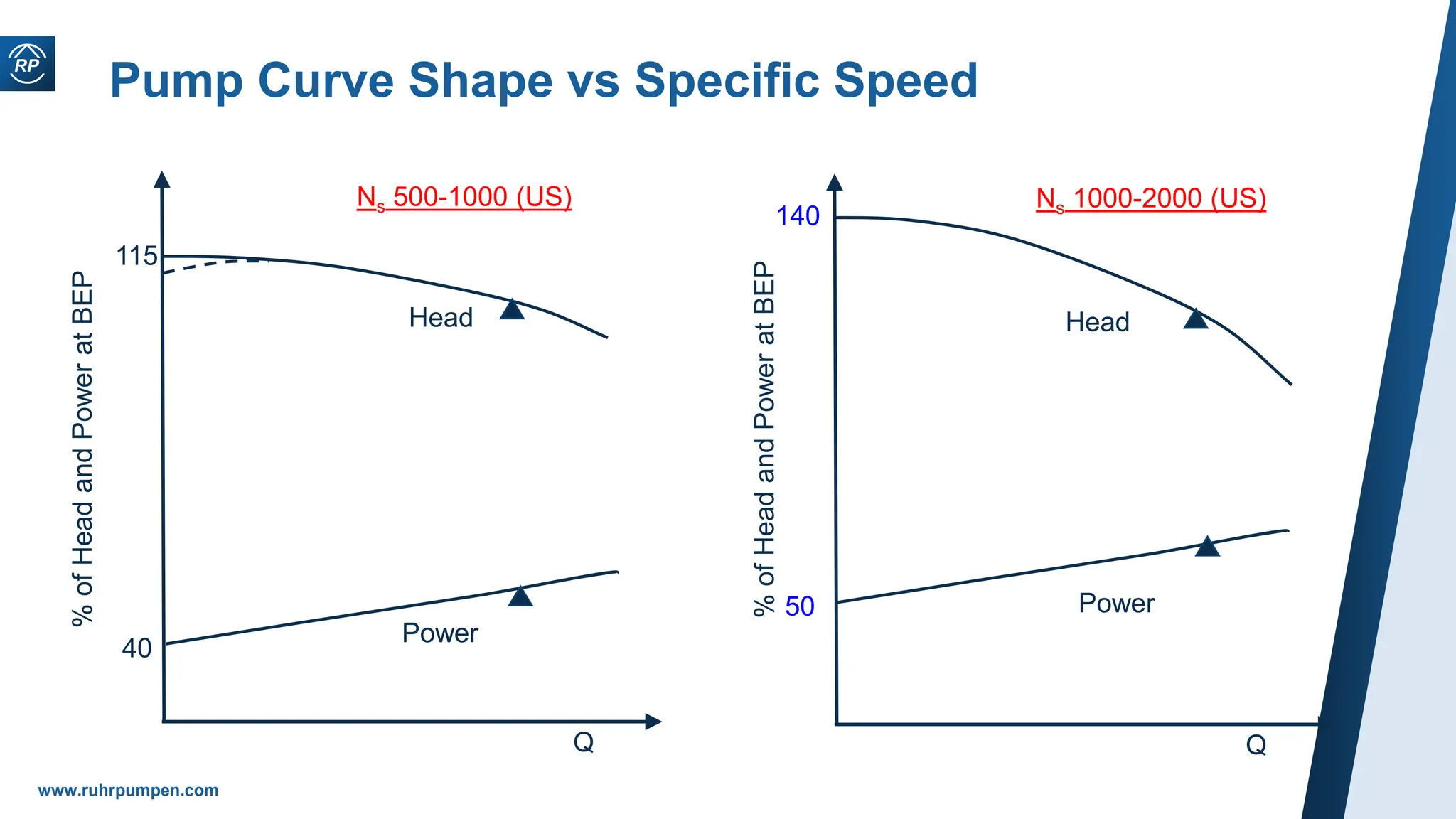
Pump Curve Shape vs Specific Speed
Q
%
of
Head
and
Power
at
BEP
Q
40
115
Ns 500-1000 (US)
Head
Power
Head
Power
Ns 1000-2000 (US)
140
50
%
of
Head
and
Power
at
BEP
www.ruhrpumpen.com
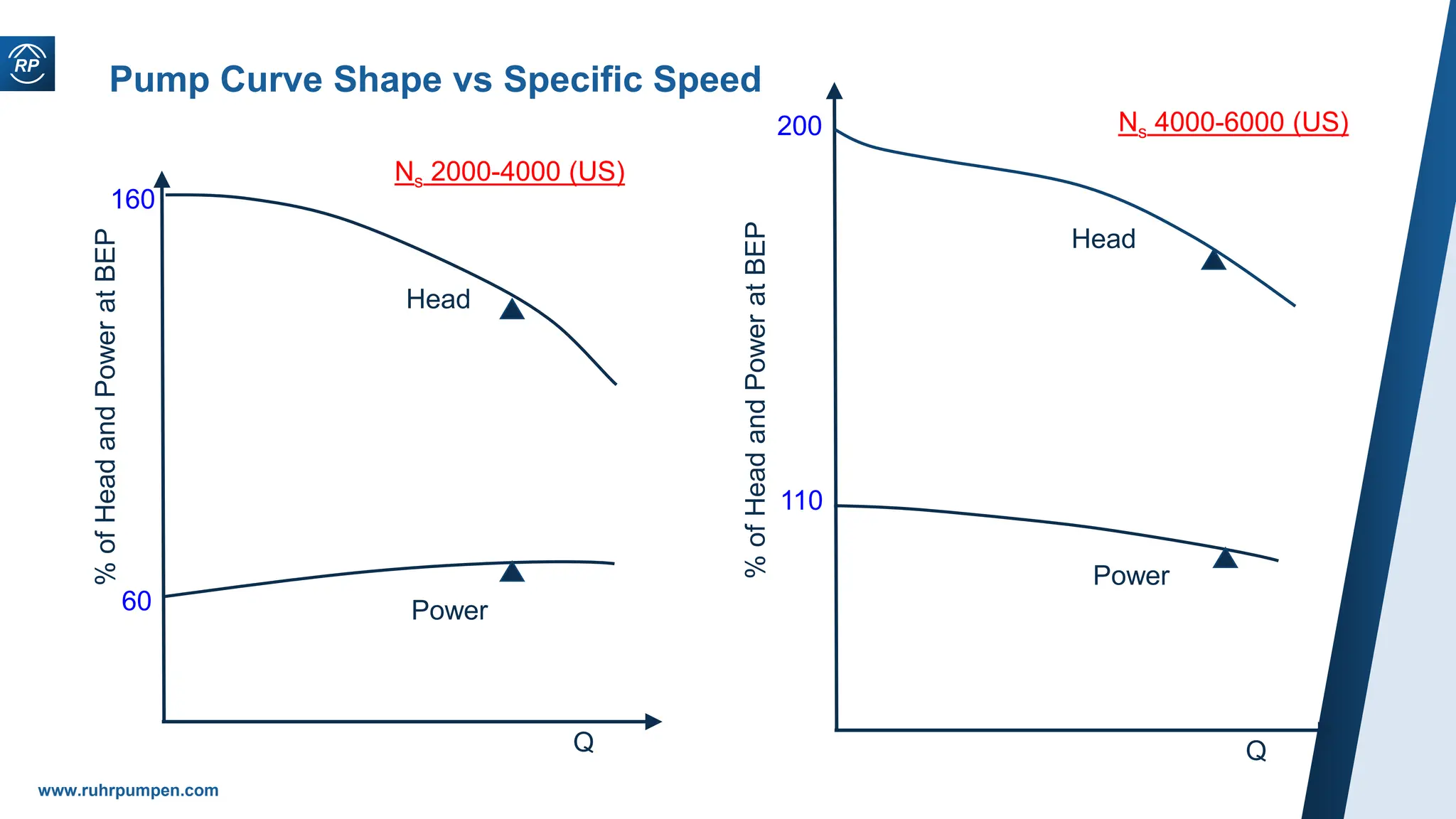
Pump Curve Shape vs Specific Speed
Q
%
of
Head
and
Power
at
BEP
60
160
Ns 2000-4000 (US)
Head
Power
Head
Power
Ns 4000-6000 (US)
200
110
%
of
Head
and
Power
at
BEP Q
www.ruhrpumpen.com
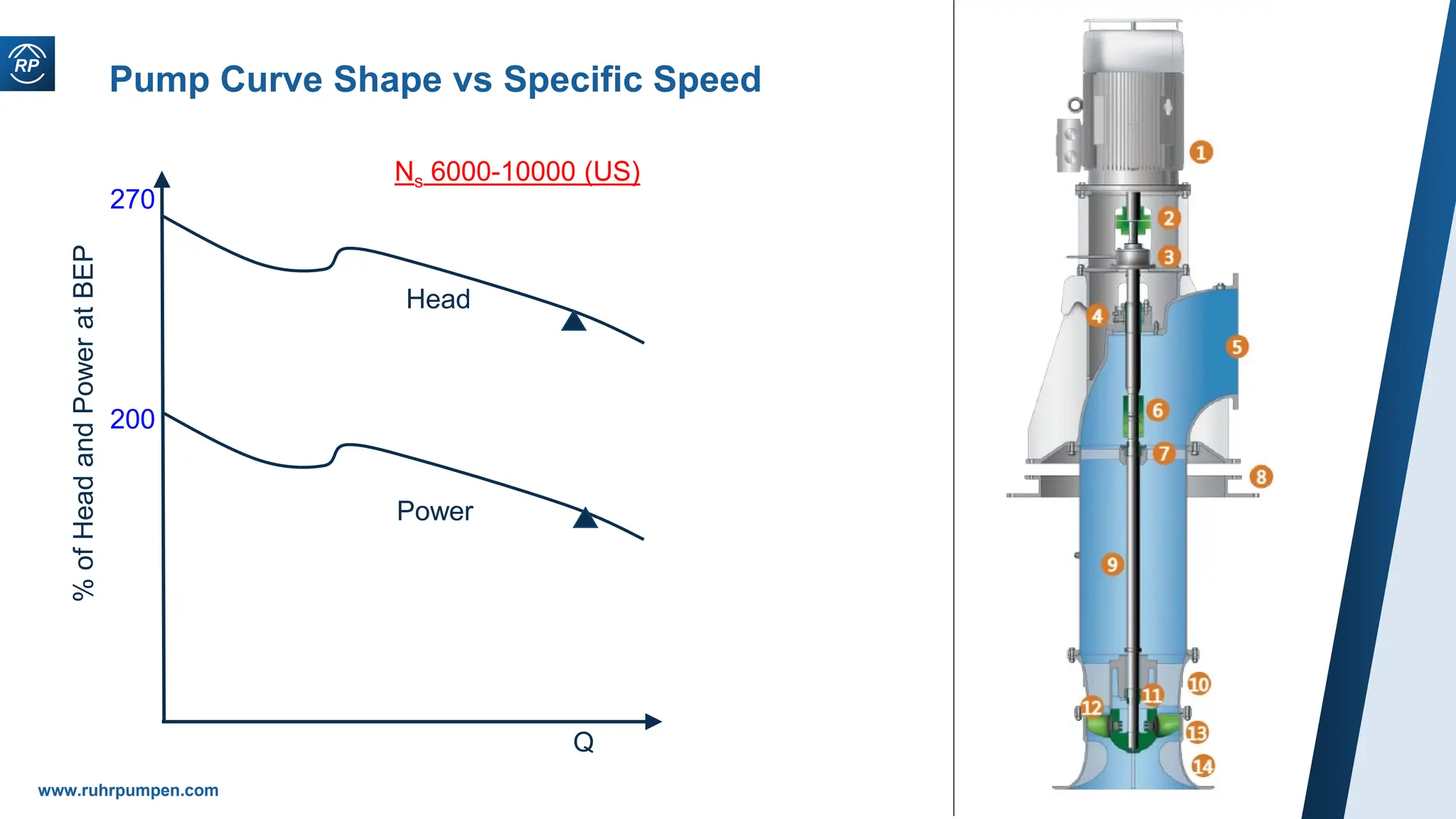
Pump Curve Shape vs Specific Speed
Q
%
of
Head
and
Power
at
BEP
200
270
Ns 6000-10000 (US)
Head
Power
www.ruhrpumpen.com
www.ruhrpumpen.com
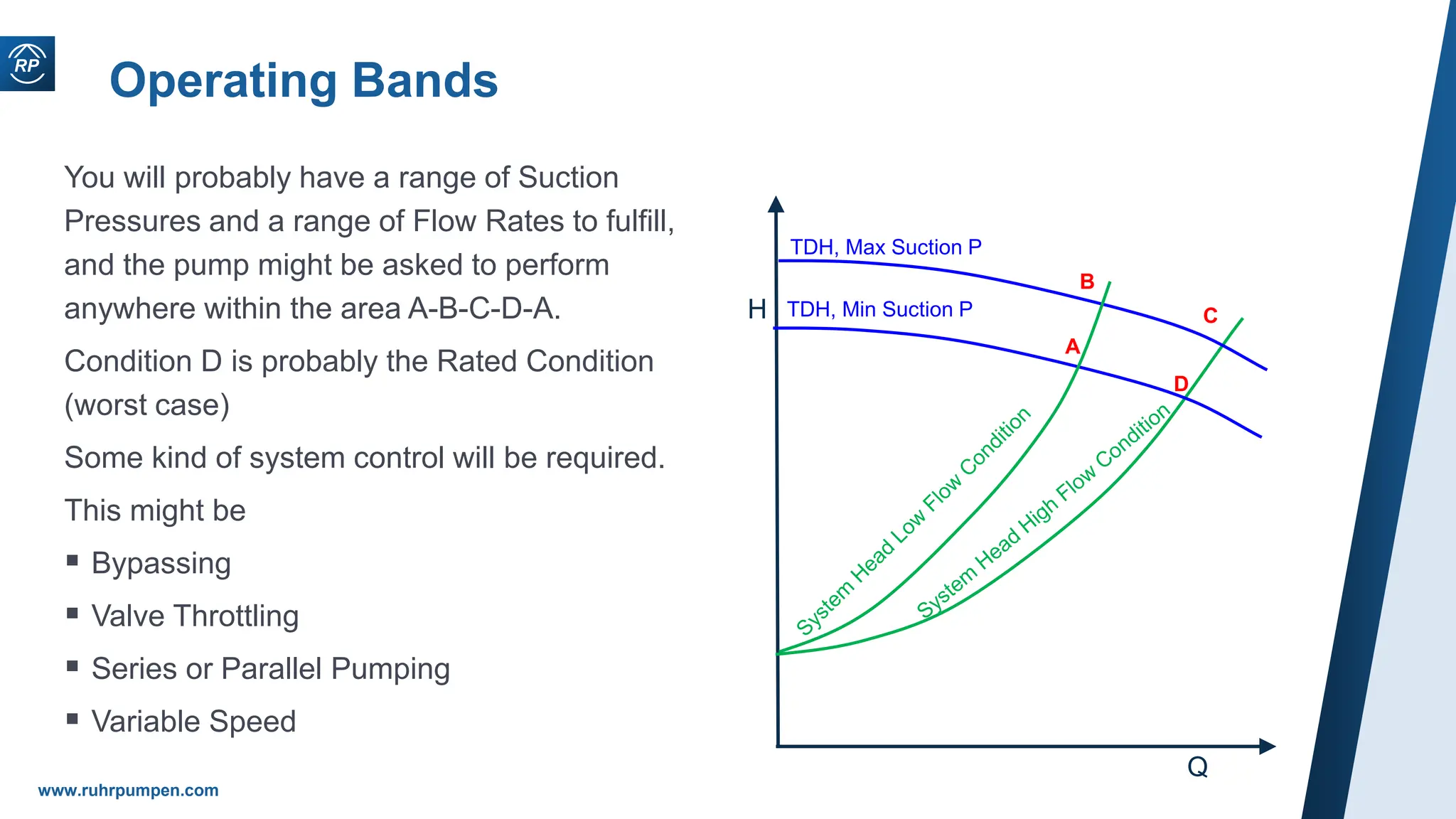
You will probably have a range of Suction
Pressures and a range of Flow Rates to fulfill,
and the pump might be asked to perform
anywhere within the area A-B-C-D-A.
Condition D is probably the Rated Condition
(worst case)
Some kind of system control will be required.
This might be
 Bypassing
 Valve Throttling
 Series or Parallel Pumping
 Variable Speed
www.ruhrpumpen.com
Operating Bands
Q
H
A
B
C
D
TDH, Max Suction P
TDH, Min Suction P
www.ruhrpumpen.com
System Control by Throttling
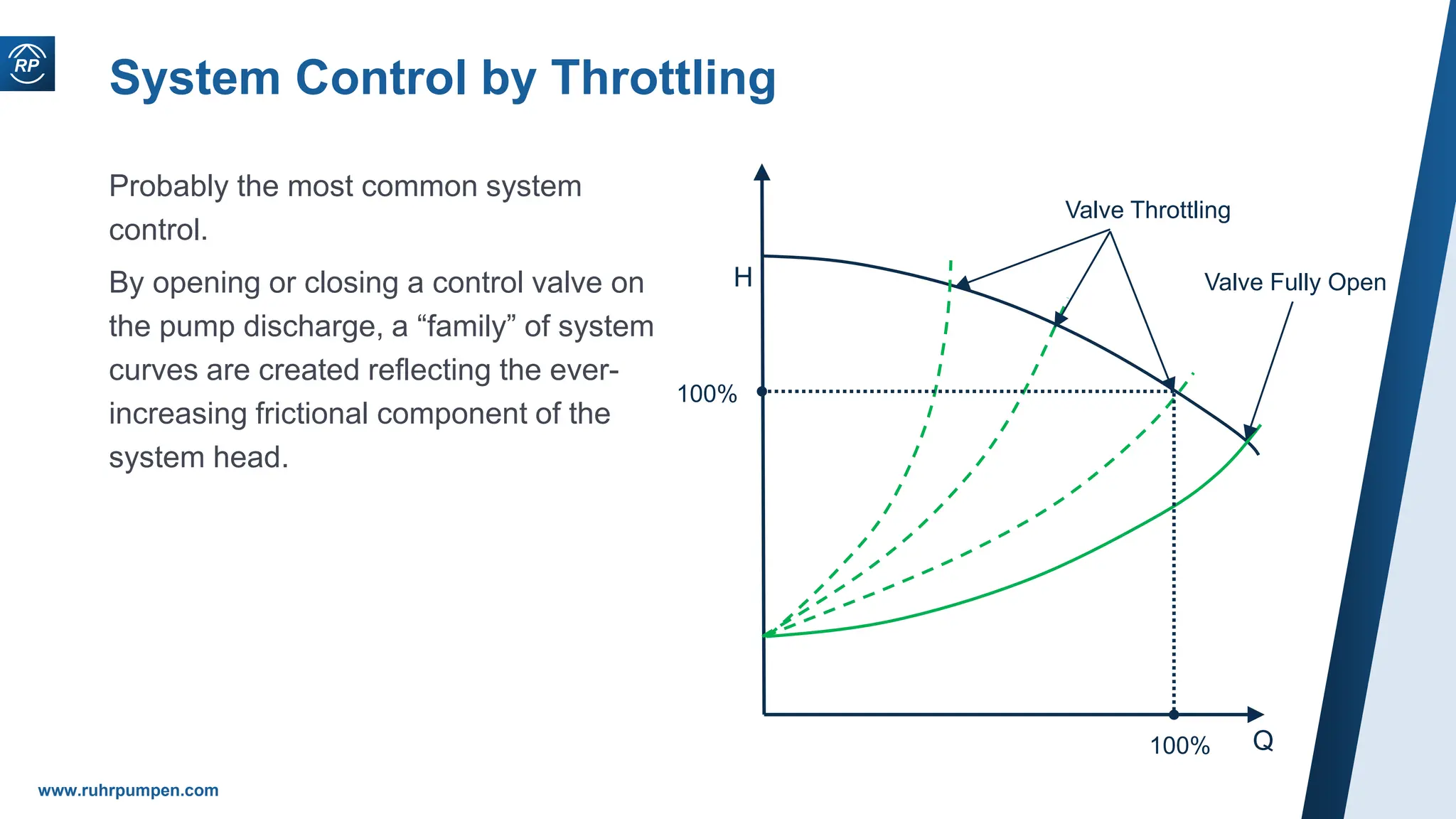
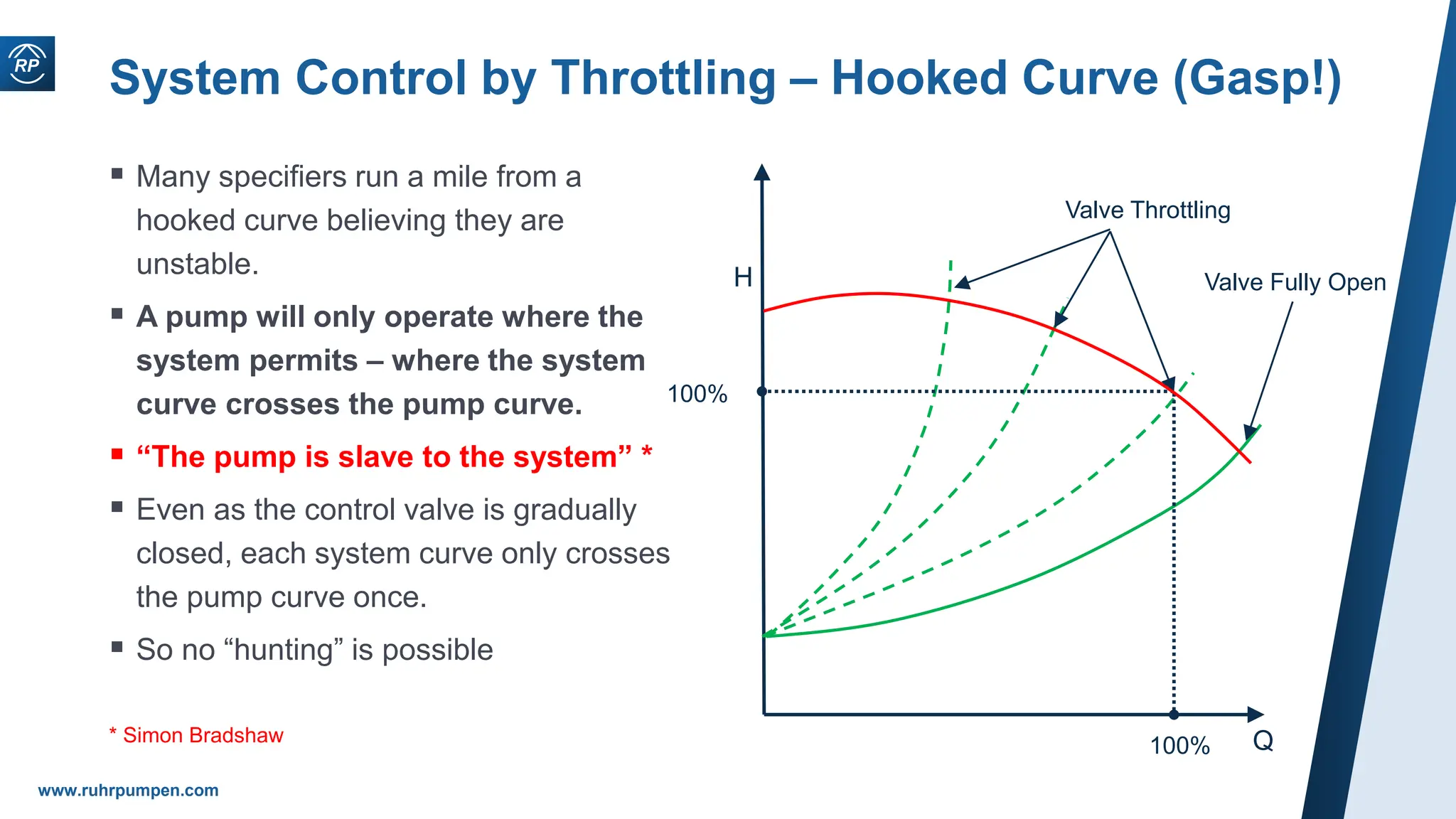
Probably the most common system
control.
By opening or closing a control valve on
the pump discharge, a “family” of system
curves are created reflecting the ever-
increasing frictional component of the
system head.
Q
H
100%
100%
Valve Throttling
Valve Fully Open
www.ruhrpumpen.com
System Control by Throttling – Hooked Curve (Gasp!)
 Many specifiers run a mile from a
hooked curve believing they are
unstable.
 A pump will only operate where the
system permits – where the system
curve crosses the pump curve.
 “The pump is slave to the system” *
 Even as the control valve is gradually
closed, each system curve only crosses
the pump curve once.
 So no “hunting” is possible
* Simon Bradshaw Q
H
100%
100%
Valve Throttling
Valve Fully Open
www.ruhrpumpen.com
System Control by Throttling – Hooked Curve (Gasp!) Extreme Case
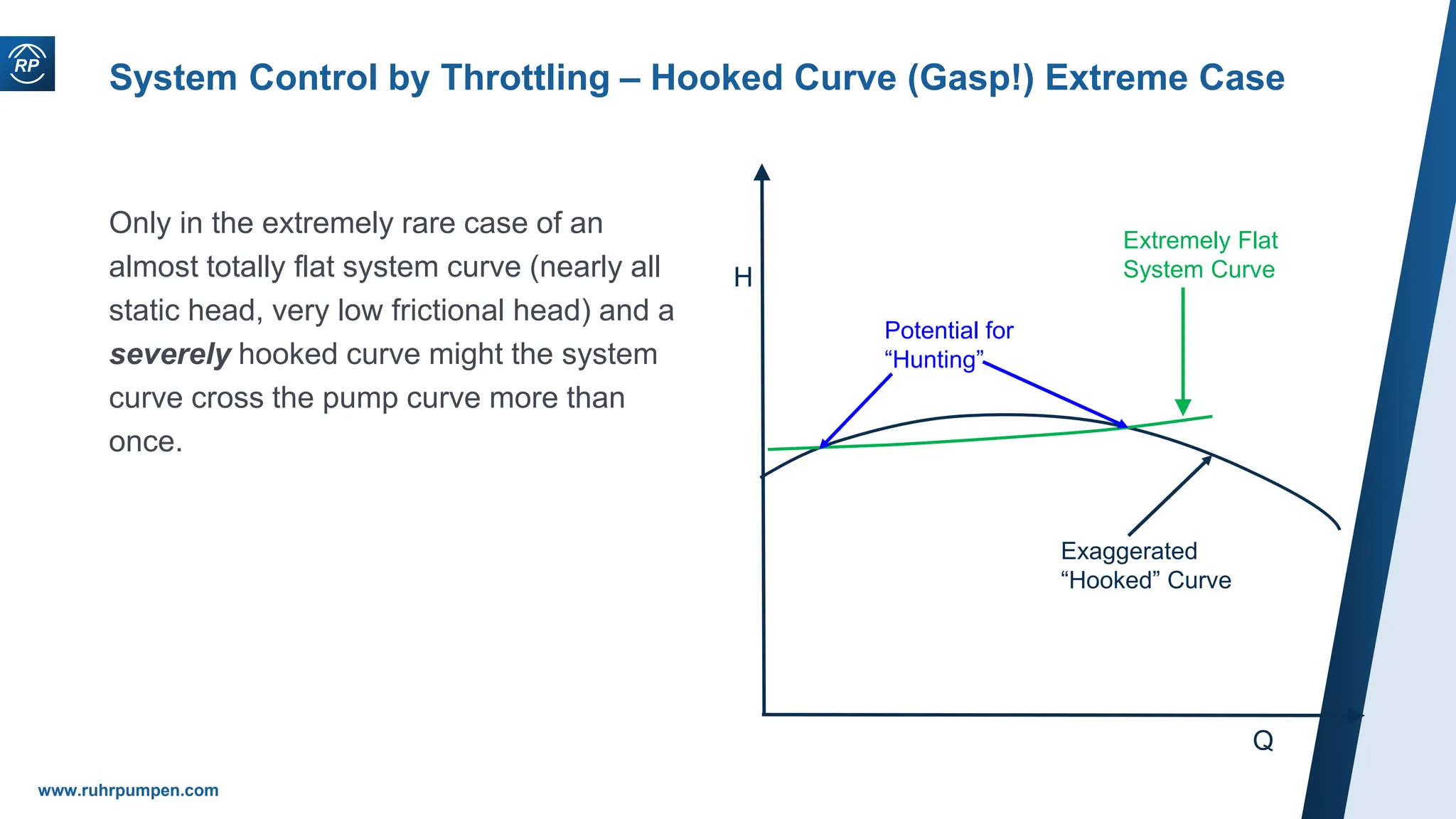
Only in the extremely rare case of an
almost totally flat system curve (nearly all
static head, very low frictional head) and a
severely hooked curve might the system
curve cross the pump curve more than
once.
Q
H
Extremely Flat
System Curve
Exaggerated
“Hooked” Curve
Potential for
“Hunting”
www.ruhrpumpen.com
Steep or Flat Pump Curve?
 The question is “What do you want to achieve?”
 With a Flat pump curve small changes in System
Head lead to large changes in Flow.
 With a steep pump curve small changes in System
Head lead to small changes in Flow.
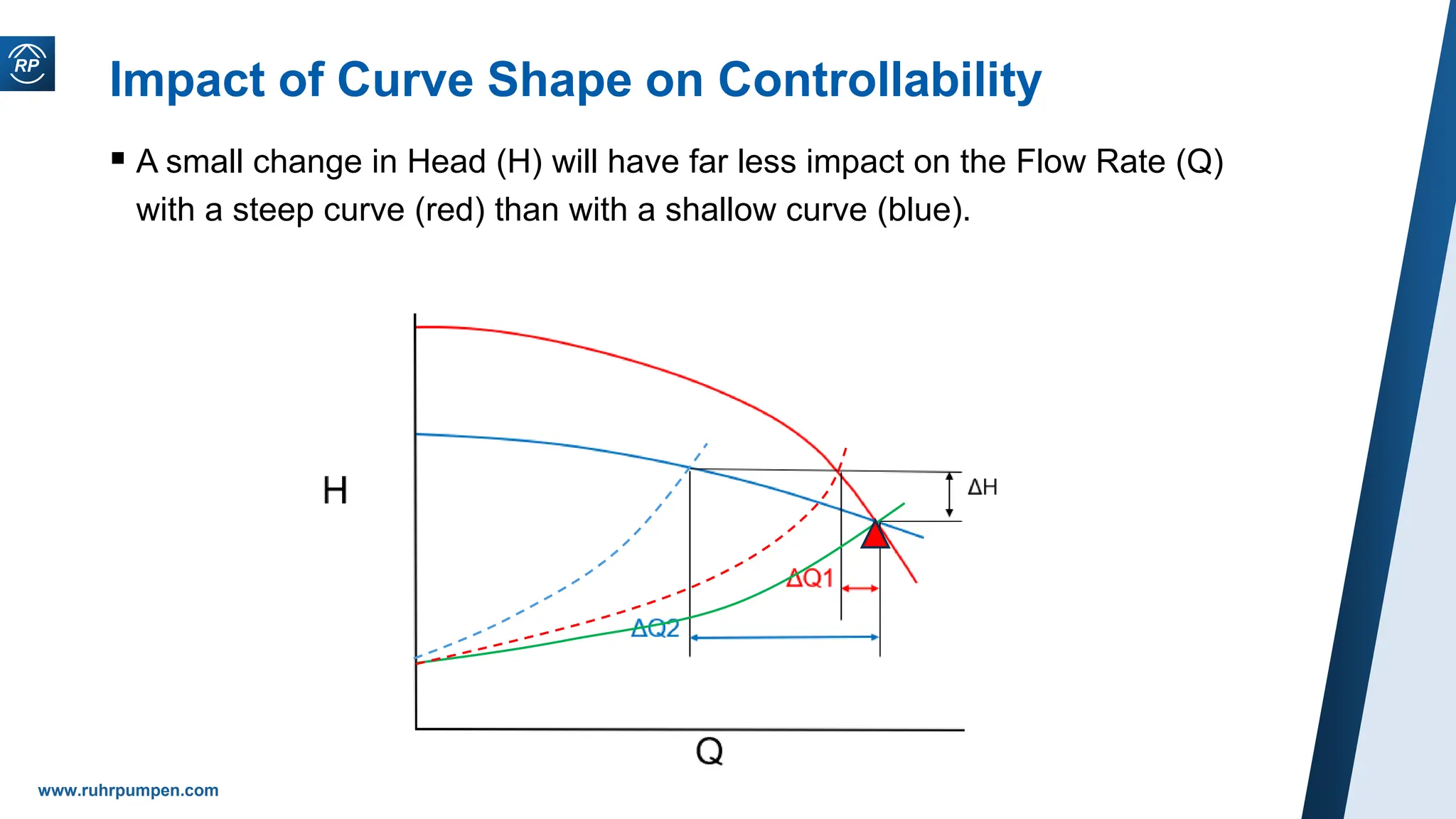
 A small change in Head (H) will have far less impact on the Flow Rate (Q)
with a steep curve (red) than with a shallow curve (blue).
www.ruhrpumpen.com
Impact of Curve Shape on Controllability
www.ruhrpumpen.com
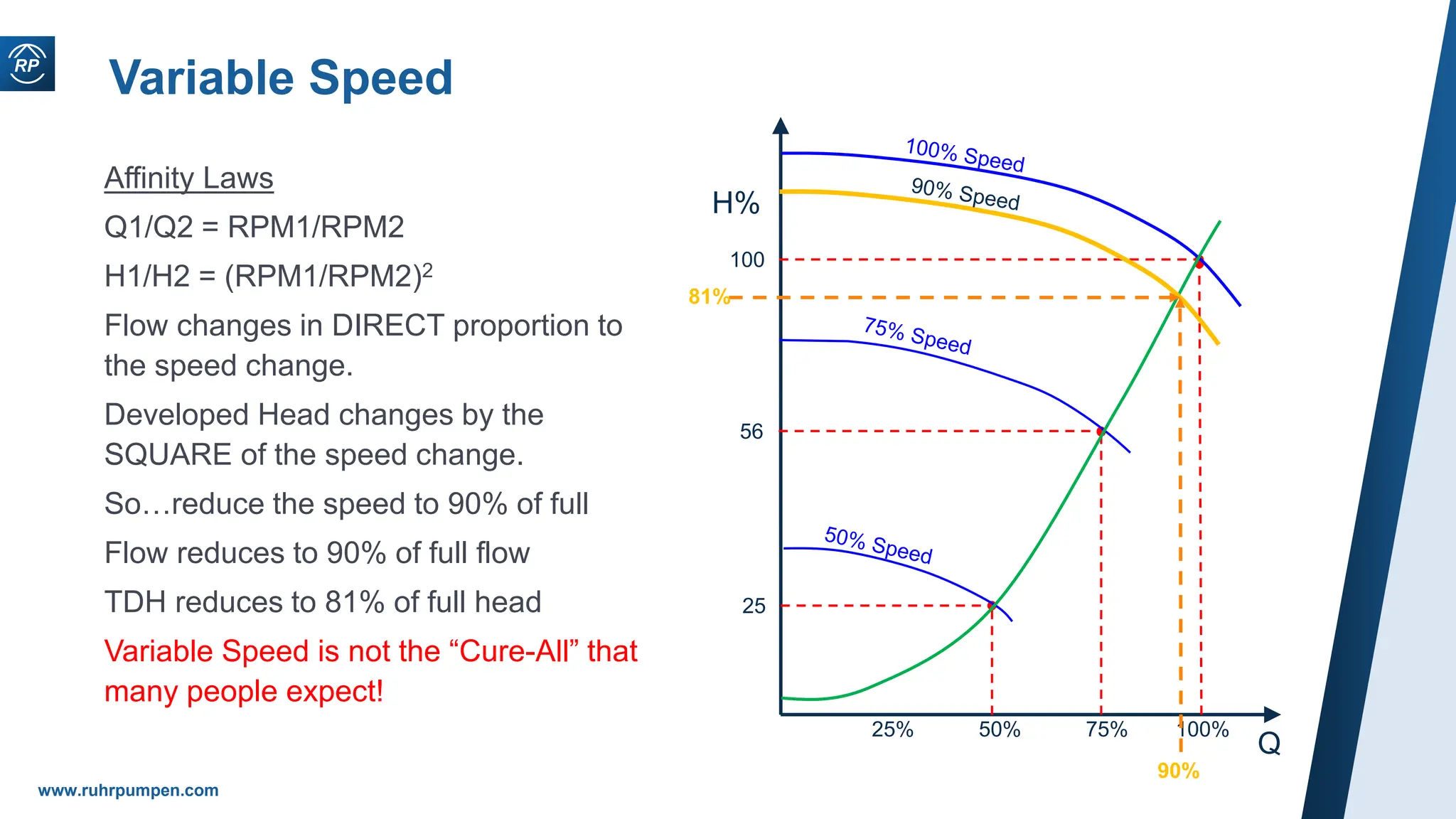
Variable Speed
Affinity Laws
Q1/Q2 = RPM1/RPM2
H1/H2 = (RPM1/RPM2)2
Flow changes in DIRECT proportion to
the speed change.
Developed Head changes by the
SQUARE of the speed change.
So…reduce the speed to 90% of full
Flow reduces to 90% of full flow
TDH reduces to 81% of full head
Variable Speed is not the “Cure-All” that
many people expect!
Q
H%
25% 50% 75% 100%
100
56
25
90%
81%
www.ruhrpumpen.com
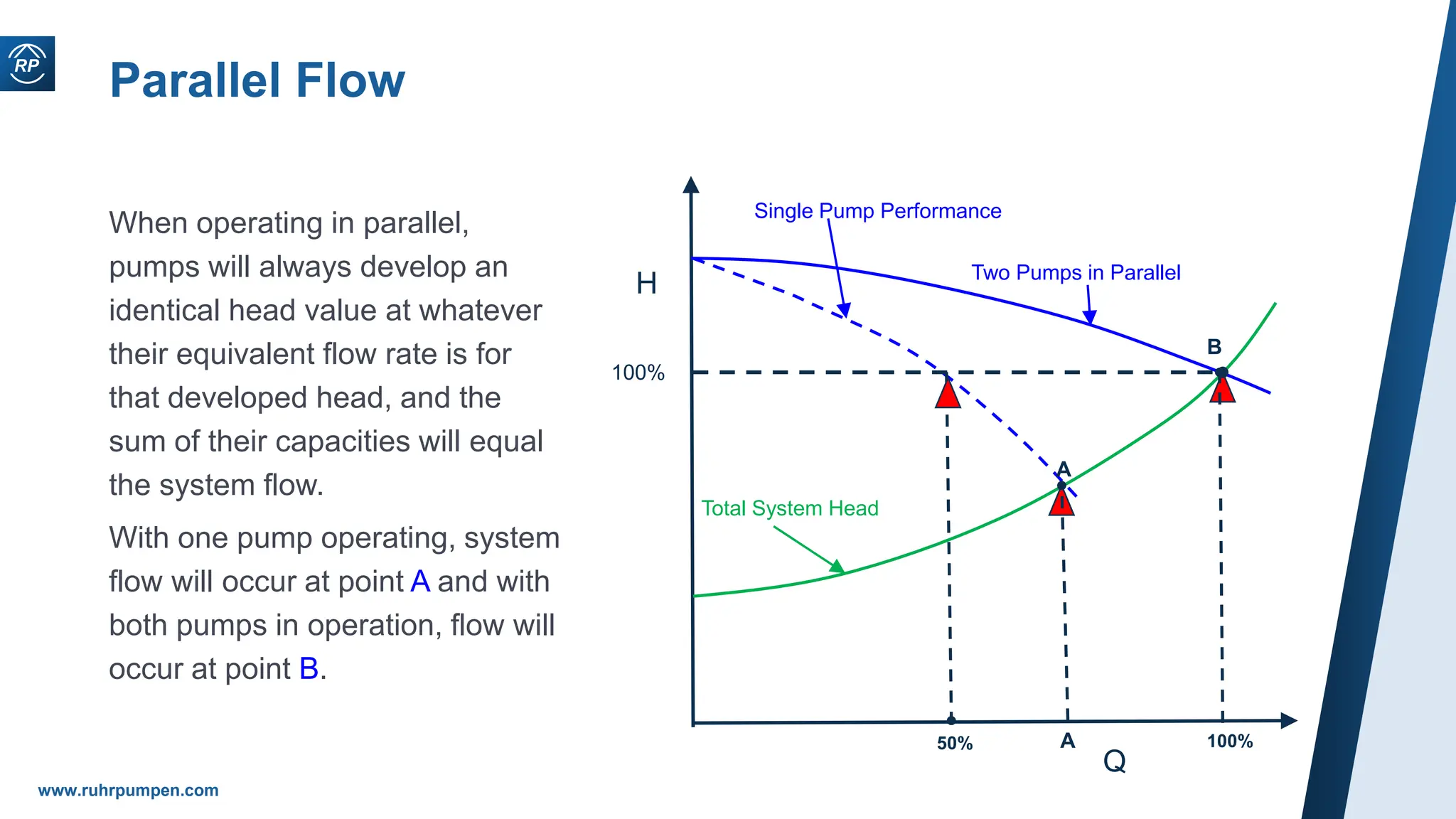
Parallel Flow
When operating in parallel,
pumps will always develop an
identical head value at whatever
their equivalent flow rate is for
that developed head, and the
sum of their capacities will equal
the system flow.
With one pump operating, system
flow will occur at point A and with
both pumps in operation, flow will
occur at point B.
Q
H
100%
Two Pumps in Parallel
Single Pump Performance
Total System Head
A
A
50% 100%
B
www.ruhrpumpen.com
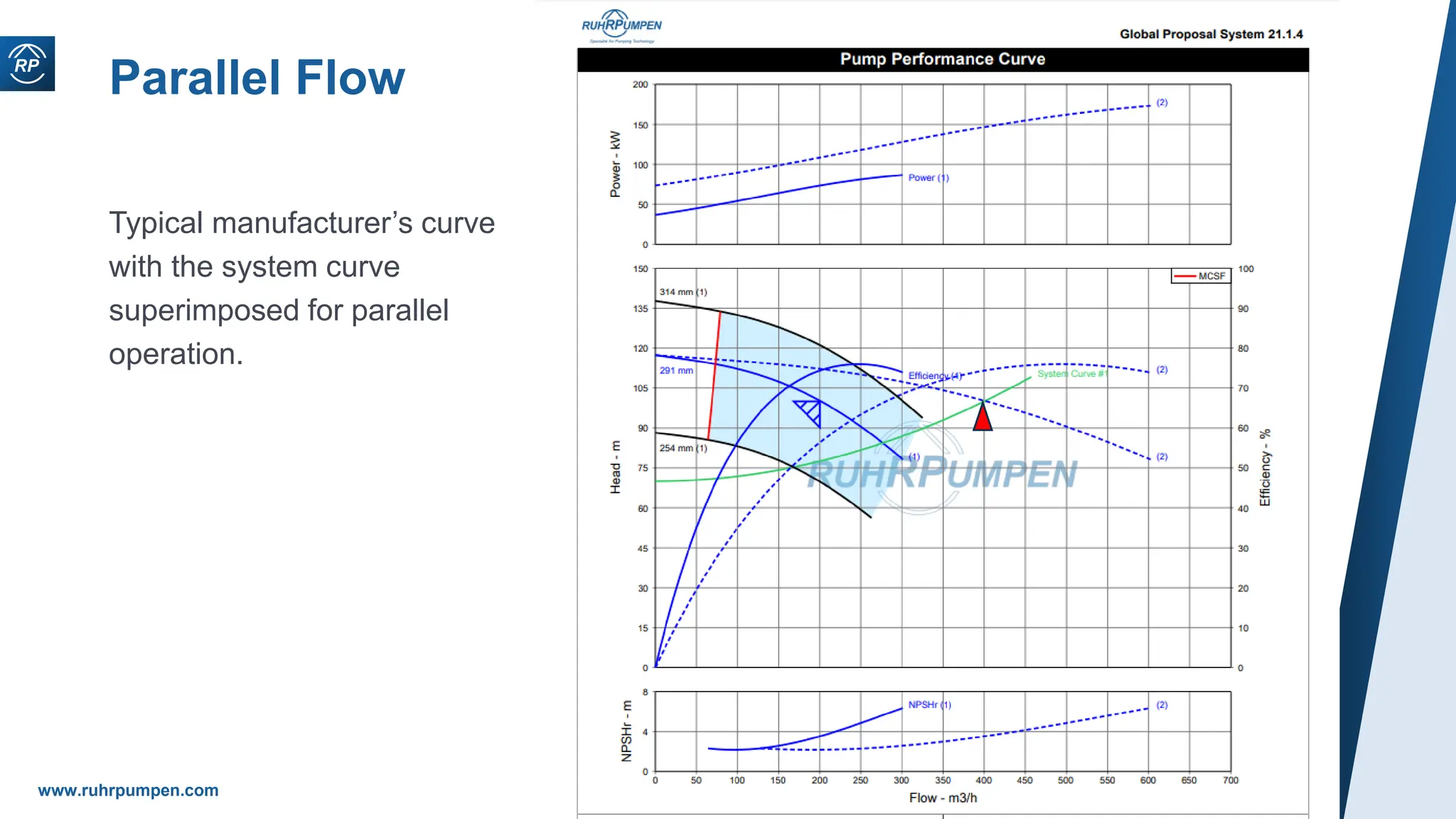
Parallel Flow
Typical manufacturer’s curve
with the system curve
superimposed for parallel
operation.
www.ruhrpumpen.com
API610 12th & Parallel Flow
 6.1.13 If parallel operation is specified and the pumps are not individually flow controlled,
the following is required:
a) the pump head curves shall be continuously rising to shutoff;
b) the head rise from rated point to shutoff shall be at least 10 %;
c) the head values of the pumps at any given flow within the preferred operating range shall be
within 3 % of each other for pumps larger than 3 in. (80 mm) discharge.
Here is why this is so important.
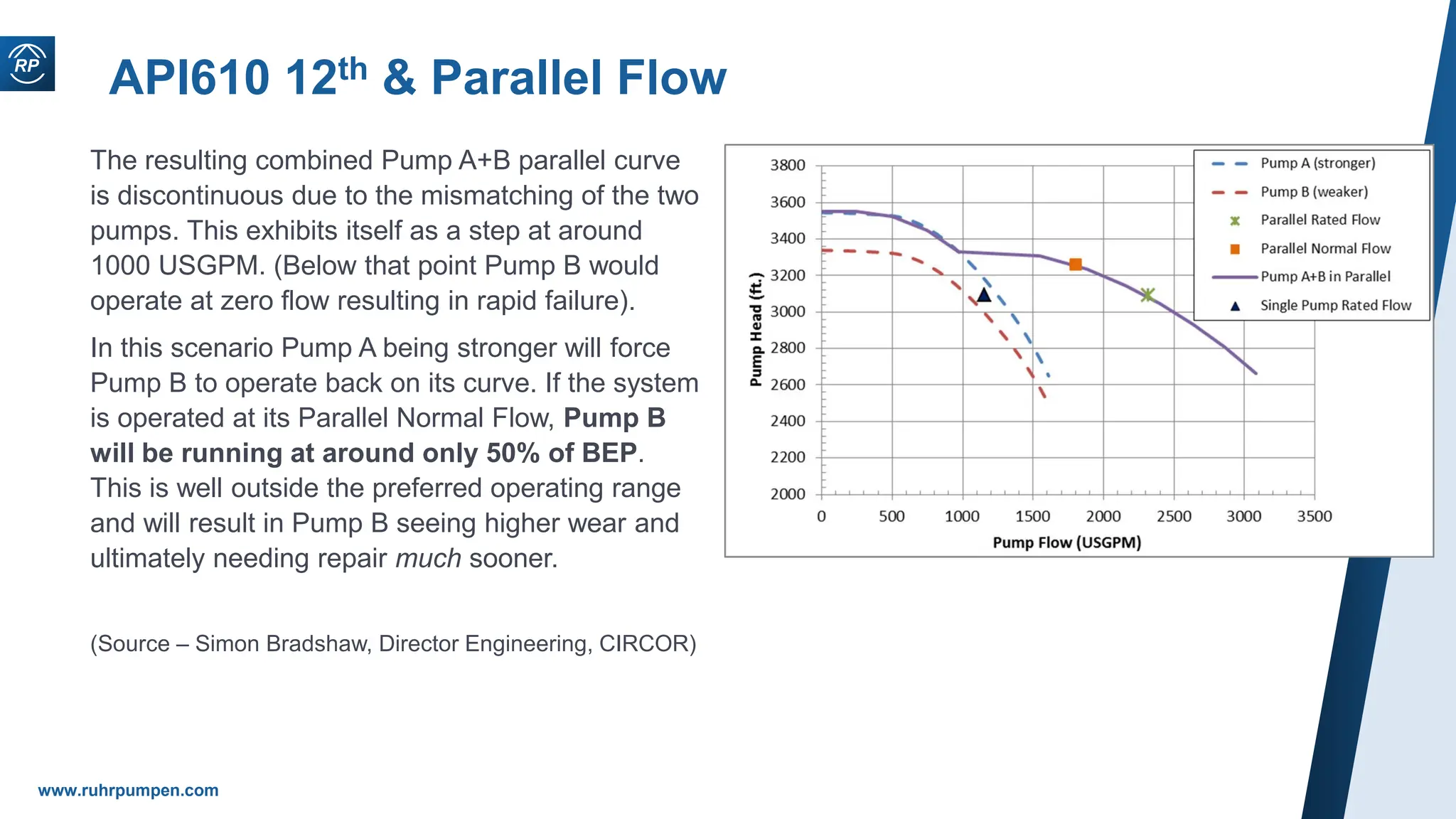
API Table 16 allows Performance Tolerances +/-3% at rated flow +/- 5%, 8% or 10%
(depending on head) at shutoff.
So without this change two “identical” pumps could easily have a “stronger pump” operating
in parallel with a “weaker pump” as illustrated below.
www.ruhrpumpen.com
API610 12th & Parallel Flow
The resulting combined Pump A+B parallel curve
is discontinuous due to the mismatching of the two
pumps. This exhibits itself as a step at around
1000 USGPM. (Below that point Pump B would
operate at zero flow resulting in rapid failure).
In this scenario Pump A being stronger will force
Pump B to operate back on its curve. If the system
is operated at its Parallel Normal Flow, Pump B
will be running at around only 50% of BEP.
This is well outside the preferred operating range
and will result in Pump B seeing higher wear and
ultimately needing repair much sooner.
(Source – Simon Bradshaw, Director Engineering, CIRCOR)
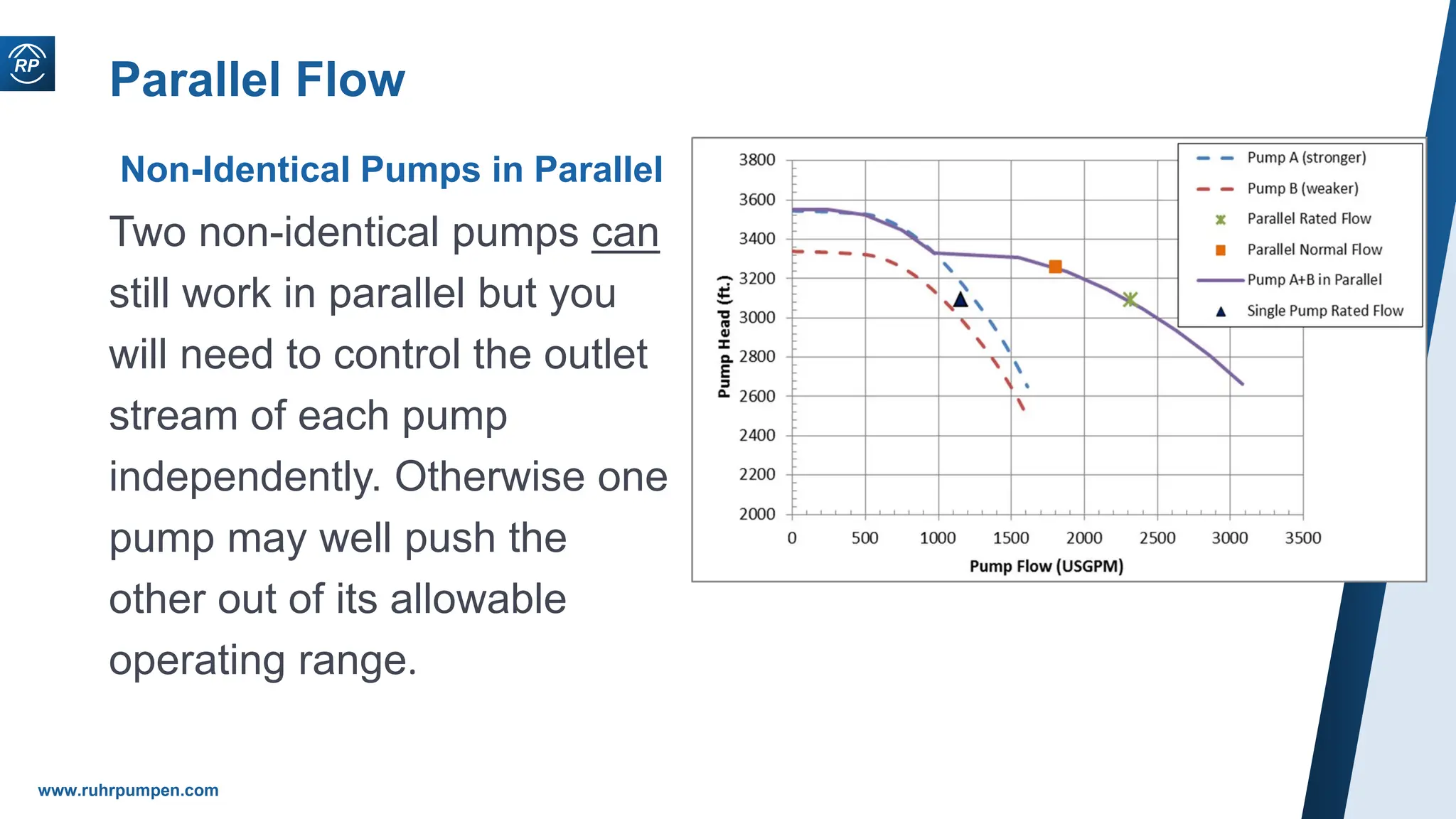
Two non-identical pumps can
still work in parallel but you
will need to control the outlet
stream of each pump
independently. Otherwise one
pump may well push the
other out of its allowable
operating range.
www.ruhrpumpen.com
Parallel Flow
Non-Identical Pumps in Parallel
www.ruhrpumpen.com
Series Flow
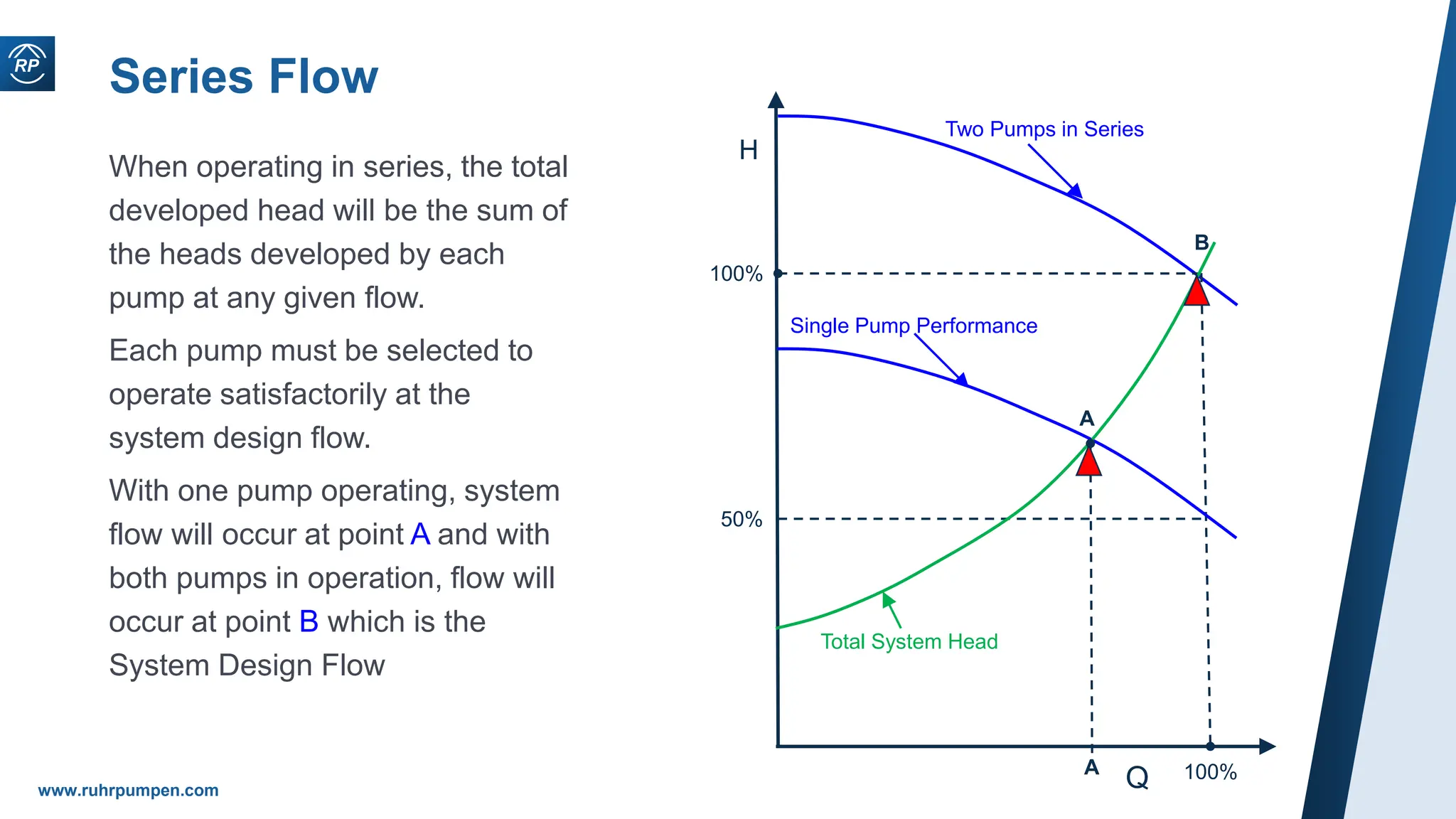
When operating in series, the total
developed head will be the sum of
the heads developed by each
pump at any given flow.
Each pump must be selected to
operate satisfactorily at the
system design flow.
With one pump operating, system
flow will occur at point A and with
both pumps in operation, flow will
occur at point B which is the
System Design Flow
Q
H
100%
50%
100%
Two Pumps in Series
Single Pump Performance
Total System Head
A
B
A
www.ruhrpumpen.com
Parallel Flow with Variable Speed
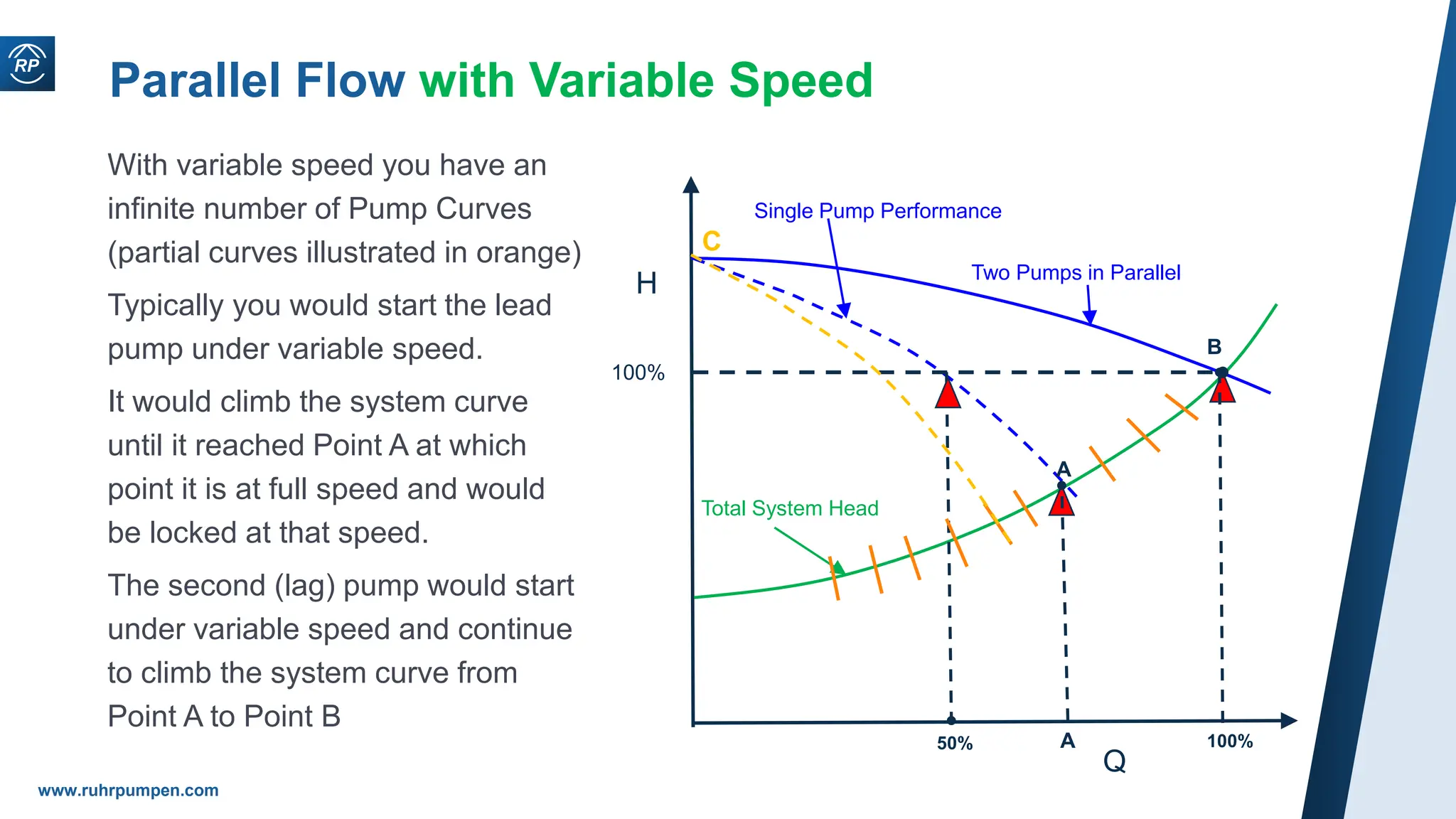
With variable speed you have an
infinite number of Pump Curves
(partial curves illustrated in orange)
Typically you would start the lead
pump under variable speed.
It would climb the system curve
until it reached Point A at which
point it is at full speed and would
be locked at that speed.
The second (lag) pump would start
under variable speed and continue
to climb the system curve from
Point A to Point B
Q
H
100%
Two Pumps in Parallel
Single Pump Performance
Total System Head
A
A
50% 100%
B
C
www.ruhrpumpen.com
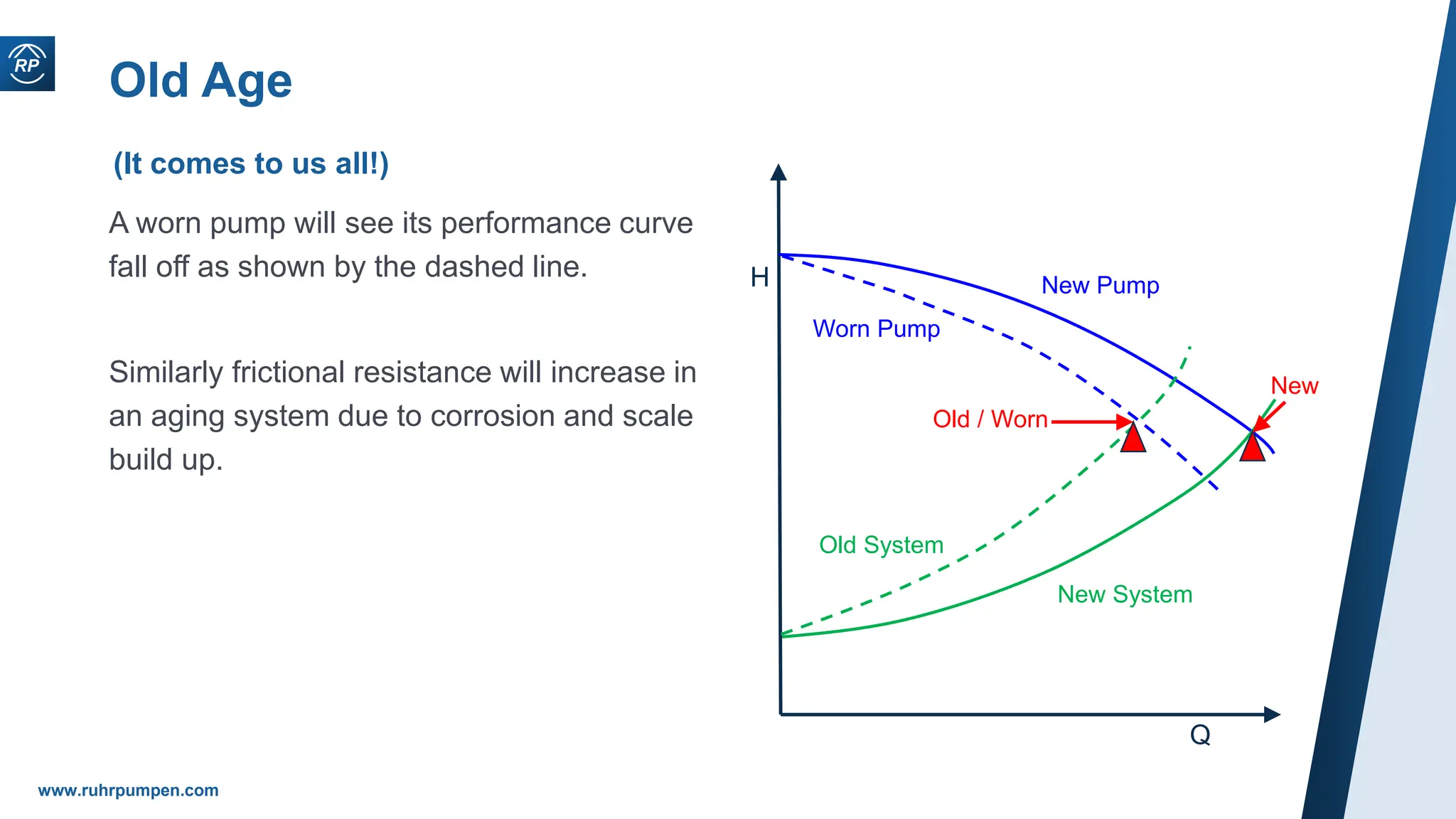
Old Age
(It comes to us all!)
A worn pump will see its performance curve
fall off as shown by the dashed line.
Similarly frictional resistance will increase in
an aging system due to corrosion and scale
build up.
Q
H New Pump
Worn Pump
New System
Old System
New
Old / Worn
www.ruhrpumpen.com
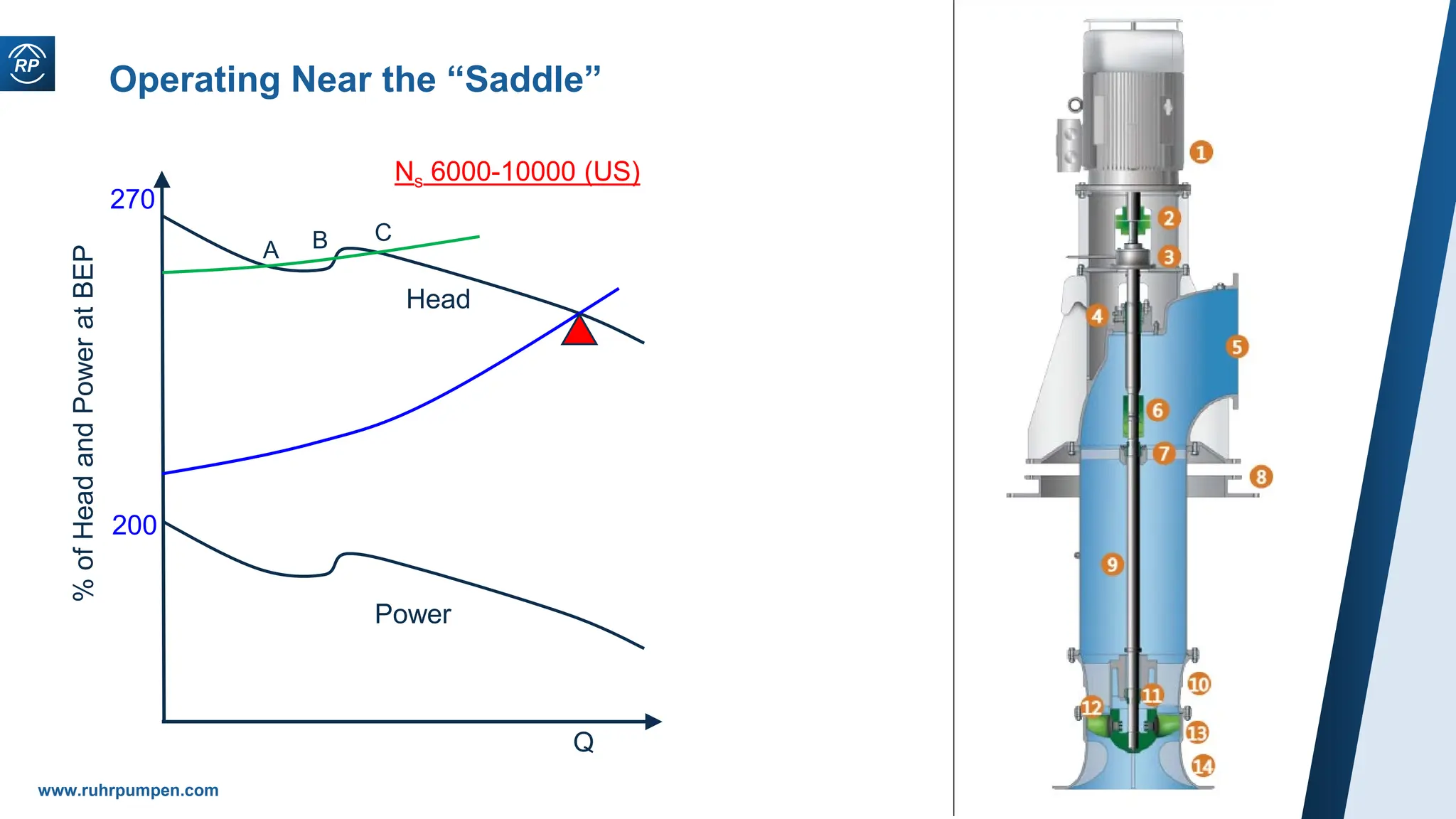
Operating Near the “Saddle”
Q
%
of
Head
and
Power
at
BEP
200
270
Ns 6000-10000 (US)
Head
Power
A B C
www.ruhrpumpen.com
Operating Near the “Saddle”
If you operated with a flat system curve (green) in the region of the “saddle” - yes
you could get hunting between flows A,B&C.
In practice you are unlikely to have a flat system curve like this (all static head very
little friction) and more importantly you would never operate this far back on the
curve of this type of pump.
These are huge flow axial flow pumps and they are operated within +/-10% of BEP.
Note how the power and head increase dramatically away from BEP.
www.ruhrpumpen.com
Coming Attractions 
“Selecting the Right Pump for the Application”
Thur 17th June – 08.00 (UK BST) (Eastern Hemisphere) & 17.00 (UK BST) (Western Hemisphere)
Aimed at Process and Mechanical Engineers and Consultant Engineers specifying pumping equipment as well as
Applications & Sales Engineers selecting and quoting them. Develop an understanding as to which type of pump
is appropriate for different applications.
Will cover such topics as when to transition from an OH2 to a BB2, when to consider VS6 pumps, Barrel vs
Horizontal Split Case multi-stage pumps.
Future subjects in preparation include:
 “NPSH made simple (or “simpler” anyway!)”
www.ruhrpumpen.com info@ruhrpumpen.com
Specialist for Pumping Technology
OUR
PUMPS
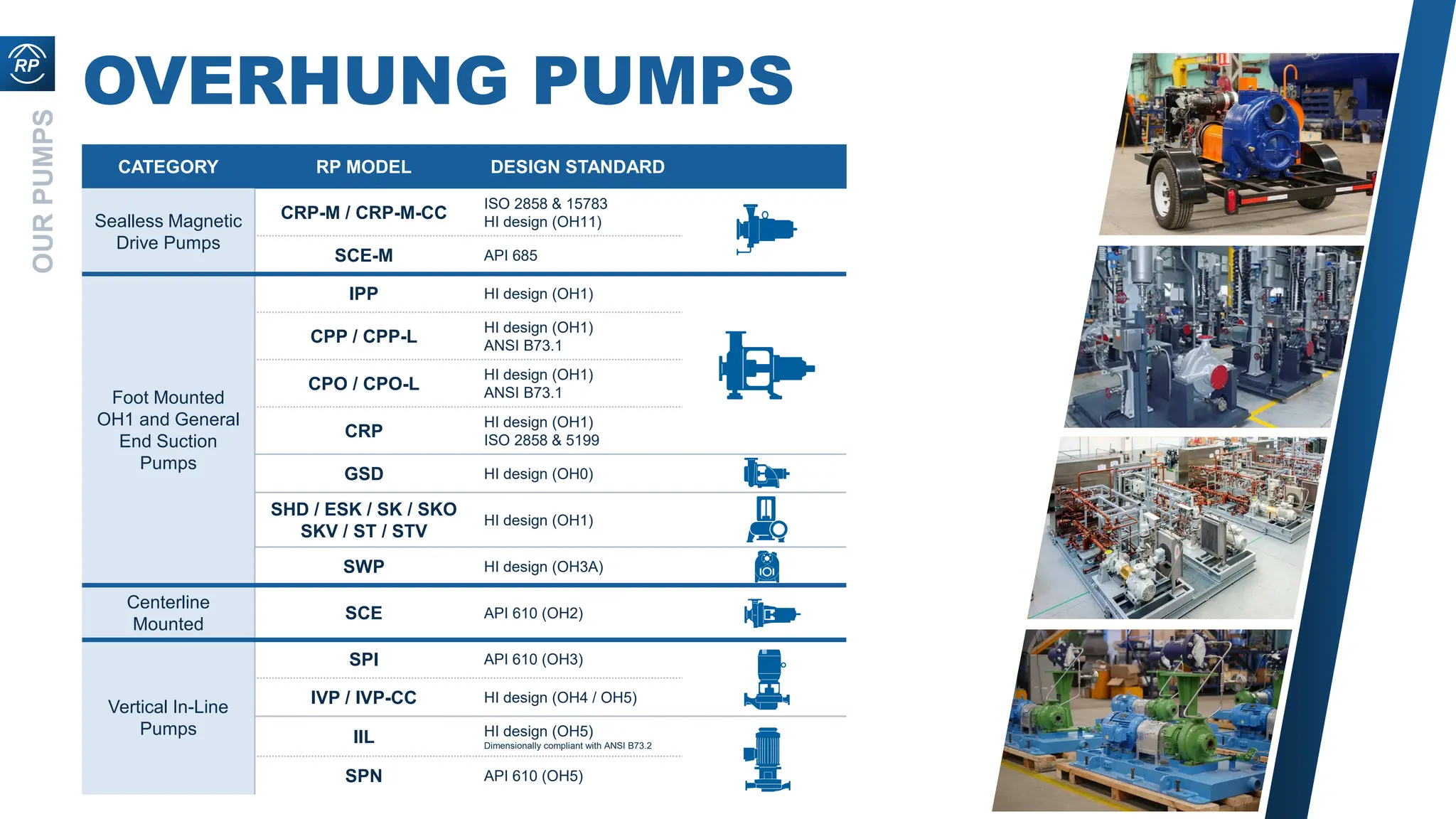
OVERHUNG PUMPS
CATEGORY RP MODEL DESIGN STANDARD
Sealless Magnetic
Drive Pumps
CRP-M / CRP-M-CC
ISO 2858 & 15783
HI design (OH11)
SCE-M API 685
Foot Mounted
OH1 and General
End Suction
Pumps
IPP HI design (OH1)
CPP / CPP-L
HI design (OH1)
ANSI B73.1
CPO / CPO-L
HI design (OH1)
ANSI B73.1
CRP
HI design (OH1)
ISO 2858 & 5199
GSD HI design (OH0)
SHD / ESK / SK / SKO
SKV / ST / STV
HI design (OH1)
SWP HI design (OH3A)
Centerline
Mounted
SCE API 610 (OH2)
Vertical In-Line
Pumps
SPI API 610 (OH3)
IVP / IVP-CC HI design (OH4 / OH5)
IIL HI design (OH5)
Dimensionally compliant with ANSI B73.2
SPN API 610 (OH5)
OUR
PUMPS
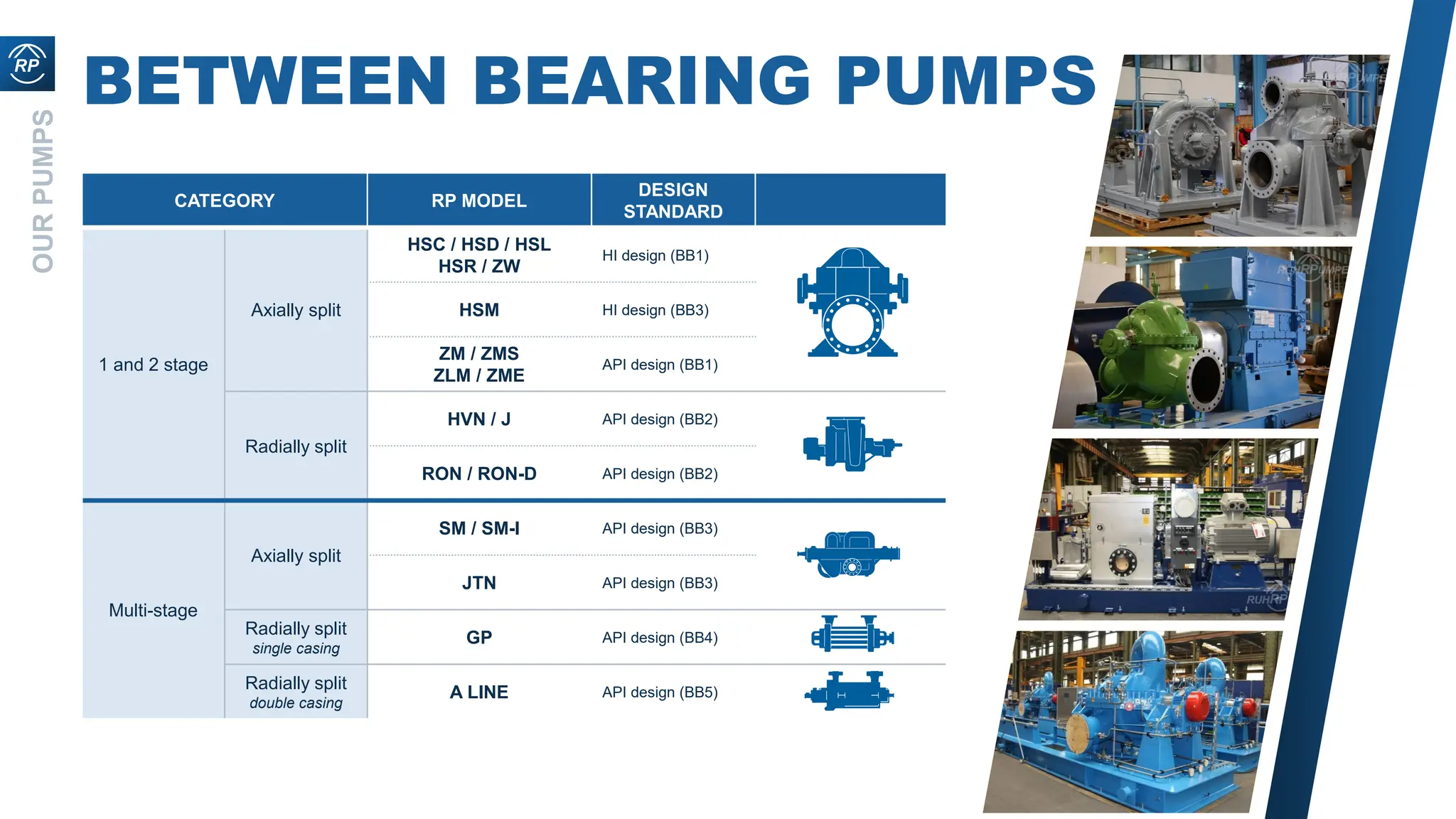
BETWEEN BEARING PUMPS
CATEGORY RP MODEL
DESIGN
STANDARD
1 and 2 stage
Axially split
HSC / HSD / HSL
HSR / ZW
HI design (BB1)
HSM HI design (BB3)
ZM / ZMS
ZLM / ZME
API design (BB1)
Radially split
HVN / J API design (BB2)
RON / RON-D API design (BB2)
Multi-stage
Axially split
SM / SM-I API design (BB3)
JTN API design (BB3)
Radially split
single casing
GP API design (BB4)
Radially split
double casing
A LINE API design (BB5)
OUR
PUMPS
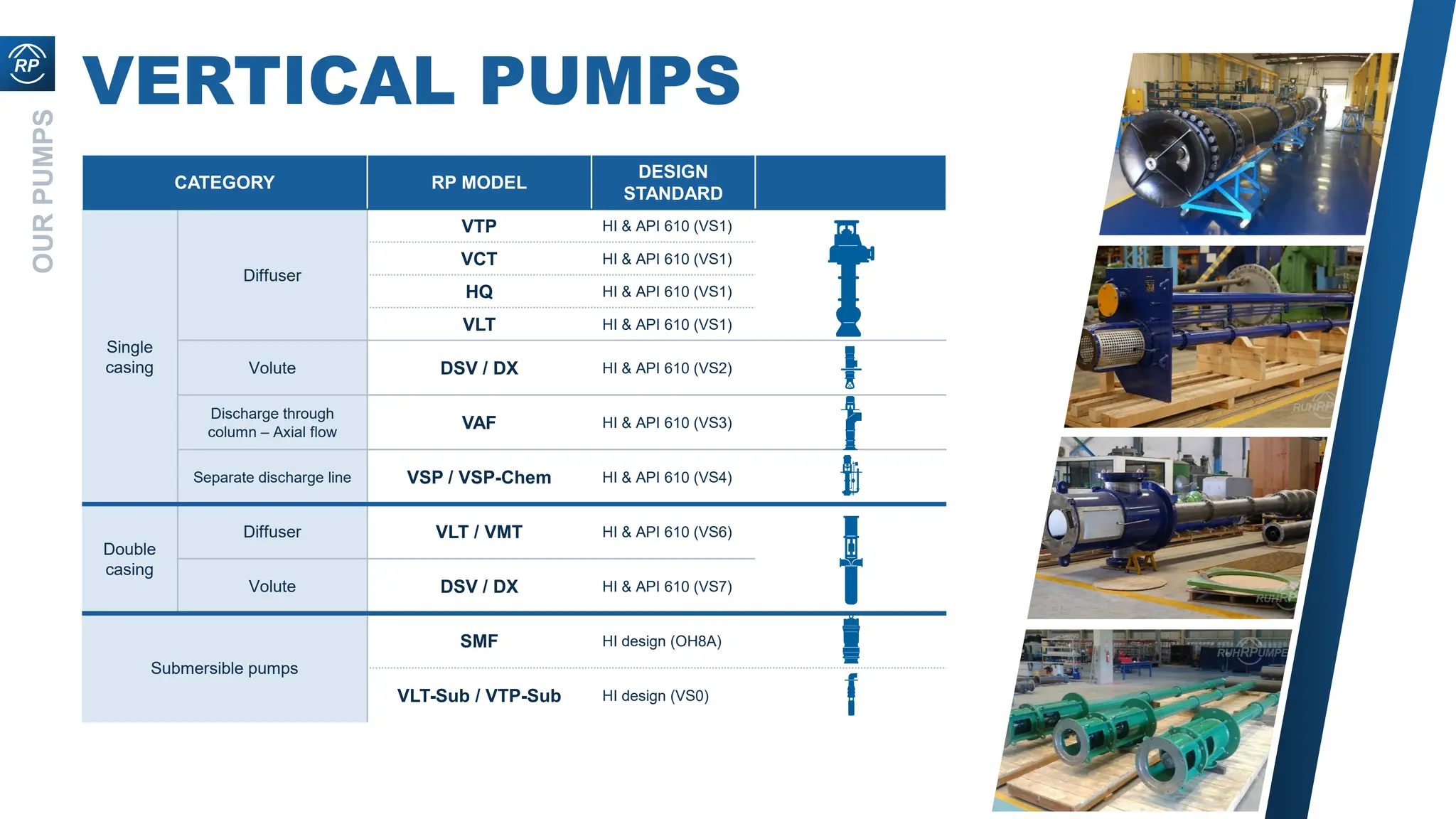
VERTICAL PUMPS
CATEGORY RP MODEL
DESIGN
STANDARD
Single
casing
Diffuser
VTP HI & API 610 (VS1)
VCT HI & API 610 (VS1)
HQ HI & API 610 (VS1)
VLT HI & API 610 (VS1)
Volute DSV / DX HI & API 610 (VS2)
Discharge through
column – Axial flow
VAF HI & API 610 (VS3)
Separate discharge line VSP / VSP-Chem HI & API 610 (VS4)
Double
casing
Diffuser VLT / VMT HI & API 610 (VS6)
Volute DSV / DX HI & API 610 (VS7)
Submersible pumps
SMF HI design (OH8A)
VLT-Sub / VTP-Sub HI design (VS0)
OUR
PUMPS
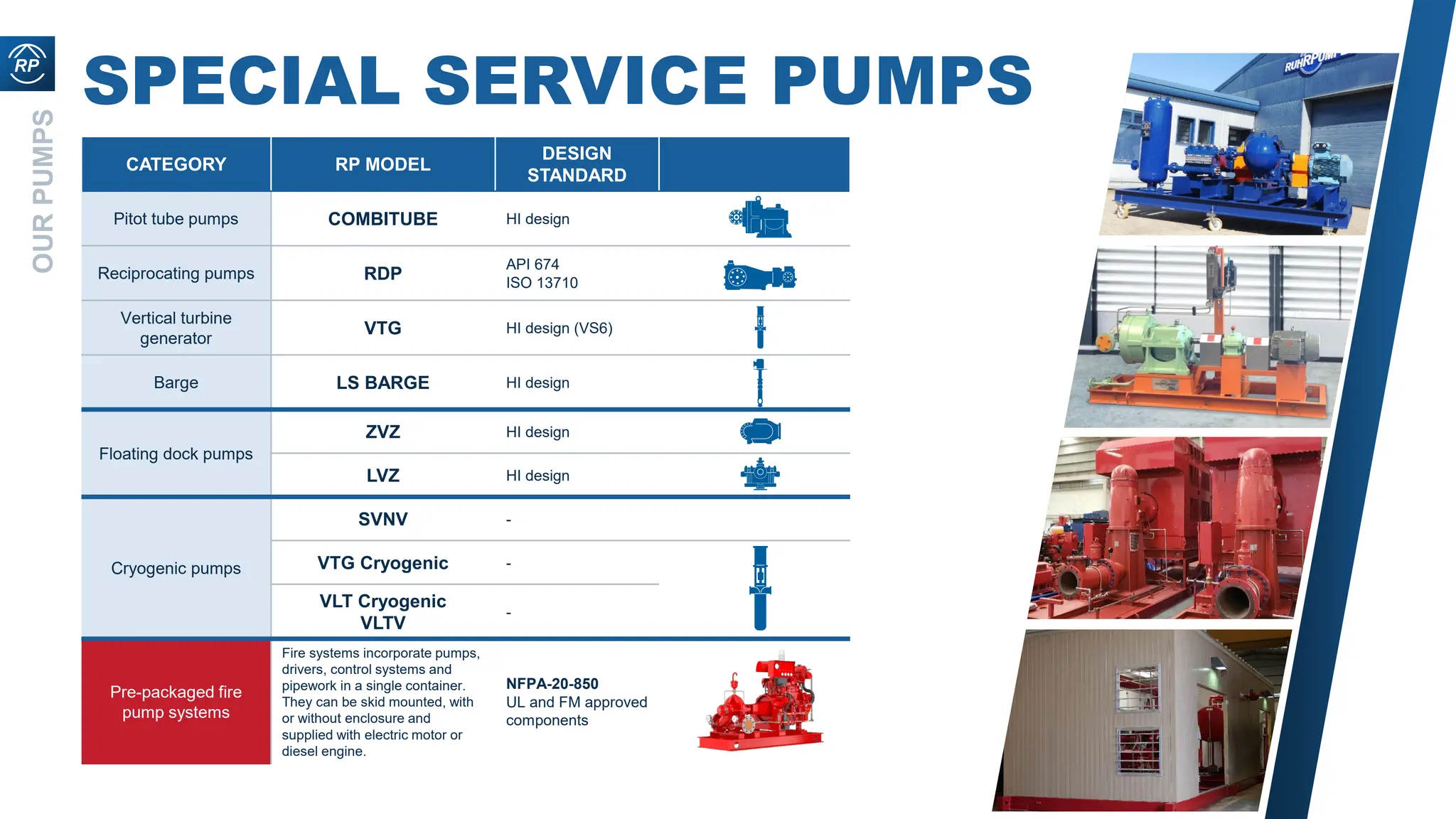
SPECIAL SERVICE PUMPS
CATEGORY RP MODEL
DESIGN
STANDARD
Pitot tube pumps COMBITUBE HI design
Reciprocating pumps RDP
API 674
ISO 13710
Vertical turbine
generator
VTG HI design (VS6)
Barge LS BARGE HI design
Floating dock pumps
ZVZ HI design
LVZ HI design
Cryogenic pumps
SVNV -
VTG Cryogenic -
VLT Cryogenic
VLTV
-
Pre-packaged fire
pump systems
Fire systems incorporate pumps,
drivers, control systems and
pipework in a single container.
They can be skid mounted, with
or without enclosure and
supplied with electric motor or
diesel engine.
NFPA-20-850
UL and FM approved
components

Short Course 3- Importance of System Curves on Pump Selection.pdf

  • 1.
    Specialist for PumpingTechnology The Importance of Using System Curves in Pump Selection and on Successful Pump Operation Simon Smith June 2021
  • 2.
    Simon graduated withan honours degree in Chemical Engineering from the University of Surrey in 1978 and began a long career in the engineered pump industry spanning 40 years (so far!) with Peerless Pump, BW/IP International / Flowserve, SPP Pumps, Ruhrpumpen and Ebara Cryodynamics. Over his long career he has filled various roles as Applications Engineer / Manager, Project Manager, Key Account Specialist, Vertical Pump Product Specialist, International Sales Engineer / Manager / Director and he has considerable experience in Training & Mentoring young engineers. www.ruhrpumpen.com Presenter Profile – Simon Smith
  • 3.
    RUHRPUMPEN AT AGLANCE VERTICAL INTEGRATION +70 YEARS OF EXPERIENCE SALES OFFICES IN +35 COUNTRIES +2,000 EMPLOYEES MANUFACTURING FACILITIES IN 10 COUNTRIES 15 SERVICE CENTERS +70,000 PUMPING SOLUTIONS INSTALLED WORLDWIDE
  • 4.
    A GLOBAL COMPANY MANUFACTURINGFACILITIES  USA [Tulsa]  Germany [Witten]  Mexico [Monterrey]  Brazil [Rio de Janeiro]  Argentina [Buenos Aires]  Egypt [Suez]  India [Chennai]  China [Changzhou]  Russia [Moscow]  United Kingdom [Lancing] Manufacturing facility & Service center Service center
  • 5.
    MARKETS WE SERVE Ourcommitment to create innovations that offer reliable solutions to our customers allow us to provide a complete range of pump systems to support core markets as:
  • 6.
    RUHRPUMPEN GROUP ORGANIZATION APIand Process Pumps Industrial Standard Pumps Fire Systems Decoking Foundry
  • 7.
    OUR PUMP LINES Ruhrpumpenoffers a broad range of highly engineered and standard pumping products that meet and exceed the requirements of the most demanding quality specifications and industry standards. Our pumps can handle head requirements as high as 13,000 ft (4,000 m) and capacities up to 300,000 gpm (68,000 m3/hr). Moreover, our pump designs cover temperatures from cryogenic temperatures of -310 °F (-196 °C) up to 752 °F (400 °C). Products include:  Single Stage Overhung Pumps  Between Bearings Pumps  Horizontal Multi-Stage Pumps  Vertical Multi-Stage Pumps  Vertical Mixed Flow & Axial Flow Pumps  Positive Displacement Pumps  Full Range of Industrial Pumps  Submersible Pumps  Magnetic Drive Pumps  Decoking Systems  Packaged Systems  Fire Systems
  • 8.
    www.ruhrpumpen.com “The Importance ofUsing System Curves in Pump Selection and on Successful Pump Operation”
  • 9.
    www.ruhrpumpen.com System Head Curve Q H StaticLift System Required Pressure Q H
  • 10.
    NS = N(RPM)Q(BEP Full Dia) 0.5 / H(BEP Full Dia) 0.75 NS(Metric) = NS(US) x 1.16 (m3/hr, m, rpm) NS(Metric) = NS(US) x 0.02 (m3/s, m, rpm) www.ruhrpumpen.com Pump Curve Shape vs Specific Speed
  • 11.
    www.ruhrpumpen.com Pump Curve Shapevs Specific Speed Q % of Head and Power at BEP Q 40 115 Ns 500-1000 (US) Head Power Head Power Ns 1000-2000 (US) 140 50 % of Head and Power at BEP
  • 12.
    www.ruhrpumpen.com Pump Curve Shapevs Specific Speed Q % of Head and Power at BEP 60 160 Ns 2000-4000 (US) Head Power Head Power Ns 4000-6000 (US) 200 110 % of Head and Power at BEP Q
  • 13.
    www.ruhrpumpen.com Pump Curve Shapevs Specific Speed Q % of Head and Power at BEP 200 270 Ns 6000-10000 (US) Head Power
  • 14.
  • 15.
  • 16.
    You will probablyhave a range of Suction Pressures and a range of Flow Rates to fulfill, and the pump might be asked to perform anywhere within the area A-B-C-D-A. Condition D is probably the Rated Condition (worst case) Some kind of system control will be required. This might be  Bypassing  Valve Throttling  Series or Parallel Pumping  Variable Speed www.ruhrpumpen.com Operating Bands Q H A B C D TDH, Max Suction P TDH, Min Suction P
  • 17.
    www.ruhrpumpen.com System Control byThrottling Probably the most common system control. By opening or closing a control valve on the pump discharge, a “family” of system curves are created reflecting the ever- increasing frictional component of the system head. Q H 100% 100% Valve Throttling Valve Fully Open
  • 18.
    www.ruhrpumpen.com System Control byThrottling – Hooked Curve (Gasp!)  Many specifiers run a mile from a hooked curve believing they are unstable.  A pump will only operate where the system permits – where the system curve crosses the pump curve.  “The pump is slave to the system” *  Even as the control valve is gradually closed, each system curve only crosses the pump curve once.  So no “hunting” is possible * Simon Bradshaw Q H 100% 100% Valve Throttling Valve Fully Open
  • 19.
    www.ruhrpumpen.com System Control byThrottling – Hooked Curve (Gasp!) Extreme Case Only in the extremely rare case of an almost totally flat system curve (nearly all static head, very low frictional head) and a severely hooked curve might the system curve cross the pump curve more than once. Q H Extremely Flat System Curve Exaggerated “Hooked” Curve Potential for “Hunting”
  • 20.
    www.ruhrpumpen.com Steep or FlatPump Curve?  The question is “What do you want to achieve?”  With a Flat pump curve small changes in System Head lead to large changes in Flow.  With a steep pump curve small changes in System Head lead to small changes in Flow.
  • 21.
     A smallchange in Head (H) will have far less impact on the Flow Rate (Q) with a steep curve (red) than with a shallow curve (blue). www.ruhrpumpen.com Impact of Curve Shape on Controllability
  • 22.
    www.ruhrpumpen.com Variable Speed Affinity Laws Q1/Q2= RPM1/RPM2 H1/H2 = (RPM1/RPM2)2 Flow changes in DIRECT proportion to the speed change. Developed Head changes by the SQUARE of the speed change. So…reduce the speed to 90% of full Flow reduces to 90% of full flow TDH reduces to 81% of full head Variable Speed is not the “Cure-All” that many people expect! Q H% 25% 50% 75% 100% 100 56 25 90% 81%
  • 23.
    www.ruhrpumpen.com Parallel Flow When operatingin parallel, pumps will always develop an identical head value at whatever their equivalent flow rate is for that developed head, and the sum of their capacities will equal the system flow. With one pump operating, system flow will occur at point A and with both pumps in operation, flow will occur at point B. Q H 100% Two Pumps in Parallel Single Pump Performance Total System Head A A 50% 100% B
  • 24.
    www.ruhrpumpen.com Parallel Flow Typical manufacturer’scurve with the system curve superimposed for parallel operation.
  • 25.
    www.ruhrpumpen.com API610 12th &Parallel Flow  6.1.13 If parallel operation is specified and the pumps are not individually flow controlled, the following is required: a) the pump head curves shall be continuously rising to shutoff; b) the head rise from rated point to shutoff shall be at least 10 %; c) the head values of the pumps at any given flow within the preferred operating range shall be within 3 % of each other for pumps larger than 3 in. (80 mm) discharge. Here is why this is so important. API Table 16 allows Performance Tolerances +/-3% at rated flow +/- 5%, 8% or 10% (depending on head) at shutoff. So without this change two “identical” pumps could easily have a “stronger pump” operating in parallel with a “weaker pump” as illustrated below.
  • 26.
    www.ruhrpumpen.com API610 12th &Parallel Flow The resulting combined Pump A+B parallel curve is discontinuous due to the mismatching of the two pumps. This exhibits itself as a step at around 1000 USGPM. (Below that point Pump B would operate at zero flow resulting in rapid failure). In this scenario Pump A being stronger will force Pump B to operate back on its curve. If the system is operated at its Parallel Normal Flow, Pump B will be running at around only 50% of BEP. This is well outside the preferred operating range and will result in Pump B seeing higher wear and ultimately needing repair much sooner. (Source – Simon Bradshaw, Director Engineering, CIRCOR)
  • 27.
    Two non-identical pumpscan still work in parallel but you will need to control the outlet stream of each pump independently. Otherwise one pump may well push the other out of its allowable operating range. www.ruhrpumpen.com Parallel Flow Non-Identical Pumps in Parallel
  • 28.
    www.ruhrpumpen.com Series Flow When operatingin series, the total developed head will be the sum of the heads developed by each pump at any given flow. Each pump must be selected to operate satisfactorily at the system design flow. With one pump operating, system flow will occur at point A and with both pumps in operation, flow will occur at point B which is the System Design Flow Q H 100% 50% 100% Two Pumps in Series Single Pump Performance Total System Head A B A
  • 29.
    www.ruhrpumpen.com Parallel Flow withVariable Speed With variable speed you have an infinite number of Pump Curves (partial curves illustrated in orange) Typically you would start the lead pump under variable speed. It would climb the system curve until it reached Point A at which point it is at full speed and would be locked at that speed. The second (lag) pump would start under variable speed and continue to climb the system curve from Point A to Point B Q H 100% Two Pumps in Parallel Single Pump Performance Total System Head A A 50% 100% B C
  • 30.
    www.ruhrpumpen.com Old Age (It comesto us all!) A worn pump will see its performance curve fall off as shown by the dashed line. Similarly frictional resistance will increase in an aging system due to corrosion and scale build up. Q H New Pump Worn Pump New System Old System New Old / Worn
  • 31.
    www.ruhrpumpen.com Operating Near the“Saddle” Q % of Head and Power at BEP 200 270 Ns 6000-10000 (US) Head Power A B C
  • 32.
    www.ruhrpumpen.com Operating Near the“Saddle” If you operated with a flat system curve (green) in the region of the “saddle” - yes you could get hunting between flows A,B&C. In practice you are unlikely to have a flat system curve like this (all static head very little friction) and more importantly you would never operate this far back on the curve of this type of pump. These are huge flow axial flow pumps and they are operated within +/-10% of BEP. Note how the power and head increase dramatically away from BEP.
  • 33.
    www.ruhrpumpen.com Coming Attractions  “Selectingthe Right Pump for the Application” Thur 17th June – 08.00 (UK BST) (Eastern Hemisphere) & 17.00 (UK BST) (Western Hemisphere) Aimed at Process and Mechanical Engineers and Consultant Engineers specifying pumping equipment as well as Applications & Sales Engineers selecting and quoting them. Develop an understanding as to which type of pump is appropriate for different applications. Will cover such topics as when to transition from an OH2 to a BB2, when to consider VS6 pumps, Barrel vs Horizontal Split Case multi-stage pumps. Future subjects in preparation include:  “NPSH made simple (or “simpler” anyway!)”
  • 34.
  • 35.
    OUR PUMPS OVERHUNG PUMPS CATEGORY RPMODEL DESIGN STANDARD Sealless Magnetic Drive Pumps CRP-M / CRP-M-CC ISO 2858 & 15783 HI design (OH11) SCE-M API 685 Foot Mounted OH1 and General End Suction Pumps IPP HI design (OH1) CPP / CPP-L HI design (OH1) ANSI B73.1 CPO / CPO-L HI design (OH1) ANSI B73.1 CRP HI design (OH1) ISO 2858 & 5199 GSD HI design (OH0) SHD / ESK / SK / SKO SKV / ST / STV HI design (OH1) SWP HI design (OH3A) Centerline Mounted SCE API 610 (OH2) Vertical In-Line Pumps SPI API 610 (OH3) IVP / IVP-CC HI design (OH4 / OH5) IIL HI design (OH5) Dimensionally compliant with ANSI B73.2 SPN API 610 (OH5)
  • 36.
    OUR PUMPS BETWEEN BEARING PUMPS CATEGORYRP MODEL DESIGN STANDARD 1 and 2 stage Axially split HSC / HSD / HSL HSR / ZW HI design (BB1) HSM HI design (BB3) ZM / ZMS ZLM / ZME API design (BB1) Radially split HVN / J API design (BB2) RON / RON-D API design (BB2) Multi-stage Axially split SM / SM-I API design (BB3) JTN API design (BB3) Radially split single casing GP API design (BB4) Radially split double casing A LINE API design (BB5)
  • 37.
    OUR PUMPS VERTICAL PUMPS CATEGORY RPMODEL DESIGN STANDARD Single casing Diffuser VTP HI & API 610 (VS1) VCT HI & API 610 (VS1) HQ HI & API 610 (VS1) VLT HI & API 610 (VS1) Volute DSV / DX HI & API 610 (VS2) Discharge through column – Axial flow VAF HI & API 610 (VS3) Separate discharge line VSP / VSP-Chem HI & API 610 (VS4) Double casing Diffuser VLT / VMT HI & API 610 (VS6) Volute DSV / DX HI & API 610 (VS7) Submersible pumps SMF HI design (OH8A) VLT-Sub / VTP-Sub HI design (VS0)
  • 38.
    OUR PUMPS SPECIAL SERVICE PUMPS CATEGORYRP MODEL DESIGN STANDARD Pitot tube pumps COMBITUBE HI design Reciprocating pumps RDP API 674 ISO 13710 Vertical turbine generator VTG HI design (VS6) Barge LS BARGE HI design Floating dock pumps ZVZ HI design LVZ HI design Cryogenic pumps SVNV - VTG Cryogenic - VLT Cryogenic VLTV - Pre-packaged fire pump systems Fire systems incorporate pumps, drivers, control systems and pipework in a single container. They can be skid mounted, with or without enclosure and supplied with electric motor or diesel engine. NFPA-20-850 UL and FM approved components