Greetings, and welcome to Financial Statistics!Greetings, and welcome to Financial Statistics!
We have all come across
Statistics in our everyday
lives. We talk about average
salaries, percentile ranks,
skew, outliers and so on. In
fact, many comparisons that
we routinely make involve
numbers. We may not be
conscious of it, but we have
been using Statistics for a
long long time.
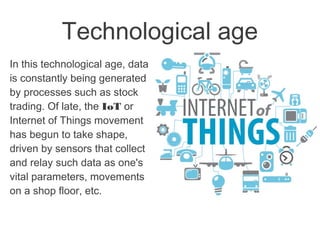
Technological age
In this technological age, data
is constantly being generated
by processes such as stock
trading. Of late, the IoT or
Internet of Things movement
has begun to take shape,
driven by sensors that collect
and relay such data as one's
vital parameters, movements
on a shop floor, etc.
Statistics rules
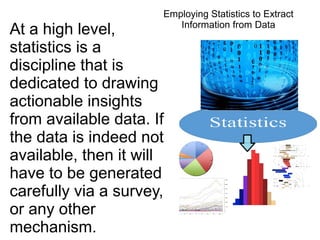
At a high level,
statistics is a
discipline that is
dedicated to drawing
actionable insights
from available data. If
the data is indeed not
available, then it will
have to be generated
carefully via a survey,
or any other
mechanism.
Employing Statistics to Extract
Information from Data
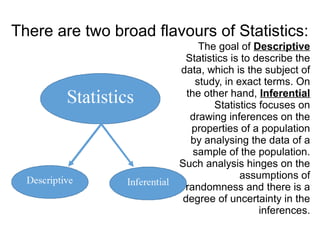
There are two broad flavours of Statistics:
The goal of Descriptive
Statistics is to describe the
data, which is the subject of
study, in exact terms. On
the other hand, Inferential
Statistics focuses on
drawing inferences on the
properties of a population
by analysing the data of a
sample of the population.
Such analysis hinges on the
assumptions of
randomness and there is a
degree of uncertainty in the
inferences.
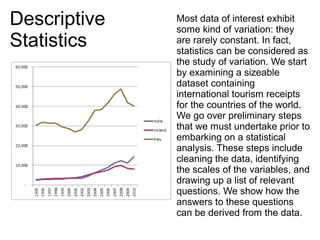
Most data of interest exhibit
some kind of variation: they
are rarely constant. In fact,
statistics can be considered as
the study of variation. We start
by examining a sizeable
dataset containing
international tourism receipts
for the countries of the world.
We go over preliminary steps
that we must undertake prior to
embarking on a statistical
analysis. These steps include
cleaning the data, identifying
the scales of the variables, and
drawing up a list of relevant
questions. We show how the
answers to these questions
can be derived from the data.
Descriptive
Statistics
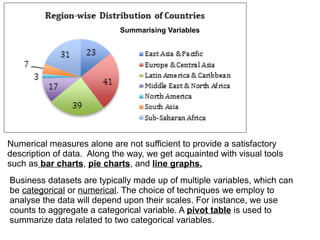
Summarising Variables
Numerical measures alone are not sufficient to provide a satisfactory
description of data. Along the way, we get acquainted with visual tools
such as bar charts, pie charts, and line graphs.
Business datasets are typically made up of multiple variables, which can
be categorical or numerical. The choice of techniques we employ to
analyse the data will depend upon their scales. For instance, we use
counts to aggregate a categorical variable. A pivot table is used to
summarize data related to two categorical variables.
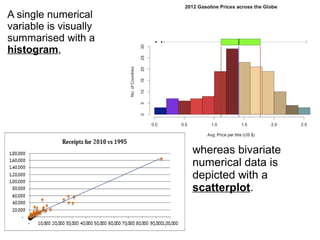
A single numerical
variable is visually
summarised with a
histogram,
whereas bivariate
numerical data is
depicted with a
scatterplot.
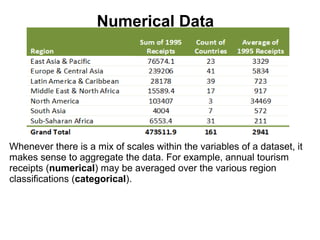
Numerical Data
Whenever there is a mix of scales within the variables of a dataset, it
makes sense to aggregate the data. For example, annual tourism
receipts (numerical) may be averaged over the various region
classifications (categorical).
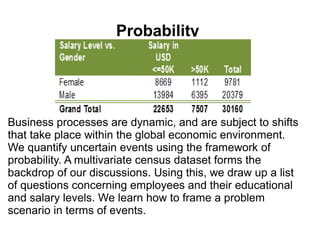
Probability
Business processes are dynamic, and are subject to shifts
that take place within the global economic environment.
We quantify uncertain events using the framework of
probability. A multivariate census dataset forms the
backdrop of our discussions. Using this, we draw up a list
of questions concerning employees and their educational
and salary levels. We learn how to frame a problem
scenario in terms of events.
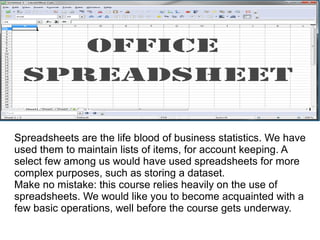
Spreadsheets are the life blood of business statistics. We have
used them to maintain lists of items, for account keeping. A
select few among us would have used spreadsheets for more
complex purposes, such as storing a dataset.
Make no mistake: this course relies heavily on the use of
spreadsheets. We would like you to become acquainted with a
few basic operations, well before the course gets underway.
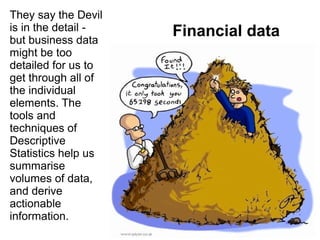
Financial data
They say the Devil
is in the detail -
but business data
might be too
detailed for us to
get through all of
the individual
elements. The
tools and
techniques of
Descriptive
Statistics help us
summarise
volumes of data,
and derive
actionable
information.
Introduction

Introduction

  • 1.
    Greetings, and welcometo Financial Statistics!Greetings, and welcome to Financial Statistics! We have all come across Statistics in our everyday lives. We talk about average salaries, percentile ranks, skew, outliers and so on. In fact, many comparisons that we routinely make involve numbers. We may not be conscious of it, but we have been using Statistics for a long long time.
  • 2.
    Technological age In thistechnological age, data is constantly being generated by processes such as stock trading. Of late, the IoT or Internet of Things movement has begun to take shape, driven by sensors that collect and relay such data as one's vital parameters, movements on a shop floor, etc.
  • 3.
  • 4.
    At a highlevel, statistics is a discipline that is dedicated to drawing actionable insights from available data. If the data is indeed not available, then it will have to be generated carefully via a survey, or any other mechanism. Employing Statistics to Extract Information from Data
  • 5.
    There are twobroad flavours of Statistics: The goal of Descriptive Statistics is to describe the data, which is the subject of study, in exact terms. On the other hand, Inferential Statistics focuses on drawing inferences on the properties of a population by analysing the data of a sample of the population. Such analysis hinges on the assumptions of randomness and there is a degree of uncertainty in the inferences.
  • 6.
    Most data ofinterest exhibit some kind of variation: they are rarely constant. In fact, statistics can be considered as the study of variation. We start by examining a sizeable dataset containing international tourism receipts for the countries of the world. We go over preliminary steps that we must undertake prior to embarking on a statistical analysis. These steps include cleaning the data, identifying the scales of the variables, and drawing up a list of relevant questions. We show how the answers to these questions can be derived from the data. Descriptive Statistics
  • 7.
    Summarising Variables Numerical measuresalone are not sufficient to provide a satisfactory description of data. Along the way, we get acquainted with visual tools such as bar charts, pie charts, and line graphs. Business datasets are typically made up of multiple variables, which can be categorical or numerical. The choice of techniques we employ to analyse the data will depend upon their scales. For instance, we use counts to aggregate a categorical variable. A pivot table is used to summarize data related to two categorical variables.
  • 8.
    A single numerical variableis visually summarised with a histogram, whereas bivariate numerical data is depicted with a scatterplot.
  • 9.
    Numerical Data Whenever thereis a mix of scales within the variables of a dataset, it makes sense to aggregate the data. For example, annual tourism receipts (numerical) may be averaged over the various region classifications (categorical).
  • 10.
    Probability Business processes aredynamic, and are subject to shifts that take place within the global economic environment. We quantify uncertain events using the framework of probability. A multivariate census dataset forms the backdrop of our discussions. Using this, we draw up a list of questions concerning employees and their educational and salary levels. We learn how to frame a problem scenario in terms of events.
  • 11.
    Spreadsheets are thelife blood of business statistics. We have used them to maintain lists of items, for account keeping. A select few among us would have used spreadsheets for more complex purposes, such as storing a dataset. Make no mistake: this course relies heavily on the use of spreadsheets. We would like you to become acquainted with a few basic operations, well before the course gets underway.
  • 12.
    Financial data They saythe Devil is in the detail - but business data might be too detailed for us to get through all of the individual elements. The tools and techniques of Descriptive Statistics help us summarise volumes of data, and derive actionable information.