
Postgraduate Certificate in Teaching
English for Academic Purposes
English Language Teaching Unit
School of Education

www.le.ac.uk
• The Pg Cert in Teaching English for Academic Purposes is a
distance learning course for existing or potential teachers of
English for academic purposes leading to a postgraduate
certificate awarded by the University of Leicester.
• Being an a hundred per cent online course, the PG cert TEAP
is available in all parts of the world with internet connection.
It is delivered via the Blackboard VLE, a globally established,
extremely stable and easy to use online learning
environment. Blackboard is the official VLE at the University
of Leicester.
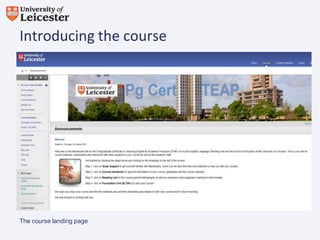
Introducing the course

The course landing page
• The course is organized into four modules, all of which are
closely informed by the BALEAP Competency Framework for
Teachers. BALEAP is the leading professional organization for
teachers of EAP in the UK. The modules are divided into three
units. Each unit contains 2 week worth of input and output
activities arranged in a series of six steps.
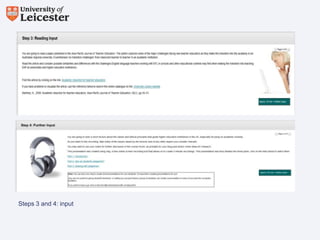
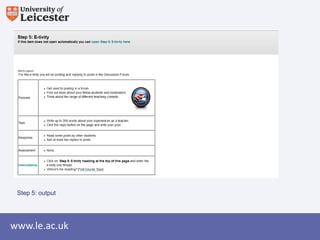
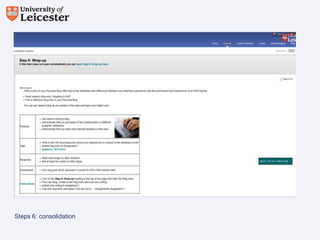
• The steps are designed to emulate pedagogic practice. Input
activities are audio, audio-video or reading based. Output
activities, called e-tivities, are based around collaborative
learning tools: wiki, blog or discussion forum – all found on
Blackboard.
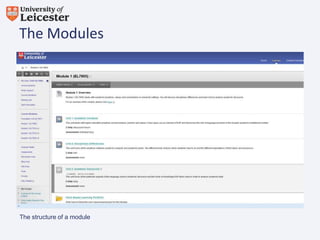
The Modules

The structure of a module
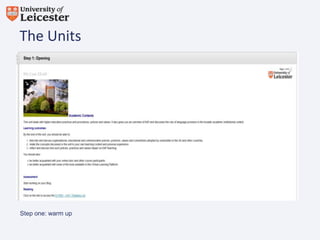
The Units

Step 1: warm up
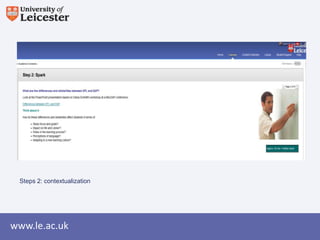
Step 2: contextualization

www.le.ac.uk
• The e-tivities and discussion for a are moderated by
an experienced EAP teacher trainer. Consideration
must be given to the particular skills of encouraging
participation, and provoking reflection and
investigation on the part of the learners.
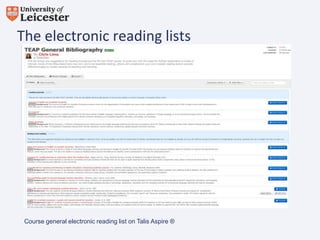
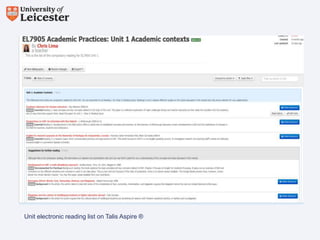
• YouTube videos and Talis Aspire reading lists can all
be accessed from within the Blackboard
environment. This keeps the course materials behind
one single log in and reduces the frustrations of
multiple loggins and learning new environments as
well as reducing the number of technical issues.
Steps 3 and 4: input
Step 5: output

www.le.ac.uk
Steps 6: consolidation
The course also aims to demonstrate the power of
online tools for EAP teaching. Participants
experience using a range of web2 tools for their
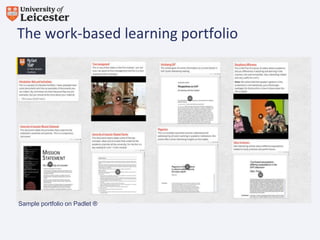
work learning based tasks. Work based learning
gives participants the opportunity to apply EAP
learning and teaching theory to their own teaching
contexts as well as provide evidence of how far they
meet BALEAP professional criteria.

www.le.ac.uk
The work-based learning portfolio

Sample portfolio on Padlet ®
The electronic reading lists

Course general electronic reading list on Talis Aspire ®
Unit electronic reading list on Talis Aspire ®
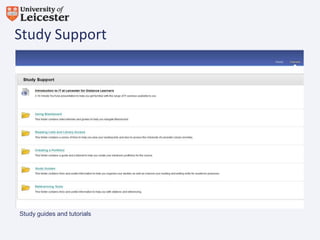
Study Support

Study guides and tutorials
A great deal of attention has been given to the
incorporation synthesis of a range of tools and
platforms to create a socially engaging online
community to support distance learners wherever
they are in the world.

www.le.ac.uk
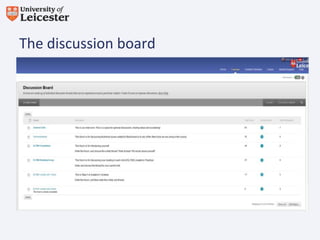
The discussion board
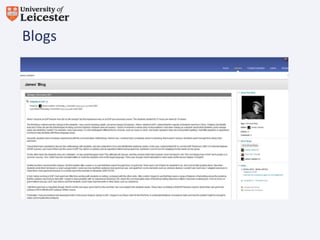
Blogs
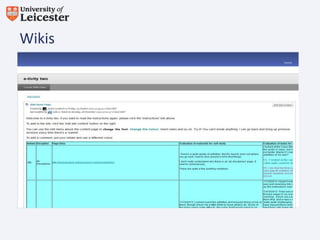
Wikis
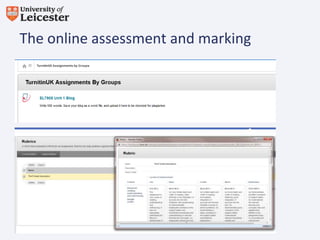
The online assessment and marking
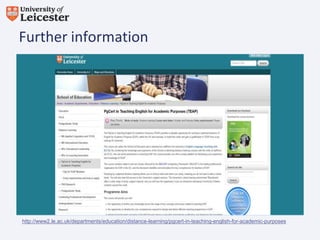
Further information

http://www2.le.ac.uk/departments/education/distance-learning/pgcert-in-teaching-english-for-academic-purposes
Introducing teap

Introducing teap

  • 1.
    Postgraduate Certificate inTeaching English for Academic Purposes English Language Teaching Unit School of Education www.le.ac.uk
  • 2.
    • The PgCert in Teaching English for Academic Purposes is a distance learning course for existing or potential teachers of English for academic purposes leading to a postgraduate certificate awarded by the University of Leicester. • Being an a hundred per cent online course, the PG cert TEAP is available in all parts of the world with internet connection. It is delivered via the Blackboard VLE, a globally established, extremely stable and easy to use online learning environment. Blackboard is the official VLE at the University of Leicester.
  • 3.
    Introducing the course Thecourse landing page
  • 4.
    • The courseis organized into four modules, all of which are closely informed by the BALEAP Competency Framework for Teachers. BALEAP is the leading professional organization for teachers of EAP in the UK. The modules are divided into three units. Each unit contains 2 week worth of input and output activities arranged in a series of six steps. • The steps are designed to emulate pedagogic practice. Input activities are audio, audio-video or reading based. Output activities, called e-tivities, are based around collaborative learning tools: wiki, blog or discussion forum – all found on Blackboard.
  • 5.
  • 6.
  • 7.
  • 8.
    • The e-tivitiesand discussion for a are moderated by an experienced EAP teacher trainer. Consideration must be given to the particular skills of encouraging participation, and provoking reflection and investigation on the part of the learners. • YouTube videos and Talis Aspire reading lists can all be accessed from within the Blackboard environment. This keeps the course materials behind one single log in and reduces the frustrations of multiple loggins and learning new environments as well as reducing the number of technical issues.
  • 9.
    Steps 3 and4: input
  • 10.
  • 11.
  • 12.
    The course alsoaims to demonstrate the power of online tools for EAP teaching. Participants experience using a range of web2 tools for their work learning based tasks. Work based learning gives participants the opportunity to apply EAP learning and teaching theory to their own teaching contexts as well as provide evidence of how far they meet BALEAP professional criteria. www.le.ac.uk
  • 13.
    The work-based learningportfolio Sample portfolio on Padlet ®
  • 14.
    The electronic readinglists Course general electronic reading list on Talis Aspire ®
  • 15.
    Unit electronic readinglist on Talis Aspire ®
  • 16.
  • 17.
    A great dealof attention has been given to the incorporation synthesis of a range of tools and platforms to create a socially engaging online community to support distance learners wherever they are in the world. www.le.ac.uk
  • 18.
  • 19.
  • 20.
  • 21.
  • 22.