Bacteriostasis and Skin
Innoxiousness of Nanosize Silver
Colloids on Textile Fabrics
By Hoon Joo Lee and Sung Hoon Jeong
Introduction
The article is from the Textile Research Journal; July 2005; 75, 7;AP
Science, page 551.
•The research deals with the bacteria fighting properties and skin-
innoxiousness of a nanosize silver colloid used as an antibacterial
treatment of textile fabrics.
•The experimenters are evaluating the nanosize colloidal silver
solution, and its ability to fight bacteria in textile fabrics.
Review of Literature
Here are all of the references that were cited:
1.Alcamo, I. E., "Fundamentals of Microbiology," The Benjamin/Cummings Publishing Company, Inc., CA, 1991, pp. 905.
2. Barratt, M. D., Quantitative Structure-Activity Relationships for Skin Irritation and Corrosivity of Neutral and Electrophilic Organic Chemicals,Toxicol. in
Vitro 10, 247-256 (1995).
3. Benson H. J., "Microbiological applications," The McGraw-Hill Companies, Inc., 1998, pp. 468.
4. Conner, C. J., Danna, G. S., Cooper,A. S., and Reeves,W.A., Durability of Zirconium-Based Antimicrobial Treatments on Cotton,Textile Res. J. 36, 359-367
(1966).
5. Cox D. M., "Nanostructure Science and Technology: High Surface Area Materials," R.W. Siegel, E. Hu, and M. C. Roco, Eds, International Technology
Research Institute,VA, 1999, pp. 49-66.
6. Craighead, H., and Leong, K., "Nanotechnology Research Direction: Biotechnology, Medicine, and Healthcare," M. C. Roco, R. S.Williams, and P.Alivisatos,
Eds, Kluwer Academic Publishers, Dordrecht,The Netherlands, 2000, pp.153-172.
7. Joeger,T. K., Joeger, R., Olsson, E., and Granqvist, C. G., Bacteria as Workers in the Living Factory: Metal-Accumulating Bacteria and their Potential for
Materials Science,Trades Biotechnol. 19, 15-20 (2001).
8. Khanna, S. N., "Handbook of Nanophase Materials: Effect on Properties of Reduced Size and Dimensione," A. N. Goldstein, Ed., M. Dekker, Inc., New
York, 1997, pp. 1-13.
9. Lee, H. J.,Yeo, S.Y., and Jeong, S. H.,Antibacterial Effect of Nanosized Silver Colloidal Solution on Textile Fabrics, J. Mater. Sci, 38, 2199-2204 (2003).
10. Lin, J., Qiu, S., Lewis, K., and Klibanov,A. M., Bactericidal Properties of Flat Surfaces and Nanoparticles Derivatized with Alkylated Polyethylenimines,
Biotechnol Lett. 24, 801-805 (2002).
11. Lin, J., Qiu, S., Lewis, K., and Klibanov,A. M., Mechanism of Bactericidal And Fungicidal Activities of Textiles Covalently Modified with Alkylated
Polyethylenimine, Biotechnol. Bioeng. 83, 168-172 (2003).
12. Murphy, J. C.,Watson, E. S.,Wirth, P.W., Skierkowski, P., Folk, R. M., and Peck, G., Cutaneous Irritation in the Topical Application of 30 Antineoplastic
Agent to New Zealand White Rabbits.Toxicology 14, 117-130 (1979).
13.Talaro, K. P., and Talaro,A., "Foundation in Microbiology," The McGraw-Hill Companies, Inc., CA, 1999, pp. 352-353.
14.Tiller, J. C., Liao, C. J., Lewis, K., and Klibanov,A. M., Designing Surfaces that Kill Bacteria on Contact, Proc. Natl.Acad. Sci USA 98, 5981-5985 (2001).
15.Tiller, J. C., Lee, S. B., Lewis, K., and Klibanov,A. M., Polymer Surfaces Derivatized with Poly(vinyl-7V-hexylpyridinium) Kill Both Air- and Water-Borne
Bacteria, Biotechnol. Bioeng. 79, 465-471 (2002).
16.Tortora, G. J., Funke, B. R., and case, C. L., "Microbiology," The Benjamin/Cummings Publishing Company, Inc. CA, 1992, pp. 167-189.
17.Vigo,T. L. and Benjaminson, M.A.,Antibacterial Fiber Treatment and Disinfection,Textile Res. J. 51, 454-465 (1981).
18.Wang, Z. L., "Characterization of Nanophase Material," Wiley-VCHVerlag GmbH, Germany, 2000, pp. 1-80.
19.Yeo, S.Y., Lee, H. J., and Jeong, S. H., Preparation of Nanocomposite Fibers for Permanent Antibacterial Effect, J. Mater. Sci 38, 2199-2203 (2003)
Review of Literature
•In articles 1 and 13, the authors found that silver has been
proven to be a useful antiseptic material.This was critical
information, because without the knowledge of that factor, the
experiment that was done wouldn’t have been possible.
•Based on the information provided in articles 14, 15, and 17, we
know that silver is a non-toxic substance.Therefore, it is not
harmful to humans.Along with the data that was stated above, it
was assumed that silver can be useful when eliminating the
bacteria present in textile woven fabrics, which come into direct
contact with human skin almost all of the time.This is also
significant, since silver can also be used to clean clothing and
other things in hospitals, and to disinfect public places that can get
very dirty.
Hypothesis
The scientists that conducted this experiment thought that the
silver colloid solution would work as an effective antibacterial
treatment for the textile fabrics (the clothes that we wear). In
other words, they believed that the silver would successfully
reduce the amount of bacteria present.
Methodology
Materials
•nanosize (really small) silver colloidal solutions [2000ppm] - they
were dissolved in distilled water at room temperature [25°C]
•two kinds of fabrics were used - polyester and cotton
•to test the antibacterial effects of the colloidal silver, it was
evaluated against both Staphylococcus aureus and Escherichia coli
(two kinds of bacteria)
•The ATCC 6538 and 25922 were the microscope models that
were used to work with the bacteria and fabrics.Also, the ATCC
4352 was utilized when Klebsiela pneumoniae was assessed, rather
than the E. coli again.
Methodology
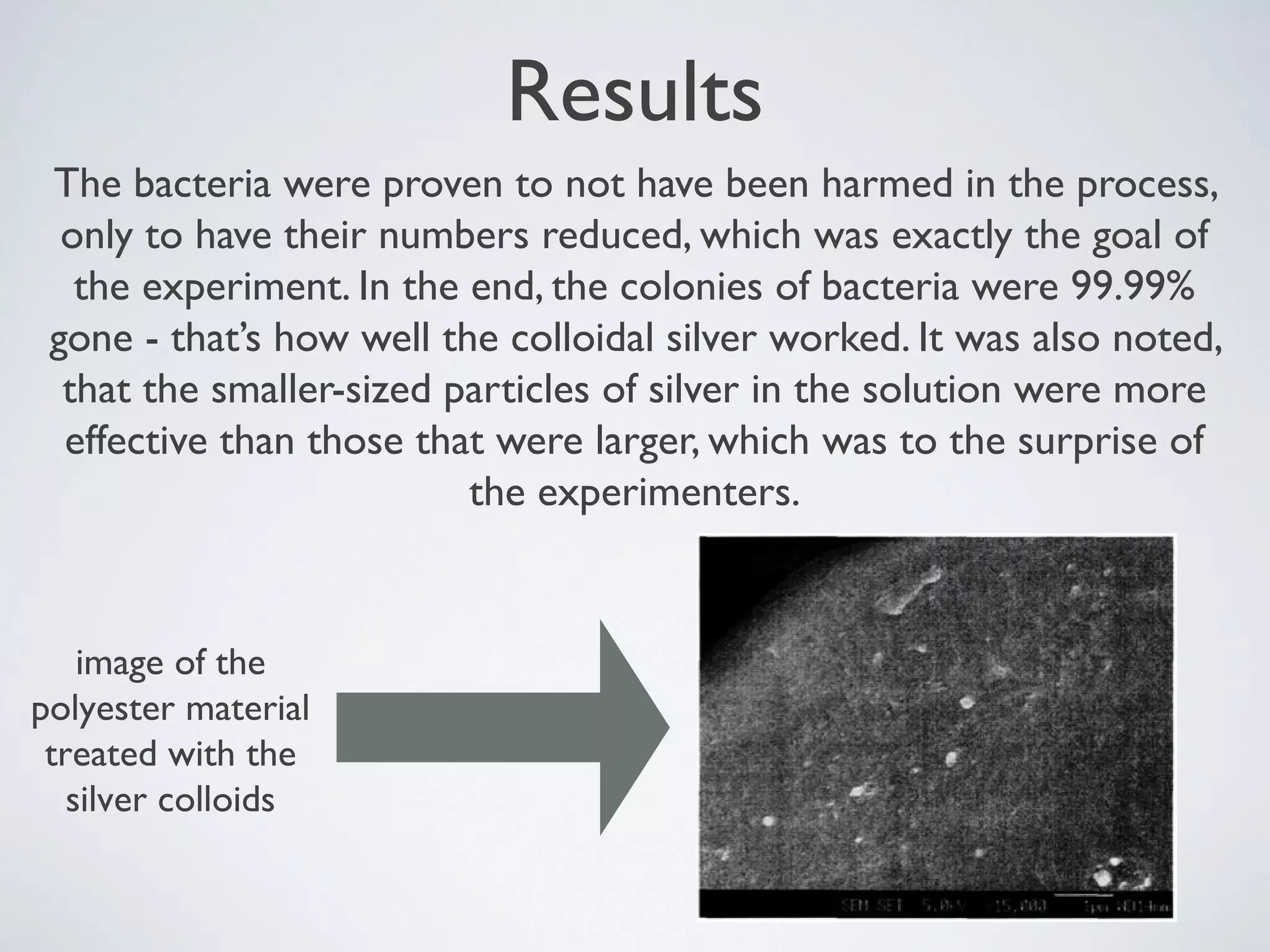
Below, is a diagram that outlines what was done to all of the
sample textile fabrics during this experiment:
First, they were dipped in the colloidal silver for a minute.
Second, the samples were dried at 70°C for three minutes.
Third, the materials were cured at 120° for two minutes.
Methodology
Next, a skin irritation test was preformed on six white, male New
Zealand rabbits that were four months old. Each of them weighed
at least 2kg [4.4 pounds].This was done at room temperature.
One milliliter of the colloidal silver solution [100ppm] was applied
to the skin.The skin conditions of these rabbits were observed
after 24 hours and 72 hours.
Lastly, with the help of the various microscopes mentioned earlier,
the scientists viewed the colloidal silver particles, in order to
make sure that the substance completely covered the treated
fabrics (evenly distributed), which it did.This was done to make
sure that the data that was being collected was accurate.
Results
The bacteria were proven to not have been harmed in the process,
only to have their numbers reduced, which was exactly the goal of
the experiment. In the end, the colonies of bacteria were 99.99%
gone - that’s how well the colloidal silver worked. It was also noted,
that the smaller-sized particles of silver in the solution were more
effective than those that were larger, which was to the surprise of
the experimenters.
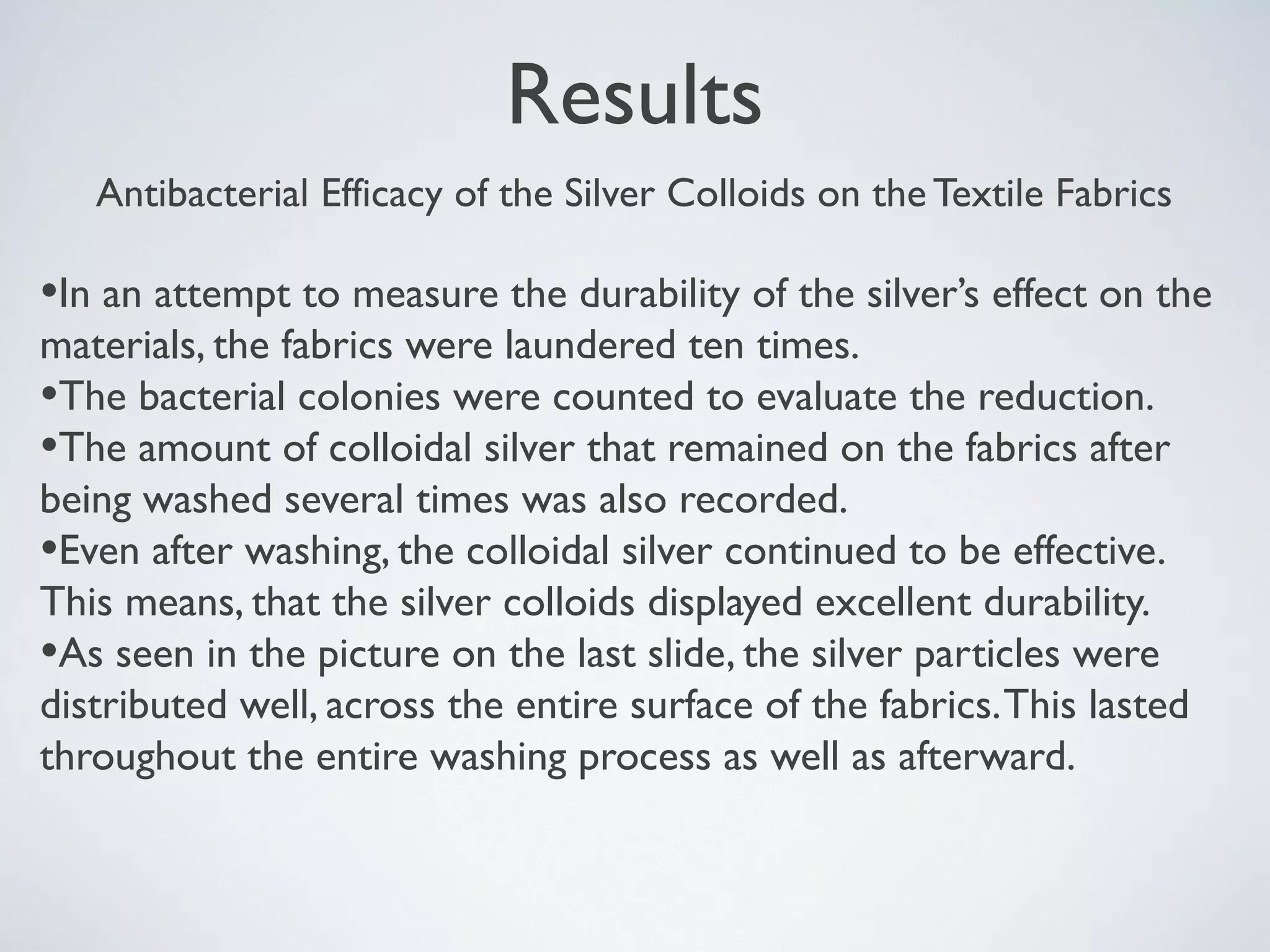
image of the
polyester material
treated with the
silver colloids
Results
Antibacterial Efficacy of the Silver Colloids on the Textile Fabrics
•In an attempt to measure the durability of the silver’s effect on the
materials, the fabrics were laundered ten times.
•The bacterial colonies were counted to evaluate the reduction.
•The amount of colloidal silver that remained on the fabrics after
being washed several times was also recorded.
•Even after washing, the colloidal silver continued to be effective.
This means, that the silver colloids displayed excellent durability.
•As seen in the picture on the last slide, the silver particles were
distributed well, across the entire surface of the fabrics.This lasted
throughout the entire washing process as well as afterward.
Results
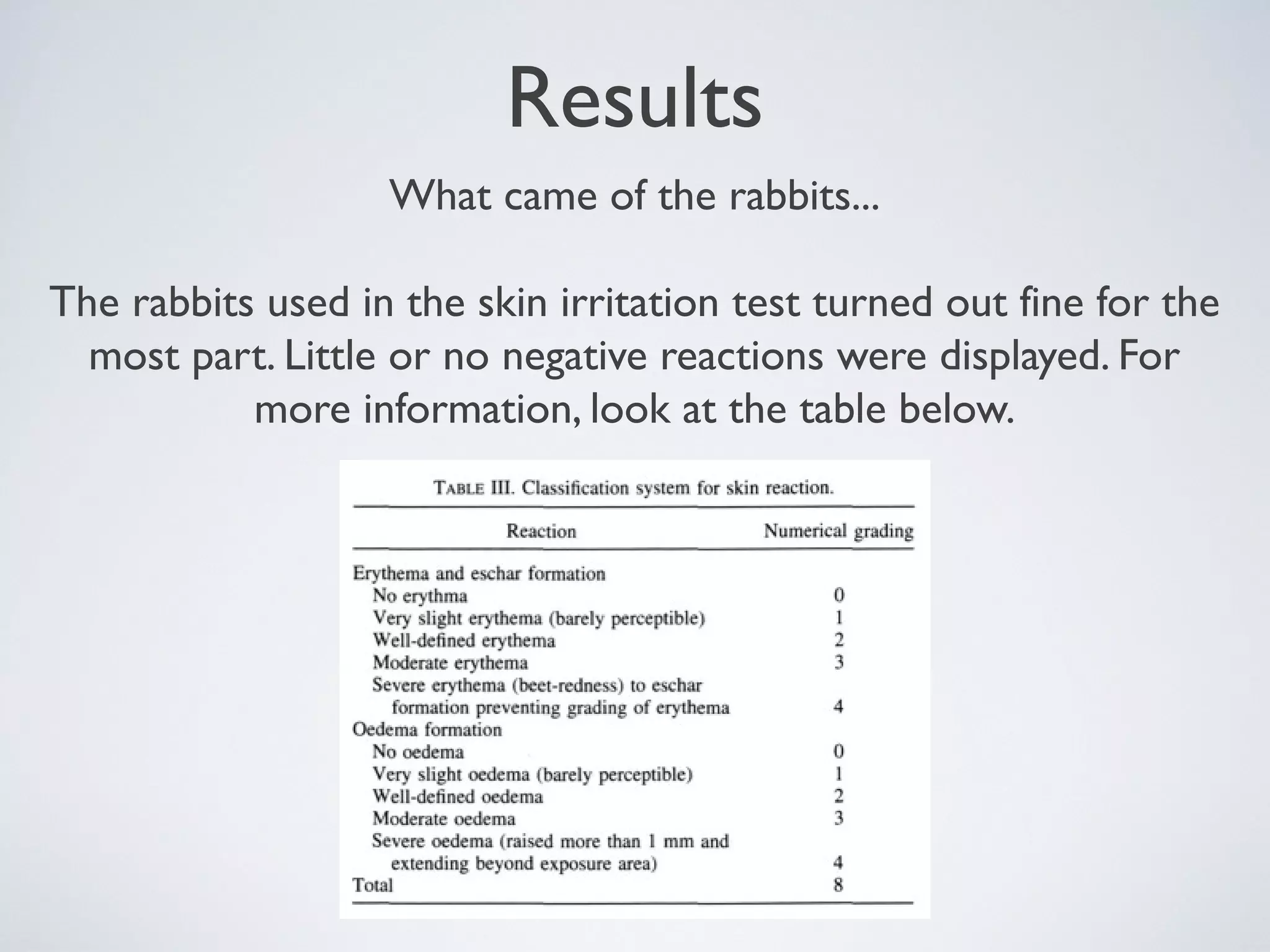
What came of the rabbits...
The rabbits used in the skin irritation test turned out fine for the
most part. Little or no negative reactions were displayed. For
more information, look at the table below.
Results
The data collected based on the rabbit’s reaction to the colloidal
silver confirmed that the silver particles rarely ever irritate animal
skin, when given these circumstances. Once again, it appears that
smaller particles happen to be less toxic than larger ones.
Therefore, silver colloids small in size can be used as antibacterial
agents on fabrics that come into contact with human skin.
Discussion
The purpose of the experiment was to test the antibacterial
effect of the silver colloids on textile fabrics. Based on all of the
information that has been recorded, the scientists concluded that
colloidal silver does have effective antibacterial characteristics. It
was not toxic to the skin, and therefore can be used to greatly
lower the amounts of bacteria present on our clothing.With all
that being true, the hypothesis turned out to be supported by the
data.
Conclusion
The hypothesis that the colloidal silver solution can be used as an
effective way of disinfecting fabrics of the bacteria on them was
proven true by this experiment. Since the data supported the
hypothesis, the facts were accepted, and colloidal silver is being
used more and more often in various locations. Examples of this,
is that silver colloids are being used to clean hospitals, and the
equipment that is used in the medical field. It has also become
more common in places such as cruise ships, to clean the railings,
and other things that come into contact with many people year-
round.

intro to research

  • 1.
    Bacteriostasis and Skin Innoxiousnessof Nanosize Silver Colloids on Textile Fabrics By Hoon Joo Lee and Sung Hoon Jeong
  • 2.
    Introduction The article isfrom the Textile Research Journal; July 2005; 75, 7;AP Science, page 551. •The research deals with the bacteria fighting properties and skin- innoxiousness of a nanosize silver colloid used as an antibacterial treatment of textile fabrics. •The experimenters are evaluating the nanosize colloidal silver solution, and its ability to fight bacteria in textile fabrics.
  • 3.
    Review of Literature Hereare all of the references that were cited: 1.Alcamo, I. E., "Fundamentals of Microbiology," The Benjamin/Cummings Publishing Company, Inc., CA, 1991, pp. 905. 2. Barratt, M. D., Quantitative Structure-Activity Relationships for Skin Irritation and Corrosivity of Neutral and Electrophilic Organic Chemicals,Toxicol. in Vitro 10, 247-256 (1995). 3. Benson H. J., "Microbiological applications," The McGraw-Hill Companies, Inc., 1998, pp. 468. 4. Conner, C. J., Danna, G. S., Cooper,A. S., and Reeves,W.A., Durability of Zirconium-Based Antimicrobial Treatments on Cotton,Textile Res. J. 36, 359-367 (1966). 5. Cox D. M., "Nanostructure Science and Technology: High Surface Area Materials," R.W. Siegel, E. Hu, and M. C. Roco, Eds, International Technology Research Institute,VA, 1999, pp. 49-66. 6. Craighead, H., and Leong, K., "Nanotechnology Research Direction: Biotechnology, Medicine, and Healthcare," M. C. Roco, R. S.Williams, and P.Alivisatos, Eds, Kluwer Academic Publishers, Dordrecht,The Netherlands, 2000, pp.153-172. 7. Joeger,T. K., Joeger, R., Olsson, E., and Granqvist, C. G., Bacteria as Workers in the Living Factory: Metal-Accumulating Bacteria and their Potential for Materials Science,Trades Biotechnol. 19, 15-20 (2001). 8. Khanna, S. N., "Handbook of Nanophase Materials: Effect on Properties of Reduced Size and Dimensione," A. N. Goldstein, Ed., M. Dekker, Inc., New York, 1997, pp. 1-13. 9. Lee, H. J.,Yeo, S.Y., and Jeong, S. H.,Antibacterial Effect of Nanosized Silver Colloidal Solution on Textile Fabrics, J. Mater. Sci, 38, 2199-2204 (2003). 10. Lin, J., Qiu, S., Lewis, K., and Klibanov,A. M., Bactericidal Properties of Flat Surfaces and Nanoparticles Derivatized with Alkylated Polyethylenimines, Biotechnol Lett. 24, 801-805 (2002). 11. Lin, J., Qiu, S., Lewis, K., and Klibanov,A. M., Mechanism of Bactericidal And Fungicidal Activities of Textiles Covalently Modified with Alkylated Polyethylenimine, Biotechnol. Bioeng. 83, 168-172 (2003). 12. Murphy, J. C.,Watson, E. S.,Wirth, P.W., Skierkowski, P., Folk, R. M., and Peck, G., Cutaneous Irritation in the Topical Application of 30 Antineoplastic Agent to New Zealand White Rabbits.Toxicology 14, 117-130 (1979). 13.Talaro, K. P., and Talaro,A., "Foundation in Microbiology," The McGraw-Hill Companies, Inc., CA, 1999, pp. 352-353. 14.Tiller, J. C., Liao, C. J., Lewis, K., and Klibanov,A. M., Designing Surfaces that Kill Bacteria on Contact, Proc. Natl.Acad. Sci USA 98, 5981-5985 (2001). 15.Tiller, J. C., Lee, S. B., Lewis, K., and Klibanov,A. M., Polymer Surfaces Derivatized with Poly(vinyl-7V-hexylpyridinium) Kill Both Air- and Water-Borne Bacteria, Biotechnol. Bioeng. 79, 465-471 (2002). 16.Tortora, G. J., Funke, B. R., and case, C. L., "Microbiology," The Benjamin/Cummings Publishing Company, Inc. CA, 1992, pp. 167-189. 17.Vigo,T. L. and Benjaminson, M.A.,Antibacterial Fiber Treatment and Disinfection,Textile Res. J. 51, 454-465 (1981). 18.Wang, Z. L., "Characterization of Nanophase Material," Wiley-VCHVerlag GmbH, Germany, 2000, pp. 1-80. 19.Yeo, S.Y., Lee, H. J., and Jeong, S. H., Preparation of Nanocomposite Fibers for Permanent Antibacterial Effect, J. Mater. Sci 38, 2199-2203 (2003)
  • 4.
    Review of Literature •Inarticles 1 and 13, the authors found that silver has been proven to be a useful antiseptic material.This was critical information, because without the knowledge of that factor, the experiment that was done wouldn’t have been possible. •Based on the information provided in articles 14, 15, and 17, we know that silver is a non-toxic substance.Therefore, it is not harmful to humans.Along with the data that was stated above, it was assumed that silver can be useful when eliminating the bacteria present in textile woven fabrics, which come into direct contact with human skin almost all of the time.This is also significant, since silver can also be used to clean clothing and other things in hospitals, and to disinfect public places that can get very dirty.
  • 5.
    Hypothesis The scientists thatconducted this experiment thought that the silver colloid solution would work as an effective antibacterial treatment for the textile fabrics (the clothes that we wear). In other words, they believed that the silver would successfully reduce the amount of bacteria present.
  • 6.
    Methodology Materials •nanosize (really small)silver colloidal solutions [2000ppm] - they were dissolved in distilled water at room temperature [25°C] •two kinds of fabrics were used - polyester and cotton •to test the antibacterial effects of the colloidal silver, it was evaluated against both Staphylococcus aureus and Escherichia coli (two kinds of bacteria) •The ATCC 6538 and 25922 were the microscope models that were used to work with the bacteria and fabrics.Also, the ATCC 4352 was utilized when Klebsiela pneumoniae was assessed, rather than the E. coli again.
  • 7.
    Methodology Below, is adiagram that outlines what was done to all of the sample textile fabrics during this experiment: First, they were dipped in the colloidal silver for a minute. Second, the samples were dried at 70°C for three minutes. Third, the materials were cured at 120° for two minutes.
  • 8.
    Methodology Next, a skinirritation test was preformed on six white, male New Zealand rabbits that were four months old. Each of them weighed at least 2kg [4.4 pounds].This was done at room temperature. One milliliter of the colloidal silver solution [100ppm] was applied to the skin.The skin conditions of these rabbits were observed after 24 hours and 72 hours. Lastly, with the help of the various microscopes mentioned earlier, the scientists viewed the colloidal silver particles, in order to make sure that the substance completely covered the treated fabrics (evenly distributed), which it did.This was done to make sure that the data that was being collected was accurate.
  • 9.
    Results The bacteria wereproven to not have been harmed in the process, only to have their numbers reduced, which was exactly the goal of the experiment. In the end, the colonies of bacteria were 99.99% gone - that’s how well the colloidal silver worked. It was also noted, that the smaller-sized particles of silver in the solution were more effective than those that were larger, which was to the surprise of the experimenters. image of the polyester material treated with the silver colloids
  • 10.
    Results Antibacterial Efficacy ofthe Silver Colloids on the Textile Fabrics •In an attempt to measure the durability of the silver’s effect on the materials, the fabrics were laundered ten times. •The bacterial colonies were counted to evaluate the reduction. •The amount of colloidal silver that remained on the fabrics after being washed several times was also recorded. •Even after washing, the colloidal silver continued to be effective. This means, that the silver colloids displayed excellent durability. •As seen in the picture on the last slide, the silver particles were distributed well, across the entire surface of the fabrics.This lasted throughout the entire washing process as well as afterward.
  • 11.
    Results What came ofthe rabbits... The rabbits used in the skin irritation test turned out fine for the most part. Little or no negative reactions were displayed. For more information, look at the table below.
  • 12.
    Results The data collectedbased on the rabbit’s reaction to the colloidal silver confirmed that the silver particles rarely ever irritate animal skin, when given these circumstances. Once again, it appears that smaller particles happen to be less toxic than larger ones. Therefore, silver colloids small in size can be used as antibacterial agents on fabrics that come into contact with human skin.
  • 13.
    Discussion The purpose ofthe experiment was to test the antibacterial effect of the silver colloids on textile fabrics. Based on all of the information that has been recorded, the scientists concluded that colloidal silver does have effective antibacterial characteristics. It was not toxic to the skin, and therefore can be used to greatly lower the amounts of bacteria present on our clothing.With all that being true, the hypothesis turned out to be supported by the data.
  • 14.
    Conclusion The hypothesis thatthe colloidal silver solution can be used as an effective way of disinfecting fabrics of the bacteria on them was proven true by this experiment. Since the data supported the hypothesis, the facts were accepted, and colloidal silver is being used more and more often in various locations. Examples of this, is that silver colloids are being used to clean hospitals, and the equipment that is used in the medical field. It has also become more common in places such as cruise ships, to clean the railings, and other things that come into contact with many people year- round.