Intro to Electronics in Python
Anna Gerber
Intro to Electronics in Python
Electricity
•  Electricity is a form of energy
•  We can connect components that convert
electrical energy into other forms of energy:
light, sound, movement, heat etc, into a circuit
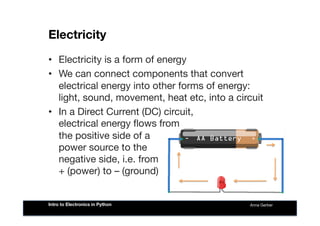
•  In a Direct Current (DC) circuit,

electrical energy flows from 

the positive side of a 

power source to the

negative side, i.e. from 

+ (power) to – (ground) 
Anna Gerber
Intro to Electronics in Python
Electrical concepts
•  Current (Amps): measures the flow of electrical
energy through a circuit
•  Voltage (Volts): measures difference in potential
energy between the positive and negative sides
of a circuit
•  Resistance (Ohms): measures a material's
opposition to the flow of energy
•  Power (Watts): the rate at which energy is
converted from one form to another
Anna Gerber
Intro to Electronics in Python
Ohm's Law
Current = Voltage / Resistance
•  Increase the voltage, and the current will
increase (i.e. speed up)
•  Increase the resistance and the current will
decrease
Anna Gerber
Intro to Electronics in Python
Sensors
•  Environmental	
  condi/ons	


(e.g.	
  temperature,	
  humidity,	
  smoke)	
  
•  Magne/c	
  (e.g.	
  hall	
  effect	
  sensor)	
  
•  Light	
  (e.g.	
  photo	
  resistor)	
  
•  Sound	
  (e.g.	
  microphone)	
  
•  Mo/on	
  (e.g.	
  accelerometer,	
  /lt,	
  pressure)	
  
•  User	
  /	
  Physical	
  Input	
  (e.g.	
  buDon)	
  
Anna Gerber
Intro to Electronics in Python
Actuators
•  Light	
  &	
  Displays	
  (e.g.	
  LED,	
  LCD)	
  
•  Sound	
  (e.g.	
  Piezo	
  buzzer)	
  
•  Mo/on	
  (e.g.	
  Servo,	
  DC	
  Motor,	
  Solenoid)	
  
•  Power	
  (e.g.	
  Relay)	
  
Anna Gerber
Intro to Electronics in Python
Digital vs Analog
•  Digital
–  discrete values (0 or 1)(LOW or HIGH)
–  Examples: tilt sensor, push button, relay, servo
•  Analog
–  continuous values
–  Examples: photo resistor, DC motor
•  Some sensors support both digital and analog
outputs
Anna Gerber
Intro to Electronics in Python
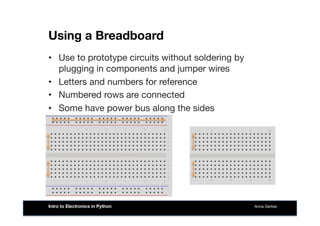
Using a Breadboard
Anna Gerber
Intro to Electronics in Python
•  Use to prototype circuits without soldering by
plugging in components and jumper wires
•  Letters and numbers for reference
•  Numbered rows are connected
•  Some have power bus along the sides
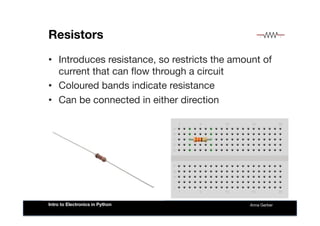
Resistors
•  Introduces resistance, so restricts the amount of
current that can flow through a circuit
•  Coloured bands indicate resistance
•  Can be connected in either direction
Anna Gerber
Intro to Electronics in Python
LEDs
•  Light Emitting Diode
•  Polarized: diodes act like one way valves so
must be connected in a certain direction
•  Emits light when a current passes through
Anna Gerber
Intro to Electronics in Python
Anode	
  (+)	
  	
  
longer	
  lead	
  
connects	
  to	
  power	
  
Cathode	
  (-­‐)	
  	
  
connects	
  to	
  ground	
  
Control
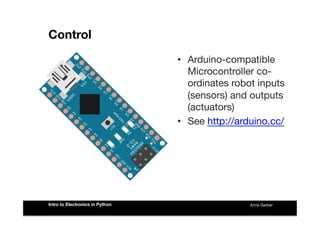
•  Arduino-compatible
Microcontroller co-
ordinates robot inputs
(sensors) and outputs
(actuators)
•  See http://arduino.cc/ 
Anna Gerber
Intro to Electronics in Python
PyFirmata
•  https://github.com/tino/pyFirmata
•  Communicates with the Arduino using the Firmata
protocol
Install using pip:
pip	
  install	
  pyfirmata	
  
Anna Gerber
Intro to Electronics in Python
Loading Firmata onto the Arduino
•  Once-off setup to prepare our Arduino for use
with PyFirmata:
–  Connect the microcontroller board via USB
–  Launch Arduino IDE and open the Firmata sketch
via the menu: File	
  >	
  Examples	
  >	
  Firmata	
  >	
  
StandardFirmata	
  
–  Select your board type (e.g. Arduino Nano w/
ATmega328) via Tools	
  >	
  Board	
  
–  Select the port for your board via Tools	
  >	
  
Serial	
  Port	
  > (the port of your Arduino) 

e.g. /dev/tty.usbserial-A9GF3L9D
–  Upload the program by clicking on Upload	
  
–  Close the IDE
Anna Gerber
Intro to Electronics in Python
BLINKING AN LED
Anna Gerber
Intro to Electronics in Python
Connecting an LED to the Arduino
•  Unplug the Arduino!
•  Attach long lead of
LED to pin 13 of
Arduino
•  Connect resistor to
cathode of resistor
and ground rail of
breadboard
•  Connect GND pin of
Arduino to ground
rail of breadboard
using a jumper wire
Anna Gerber
Intro to Electronics in Python
Creating the program
1.  Create a Python program file (e.g. blink.py)
2.  Edit it using a text editor e.g. SublimeText
3.  At the start of your program import the library

import	
  pyfirmata	
  
Anna Gerber
Intro to Electronics in Python
Creating the board
We create a Board object which corresponds to our
Arduino-compatible microcontroller board and store it
in a variable. 
We need to provide the port as a parameter:
board	
  =	
  pyfirmata.Arduino("/dev/tty.usbserial-­‐A9QPTF37")	
  
Anna Gerber
Intro to Electronics in Python
Controlling the LED
•  Then we can control the LED via the pin it is
connected to (in this case, pin 13)
•  Use a variable for the pin number to make it easier to
change later
–  PIN	
  =	
  13	
  
•  Turn on LED on pin 13
–  board.digital[PIN].write(1)	
  
•  Turn off LED on pin 13
–  board.digital[PIN].write(0)	
  
Anna Gerber
Intro to Electronics in Python
Delayed behaviour
•  Use the pass_time function to delay functions
by a certain number of seconds e.g. blink LED
on then off after one second:
	
  	
  board.digital[PIN].write(0)	


  board.pass_time(1)	


  board.digital[PIN].write(1)	
  
Anna Gerber
Intro to Electronics in Python
Repeating behaviour (loops)
Use a while loop to blink indefinitely:
while	
  True	
  :	
  
board.digital[PIN].write(0)	
  
board.pass_time(1)	
  
board.digital[PIN].write(1)	
  
board.pass_time(1)	
  
Anna Gerber
Intro to Electronics in Python
The entire blink program
import	
  pyfirmata	
  
PORT	
  =	
  "/dev/tty.usbserial-­‐A9QPTF37"	
  
PIN	
  =	
  13	
  
board	
  =	
  pyfirmata.Arduino(PORT)	
  
while	
  True:	


  board.digital[PIN].write(0)	


  board.pass_time(1)	


  board.digital[PIN].write(1)	


  board.pass_time(1)	
  
Anna Gerber
Intro to Electronics in Python
Running the program from Terminal
•  Open the Terminal app
•  Change directory to the location where you have
saved your code e.g. 

	
  >	
  cd	
  ~/Desktop/code/	
  
•  Run your program using Python e.g.

	
  >	
  python blink.py

•  Hit control-C to stop the program
Anna Gerber
Intro to Electronics in Python
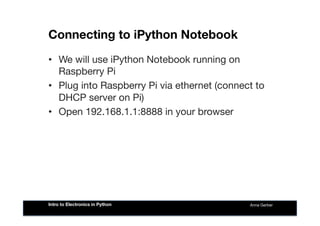
Connecting to iPython Notebook
•  We will use iPython Notebook running on
Raspberry Pi
•  Plug into Raspberry Pi via ethernet (connect to
DHCP server on Pi)
•  Open 192.168.1.1:8888 in your browser
Anna Gerber
Intro to Electronics in Python
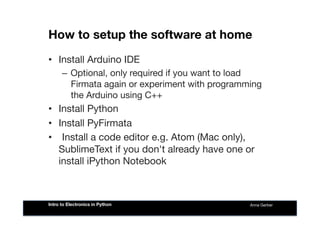
How to setup the software at home
•  Install Arduino IDE 
–  Optional, only required if you want to load
Firmata again or experiment with programming
the Arduino using C++
•  Install Python
•  Install PyFirmata	
  
• 	
   Install a code editor e.g. Atom (Mac only),
SublimeText if you don't already have one or
install iPython Notebook
Anna Gerber
Intro to Electronics in Python
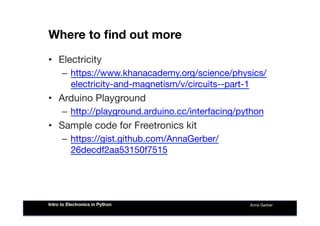
Where to find out more
•  Electricity
–  https://www.khanacademy.org/science/physics/
electricity-and-magnetism/v/circuits--part-1
•  Arduino Playground 

–  http://playground.arduino.cc/interfacing/python
•  Sample code for Freetronics kit
–  https://gist.github.com/AnnaGerber/
26decdf2aa53150f7515
Anna Gerber
Intro to Electronics in Python

Intro to Electronics in Python

  • 1.
    Intro to Electronicsin Python Anna Gerber Intro to Electronics in Python
  • 2.
    Electricity •  Electricity isa form of energy •  We can connect components that convert electrical energy into other forms of energy: light, sound, movement, heat etc, into a circuit •  In a Direct Current (DC) circuit,
 electrical energy flows from 
 the positive side of a 
 power source to the
 negative side, i.e. from 
 + (power) to – (ground) Anna Gerber Intro to Electronics in Python
  • 3.
    Electrical concepts •  Current(Amps): measures the flow of electrical energy through a circuit •  Voltage (Volts): measures difference in potential energy between the positive and negative sides of a circuit •  Resistance (Ohms): measures a material's opposition to the flow of energy •  Power (Watts): the rate at which energy is converted from one form to another Anna Gerber Intro to Electronics in Python
  • 4.
    Ohm's Law Current =Voltage / Resistance •  Increase the voltage, and the current will increase (i.e. speed up) •  Increase the resistance and the current will decrease Anna Gerber Intro to Electronics in Python
  • 5.
    Sensors •  Environmental  condi/ons       (e.g.  temperature,  humidity,  smoke)   •  Magne/c  (e.g.  hall  effect  sensor)   •  Light  (e.g.  photo  resistor)   •  Sound  (e.g.  microphone)   •  Mo/on  (e.g.  accelerometer,  /lt,  pressure)   •  User  /  Physical  Input  (e.g.  buDon)   Anna Gerber Intro to Electronics in Python
  • 6.
    Actuators •  Light  &  Displays  (e.g.  LED,  LCD)   •  Sound  (e.g.  Piezo  buzzer)   •  Mo/on  (e.g.  Servo,  DC  Motor,  Solenoid)   •  Power  (e.g.  Relay)   Anna Gerber Intro to Electronics in Python
  • 7.
    Digital vs Analog • Digital –  discrete values (0 or 1)(LOW or HIGH) –  Examples: tilt sensor, push button, relay, servo •  Analog –  continuous values –  Examples: photo resistor, DC motor •  Some sensors support both digital and analog outputs Anna Gerber Intro to Electronics in Python
  • 8.
    Using a Breadboard AnnaGerber Intro to Electronics in Python •  Use to prototype circuits without soldering by plugging in components and jumper wires •  Letters and numbers for reference •  Numbered rows are connected •  Some have power bus along the sides
  • 9.
    Resistors •  Introduces resistance,so restricts the amount of current that can flow through a circuit •  Coloured bands indicate resistance •  Can be connected in either direction Anna Gerber Intro to Electronics in Python
  • 10.
    LEDs •  Light EmittingDiode •  Polarized: diodes act like one way valves so must be connected in a certain direction •  Emits light when a current passes through Anna Gerber Intro to Electronics in Python Anode  (+)     longer  lead   connects  to  power   Cathode  (-­‐)     connects  to  ground  
  • 11.
    Control •  Arduino-compatible Microcontroller co- ordinatesrobot inputs (sensors) and outputs (actuators) •  See http://arduino.cc/ Anna Gerber Intro to Electronics in Python
  • 12.
    PyFirmata •  https://github.com/tino/pyFirmata •  Communicateswith the Arduino using the Firmata protocol Install using pip: pip  install  pyfirmata   Anna Gerber Intro to Electronics in Python
  • 13.
    Loading Firmata ontothe Arduino •  Once-off setup to prepare our Arduino for use with PyFirmata: –  Connect the microcontroller board via USB –  Launch Arduino IDE and open the Firmata sketch via the menu: File  >  Examples  >  Firmata  >   StandardFirmata   –  Select your board type (e.g. Arduino Nano w/ ATmega328) via Tools  >  Board   –  Select the port for your board via Tools  >   Serial  Port  > (the port of your Arduino) 
 e.g. /dev/tty.usbserial-A9GF3L9D –  Upload the program by clicking on Upload   –  Close the IDE Anna Gerber Intro to Electronics in Python
  • 14.
    BLINKING AN LED AnnaGerber Intro to Electronics in Python
  • 15.
    Connecting an LEDto the Arduino •  Unplug the Arduino! •  Attach long lead of LED to pin 13 of Arduino •  Connect resistor to cathode of resistor and ground rail of breadboard •  Connect GND pin of Arduino to ground rail of breadboard using a jumper wire Anna Gerber Intro to Electronics in Python
  • 16.
    Creating the program 1. Create a Python program file (e.g. blink.py) 2.  Edit it using a text editor e.g. SublimeText 3.  At the start of your program import the library import  pyfirmata   Anna Gerber Intro to Electronics in Python
  • 17.
    Creating the board Wecreate a Board object which corresponds to our Arduino-compatible microcontroller board and store it in a variable. We need to provide the port as a parameter: board  =  pyfirmata.Arduino("/dev/tty.usbserial-­‐A9QPTF37")   Anna Gerber Intro to Electronics in Python
  • 18.
    Controlling the LED • Then we can control the LED via the pin it is connected to (in this case, pin 13) •  Use a variable for the pin number to make it easier to change later –  PIN  =  13   •  Turn on LED on pin 13 –  board.digital[PIN].write(1)   •  Turn off LED on pin 13 –  board.digital[PIN].write(0)   Anna Gerber Intro to Electronics in Python
  • 19.
    Delayed behaviour •  Usethe pass_time function to delay functions by a certain number of seconds e.g. blink LED on then off after one second:    board.digital[PIN].write(0)      board.pass_time(1)      board.digital[PIN].write(1)   Anna Gerber Intro to Electronics in Python
  • 20.
    Repeating behaviour (loops) Usea while loop to blink indefinitely: while  True  :   board.digital[PIN].write(0)   board.pass_time(1)   board.digital[PIN].write(1)   board.pass_time(1)   Anna Gerber Intro to Electronics in Python
  • 21.
    The entire blinkprogram import  pyfirmata   PORT  =  "/dev/tty.usbserial-­‐A9QPTF37"   PIN  =  13   board  =  pyfirmata.Arduino(PORT)   while  True:          board.digital[PIN].write(0)          board.pass_time(1)          board.digital[PIN].write(1)          board.pass_time(1)   Anna Gerber Intro to Electronics in Python
  • 22.
    Running the programfrom Terminal •  Open the Terminal app •  Change directory to the location where you have saved your code e.g. 
  >  cd  ~/Desktop/code/   •  Run your program using Python e.g.
  >  python blink.py
 •  Hit control-C to stop the program Anna Gerber Intro to Electronics in Python
  • 23.
    Connecting to iPythonNotebook •  We will use iPython Notebook running on Raspberry Pi •  Plug into Raspberry Pi via ethernet (connect to DHCP server on Pi) •  Open 192.168.1.1:8888 in your browser Anna Gerber Intro to Electronics in Python
  • 24.
    How to setupthe software at home •  Install Arduino IDE –  Optional, only required if you want to load Firmata again or experiment with programming the Arduino using C++ •  Install Python •  Install PyFirmata   •    Install a code editor e.g. Atom (Mac only), SublimeText if you don't already have one or install iPython Notebook Anna Gerber Intro to Electronics in Python
  • 25.
    Where to findout more •  Electricity –  https://www.khanacademy.org/science/physics/ electricity-and-magnetism/v/circuits--part-1 •  Arduino Playground –  http://playground.arduino.cc/interfacing/python •  Sample code for Freetronics kit –  https://gist.github.com/AnnaGerber/ 26decdf2aa53150f7515 Anna Gerber Intro to Electronics in Python