Blockchain beyond Confidential Compute.
Views from Oasis Labs, IBM and Samsung
Intro: the Blockchain revolution
Lennart Frantzell
IBM Developer Advocate
2019 10 16
Agenda
Group Name / DOC ID / Month XX, 2018 / © 2018 IBM Corporation 2
6:00 Arrival, light dinner, mingle
6:15 Introduction to Blockchain and Confidential Compute
6:30 View from Oasis Labs
7:00 View from IBM
7:30 View from Samsung
8:00 Discussion, where do we go from here?
Some Background
Group Name / DOC ID / Month XX, 2018 / © 2018 IBM Corporation 3
A new area in business computing started
during the global financial crisis in
October 2008 in October 2008
4
With Satoshi Nakamoto’s eight page paper: Bitcoin: A Peer-to-Peer Electronic
Cash System
A purely peer-to-peer version of electronic cash would allow online payments to be
sent directly from one party to another without going through a financial institution.
Digital signatures provide part of the solution, but the main benefits are lost if a trusted
third party is still required to prevent double-spending. We propose a solution to the
double-spending problem using a peer-to-peer network.
https://bitcoin.org/bitcoin.pdfs.
https://
In the last ten years Blockchain has
begun to change the world
Group Name / DOC ID / Month XX, 2018 / © 2018 IBM Corporation 5
Blockchain is not just a new technology, it is a
technological revolution
There are two facets to the Blockchain revolution:
• Bitcoin and cryptocurrencies
• Blockchain
Blockchain and Hyperledger Fabric or IBM Blockchain
Platform
On the threshold of something brand new
Group Name / DOC ID / Month XX, 2018 / © 2018 IBM Corporation 6
Face
book
Libra
leads
to
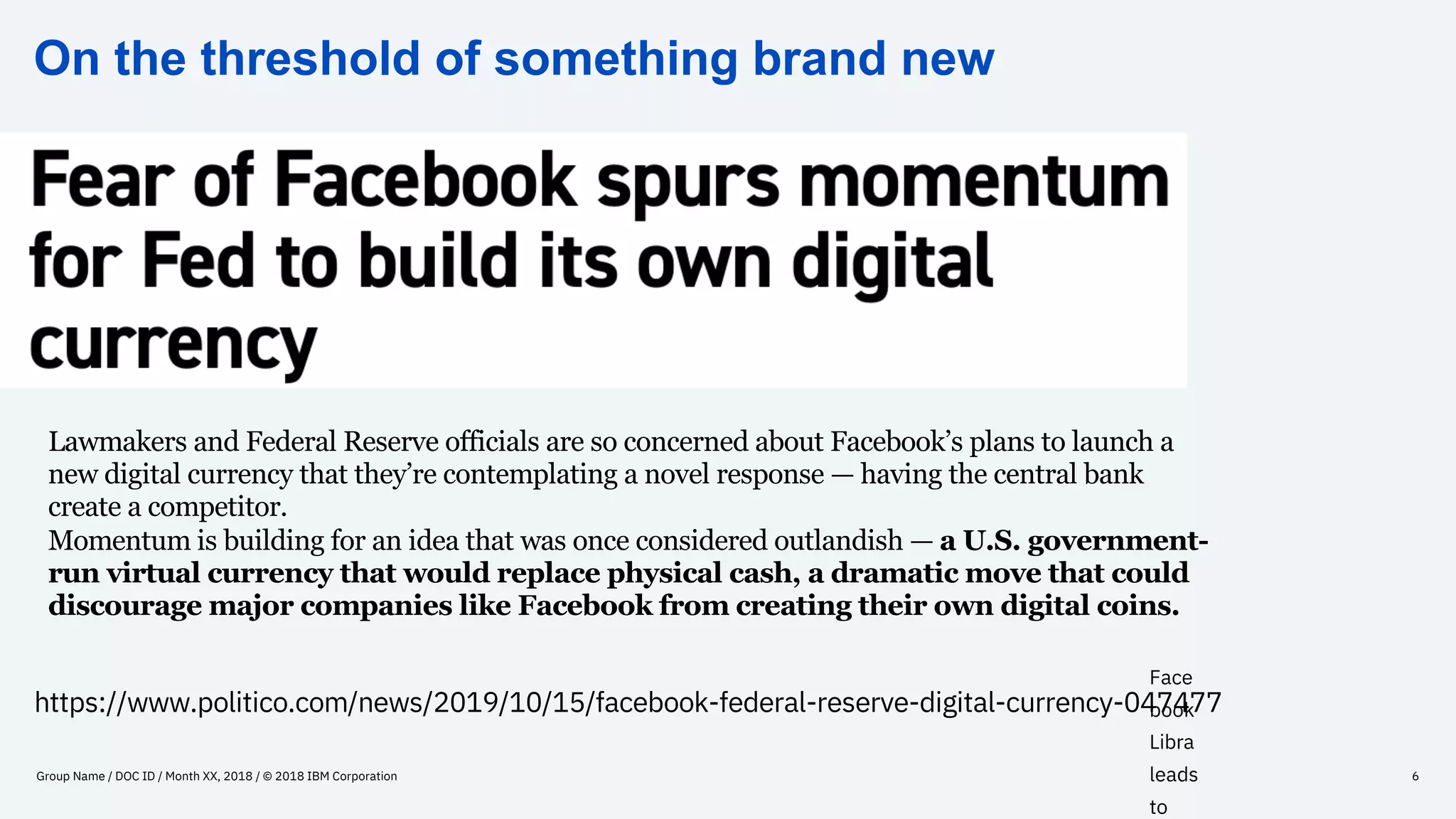
https://www.politico.com/news/2019/10/15/facebook-federal-reserve-digital-currency-047477
Lawmakers and Federal Reserve officials are so concerned about Facebook’s plans to launch a
new digital currency that they’re contemplating a novel response — having the central bank
create a competitor.
Momentum is building for an idea that was once considered outlandish — a U.S. government-
run virtual currency that would replace physical cash, a dramatic move that could
discourage major companies like Facebook from creating their own digital coins.
Cont…
Group Name / DOC ID / Month XX, 2018 / © 2018 IBM Corporation 7
The details of a possible Fed-developed digital currency are
still vague.
But advocates and experts say such an instrument could
give consumers a new way to make payments without
having to rely on banks and without incurring fees when
they transfer money.
The digital currency would likely take some inspiration from
the technology that underpins other cryptocurrencies such as
Bitcoin.
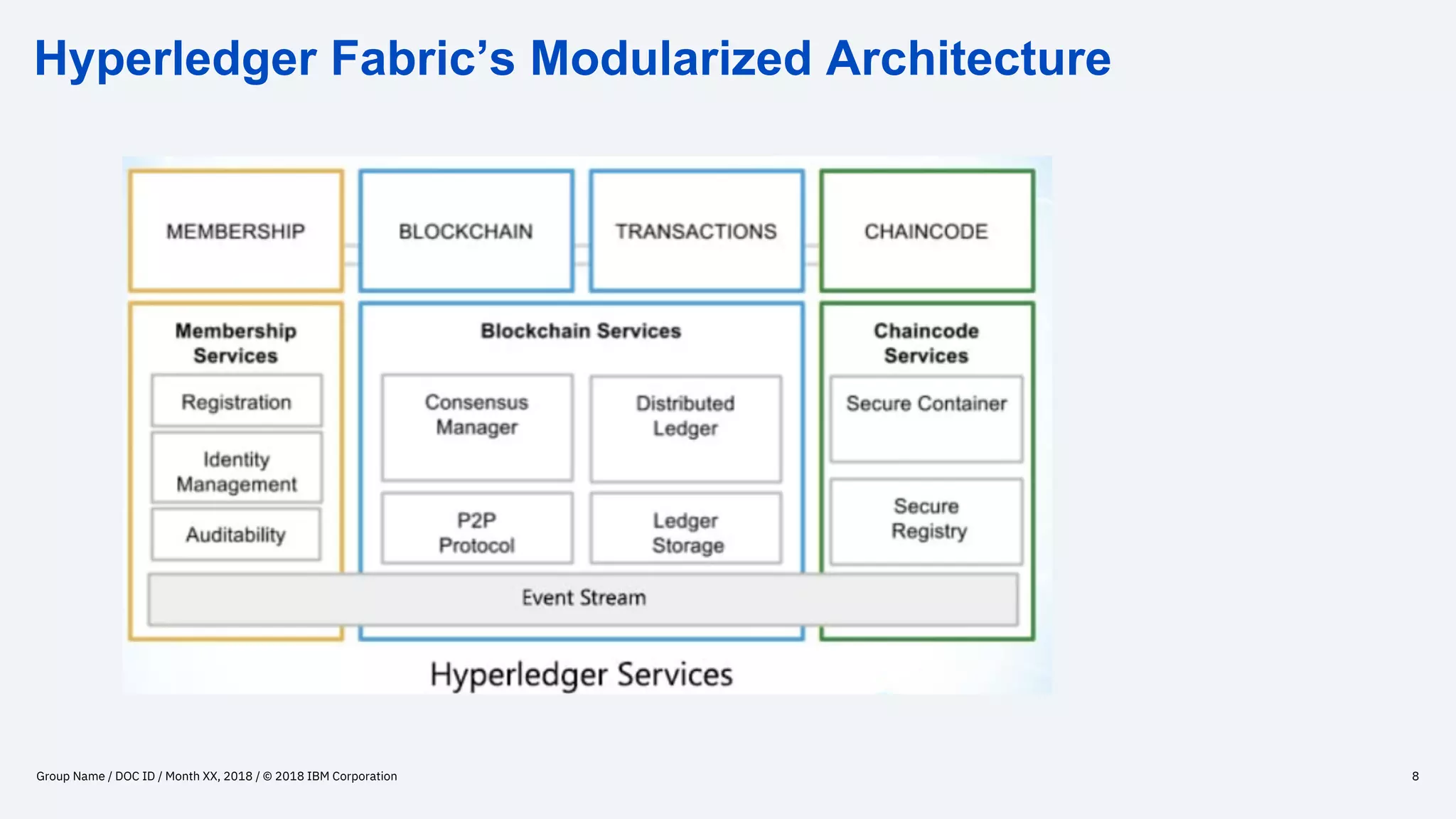
Hyperledger Fabric’s Modularized Architecture
Group Name / DOC ID / Month XX, 2018 / © 2018 IBM Corporation 8
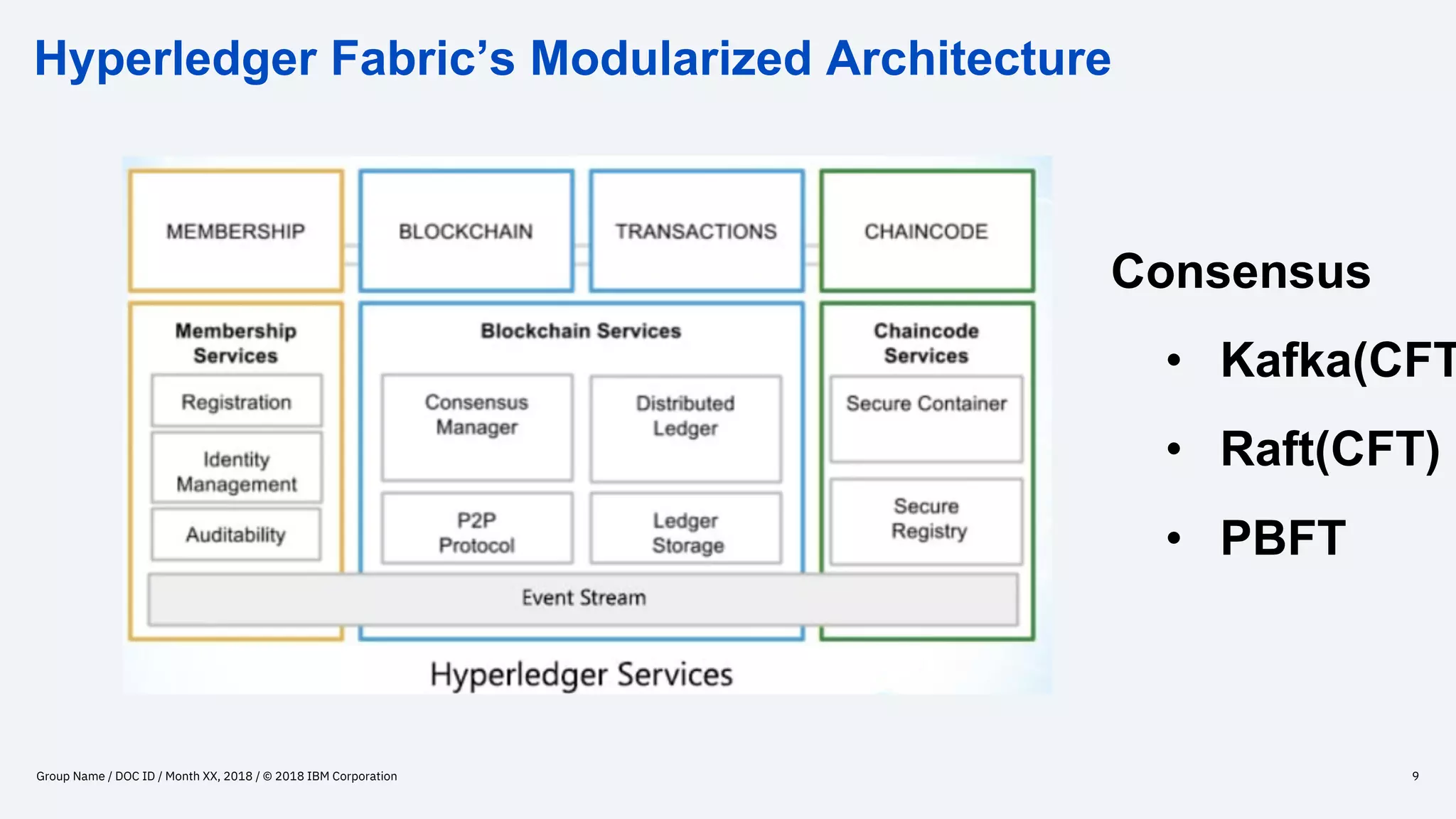
Hyperledger Fabric’s Modularized Architecture
Group Name / DOC ID / Month XX, 2018 / © 2018 IBM Corporation 9
Consensus
• Kafka(CFT
• Raft(CFT)
• PBFT
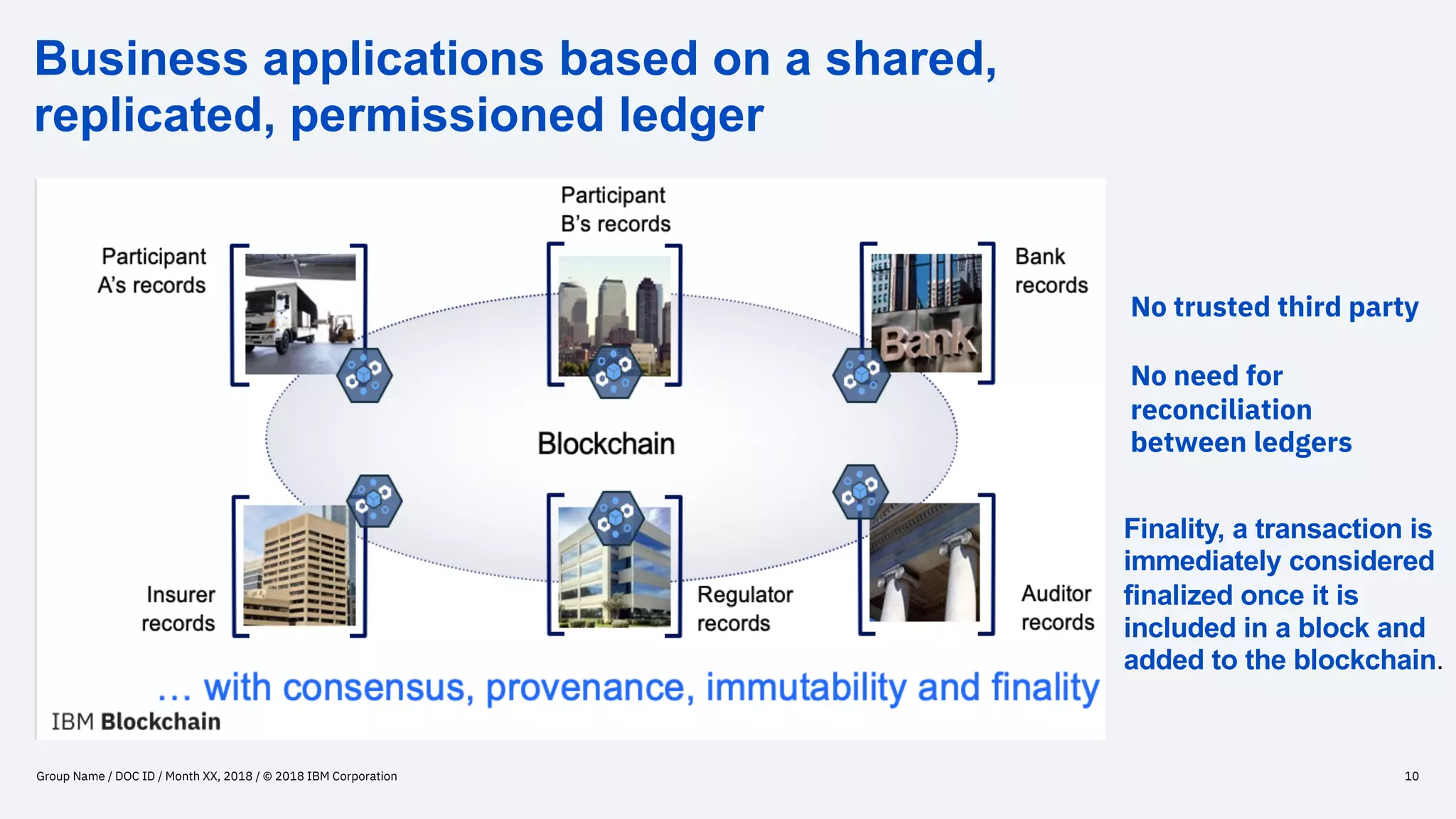
Business applications based on a shared,
replicated, permissioned ledger
Group Name / DOC ID / Month XX, 2018 / © 2018 IBM Corporation 10
No trusted third party
No need for
reconciliation
between ledgers
Finality, a transaction is
immediately considered
finalized once it is
included in a block and
added to the blockchain.
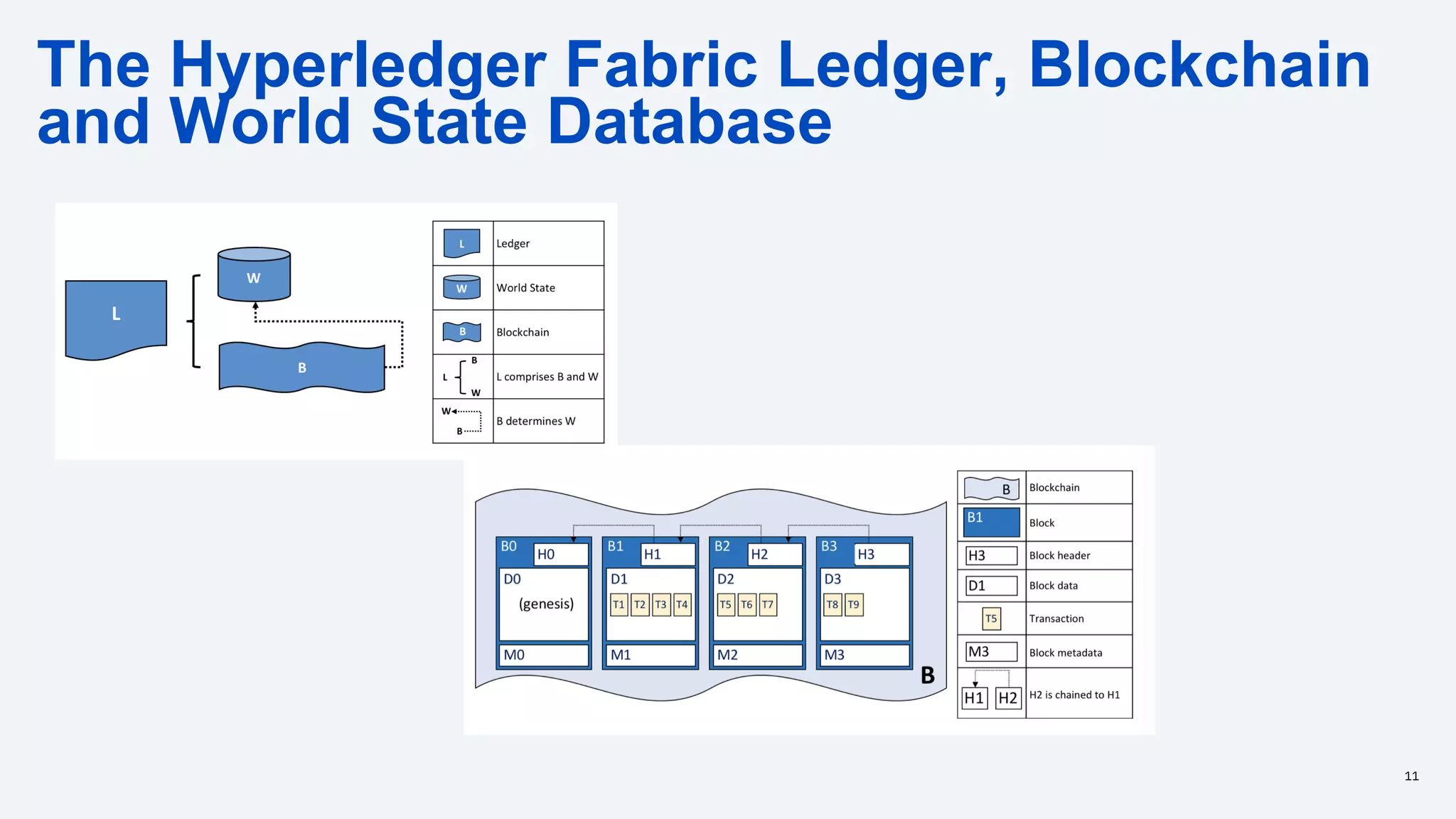
The Hyperledger Fabric Ledger, Blockchain
and World State Database
11
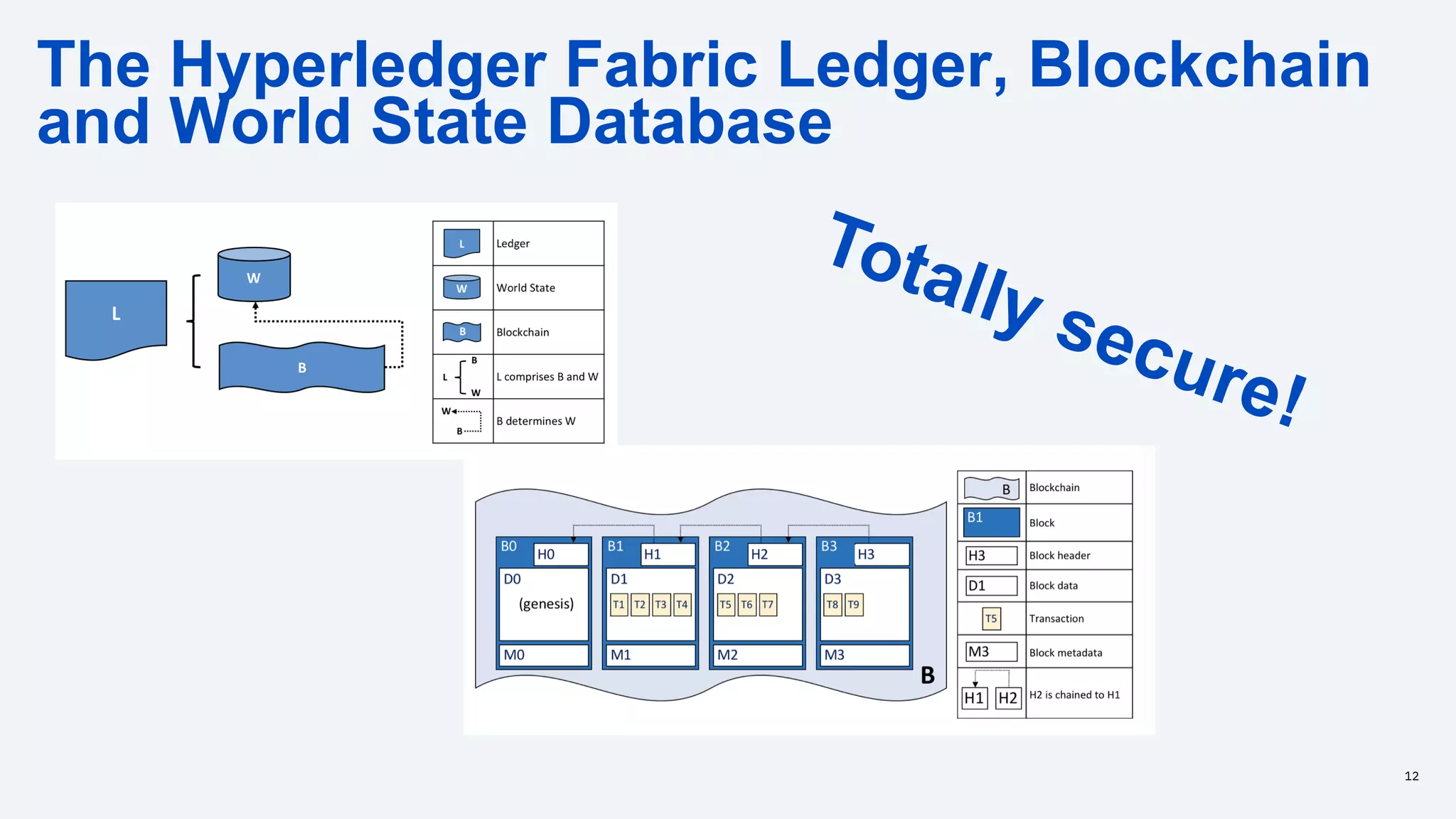
The Hyperledger Fabric Ledger, Blockchain
and World State Database
12
Totally secure!
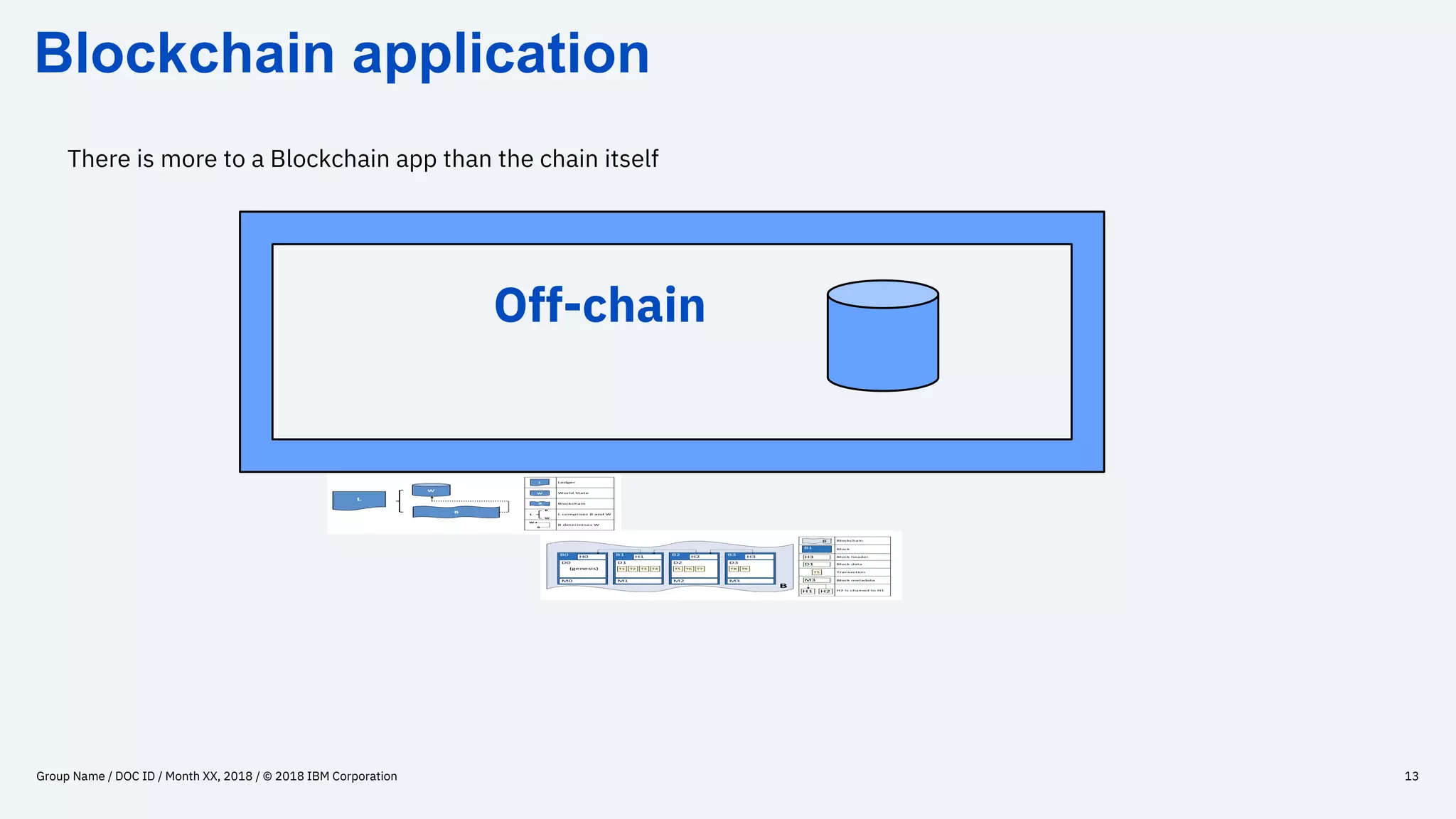
Blockchain application
Group Name / DOC ID / Month XX, 2018 / © 2018 IBM Corporation 13
There is more to a Blockchain app than the chain itself
Off-chain
Successful Hyperledger Fabric
Applications: Food Trust
Group Name / DOC ID / Month XX, 2018 / © 2018 IBM Corporation 14
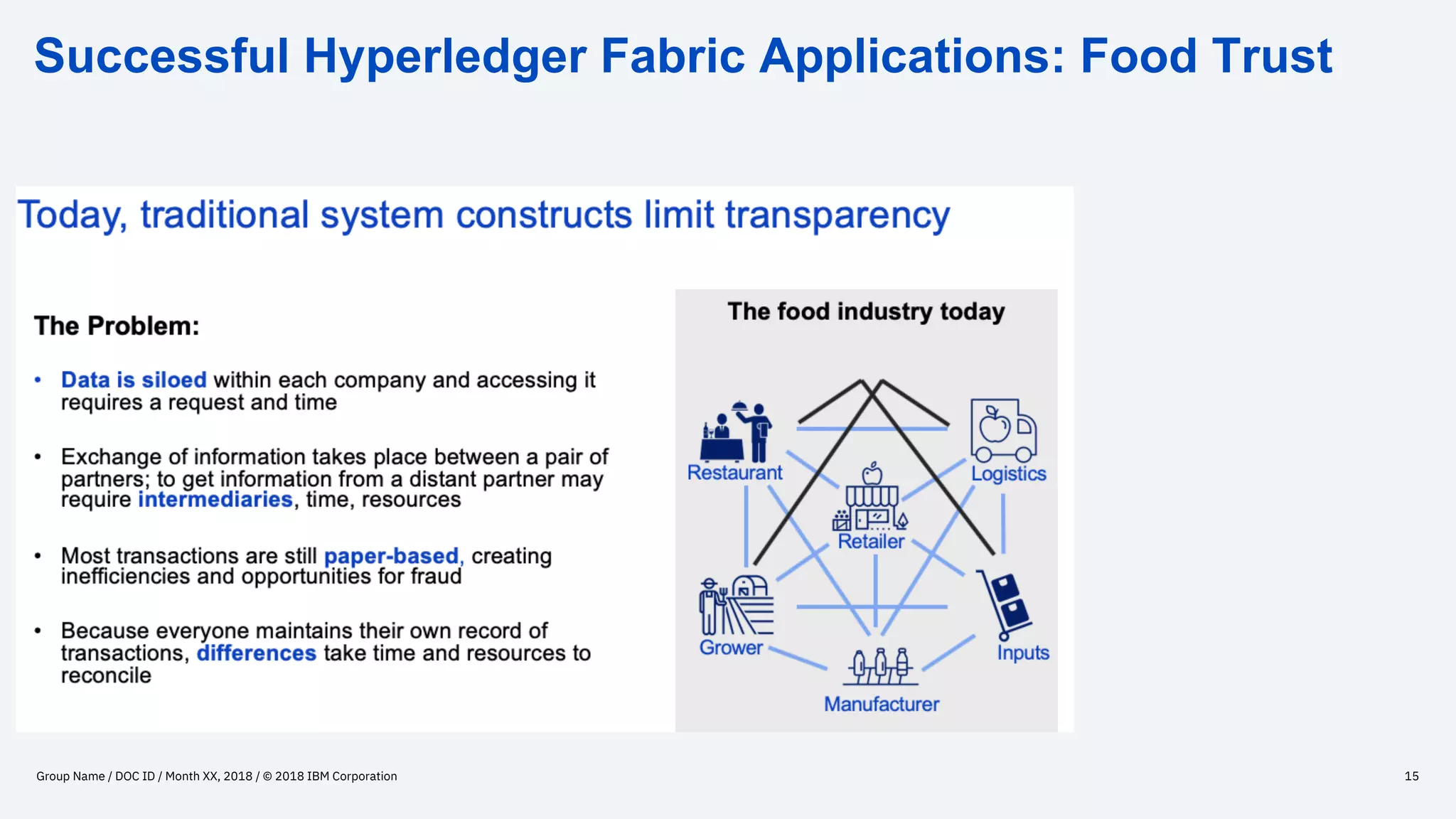
Successful Hyperledger Fabric Applications: Food Trust
Group Name / DOC ID / Month XX, 2018 / © 2018 IBM Corporation 15
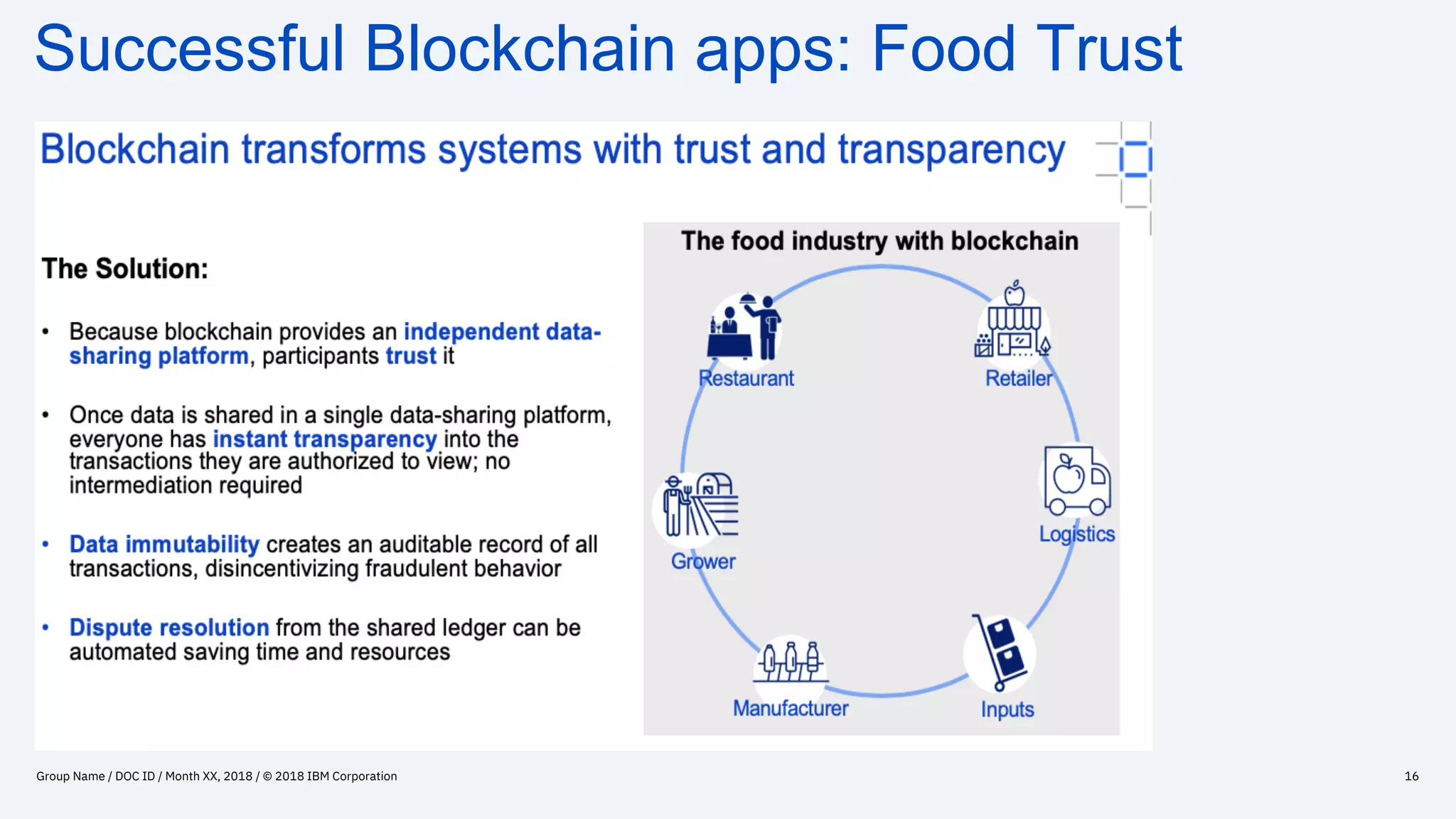
Successful Blockchain apps: Food Trust
Group Name / DOC ID / Month XX, 2018 / © 2018 IBM Corporation 16
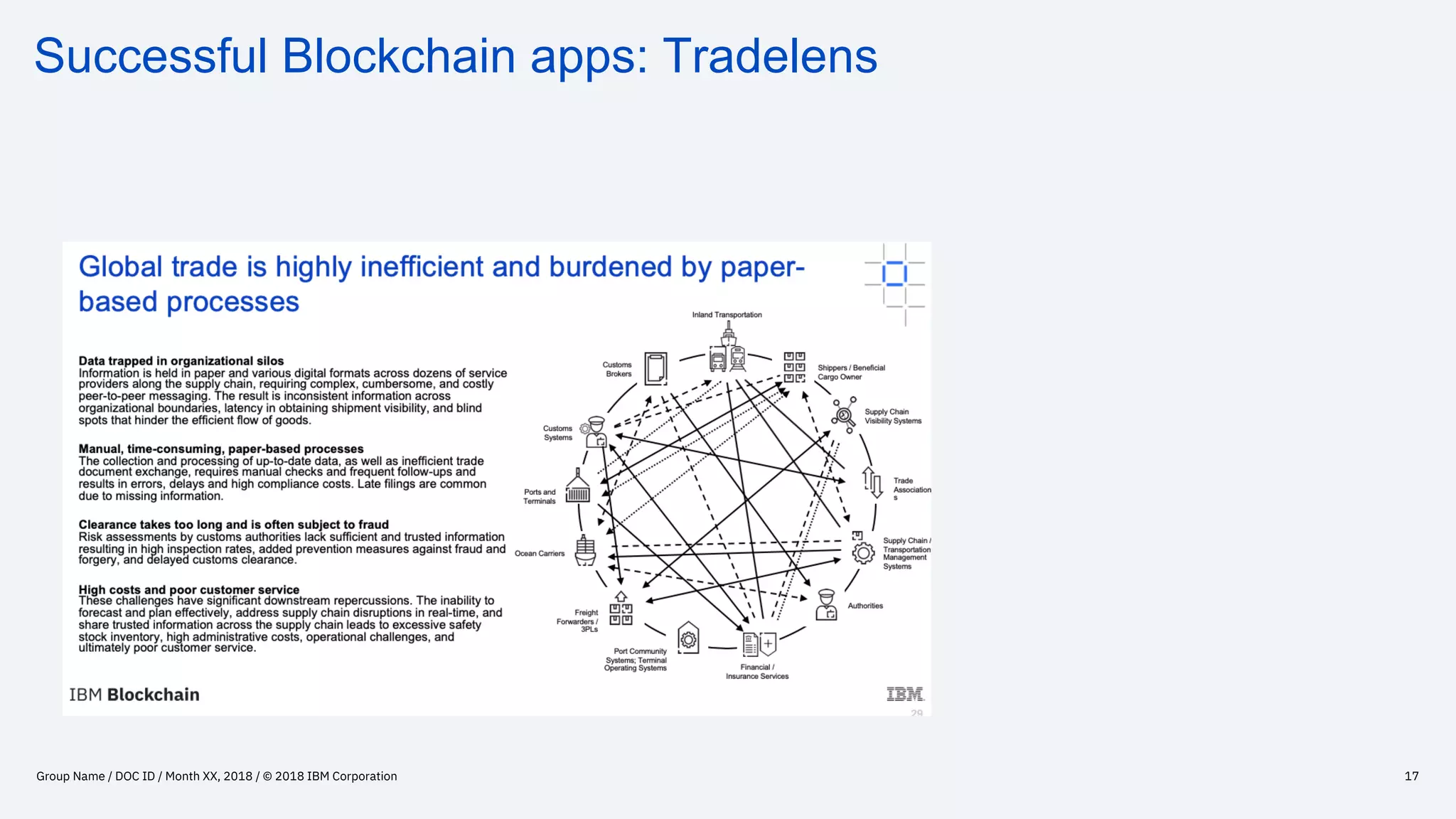
Successful Blockchain apps: Tradelens
Group Name / DOC ID / Month XX, 2018 / © 2018 IBM Corporation 17
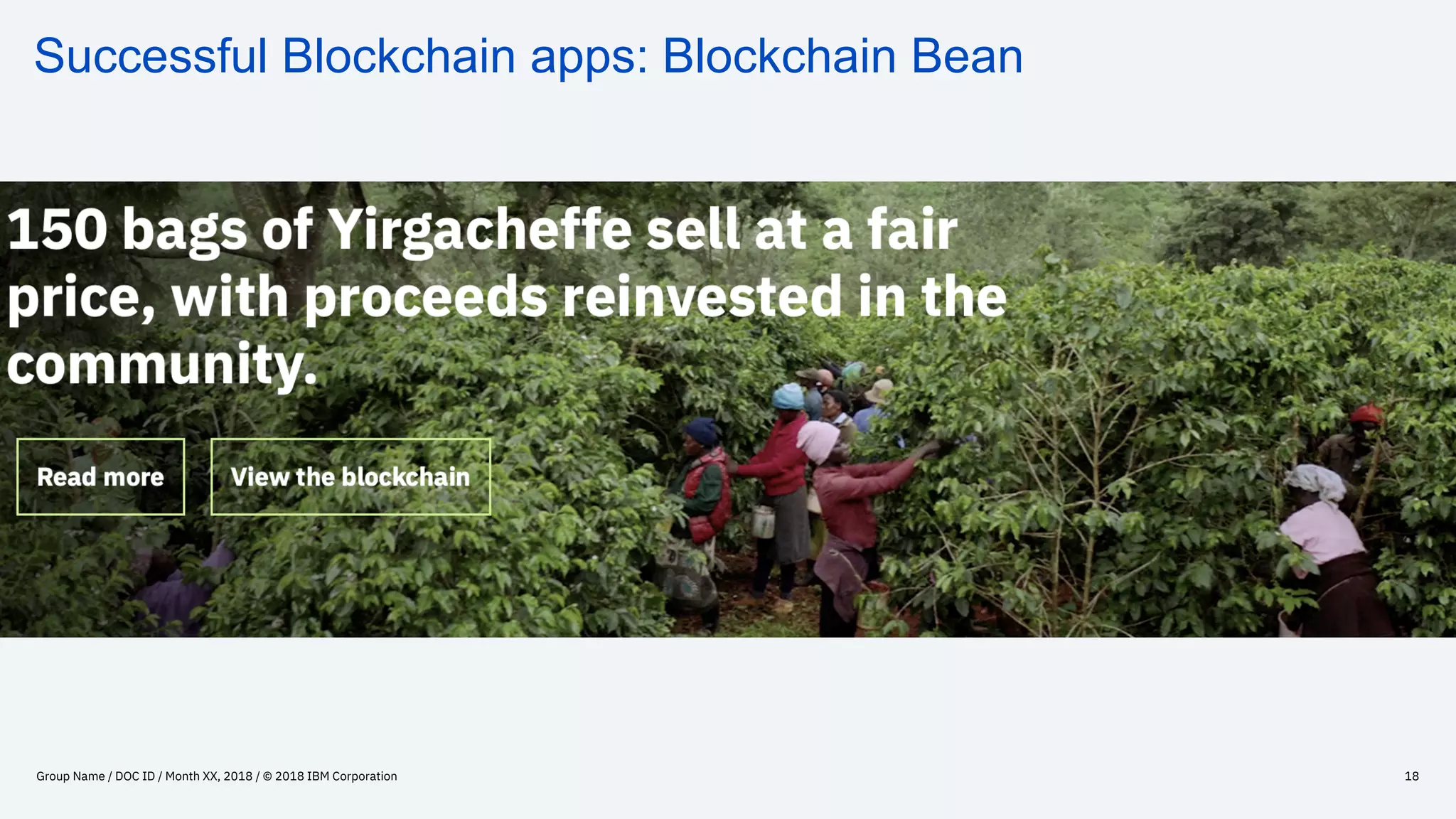
Successful Blockchain apps: Blockchain Bean
Group Name / DOC ID / Month XX, 2018 / © 2018 IBM Corporation 18
Group Name / DOC ID / Month XX, 2018 / © 2018 IBM Corporation 19
So how do we make our Blockchain
applications totally secure?
Group Name / DOC ID / Month XX, 2018 / © 2018 IBM Corporation 20
Channels and encryption
Group Name / DOC ID / Month XX, 2018 / © 2018 IBM Corporation 21
In Fabric v1.0 there is a concept of channels to privately share data with a subset of network members. Only members of the channel will store and have
access to the data.
It is possible to encrypt data on-chain such that chaincode is still able to see the data and apply logic on it (as opposed to an off-chain encryption where
the data being garbage is not usable on chain). The idea is to pass the encryption key as part of a transient input parameter (which is not transmitted to
ordering service and other channel node). So only the endorsers and any node that get to know the key can decrypt the data. In v1.1 to be released on Q1
2018, Fabric will support an encryption layer API to the access state (see FAB 830). There are 2 drawbacks of having encrypted data on chain:
Key maintenance and sharing is overhead
Risk of keys leakage + encryption breaking in the future
For privacy, rather than encryption, it might be better to chose a data segregation approach. That is what FAB 1151, also part of v1.1 (Experimental!)
proposes:
Each private data belongs to a collection defining the organizations which can access it
The hash of the private state is included in the public state
Endorser keep the private state calculated during the transaction simulation into a transient storage area and apply it at commit phase
Other allowed nodes can request the private state via gossip
https://stackoverflow.com/questions/42340143/does-hyperledger-fabric-supports-encrypted-transaction
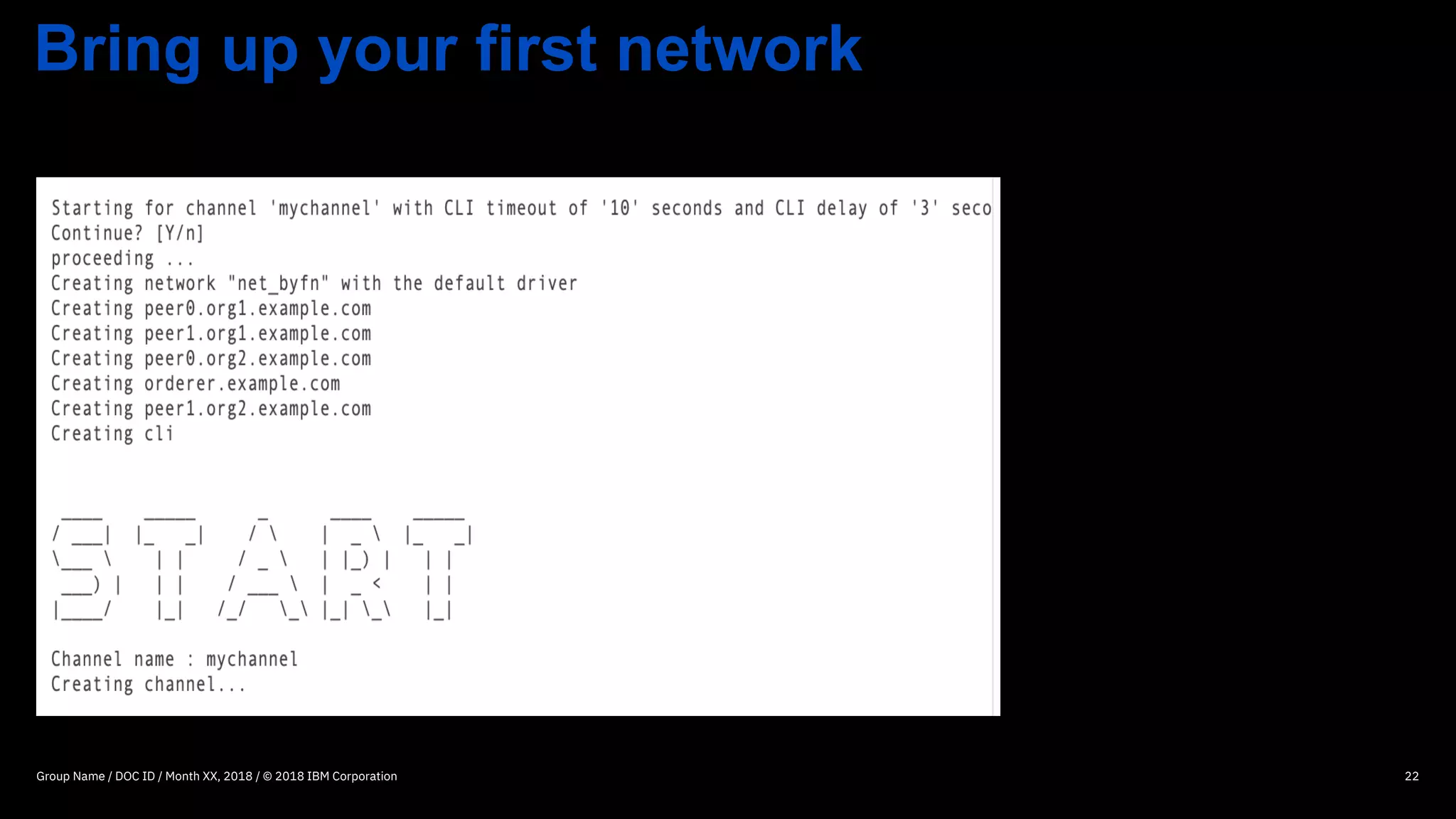
Bring up your first network
Group Name / DOC ID / Month XX, 2018 / © 2018 IBM Corporation 22
Consensus Algorithms
Group Name / DOC ID / Month XX, 2018 / © 2018 IBM Corporation 23
The process of keeping the ledger transactions synchronized across the network
— to ensure that ledgers update only when transactions are approved by the
appropriate participants, and that when ledgers do update, they update with the
same transactions in the same order — is called consensus
Solo place holder, only one node, not fault tolerant
Kafka The Kafka ordering service leverages a cluster of Kafka brokers and a
Zookeeper ensemble to provide for a crash fault tolerant (CFT) ordering
service
Raft. New as of v1.4.1, Raft is a crash fault tolerant (CFT) ordering service
based on an implementation of the Raft protocol.
PBFT (Practical Byzantine Fault Tolerance) is a way for a distributed network to
reach the consensus set for the Blockchain even if some nodes are malicious
Security and Blockchain
24
• In general terms, a blockchain is an immutable transaction ledger,
maintained within a distributed network of peer nodes.
• These nodes each maintain a copy of the ledger by applying
transactions that have been validated by a consensus protocol, grouped
into blocks that include a hash that bind each block to the preceding
block.
• Peers leverage gossip to broadcast ledger and channel data in a
scalable fashion. Gossip messaging is continuous, and each peer on a
channel is constantly receiving current and consistent ledger data from
multiple peers.
• Digital identities through X.509 certificates
https://hyperledger-fabric.readthedocs.io/en/release-1.4/whatis.html

Intro blockchain beyond confidential compute. views from oasis labs, ibm and samsung v2

  • 1.
    Blockchain beyond ConfidentialCompute. Views from Oasis Labs, IBM and Samsung Intro: the Blockchain revolution Lennart Frantzell IBM Developer Advocate 2019 10 16
  • 2.
    Agenda Group Name /DOC ID / Month XX, 2018 / © 2018 IBM Corporation 2 6:00 Arrival, light dinner, mingle 6:15 Introduction to Blockchain and Confidential Compute 6:30 View from Oasis Labs 7:00 View from IBM 7:30 View from Samsung 8:00 Discussion, where do we go from here?
  • 3.
    Some Background Group Name/ DOC ID / Month XX, 2018 / © 2018 IBM Corporation 3
  • 4.
    A new areain business computing started during the global financial crisis in October 2008 in October 2008 4 With Satoshi Nakamoto’s eight page paper: Bitcoin: A Peer-to-Peer Electronic Cash System A purely peer-to-peer version of electronic cash would allow online payments to be sent directly from one party to another without going through a financial institution. Digital signatures provide part of the solution, but the main benefits are lost if a trusted third party is still required to prevent double-spending. We propose a solution to the double-spending problem using a peer-to-peer network. https://bitcoin.org/bitcoin.pdfs. https://
  • 5.
    In the lastten years Blockchain has begun to change the world Group Name / DOC ID / Month XX, 2018 / © 2018 IBM Corporation 5 Blockchain is not just a new technology, it is a technological revolution There are two facets to the Blockchain revolution: • Bitcoin and cryptocurrencies • Blockchain Blockchain and Hyperledger Fabric or IBM Blockchain Platform
  • 6.
    On the thresholdof something brand new Group Name / DOC ID / Month XX, 2018 / © 2018 IBM Corporation 6 Face book Libra leads to https://www.politico.com/news/2019/10/15/facebook-federal-reserve-digital-currency-047477 Lawmakers and Federal Reserve officials are so concerned about Facebook’s plans to launch a new digital currency that they’re contemplating a novel response — having the central bank create a competitor. Momentum is building for an idea that was once considered outlandish — a U.S. government- run virtual currency that would replace physical cash, a dramatic move that could discourage major companies like Facebook from creating their own digital coins.
  • 7.
    Cont… Group Name /DOC ID / Month XX, 2018 / © 2018 IBM Corporation 7 The details of a possible Fed-developed digital currency are still vague. But advocates and experts say such an instrument could give consumers a new way to make payments without having to rely on banks and without incurring fees when they transfer money. The digital currency would likely take some inspiration from the technology that underpins other cryptocurrencies such as Bitcoin.
  • 8.
    Hyperledger Fabric’s ModularizedArchitecture Group Name / DOC ID / Month XX, 2018 / © 2018 IBM Corporation 8
  • 9.
    Hyperledger Fabric’s ModularizedArchitecture Group Name / DOC ID / Month XX, 2018 / © 2018 IBM Corporation 9 Consensus • Kafka(CFT • Raft(CFT) • PBFT
  • 10.
    Business applications basedon a shared, replicated, permissioned ledger Group Name / DOC ID / Month XX, 2018 / © 2018 IBM Corporation 10 No trusted third party No need for reconciliation between ledgers Finality, a transaction is immediately considered finalized once it is included in a block and added to the blockchain.
  • 11.
    The Hyperledger FabricLedger, Blockchain and World State Database 11
  • 12.
    The Hyperledger FabricLedger, Blockchain and World State Database 12 Totally secure!
  • 13.
    Blockchain application Group Name/ DOC ID / Month XX, 2018 / © 2018 IBM Corporation 13 There is more to a Blockchain app than the chain itself Off-chain
  • 14.
    Successful Hyperledger Fabric Applications:Food Trust Group Name / DOC ID / Month XX, 2018 / © 2018 IBM Corporation 14
  • 15.
    Successful Hyperledger FabricApplications: Food Trust Group Name / DOC ID / Month XX, 2018 / © 2018 IBM Corporation 15
  • 16.
    Successful Blockchain apps:Food Trust Group Name / DOC ID / Month XX, 2018 / © 2018 IBM Corporation 16
  • 17.
    Successful Blockchain apps:Tradelens Group Name / DOC ID / Month XX, 2018 / © 2018 IBM Corporation 17
  • 18.
    Successful Blockchain apps:Blockchain Bean Group Name / DOC ID / Month XX, 2018 / © 2018 IBM Corporation 18
  • 19.
    Group Name /DOC ID / Month XX, 2018 / © 2018 IBM Corporation 19 So how do we make our Blockchain applications totally secure?
  • 20.
    Group Name /DOC ID / Month XX, 2018 / © 2018 IBM Corporation 20
  • 21.
    Channels and encryption GroupName / DOC ID / Month XX, 2018 / © 2018 IBM Corporation 21 In Fabric v1.0 there is a concept of channels to privately share data with a subset of network members. Only members of the channel will store and have access to the data. It is possible to encrypt data on-chain such that chaincode is still able to see the data and apply logic on it (as opposed to an off-chain encryption where the data being garbage is not usable on chain). The idea is to pass the encryption key as part of a transient input parameter (which is not transmitted to ordering service and other channel node). So only the endorsers and any node that get to know the key can decrypt the data. In v1.1 to be released on Q1 2018, Fabric will support an encryption layer API to the access state (see FAB 830). There are 2 drawbacks of having encrypted data on chain: Key maintenance and sharing is overhead Risk of keys leakage + encryption breaking in the future For privacy, rather than encryption, it might be better to chose a data segregation approach. That is what FAB 1151, also part of v1.1 (Experimental!) proposes: Each private data belongs to a collection defining the organizations which can access it The hash of the private state is included in the public state Endorser keep the private state calculated during the transaction simulation into a transient storage area and apply it at commit phase Other allowed nodes can request the private state via gossip https://stackoverflow.com/questions/42340143/does-hyperledger-fabric-supports-encrypted-transaction
  • 22.
    Bring up yourfirst network Group Name / DOC ID / Month XX, 2018 / © 2018 IBM Corporation 22
  • 23.
    Consensus Algorithms Group Name/ DOC ID / Month XX, 2018 / © 2018 IBM Corporation 23 The process of keeping the ledger transactions synchronized across the network — to ensure that ledgers update only when transactions are approved by the appropriate participants, and that when ledgers do update, they update with the same transactions in the same order — is called consensus Solo place holder, only one node, not fault tolerant Kafka The Kafka ordering service leverages a cluster of Kafka brokers and a Zookeeper ensemble to provide for a crash fault tolerant (CFT) ordering service Raft. New as of v1.4.1, Raft is a crash fault tolerant (CFT) ordering service based on an implementation of the Raft protocol. PBFT (Practical Byzantine Fault Tolerance) is a way for a distributed network to reach the consensus set for the Blockchain even if some nodes are malicious
  • 24.
    Security and Blockchain 24 •In general terms, a blockchain is an immutable transaction ledger, maintained within a distributed network of peer nodes. • These nodes each maintain a copy of the ledger by applying transactions that have been validated by a consensus protocol, grouped into blocks that include a hash that bind each block to the preceding block. • Peers leverage gossip to broadcast ledger and channel data in a scalable fashion. Gossip messaging is continuous, and each peer on a channel is constantly receiving current and consistent ledger data from multiple peers. • Digital identities through X.509 certificates https://hyperledger-fabric.readthedocs.io/en/release-1.4/whatis.html