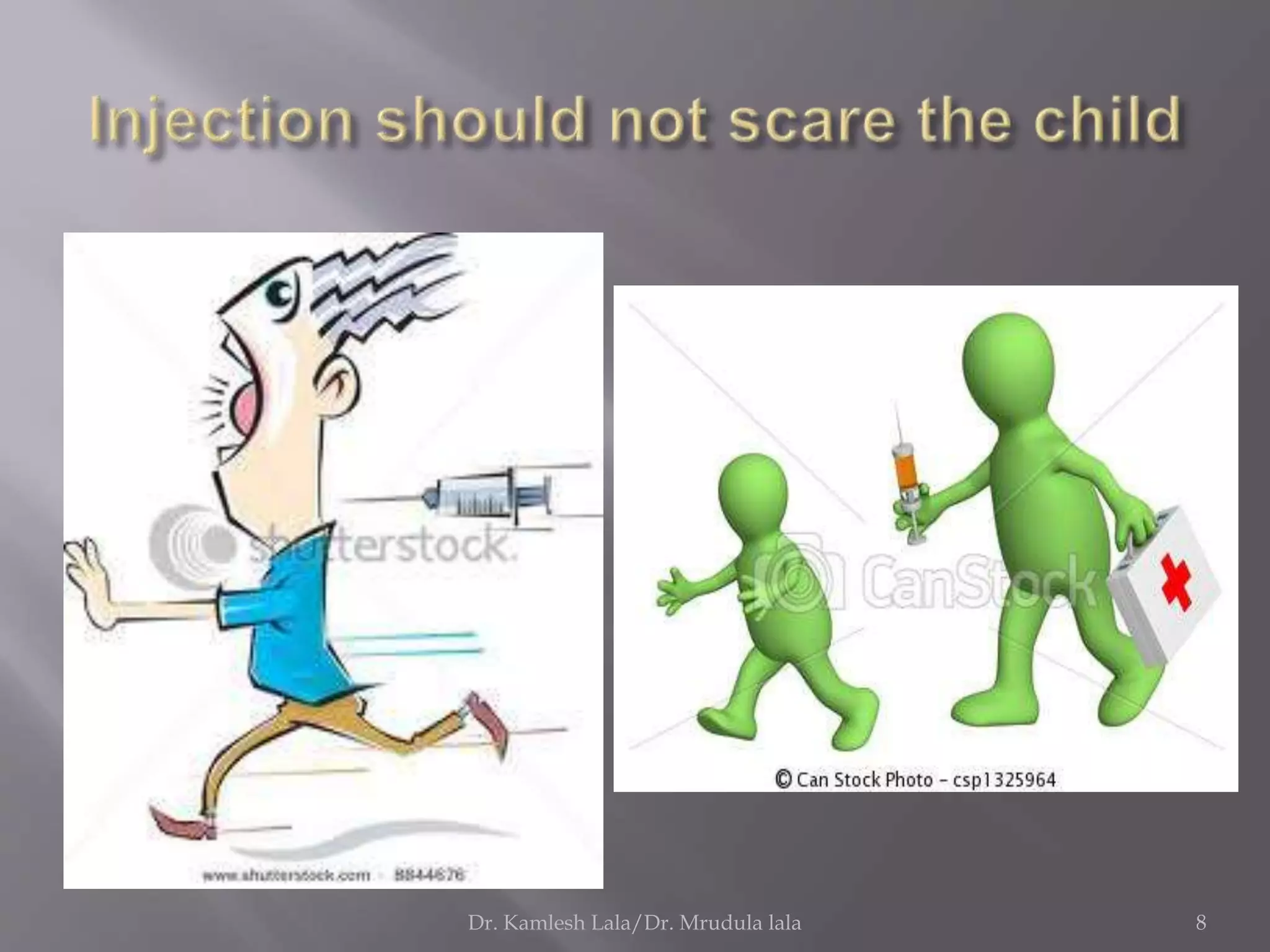
Causes and Measures to alleviate it
Dr. Kamlesh Lala MBBS, D Ped
Dr. (Mrs) Mrudula Lala MD (community medicine)
Ahmedabad, INDIA
kamleshlala@hotmail.com
1Dr. Kamlesh Lala/Dr. Mrudula lala
2Dr. Kamlesh Lala/Dr. Mrudula lala
 Intramuscular Injection is the most widely
practiced percutaneous procedure
 Each child is compulsorily exposed to this in
his early childhood by way of immunisation
 The most common side effect is apprehension
and pain
3Dr. Kamlesh Lala/Dr. Mrudula lala
Pain is a subjective phenomenon influenced by
multiple factors including
 Age
 Anxiety level
 Previous experience
 Ambience
 Approach of a provider
 Culture
4Dr. Kamlesh Lala/Dr. Mrudula lala
It is said that
“Pain is inevitable”
But
“Suffering is optional”
But here we try to reduce this
suffering
5Dr. Kamlesh Lala/Dr. Mrudula lala
 Concern and anxiety about
injections are common for all
ages.
 Several methods are found
effective to relieve this
apprehension and discomfort in
different stages of injection
procedure
6Dr. Kamlesh Lala/Dr. Mrudula lala
 Despite ready availability of different
modalities, only 6% of pediatric offices use
pain control for shots.
 Research suggests that poor pediatric pain
management results in short and long term
repercussions for child, parent and staff.
 Untreated immunisation pain might also lead
to distorted negative memories of that
experience.
Dr. Kamlesh Lala/Dr. Mrudula lala 7
8Dr. Kamlesh Lala/Dr. Mrudula lala
 Before Injection
 Drug
 Equipment
 Site Selection
 Pre Injection
 During Injection
 Post Injection
9Dr. Kamlesh Lala/Dr. Mrudula lala
 Give age appropriate dose of NSAID. Avoid
aspirin in children. Administer Paracetamol in
dose of 15-20 mg/kg.
 Local Anaesthetic (5% Xylocaine) can be
applied at the site of injection an hour before
 Administer sweet tasting liquid (2ml of 20%
w/v sucrose or expressed breast milk)
immediately before.
 Child can even be breast fed immediately
before
10Dr. Kamlesh Lala/Dr. Mrudula lala
 In one study, the only factor that significantly
improved immunisation pain for around 6
month olds was positive parent coping
statements in the 30 seconds preceding
immunisation
Dr. Kamlesh Lala/Dr. Mrudula lala 11
 Shake Test for DTwP vaccine: Shake well the
vaccine vial. After shaking, the vaccine
sediment within 30 minutes leaving a deposit
below a column of transparent fluid. This
indicates that vaccine has been frozen in a cold
chain. Discard such vial. Frozen vaccine
increases the chances of local reaction and
sterile abscess.
12Dr. Kamlesh Lala/Dr. Mrudula lala
 Benzyl Alcohol (BA) is used to increase the
lipid solubility of esterified compounds and to
prevent bacteria growth. It can cause
destruction of cells and localised pain and
inflammation.
 After injection of the drug, BA is absorbed from
the site causing active drug to precipitate fine
crystals within the muscle. This causes pain
after 4-12 hours of injection characterised by
pain and induration.
13Dr. Kamlesh Lala/Dr. Mrudula lala
 Tissue irritation is the most common cause of
Post Injection Pain. It starts 12-24 hours after
injection with warm, red, tender induration.
This will fade after 72 hours.
 Common with hormone injections and DTP.
 More common in a brand manufactured by
local drug company. (poor quality of raw
material, excessive preservative, too much BA
used)
Dr. Kamlesh Lala/Dr. Mrudula lala 14
 Addition of Benzyl Benzoate (BB) can reduce it.
 Gently warm the oily injection by rubbing it in
between two palms so as to improve the
viscosity of the drug.
 Larger than 5 ml volume is not advised for
intramuscular injection. It should be divided
into multiple injection at different sites.
15Dr. Kamlesh Lala/Dr. Mrudula lala
 Use new syringe and needle every time.
 Longer needle reduces redness and swelling,
because medication is sure into the muscle.
More so with Chloroquine and Diclofenac. So
use 1.5” long needle for gluteal injection in
adolescents and adults.
 Use wide bore needle e.g.. 23g because narrow
bore produces a jet under pressure causing
muscle injury and pain.
 For oily injection, use still wider bore needle
(21g or 22g).
16Dr. Kamlesh Lala/Dr. Mrudula lala
 Use anterolateral thigh in children up to 2
years or even up to 5 years.
 After that use deltoid muscle
 In adults use gluteal muscle for oily injection or
if volume is greater than 2 ml.
 Larger volumes are better tolerated in larger
muscle groups
17Dr. Kamlesh Lala/Dr. Mrudula lala
 Do not use the same site over and over again
for days for multiple injections.
 It may cause irritation and muscle injury; and
increases the chances of infection.
 Rotate the site.
Dr. Kamlesh Lala/Dr. Mrudula lala 18
 After swabbing the site with spirit or alcohol,
allow it to dry, or it may cause irritation.
 Topical refrigerant (vapocoolant) spray
immediately before the injection may reduce
the short term pain.
 Do not keep the air bubble inside the syringe.
 Proper positioning of the patient allows to
identify the site correctly.
 Ensures patient’s comfort by muscle relaxation.
Dr. Kamlesh Lala/Dr. Mrudula lala 19
 1. Standard technique
The needle is introduced at 900 with steady
pressure and aspiration to be performed for 5-
10 seconds, drug is slowly injected over 5-10
secs., and the needle to be withdrawn slowly
 2. Pragmatic technique
The needle is introduced at 900 with steady
pressure and no aspiration is to be performed,
drug is rapidly injected over 1-2 secs., and the
needle to be withdrawn rapidly
Dr. Kamlesh Lala/Dr. Mrudula lala 20
In a randomised controlled trial to compare acute
pain response during immunisation in infants
using these two techniques, it was found that
Pragmatic technique is less painful than a
standard one.
Dr. Kamlesh Lala/Dr. Mrudula lala 21
Z track technique.
Skin is pulled downwards and laterally before
injection. This displaces the skin and SC tissue
leaving the muscle there only and uses the
valve action to prevent leakage of medication
into the SC tissue and later on irritation.
Dr. Kamlesh Lala/Dr. Mrudula lala 22
23Dr. Kamlesh Lala/Dr. Mrudula lala
 Age appropriate non pharmacological
techniques may provide distraction from pain.
 Some of the distraction techniques are age
appropriate toys, playing music, pretending to
blow away pain, watching TV, conversation
with child, deep breathing etc.
Dr. Kamlesh Lala/Dr. Mrudula lala 24
Dr. Kamlesh Lala/Dr. Mrudula lala 25
 Tactile Stimulation
Rubbing or stroking the skin near
the injection site with moderate
intensity may decrease the pain in
older children and adults.
Dr. Kamlesh Lala/Dr. Mrudula lala 26
 Aspiration can be performed in non immunisation
injections, but should be fast.
 Ensure that the injection is deep into the muscle
and fully through any subcutaneous fat. Injection
into the fat may result in fat necrosis and abscess.
 In case of larger volume injection, inject the drug
slowly so as to reduce muscle fascia displacement
(which may result in pain and scarring of muscle)
 Withdraw the needle at the same angle as for
penetration.
Dr. Kamlesh Lala/Dr. Mrudula lala 27
Dr. Kamlesh Lala/Dr. Mrudula lala 28
 Order of Injection
For multiple injections, especially
during immunisation, inject the
most painful injection (DTP) last
Dr. Kamlesh Lala/Dr. Mrudula lala 29
 Apply a little pressure to the injection site for 5-
10 seconds.
 Do not massage or rub the site.
 Do not apply hot or cold compresses. Clean
cold wet wash cloth can be applied over sore
area.
Dr. Kamlesh Lala/Dr. Mrudula lala 30
Patient should leave the clinic laughing……and
not crying….
Dr. Kamlesh Lala/Dr. Mrudula lala 31

Intramuscular injection pain ppt

  • 1.
    Causes and Measuresto alleviate it Dr. Kamlesh Lala MBBS, D Ped Dr. (Mrs) Mrudula Lala MD (community medicine) Ahmedabad, INDIA kamleshlala@hotmail.com 1Dr. Kamlesh Lala/Dr. Mrudula lala
  • 2.
  • 3.
     Intramuscular Injectionis the most widely practiced percutaneous procedure  Each child is compulsorily exposed to this in his early childhood by way of immunisation  The most common side effect is apprehension and pain 3Dr. Kamlesh Lala/Dr. Mrudula lala
  • 4.
    Pain is asubjective phenomenon influenced by multiple factors including  Age  Anxiety level  Previous experience  Ambience  Approach of a provider  Culture 4Dr. Kamlesh Lala/Dr. Mrudula lala
  • 5.
    It is saidthat “Pain is inevitable” But “Suffering is optional” But here we try to reduce this suffering 5Dr. Kamlesh Lala/Dr. Mrudula lala
  • 6.
     Concern andanxiety about injections are common for all ages.  Several methods are found effective to relieve this apprehension and discomfort in different stages of injection procedure 6Dr. Kamlesh Lala/Dr. Mrudula lala
  • 7.
     Despite readyavailability of different modalities, only 6% of pediatric offices use pain control for shots.  Research suggests that poor pediatric pain management results in short and long term repercussions for child, parent and staff.  Untreated immunisation pain might also lead to distorted negative memories of that experience. Dr. Kamlesh Lala/Dr. Mrudula lala 7
  • 8.
  • 9.
     Before Injection Drug  Equipment  Site Selection  Pre Injection  During Injection  Post Injection 9Dr. Kamlesh Lala/Dr. Mrudula lala
  • 10.
     Give ageappropriate dose of NSAID. Avoid aspirin in children. Administer Paracetamol in dose of 15-20 mg/kg.  Local Anaesthetic (5% Xylocaine) can be applied at the site of injection an hour before  Administer sweet tasting liquid (2ml of 20% w/v sucrose or expressed breast milk) immediately before.  Child can even be breast fed immediately before 10Dr. Kamlesh Lala/Dr. Mrudula lala
  • 11.
     In onestudy, the only factor that significantly improved immunisation pain for around 6 month olds was positive parent coping statements in the 30 seconds preceding immunisation Dr. Kamlesh Lala/Dr. Mrudula lala 11
  • 12.
     Shake Testfor DTwP vaccine: Shake well the vaccine vial. After shaking, the vaccine sediment within 30 minutes leaving a deposit below a column of transparent fluid. This indicates that vaccine has been frozen in a cold chain. Discard such vial. Frozen vaccine increases the chances of local reaction and sterile abscess. 12Dr. Kamlesh Lala/Dr. Mrudula lala
  • 13.
     Benzyl Alcohol(BA) is used to increase the lipid solubility of esterified compounds and to prevent bacteria growth. It can cause destruction of cells and localised pain and inflammation.  After injection of the drug, BA is absorbed from the site causing active drug to precipitate fine crystals within the muscle. This causes pain after 4-12 hours of injection characterised by pain and induration. 13Dr. Kamlesh Lala/Dr. Mrudula lala
  • 14.
     Tissue irritationis the most common cause of Post Injection Pain. It starts 12-24 hours after injection with warm, red, tender induration. This will fade after 72 hours.  Common with hormone injections and DTP.  More common in a brand manufactured by local drug company. (poor quality of raw material, excessive preservative, too much BA used) Dr. Kamlesh Lala/Dr. Mrudula lala 14
  • 15.
     Addition ofBenzyl Benzoate (BB) can reduce it.  Gently warm the oily injection by rubbing it in between two palms so as to improve the viscosity of the drug.  Larger than 5 ml volume is not advised for intramuscular injection. It should be divided into multiple injection at different sites. 15Dr. Kamlesh Lala/Dr. Mrudula lala
  • 16.
     Use newsyringe and needle every time.  Longer needle reduces redness and swelling, because medication is sure into the muscle. More so with Chloroquine and Diclofenac. So use 1.5” long needle for gluteal injection in adolescents and adults.  Use wide bore needle e.g.. 23g because narrow bore produces a jet under pressure causing muscle injury and pain.  For oily injection, use still wider bore needle (21g or 22g). 16Dr. Kamlesh Lala/Dr. Mrudula lala
  • 17.
     Use anterolateralthigh in children up to 2 years or even up to 5 years.  After that use deltoid muscle  In adults use gluteal muscle for oily injection or if volume is greater than 2 ml.  Larger volumes are better tolerated in larger muscle groups 17Dr. Kamlesh Lala/Dr. Mrudula lala
  • 18.
     Do notuse the same site over and over again for days for multiple injections.  It may cause irritation and muscle injury; and increases the chances of infection.  Rotate the site. Dr. Kamlesh Lala/Dr. Mrudula lala 18
  • 19.
     After swabbingthe site with spirit or alcohol, allow it to dry, or it may cause irritation.  Topical refrigerant (vapocoolant) spray immediately before the injection may reduce the short term pain.  Do not keep the air bubble inside the syringe.  Proper positioning of the patient allows to identify the site correctly.  Ensures patient’s comfort by muscle relaxation. Dr. Kamlesh Lala/Dr. Mrudula lala 19
  • 20.
     1. Standardtechnique The needle is introduced at 900 with steady pressure and aspiration to be performed for 5- 10 seconds, drug is slowly injected over 5-10 secs., and the needle to be withdrawn slowly  2. Pragmatic technique The needle is introduced at 900 with steady pressure and no aspiration is to be performed, drug is rapidly injected over 1-2 secs., and the needle to be withdrawn rapidly Dr. Kamlesh Lala/Dr. Mrudula lala 20
  • 21.
    In a randomisedcontrolled trial to compare acute pain response during immunisation in infants using these two techniques, it was found that Pragmatic technique is less painful than a standard one. Dr. Kamlesh Lala/Dr. Mrudula lala 21
  • 22.
    Z track technique. Skinis pulled downwards and laterally before injection. This displaces the skin and SC tissue leaving the muscle there only and uses the valve action to prevent leakage of medication into the SC tissue and later on irritation. Dr. Kamlesh Lala/Dr. Mrudula lala 22
  • 23.
  • 24.
     Age appropriatenon pharmacological techniques may provide distraction from pain.  Some of the distraction techniques are age appropriate toys, playing music, pretending to blow away pain, watching TV, conversation with child, deep breathing etc. Dr. Kamlesh Lala/Dr. Mrudula lala 24
  • 25.
    Dr. Kamlesh Lala/Dr.Mrudula lala 25
  • 26.
     Tactile Stimulation Rubbingor stroking the skin near the injection site with moderate intensity may decrease the pain in older children and adults. Dr. Kamlesh Lala/Dr. Mrudula lala 26
  • 27.
     Aspiration canbe performed in non immunisation injections, but should be fast.  Ensure that the injection is deep into the muscle and fully through any subcutaneous fat. Injection into the fat may result in fat necrosis and abscess.  In case of larger volume injection, inject the drug slowly so as to reduce muscle fascia displacement (which may result in pain and scarring of muscle)  Withdraw the needle at the same angle as for penetration. Dr. Kamlesh Lala/Dr. Mrudula lala 27
  • 28.
    Dr. Kamlesh Lala/Dr.Mrudula lala 28
  • 29.
     Order ofInjection For multiple injections, especially during immunisation, inject the most painful injection (DTP) last Dr. Kamlesh Lala/Dr. Mrudula lala 29
  • 30.
     Apply alittle pressure to the injection site for 5- 10 seconds.  Do not massage or rub the site.  Do not apply hot or cold compresses. Clean cold wet wash cloth can be applied over sore area. Dr. Kamlesh Lala/Dr. Mrudula lala 30
  • 31.
    Patient should leavethe clinic laughing……and not crying…. Dr. Kamlesh Lala/Dr. Mrudula lala 31