And how to
handle related
situations
IDENTIFYING
INTOXICATED PATRONS
 BAC (blood alcohol concentration) and calculations
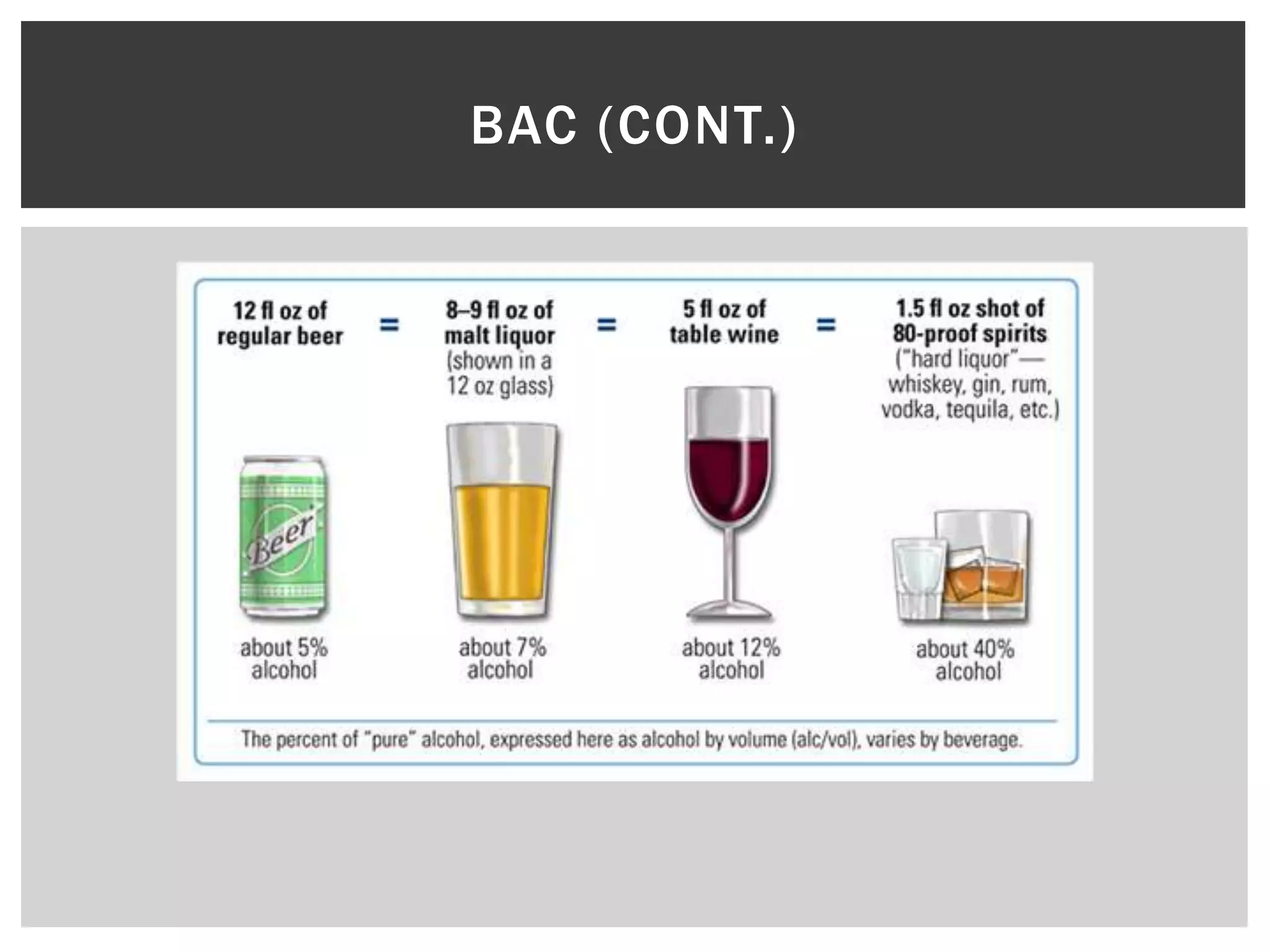
 Alcohol percentages
 Signs of intoxication
 Handling intoxicated customers
 Laws related to your state
WHAT YOU WILL LEARN
The definition of blood alcohol content is the concentration of
alcohol in one's bloodstream, expressed as a percentage. Blood
alcohol content, or BAC, is used to determine whether a person
is legally intoxicated, especially under a driving while
intoxicated law.
Unless a person has developed a very high tolerance for alcohol,
a BAC rating of 0.20% represents very serious intoxication. In
general most first-time drinkers are unconscious by about
0.15%. A range of 0.35% to 0.40% usually represents
potentially fatal alcohol poisoning.
BAC (BLOOD ALCOHOL CONTENT)
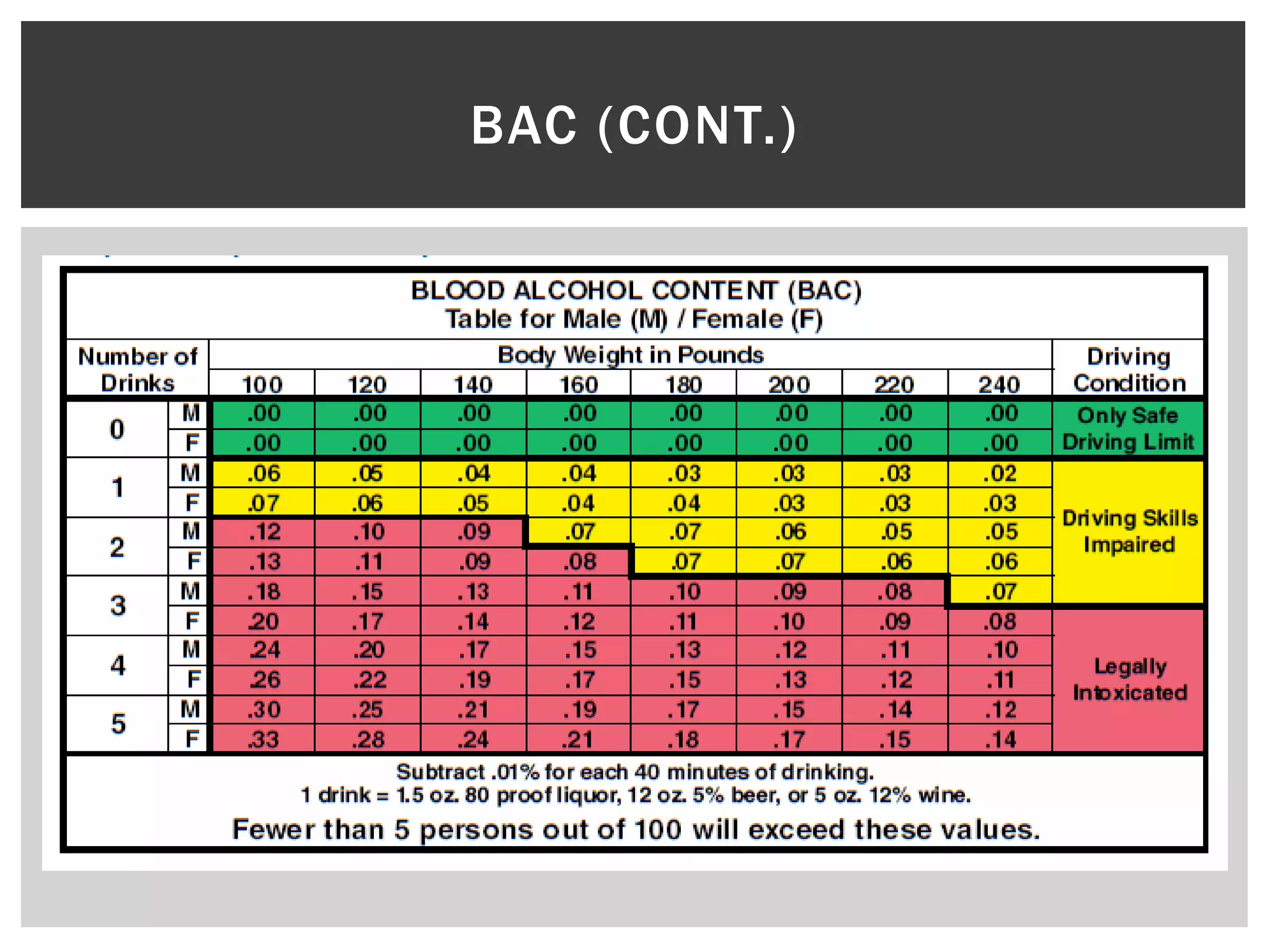
BAC (CONT.)
BAC (CONT.)
https://www.smartserve.ca/blood-alcohol-concentration
BAC CALCULATOR
Go to the website, play around!
The previous charts and calculations are generic, and when
consuming alcohol/serving customers, the following other
factors need to be taken into consideration:
 Alcohol tolerance
 Weight
 Amount of sleep
 Medication
 Amount of food consumed
 Percentage of alcohol in drinks consumed
BAC (CONT.)
EXAMPLES AND
EXPLANATIONS OF
SIGNS OF INTOXICATION
Slurred speech/no speech
Stumbling
Heavy eyelids
Loud speech
Bloodshot eyes
Smell of alcohol on breath
INTOXICATED BEHAVIORS: OBVIOUS
SIGNS
Increased profanity
“Liquid courage”
Close proximity
Increased cigarette smoking
Overspending
Repeating his or herself
Confused speech
Crying
Increased leaning
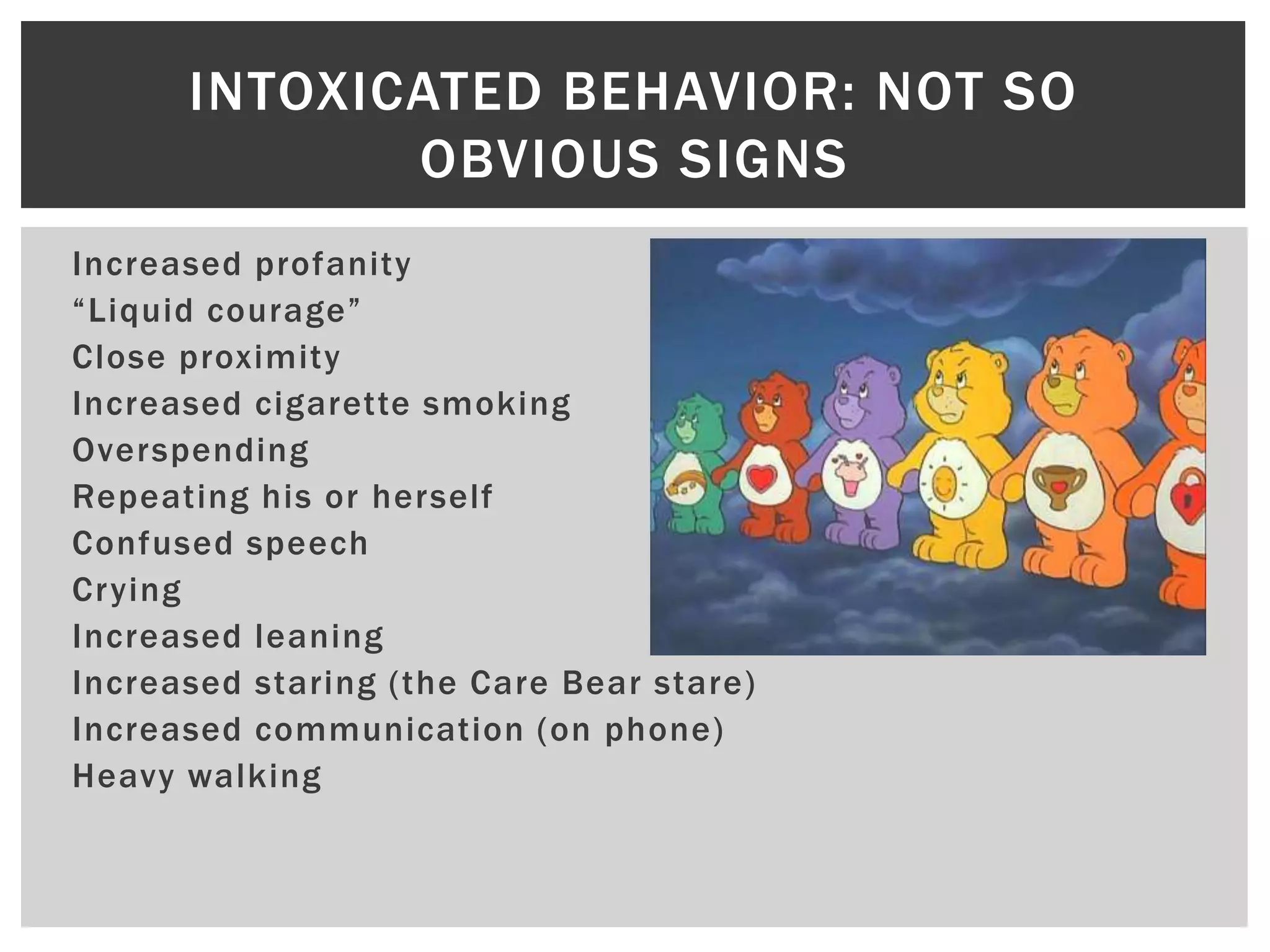
Increased staring (the Care Bear stare)
Increased communication (on phone)
Heavy walking
INTOXICATED BEHAVIOR: NOT SO
OBVIOUS SIGNS
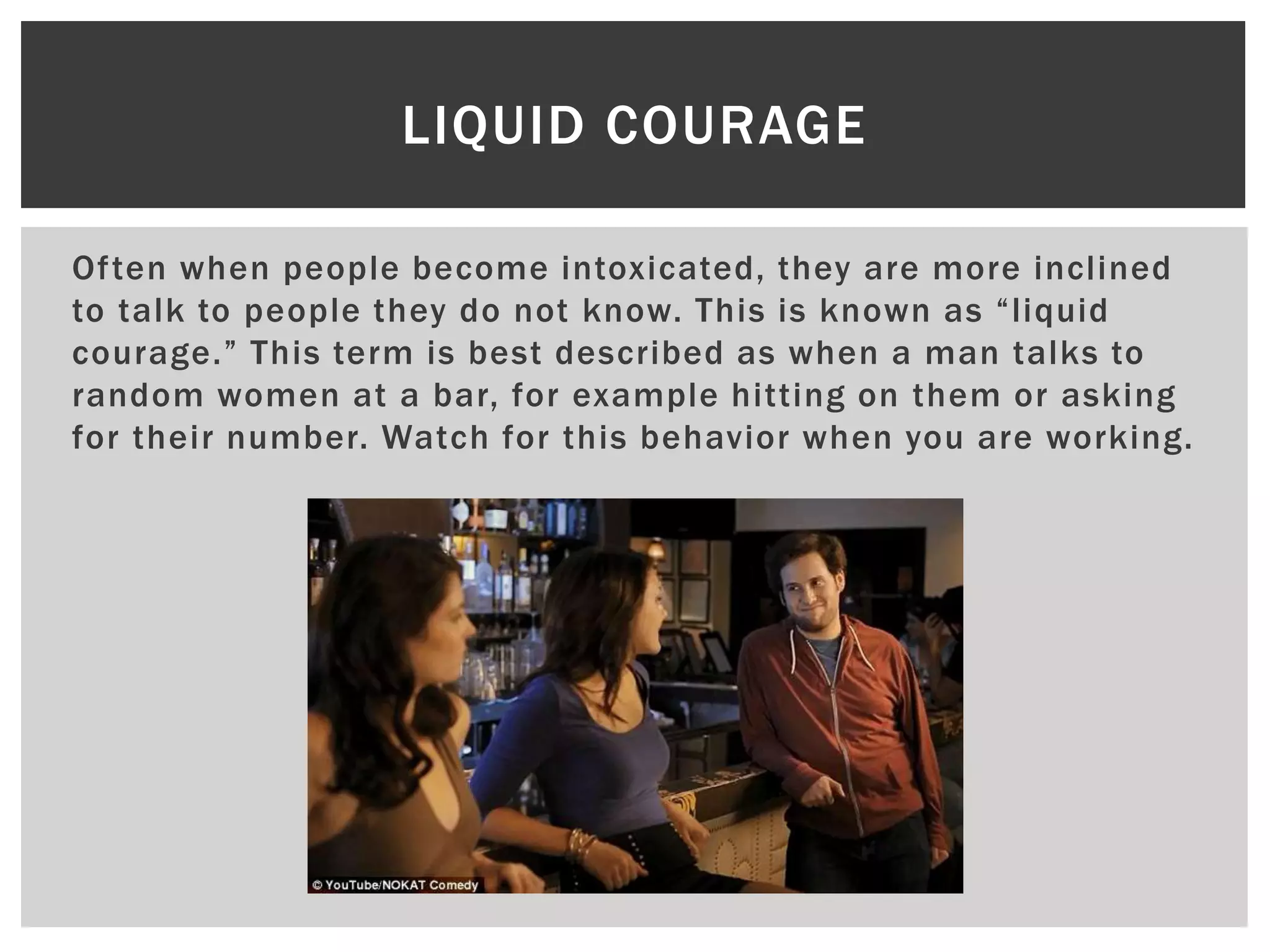
Often when people become intoxicated, they are more inclined
to talk to people they do not know. This is known as “liquid
courage.” This term is best described as when a man talks to
random women at a bar, for example hitting on them or asking
for their number. Watch for this behavior when you are working.
LIQUID COURAGE
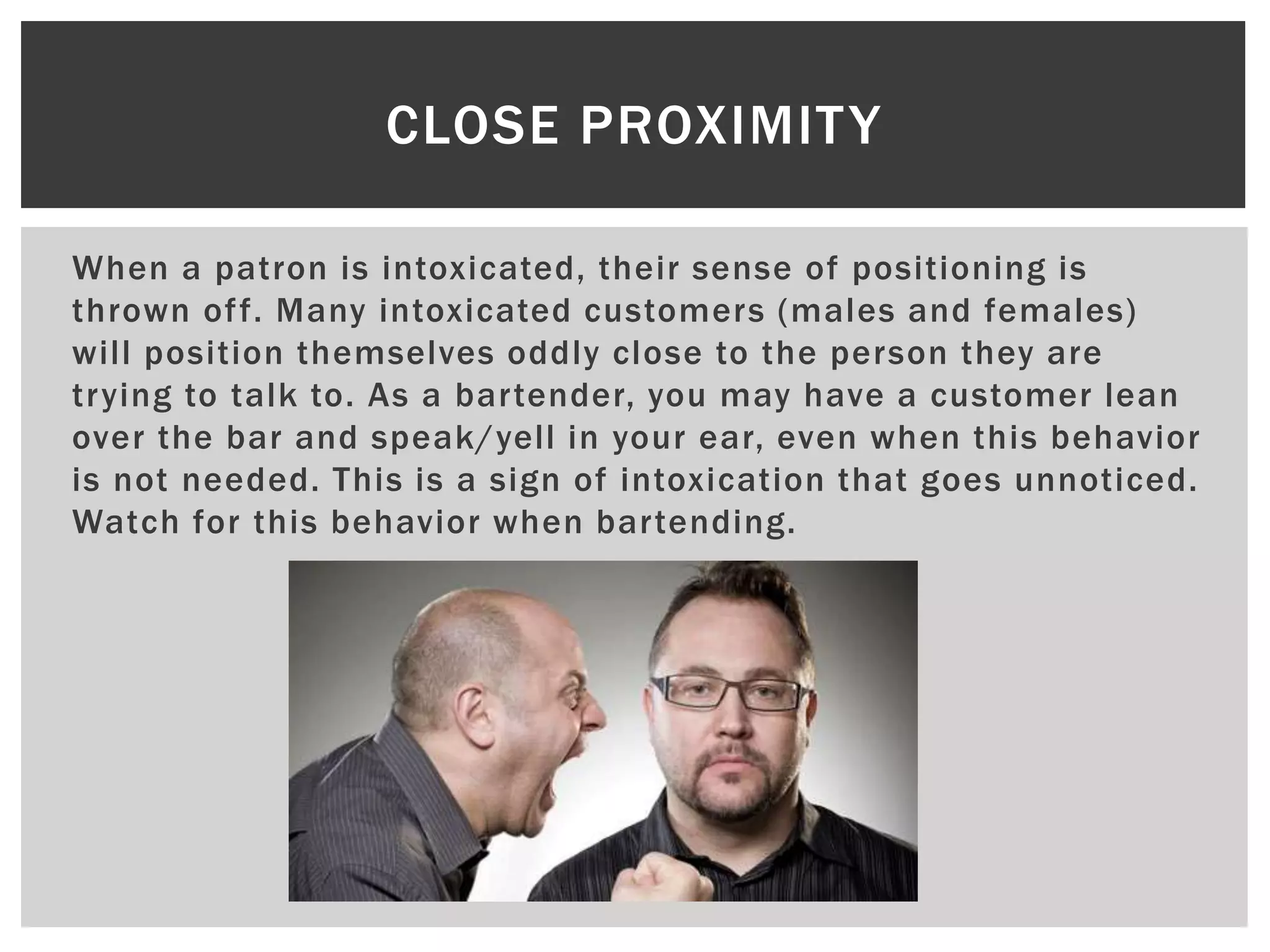
When a patron is intoxicated, their sense of positioning is
thrown off. Many intoxicated customers (males and females)
will position themselves oddly close to the person they are
trying to talk to. As a bartender, you may have a customer lean
over the bar and speak/yell in your ear, even when this behavior
is not needed. This is a sign of intoxication that goes unnoticed.
Watch for this behavior when bartending.
CLOSE PROXIMITY
Some patrons tend to
smoke more when they
drink. It might be
difficult to tell an
intoxicated person from
a sober person in this
case, but observe the
customers that have
been at your
establishment for long
hours, and take note if
they show signs of
increased cigarette
smoking.
Intoxicated customers
also tend to start
spending more money as
the night goes on. If you
notice a customer’s
spending's start to
increase drastically, keep
an eye on them for other
obvious signs of
intoxication. More money
is GREAT, but not at the
expense of your job.
INCREASED SMOKING/OVERSPENDING
Example- asking for a
drink 4 or 5 times
when you have
already helped
them/are helping
another customer
Example- Asking for a
drink that does not
make sense- “Grey
Goose and vodka,”
“Jager Bombs”
instead of “Vegas
Bombs,” or changing
their order multiple
times.
REPEATING/CONFUSED SPEECH
If you see a customer
constantly leaning on
a door, bar, etc., this
means they are
having trouble
standing and in most
cases should be
removed from the
establishment.
Increased staring is
also related to drug
abuse. This can be a
sign of intoxication
and should be noted
alongside other signs.
INCREASED LEANING/STARING
 Monitor customers for signs of intoxication, note any changes
in behavior
 If customer is obviously intoxicated, calmly offer a glass of
water
 If a customer becomes angry or unruly, repeat your reasoning
and notify your manager
 If the customer still does not oblige when speaking to a
manager or bouncer, he or she may be removed from the
establishment
*Do not let a customer degrade or talk down to you. YOU are
the person in charge. If you feel uncomfortable cutting a
customer off, notify a manager immediately.
HANDLING INTOXICATED CUSTOMERS
If you feel a patron is reaching early stages of intoxication,
there are some drinks and diversions you can offer to ensure
you are not over serving
Mixed shots instead of straight shots
Mixed drinks instead of shots
Light beers instead of heavy beers
Single shot drinks instead of doubles
*You can also add light ice to drinks and add more juice or soda
*When offering mixed shots, use fun names and colors. This
can be easily done with light liquors and flavored juices.
DIVERSIONS TO CONSIDER
Read
through
the
scenarios
and write
down on a
piece of
paper how
you would
handle
them. You
and your
instructor
will talk
through
your
decision
after the
module is
complete
HANDLING DIFFERENT
SCENARIOS
Let’s say a patron (man) walks up and orders a light beer. You
suspect slight intoxication since he had previously taken 3
shots of straight liquor in 1 hour, but he is not showing any
obvious signs. In this case, offer the beer and closely monitor
their behavior throughout the night. You notice their eyes start
to droop and slight swaying back and forth. The customer then
begins to speak loudly to his friends and hit on random women.
At this point, you notice obvious signs of intoxication. He then
asks you for a shot of hard liquor. What would you do?
HANDLING THE SITUATION: A GENERIC
SCENARIO
A woman is out with her friends at your establishment. She is
drinking cheap vodka with cranberry juice (1 ounce drinks). She
looks to be approx. 120 pounds. In the past 2 hours, she has
already had 4 drinks, but it is early in the night and this bar
appears to be her first stop. At the moment she seems totally
fine and is holding herself together, no stumbling, no slurring,
walking straight. She then walks up to you and asks for a round
of shots, but does not know what to order. What would you
suggest?
HANDLING THE SITUATION: A GENERIC
SCENARIO
ADDITIONAL
ASSESSMENT
Role Play: All employees, new and old, will engage in
role-play. Different scenarios will be drawn from a hat,
and the old employees will act this out. The new
employees will then be behind the bar and decide the
best outcome/solution.
Strategic questioning: The manager on duty will ask
random questions throughout the day to ensure the
learner is paying attention. This will keep them alert and
informed as well as constantly learning.
ADDITIONAL ASSESSMENT
Observation: On the employee’s first night shift, a manager will
be closely watching the employee to see if he or she is handling
different situations the right way. The manager can step in at
any time to correct the employee if they seem to be having
trouble.
Shadowing: The new employee will be required to shadow
veteran employees during 2 shifts before beginning his or her
first busy night shift.
Recall: Learners must write down a list of 10 signs of
intoxication (obvious and not so obvious).
ADDITIONAL ASSESSMENT
 In some states and cases, the person serving alcohol is
responsible for accidents or injuries to person consuming alcohol
 It is illegal in every state to serve alcohol to a minor (under 21)
 Leaving establishments with alcohol is only allowed in certain
states
 If a patron is drinking at your establishment, and gets a DUI or is
in an accident after they leave, you can be charged with over
serving and be fined and/or possibly serve jail time.
 When in doubt, don’t serve!
Alcohol laws according to each state:
https://www.consumer.ftc.gov/articles/0388-alcohol-laws-state
ADDITIONAL INFORMATION
Note differences in laws with your state and other states
As your journey begins as a bartender, you will be put in a lot of
different situations, good and bad. You are expected to handle
these situations in a calm and professional manner. The more
you are exposed to different scenarios, the better you can equip
yourself with the resources and knowledge needed to handle
them. As a bartender, you are the person in charge of serving
and cutting customers off. Be alert, be observant, be assertive.
Have fun!
TIME TO APPLY

Intoxicated customers

  • 1.
    And how to handlerelated situations IDENTIFYING INTOXICATED PATRONS
  • 2.
     BAC (bloodalcohol concentration) and calculations  Alcohol percentages  Signs of intoxication  Handling intoxicated customers  Laws related to your state WHAT YOU WILL LEARN
  • 3.
    The definition ofblood alcohol content is the concentration of alcohol in one's bloodstream, expressed as a percentage. Blood alcohol content, or BAC, is used to determine whether a person is legally intoxicated, especially under a driving while intoxicated law. Unless a person has developed a very high tolerance for alcohol, a BAC rating of 0.20% represents very serious intoxication. In general most first-time drinkers are unconscious by about 0.15%. A range of 0.35% to 0.40% usually represents potentially fatal alcohol poisoning. BAC (BLOOD ALCOHOL CONTENT)
  • 4.
  • 5.
  • 6.
  • 7.
    The previous chartsand calculations are generic, and when consuming alcohol/serving customers, the following other factors need to be taken into consideration:  Alcohol tolerance  Weight  Amount of sleep  Medication  Amount of food consumed  Percentage of alcohol in drinks consumed BAC (CONT.)
  • 8.
  • 9.
    Slurred speech/no speech Stumbling Heavyeyelids Loud speech Bloodshot eyes Smell of alcohol on breath INTOXICATED BEHAVIORS: OBVIOUS SIGNS
  • 10.
    Increased profanity “Liquid courage” Closeproximity Increased cigarette smoking Overspending Repeating his or herself Confused speech Crying Increased leaning Increased staring (the Care Bear stare) Increased communication (on phone) Heavy walking INTOXICATED BEHAVIOR: NOT SO OBVIOUS SIGNS
  • 11.
    Often when peoplebecome intoxicated, they are more inclined to talk to people they do not know. This is known as “liquid courage.” This term is best described as when a man talks to random women at a bar, for example hitting on them or asking for their number. Watch for this behavior when you are working. LIQUID COURAGE
  • 12.
    When a patronis intoxicated, their sense of positioning is thrown off. Many intoxicated customers (males and females) will position themselves oddly close to the person they are trying to talk to. As a bartender, you may have a customer lean over the bar and speak/yell in your ear, even when this behavior is not needed. This is a sign of intoxication that goes unnoticed. Watch for this behavior when bartending. CLOSE PROXIMITY
  • 13.
    Some patrons tendto smoke more when they drink. It might be difficult to tell an intoxicated person from a sober person in this case, but observe the customers that have been at your establishment for long hours, and take note if they show signs of increased cigarette smoking. Intoxicated customers also tend to start spending more money as the night goes on. If you notice a customer’s spending's start to increase drastically, keep an eye on them for other obvious signs of intoxication. More money is GREAT, but not at the expense of your job. INCREASED SMOKING/OVERSPENDING
  • 14.
    Example- asking fora drink 4 or 5 times when you have already helped them/are helping another customer Example- Asking for a drink that does not make sense- “Grey Goose and vodka,” “Jager Bombs” instead of “Vegas Bombs,” or changing their order multiple times. REPEATING/CONFUSED SPEECH
  • 15.
    If you seea customer constantly leaning on a door, bar, etc., this means they are having trouble standing and in most cases should be removed from the establishment. Increased staring is also related to drug abuse. This can be a sign of intoxication and should be noted alongside other signs. INCREASED LEANING/STARING
  • 16.
     Monitor customersfor signs of intoxication, note any changes in behavior  If customer is obviously intoxicated, calmly offer a glass of water  If a customer becomes angry or unruly, repeat your reasoning and notify your manager  If the customer still does not oblige when speaking to a manager or bouncer, he or she may be removed from the establishment *Do not let a customer degrade or talk down to you. YOU are the person in charge. If you feel uncomfortable cutting a customer off, notify a manager immediately. HANDLING INTOXICATED CUSTOMERS
  • 17.
    If you feela patron is reaching early stages of intoxication, there are some drinks and diversions you can offer to ensure you are not over serving Mixed shots instead of straight shots Mixed drinks instead of shots Light beers instead of heavy beers Single shot drinks instead of doubles *You can also add light ice to drinks and add more juice or soda *When offering mixed shots, use fun names and colors. This can be easily done with light liquors and flavored juices. DIVERSIONS TO CONSIDER
  • 18.
    Read through the scenarios and write down ona piece of paper how you would handle them. You and your instructor will talk through your decision after the module is complete HANDLING DIFFERENT SCENARIOS
  • 19.
    Let’s say apatron (man) walks up and orders a light beer. You suspect slight intoxication since he had previously taken 3 shots of straight liquor in 1 hour, but he is not showing any obvious signs. In this case, offer the beer and closely monitor their behavior throughout the night. You notice their eyes start to droop and slight swaying back and forth. The customer then begins to speak loudly to his friends and hit on random women. At this point, you notice obvious signs of intoxication. He then asks you for a shot of hard liquor. What would you do? HANDLING THE SITUATION: A GENERIC SCENARIO
  • 20.
    A woman isout with her friends at your establishment. She is drinking cheap vodka with cranberry juice (1 ounce drinks). She looks to be approx. 120 pounds. In the past 2 hours, she has already had 4 drinks, but it is early in the night and this bar appears to be her first stop. At the moment she seems totally fine and is holding herself together, no stumbling, no slurring, walking straight. She then walks up to you and asks for a round of shots, but does not know what to order. What would you suggest? HANDLING THE SITUATION: A GENERIC SCENARIO
  • 21.
  • 22.
    Role Play: Allemployees, new and old, will engage in role-play. Different scenarios will be drawn from a hat, and the old employees will act this out. The new employees will then be behind the bar and decide the best outcome/solution. Strategic questioning: The manager on duty will ask random questions throughout the day to ensure the learner is paying attention. This will keep them alert and informed as well as constantly learning. ADDITIONAL ASSESSMENT
  • 23.
    Observation: On theemployee’s first night shift, a manager will be closely watching the employee to see if he or she is handling different situations the right way. The manager can step in at any time to correct the employee if they seem to be having trouble. Shadowing: The new employee will be required to shadow veteran employees during 2 shifts before beginning his or her first busy night shift. Recall: Learners must write down a list of 10 signs of intoxication (obvious and not so obvious). ADDITIONAL ASSESSMENT
  • 24.
     In somestates and cases, the person serving alcohol is responsible for accidents or injuries to person consuming alcohol  It is illegal in every state to serve alcohol to a minor (under 21)  Leaving establishments with alcohol is only allowed in certain states  If a patron is drinking at your establishment, and gets a DUI or is in an accident after they leave, you can be charged with over serving and be fined and/or possibly serve jail time.  When in doubt, don’t serve! Alcohol laws according to each state: https://www.consumer.ftc.gov/articles/0388-alcohol-laws-state ADDITIONAL INFORMATION Note differences in laws with your state and other states
  • 25.
    As your journeybegins as a bartender, you will be put in a lot of different situations, good and bad. You are expected to handle these situations in a calm and professional manner. The more you are exposed to different scenarios, the better you can equip yourself with the resources and knowledge needed to handle them. As a bartender, you are the person in charge of serving and cutting customers off. Be alert, be observant, be assertive. Have fun! TIME TO APPLY