
Interviewing
From Interview to Offer
While a sharp resume and persuasive cover letter will get
you an interview, you’ll need excellent interviewing skills to
close the deal and land your desired position. All too often,
job and internship seekers invest large amounts of time to
write their application documents but give short shrift to
interview preparation.

An interview can be conversational (that is what you hope
for!) but it is NOT just a conversation. Even the most
confident and personable people person will benefit
dramatically from thoughtful interview preparation. You
have come this far; be sure you keep up the momentum
and build upon your preliminary success.

Read over this advice and find more
detail on the Career Center website.

Research industry, employer, and role. Follow the
relevant news, learn the organization’s website backwards and
forwards and scope out your interviewers on LinkedIn and
Google.	Reach	out	to	employees—maybe	even	Duke	alums—
in the company.

Rehearse your introduction. What will you say to create a
positive and compelling first impression when you are asked
the question, “Tell me about yourself”? No matter how it
is phrased, expect that you will open the interview with a
platform to talk about your interest in the opportunity and how
it fits with your strengths and experiences.

Connect your experiences. Practice telling short stories that
give evidence to your success. Mentally connect these stories
to the qualities they best represent.

Prepare your own questions. You will be given the
opportunity to ask questions during your interviews. This
is a valuable part of the interview, not just a polite gesture.
Consider questions about the role, company specifics (but
never salary or benefits—not yet), the personal experiences
of people that you meet, or questions that relate to current
events or news.

Send thank-you notes. Send them the very next day to each
person or group that you meet. Refer to something interesting
or unique from the conversation to create an opportunity
for the reader to think of you again. Paper makes a stronger
impression, but email is the way to go if a hiring decision will
be made before snail mail can reach its destination.               37
Behavioral Interviews
                                          The vast majority of interviews are
                                          behavioral in nature. Frequently, behavioral
                                          questions will include some form of, “Tell
                                          me about a time when…” and will relate to
                                                           tasks, scenarios, and qualities
                                                           that will be significant to the
                                                           position you are now seeking.
                                                           Through this method, the
                                                           interviewer hopes to gauge
                                                           your potential for success. The
                                                           premise of behavioral-based
                                                           interviews is that your past
                                          actions are the best predictor of your future
                                          performance. The appropriate response is to
                                          share a concise, but detailed story about a
                                          relevant experience.


                                 Behavioral Interview Success
     • Provide well thought-out examples with successful endings. Even a story about your
       biggest failure can conclude with what you learned from the experience!

     • Refer to specific examples rather than broad characterizations.

     • Be sure that your story has a beginning, middle, and end. See the STAR method for
       responding on the next page.

     • Prepare your stories in advance by anticipating the expected strengths needed for the
       role and matching them with your own accomplishments.

     • Address and contextualize your own contributions when discussing a group project.

     • Pull examples from across your range of experiences. Using just one or a few can cre-
       ate a sense that others have not been valuable.

     • Speak positively about yourself, colleagues, supervisors, and peers.
38   • Use the most recent examples when possible.
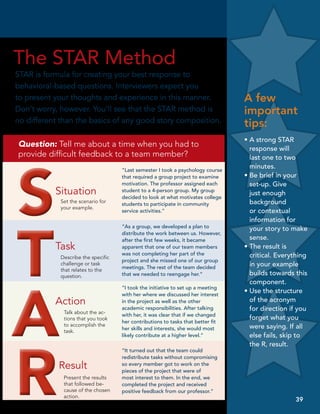
The STAR Method
STAR is formula for creating your best response to
behavioral-based questions. Interviewers expect you
to present your thoughts and experience in this manner.                           A few
Don’t worry, however. You’ll see that the STAR method is                          important
no different than the basics of any good story composition.                       tips:
                                                                                  • A strong STAR
Question: Tell me about a time when you had to                                      response will
provide difficult feedback to a team member?


S
                                                                                    last one to two
                                     “last semester i took a psychology course
                                                                                    minutes.
                                     that required a group project to examine     • Be brief in your
                                     motivation. the professor assigned each        set-up. Give
           Situation                 student to a 4-person group. My group
                                     decided to look at what motivates college
                                                                                    just enough
             Set the scenario for
                                     students to participate in community           background
             your example.
                                     service activities.”                           or contextual


T
                                                                                    information for
                                     “as a group, we developed a plan to            your story to make
                                     distribute the work between us. however,
                                     after the first few weeks, it became           sense.
           Task                      apparent that one of our team members        • The result is
                                     was not completing her part of the             critical. everything
             Describe the specific
                                     project and she missed one of our group
             challenge or task
                                     meetings. the rest of the team decided
                                                                                    in your example
             that relates to the
             question.               that we needed to reengage her.”               builds towards this


A
                                                                                    component.
                                     “i took the initiative to set up a meeting
                                     with her where we discussed her interest
                                                                                  • Use the structure
           Action                    in the project as well as the other            of the acronym
              Talk about the ac-
                                     academic responsibilities. after talking       for direction if you
                                     with her, it was clear that if we changed
              tions that you took                                                   forget what you
                                     her contributions to tasks that better fit
              to accomplish the                                                     were saying. if all
                                     her skills and interests, she would most
              task.
                                     likely contribute at a higher level.”          else fails, skip to


R
                                                                                    the r, result.
                                     “it turned out that the team could
                                     redistribute tasks without compromising
            Result                   so every member got to work on the
                                     pieces of the project that were of
              Present the results    most interest to them. in the end, we
              that followed be-      completed the project and received
              cause of the chosen    positive feedback from our professor.”
              action.                                                                              39
                                                                                                   39
Case Interviews
          Case interviews are a specialized type of interview common
          in the consulting industry. In a case interview, the interviewer
          presents a dilemma, and the candidate must analyze and
          discuss the problem and propose a solution.


          Employers use case interviews as a way to evaluate a
          candidate’s qualitative, problem-solving, and analytical
          skills and often their business acumen. In addition they
          will evaluate the communication skills, listening skills,
          enthusiasm and non-verbal cues, e.g., eye contact, of the
          candidate. The way in which a candidate arrives at a solution
          to the question, which demonstrates to an employer how
          the candidate thinks through a dilemma, is as important as
          the actual solution the candidate provides, if not more.


      Case	Question	Types
      Typical case questions fall into four categories:
          Calculations/Computational Scenario – Devise a solution given a
          problem statement, data elements, and possibly a formula

          Business Operation Scenario – Devise a solution given a problem
          related to operational effectiveness.
          Example: How can you increase efficiency of Starbuck’s ordering process
          by decreasing wait time during peak hours?

          Business Strategy Scenario – Devise a solution given a problem
          related to strategy and new markets.
          Example: How will airlines remain competitive with rising fuel costs and
          increased regulations?

          Brainteaser – Two primary types including the estimation case, How
          many golf courses exist in Wisconsin? and the random fact analysis, Why
          are manhole covers round?

      Resources for students preparing for a case interview are
      the following:
         •    Case In Point: Complete Case Interview Preparation by Marc Casentino
         •	   Mock interviews through the Career Center
         •	   Practice cases and interactive online cases on employers’ websites
 40
40

Interviewing

  • 1.
    Interviewing From Interview toOffer While a sharp resume and persuasive cover letter will get you an interview, you’ll need excellent interviewing skills to close the deal and land your desired position. All too often, job and internship seekers invest large amounts of time to write their application documents but give short shrift to interview preparation. An interview can be conversational (that is what you hope for!) but it is NOT just a conversation. Even the most confident and personable people person will benefit dramatically from thoughtful interview preparation. You have come this far; be sure you keep up the momentum and build upon your preliminary success. Read over this advice and find more detail on the Career Center website. Research industry, employer, and role. Follow the relevant news, learn the organization’s website backwards and forwards and scope out your interviewers on LinkedIn and Google. Reach out to employees—maybe even Duke alums— in the company. Rehearse your introduction. What will you say to create a positive and compelling first impression when you are asked the question, “Tell me about yourself”? No matter how it is phrased, expect that you will open the interview with a platform to talk about your interest in the opportunity and how it fits with your strengths and experiences. Connect your experiences. Practice telling short stories that give evidence to your success. Mentally connect these stories to the qualities they best represent. Prepare your own questions. You will be given the opportunity to ask questions during your interviews. This is a valuable part of the interview, not just a polite gesture. Consider questions about the role, company specifics (but never salary or benefits—not yet), the personal experiences of people that you meet, or questions that relate to current events or news. Send thank-you notes. Send them the very next day to each person or group that you meet. Refer to something interesting or unique from the conversation to create an opportunity for the reader to think of you again. Paper makes a stronger impression, but email is the way to go if a hiring decision will be made before snail mail can reach its destination. 37
  • 2.
    Behavioral Interviews The vast majority of interviews are behavioral in nature. Frequently, behavioral questions will include some form of, “Tell me about a time when…” and will relate to tasks, scenarios, and qualities that will be significant to the position you are now seeking. Through this method, the interviewer hopes to gauge your potential for success. The premise of behavioral-based interviews is that your past actions are the best predictor of your future performance. The appropriate response is to share a concise, but detailed story about a relevant experience. Behavioral Interview Success • Provide well thought-out examples with successful endings. Even a story about your biggest failure can conclude with what you learned from the experience! • Refer to specific examples rather than broad characterizations. • Be sure that your story has a beginning, middle, and end. See the STAR method for responding on the next page. • Prepare your stories in advance by anticipating the expected strengths needed for the role and matching them with your own accomplishments. • Address and contextualize your own contributions when discussing a group project. • Pull examples from across your range of experiences. Using just one or a few can cre- ate a sense that others have not been valuable. • Speak positively about yourself, colleagues, supervisors, and peers. 38 • Use the most recent examples when possible.
  • 3.
    The STAR Method STARis formula for creating your best response to behavioral-based questions. Interviewers expect you to present your thoughts and experience in this manner. A few Don’t worry, however. You’ll see that the STAR method is important no different than the basics of any good story composition. tips: • A strong STAR Question: Tell me about a time when you had to response will provide difficult feedback to a team member? S last one to two “last semester i took a psychology course minutes. that required a group project to examine • Be brief in your motivation. the professor assigned each set-up. Give Situation student to a 4-person group. My group decided to look at what motivates college just enough Set the scenario for students to participate in community background your example. service activities.” or contextual T information for “as a group, we developed a plan to your story to make distribute the work between us. however, after the first few weeks, it became sense. Task apparent that one of our team members • The result is was not completing her part of the critical. everything Describe the specific project and she missed one of our group challenge or task meetings. the rest of the team decided in your example that relates to the question. that we needed to reengage her.” builds towards this A component. “i took the initiative to set up a meeting with her where we discussed her interest • Use the structure Action in the project as well as the other of the acronym Talk about the ac- academic responsibilities. after talking for direction if you with her, it was clear that if we changed tions that you took forget what you her contributions to tasks that better fit to accomplish the were saying. if all her skills and interests, she would most task. likely contribute at a higher level.” else fails, skip to R the r, result. “it turned out that the team could redistribute tasks without compromising Result so every member got to work on the pieces of the project that were of Present the results most interest to them. in the end, we that followed be- completed the project and received cause of the chosen positive feedback from our professor.” action. 39 39
  • 4.
    Case Interviews Case interviews are a specialized type of interview common in the consulting industry. In a case interview, the interviewer presents a dilemma, and the candidate must analyze and discuss the problem and propose a solution. Employers use case interviews as a way to evaluate a candidate’s qualitative, problem-solving, and analytical skills and often their business acumen. In addition they will evaluate the communication skills, listening skills, enthusiasm and non-verbal cues, e.g., eye contact, of the candidate. The way in which a candidate arrives at a solution to the question, which demonstrates to an employer how the candidate thinks through a dilemma, is as important as the actual solution the candidate provides, if not more. Case Question Types Typical case questions fall into four categories: Calculations/Computational Scenario – Devise a solution given a problem statement, data elements, and possibly a formula Business Operation Scenario – Devise a solution given a problem related to operational effectiveness. Example: How can you increase efficiency of Starbuck’s ordering process by decreasing wait time during peak hours? Business Strategy Scenario – Devise a solution given a problem related to strategy and new markets. Example: How will airlines remain competitive with rising fuel costs and increased regulations? Brainteaser – Two primary types including the estimation case, How many golf courses exist in Wisconsin? and the random fact analysis, Why are manhole covers round? Resources for students preparing for a case interview are the following: • Case In Point: Complete Case Interview Preparation by Marc Casentino • Mock interviews through the Career Center • Practice cases and interactive online cases on employers’ websites 40 40