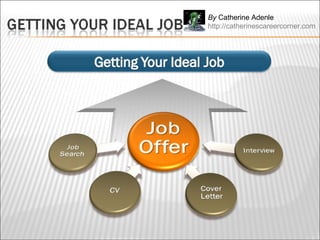
By  Catherine Adenle http://catherinescareercorner.com
Aims Sourcing your ideal role Effective CV Preparation Covering Letter Job Interview Summary By  Catherine Adenle http://catherinescareercorner.com
Be able to search effectively for new role Prepare an effective CV and covering letter. Attend job interviews with increased confidence. After the interview By  Catherine Adenle http://catherinescareercorner.com
Job Strategy Job Sites e.g. totaljobs, monster etc Word of mouth Newspapers Internet (Twitter, LinkedIn, Facebook) Networking (F2F, Social Media, WOM) Recruitment Agencies Headhunted  By  Catherine Adenle http://catherinescareercorner.com
Define your product Know yourself and your skills Regularly, not just when facing imposed change Determine the strengths you are selling to potential employers What makes you stand out from the crowd Determine your market Do you need to undertake training or development to increase your competitiveness? Target your marketing appropriately Make a plan Be positive By  Catherine Adenle http://catherinescareercorner.com
1. Communication Skills 2. Honesty/Integrity 3. Teamwork Skills 4. Interpersonal Skills 5. Strong Work Ethic 6. Motivation/Initiative 7. Flexibility/Adaptability 8. Analytical Skills 9. Computer Skills 10. Organisational Skills By  Catherine Adenle http://catherinescareercorner.com
Clearly identify skills and competencies. Use of ‘power words’ or ‘action words’ Make it clear. Two A4 pages. Be honest. Concentrate on achievements. Proof read. Highlight goals Use same font. No spelling mistakes Lean and mean By  Catherine Adenle http://catherinescareercorner.com
How does it look? Is it tailored to the job for which I am applying? Are there any errors? Do my exceptional selling points stand out? Is it in chronological order? Are my skills and competencies set out? Does my covering letter complement my CV? Have I used action words? Is the most relevant information at the front? Am I being honest? Does it stand out? By  Catherine Adenle http://catherinescareercorner.com
Do it now Do target your CV towards the job Do sell yourself Start with general contact information Cut out the rubbish and make it interesting Format your CV appropriately Edit and Edit again! Do make it 2pp Do spell check Do make it result orientated By  Catherine Adenle http://catherinescareercorner.com
Don’t do it all by yourself the first time - seek advice and second opinion Don’t include  Age; Ethnic identity; Political affiliation; Religious preference; Hobbies; Marital status; Sexual orientation; Place of birth; Photographs; Height; Weight; and Health Don’t include humour Don’t give excessive details Don’t clutter it Don’t send off your CV unless you are completely satisfied it is as good as it could be.  By  Catherine Adenle http://catherinescareercorner.com
Failure to identify what the employer is looking for. Underestimating and underselling the skills you have to offer. Failure to provide the right evidence to support skills and competencies. By  Catherine Adenle http://catherinescareercorner.com
… a tool to inform, persuade and get you an interview, and it's also a reflection of who you are, so you want to be sure that it is error-free and easy to read and understand.  By  Catherine Adenle http://catherinescareercorner.com
Demonstrate to the employer your interest in and knowledge of the company Highlight, not repeat particular parts of your CV that are your unique selling points;  Draw attention to additional information that does not fit easily into a CV;  Explain any personal circumstances or anomalies in your application. By  Catherine Adenle http://catherinescareercorner.com
Address your letter to a named person.  Think from the employer’s perspective rather than your own.  Tell them what you can contribute to the organisation rather than how it can benefit you.  Ideally your covering letter should be no more than one page long and with short and clearly themed paragraphs. By  Catherine Adenle http://catherinescareercorner.com
Briefly introduce yourself State what position you’re applying for and where you saw it advertised.  Explain why you’re interested in this type of work Explain why you’re interested in working for this particular employer.  Highlight the ways in which you’re suitable for this position.  Take the opportunity, if necessary, to explain any anomalies in your background, such as any time gaps or any ways in which you don’t match the selection criteria.  Indicate availability for interview Show enthusiasm By  Catherine Adenle http://catherinescareercorner.com
Don’t repeat your CV Does my covering letter complement my CV? Make sure you’ve read the advert properly. Point out what you can do for them. Don’t include negative information. Always check for spelling and grammar. Don’t make it too long. By  Catherine Adenle http://catherinescareercorner.com
How do you ace your job interview? By  Catherine Adenle http://catherinescareercorner.com
Can you do the job? Will you do the job? Will you fit in? By  Catherine Adenle http://catherinescareercorner.com
It creates a good impression It helps to boost confidence It demonstrates enthusiasm & pro-activeness It better prepares you for difficult situations It allows you to review your performance more accurately By  Catherine Adenle http://catherinescareercorner.com
Biographical – talk through your CV Stress – what if scenarios Problem Solving – activities based test Situational/Behavioural – evidence based (of past behaviour) By  Catherine Adenle http://catherinescareercorner.com
By  Catherine Adenle http://catherinescareercorner.com
Don’t slouch Sit back in your chair Maintain eye contact Try not to gesture too much No funny faces Be enthusiastic Speak clearly and slowly Use positive language Avoid to many “errs” and “ums” Ask for time to think By  Catherine Adenle http://catherinescareercorner.com
By  Catherine Adenle http://catherinescareercorner.com
Behavioural Interview Questions, also called Situational, used as a tool to discover how your performance in a previous job may contribute to your future performance in the role being recruited for. Use  STAR *  approach to answer. Evidence based - is a style of interviewing often used to evaluate a candidate's competence, particularly when it is hard to select on the basis of technical merit Preparation!!! Do not memorize answers; the key to interviewing success is simply being prepared for the questions. Have a mental outline to follow in responding to each question. * S ituation, or  T ask - describe the situation,  A ction - describe the action you took,  R esult - How did the event end? What did you accomplish? What did you learn? By  Catherine Adenle http://catherinescareercorner.com
Find out the positions held by the interviewers in advance Maintain eye contact with all interviewers even when you are answering a question from one of them Try to remember their names and positions so you can address your questions at the end of the interview specifically to them By  Catherine Adenle http://catherinescareercorner.com
Analyse what happened Send a ‘thank you’ note If you are offered a job, make sure you accept for the right reasons If not, ask for feedback – and be open to it Do not view rejection letters as negative. By  Catherine Adenle http://catherinescareercorner.com
Consider the impression the company made on you: Were they professional in their approach? What was the company culture? Did you meet any other members of the department or management team? Do you think you will get on with your manager and with other people? Corporate Values Think about the big picture Training needs Prospects Salary Location Fringe benefits  (pension, medical insurance etc) By  Catherine Adenle http://catherinescareercorner.com
Sourcing your perfect job Tailor your CV to the role you are applying for. Adopt the same approach if the job is internal Prepare for the interview Sell yourself!! By  Catherine Adenle http://catherinescareercorner.com
Questions? Contact:  Catherine Adenle http://catherinescareercorner.com http://twitter.com/catherineadenle By  Catherine Adenle http://catherinescareercorner.com

Getting Your Ideal Job by Catherine Adenle

  • 1.
    By CatherineAdenle http://catherinescareercorner.com
  • 2.
    Aims Sourcing yourideal role Effective CV Preparation Covering Letter Job Interview Summary By Catherine Adenle http://catherinescareercorner.com
  • 3.
    Be able tosearch effectively for new role Prepare an effective CV and covering letter. Attend job interviews with increased confidence. After the interview By Catherine Adenle http://catherinescareercorner.com
  • 4.
    Job Strategy JobSites e.g. totaljobs, monster etc Word of mouth Newspapers Internet (Twitter, LinkedIn, Facebook) Networking (F2F, Social Media, WOM) Recruitment Agencies Headhunted By Catherine Adenle http://catherinescareercorner.com
  • 5.
    Define your productKnow yourself and your skills Regularly, not just when facing imposed change Determine the strengths you are selling to potential employers What makes you stand out from the crowd Determine your market Do you need to undertake training or development to increase your competitiveness? Target your marketing appropriately Make a plan Be positive By Catherine Adenle http://catherinescareercorner.com
  • 6.
    1. Communication Skills2. Honesty/Integrity 3. Teamwork Skills 4. Interpersonal Skills 5. Strong Work Ethic 6. Motivation/Initiative 7. Flexibility/Adaptability 8. Analytical Skills 9. Computer Skills 10. Organisational Skills By Catherine Adenle http://catherinescareercorner.com
  • 7.
    Clearly identify skillsand competencies. Use of ‘power words’ or ‘action words’ Make it clear. Two A4 pages. Be honest. Concentrate on achievements. Proof read. Highlight goals Use same font. No spelling mistakes Lean and mean By Catherine Adenle http://catherinescareercorner.com
  • 8.
    How does itlook? Is it tailored to the job for which I am applying? Are there any errors? Do my exceptional selling points stand out? Is it in chronological order? Are my skills and competencies set out? Does my covering letter complement my CV? Have I used action words? Is the most relevant information at the front? Am I being honest? Does it stand out? By Catherine Adenle http://catherinescareercorner.com
  • 9.
    Do it nowDo target your CV towards the job Do sell yourself Start with general contact information Cut out the rubbish and make it interesting Format your CV appropriately Edit and Edit again! Do make it 2pp Do spell check Do make it result orientated By Catherine Adenle http://catherinescareercorner.com
  • 10.
    Don’t do itall by yourself the first time - seek advice and second opinion Don’t include Age; Ethnic identity; Political affiliation; Religious preference; Hobbies; Marital status; Sexual orientation; Place of birth; Photographs; Height; Weight; and Health Don’t include humour Don’t give excessive details Don’t clutter it Don’t send off your CV unless you are completely satisfied it is as good as it could be. By Catherine Adenle http://catherinescareercorner.com
  • 11.
    Failure to identifywhat the employer is looking for. Underestimating and underselling the skills you have to offer. Failure to provide the right evidence to support skills and competencies. By Catherine Adenle http://catherinescareercorner.com
  • 12.
    … a toolto inform, persuade and get you an interview, and it's also a reflection of who you are, so you want to be sure that it is error-free and easy to read and understand. By Catherine Adenle http://catherinescareercorner.com
  • 13.
    Demonstrate to theemployer your interest in and knowledge of the company Highlight, not repeat particular parts of your CV that are your unique selling points; Draw attention to additional information that does not fit easily into a CV; Explain any personal circumstances or anomalies in your application. By Catherine Adenle http://catherinescareercorner.com
  • 14.
    Address your letterto a named person. Think from the employer’s perspective rather than your own. Tell them what you can contribute to the organisation rather than how it can benefit you. Ideally your covering letter should be no more than one page long and with short and clearly themed paragraphs. By Catherine Adenle http://catherinescareercorner.com
  • 15.
    Briefly introduce yourselfState what position you’re applying for and where you saw it advertised. Explain why you’re interested in this type of work Explain why you’re interested in working for this particular employer. Highlight the ways in which you’re suitable for this position. Take the opportunity, if necessary, to explain any anomalies in your background, such as any time gaps or any ways in which you don’t match the selection criteria. Indicate availability for interview Show enthusiasm By Catherine Adenle http://catherinescareercorner.com
  • 16.
    Don’t repeat yourCV Does my covering letter complement my CV? Make sure you’ve read the advert properly. Point out what you can do for them. Don’t include negative information. Always check for spelling and grammar. Don’t make it too long. By Catherine Adenle http://catherinescareercorner.com
  • 17.
    How do youace your job interview? By Catherine Adenle http://catherinescareercorner.com
  • 18.
    Can you dothe job? Will you do the job? Will you fit in? By Catherine Adenle http://catherinescareercorner.com
  • 19.
    It creates agood impression It helps to boost confidence It demonstrates enthusiasm & pro-activeness It better prepares you for difficult situations It allows you to review your performance more accurately By Catherine Adenle http://catherinescareercorner.com
  • 20.
    Biographical – talkthrough your CV Stress – what if scenarios Problem Solving – activities based test Situational/Behavioural – evidence based (of past behaviour) By Catherine Adenle http://catherinescareercorner.com
  • 21.
    By CatherineAdenle http://catherinescareercorner.com
  • 22.
    Don’t slouch Sitback in your chair Maintain eye contact Try not to gesture too much No funny faces Be enthusiastic Speak clearly and slowly Use positive language Avoid to many “errs” and “ums” Ask for time to think By Catherine Adenle http://catherinescareercorner.com
  • 23.
    By CatherineAdenle http://catherinescareercorner.com
  • 24.
    Behavioural Interview Questions,also called Situational, used as a tool to discover how your performance in a previous job may contribute to your future performance in the role being recruited for. Use STAR * approach to answer. Evidence based - is a style of interviewing often used to evaluate a candidate's competence, particularly when it is hard to select on the basis of technical merit Preparation!!! Do not memorize answers; the key to interviewing success is simply being prepared for the questions. Have a mental outline to follow in responding to each question. * S ituation, or T ask - describe the situation, A ction - describe the action you took, R esult - How did the event end? What did you accomplish? What did you learn? By Catherine Adenle http://catherinescareercorner.com
  • 25.
    Find out thepositions held by the interviewers in advance Maintain eye contact with all interviewers even when you are answering a question from one of them Try to remember their names and positions so you can address your questions at the end of the interview specifically to them By Catherine Adenle http://catherinescareercorner.com
  • 26.
    Analyse what happenedSend a ‘thank you’ note If you are offered a job, make sure you accept for the right reasons If not, ask for feedback – and be open to it Do not view rejection letters as negative. By Catherine Adenle http://catherinescareercorner.com
  • 27.
    Consider the impressionthe company made on you: Were they professional in their approach? What was the company culture? Did you meet any other members of the department or management team? Do you think you will get on with your manager and with other people? Corporate Values Think about the big picture Training needs Prospects Salary Location Fringe benefits (pension, medical insurance etc) By Catherine Adenle http://catherinescareercorner.com
  • 28.
    Sourcing your perfectjob Tailor your CV to the role you are applying for. Adopt the same approach if the job is internal Prepare for the interview Sell yourself!! By Catherine Adenle http://catherinescareercorner.com
  • 29.
    Questions? Contact: Catherine Adenle http://catherinescareercorner.com http://twitter.com/catherineadenle By Catherine Adenle http://catherinescareercorner.com

Editor's Notes

  • #2 - Welcome - Introduction: Presentation is about giving you some hints and tips on sourcing roles, writing a CV, a covering letter and how to deal with job interviews.
  • #3 This is the agenda
  • #4 Aims of this presentation – think about your own objectives for viewing this presentation. Write these down on a notepad.
  • #5 What are the best ways to source job opportunities?
  • #6 The principle way to sell yourself is 1 st on paper – through your CV and covering letter but there is no such thing as a perfect CV. You need to have a clear idea of what you can offer a potential employer. Look at it in 3 ways - Define your product (i.e. YOU!) why are you unique, what are your special skills and talents? What makes you different or better than other candidates? Be proactive and understand the benefit of marketing yourself on a regular basis – you can’t sell yourself effectively if you are unclear about your marketability. Evaluate and establish any obvious gaps, look at training and development to make you more competitive. 2 – Determine your market – who are your target customers now and in the future and why they would want you? If your seeking employment your target market can be internal, external or both. You don’t have to leave a current employer to advance in your career. 3 – Make a plan – all your activities and efforts should support your goal, whether its to become better known in your present establishment or a different field. When putting your plan into action, be positive about discussing your career goals. If the recruiter/ manager or even yourself, don’t know what you need or want then they can’t help. If you are looking for a step up in the same company and need advice you can go to your mentor, manager, any HR manager/advisor.
  • #7 This is the employers wish list – important to know what these skills are when compiling your CV. How can you demonstrate to a potential employer that you have any or all of the skills and attributes that they wish for.
  • #8 Now , can you check your CV against these characteristics?
  • #9 Before you send your CV off to a company, use this checklist and honestly answer these questions.
  • #10 Do it now It takes at least two days to write a superb CV, addressing the issues and organising the information so that you sell yourself. The biggest error most people make is throwing away a great chance by rushing a mediocre CV out at the last minute. Regard your CV and application letter as work in progress and give it a polish every couple of months. You never know when you will be asked for it. Do target your CV towards the job Do sell yourself Start with general contact information Cut out the rubbish You do not need to be headlining the trivial details of your life like the primary school you went. You do not need to tell them what you did when you were 10. You need extremely detailed guide to how to select and order your content. The story of your career needs to build up expectations that you are worth meeting. You need to tell them the context in which your achievements have taken place and let them know what value you will offer for the future. Format your CV Font, typesize do matter. As well, few sensible headings such as PROFESSIONAL, CAREER and PERSONAL - under which you can group your skills/qualifications, narrative of achievements and necessary details. Bulleted paragraphs are a great way to save space and add impact but they need to be congruent. They need to relate to the one before and the one after in an intelligent way. Lists of superlative claims with no substantiating evidence cannot be understood in context and cut no ice with anyone. The medium is in the message. If they have reached the third paragraph of your letter and glanced at your CV, you have already shown them that you can communicate. There is no need to tell them you are a GOOD COMMUNICATOR, a SELF-STARTER or a GREAT TEAM PLAYER in so many words. It needs to be implicit in your account of yourself, not stuffed under their nose as a grandiose claim. People who do that look naive; people who get good jobs come across as mature enough to know how to say things that matter about the real issues involved Edit Your letter needs to sing, summarise, promise, capture the spirit of what's best about you. Safe, boring, over-length, repetitive letters that regurgitate your CV or try to match every single minor point in the job definition will have one damaging effect on the reader - they will think you are not very bright. Professional writers throw away more stuff than they publish; put it all down and then reduce it until you fit two pages. If necessary group your entire EARLY CAREER under a separate heading and just give each job a line or two. Place the focus on the last 5-10 years and the highest levels of activity and achievement. Cut the minor roles and competencies which are already implied by the big stuff you do.
  • #11 DON'Ts Don't try and do it all by yourself the first time. Seek help from others such as faculty advisors, career specialists, or colleagues. Don't include the following information. These things are not necessary: Age; Ethnic identity; Political affiliation; Religious preference; Hobbies; Marital status; Sexual orientation; Place of birth; Photographs; Height; Weight; and Health. Don't include information that is humorous. The CV is not the place for humour or being "cute." Don't pad your CV by listing excessively detailed information about research or teaching. Instead, provide the titles of research projects and course names along with brief summaries of your work. Don’t clutter it Don’t send off your CV unless you are completely satisfied it is as good as it could be. You will not get a second chance.
  • #12 Point 1 – do not put together a generic CV for all the jobs you apply for tailor it to suit the role you are applying for. Do this by looking at the job advert if it doesn't contain enough information call and ask for a job description or ask for a chat with the person who is dealing with the vacancy. Point 2 – As mentioned previously this is the opportunity to sell your self. Point 3 – Employers want evidence!!
  • #15 Address your letter to a named person. Especially with speculative applications, you should phone the company and find out the name of the person who deals with recruitment. This will ensure that it reaches the right person. It also gives you a contact name for a follow-up call or email. Think from the employer’s perspective rather than your own. Tell them what you can contribute to the organisation rather than how it can benefit you. Ideally your covering letter should be no more than one page long and with short and clearly themed paragraphs.
  • #16 Briefly introduce yourself, state what position you’re applying for and where you saw it advertised. For a speculative letter, specify the type of work you’re looking for. Explain why you’re interested in this type of work, demonstrating an understanding of what it’s likely to involve. Explain why you’re interested in working for this particular employer. Demonstrate enthusiasm and evidence of research into such aspects as their successes, involvements, values or clients. Highlight the ways in which you’re suitable for this position. Provide evidence of your key strengths by referring to experience listed on your CV. Aim to show that your key strengths reflect the requirements of the employer and position. Take the opportunity, if necessary, to explain any anomalies in your background, such as any time gaps or any ways in which you don’t match the selection criteria. Perhaps explain how any hurdles you’ve encountered have helped you develop in a positive way. Indicate availability for interview
  • #17 You need to draw together all of the facts and comments in your CV as to why you are the most suitable candidate. Include any references for the job you are applying.
  • #18 You’ve seen a role that you like the sound of, you’ve complied your CV and a covering letter. Now its time for the interview!! How do you ace it?
  • #19 What is the purpose of an interview?
  • #20 Don’t reveal slide content until activity is over. Activity – group discussion what happens if you don’t prepare? (10mins) Flip Chart it.
  • #21 Ask the group What do they understand by these terms? Biographical – this is where an interviewer will ask you to talk through your CV in date order. Stress – What if scenarios - this puts the pressure on. Problem Solving – Activities based so there may be tests involved Situational/Behavioural – Focusing on competencies – evidence based. Past behaviour can predict future behaviour.
  • #22 Ask the group what do we mean by this? Practice – Think about questions you may be asked and try them out on a family member or friend. Do a trial run to the place where you are being interviewed especially if its an area you are not familiar with. Plan – Your route of how to get there, what you are going to where etc. Prepare – Know role that you are applying for – make sure that you have a copy of your CV/covering letter and a copy of the job description/advert. DO some research on the company you are applying for you may get asked about what you know and why you want to work for this company. Take a note pad and pen with you. Prepare questions for the panel before hand so you don’t forget anything. Punctuality – Arrive early!! Lateness creates a bad impression!! Don’t forget to turn off your mobile!!!!!!!!
  • #24 Psychometric tests – 2 types personality & aptitude. Assessment centres - Normally a whole day with group exercises, written assessments, an interview and a presentation on the company.
  • #25 Point 1 – more and more businesses are using these types of questions so it is important to prepare before hand examples of team working, communication etc. What ever you feel they are looking for in the job description. Point 2 – an interviewer will want to know how you have demonstrated a particular behaviour give examples don’t give theoretical answers. Refer to STAR – Situation & Task Action Result Respond with ‘I’ and not ‘we’. If a question is people or team based rather than process based – make sure that you respond with STAR. STAR can be used in response to any of the types of questioning. REMEMBER – you can ask questions – for example, IF you are asked a situational question you can give your answer and then ask how they dealt with a similar situation in this company.
  • #26 Act professionally and dress to impress.
  • #27 What do you think you should do after the interview? Feedback – don’t ask for feedback unless you are prepared to use it
  • #28 Ask – what is important to you? e,.g location, salary benefits, career prospects The benefit of remaining at your current job rather than moving