

Dr. Ravi Kumar Sharma
Senior Resident, Respiratory Medicine
BPSGMCW Khanpur kalan Sonepat, Haryana
 ILD refers to a heterogeneous collection of
more than one hundred distinct lung
disorders that tend to be grouped together
because they share clinical, radiographic, and
pathologic features. These disorders are
sometimes called diffuse parenchymal lung
disease (DPLD) to make the point that the
interstitium is not the only compartment of
the lung affected.
DIAGNOSTIC APPROACH
 The typical presentation of ILD is nonspecific
and may include vague pulmonary
complaints, such as dyspnea on exertion or
cough, and an abnormal radiograph.
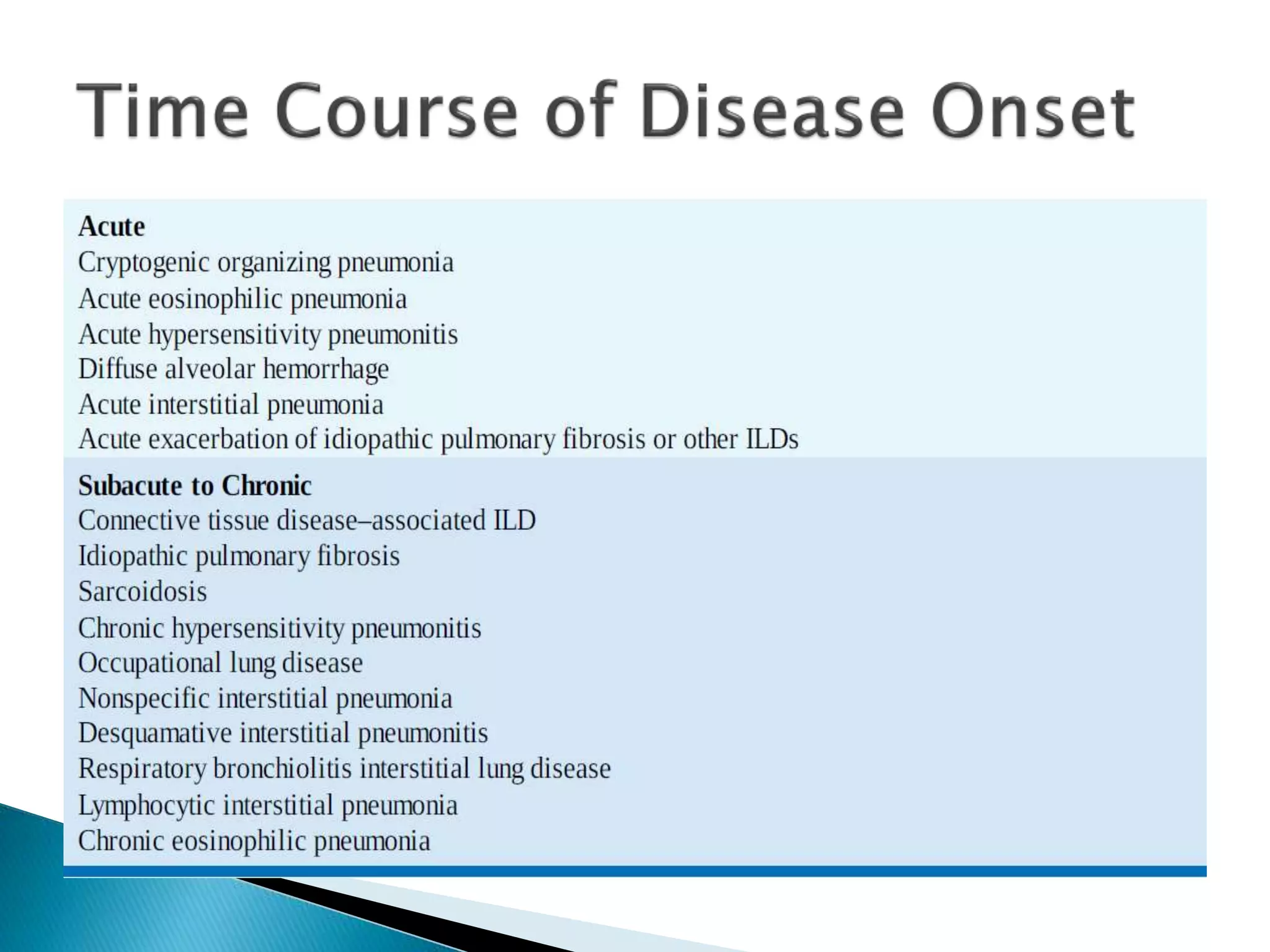
 In some cases the time course of the disease
may suggest certain forms of ILD.
 The acute forms of ILD must be distinguished
from respiratory infections and pulmonary
edema due to congestive heart failure.
 night sweats, fever, fatigue, or weight loss
 heliotrope rash, Gottron’s papules, or
“mechanic’s hands in case of Dermatomyositis.
 history of skin tightness and thickening,
telangiectasias, Raynaud’s phenomenon, or
digital pitting in systemic sclerosis.
 Papular eruptions, lupus pernio, and erythema
nodosum may be seen in sarcoidosis.
 Patients with systemic lupus erythematosus (SLE)
may describe malar rash, photosensitivity skin
reaction, or hair loss
 The occupational history should be thorough,
including a review of all jobs held in the past.
 Any occupation in which a history of
exposure to organic or inorganic products
was present.
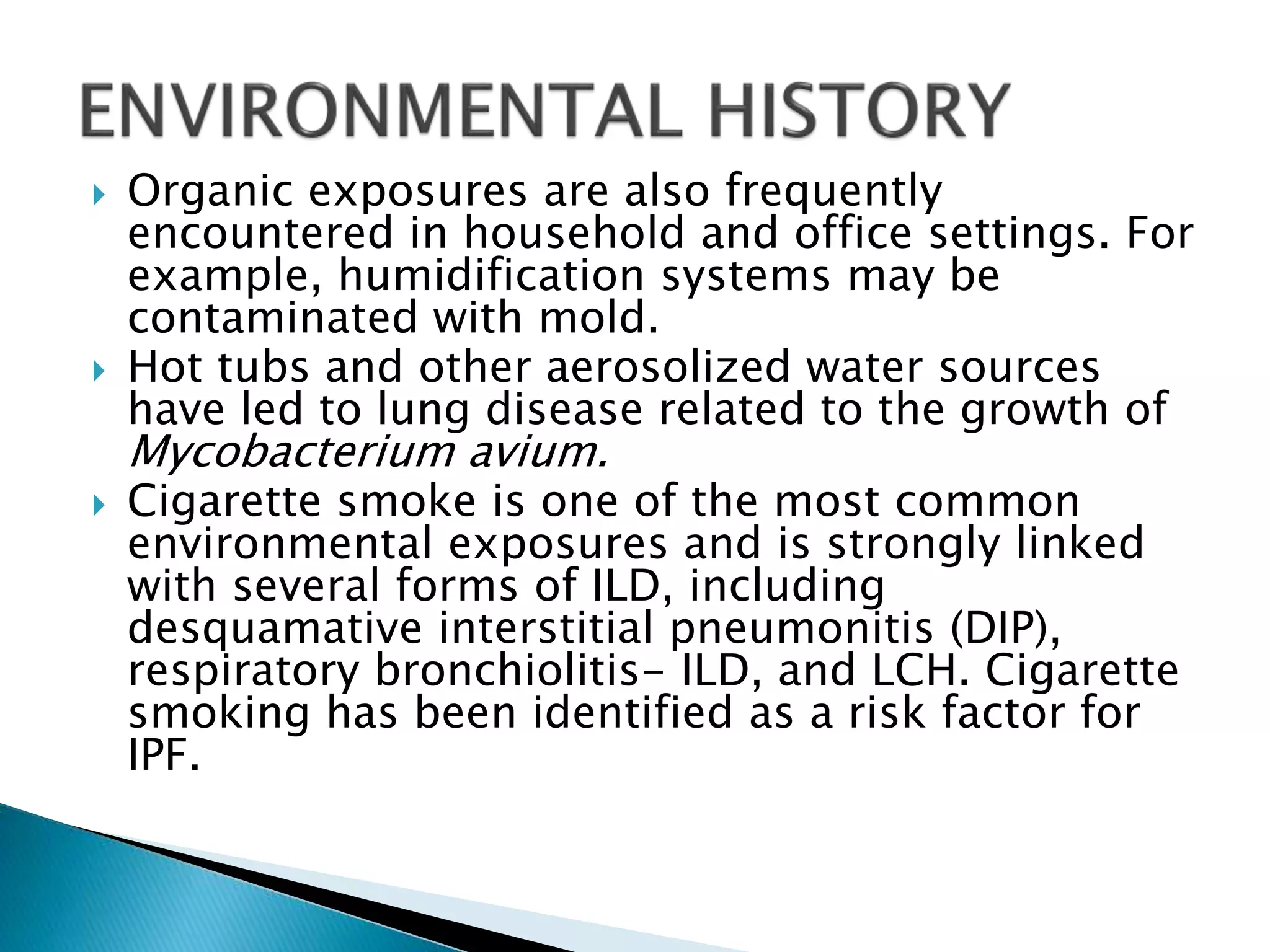
 Organic exposures are also frequently
encountered in household and office settings. For
example, humidification systems may be
contaminated with mold.
 Hot tubs and other aerosolized water sources
have led to lung disease related to the growth of
Mycobacterium avium.
 Cigarette smoke is one of the most common
environmental exposures and is strongly linked
with several forms of ILD, including
desquamative interstitial pneumonitis (DIP),
respiratory bronchiolitis- ILD, and LCH. Cigarette
smoking has been identified as a risk factor for
IPF.
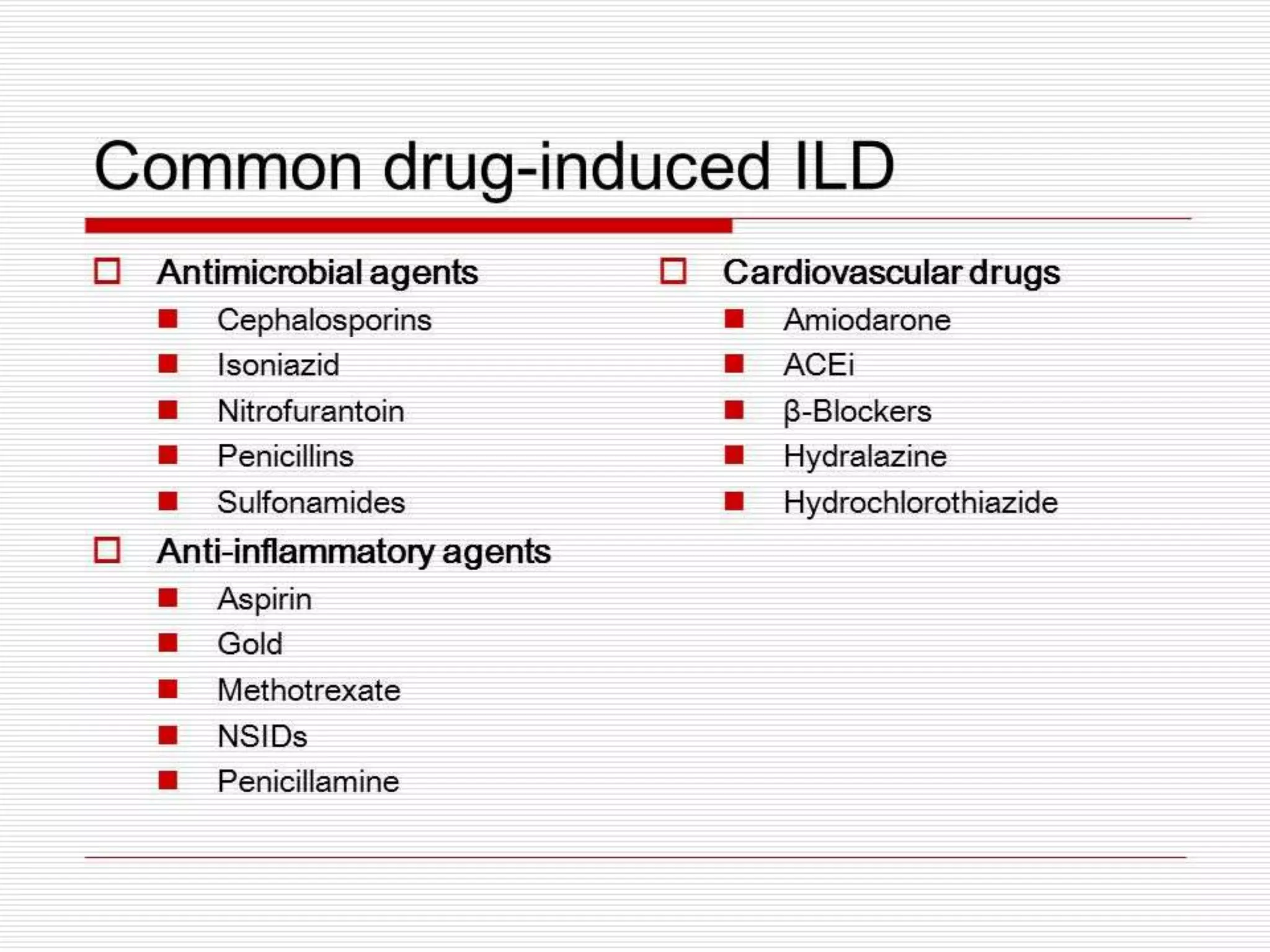
 Numerous drugs have been implicated in the
development of ILD, ranging from acute
pneumonitis to chronic fibrotic lung disease
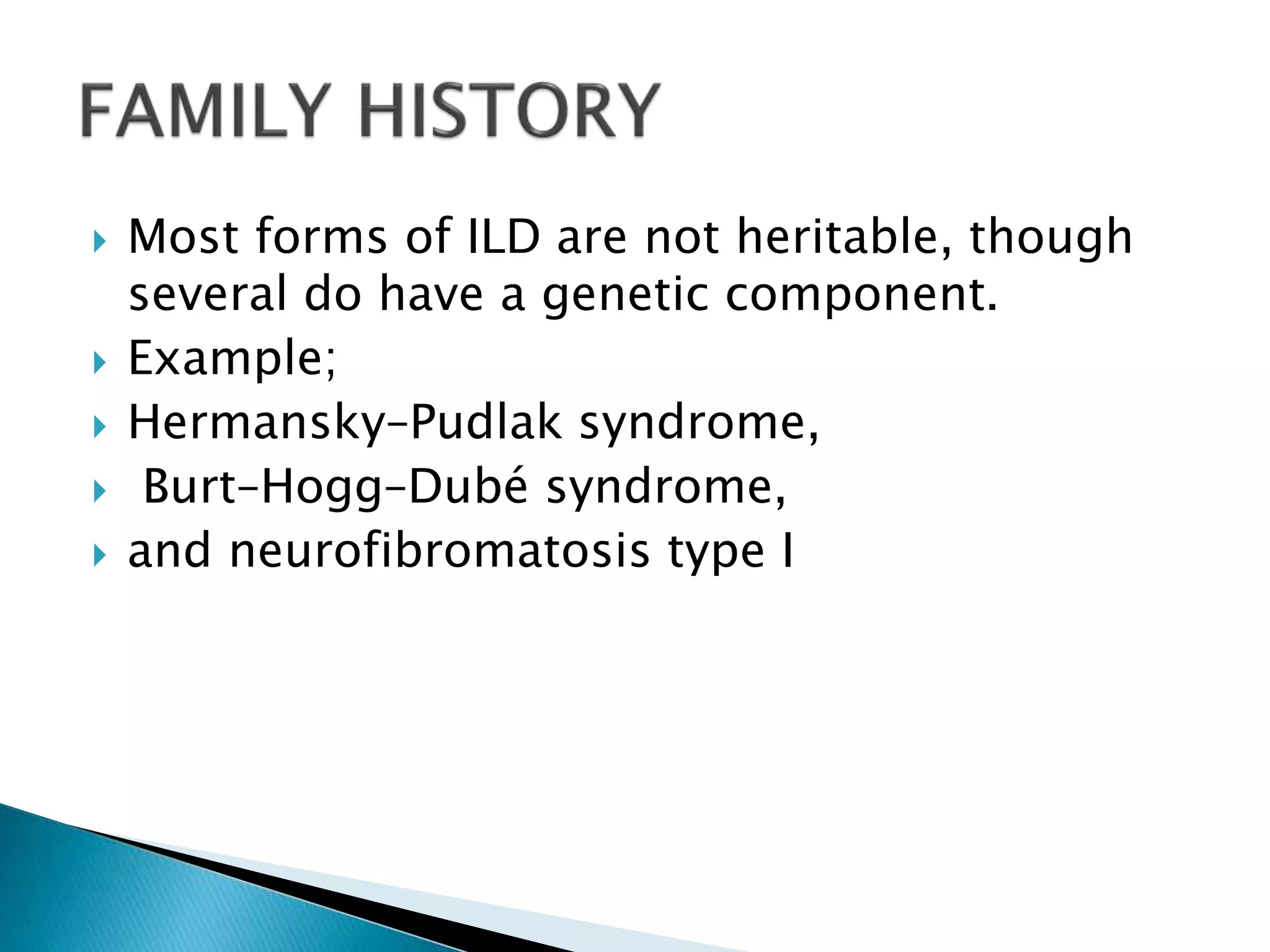
 Most forms of ILD are not heritable, though
several do have a genetic component.
 Example;
 Hermansky–Pudlak syndrome,
 Burt–Hogg–Dubé syndrome,
 and neurofibromatosis type I
 On general Survey-
 Clubbing , Cynosis in case of Acute exacerbation
of ILD, Mechanic hand, Skin tightness,
 On systemic Examination.
 fine, inspiratory, basilar“Velcro” crackles.
 Wheezing
 Signs of pulmonary hypertension and right heart
failure include an increased P2 component, a
right ventricular heave, elevated jugular venous
pressure, and lower extremity edema.
 sarcoidosis, silicosis, and LCH are among the
diseases with an upper lobe predominance,
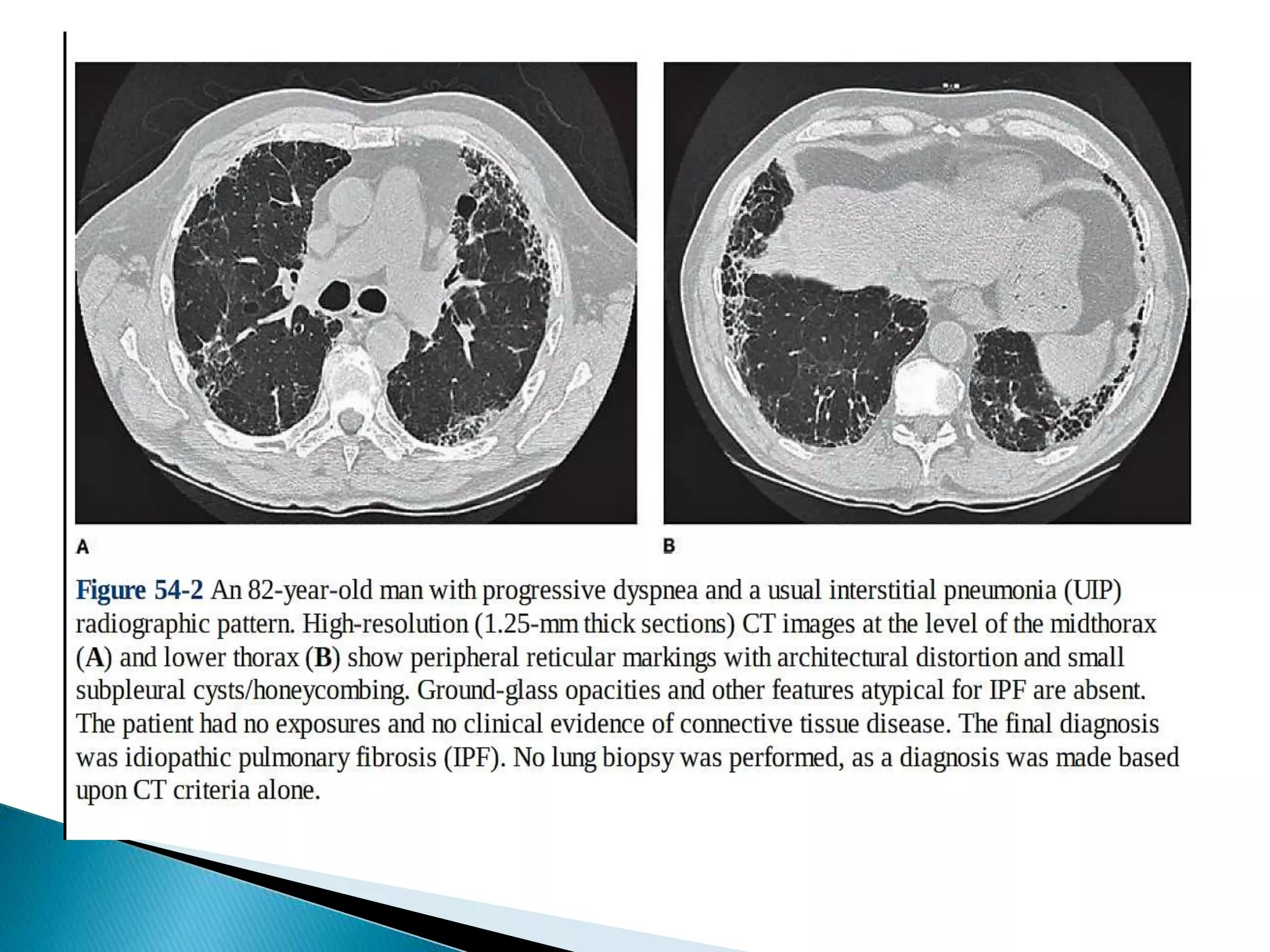
 while IPF, connective tissue disease–
associated ILD, and asbestosis are all lower
lobe predominant.
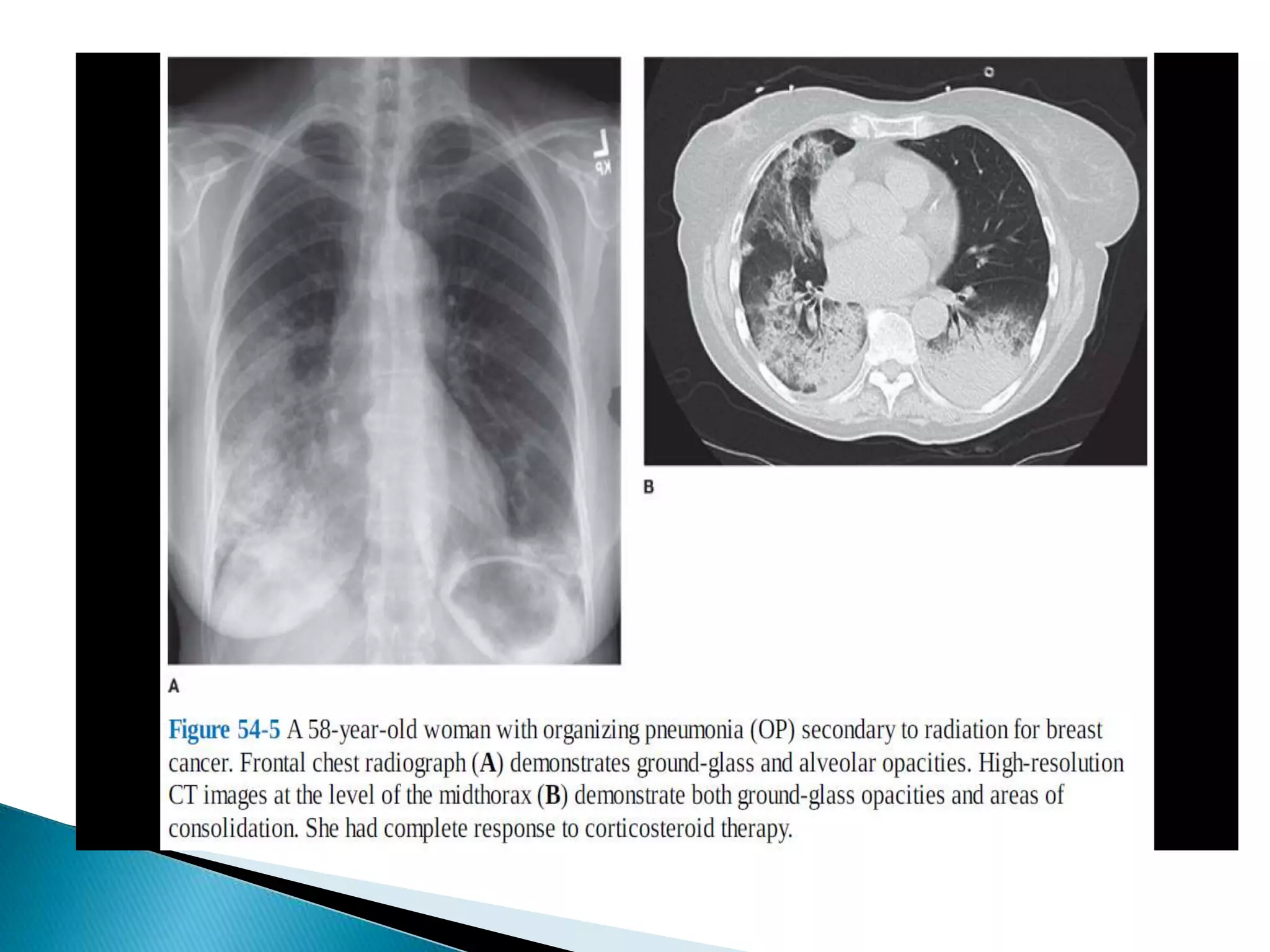
 Peripheral alveolar opacities are typical
findings in organizing pneumonia and
chronic eosinophilic pneumonia
 Lower lung volume ; apparently shrunken
lung.
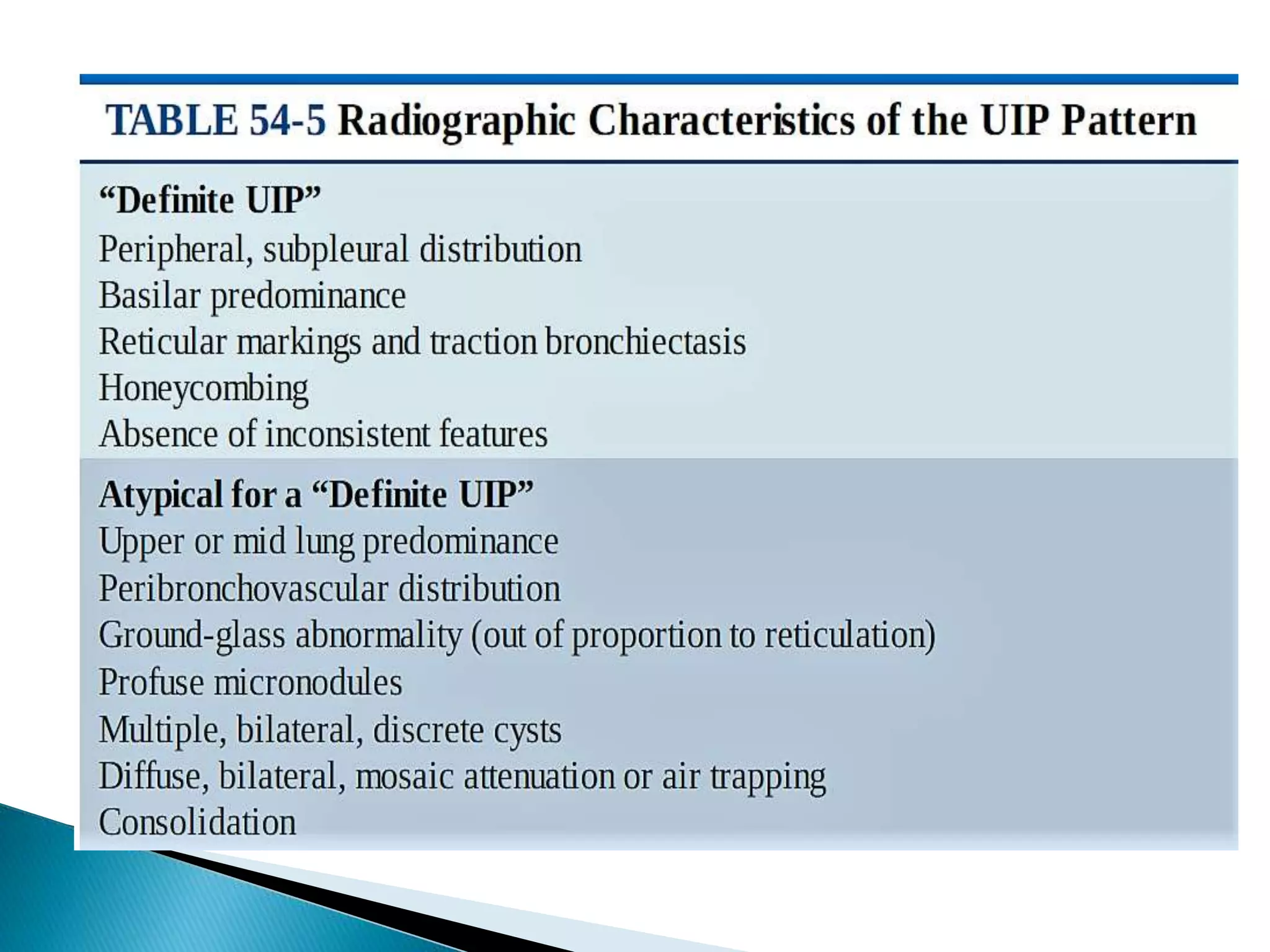
 the characteristic radiographic features of IPF
are collectively known as the “UIP pattern,”
 Typically, spirometry in most forms of ILD
demonstrates a restrictive pattern.
 Decrement in the diffusing capacity DLCO.
 Formal 6-minute walk testing is quite useful,
additionally offering an assessment of
exercise capacity in terms of distance walked,
heart rate response, and causes for exercise
discontinuation (including leg discomfort or
chest pain)
 Bronchoscopy and BAL fluid analysis
 Surgical Lung Bx
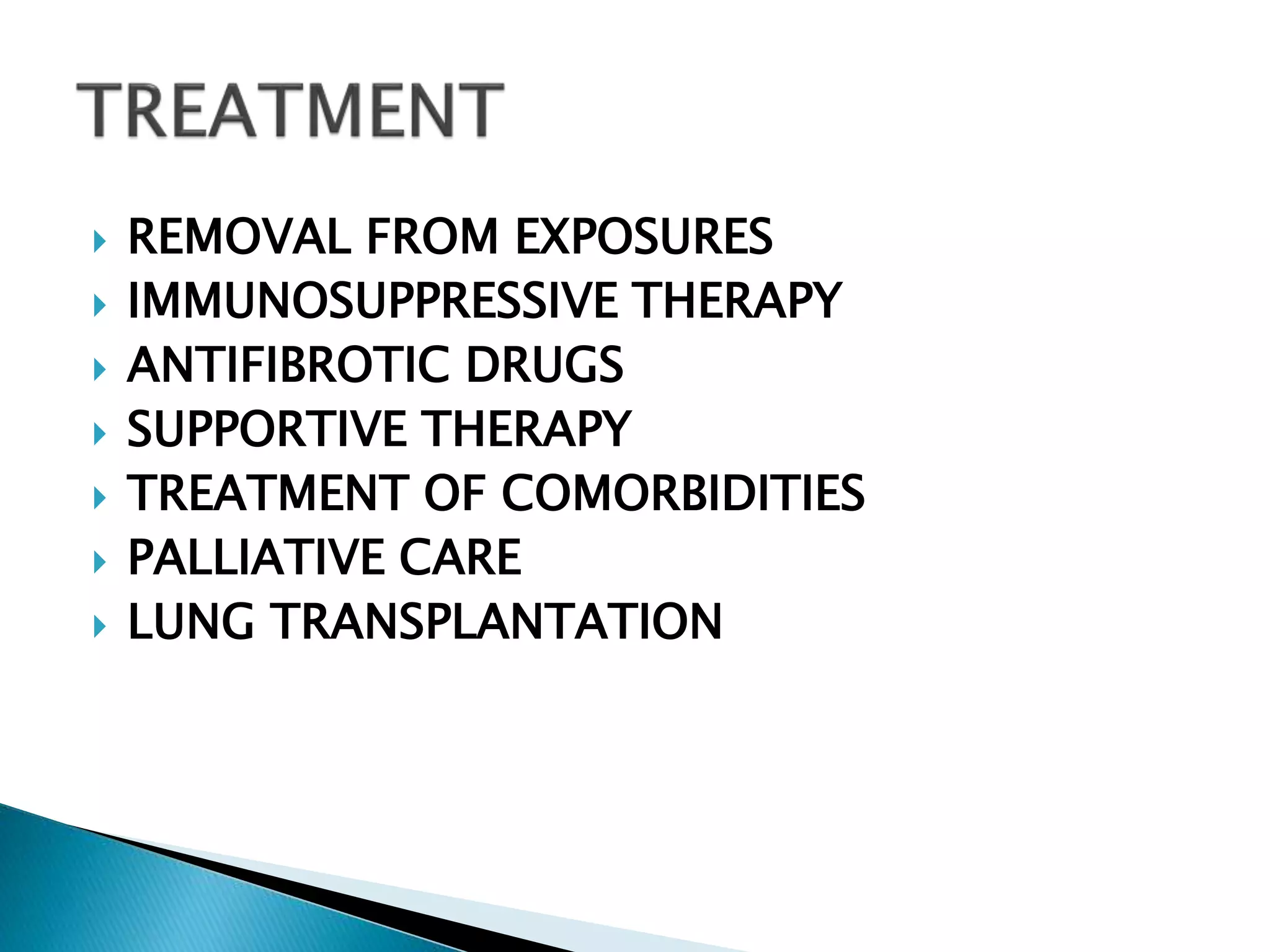
TREATMENT
 REMOVAL FROM EXPOSURES
 IMMUNOSUPPRESSIVE THERAPY
 ANTIFIBROTIC DRUGS
 SUPPORTIVE THERAPY
 TREATMENT OF COMORBIDITIES
 PALLIATIVE CARE
 LUNG TRANSPLANTATION
 Some forms of ILD, including COP, connective
tissue disease–associated ILD, and
sarcoidosis, may demonstrate a favorable
response to corticosteroids and other
immunosuppressive agents
 If no clinical improvement is seen after 3 to 6
months of therapy, discontinuation of
immunosuppressive therapy should be
strongly considered.
 Pirfenidone, a small-molecule drug which
appears to have antifibrotic properties, may
stabilize lung function in patient with IPF.
 Home oxygen therapy
 Pulmonary rehabilitation
 Regulated exercise training
 Diet and general care advise
 Rx for GERD
 Rx for Osteroporosis and undelying medical
condition like DM, HTN
 The approach to ILD includes a careful history
and physical examination, with a focus on
identifying an etiology for the ILD.
 Important considerations include a complete
investigation of environmental, occupational, and
drug exposures as well as a thorough search for
underlying connective tissue disease.
 Laboratory tests, pulmonary physiologic studies,
radiography, and biopsy of lung tissue may be
necessary.
 Multidisciplinary review is an essential part of the
diagnostic evaluation.
 Decisions regarding diagnostic and therapeutic
approach must be individualized
Interstitial lung disease; Basic Understanding and approach

Interstitial lung disease; Basic Understanding and approach

  • 1.
    Dr. Ravi KumarSharma Senior Resident, Respiratory Medicine BPSGMCW Khanpur kalan Sonepat, Haryana
  • 2.
     ILD refersto a heterogeneous collection of more than one hundred distinct lung disorders that tend to be grouped together because they share clinical, radiographic, and pathologic features. These disorders are sometimes called diffuse parenchymal lung disease (DPLD) to make the point that the interstitium is not the only compartment of the lung affected.
  • 4.
  • 6.
     The typicalpresentation of ILD is nonspecific and may include vague pulmonary complaints, such as dyspnea on exertion or cough, and an abnormal radiograph.  In some cases the time course of the disease may suggest certain forms of ILD.  The acute forms of ILD must be distinguished from respiratory infections and pulmonary edema due to congestive heart failure.
  • 8.
     night sweats,fever, fatigue, or weight loss  heliotrope rash, Gottron’s papules, or “mechanic’s hands in case of Dermatomyositis.  history of skin tightness and thickening, telangiectasias, Raynaud’s phenomenon, or digital pitting in systemic sclerosis.  Papular eruptions, lupus pernio, and erythema nodosum may be seen in sarcoidosis.  Patients with systemic lupus erythematosus (SLE) may describe malar rash, photosensitivity skin reaction, or hair loss
  • 9.
     The occupationalhistory should be thorough, including a review of all jobs held in the past.  Any occupation in which a history of exposure to organic or inorganic products was present.
  • 11.
     Organic exposuresare also frequently encountered in household and office settings. For example, humidification systems may be contaminated with mold.  Hot tubs and other aerosolized water sources have led to lung disease related to the growth of Mycobacterium avium.  Cigarette smoke is one of the most common environmental exposures and is strongly linked with several forms of ILD, including desquamative interstitial pneumonitis (DIP), respiratory bronchiolitis- ILD, and LCH. Cigarette smoking has been identified as a risk factor for IPF.
  • 12.
     Numerous drugshave been implicated in the development of ILD, ranging from acute pneumonitis to chronic fibrotic lung disease
  • 14.
     Most formsof ILD are not heritable, though several do have a genetic component.  Example;  Hermansky–Pudlak syndrome,  Burt–Hogg–Dubé syndrome,  and neurofibromatosis type I
  • 15.
     On generalSurvey-  Clubbing , Cynosis in case of Acute exacerbation of ILD, Mechanic hand, Skin tightness,  On systemic Examination.  fine, inspiratory, basilar“Velcro” crackles.  Wheezing  Signs of pulmonary hypertension and right heart failure include an increased P2 component, a right ventricular heave, elevated jugular venous pressure, and lower extremity edema.
  • 16.
     sarcoidosis, silicosis,and LCH are among the diseases with an upper lobe predominance,  while IPF, connective tissue disease– associated ILD, and asbestosis are all lower lobe predominant.  Peripheral alveolar opacities are typical findings in organizing pneumonia and chronic eosinophilic pneumonia  Lower lung volume ; apparently shrunken lung.
  • 17.
     the characteristicradiographic features of IPF are collectively known as the “UIP pattern,”
  • 22.
     Typically, spirometryin most forms of ILD demonstrates a restrictive pattern.  Decrement in the diffusing capacity DLCO.  Formal 6-minute walk testing is quite useful, additionally offering an assessment of exercise capacity in terms of distance walked, heart rate response, and causes for exercise discontinuation (including leg discomfort or chest pain)
  • 23.
     Bronchoscopy andBAL fluid analysis  Surgical Lung Bx
  • 24.
  • 25.
     REMOVAL FROMEXPOSURES  IMMUNOSUPPRESSIVE THERAPY  ANTIFIBROTIC DRUGS  SUPPORTIVE THERAPY  TREATMENT OF COMORBIDITIES  PALLIATIVE CARE  LUNG TRANSPLANTATION
  • 26.
     Some formsof ILD, including COP, connective tissue disease–associated ILD, and sarcoidosis, may demonstrate a favorable response to corticosteroids and other immunosuppressive agents  If no clinical improvement is seen after 3 to 6 months of therapy, discontinuation of immunosuppressive therapy should be strongly considered.
  • 27.
     Pirfenidone, asmall-molecule drug which appears to have antifibrotic properties, may stabilize lung function in patient with IPF.
  • 28.
     Home oxygentherapy  Pulmonary rehabilitation  Regulated exercise training  Diet and general care advise
  • 29.
     Rx forGERD  Rx for Osteroporosis and undelying medical condition like DM, HTN
  • 30.
     The approachto ILD includes a careful history and physical examination, with a focus on identifying an etiology for the ILD.  Important considerations include a complete investigation of environmental, occupational, and drug exposures as well as a thorough search for underlying connective tissue disease.  Laboratory tests, pulmonary physiologic studies, radiography, and biopsy of lung tissue may be necessary.  Multidisciplinary review is an essential part of the diagnostic evaluation.  Decisions regarding diagnostic and therapeutic approach must be individualized