INTERSTITIAL LUNG
DISEASE
Interstitial Lung Disease
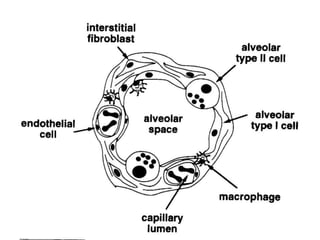
Diseases of lung interstitium
Not a single disease – over 250 different diseases with similar clinical
and/or radiological features
Also known as : Diffuse Parenchymal Lung Disease or Diffuse Lung
disease because of Involvement of air spaces , vessels, airways, ?pleura -
i.e. diffuse involvement
Idiopathic pulmonary fibrosis (IPF) or Idiopathic Interstitial
Pneumonias (IIPs) are sometimes used synonymously with ILD
Characteristics
 Common clinical, radiological, physiological and histo pathologic
features
 Hetero genous conditions
- Inflammatory
- Granulomatous
- Infections
- Depositions
- Oedema
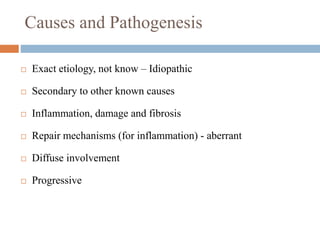
Causes and Pathogenesis
 Exact etiology, not know – Idiopathic
 Secondary to other known causes
 Inflammation, damage and fibrosis
 Repair mechanisms (for inflammation) - aberrant
 Diffuse involvement
 Progressive
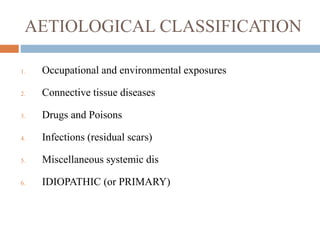
AETIOLOGICAL CLASSIFICATION
1. Occupational and environmental exposures
2. Connective tissue diseases
3. Drugs and Poisons
4. Infections (residual scars)
5. Miscellaneous systemic dis
6. IDIOPATHIC (or PRIMARY)
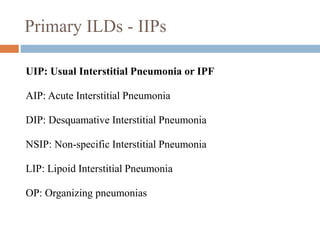
Primary ILDs - IIPs
UIP: Usual Interstitial Pneumonia or IPF
AIP: Acute Interstitial Pneumonia
DIP: Desquamative Interstitial Pneumonia
NSIP: Non-specific Interstitial Pneumonia
LIP: Lipoid Interstitial Pneumonia
OP: Organizing pneumonias
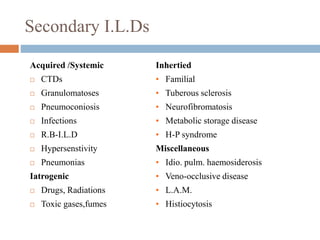
Secondary I.L.Ds
Acquired /Systemic Inhertied
 CTDs • Familial
 Granulomatoses • Tuberous sclerosis
 Pneumoconiosis • Neurofibromatosis
 Infections • Metabolic storage disease
 R.B-I.L.D • H-P syndrome
 Hypersenstivity Miscellaneous
 Pneumonias • Idio. pulm. haemosiderosis
Iatrogenic • Veno-occlusive disease
 Drugs, Radiations • L.A.M.
 Toxic gases,fumes • Histiocytosis
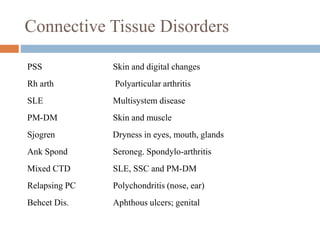
Connective Tissue Disorders
PSS Skin and digital changes
Rh arth Polyarticular arthritis
SLE Multisystem disease
PM-DM Skin and muscle
Sjogren Dryness in eyes, mouth, glands
Ank Spond Seroneg. Spondylo-arthritis
Mixed CTD SLE, SSC and PM-DM
Relapsing PC Polychondritis (nose, ear)
Behcet Dis. Aphthous ulcers; genital
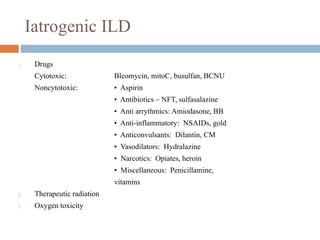
Iatrogenic ILD
1. Drugs
Cytotoxic: Bleomycin, mitoC, busulfan, BCNU
Noncytotoxic: • Aspirin
• Antibiotics – NFT, sulfasalazine
• Anti arrythmics: Amiodasone, BB
• Anti-inflammatory: NSAIDs, gold
• Anticonvulsants: Dilantin, CM
• Vasodilators: Hydralazine
• Narcotics: Opiates, heroin
• Miscellaneous: Penicillamine,
vitamins
2. Therapeutic radiation
3. Oxygen toxicity
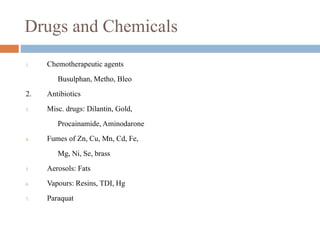
Drugs and Chemicals
1. Chemotherapeutic agents
Busulphan, Metho, Bleo
2. Antibiotics
3. Misc. drugs: Dilantin, Gold,
Procainamide, Aminodarone
4. Fumes of Zn, Cu, Mn, Cd, Fe,
Mg, Ni, Se, brass
5. Aerosols: Fats
6. Vapours: Resins, TDI, Hg
7. Paraquat
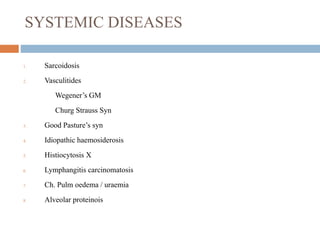
SYSTEMIC DISEASES
1. Sarcoidosis
2. Vasculitides
Wegener’s GM
Churg Strauss Syn
3. Good Pasture’s syn
4. Idiopathic haemosiderosis
5. Histiocytosis X
6. Lymphangitis carcinomatosis
7. Ch. Pulm oedema / uraemia
8. Alveolar proteinois
Honey Comb Lung
 Irreversible end-stage disease
 Cystic space formation
Dense fibrosis
Metaplastic cuboidal epithelium
Mucus formation
 Interstitial smooth m. proliferation
 Pulmonary vascular change
 Malignant change (potential)
DIAGNOSIS
 Clinical features
 Laboratory investigations: Hematological, biochemical,
immunological etc.
 Radiology: CXR, HRCT
 Pulmonary function tests
 Bronchoscopy: BAL, lung biopsy
 Surgical lung biopsy
Diagnosis Issues
1. Diffuse vs. Local
2. Primary vs. Secondary
3. Cause of secondary ILD
4. Acute vs Chronic
5. Disease activity and progression
6. Responsive vs Nonresponsive
(to tmt)
7. Presence of complications
DIFF. DIAGNOSIS
1. Causes of breathlessness
. Left heart failure
. Pulm. Thromboembolism
. Miscellaneous-anemia
2. Respiratory Diseases
. COPD
. Bronchiectasis
. Ch. Pneumonias- eosinophilic
SYMPTOMS
 Progressive breathlessness
 Cough (non productive)
 Onset: Insidious / acute
 Symptoms / history of underlying disease/exposure
PHYSICAL EXAMINATION
 Tachypnoea
 Reduced chest expansion / intercostal retraction
 Exercise induced cyanosis
 Clubbing
 Breath sounds – well heard
 Bibasilar end-inspiratory day (Velcro) crackles
 Pulm hypert / cor pulmonale
 Signs of CTD or other causes responsible for ILD
INVESTIGATIONS
1. Haematological – leucocytosis, Polycythaemia / anaemia
2. Biochem: (renal, Liver)
3. Raised ESR, hypergammaglob.
4. Immunological tests: LE cell, Rhematoid factor,
Antinuclear Ab., Immune complexes
5. Cardiac function
6. Others: ACE, LDH, antibodies (etc.)
RADIOLOGICAL STUDIES
1. What is most helpful?
Diagnosis
Disease extent
Progression
2. Radiological findings: distribution and pattern
3. Correlation
4. Cost-effectiveness
CLASSICAL RADIOGRAPH
 Basilar / diffuse shadows
reticular/nodular/RN
 Mixed patterns ?
 Honey combing
 Decreased volume
 Pulm hypertension
ATYPICAL PATTERNS
1. Upper zone predominance: Granulomatous dis.,
Pneumoconioses
2. Increased volume: LAM, Sarcoidosis
3. Pleural involvement: CTD, sarcoidosis, Asbestosis, Drugs
4. Miliary pattern : TBL, Granulomatoses
5. Hilar / mediastinal LN
Sarcoidosis
Lymphoma / Lymphangitis
6. Pneumothorax
Histocytosis X / LAM
7. Kerley B lines
8. Normal CXR
HIGH RESOLUTION CT
 Better resolution / more accuracy
 Earlier detection
 Better assessment of extent and distribution
 Occult adenopathy
 Selection of biopsy site
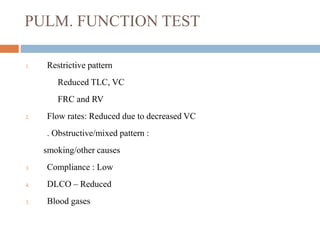
PULM. FUNCTION TEST
1. Restrictive pattern
Reduced TLC, VC
FRC and RV
2. Flow rates: Reduced due to decreased VC
. Obstructive/mixed pattern :
smoking/other causes
3. Compliance : Low
4. DLCO – Reduced
5. Blood gases
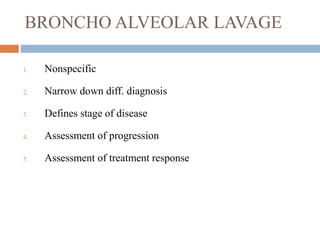
BRONCHO ALVEOLAR LAVAGE
1. Nonspecific
2. Narrow down diff. diagnosis
3. Defines stage of disease
4. Assessment of progression
5. Assessment of treatment response
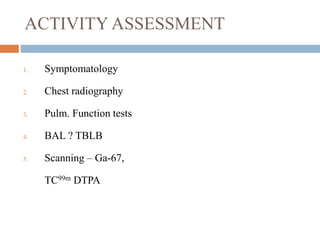
ACTIVITY ASSESSMENT
1. Symptomatology
2. Chest radiography
3. Pulm. Function tests
4. BAL ? TBLB
5. Scanning – Ga-67,
TC99m DTPA
TREATMENT
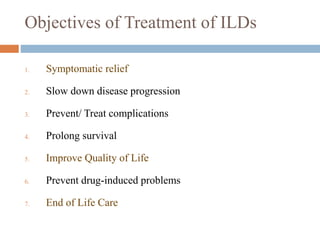
Objectives of Treatment of ILDs
1. Symptomatic relief
2. Slow down disease progression
3. Prevent/ Treat complications
4. Prolong survival
5. Improve Quality of Life
6. Prevent drug-induced problems
7. End of Life Care
Treatment Principles
I. Secondary ILDs
Treatment of ILD of a known primary cause essentially comprises
the treatment of the primary disorder.
Symptomatic
Anti-inflammatory
Supportive
II. Primary ILD (Idiopathic Interstitial Pneumonias) and Pulmonary
Fibrosis
Treatment of IIP/IPF
 Of all IIPs, Idiopathic Pulmonary Fibrosis (IPF) i.e. U.I.P. is the
most common form.
 It is associated with an extremely poor prognosis for survival in
most patients.
 Life expectancy after diagnosis varies, but is on average less than 5
years.
Current Drug Treatment
1. Corticosteroids
2. Immunosuppressive drugs: Azathioprine,
Cyclophosphamide, Cyclosporine
3. Antifibrotic drugs: Pirfenidone, Colchicine, D-
penicillamine, Pentoxyfylline
4. Anti-oxidants: N. Acetyl-cysteine

Supportive Treatment
1. Underlying cause – Identification and management
2. Oxygen therapy
3. Management of pulmonary hypertension and cardiac failure
 Pulm. Vasodilators
 Diuretics
4. Antibiotics for infections
5. Miscellaneous
End Stage Disease
1. Lung Transplantation
2. Palliative End of Life Care
 Domicilliary Oxygen
 Symptomatic relief
 Discontinuation of steroids and immunosuppressive drugs
Sarcoidosis
 Multi-system granulomatous disorder
 Unknown etiology
 Pulmonary features > 80% (Interstitial infiltrates/fibrosis)
 Extrapulmonary (Eyes, skin, liver, spleen, nervous systme, cardiac
etc): Approx. 30%
 Increasing recognition
 Diagnosis primarily on lung biopsy; Serum ACE
 Treatment: Corticosteroids and other anti-inflammatory drugs
THANK YOU

Interstitial Lung Disease | Jindal Chest Clinics

  • 1.
  • 2.
    Interstitial Lung Disease Diseasesof lung interstitium Not a single disease – over 250 different diseases with similar clinical and/or radiological features Also known as : Diffuse Parenchymal Lung Disease or Diffuse Lung disease because of Involvement of air spaces , vessels, airways, ?pleura - i.e. diffuse involvement Idiopathic pulmonary fibrosis (IPF) or Idiopathic Interstitial Pneumonias (IIPs) are sometimes used synonymously with ILD
  • 4.
    Characteristics  Common clinical,radiological, physiological and histo pathologic features  Hetero genous conditions - Inflammatory - Granulomatous - Infections - Depositions - Oedema
  • 5.
    Causes and Pathogenesis Exact etiology, not know – Idiopathic  Secondary to other known causes  Inflammation, damage and fibrosis  Repair mechanisms (for inflammation) - aberrant  Diffuse involvement  Progressive
  • 6.
    AETIOLOGICAL CLASSIFICATION 1. Occupationaland environmental exposures 2. Connective tissue diseases 3. Drugs and Poisons 4. Infections (residual scars) 5. Miscellaneous systemic dis 6. IDIOPATHIC (or PRIMARY)
  • 7.
    Primary ILDs -IIPs UIP: Usual Interstitial Pneumonia or IPF AIP: Acute Interstitial Pneumonia DIP: Desquamative Interstitial Pneumonia NSIP: Non-specific Interstitial Pneumonia LIP: Lipoid Interstitial Pneumonia OP: Organizing pneumonias
  • 8.
    Secondary I.L.Ds Acquired /SystemicInhertied  CTDs • Familial  Granulomatoses • Tuberous sclerosis  Pneumoconiosis • Neurofibromatosis  Infections • Metabolic storage disease  R.B-I.L.D • H-P syndrome  Hypersenstivity Miscellaneous  Pneumonias • Idio. pulm. haemosiderosis Iatrogenic • Veno-occlusive disease  Drugs, Radiations • L.A.M.  Toxic gases,fumes • Histiocytosis
  • 9.
    Connective Tissue Disorders PSSSkin and digital changes Rh arth Polyarticular arthritis SLE Multisystem disease PM-DM Skin and muscle Sjogren Dryness in eyes, mouth, glands Ank Spond Seroneg. Spondylo-arthritis Mixed CTD SLE, SSC and PM-DM Relapsing PC Polychondritis (nose, ear) Behcet Dis. Aphthous ulcers; genital
  • 10.
    Iatrogenic ILD 1. Drugs Cytotoxic:Bleomycin, mitoC, busulfan, BCNU Noncytotoxic: • Aspirin • Antibiotics – NFT, sulfasalazine • Anti arrythmics: Amiodasone, BB • Anti-inflammatory: NSAIDs, gold • Anticonvulsants: Dilantin, CM • Vasodilators: Hydralazine • Narcotics: Opiates, heroin • Miscellaneous: Penicillamine, vitamins 2. Therapeutic radiation 3. Oxygen toxicity
  • 11.
    Drugs and Chemicals 1.Chemotherapeutic agents Busulphan, Metho, Bleo 2. Antibiotics 3. Misc. drugs: Dilantin, Gold, Procainamide, Aminodarone 4. Fumes of Zn, Cu, Mn, Cd, Fe, Mg, Ni, Se, brass 5. Aerosols: Fats 6. Vapours: Resins, TDI, Hg 7. Paraquat
  • 12.
    SYSTEMIC DISEASES 1. Sarcoidosis 2.Vasculitides Wegener’s GM Churg Strauss Syn 3. Good Pasture’s syn 4. Idiopathic haemosiderosis 5. Histiocytosis X 6. Lymphangitis carcinomatosis 7. Ch. Pulm oedema / uraemia 8. Alveolar proteinois
  • 13.
    Honey Comb Lung Irreversible end-stage disease  Cystic space formation Dense fibrosis Metaplastic cuboidal epithelium Mucus formation  Interstitial smooth m. proliferation  Pulmonary vascular change  Malignant change (potential)
  • 14.
    DIAGNOSIS  Clinical features Laboratory investigations: Hematological, biochemical, immunological etc.  Radiology: CXR, HRCT  Pulmonary function tests  Bronchoscopy: BAL, lung biopsy  Surgical lung biopsy
  • 15.
    Diagnosis Issues 1. Diffusevs. Local 2. Primary vs. Secondary 3. Cause of secondary ILD 4. Acute vs Chronic 5. Disease activity and progression 6. Responsive vs Nonresponsive (to tmt) 7. Presence of complications
  • 16.
    DIFF. DIAGNOSIS 1. Causesof breathlessness . Left heart failure . Pulm. Thromboembolism . Miscellaneous-anemia 2. Respiratory Diseases . COPD . Bronchiectasis . Ch. Pneumonias- eosinophilic
  • 17.
    SYMPTOMS  Progressive breathlessness Cough (non productive)  Onset: Insidious / acute  Symptoms / history of underlying disease/exposure
  • 18.
    PHYSICAL EXAMINATION  Tachypnoea Reduced chest expansion / intercostal retraction  Exercise induced cyanosis  Clubbing  Breath sounds – well heard  Bibasilar end-inspiratory day (Velcro) crackles  Pulm hypert / cor pulmonale  Signs of CTD or other causes responsible for ILD
  • 19.
    INVESTIGATIONS 1. Haematological –leucocytosis, Polycythaemia / anaemia 2. Biochem: (renal, Liver) 3. Raised ESR, hypergammaglob. 4. Immunological tests: LE cell, Rhematoid factor, Antinuclear Ab., Immune complexes 5. Cardiac function 6. Others: ACE, LDH, antibodies (etc.)
  • 20.
    RADIOLOGICAL STUDIES 1. Whatis most helpful? Diagnosis Disease extent Progression 2. Radiological findings: distribution and pattern 3. Correlation 4. Cost-effectiveness
  • 21.
    CLASSICAL RADIOGRAPH  Basilar/ diffuse shadows reticular/nodular/RN  Mixed patterns ?  Honey combing  Decreased volume  Pulm hypertension
  • 22.
    ATYPICAL PATTERNS 1. Upperzone predominance: Granulomatous dis., Pneumoconioses 2. Increased volume: LAM, Sarcoidosis 3. Pleural involvement: CTD, sarcoidosis, Asbestosis, Drugs 4. Miliary pattern : TBL, Granulomatoses
  • 23.
    5. Hilar /mediastinal LN Sarcoidosis Lymphoma / Lymphangitis 6. Pneumothorax Histocytosis X / LAM 7. Kerley B lines 8. Normal CXR
  • 24.
    HIGH RESOLUTION CT Better resolution / more accuracy  Earlier detection  Better assessment of extent and distribution  Occult adenopathy  Selection of biopsy site
  • 25.
    PULM. FUNCTION TEST 1.Restrictive pattern Reduced TLC, VC FRC and RV 2. Flow rates: Reduced due to decreased VC . Obstructive/mixed pattern : smoking/other causes 3. Compliance : Low 4. DLCO – Reduced 5. Blood gases
  • 26.
    BRONCHO ALVEOLAR LAVAGE 1.Nonspecific 2. Narrow down diff. diagnosis 3. Defines stage of disease 4. Assessment of progression 5. Assessment of treatment response
  • 27.
    ACTIVITY ASSESSMENT 1. Symptomatology 2.Chest radiography 3. Pulm. Function tests 4. BAL ? TBLB 5. Scanning – Ga-67, TC99m DTPA
  • 28.
  • 29.
    Objectives of Treatmentof ILDs 1. Symptomatic relief 2. Slow down disease progression 3. Prevent/ Treat complications 4. Prolong survival 5. Improve Quality of Life 6. Prevent drug-induced problems 7. End of Life Care
  • 30.
    Treatment Principles I. SecondaryILDs Treatment of ILD of a known primary cause essentially comprises the treatment of the primary disorder. Symptomatic Anti-inflammatory Supportive II. Primary ILD (Idiopathic Interstitial Pneumonias) and Pulmonary Fibrosis
  • 31.
    Treatment of IIP/IPF Of all IIPs, Idiopathic Pulmonary Fibrosis (IPF) i.e. U.I.P. is the most common form.  It is associated with an extremely poor prognosis for survival in most patients.  Life expectancy after diagnosis varies, but is on average less than 5 years.
  • 32.
    Current Drug Treatment 1.Corticosteroids 2. Immunosuppressive drugs: Azathioprine, Cyclophosphamide, Cyclosporine 3. Antifibrotic drugs: Pirfenidone, Colchicine, D- penicillamine, Pentoxyfylline 4. Anti-oxidants: N. Acetyl-cysteine
  • 33.
    Supportive Treatment 1. Underlyingcause – Identification and management 2. Oxygen therapy 3. Management of pulmonary hypertension and cardiac failure  Pulm. Vasodilators  Diuretics 4. Antibiotics for infections 5. Miscellaneous
  • 34.
    End Stage Disease 1.Lung Transplantation 2. Palliative End of Life Care  Domicilliary Oxygen  Symptomatic relief  Discontinuation of steroids and immunosuppressive drugs
  • 35.
    Sarcoidosis  Multi-system granulomatousdisorder  Unknown etiology  Pulmonary features > 80% (Interstitial infiltrates/fibrosis)  Extrapulmonary (Eyes, skin, liver, spleen, nervous systme, cardiac etc): Approx. 30%  Increasing recognition  Diagnosis primarily on lung biopsy; Serum ACE  Treatment: Corticosteroids and other anti-inflammatory drugs
  • 36.