Real-Time Linux and Interrupts
Related Latency Measurements
Propose A New IRQ Tracer
Steven S. Chen
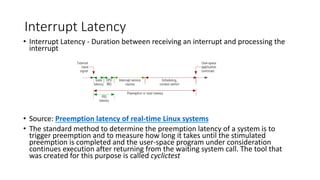
Interrupt Latency
• Interrupt Latency - Duration between receiving an interrupt and processing the
interrupt
• Source: Preemption latency of real-time Linux systems
• The standard method to determine the preemption latency of a system is to
trigger preemption and to measure how long it takes until the stimulated
preemption is completed and the user-space program under consideration
continues execution after returning from the waiting system call. The tool that
was created for this purpose is called cyclictest
Existing method to calculate Interrupt Latency
Nokia driver - Adding a periodic timer interrupt
Record the maximum difference between (actual time of invocation -
expected time of invocation)
Record the maximum skid in cycles from the time the interrupt was
executed last to the time the ISR is executed this time
Problem with existing method
Intrusive - The act of measuring changes the application behavior
Not portable – depends on hardware timer
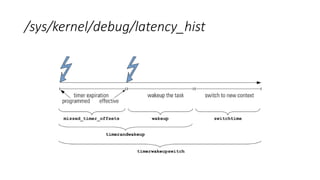
/sys/kernel/debug/latency_hist
New IRQ Tracer
• Measure isr entry/exit time can determine if there are any abnormal
events in ISR processing in realtime systems
• Most problems are in user added driver code not in the kernel source
• Existing methods
• ftrace
• Redhat irq tracer patch https://lwn.net/Articles/320336/
• Broadcom irq trace driver
https://android.googlesource.com/kernel/bcm/+/android-bcm-tetra-3.10-
kitkat-wear/drivers/char/broadcom/trace_log.c
• Hw_latency detector https://lwn.net/Articles/696460/
• https://github.com/XaF/hwlat-detector
New Irq Tracer (2)
• Combine the best of above feature
• Less overhead
• As standalone kernel module
• Can be used in real time in production code
• Measures ALL real interrupts not just simulated timer interrupts
• Allow more customization start/stop/duration/window etc
• And post processing in user space
References
• Frequently Asked Questions

Interrupt latency and its measurements methods

  • 1.
    Real-Time Linux andInterrupts Related Latency Measurements Propose A New IRQ Tracer Steven S. Chen
  • 2.
    Interrupt Latency • InterruptLatency - Duration between receiving an interrupt and processing the interrupt • Source: Preemption latency of real-time Linux systems • The standard method to determine the preemption latency of a system is to trigger preemption and to measure how long it takes until the stimulated preemption is completed and the user-space program under consideration continues execution after returning from the waiting system call. The tool that was created for this purpose is called cyclictest
  • 3.
    Existing method tocalculate Interrupt Latency Nokia driver - Adding a periodic timer interrupt Record the maximum difference between (actual time of invocation - expected time of invocation) Record the maximum skid in cycles from the time the interrupt was executed last to the time the ISR is executed this time Problem with existing method Intrusive - The act of measuring changes the application behavior Not portable – depends on hardware timer
  • 4.
  • 5.
    New IRQ Tracer •Measure isr entry/exit time can determine if there are any abnormal events in ISR processing in realtime systems • Most problems are in user added driver code not in the kernel source • Existing methods • ftrace • Redhat irq tracer patch https://lwn.net/Articles/320336/ • Broadcom irq trace driver https://android.googlesource.com/kernel/bcm/+/android-bcm-tetra-3.10- kitkat-wear/drivers/char/broadcom/trace_log.c • Hw_latency detector https://lwn.net/Articles/696460/ • https://github.com/XaF/hwlat-detector
  • 6.
    New Irq Tracer(2) • Combine the best of above feature • Less overhead • As standalone kernel module • Can be used in real time in production code • Measures ALL real interrupts not just simulated timer interrupts • Allow more customization start/stop/duration/window etc • And post processing in user space
  • 7.