INTERROGATIVE &
DEMONSTRATIVE
PRONOUNS
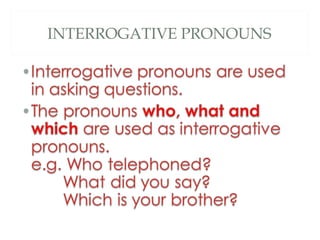
INTERROGATIVE PRONOUNS
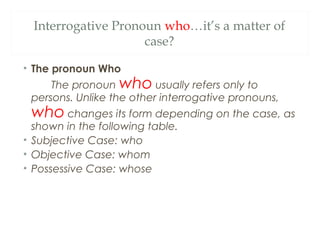
Interrogative Pronoun who…it’s a matter of
case?
• The pronoun Who
The pronoun who usually refers only to
persons. Unlike the other interrogative pronouns,
who changes its form depending on the case, as
shown in the following table.
• Subjective Case: who
• Objective Case: whom
• Possessive Case: whose
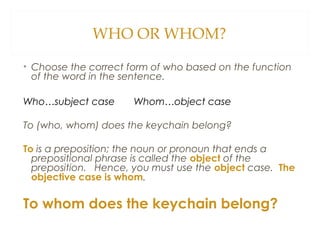
WHO OR WHOM?
• Choose the correct form of who based on the function
of the word in the sentence.
Who…subject case Whom…object case
To (who, whom) does the keychain belong?
To is a preposition; the noun or pronoun that ends a
prepositional phrase is called the object of the
preposition. Hence, you must use the object case. The
objective case is whom.
To whom does the keychain belong?
WHO OR WHOM?
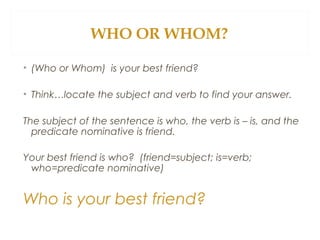
• (Who or Whom) is your best friend?
• Think…locate the subject and verb to find your answer.
The subject of the sentence is who, the verb is – is, and the
predicate nominative is friend.
Your best friend is who? (friend=subject; is=verb;
who=predicate nominative)
Who is your best friend?
WHO OR WHOM?
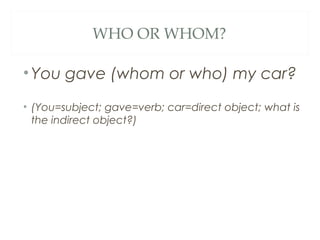
•You gave (whom or who) my car?
• (You=subject; gave=verb; car=direct object; what is
the indirect object?)
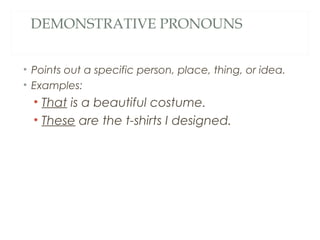
DEMONSTRATIVE PRONOUNS
• Points out a specific person, place, thing, or idea.
• Examples:
• That is a beautiful costume.
• These are the t-shirts I designed.
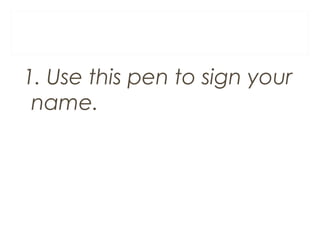
1. Use this pen to sign your
name.
2. That is the craziest cat I
have ever seen!
2. That is the craziest cat I
have ever seen!

Interrogative and demonstrative pronouns

  • 1.
  • 2.
  • 3.
    Interrogative Pronoun who…it’sa matter of case? • The pronoun Who The pronoun who usually refers only to persons. Unlike the other interrogative pronouns, who changes its form depending on the case, as shown in the following table. • Subjective Case: who • Objective Case: whom • Possessive Case: whose
  • 4.
    WHO OR WHOM? •Choose the correct form of who based on the function of the word in the sentence. Who…subject case Whom…object case To (who, whom) does the keychain belong? To is a preposition; the noun or pronoun that ends a prepositional phrase is called the object of the preposition. Hence, you must use the object case. The objective case is whom. To whom does the keychain belong?
  • 5.
    WHO OR WHOM? •(Who or Whom) is your best friend? • Think…locate the subject and verb to find your answer. The subject of the sentence is who, the verb is – is, and the predicate nominative is friend. Your best friend is who? (friend=subject; is=verb; who=predicate nominative) Who is your best friend?
  • 6.
    WHO OR WHOM? •Yougave (whom or who) my car? • (You=subject; gave=verb; car=direct object; what is the indirect object?)
  • 7.
    DEMONSTRATIVE PRONOUNS • Pointsout a specific person, place, thing, or idea. • Examples: • That is a beautiful costume. • These are the t-shirts I designed.
  • 8.
    1. Use thispen to sign your name.
  • 9.
    2. That isthe craziest cat I have ever seen!
  • 10.
    2. That isthe craziest cat I have ever seen!