- Mayank Bhardwaj
Assistant Professor - Communication Skills
1

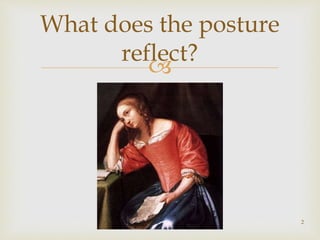
What does the posture
reflect?
2

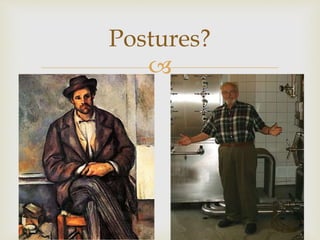
Postures?
3

 Closed posture is a posture in which parts of the
body most susceptible to trauma are obscured.
 These body parts are: throat, abdomen and genitals.
Damage to either prevents the transfer of their genes
to future generations and is sometimes seen as being
synonymous with death.
Closed Posture
4

 Arms crossed on the chest or abdomen,
 Hands clasped in front of the genitals, and crossing
legs.
 Clothing may also signal closed posture: a buttoned
suit, or a handbag or briefcase held in front of the
person.
 Closed posture often gives the impression of
detachment, disinterest, and hostility. Research has
also shown that these behaviors usually convey
unpleasant feelings.
Contd.
5

 Open posture is a posture in which the vulnerable
parts of the body are exposed. The head is raised.
 The shirt may be unbuttoned at the neck, a bag is
held on the shoulder or at the side.
 Open posture is often perceived as communicating a
friendly and positive attitude.
 The feet are spread. The palms are up and the hands
and fingers are spread.
Open Posture
6

7

8

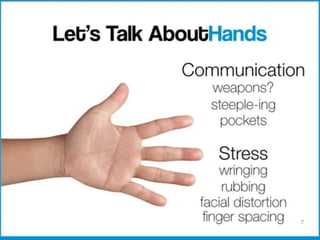
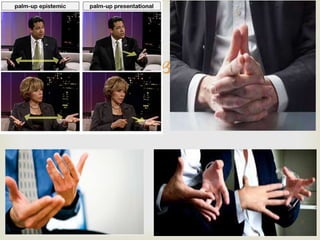
 Showing the palms of the hands or leaning forward can
be a signal of open posture, especially if the hand is
relaxed.
 The back of the hand or clenching hands into fists may
represent a closed posture.
 Hands clasped behind the back may also signal closed
posture even though the front is exposed because it can
give the impression of hiding something or resistance to
closer contact.
 Closed and open posture also apply when seated.
Crossed legs and arms can signal closed posture.
Hands – A Critical
Indicator
9

Inclination of the body. During conversation, a
person may lean slightly toward another person or
tilt slightly away from him/her. This behavior is
usually unconscious.
 An inclination towards can be an expression of
sympathy and acceptance.
 Inclining away can signal dislike, disapproval, or a
desire to end the conversation. Different inclinations
of the head may carry similar meanings.
Interpersonal Attitudes
10

Similarity. During the conversation, people have
an unconscious tendency to imitate others' behavior.
 This happens when the conversation runs
seamlessly and is enjoyable for both parties.
 This approximation of attitudes, gestures, and body
movements can indicate the emergence of a bond
and sympathy and is known as stereotyped behavior
as defined by Edwin Ray Guthrie.
 Lack of synchronous behavior may lead to a sense
that the contact is artificial, forced, or unpleasant.
Contd.
11

Orientation of the body. Usually people talk
directed toward each other, but not squarely face to
face, which can be indicative of a confrontational
stance.
 In conversation, the participants' bodies are usually
turned toward each other at an angle.
 When a person ignores someone else, they tend to
ignore or avoid contact by showing the other person
their side or back.
Contd.
12

 If two people of different social standings talk to each
other, the person with a higher position usually takes a
more relaxed attitude. Their posture may be unbalanced,
relaxed, and may appear to be nonchalant.
 A person with a lower position often maintains
symmetrical posture by placing both hands on their lap
or at their sides.
 Typically, a person with higher status sits down and talks
while sitting.
 A person of lower status may stand or they may remain
standing until they are asked to sit.
Social Standing
13

Mood influences muscle tone, energy level, and one's
internal sense of well-being. Thus, body posture can
reveal a person's current state of mind.
 Anger, sadness, and disgust are by far the most
recognized body postures that are indicative of
emotions.
Influencer - Mood
14

Stress can affect posture subconsciously; a person
under stress will often have a greater amount of
muscle tension, and may also have shallow
breathing.
Well-being affects posture by giving it a sense of
energy and balance. A person's spine will be straight
and the head raised.
Influencer - Wellbeing
15

Malaise affects posture with a sense of tiredness. A
person's shoulders may droop, and the head may be
bowed down or tilted to the left or right.
Confidence affects posture by the uprightness (or
not) of one's body.
Contd.
16

Thank You.
17

Interpreting Body Language - Posture Behavior

  • 1.
    - Mayank Bhardwaj AssistantProfessor - Communication Skills 1
  • 2.
     What does theposture reflect? 2
  • 3.
  • 4.
      Closed postureis a posture in which parts of the body most susceptible to trauma are obscured.  These body parts are: throat, abdomen and genitals. Damage to either prevents the transfer of their genes to future generations and is sometimes seen as being synonymous with death. Closed Posture 4
  • 5.
      Arms crossedon the chest or abdomen,  Hands clasped in front of the genitals, and crossing legs.  Clothing may also signal closed posture: a buttoned suit, or a handbag or briefcase held in front of the person.  Closed posture often gives the impression of detachment, disinterest, and hostility. Research has also shown that these behaviors usually convey unpleasant feelings. Contd. 5
  • 6.
      Open postureis a posture in which the vulnerable parts of the body are exposed. The head is raised.  The shirt may be unbuttoned at the neck, a bag is held on the shoulder or at the side.  Open posture is often perceived as communicating a friendly and positive attitude.  The feet are spread. The palms are up and the hands and fingers are spread. Open Posture 6
  • 7.
  • 8.
  • 9.
      Showing thepalms of the hands or leaning forward can be a signal of open posture, especially if the hand is relaxed.  The back of the hand or clenching hands into fists may represent a closed posture.  Hands clasped behind the back may also signal closed posture even though the front is exposed because it can give the impression of hiding something or resistance to closer contact.  Closed and open posture also apply when seated. Crossed legs and arms can signal closed posture. Hands – A Critical Indicator 9
  • 10.
     Inclination of thebody. During conversation, a person may lean slightly toward another person or tilt slightly away from him/her. This behavior is usually unconscious.  An inclination towards can be an expression of sympathy and acceptance.  Inclining away can signal dislike, disapproval, or a desire to end the conversation. Different inclinations of the head may carry similar meanings. Interpersonal Attitudes 10
  • 11.
     Similarity. During theconversation, people have an unconscious tendency to imitate others' behavior.  This happens when the conversation runs seamlessly and is enjoyable for both parties.  This approximation of attitudes, gestures, and body movements can indicate the emergence of a bond and sympathy and is known as stereotyped behavior as defined by Edwin Ray Guthrie.  Lack of synchronous behavior may lead to a sense that the contact is artificial, forced, or unpleasant. Contd. 11
  • 12.
     Orientation of thebody. Usually people talk directed toward each other, but not squarely face to face, which can be indicative of a confrontational stance.  In conversation, the participants' bodies are usually turned toward each other at an angle.  When a person ignores someone else, they tend to ignore or avoid contact by showing the other person their side or back. Contd. 12
  • 13.
      If twopeople of different social standings talk to each other, the person with a higher position usually takes a more relaxed attitude. Their posture may be unbalanced, relaxed, and may appear to be nonchalant.  A person with a lower position often maintains symmetrical posture by placing both hands on their lap or at their sides.  Typically, a person with higher status sits down and talks while sitting.  A person of lower status may stand or they may remain standing until they are asked to sit. Social Standing 13
  • 14.
     Mood influences muscletone, energy level, and one's internal sense of well-being. Thus, body posture can reveal a person's current state of mind.  Anger, sadness, and disgust are by far the most recognized body postures that are indicative of emotions. Influencer - Mood 14
  • 15.
     Stress can affectposture subconsciously; a person under stress will often have a greater amount of muscle tension, and may also have shallow breathing. Well-being affects posture by giving it a sense of energy and balance. A person's spine will be straight and the head raised. Influencer - Wellbeing 15
  • 16.
     Malaise affects posturewith a sense of tiredness. A person's shoulders may droop, and the head may be bowed down or tilted to the left or right. Confidence affects posture by the uprightness (or not) of one's body. Contd. 16
  • 17.

Editor's Notes

  • #3 Slouched, forehead resting on palm – lost in thoughts possibly concerned about a problem mentioned in the letter or paper shown.
  • #4 Closed posture – indicates what – closed thoughts and attitude towards the environment or the person specific present on-spot. Open posture – indicates what – open thought and positive attitude – open behaviour towards and a welcoming attitude to people.
  • #5 Death here indicates that the person due to life threatening or image damaging reasons will be closed to others.