INTERPRETATION OF
STATIC SIMS SPECTRA
ALEX HENDERSON
SURFACE ANALYSIS RESEARCH CENTRE
UNIVERSITY OF MANCHESTER, UK
Joint IAEA-SPIRIT-Japan Technical Meeting on
Development and Utilization of MeV-SIMS
Inter-University Centre, Dubrovnik, Croatia. 21-25 May 2012
What’s the question?






Know the chemistry of the sample?
– an understanding of the experimental parameters
Don’t know the sample, but believe it to be pure?
– looking for identification
Believe the sample to be an unknown mixture?
– just looking for help in identifying the components
Accurate mass of molecular ion


Is accurate mass of the molecular ion sufficient to
determine molecular structure?
Accurate mass for molecular structure








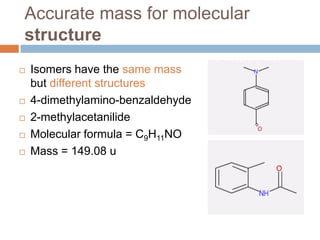
Isomers have the same mass but
different structures
4-dimethylamino-benzaldehyde
2-methylacetanilide
Molecular formula = C9H11NO
Mass = 149.08 u
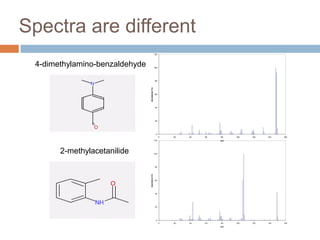
Spectra are different
120

4-dimethylamino-benzaldehyde

100

abundance (%)

80

60

40

20

0
0

20

40

60

120

2-methylacetanilide

80

100

120

140

160

m/z

100

abundance (%)

80

60

40

20

0
0

20

40

60

80
m/z

Mass
Spectrometry::Interpretation
100

120

140

160
Accurate mass of molecular ion


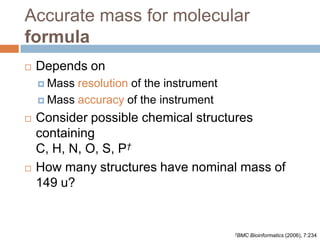
Is accurate mass of the molecular ion sufficient to
determine molecular formula?
Accurate mass for molecular formula


Depends on
 Mass

resolution of the instrument
 Mass accuracy of the instrument




Consider possible chemical structures containing
C, H, N, O, S, P†
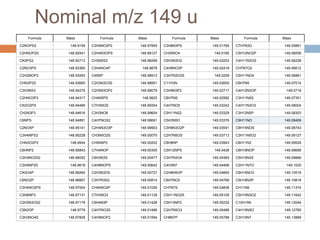
How many structures have nominal mass of 149 u?

†BMC

Bioinformatics (2006), 7:234
Nominal m/z 149 u
Formula
C2NOPS2

Mass

Formula

Mass

Formula

Mass

148.9159

C3H5NO2P2

148.97955

C3H8N3PS

149.01765

C2HNOP2S

148.92541

C2H4N3OPS

148.98127

CH3N5O4

CN3PS2

148.92713

CH3N5S2

148.98299

C2NO3PS

148.93365

C3H4NO4P

C2H2NOP3

148.93493

CHN3P2S

Formula

Mass

C7H7N3O

149.05891

149.0185

C5H12NO2P

149.06056

C6H3N3O2

149.02253

C4H11N3OS

149.06228

148.9878

C4H8NO3P

149.02418

CH7N7O2

149.06612

C4N5P

148.98913

C3H7N3O2S

149.0259

C5H11NO4

149.06881

148.93665

C2H3N3O3S

148.98951

C11H3N

149.02655

C6H7N5

149.07014

C3H3NS3

148.94276

C2H5N3OP2

148.99079

C3H9N3P2

149.02717

C4H12N3OP

C2HNO3P2

148.94317

CH4N5PS

148.9925

C8H7NS

149.02992

C3H11N5S

149.07351

CN3O2PS

148.94489

C7H3NOS

148.99354

C4H7NO5

149.03242

C4H11N3O3

149.08004

CH2N3P3

148.94616

C3H3NO6

148.99604

C5H11NS2

149.03329

C3H12N5P

149.08303

C6NPS

148.94891

C4H7NOS2

148.99691

C5H3N5O

149.03376

C9H11NO

149.08406

C2NO5P

148.95141

C2H4N3O3P

148.99903

C3H8N3O2P

149.03541

C6H15NOS

149.08743

C3H4NPS2

148.95228

CH3N5O2S

149.00075

C2H7N5OS

149.03713

C3H11N5O2

149.09127

CHN3O2P2

148.9544

CH5N5P2

149.00202

C8H8NP

149.03943

C8H11N3

149.09529

C6HNP2

148.95843

C7H4NOP

149.00305

C5H12NPS

149.0428

C6H16NOP

149.09695

C3H3NO2S2

148.96052

C6H3N3S

149.00477

C3H7N3O4

149.04365

C5H15N3S

149.09866

148.9618

C4H8NOPS

149.00642

C4H3N7

149.04499

C2H11N7O

149.1025

CN3O4P

148.96265

C2H3N3O5

149.00727

C2H8N5OP

149.04665

C6H15NO3

149.10519

C6NO2P

148.96667

C3H7N3S2

149.00814

C8H7NO2

149.04768

C5H16N3P

149.10818

C3H4NO2PS

148.97004

CH4N5O2P

149.01026

CH7N7S

149.04836

CH11N9

149.11374

C3H6NP3

148.97131

C7H3NO3

149.01129

C5H11NO2S

149.05105

C5H15N3O2

149.11642

C2H3N3OS2

148.97176

C6H4N3P

149.01428

C5H13NP2

149.05232

C10H15N

149.12044

148.9779

C4H7NO3S

149.01466

C2H7N5O3

149.05489

C4H15N5O

149.12765

148.97828

C4H9NOP2

149.01594

CH8N7P

149.05788

C3H15N7

149.13889

C3H5NP2S

C5N3OP
C3H3NO4S

149.0718
High mass resolution required
Nominally all at m/z 86
 Lipid (DPPC)
m/z = 86.0969692
 Unknown
 Silicon substrate [Si3H2]+
m/z = 85.9464332
Separation = 0.15 u
m/z 86

Analytical chemistry 80 (2008) 9058-9064
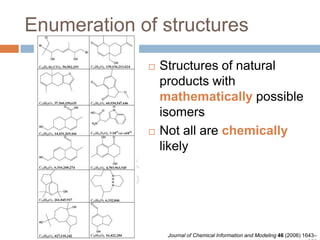
Enumeration of structures




Structures of natural
products with
mathematically possible
isomers
Not all are chemically
likely

Journal of Chemical Information and Modeling 46 (2006) 1643–1656
Mass spectrometry literature




Can’t always rely on ‘traditional’ MS literature and
resources
Most MS assumes a separation step
 GC-MS
 LC-MS




Therefore doing identification of pure material
SIMS involves mixtures so spectra are overlapped
Bond breaking – EI vs. SIMS




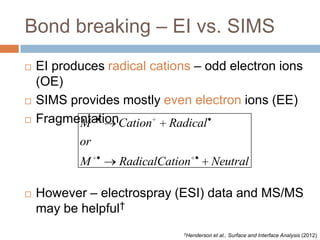
EI produces radical cations – odd electron ions (OE)
SIMS provides mostly even electron ions (EE)
Fragmentation
M   Cation   Radical 
or
M   RadicalCation   Neutral



However – electrospray (ESI) data and MS/MS may
be helpful†

†Henderson

et al., Surface and Interface Analysis (2012) accepted
Nitrogen rule






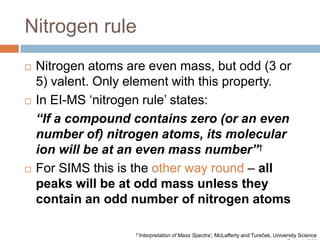
Nitrogen atoms are even mass, but odd (3 or 5)
valent. Only element with this property.
In EI-MS ‘nitrogen rule’ states:
“If a compound contains zero (or an even number of)
nitrogen atoms, its molecular ion will be at an even
mass numberӠ
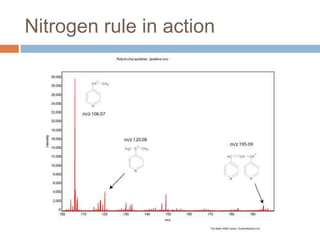
For SIMS this is the other way round – all peaks
will be at odd mass unless they contain an odd
number of nitrogen atoms
†‘Interpretation

of Mass Spectra’, McLafferty and Tureček, University Science Books, 1993
Nitrogen rule in action
Stability




Potential for a peak to be intense in a spectrum is a
function of its concentration and its stability
Electron-withdrawing groups (F, Cl, Br, I, OH, NO2)
can destabilise a positive centre
Inductive effect




Electron transfer toward a positive charge is called the
inductive effect
Alkyl groups can donate electron density in the following
order
(CH3)3C+ > (CH3)2CH+ > CH3CH2+ >> CH3+



Fragmentation of hydrocarbons can give peaks at m/z 57
and 43 with higher abundance than m/z 29 and 15

‘Interpretation of Mass Spectra’, McLafferty and Tureček, University Science Books, 1993
Stevenson’s rule


In principle the positive charge could go with either
product species
When a fragmentation takes place, the positive charge
remains on the fragment with the lowest ionization energy





Criterion originally established for the
fragmentation of alkanes by Stevenson in 1951
Homolytic dissociation of a C–C bond always
produces product pairs, their relative abundances
being basically governed by Stevenson's rule
Discuss. Faraday Soc. 10 (1951) 35-45
Aromatic stability






Aromatic resonance structures are particularly
stable
These result in intense spectra features
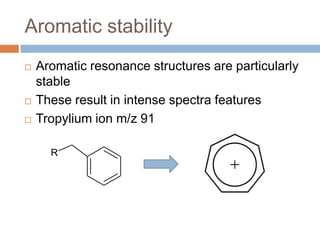
Tropylium ion m/z 91
R
Contamination


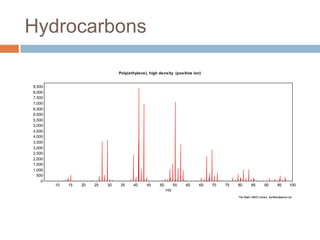
Hydrocarbons
 Particularly



in cities due to car exhaust gasses

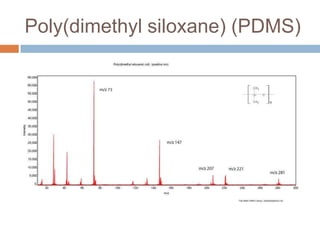
Siloxanes
 From

any plastic material
 Poly(dimethylsiloxane) used as a release agent


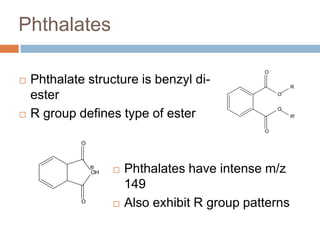
Phthalates
 Common



polymer additives

Salts
 For

example, sodium causes cationisation adducts
Hydrocarbons

Intensity

Poly(ethylene), high density (positive ion)

8,500
8,000
7,500
7,000
6,500
6,000
5,500
5,000
4,500
4,000
3,500
3,000
2,500
2,000
1,500
1,000
500
0
10

15

20

25

30

35

40

45

50

55

60

65

70

75

80

85

90

95

100

m/z
The Static SIMS Library, SurfaceSpectra Ltd
Poly(dimethyl siloxane) (PDMS)
Phthalates



Phthalate structure is benzyl di-ester
R group defines type of ester




Phthalates have intense m/z 149
Also exhibit R group patterns
Salts cause cationisation







Alkali metal (Li, Na, K, Rb, Cs) adducts to neutral
molecules and fragments
Pattern of peaks shifted by mass of adduct element
Can also see NaxCly in some samples
Historically, samples deposited on silver to improve
signal
Isotope patterns








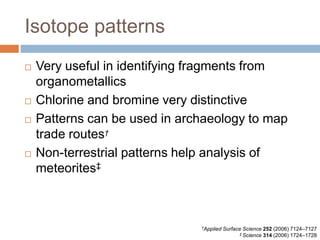
Very useful in identifying fragments from
organometallics
Chlorine and bromine very distinctive
Patterns can be used in archaeology to map trade
routes†
Non-terrestrial patterns help analysis of meteorites‡

†Applied

Surface Science 252 (2006) 7124–7127
‡ Science 314 (2006) 1724–1728
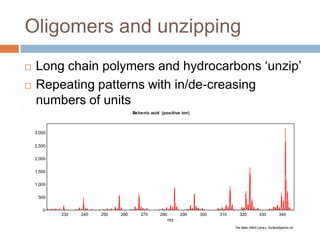
Oligomers and unzipping



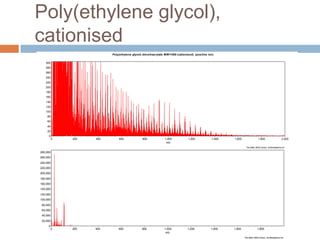
Long chain polymers and hydrocarbons ‘unzip’
Repeating patterns with in/de-creasing numbers of
units
Behenic acid (positive ion)

3,000

Intensity

2,500
2,000
1,500
1,000
500
0
230

240

250

260

270

280
m/z

290

300

310

320

330

340

The Static SIMS Library, SurfaceSpectra Ltd
Poly(ethylene glycol), cationised
Poly(ethylene glycol) dim ethacrylate MW=1000 (cationised) (positive ion)
300
280
260
240
220

Intensity

200
180
160
140
120
100
80
60
40
20
0
0

200

400

600
800
1,000
1,200
1,400
m/z
Poly(ethylene glycol) dim ethacrylate MW=1000 (cationised) (positive ion)

1,600

1,800

2,000

The Static SIMS Library, SurfaceSpectra Ltd

280,000
260,000
240,000
220,000
200,000

Intensity

180,000
160,000
140,000
120,000
100,000
80,000
60,000
40,000
20,000
0
0

200

400

600

800

1,000
m/z

1,200

1,400

1,600

1,800
The Static SIMS Library, SurfaceSpectra Ltd
Libraries and matching
Spectral matching








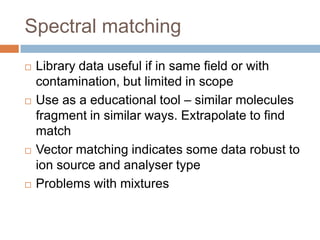
Library data useful if in same field or with
contamination, but limited in scope
Use as a educational tool – similar molecules
fragment in similar ways. Extrapolate to find match
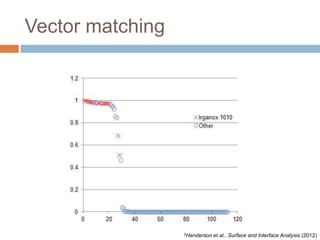
Vector matching indicates some data robust to ion
source and analyser type
Problems with mixtures
Vector matching

†Henderson

et al., Surface and Interface Analysis (2012) accepted
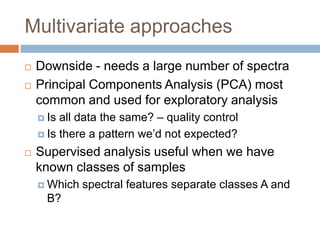
Multivariate approaches



Downside - needs a large number of spectra
Principal Components Analysis (PCA) most common
and used for exploratory analysis
 Is

all data the same? – quality control
 Is there a pattern we’d not expected?


Supervised analysis useful when we have known
classes of samples
 Which

spectral features separate classes A and B?
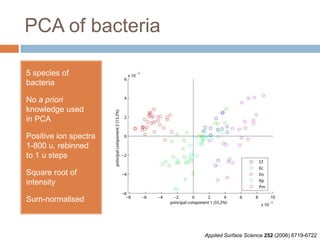
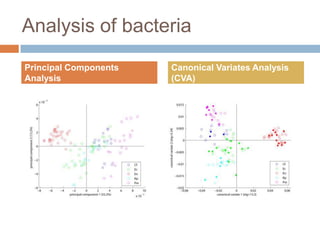
PCA of bacteria
5 species of bacteria
No a priori
knowledge used
in PCA
Positive ion spectra
1-800 u, rebinned to
1 u steps

Square root of
intensity
Sum-normalised

Applied Surface Science 252 (2006) 6719-6722
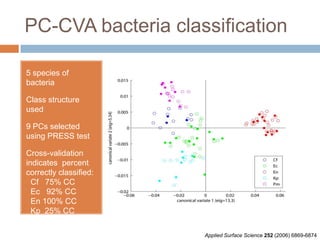
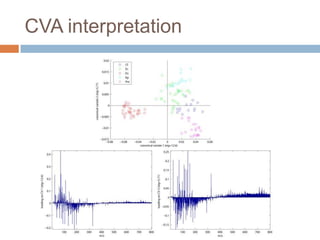
PC-CVA bacteria classification
5 species of bacteria
Class structure used
9 PCs selected using
PRESS test
Cross-validation
indicates percent
correctly classified:
Cf 75% CC
Ec 92% CC
En 100% CC
Kp 25% CC
Pm 50% CC

Applied Surface Science 252 (2006) 6869-6874
Analysis of bacteria
Principal Components Analysis

Canonical Variates Analysis (CVA)
CVA interpretation
Summary








SIMS interpretation is difficult, but even without
absolute answers the analysis is useful
What SIMS lacks in ultimate species identification it
makes up for in spatial location
New ionisation sources produce data nearer to
‘traditional’ MS, opening up resources
Tandem MS approaches are breaking through
www.sarc.manchester.ac.uk
alex.henderson@manchester.ac.uk

Interpretation of Static SIMS Spectra

  • 1.
    INTERPRETATION OF STATIC SIMSSPECTRA ALEX HENDERSON SURFACE ANALYSIS RESEARCH CENTRE UNIVERSITY OF MANCHESTER, UK Joint IAEA-SPIRIT-Japan Technical Meeting on Development and Utilization of MeV-SIMS Inter-University Centre, Dubrovnik, Croatia. 21-25 May 2012
  • 2.
    What’s the question?    Knowthe chemistry of the sample? – an understanding of the experimental parameters Don’t know the sample, but believe it to be pure? – looking for identification Believe the sample to be an unknown mixture? – just looking for help in identifying the components
  • 3.
    Accurate mass ofmolecular ion  Is accurate mass of the molecular ion sufficient to determine molecular structure?
  • 4.
    Accurate mass formolecular structure      Isomers have the same mass but different structures 4-dimethylamino-benzaldehyde 2-methylacetanilide Molecular formula = C9H11NO Mass = 149.08 u
  • 5.
    Spectra are different 120 4-dimethylamino-benzaldehyde 100 abundance(%) 80 60 40 20 0 0 20 40 60 120 2-methylacetanilide 80 100 120 140 160 m/z 100 abundance (%) 80 60 40 20 0 0 20 40 60 80 m/z Mass Spectrometry::Interpretation 100 120 140 160
  • 6.
    Accurate mass ofmolecular ion  Is accurate mass of the molecular ion sufficient to determine molecular formula?
  • 7.
    Accurate mass formolecular formula  Depends on  Mass resolution of the instrument  Mass accuracy of the instrument   Consider possible chemical structures containing C, H, N, O, S, P† How many structures have nominal mass of 149 u? †BMC Bioinformatics (2006), 7:234
  • 8.
    Nominal m/z 149u Formula C2NOPS2 Mass Formula Mass Formula Mass 148.9159 C3H5NO2P2 148.97955 C3H8N3PS 149.01765 C2HNOP2S 148.92541 C2H4N3OPS 148.98127 CH3N5O4 CN3PS2 148.92713 CH3N5S2 148.98299 C2NO3PS 148.93365 C3H4NO4P C2H2NOP3 148.93493 CHN3P2S Formula Mass C7H7N3O 149.05891 149.0185 C5H12NO2P 149.06056 C6H3N3O2 149.02253 C4H11N3OS 149.06228 148.9878 C4H8NO3P 149.02418 CH7N7O2 149.06612 C4N5P 148.98913 C3H7N3O2S 149.0259 C5H11NO4 149.06881 148.93665 C2H3N3O3S 148.98951 C11H3N 149.02655 C6H7N5 149.07014 C3H3NS3 148.94276 C2H5N3OP2 148.99079 C3H9N3P2 149.02717 C4H12N3OP C2HNO3P2 148.94317 CH4N5PS 148.9925 C8H7NS 149.02992 C3H11N5S 149.07351 CN3O2PS 148.94489 C7H3NOS 148.99354 C4H7NO5 149.03242 C4H11N3O3 149.08004 CH2N3P3 148.94616 C3H3NO6 148.99604 C5H11NS2 149.03329 C3H12N5P 149.08303 C6NPS 148.94891 C4H7NOS2 148.99691 C5H3N5O 149.03376 C9H11NO 149.08406 C2NO5P 148.95141 C2H4N3O3P 148.99903 C3H8N3O2P 149.03541 C6H15NOS 149.08743 C3H4NPS2 148.95228 CH3N5O2S 149.00075 C2H7N5OS 149.03713 C3H11N5O2 149.09127 CHN3O2P2 148.9544 CH5N5P2 149.00202 C8H8NP 149.03943 C8H11N3 149.09529 C6HNP2 148.95843 C7H4NOP 149.00305 C5H12NPS 149.0428 C6H16NOP 149.09695 C3H3NO2S2 148.96052 C6H3N3S 149.00477 C3H7N3O4 149.04365 C5H15N3S 149.09866 148.9618 C4H8NOPS 149.00642 C4H3N7 149.04499 C2H11N7O 149.1025 CN3O4P 148.96265 C2H3N3O5 149.00727 C2H8N5OP 149.04665 C6H15NO3 149.10519 C6NO2P 148.96667 C3H7N3S2 149.00814 C8H7NO2 149.04768 C5H16N3P 149.10818 C3H4NO2PS 148.97004 CH4N5O2P 149.01026 CH7N7S 149.04836 CH11N9 149.11374 C3H6NP3 148.97131 C7H3NO3 149.01129 C5H11NO2S 149.05105 C5H15N3O2 149.11642 C2H3N3OS2 148.97176 C6H4N3P 149.01428 C5H13NP2 149.05232 C10H15N 149.12044 148.9779 C4H7NO3S 149.01466 C2H7N5O3 149.05489 C4H15N5O 149.12765 148.97828 C4H9NOP2 149.01594 CH8N7P 149.05788 C3H15N7 149.13889 C3H5NP2S C5N3OP C3H3NO4S 149.0718
  • 9.
    High mass resolutionrequired Nominally all at m/z 86  Lipid (DPPC) m/z = 86.0969692  Unknown  Silicon substrate [Si3H2]+ m/z = 85.9464332 Separation = 0.15 u m/z 86 Analytical chemistry 80 (2008) 9058-9064
  • 10.
    Enumeration of structures   Structuresof natural products with mathematically possible isomers Not all are chemically likely Journal of Chemical Information and Modeling 46 (2006) 1643–1656
  • 11.
    Mass spectrometry literature   Can’talways rely on ‘traditional’ MS literature and resources Most MS assumes a separation step  GC-MS  LC-MS   Therefore doing identification of pure material SIMS involves mixtures so spectra are overlapped
  • 12.
    Bond breaking –EI vs. SIMS    EI produces radical cations – odd electron ions (OE) SIMS provides mostly even electron ions (EE) Fragmentation M   Cation   Radical  or M   RadicalCation   Neutral  However – electrospray (ESI) data and MS/MS may be helpful† †Henderson et al., Surface and Interface Analysis (2012) accepted
  • 13.
    Nitrogen rule    Nitrogen atomsare even mass, but odd (3 or 5) valent. Only element with this property. In EI-MS ‘nitrogen rule’ states: “If a compound contains zero (or an even number of) nitrogen atoms, its molecular ion will be at an even mass number”† For SIMS this is the other way round – all peaks will be at odd mass unless they contain an odd number of nitrogen atoms †‘Interpretation of Mass Spectra’, McLafferty and Tureček, University Science Books, 1993
  • 14.
  • 15.
    Stability   Potential for apeak to be intense in a spectrum is a function of its concentration and its stability Electron-withdrawing groups (F, Cl, Br, I, OH, NO2) can destabilise a positive centre
  • 16.
    Inductive effect   Electron transfertoward a positive charge is called the inductive effect Alkyl groups can donate electron density in the following order (CH3)3C+ > (CH3)2CH+ > CH3CH2+ >> CH3+  Fragmentation of hydrocarbons can give peaks at m/z 57 and 43 with higher abundance than m/z 29 and 15 ‘Interpretation of Mass Spectra’, McLafferty and Tureček, University Science Books, 1993
  • 17.
    Stevenson’s rule  In principlethe positive charge could go with either product species When a fragmentation takes place, the positive charge remains on the fragment with the lowest ionization energy   Criterion originally established for the fragmentation of alkanes by Stevenson in 1951 Homolytic dissociation of a C–C bond always produces product pairs, their relative abundances being basically governed by Stevenson's rule Discuss. Faraday Soc. 10 (1951) 35-45
  • 18.
    Aromatic stability    Aromatic resonancestructures are particularly stable These result in intense spectra features Tropylium ion m/z 91 R
  • 19.
    Contamination  Hydrocarbons  Particularly  in citiesdue to car exhaust gasses Siloxanes  From any plastic material  Poly(dimethylsiloxane) used as a release agent  Phthalates  Common  polymer additives Salts  For example, sodium causes cationisation adducts
  • 20.
    Hydrocarbons Intensity Poly(ethylene), high density(positive ion) 8,500 8,000 7,500 7,000 6,500 6,000 5,500 5,000 4,500 4,000 3,500 3,000 2,500 2,000 1,500 1,000 500 0 10 15 20 25 30 35 40 45 50 55 60 65 70 75 80 85 90 95 100 m/z The Static SIMS Library, SurfaceSpectra Ltd
  • 21.
  • 22.
    Phthalates   Phthalate structure isbenzyl di-ester R group defines type of ester   Phthalates have intense m/z 149 Also exhibit R group patterns
  • 23.
    Salts cause cationisation     Alkalimetal (Li, Na, K, Rb, Cs) adducts to neutral molecules and fragments Pattern of peaks shifted by mass of adduct element Can also see NaxCly in some samples Historically, samples deposited on silver to improve signal
  • 24.
    Isotope patterns     Very usefulin identifying fragments from organometallics Chlorine and bromine very distinctive Patterns can be used in archaeology to map trade routes† Non-terrestrial patterns help analysis of meteorites‡ †Applied Surface Science 252 (2006) 7124–7127 ‡ Science 314 (2006) 1724–1728
  • 25.
    Oligomers and unzipping   Longchain polymers and hydrocarbons ‘unzip’ Repeating patterns with in/de-creasing numbers of units Behenic acid (positive ion) 3,000 Intensity 2,500 2,000 1,500 1,000 500 0 230 240 250 260 270 280 m/z 290 300 310 320 330 340 The Static SIMS Library, SurfaceSpectra Ltd
  • 26.
    Poly(ethylene glycol), cationised Poly(ethyleneglycol) dim ethacrylate MW=1000 (cationised) (positive ion) 300 280 260 240 220 Intensity 200 180 160 140 120 100 80 60 40 20 0 0 200 400 600 800 1,000 1,200 1,400 m/z Poly(ethylene glycol) dim ethacrylate MW=1000 (cationised) (positive ion) 1,600 1,800 2,000 The Static SIMS Library, SurfaceSpectra Ltd 280,000 260,000 240,000 220,000 200,000 Intensity 180,000 160,000 140,000 120,000 100,000 80,000 60,000 40,000 20,000 0 0 200 400 600 800 1,000 m/z 1,200 1,400 1,600 1,800 The Static SIMS Library, SurfaceSpectra Ltd
  • 27.
  • 28.
    Spectral matching     Library datauseful if in same field or with contamination, but limited in scope Use as a educational tool – similar molecules fragment in similar ways. Extrapolate to find match Vector matching indicates some data robust to ion source and analyser type Problems with mixtures
  • 29.
    Vector matching †Henderson et al.,Surface and Interface Analysis (2012) accepted
  • 30.
    Multivariate approaches   Downside -needs a large number of spectra Principal Components Analysis (PCA) most common and used for exploratory analysis  Is all data the same? – quality control  Is there a pattern we’d not expected?  Supervised analysis useful when we have known classes of samples  Which spectral features separate classes A and B?
  • 31.
    PCA of bacteria 5species of bacteria No a priori knowledge used in PCA Positive ion spectra 1-800 u, rebinned to 1 u steps Square root of intensity Sum-normalised Applied Surface Science 252 (2006) 6719-6722
  • 32.
    PC-CVA bacteria classification 5species of bacteria Class structure used 9 PCs selected using PRESS test Cross-validation indicates percent correctly classified: Cf 75% CC Ec 92% CC En 100% CC Kp 25% CC Pm 50% CC Applied Surface Science 252 (2006) 6869-6874
  • 33.
    Analysis of bacteria PrincipalComponents Analysis Canonical Variates Analysis (CVA)
  • 34.
  • 35.
    Summary     SIMS interpretation isdifficult, but even without absolute answers the analysis is useful What SIMS lacks in ultimate species identification it makes up for in spatial location New ionisation sources produce data nearer to ‘traditional’ MS, opening up resources Tandem MS approaches are breaking through
  • 36.