HINDUSTHAN COLLEGE OF ENGINEERING AND TECHNOLOGY
(An Autonomous Institution, Affiliated to Anna University, Chennai)
Valley Campus, Pollachi Highway, Coimbatore - 641032
DEPARTMENT OF CHEMICAL ENGINEERING
INTERNSHIP
on
MACSUR PHARMACY INDIA PVT LTD – PONDICHERRY
Submitted By
MADHUMITHA S (720722114025)
ANNA UNIVERSITY: CHENNAI 600 025
Nov 2025
ABOUT THE INDUSTRY
Macsur Pharmacy India Pvt Ltd, located in Pondicherry,
is a reputed pharmaceutical manufacturing company
engaged in the production of a wide range of dosage
forms including tablets, syrups, capsules, and
ointments.The company operates under strict WHO-GMP
guidelines and adheres to quality control measures to
ensure safety and efficacy.Their mission is to provide
high-quality, affordable medicines to improve healthcare
outcomes in India and abroad.
PRODUCTS MANUFACTURED
 Tablets: Paracetamol, Diclofenac, Multivitamin
 Antihistamines Syrups: Cough Syrups, Vitamin Syrups Antacid
 Suspensions Capsules: Antibiotics
 Multivitamins Ointments: Analgesic creams, Antifungal creams.
 Other Dosage Forms: Sachets, Oral Drops
TABLET MANUFACTURING PROCESS
STAGES:
 Weighing & Dispensing
 Mixing & Granulation
 Drying
 Blending & Lubrication
 Compression
 Coating
 Packaging
WEIGHING & DISPENSING
 Raw materials are weighed accurately
according to the batch manufacturing
record.
 Conducted in a dust-free, controlled
environment.
 Prevents contamination and ensures correct
formulation.
 Documentation maintained as per SOPs.
MIXING & GRANULATION
 Active ingredients and excipients
blended to achieve uniformity.
 Wet granulation carried out using binder
solution to form granules.
 Equipment: Rapid Mixer Granulator
(RMG).
 Ensures proper flow properties and
compression characteristics.
DRYING
 Purpose: Remove excess
moisture from granules to
prevent microbial growth.
 Equipment: Fluid Bed Dryer
(FBD).
 Controlled temperature and air
flow prevent degradation of
active ingredients.
BLENDING & LUBRICATION
 Dried granules blended with lubricants (e.g., magnesium
stearate).
 Improves flowability and prevents sticking during
compression.
 Final blending ensures uniform distribution of ingredients.
COMPRESSION
 Tablets formed using a rotary tablet
press.
 In-process checks include hardness,
thickness, friability, and weight
variation.
 Ensures uniform tablet quality and
appearance.
COATING
Types: Film coating, sugar coating, and enteric coating.
Purpose: Protect the drug, mask unpleasant taste, control
release profile.
Equipment: Auto coater with spray system.
PACKAGING
 Methods: Blister packing,
strip packing, and bottle
filling.
 Includes batch coding,
manufacturing and expiry
date labelling.
 Final inspection ensures
product quality before
dispatch.
SYRUP MANUFACTURING PROCESS
Stages: Weighing of ingredients Dissolution
of sugar in purified water Addition of active
ingredients and flavours FiltrationFilling
into bottles Labelling and packing
DETAILED SYRUP PRODUCTION
 Sugar dissolved in heated purified water in
dissolution tank.
 Active ingredients, flavours, and colours added under
stirring.
 Filtration removes undissolved particles.
 Bottling and labelling done under sterile conditions.
QUALITY CONTROL
 Raw Material Testing: Identity, purity, and
strength.
 In-Process Testing: pH, viscosity, weight
variation, assay.
 Finished Product Testing: Dissolution, content
uniformity, stability.
 Compliance with pharmacopeial standards
(IP/BP/USP).
MY ROLE & LEARNINGS
 Observed and assisted in tablet and syrup manufacturing.
 Learned Good Manufacturing Practices (GMP) and
documentation procedures.
 Participated in quality control checks.
 Understood large-scale pharmaceutical manufacturing
and quality systems.
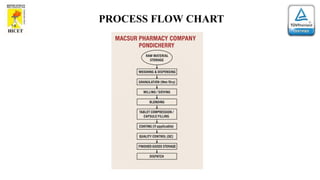
PROCESS FLOW CHART
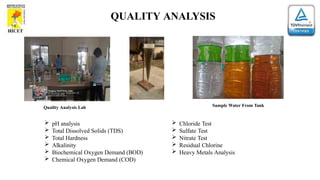
QUALITY ANALYSIS
Quality Analysis Lab Sample Water From Tank
 pH analysis
 Total Dissolved Solids (TDS)
 Total Hardness
 Alkalinity
 Biochemical Oxygen Demand (BOD)
 Chemical Oxygen Demand (COD)
 Chloride Test
 Sulfate Test
 Nitrate Test
 Residual Chlorine
 Heavy Metals Analysis
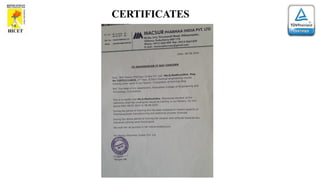
CERTIFICATES
CONCLUSION & OUTCOME
 Internship provided hands-on exposure to pharmaceutical production
processes.
 Enhanced understanding of GMP, QC, and QA in manufacturing.
 Strengthened technical skills and prepared for a career in
pharma/chemical industries.

INTERNSHIPrepot to the college student a

  • 1.
    HINDUSTHAN COLLEGE OFENGINEERING AND TECHNOLOGY (An Autonomous Institution, Affiliated to Anna University, Chennai) Valley Campus, Pollachi Highway, Coimbatore - 641032 DEPARTMENT OF CHEMICAL ENGINEERING INTERNSHIP on MACSUR PHARMACY INDIA PVT LTD – PONDICHERRY Submitted By MADHUMITHA S (720722114025) ANNA UNIVERSITY: CHENNAI 600 025 Nov 2025
  • 2.
    ABOUT THE INDUSTRY MacsurPharmacy India Pvt Ltd, located in Pondicherry, is a reputed pharmaceutical manufacturing company engaged in the production of a wide range of dosage forms including tablets, syrups, capsules, and ointments.The company operates under strict WHO-GMP guidelines and adheres to quality control measures to ensure safety and efficacy.Their mission is to provide high-quality, affordable medicines to improve healthcare outcomes in India and abroad.
  • 3.
    PRODUCTS MANUFACTURED  Tablets:Paracetamol, Diclofenac, Multivitamin  Antihistamines Syrups: Cough Syrups, Vitamin Syrups Antacid  Suspensions Capsules: Antibiotics  Multivitamins Ointments: Analgesic creams, Antifungal creams.  Other Dosage Forms: Sachets, Oral Drops
  • 4.
    TABLET MANUFACTURING PROCESS STAGES: Weighing & Dispensing  Mixing & Granulation  Drying  Blending & Lubrication  Compression  Coating  Packaging
  • 5.
    WEIGHING & DISPENSING Raw materials are weighed accurately according to the batch manufacturing record.  Conducted in a dust-free, controlled environment.  Prevents contamination and ensures correct formulation.  Documentation maintained as per SOPs. MIXING & GRANULATION  Active ingredients and excipients blended to achieve uniformity.  Wet granulation carried out using binder solution to form granules.  Equipment: Rapid Mixer Granulator (RMG).  Ensures proper flow properties and compression characteristics.
  • 6.
    DRYING  Purpose: Removeexcess moisture from granules to prevent microbial growth.  Equipment: Fluid Bed Dryer (FBD).  Controlled temperature and air flow prevent degradation of active ingredients. BLENDING & LUBRICATION  Dried granules blended with lubricants (e.g., magnesium stearate).  Improves flowability and prevents sticking during compression.  Final blending ensures uniform distribution of ingredients.
  • 7.
    COMPRESSION  Tablets formedusing a rotary tablet press.  In-process checks include hardness, thickness, friability, and weight variation.  Ensures uniform tablet quality and appearance. COATING Types: Film coating, sugar coating, and enteric coating. Purpose: Protect the drug, mask unpleasant taste, control release profile. Equipment: Auto coater with spray system.
  • 8.
    PACKAGING  Methods: Blisterpacking, strip packing, and bottle filling.  Includes batch coding, manufacturing and expiry date labelling.  Final inspection ensures product quality before dispatch. SYRUP MANUFACTURING PROCESS Stages: Weighing of ingredients Dissolution of sugar in purified water Addition of active ingredients and flavours FiltrationFilling into bottles Labelling and packing
  • 9.
    DETAILED SYRUP PRODUCTION Sugar dissolved in heated purified water in dissolution tank.  Active ingredients, flavours, and colours added under stirring.  Filtration removes undissolved particles.  Bottling and labelling done under sterile conditions. QUALITY CONTROL  Raw Material Testing: Identity, purity, and strength.  In-Process Testing: pH, viscosity, weight variation, assay.  Finished Product Testing: Dissolution, content uniformity, stability.  Compliance with pharmacopeial standards (IP/BP/USP).
  • 10.
    MY ROLE &LEARNINGS  Observed and assisted in tablet and syrup manufacturing.  Learned Good Manufacturing Practices (GMP) and documentation procedures.  Participated in quality control checks.  Understood large-scale pharmaceutical manufacturing and quality systems.
  • 11.
  • 12.
    QUALITY ANALYSIS Quality AnalysisLab Sample Water From Tank  pH analysis  Total Dissolved Solids (TDS)  Total Hardness  Alkalinity  Biochemical Oxygen Demand (BOD)  Chemical Oxygen Demand (COD)  Chloride Test  Sulfate Test  Nitrate Test  Residual Chlorine  Heavy Metals Analysis
  • 13.
  • 14.
    CONCLUSION & OUTCOME Internship provided hands-on exposure to pharmaceutical production processes.  Enhanced understanding of GMP, QC, and QA in manufacturing.  Strengthened technical skills and prepared for a career in pharma/chemical industries.