



My Summer at Lost Valley
Lost  Valley Educational Center is an intentional community and  nonprofit educational center dedicated to learning, living, and  teaching sustainable, ecologically-based culture.
The mission of Lost Valley Educational Center is to create and foster mutually beneficial relations between humans and all parts of the web of existence. We believe that these relationships provide a means to well-being as well as survival.
In fulfilling this mission, our purpose is to create and maintain an intentional community and an educational center dedicated to three goals which guide us in all activities.   To educate broadly in areas such as ecology, sustainable agriculture, human-made environments, personal and spiritual growth, and community development. To live an ethic in which we are open to spiritual diversity, demonstrate right livelihood and sustainable economics, support individuals in their personal growth and healing, and steward the land to sustain and heal the earth for generations to come. To participate in the global community, network with others and facilitate the evolution of cooperative societies and socially responsible relationships at every level. We dedicate ourselves to learning and teaching this way of life.
Ecovillage and Permaculture Certificate Program: Integrating Land, Building, and Social Sustainability A two month holistic introduction to creating ecovillages and sustainable communities.
What Is Permaculture? PERMACULTURE, from PERMAment agriCULTURE, is a practical system of ecological design. By learning to mirror the patterns found in healthy natural environments, you can build profitable, productive, sustainable, cultivated ecosystems which have the  diversity, stability, and resilience of natural ecosystems Permaculture designs range from households to major agricultural enterprises and even whole bio-regions. It integrates disciplines relating to food, shelter, energy, water, waste mangement, economics and social sciences to create whole systems capable of reclaiming devastated lands and building sound social/economic systems.
The Difference is in the Ethic! Most design systems are defined by a "market driven" ethic in which most considerations are subservient to the conclusions of a short term cost/benefit analysis, discounting or ignoring such factors as environmental degradation or destruction of human community. Permaculture departs from any other design system in that it is guided by a common sense ethical system which forms the criteria for design decisions. The ethic is   Care of the Earth    Care of the People of the Earth    Conscious Frugality  System surpluses distributed to accomplish these aims
 
What does Lost Valley do to Be more sustainable? PERMACULTURE APPLIED New Forest Meadow Pond Swale Systems Hedgerows Forest Gardening Nut Orchard Orchards Gardens Chickens Solar Hot Water Systems Greywater System Our diverse young forest contrasts with the douglas fir  monoculture common in Oregon and will serve as a multi-ecosystem and multi-functional forest in the future.
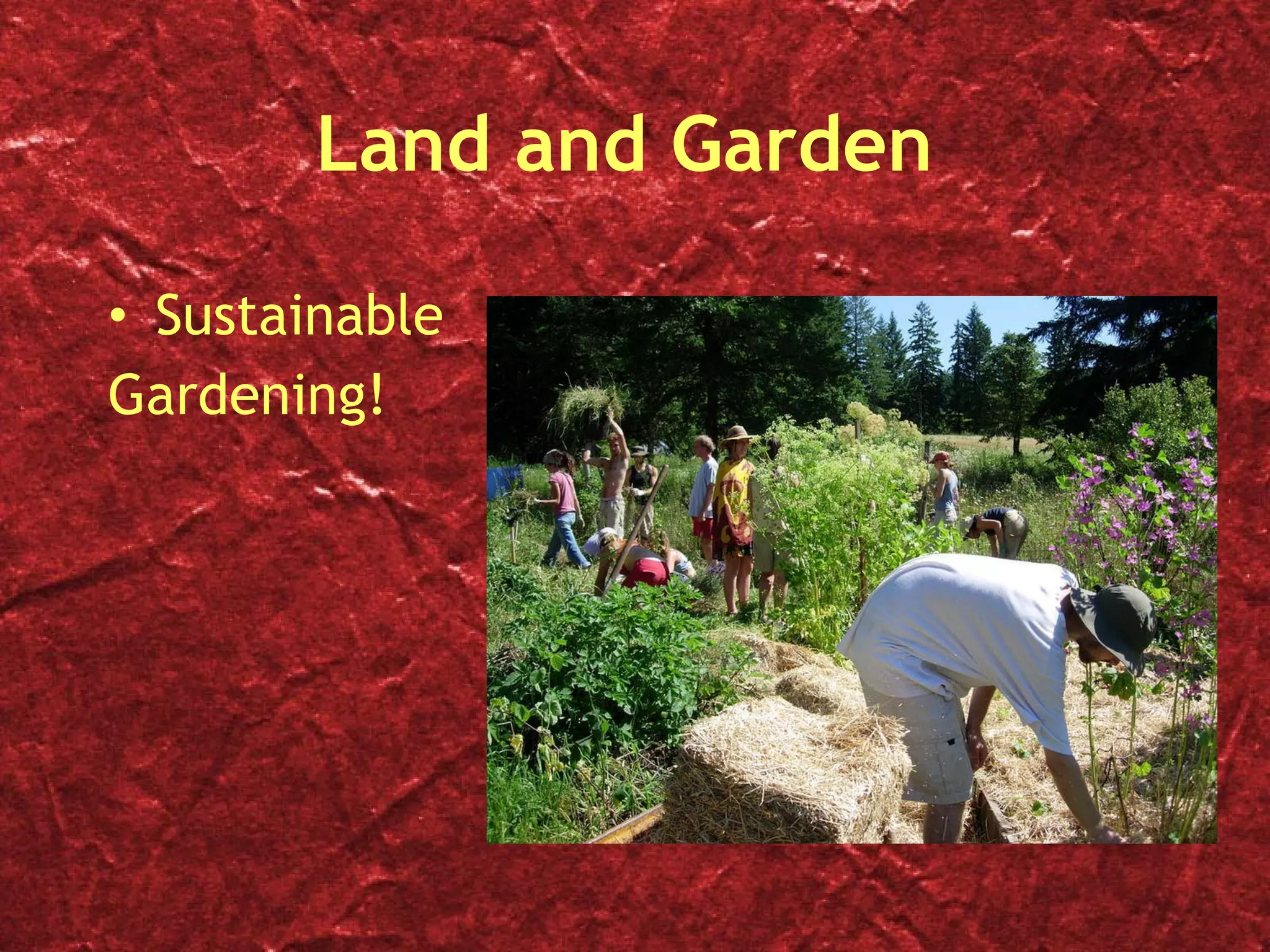
Sustainable Gardening Uses permaculture principles Does not use chemicals Uses perennial and native plants Has an emphasis on diversity Employs energy recycling techniques Maximizes edge and diversity of landscape Encourages mutually beneficial natural systems
Energy Recycling Grey water system Black water system Use of biomass chickens
Appropriate Technology Compact fluorescent light bulb Haybox Solar cooker Photovoltaic system Solar-assisted shower  and clothes washer Efficient clothes washer Energy-efficient dryer Wastewater leach field Solar Hot Water Panels Solar Shower Reduced flush volume in toilet tanks Insulation wherever possible Our south-facing solar water heating panels preheat the water in our lodge during the summer months
A little about the program 24 students of all ages and walks of life Lived in tents  Hands on learning Integrated into community Culminated in a final design project of Lost Valley in 2010
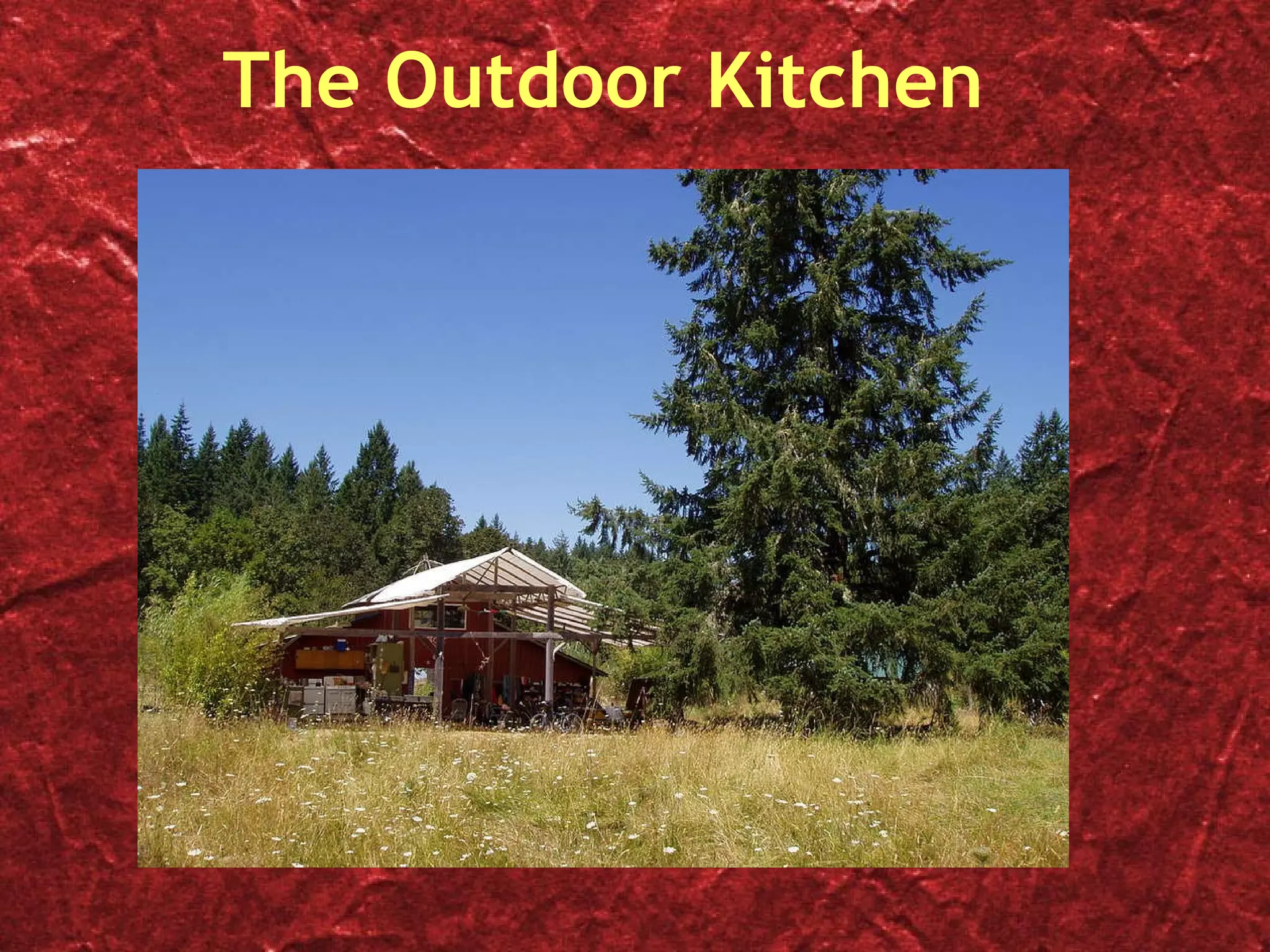
The Outdoor Kitchen
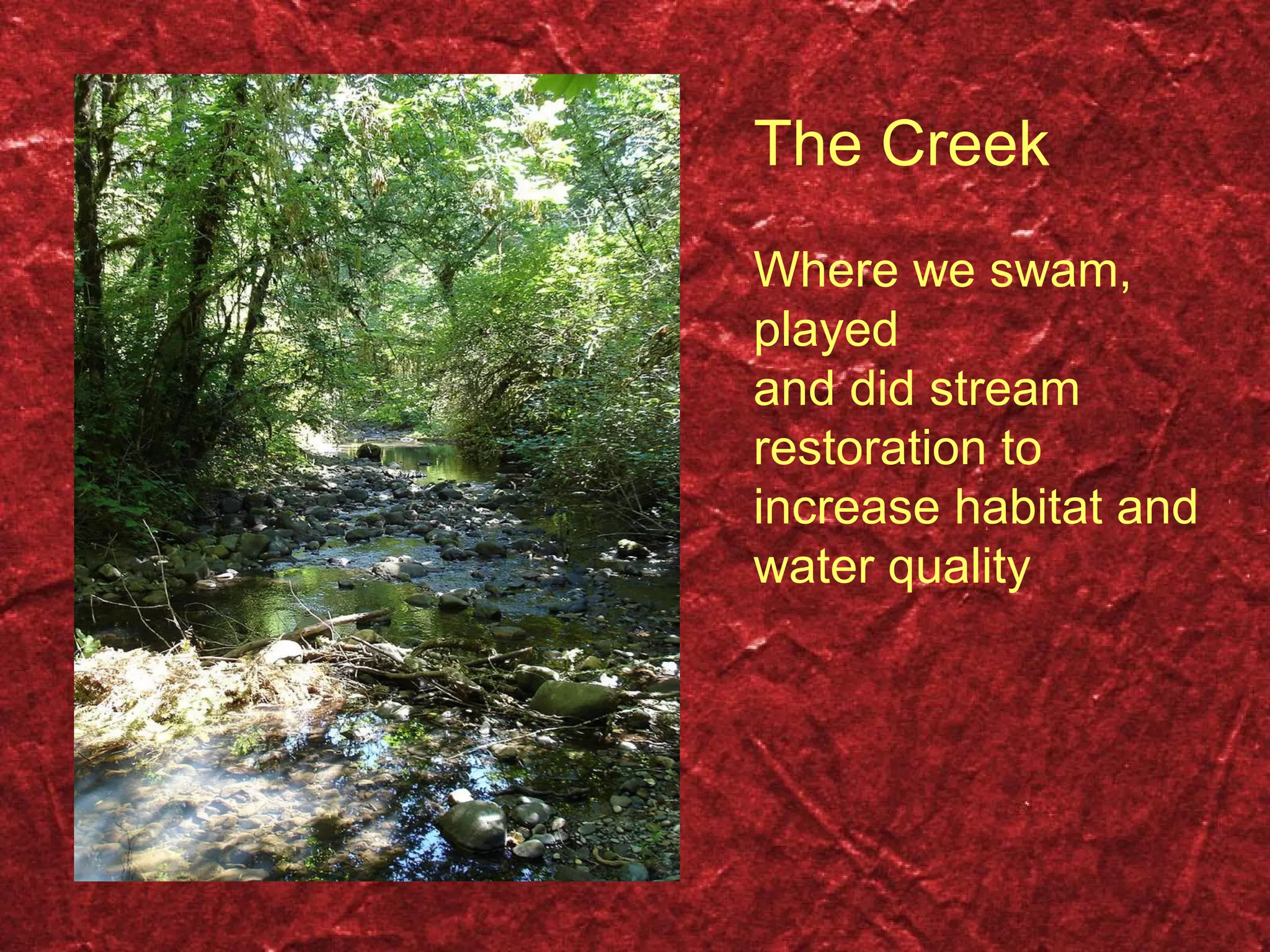
The Creek Where we swam,  played  and did stream restoration to increase habitat and water quality
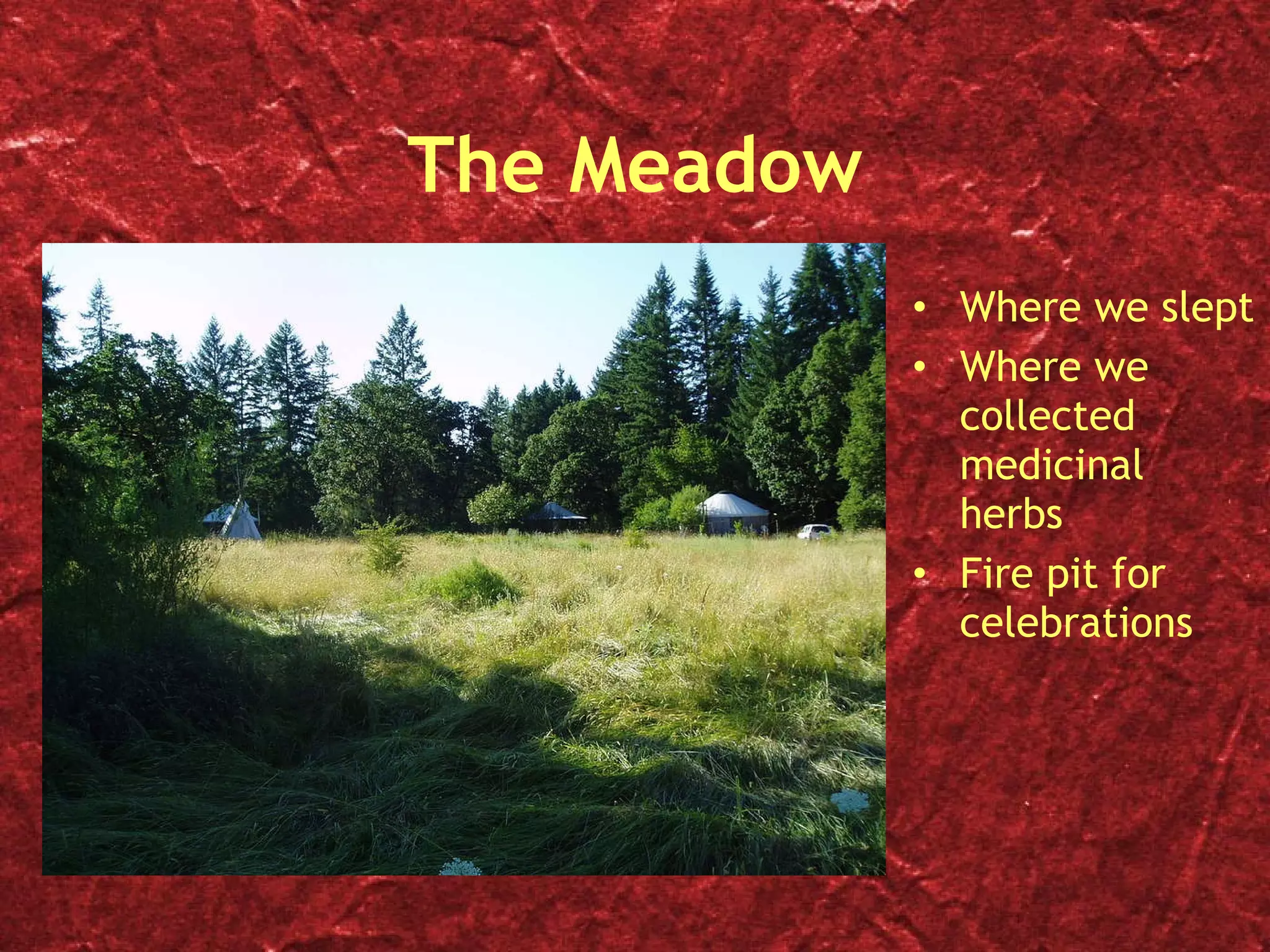
The Meadow Where we slept Where we collected medicinal herbs Fire pit for celebrations
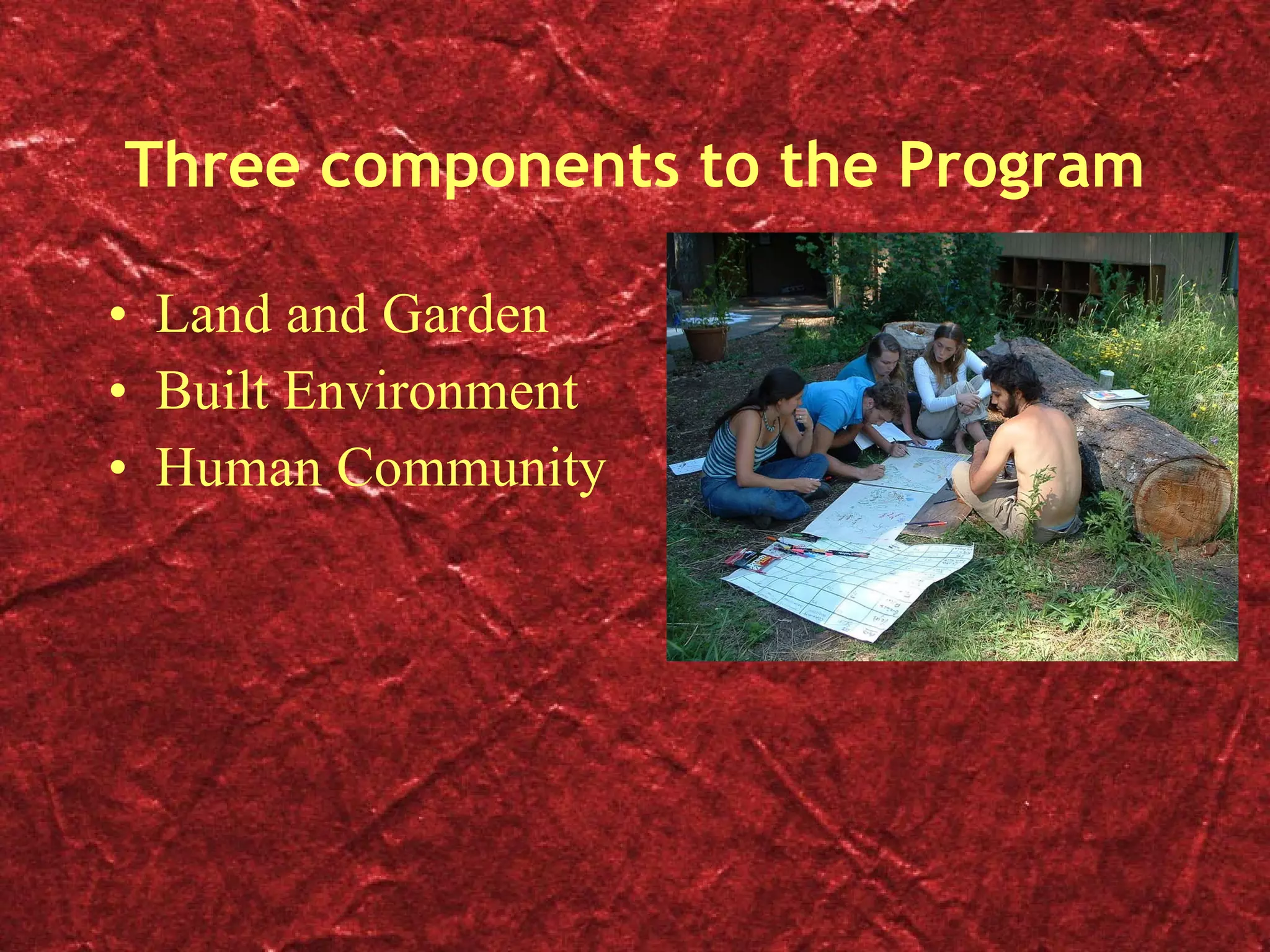
Three components to the Program Land and Garden Built Environment Human Community
Land and Garden Sustainable  Gardening!
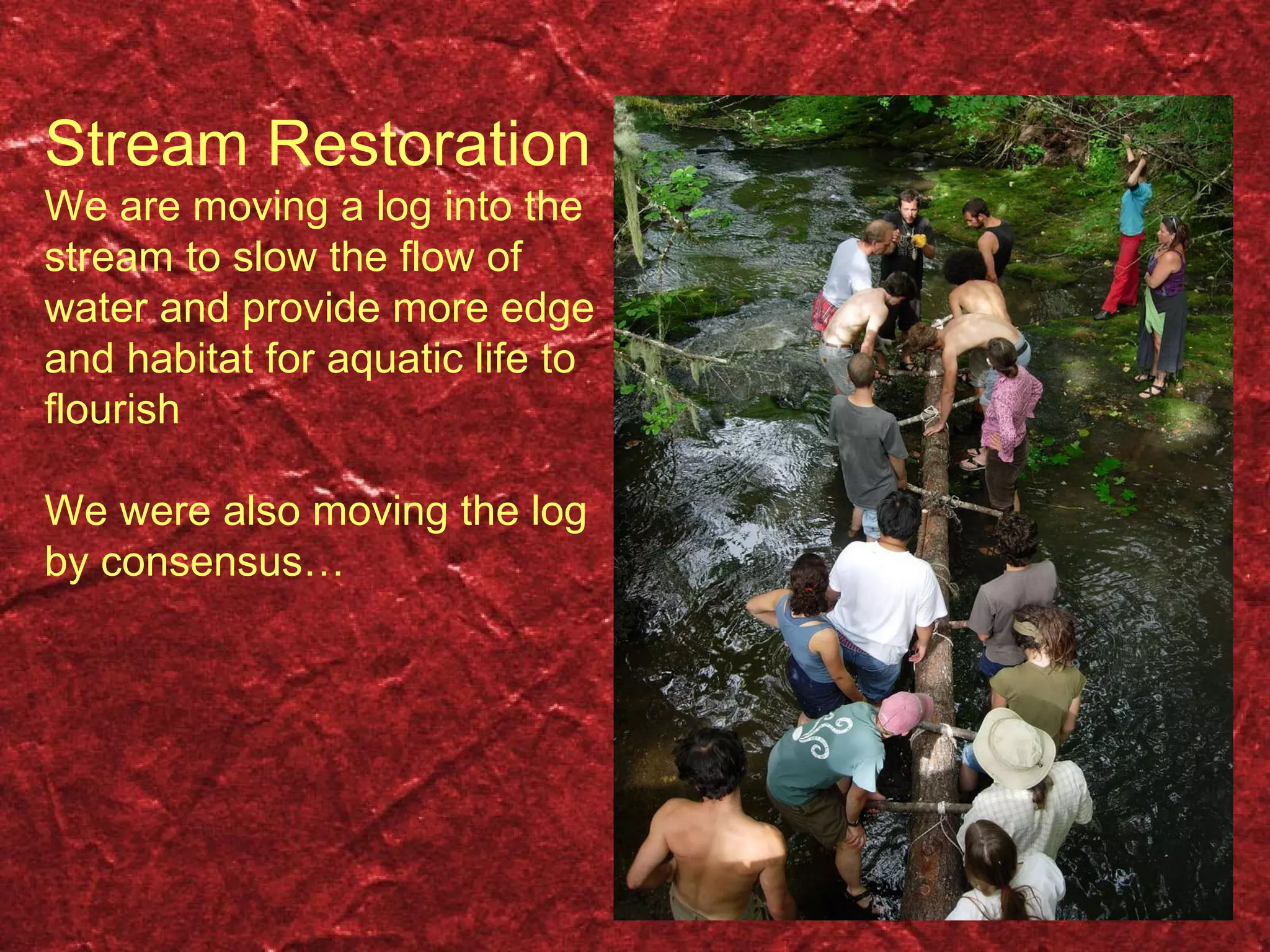
Stream Restoration We are moving a log into the stream to slow the flow of water and provide more edge and habitat for aquatic life to flourish We were also moving the log by consensus…
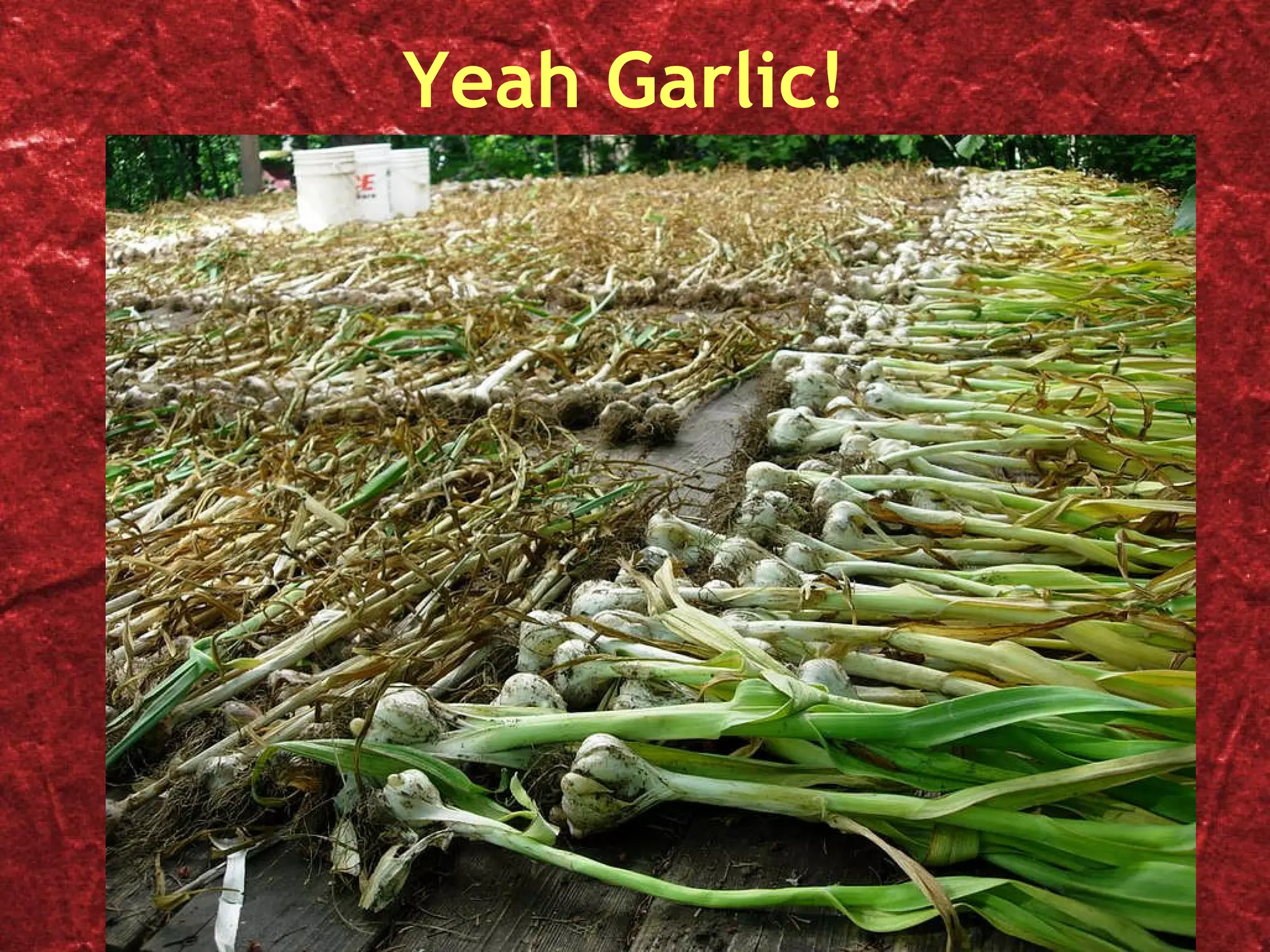
Yeah Garlic!
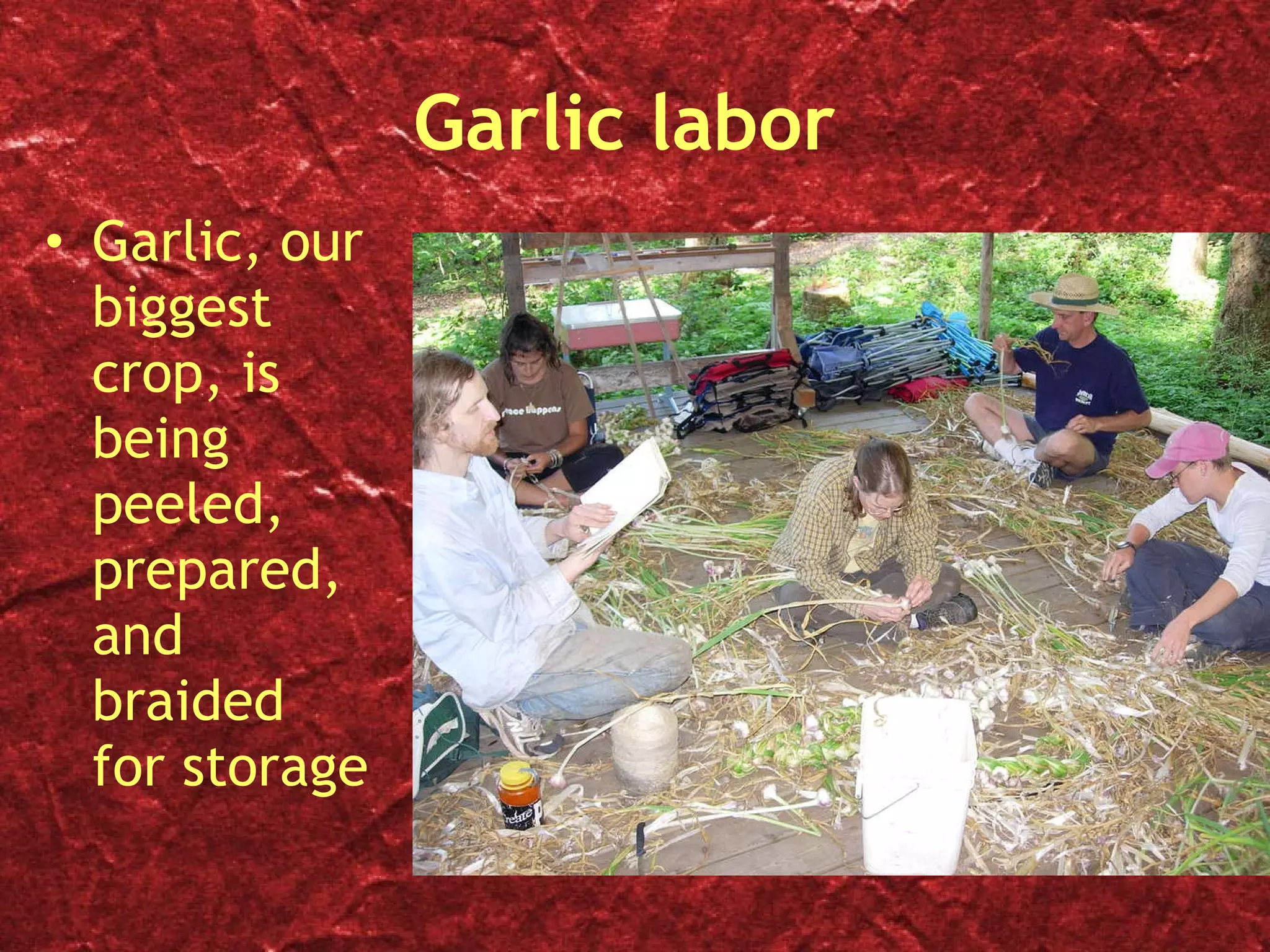
Garlic labor Garlic, our biggest crop, is being peeled, prepared, and braided for storage
Making herbal salves and tinctures Salves are a wax based cream with healing herbs in it that can be used topically Tinctures are usually alcohol based and can be drunken
A short medicinal herb quiz
 
Valerian The root is used as a muscle relaxant,sedative,nervine and is good for insomnia and migranes.
 
Yarrow The flowering herb can be applied to wounds and made into a tea. It helps stop bleeding and induces sweating It is good for fever, colds and flu, cystisis, anti-bacterial, anti-inflammatory and is an astringent
 
Heal-All (prunella) The flowering herb is a good poultice for skin wounds and bites
 
Common Plantain Leaves are an astringent and make a good poultice for wounds, burns, skin irritations, and insect bites. It also relieves pain and itch an acts as an anti-inflammatory
 
Comfrey/Knitbone The leaves and roots help repair body tissue for any injury, soothes inflammation, stops bleeding, strengthens bones, and heals respiratory system
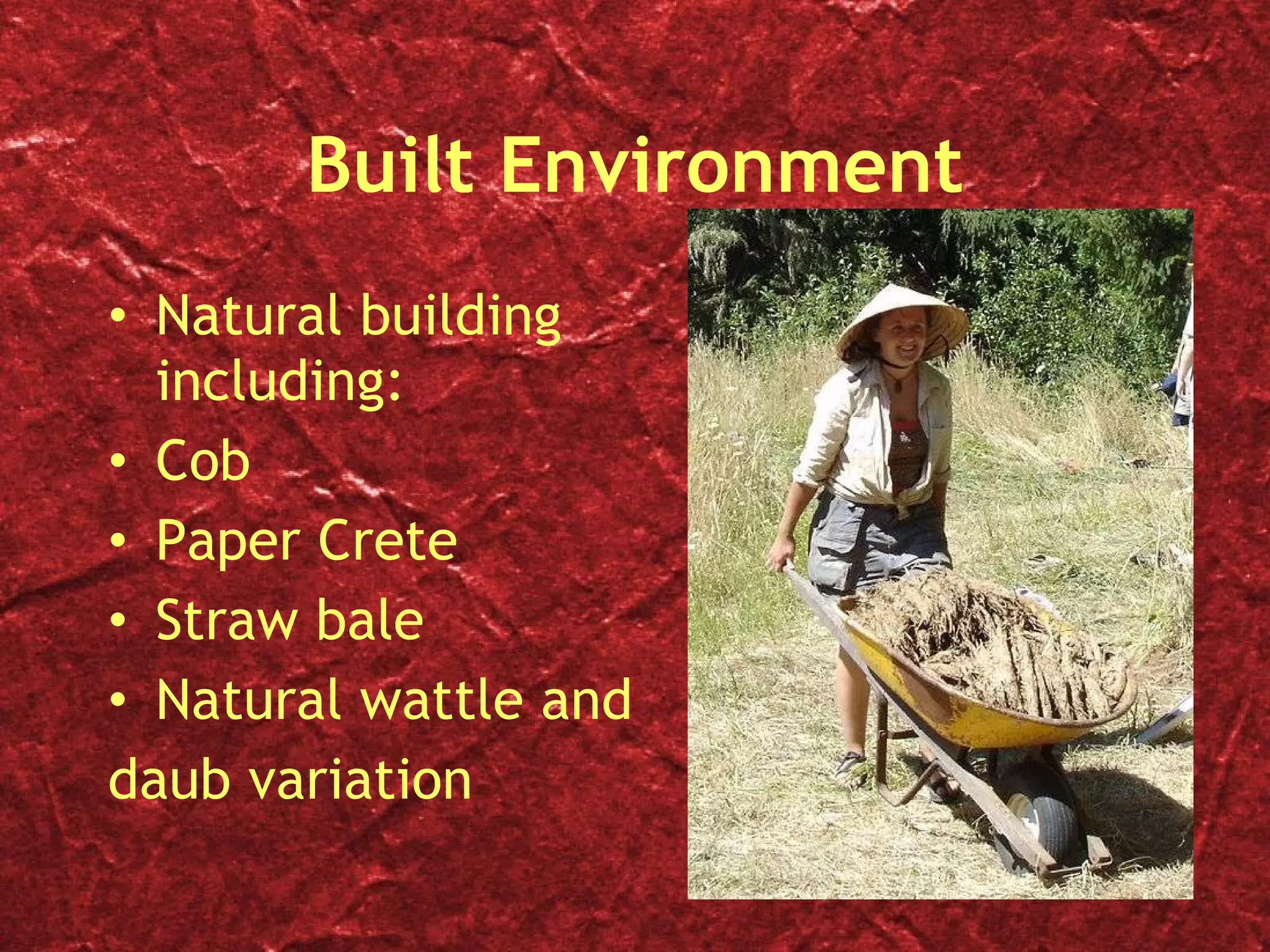
Built Environment Natural building including: Cob Paper Crete Straw bale Natural wattle and  daub variation
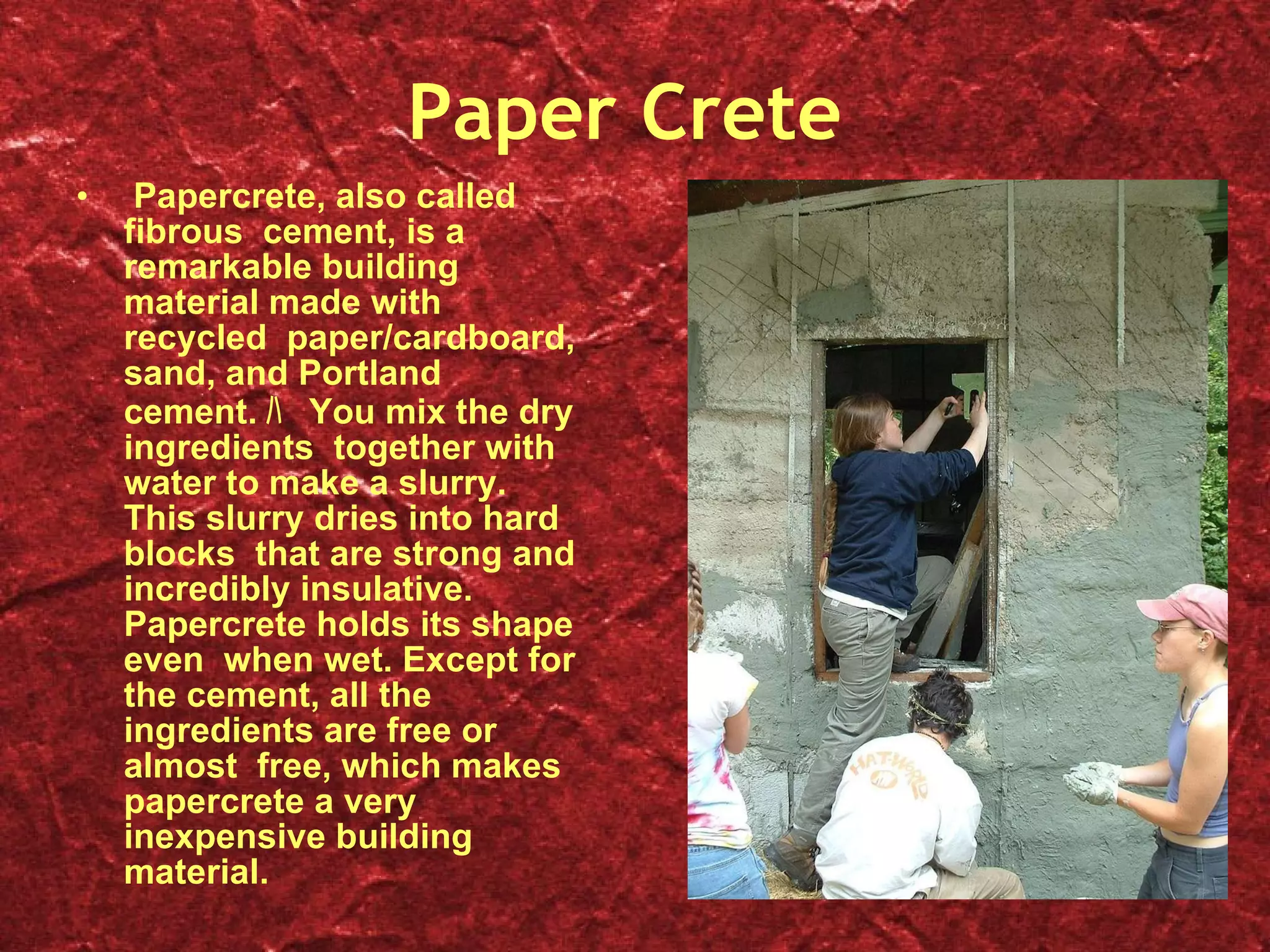
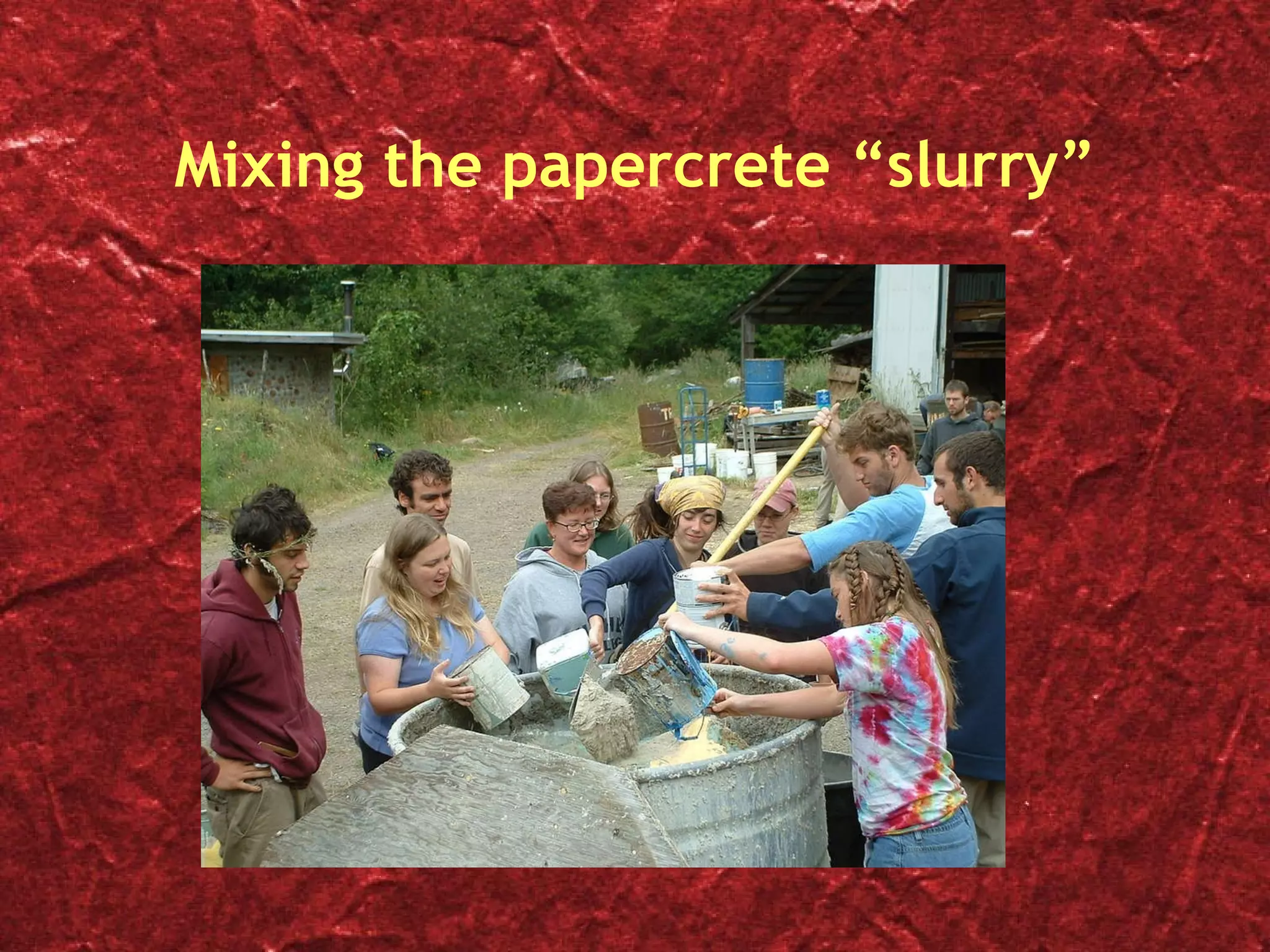
Paper Crete Papercrete, also called fibrous  cement, is a remarkable building material made with recycled  paper/cardboard, sand, and Portland cement. ハ   You mix the dry ingredients  together with water to make a slurry. This slurry dries into hard blocks  that are strong and incredibly insulative. Papercrete holds its shape even  when wet. Except for the cement, all the ingredients are free or almost  free, which makes papercrete a very inexpensive building material.
Mixing the papercrete “slurry”
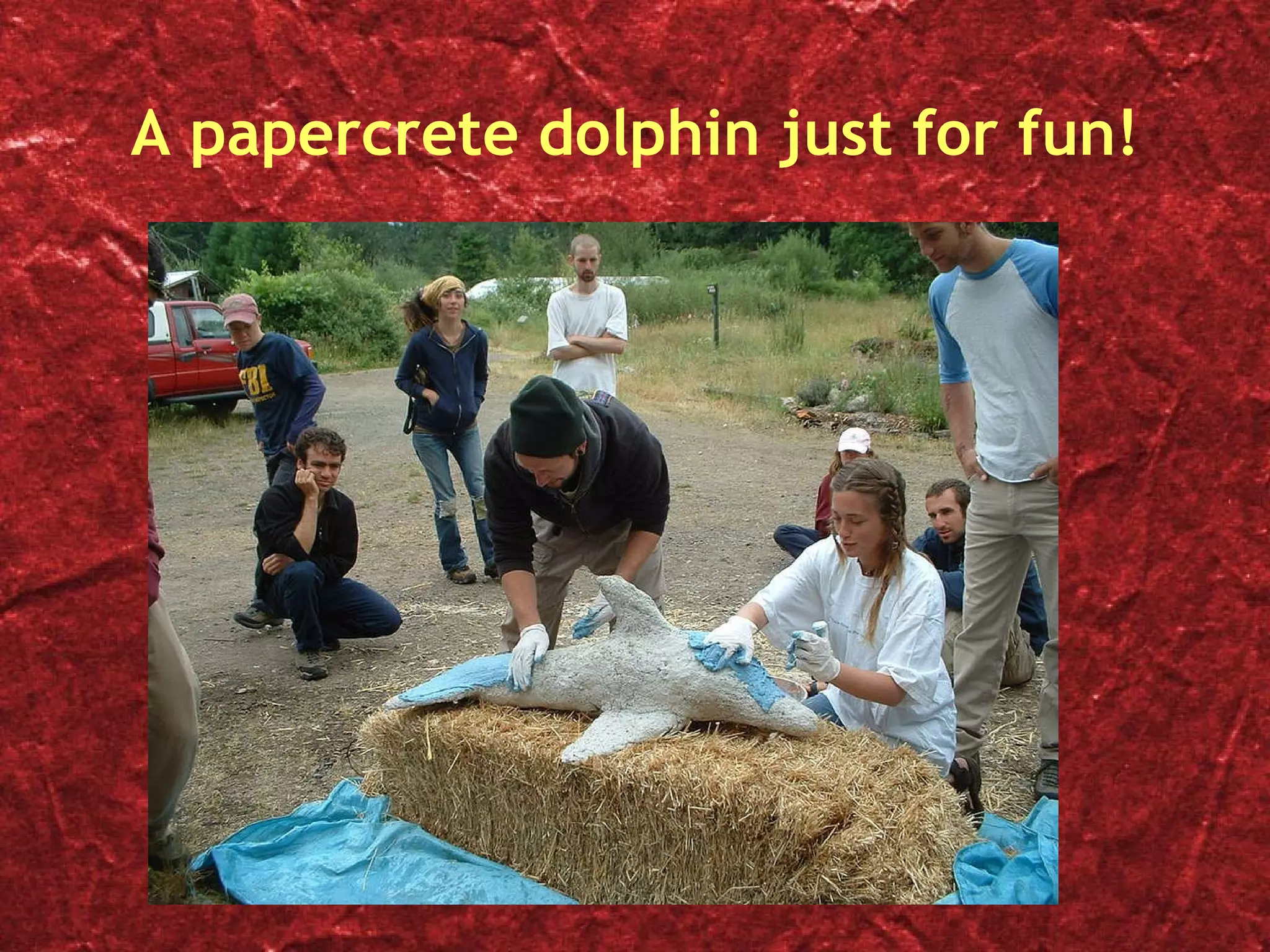
A papercrete dolphin just for fun!
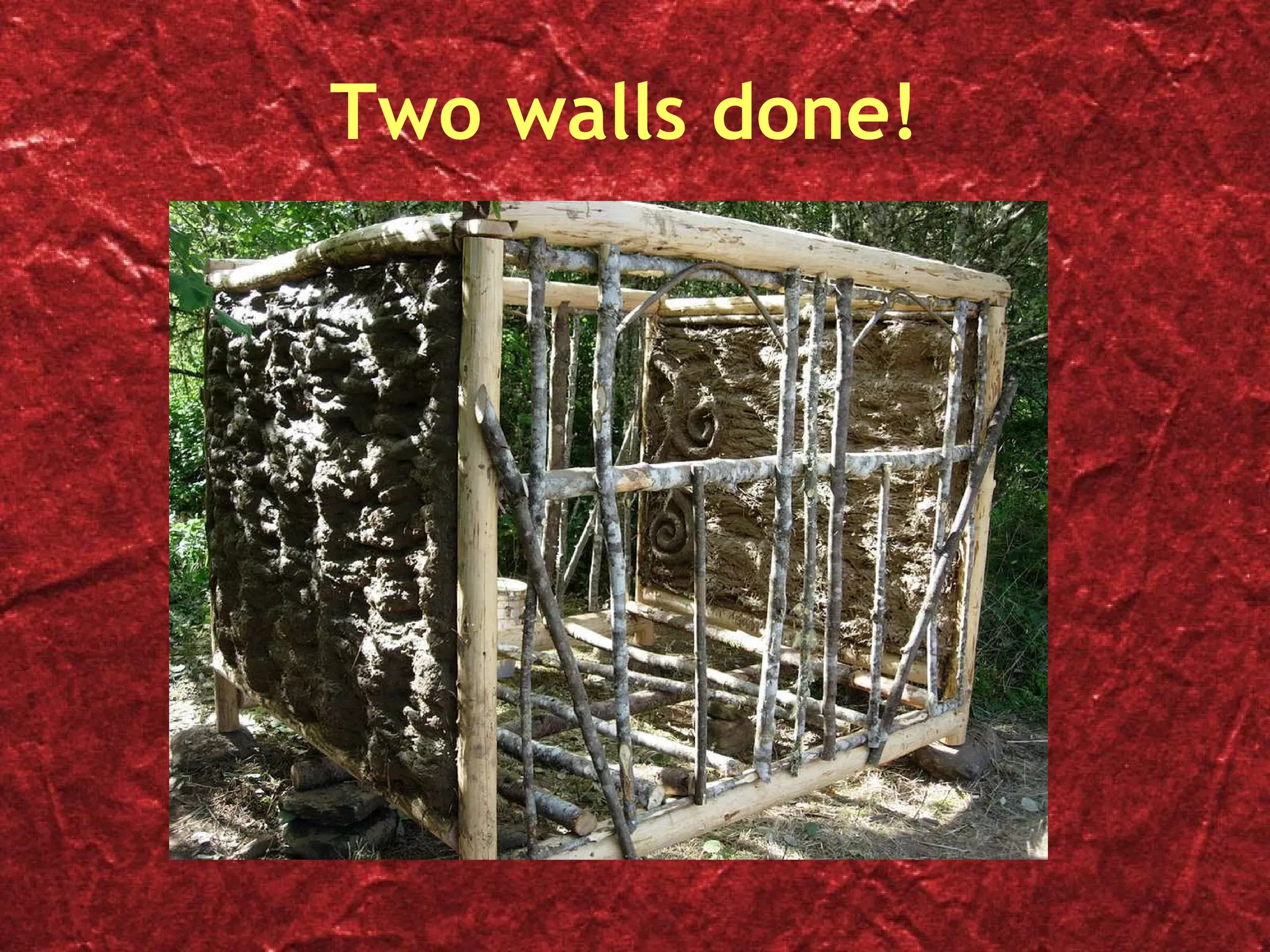
Cob and Cob Weave Cob structures are built using clay from the land, sand, and straw. Cob is a simple and versatile building material that can last a long time given a solid roof with an adequate overhang and good plaster. The potentially large thermal mass of cob ensures stable temperatures, staying warm at night and cool during the day.
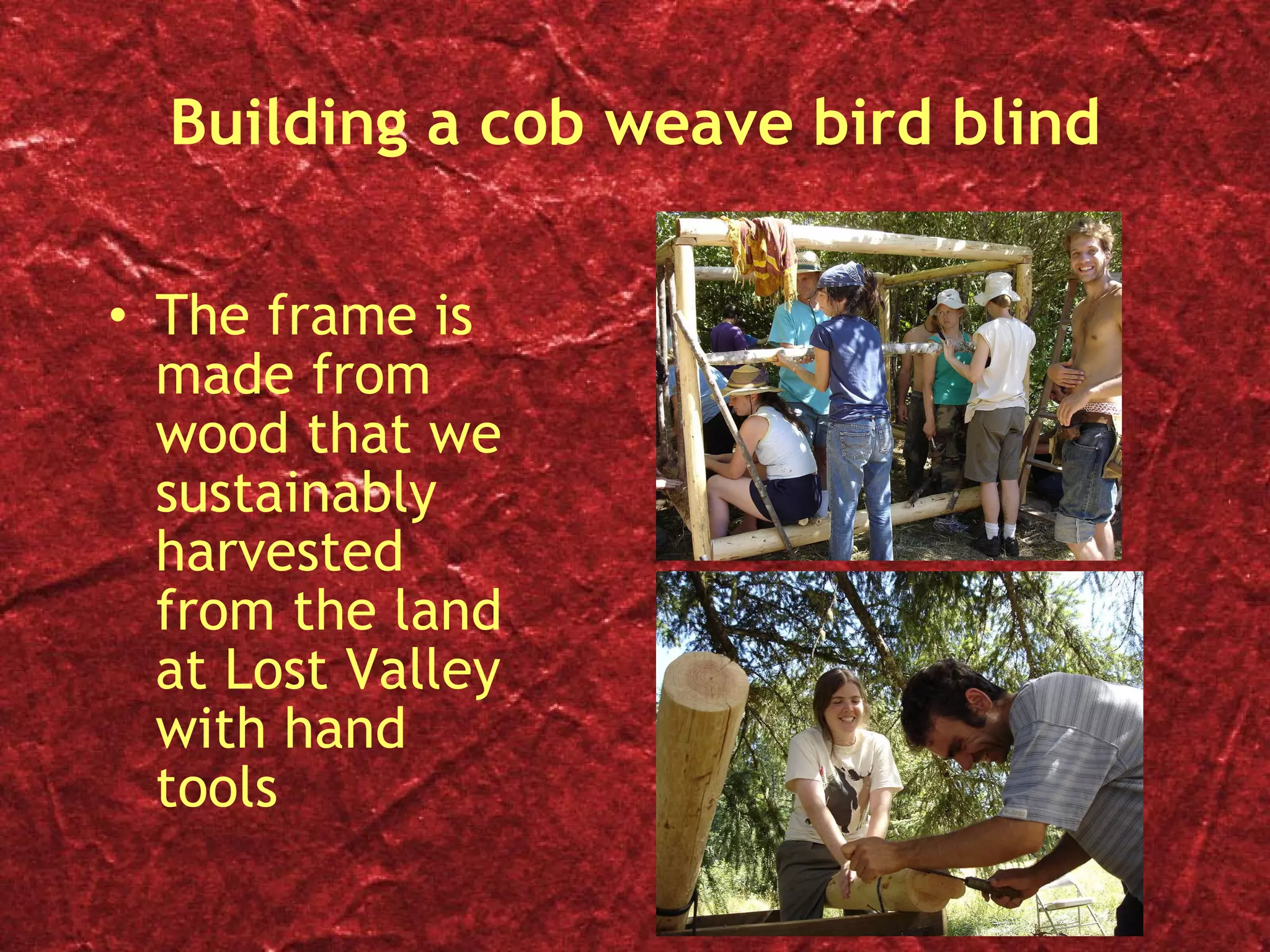
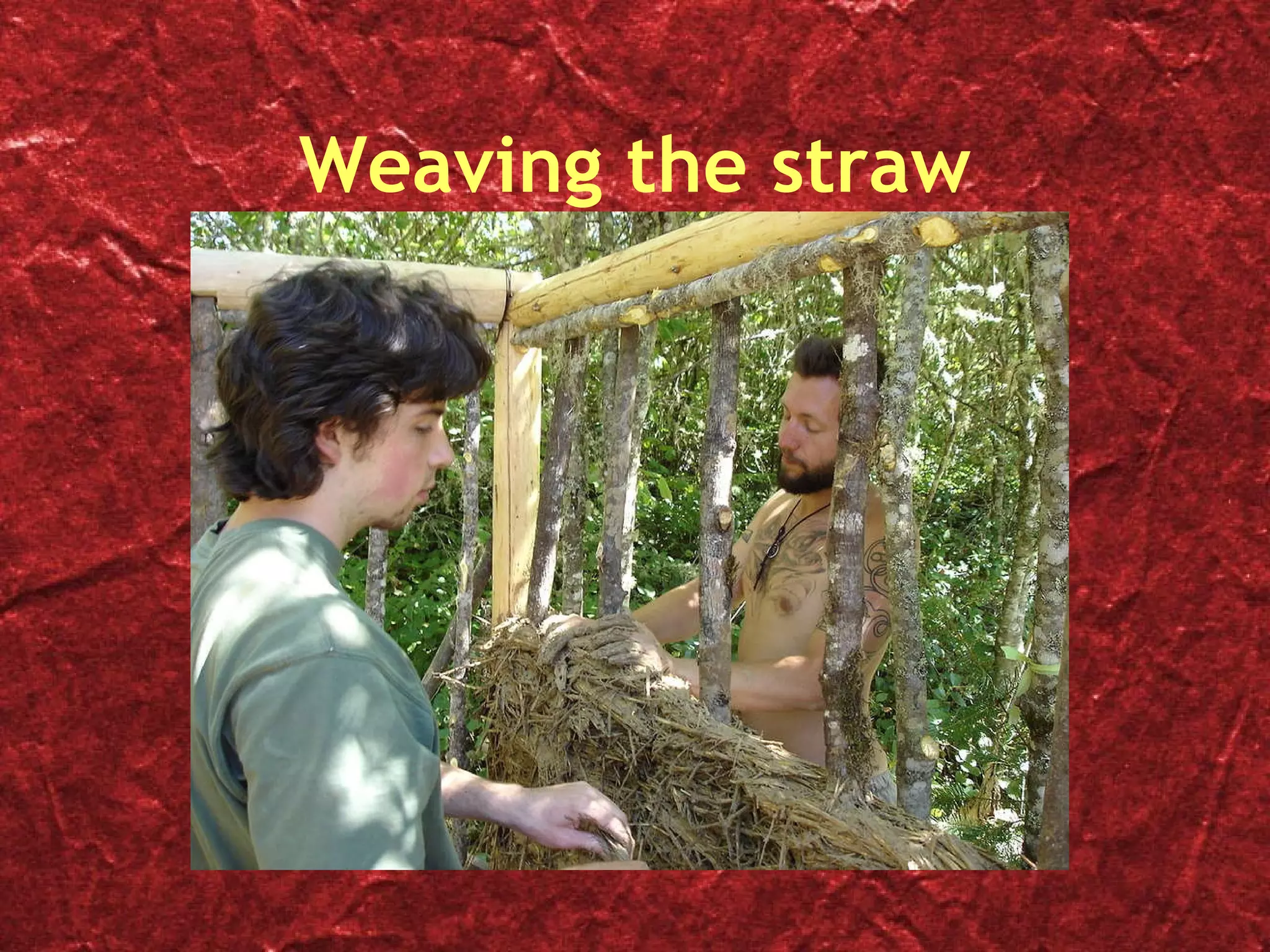
Building a cob weave bird blind The frame is made from wood that we sustainably harvested from the land at Lost Valley with hand tools
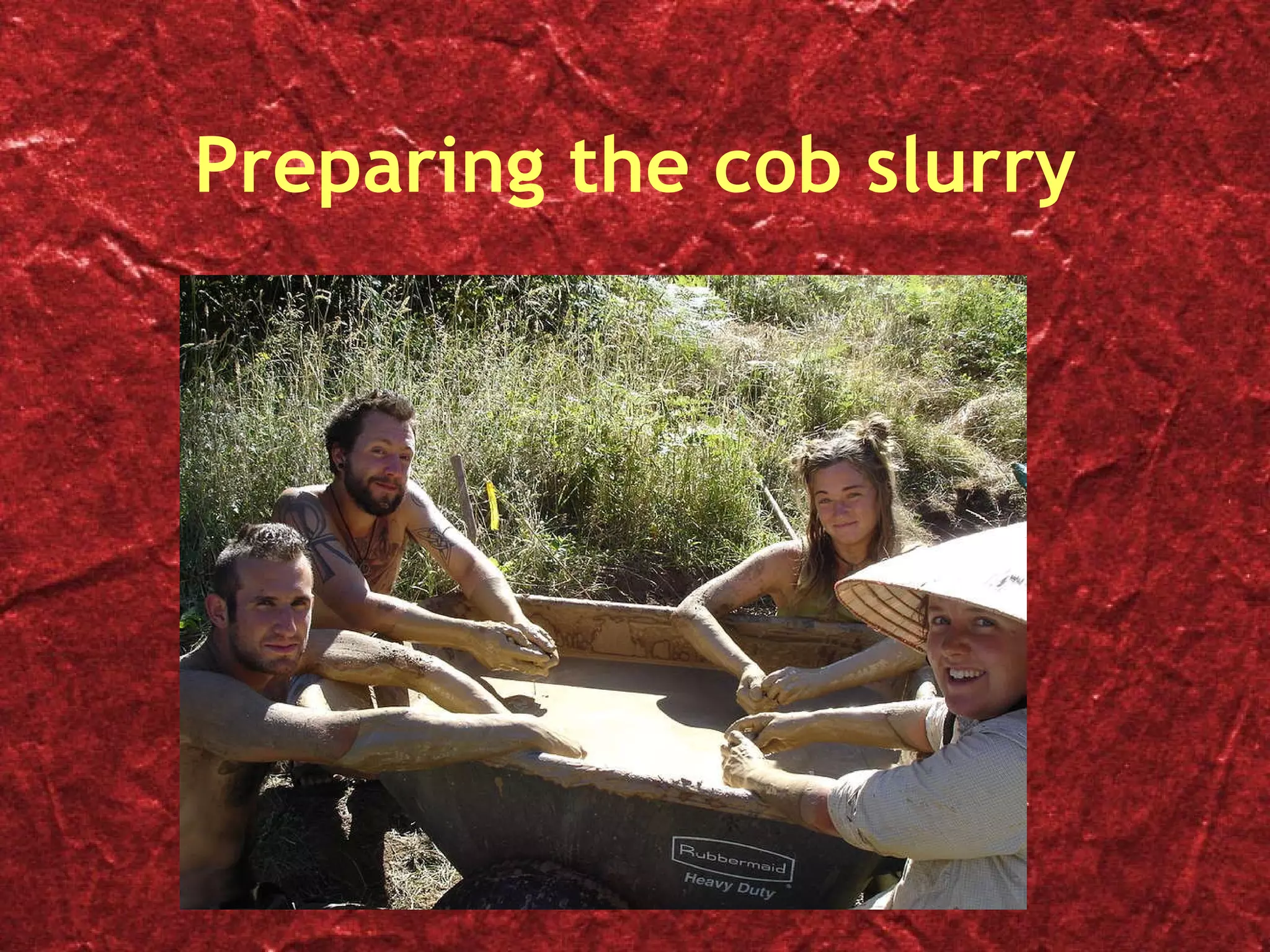
Preparing the cob slurry
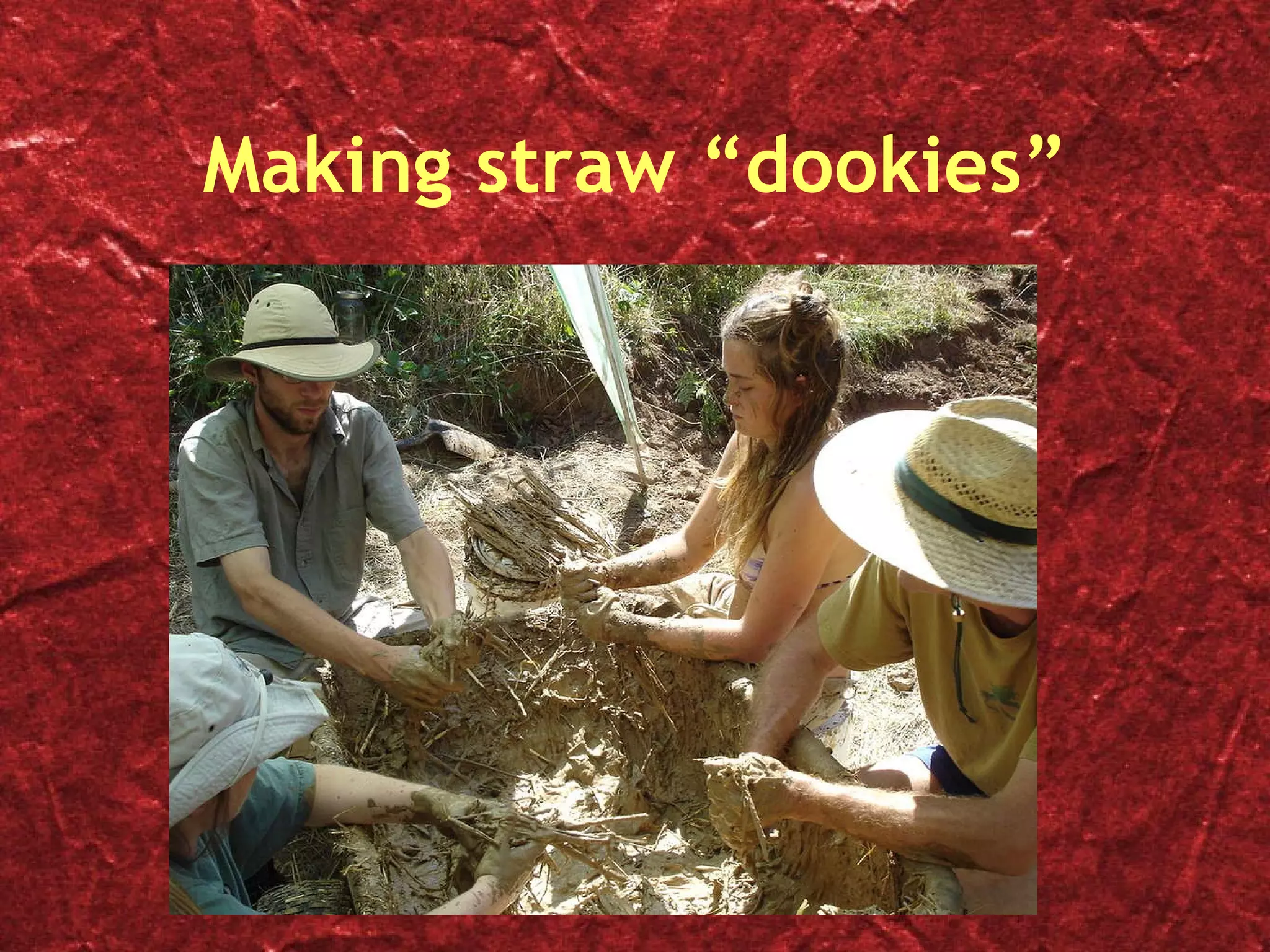
Making straw “dookies”
 
Weaving the straw
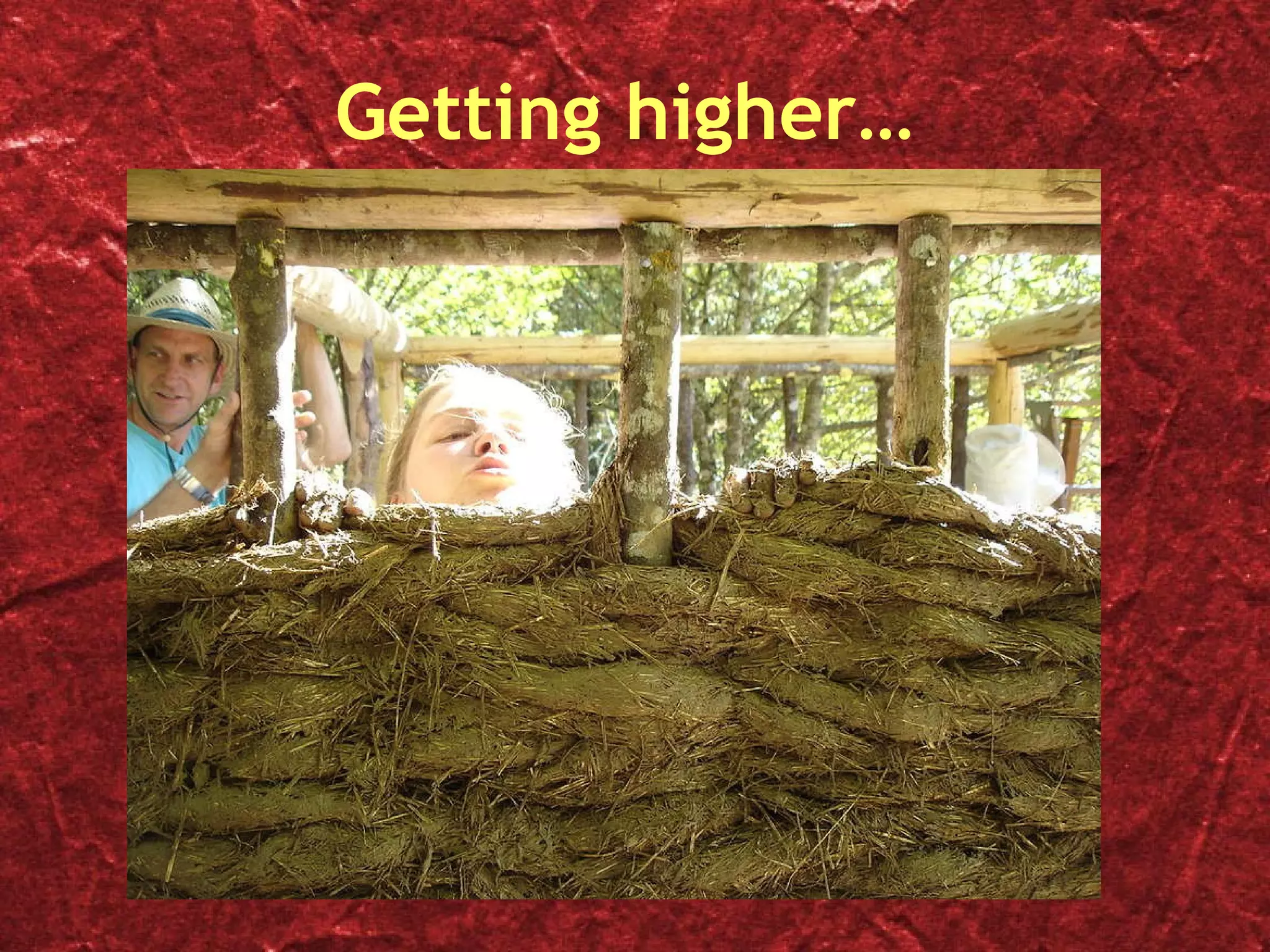
Getting higher…
Two walls done!
Renewable Energy We also studies applications of: Biodiesel Wind power Solar power Microhydo power Appropriate design for energy conservation Conbustion stoves
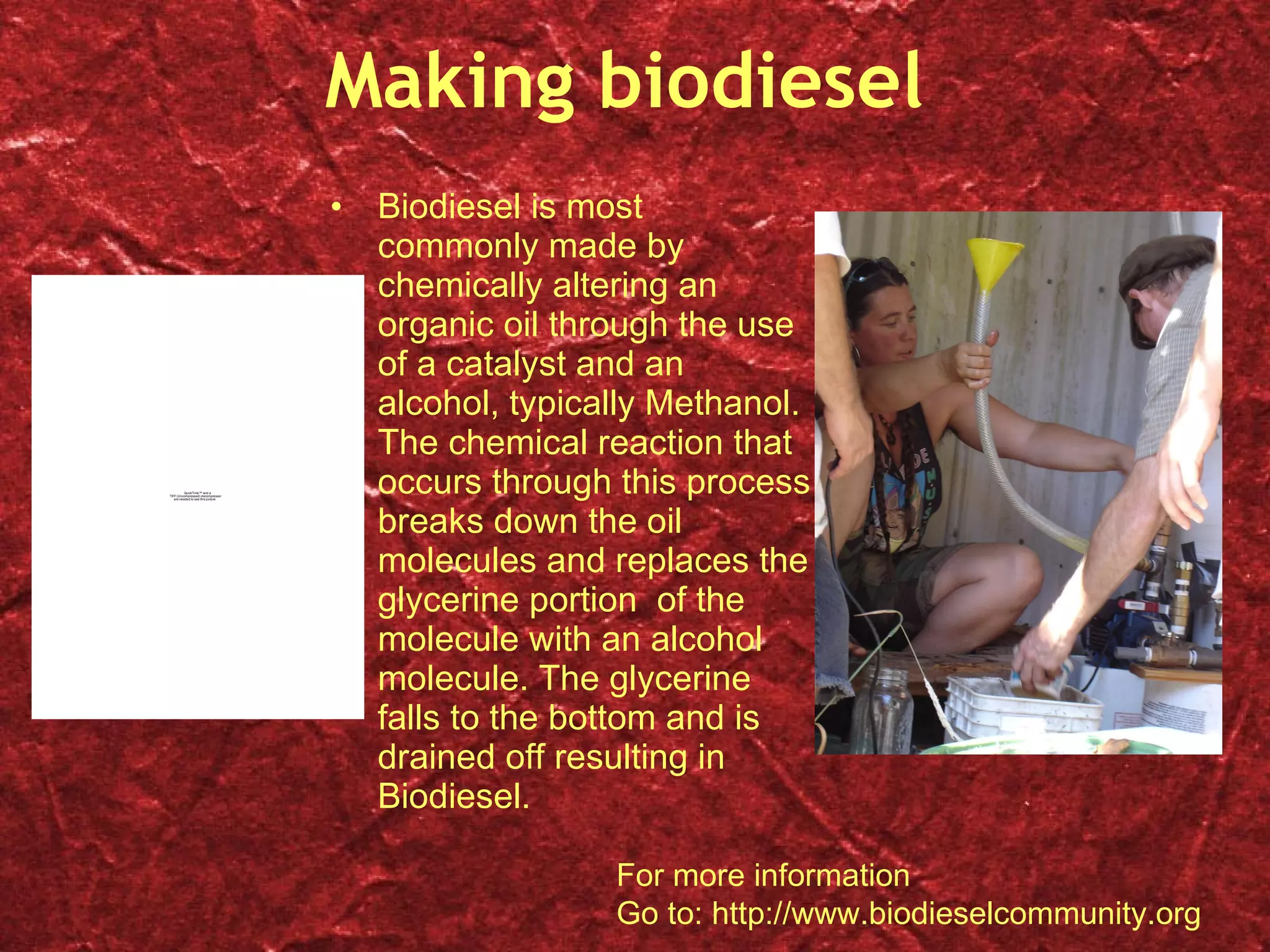
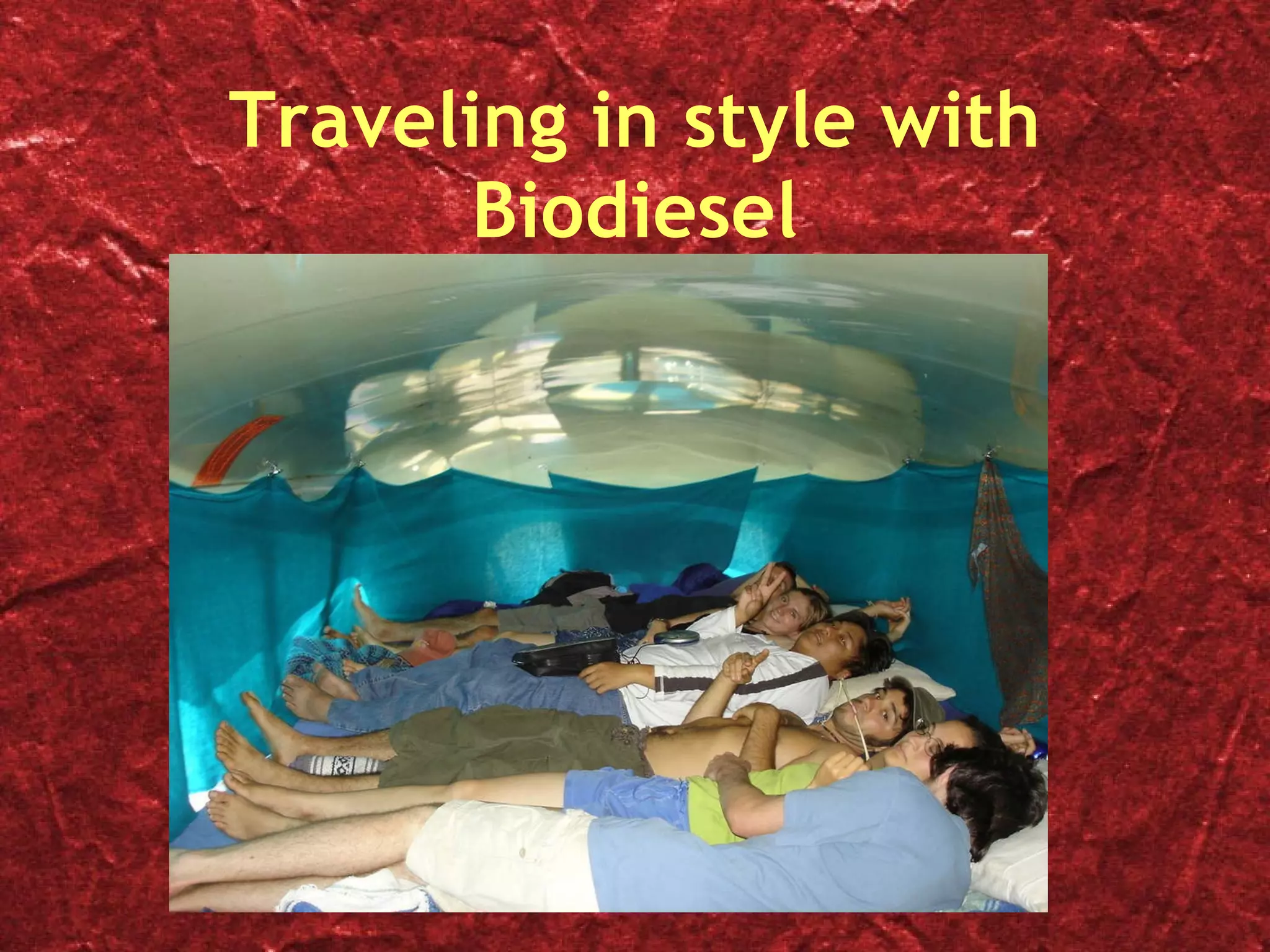
Making biodiesel Biodiesel is most commonly made by chemically altering an organic oil through the use of a catalyst and an alcohol, typically Methanol.  The chemical reaction that occurs through this process breaks down the oil molecules and replaces the glycerine portion  of the molecule with an alcohol molecule. The glycerine falls to the bottom and is drained off resulting in Biodiesel. For more information Go to: http://www.biodieselcommunity.org
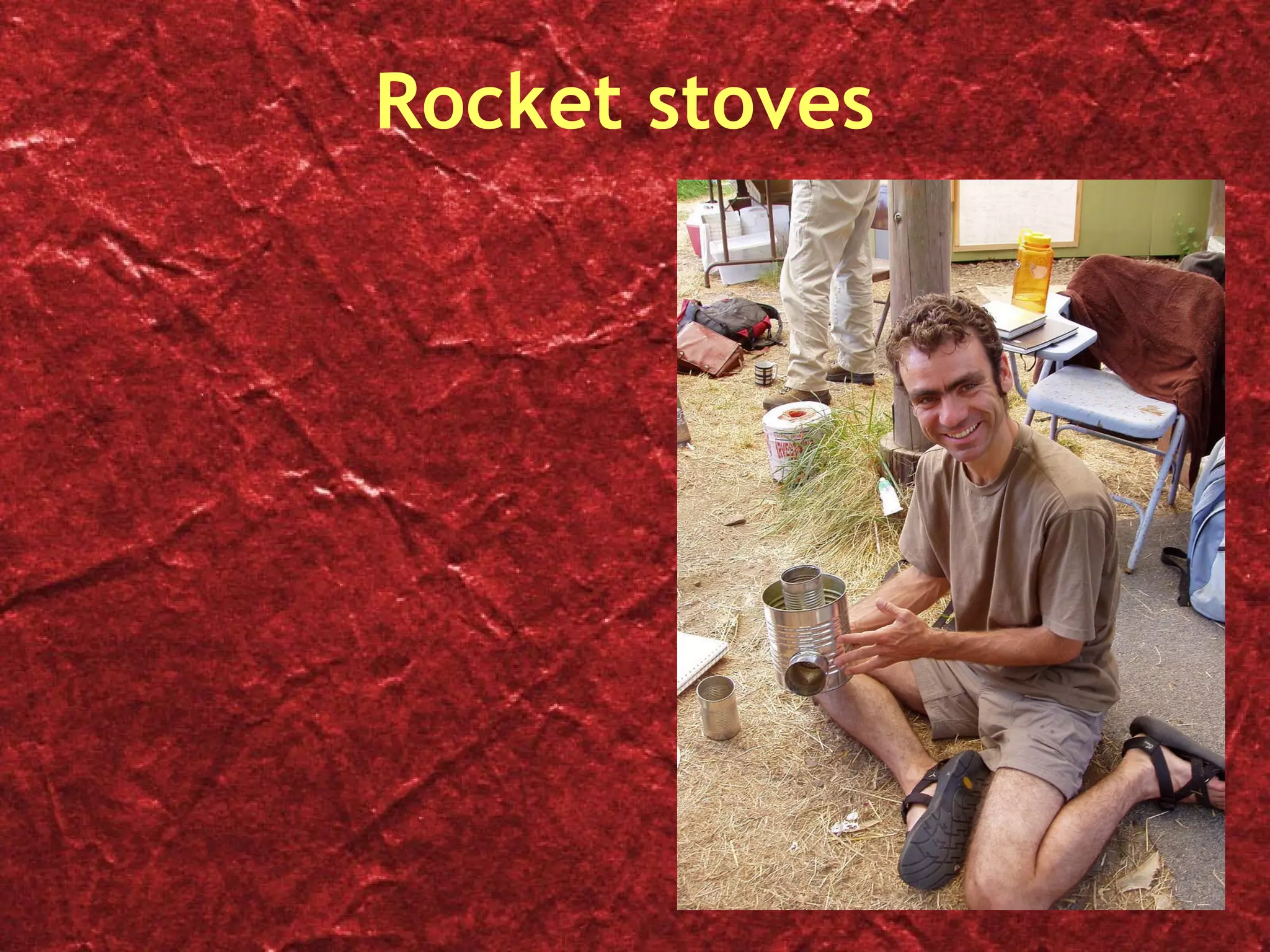
Rocket stoves
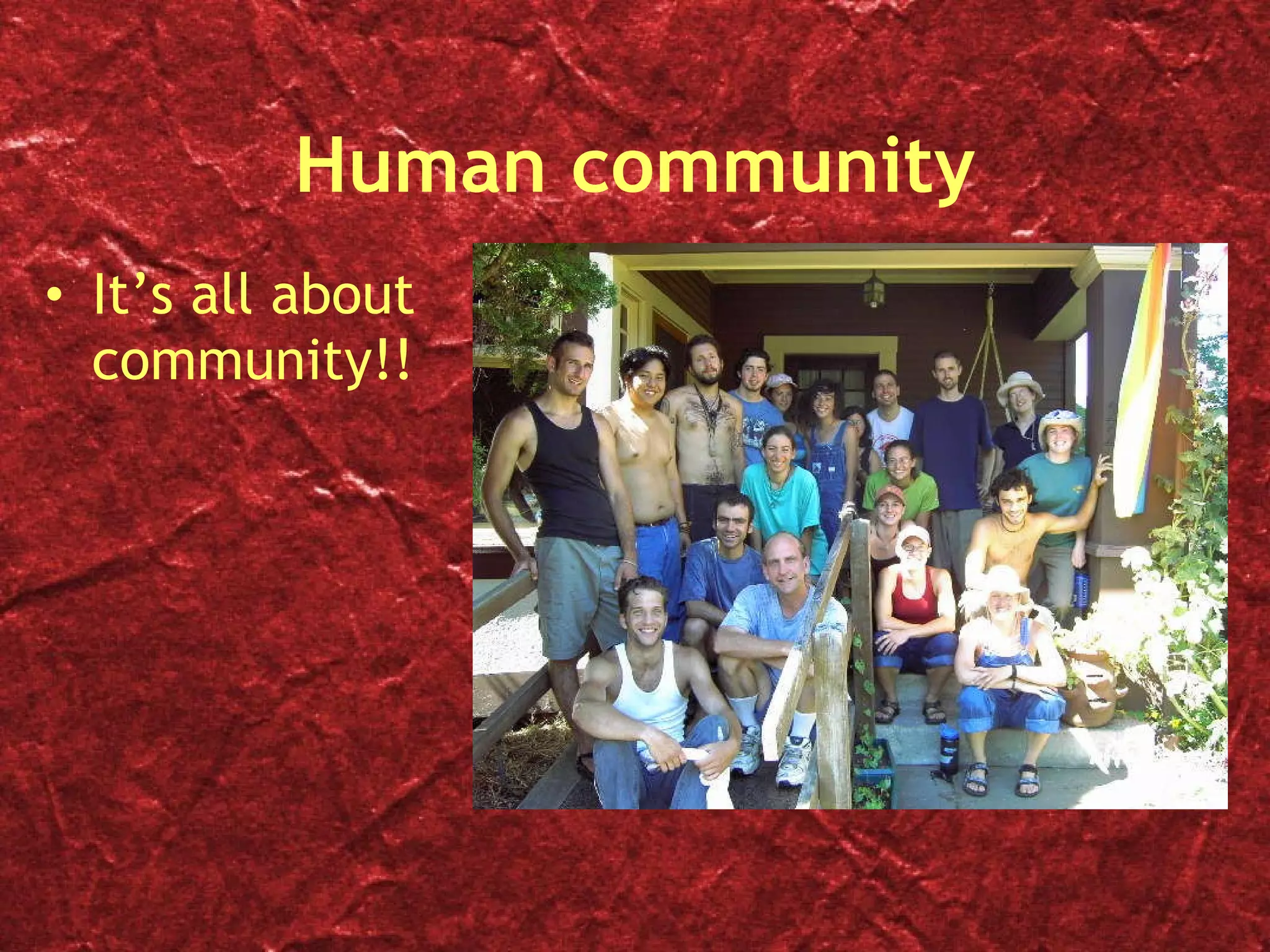
Human community It’s all about community!!
Community development We studied the importance of community and community building techniques Community building at its best is the process of cultivating relationships with people in a way that helps them see their gifts and capacities and motivates them to enthusiastically draw on their gifts to make connections with others and take action toward their vision of success.
We studies and employed structures and workshops to consciously cultivate a strong sense of community and encouraged a way of seeing and a way of relating and interacting characterized by openness and respect.
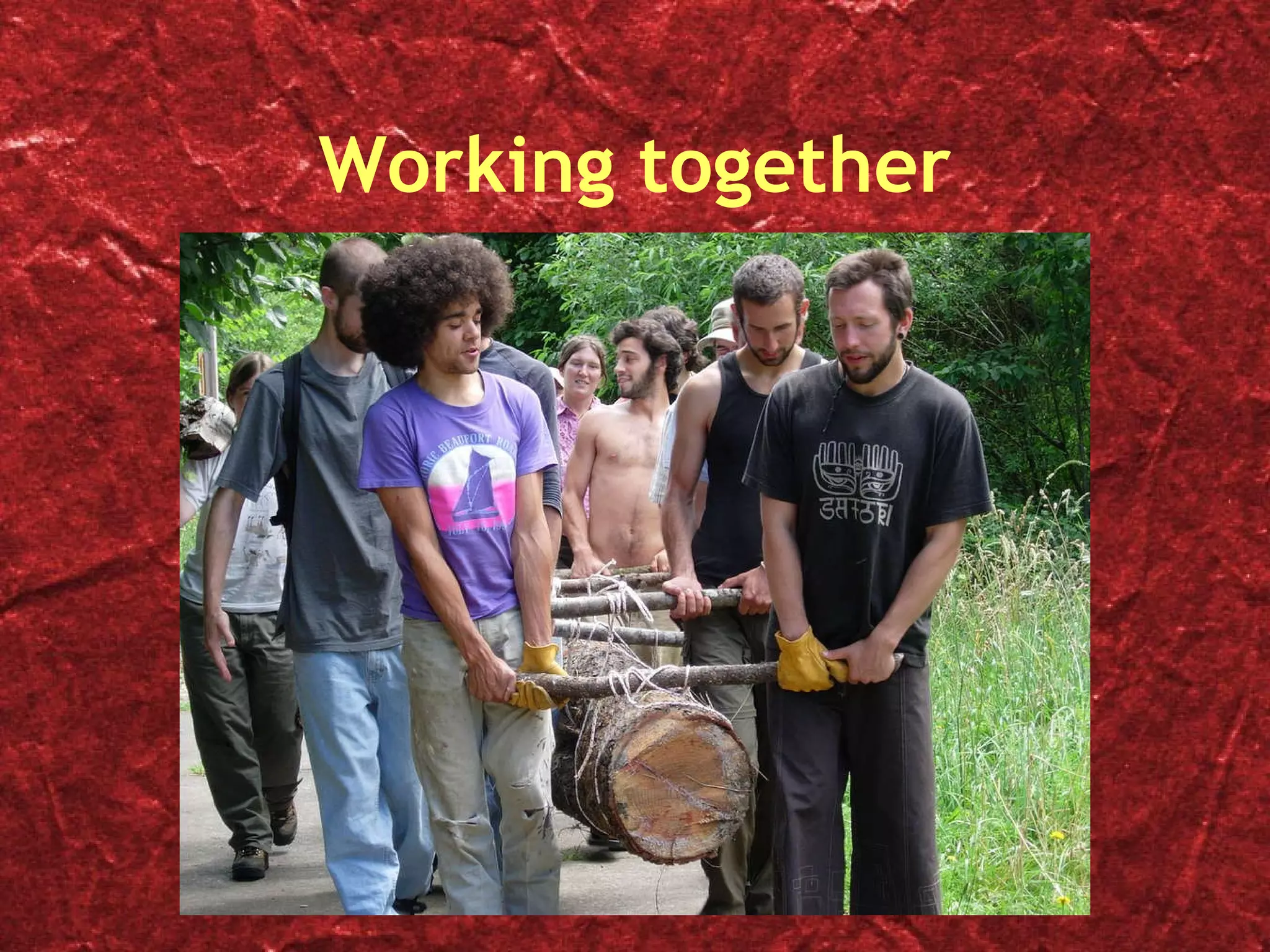
Working together
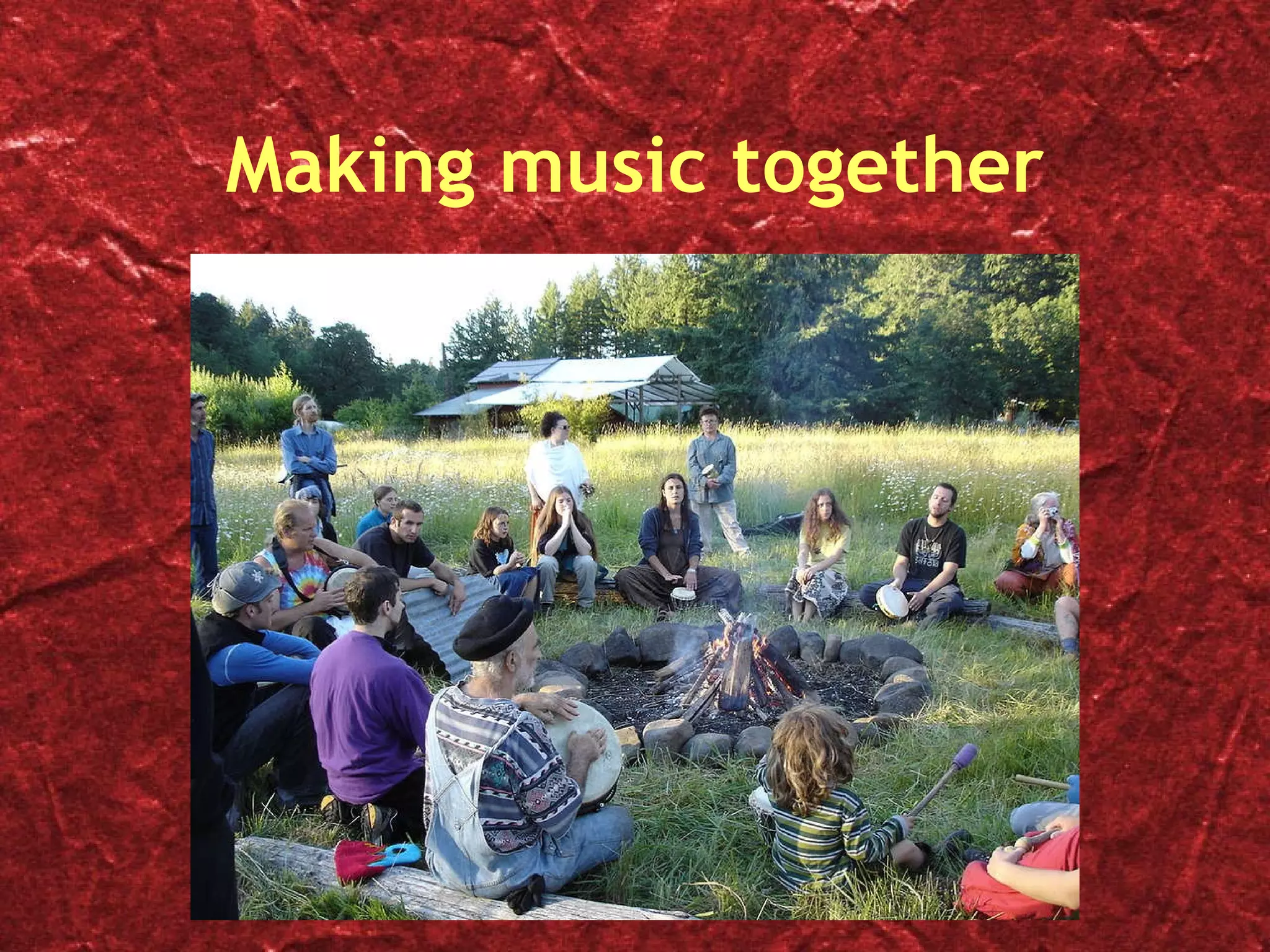
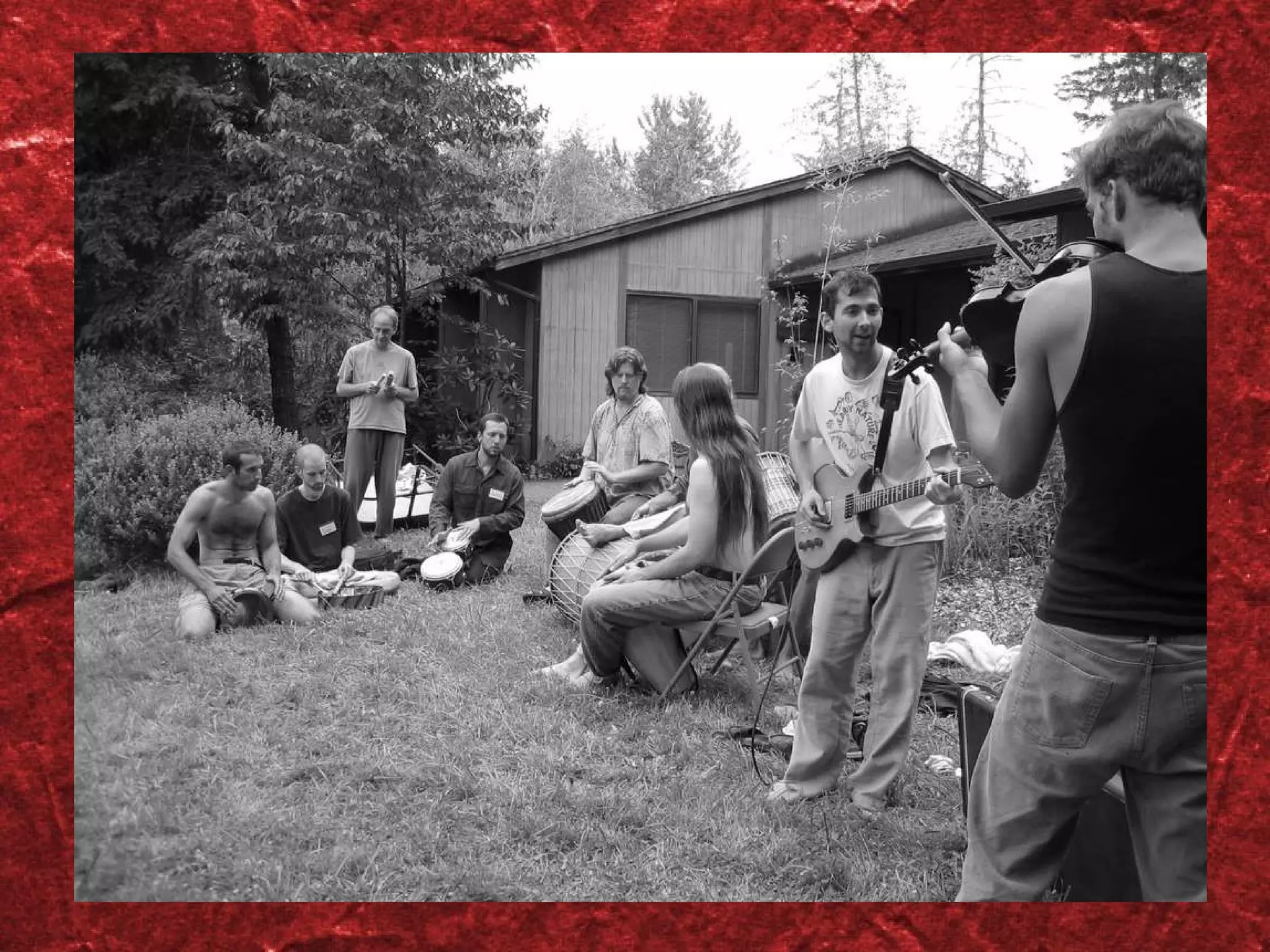
Making music together
 
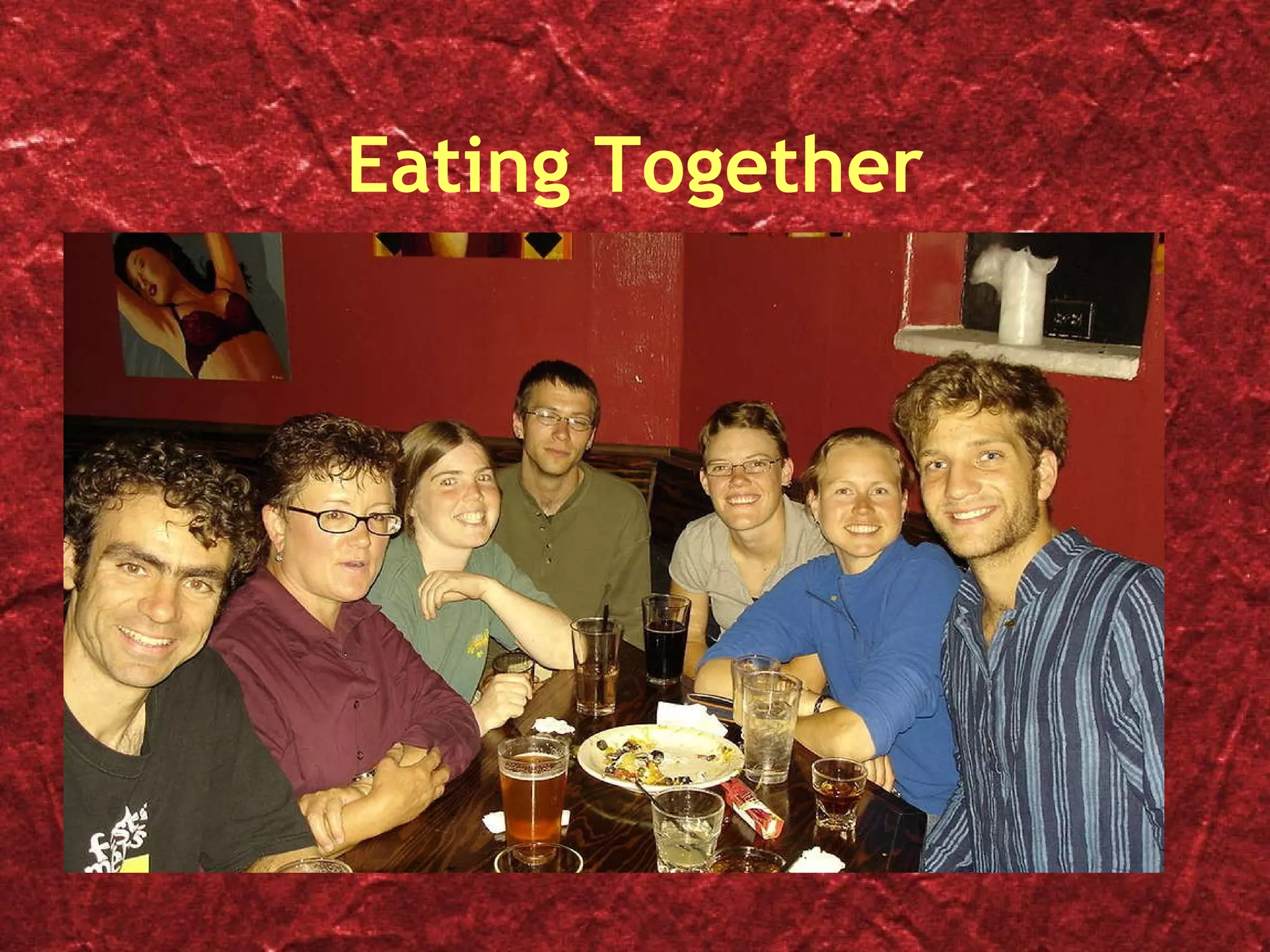
Eating Together
Traveling in style with Biodiesel
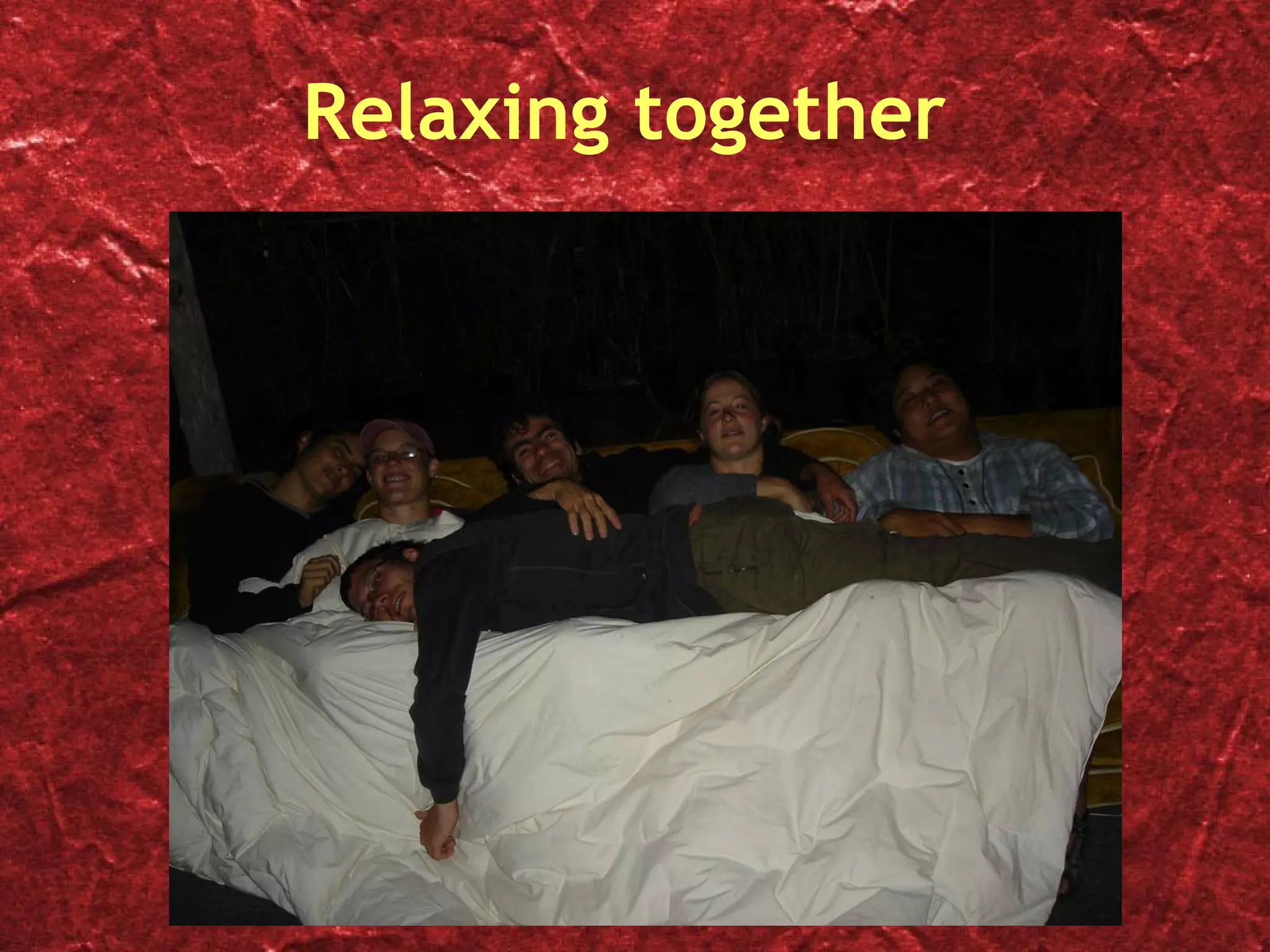
Relaxing together
 
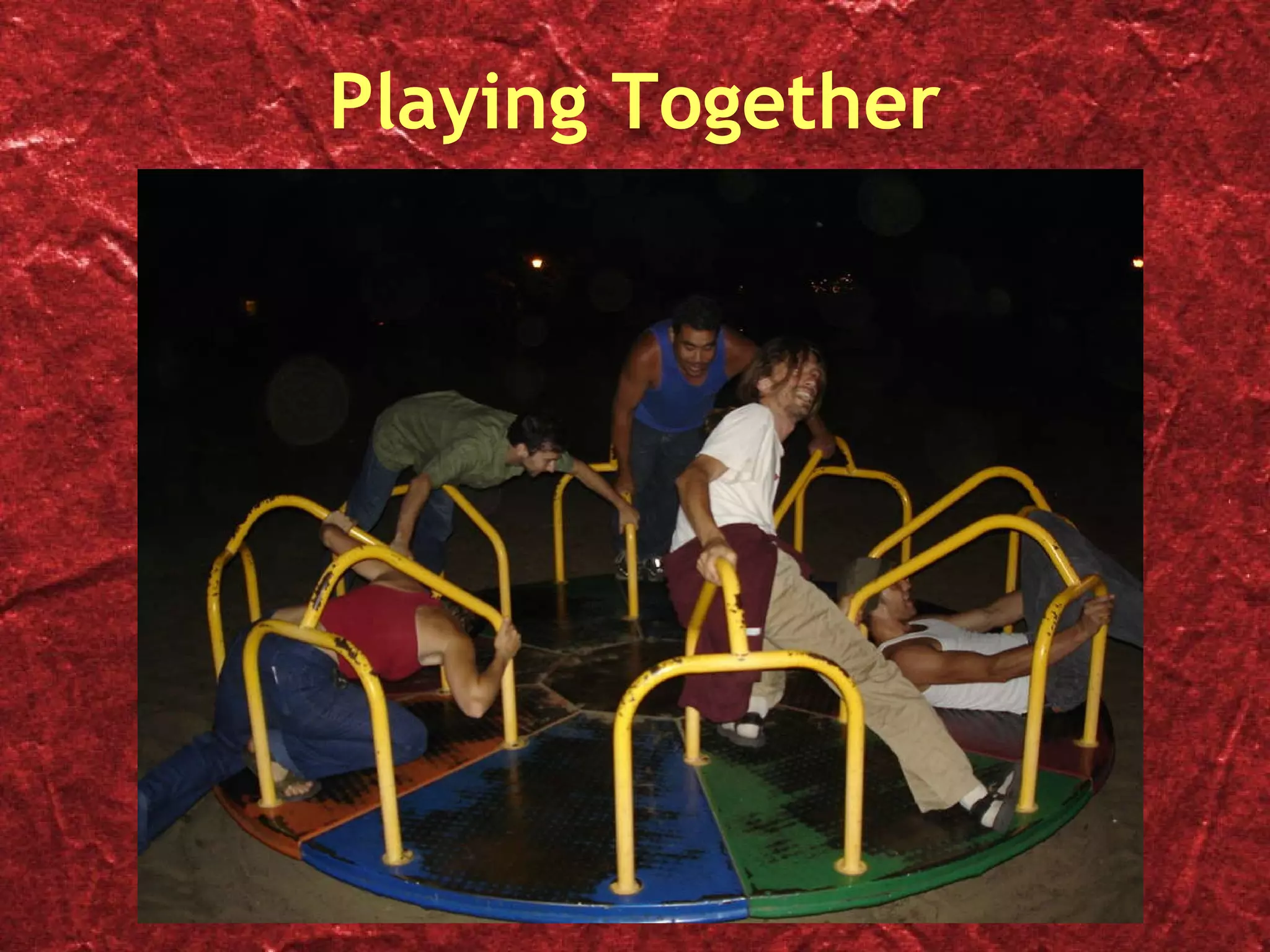
Playing Together
What about Ecovillages? Well, an Ecovillage is the dynamic integration of all of these elements. The last couple weeks of our program were focused on designing Lost Valley as a functioning Ecovillage while integrating all the elements of permaculture.
What is an Ecovillage? A human scale Full featured settlement In which human activities are harmlessly integrated into the natural world In a way that is supportive of healthy human development and can be successfully continued into the indefinite future.
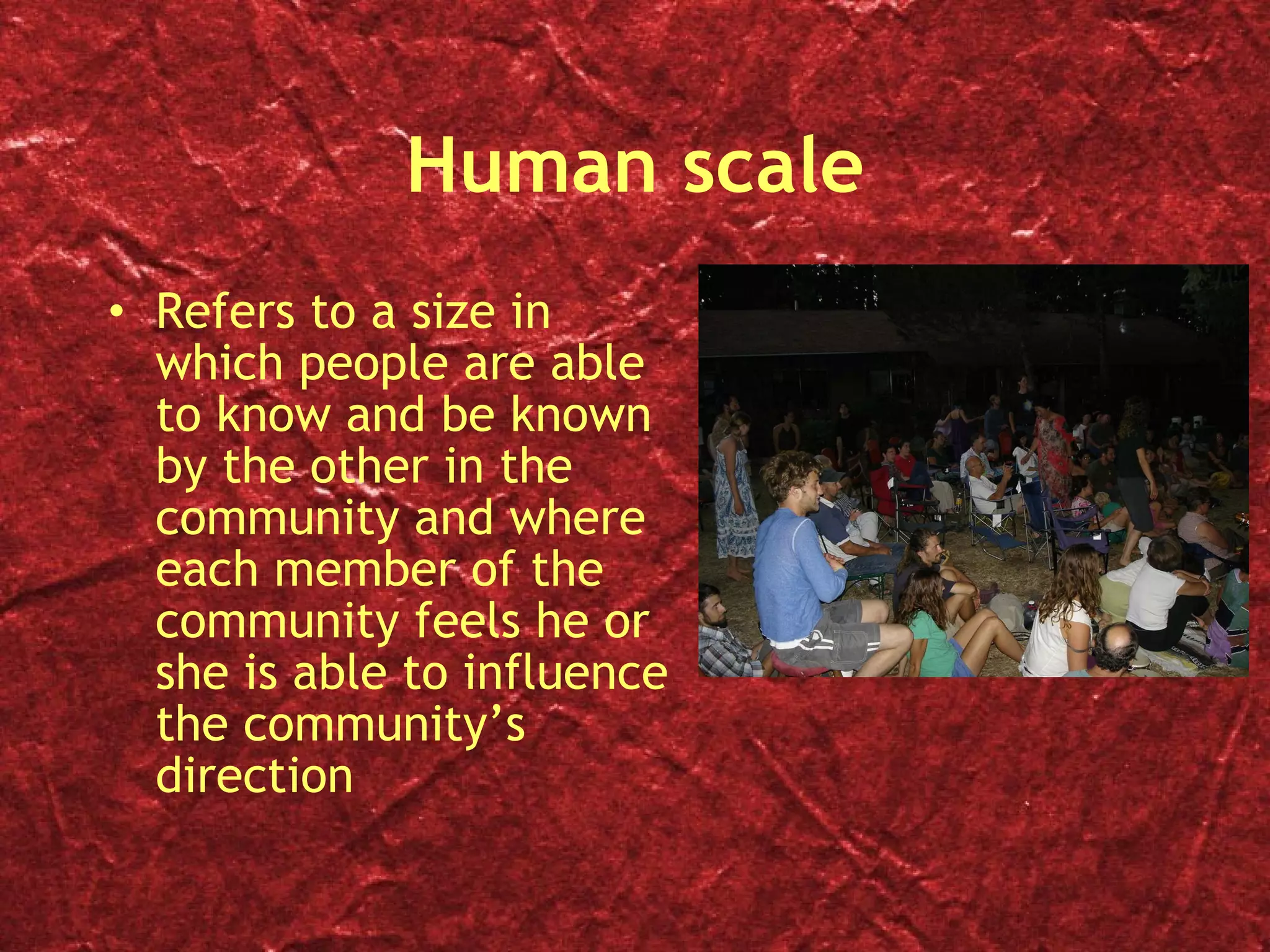
Human scale Refers to a size in which people are able to know and be known by the other in the community and where each member of the community feels he or she is able to influence the community’s direction
Fully featured settlement Is one which all the major functions of normal living-residence, food provision, manufacture, leisure, social life, and commerce are plainly present and in balanced proportions
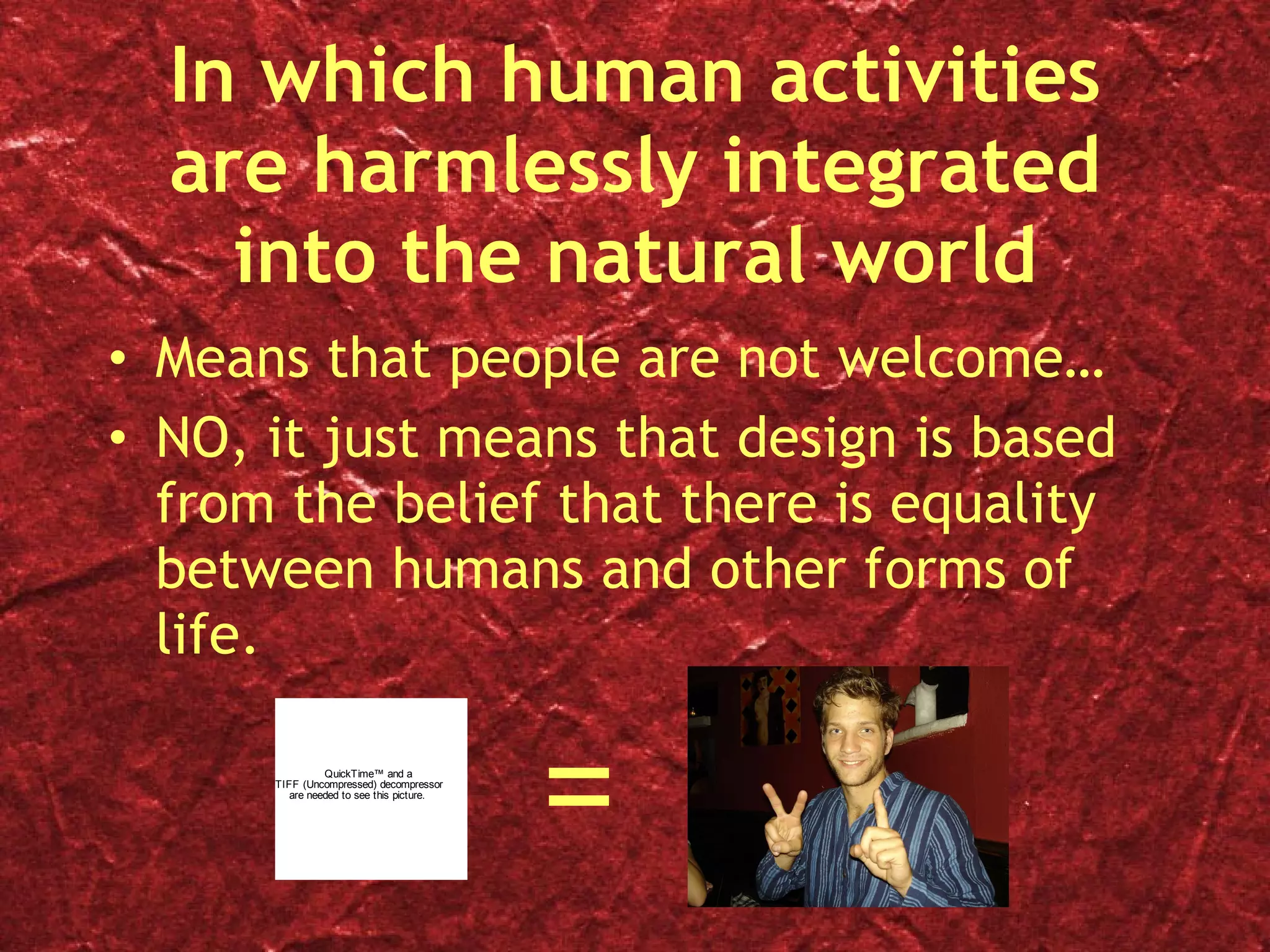
In which human activities are harmlessly integrated into the natural world Means that people are not welcome… NO, it just means that design is based from the belief that there is equality between humans and other forms of life. =
In a way that is supportive of healthy human development Is structured in a way that involves a balanced and integrated development of all aspects of human life- physical, emotional, mental, and spiritual.
And that can be successfully continued into the indefinite future This is the sustainability principle, which brings with it a profound commitment to fairness and non-exploitation toward other parts of today’s world, human and non-human, and towards all future life.
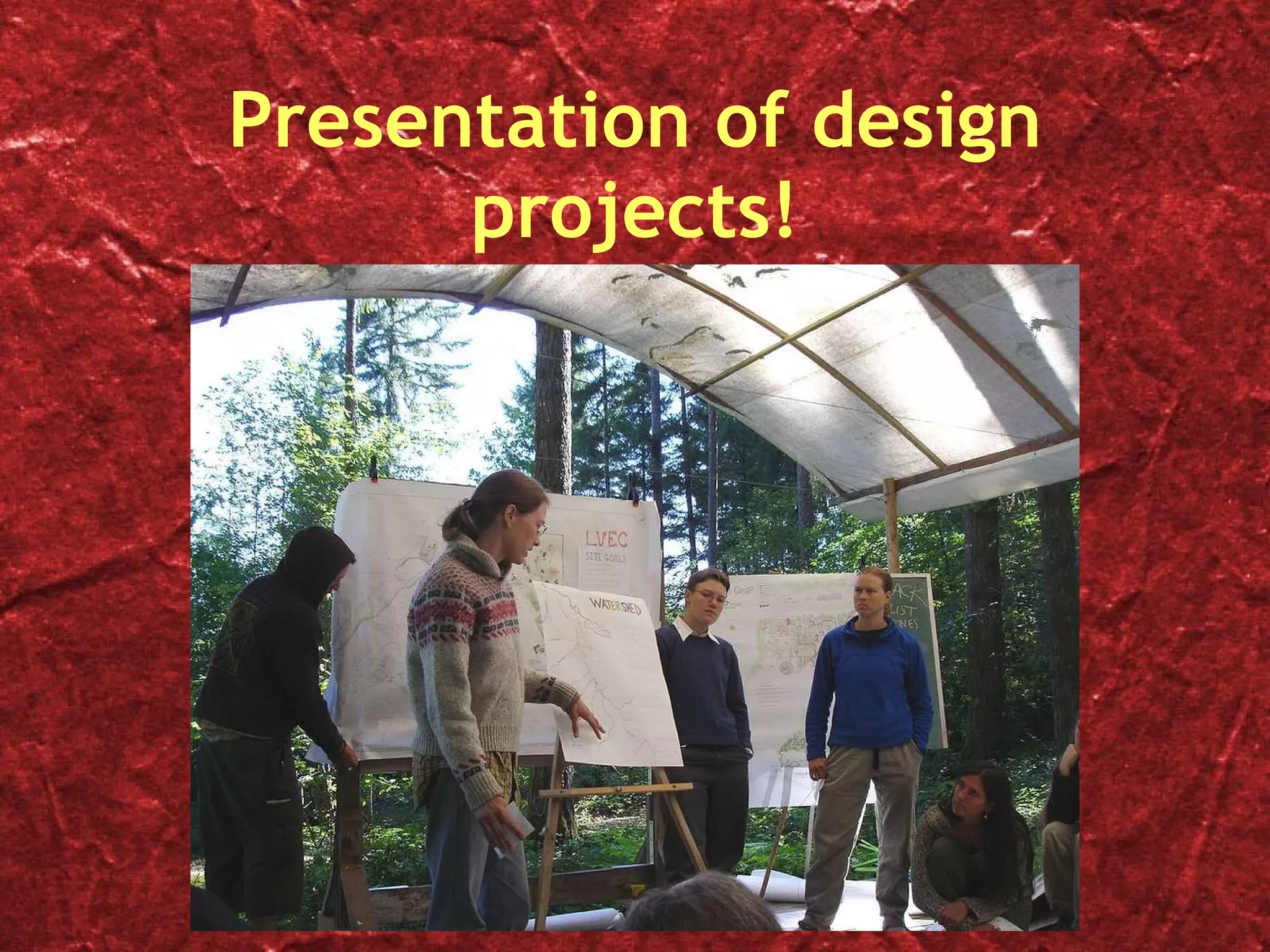
Presentation of design projects!
Useful Links Lost Valley Website  www.lostvalley.org Biodiesel  www.biodiesel.org Intentional Communities Website  www.ic.org Ecovillages  www.ecovillages.org Permaculture International  www.permacultureinternational.org
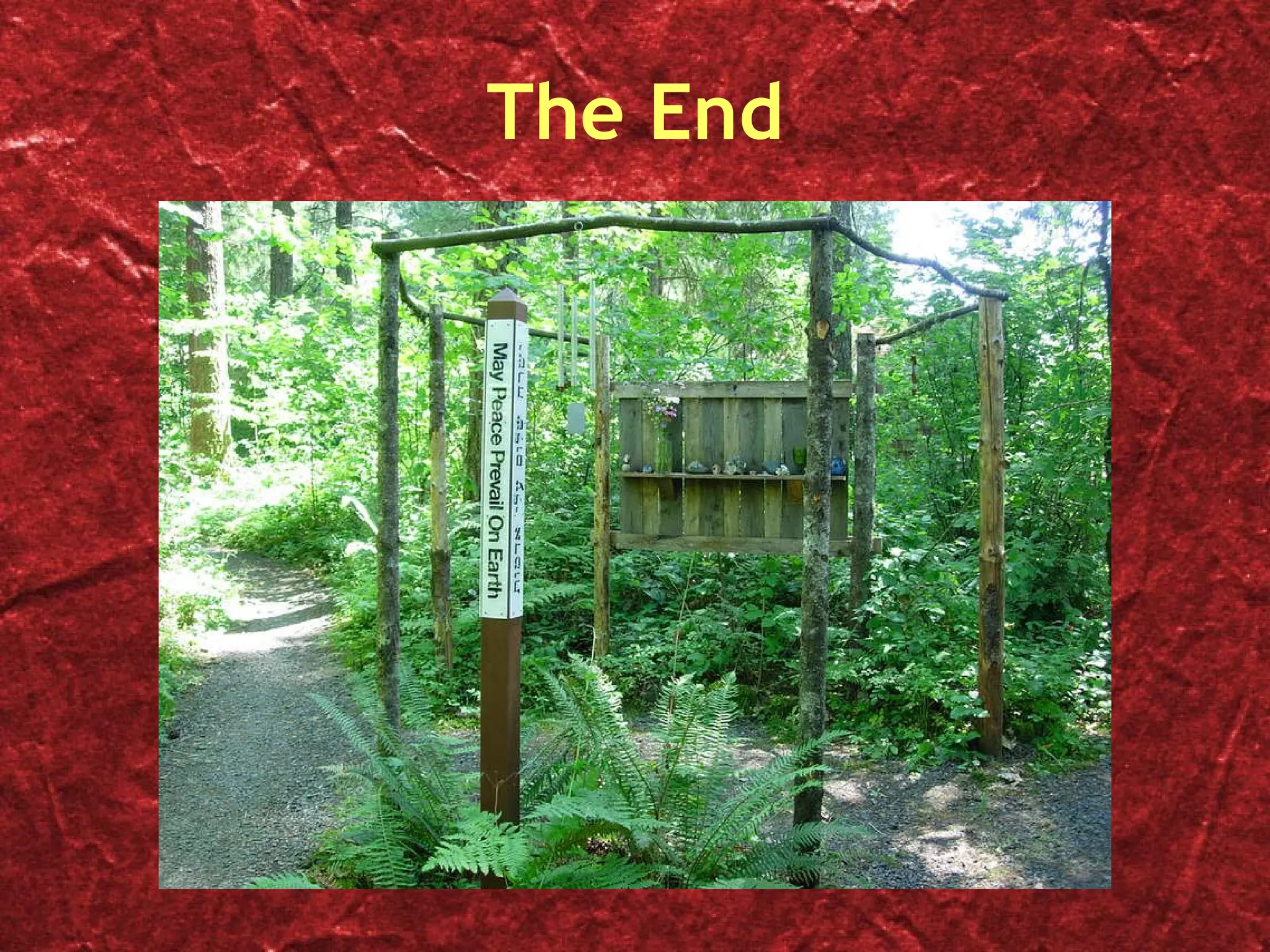
The End

Internship Lost Valley

  • 1.
    My Summer atLost Valley
  • 2.
    Lost ValleyEducational Center is an intentional community and nonprofit educational center dedicated to learning, living, and teaching sustainable, ecologically-based culture.
  • 3.
    The mission ofLost Valley Educational Center is to create and foster mutually beneficial relations between humans and all parts of the web of existence. We believe that these relationships provide a means to well-being as well as survival.
  • 4.
    In fulfilling thismission, our purpose is to create and maintain an intentional community and an educational center dedicated to three goals which guide us in all activities. To educate broadly in areas such as ecology, sustainable agriculture, human-made environments, personal and spiritual growth, and community development. To live an ethic in which we are open to spiritual diversity, demonstrate right livelihood and sustainable economics, support individuals in their personal growth and healing, and steward the land to sustain and heal the earth for generations to come. To participate in the global community, network with others and facilitate the evolution of cooperative societies and socially responsible relationships at every level. We dedicate ourselves to learning and teaching this way of life.
  • 5.
    Ecovillage and PermacultureCertificate Program: Integrating Land, Building, and Social Sustainability A two month holistic introduction to creating ecovillages and sustainable communities.
  • 6.
    What Is Permaculture?PERMACULTURE, from PERMAment agriCULTURE, is a practical system of ecological design. By learning to mirror the patterns found in healthy natural environments, you can build profitable, productive, sustainable, cultivated ecosystems which have the diversity, stability, and resilience of natural ecosystems Permaculture designs range from households to major agricultural enterprises and even whole bio-regions. It integrates disciplines relating to food, shelter, energy, water, waste mangement, economics and social sciences to create whole systems capable of reclaiming devastated lands and building sound social/economic systems.
  • 7.
    The Difference isin the Ethic! Most design systems are defined by a "market driven" ethic in which most considerations are subservient to the conclusions of a short term cost/benefit analysis, discounting or ignoring such factors as environmental degradation or destruction of human community. Permaculture departs from any other design system in that it is guided by a common sense ethical system which forms the criteria for design decisions. The ethic is Care of the Earth Care of the People of the Earth Conscious Frugality System surpluses distributed to accomplish these aims
  • 8.
  • 9.
    What does LostValley do to Be more sustainable? PERMACULTURE APPLIED New Forest Meadow Pond Swale Systems Hedgerows Forest Gardening Nut Orchard Orchards Gardens Chickens Solar Hot Water Systems Greywater System Our diverse young forest contrasts with the douglas fir monoculture common in Oregon and will serve as a multi-ecosystem and multi-functional forest in the future.
  • 10.
    Sustainable Gardening Usespermaculture principles Does not use chemicals Uses perennial and native plants Has an emphasis on diversity Employs energy recycling techniques Maximizes edge and diversity of landscape Encourages mutually beneficial natural systems
  • 11.
    Energy Recycling Greywater system Black water system Use of biomass chickens
  • 12.
    Appropriate Technology Compactfluorescent light bulb Haybox Solar cooker Photovoltaic system Solar-assisted shower and clothes washer Efficient clothes washer Energy-efficient dryer Wastewater leach field Solar Hot Water Panels Solar Shower Reduced flush volume in toilet tanks Insulation wherever possible Our south-facing solar water heating panels preheat the water in our lodge during the summer months
  • 13.
    A little aboutthe program 24 students of all ages and walks of life Lived in tents Hands on learning Integrated into community Culminated in a final design project of Lost Valley in 2010
  • 14.
  • 15.
    The Creek Wherewe swam, played and did stream restoration to increase habitat and water quality
  • 16.
    The Meadow Wherewe slept Where we collected medicinal herbs Fire pit for celebrations
  • 17.
    Three components tothe Program Land and Garden Built Environment Human Community
  • 18.
    Land and GardenSustainable Gardening!
  • 19.
    Stream Restoration Weare moving a log into the stream to slow the flow of water and provide more edge and habitat for aquatic life to flourish We were also moving the log by consensus…
  • 20.
  • 21.
    Garlic labor Garlic,our biggest crop, is being peeled, prepared, and braided for storage
  • 22.
    Making herbal salvesand tinctures Salves are a wax based cream with healing herbs in it that can be used topically Tinctures are usually alcohol based and can be drunken
  • 23.
  • 24.
  • 25.
    Valerian The rootis used as a muscle relaxant,sedative,nervine and is good for insomnia and migranes.
  • 26.
  • 27.
    Yarrow The floweringherb can be applied to wounds and made into a tea. It helps stop bleeding and induces sweating It is good for fever, colds and flu, cystisis, anti-bacterial, anti-inflammatory and is an astringent
  • 28.
  • 29.
    Heal-All (prunella) Theflowering herb is a good poultice for skin wounds and bites
  • 30.
  • 31.
    Common Plantain Leavesare an astringent and make a good poultice for wounds, burns, skin irritations, and insect bites. It also relieves pain and itch an acts as an anti-inflammatory
  • 32.
  • 33.
    Comfrey/Knitbone The leavesand roots help repair body tissue for any injury, soothes inflammation, stops bleeding, strengthens bones, and heals respiratory system
  • 34.
    Built Environment Naturalbuilding including: Cob Paper Crete Straw bale Natural wattle and daub variation
  • 35.
    Paper Crete Papercrete,also called fibrous cement, is a remarkable building material made with recycled paper/cardboard, sand, and Portland cement. ハ You mix the dry ingredients together with water to make a slurry. This slurry dries into hard blocks that are strong and incredibly insulative. Papercrete holds its shape even when wet. Except for the cement, all the ingredients are free or almost free, which makes papercrete a very inexpensive building material.
  • 36.
  • 37.
    A papercrete dolphinjust for fun!
  • 38.
    Cob and CobWeave Cob structures are built using clay from the land, sand, and straw. Cob is a simple and versatile building material that can last a long time given a solid roof with an adequate overhang and good plaster. The potentially large thermal mass of cob ensures stable temperatures, staying warm at night and cool during the day.
  • 39.
    Building a cobweave bird blind The frame is made from wood that we sustainably harvested from the land at Lost Valley with hand tools
  • 40.
  • 41.
  • 42.
  • 43.
  • 44.
  • 45.
  • 46.
    Renewable Energy Wealso studies applications of: Biodiesel Wind power Solar power Microhydo power Appropriate design for energy conservation Conbustion stoves
  • 47.
    Making biodiesel Biodieselis most commonly made by chemically altering an organic oil through the use of a catalyst and an alcohol, typically Methanol. The chemical reaction that occurs through this process breaks down the oil molecules and replaces the glycerine portion of the molecule with an alcohol molecule. The glycerine falls to the bottom and is drained off resulting in Biodiesel. For more information Go to: http://www.biodieselcommunity.org
  • 48.
  • 49.
    Human community It’sall about community!!
  • 50.
    Community development Westudied the importance of community and community building techniques Community building at its best is the process of cultivating relationships with people in a way that helps them see their gifts and capacities and motivates them to enthusiastically draw on their gifts to make connections with others and take action toward their vision of success.
  • 51.
    We studies andemployed structures and workshops to consciously cultivate a strong sense of community and encouraged a way of seeing and a way of relating and interacting characterized by openness and respect.
  • 52.
  • 53.
  • 54.
  • 55.
  • 56.
    Traveling in stylewith Biodiesel
  • 57.
  • 58.
  • 59.
  • 60.
    What about Ecovillages?Well, an Ecovillage is the dynamic integration of all of these elements. The last couple weeks of our program were focused on designing Lost Valley as a functioning Ecovillage while integrating all the elements of permaculture.
  • 61.
    What is anEcovillage? A human scale Full featured settlement In which human activities are harmlessly integrated into the natural world In a way that is supportive of healthy human development and can be successfully continued into the indefinite future.
  • 62.
    Human scale Refersto a size in which people are able to know and be known by the other in the community and where each member of the community feels he or she is able to influence the community’s direction
  • 63.
    Fully featured settlementIs one which all the major functions of normal living-residence, food provision, manufacture, leisure, social life, and commerce are plainly present and in balanced proportions
  • 64.
    In which humanactivities are harmlessly integrated into the natural world Means that people are not welcome… NO, it just means that design is based from the belief that there is equality between humans and other forms of life. =
  • 65.
    In a waythat is supportive of healthy human development Is structured in a way that involves a balanced and integrated development of all aspects of human life- physical, emotional, mental, and spiritual.
  • 66.
    And that canbe successfully continued into the indefinite future This is the sustainability principle, which brings with it a profound commitment to fairness and non-exploitation toward other parts of today’s world, human and non-human, and towards all future life.
  • 67.
  • 68.
    Useful Links LostValley Website www.lostvalley.org Biodiesel www.biodiesel.org Intentional Communities Website www.ic.org Ecovillages www.ecovillages.org Permaculture International www.permacultureinternational.org
  • 69.