IoT - Internet of Things
Recent developments and trends
PRESENTED BY
DENNIS JACOB VARGHESE
P8
ROLL NO: 8525
GUIDED BY
Mr. AGESH MARKOSE
ASSISTANT PROFESSOR
DEPARTMENT OF MECHANICAL
ENGINEERING
TKMCE
Contents
● Literature review
● Introduction
● How it works? - Enabling Technologies for IoT
● IoT around us
● Challenges faced
● Major applications
● Conclusion - The future
Literature Review
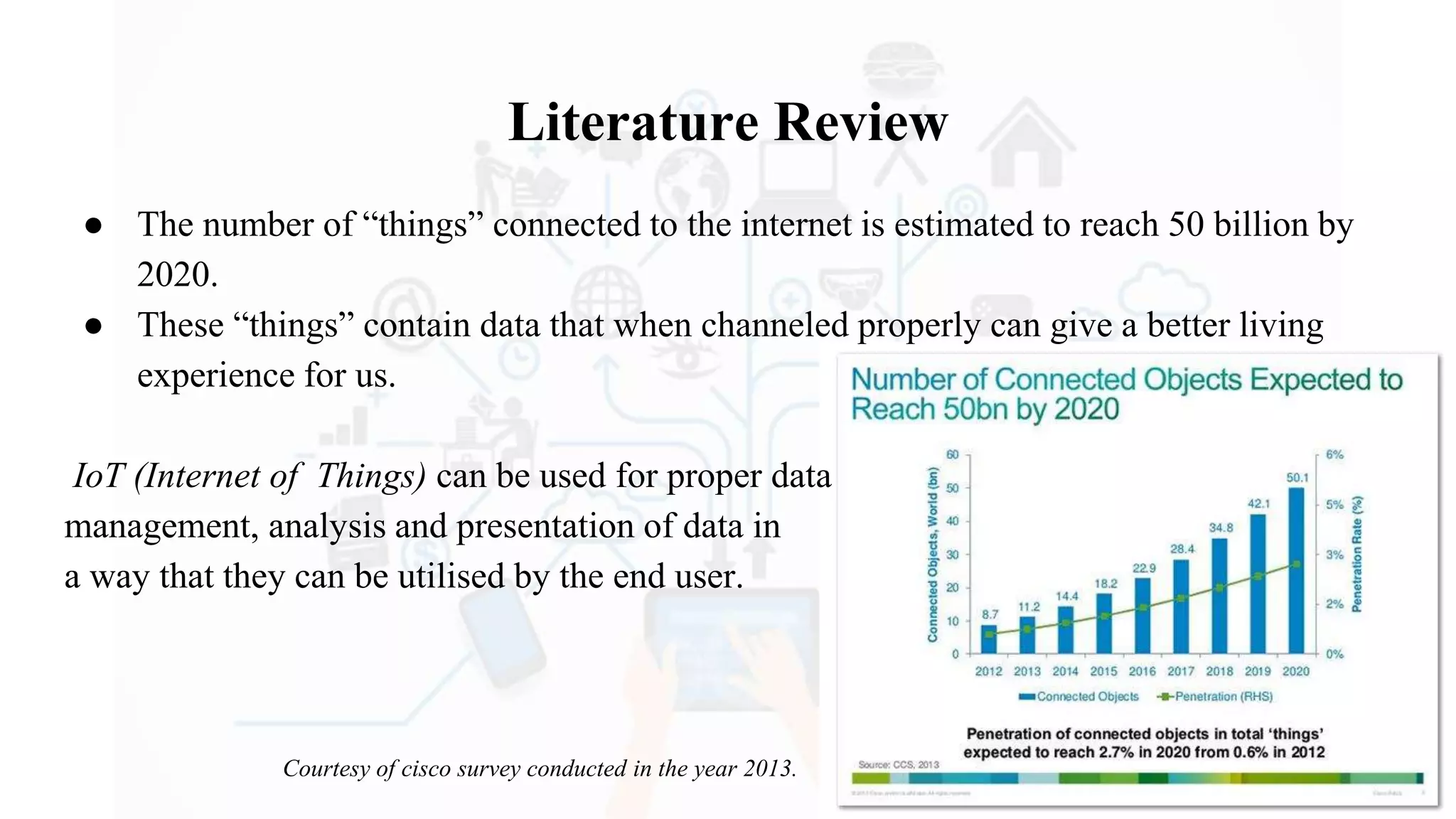
● The number of “things” connected to the internet is estimated to reach 50 billion by
2020.
● These “things” contain data that when channeled properly can give a better living
experience for us.
IoT (Internet of Things) can be used for proper data
management, analysis and presentation of data in
a way that they can be utilised by the end user.
Courtesy of cisco survey conducted in the year 2013.
Literature Review (continued..)
● As there is a hike in the number of devices connected to the network the challenges
faced in running the system also increases.
● As mentioned in her paper by Sabrina, data handled in IoT networks are different
from the traditional internet.
● They mostly contain sensitive data of the users.
● Existing protocols for data transfer (TCP/IP) cannot be used here.
● We require a new security system to meet the new challenges.
Reference: Ad Hoc Networks, Sabrina Sicari
“Internet” & “Things”
Internet - Global system of interconnected computers that use the standard Internet
Protocol Suite (TCP/IP) to serve billions of users worldwide.
“Things” in this context refers to not only electronics but everything including food,
clothing, furniture, automobile, infrastructure, people etc.
So at this point “things” refers to any real object in this physical or material world.
What is IoT - Introduction
Coined from two words “Internet” & “Things”.
The Internet of things is the network of physical devices,vehicles or other items embedded
with electronic sensors, software and connectivity which enables these objects to connect
and exchange data.
In simple words IoT is an ecosystem of connected physical objects that are accessible
through the internet.
Coining and first application
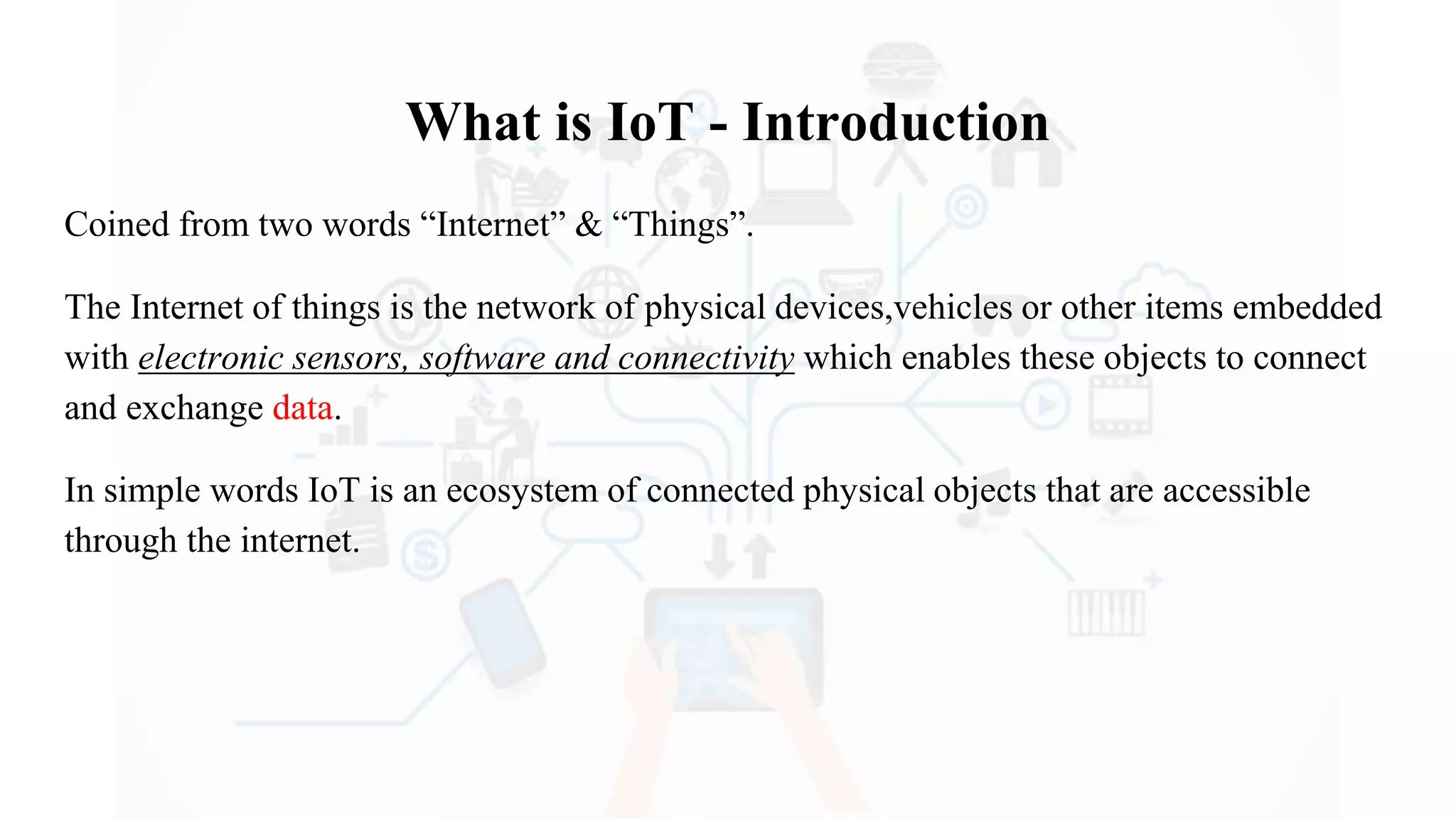
Kevin Aston is credited for coining the term “Internet of things” even though the
buzzword was popularised by the coffee vending machine in Carnegie Mellon
university.
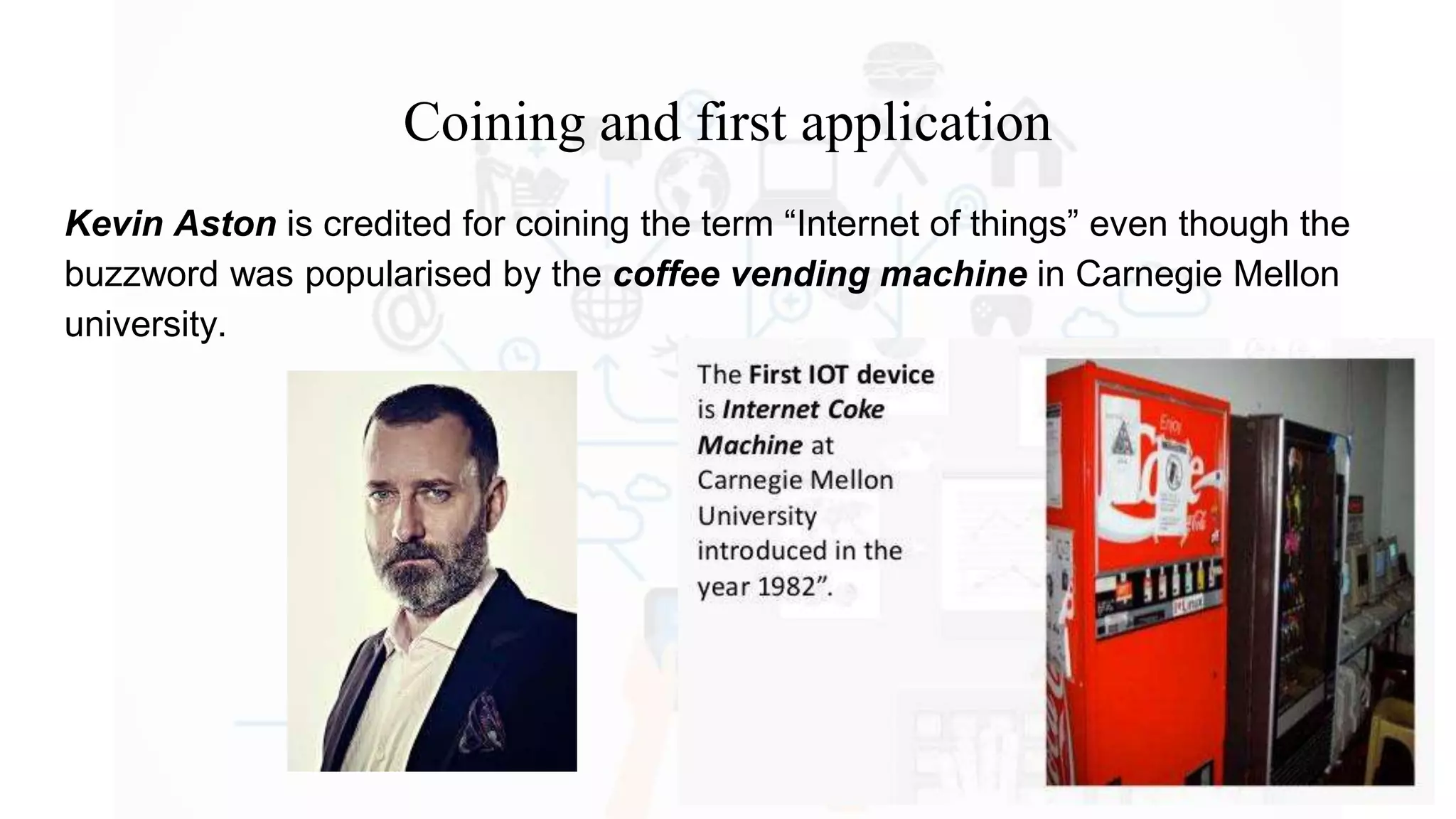
IoT around us
How it works? - Enabling Technologies
There are mainly three main requirements for implementing an IoT network.
➔ Hardware - sensors, actuators, CCTV, RFID tags.
➔ Middleware - on demand storage and computing tools for data analytics
➔ Presentation - visualization,interpretation and control tools.
RFID
RFID - Radio frequency identification
A method where in electromagnetic fields are used to identify and track tags attached to
objects.The tags contain electronically stored information.
RFID offers advantages over manual systems or use of barcodes.
RFID can be used in many applications such as:
● Tracking of goods
● Tracking of people and goods
● Easy payment and toll collection
● Airport baggage tracking logistics
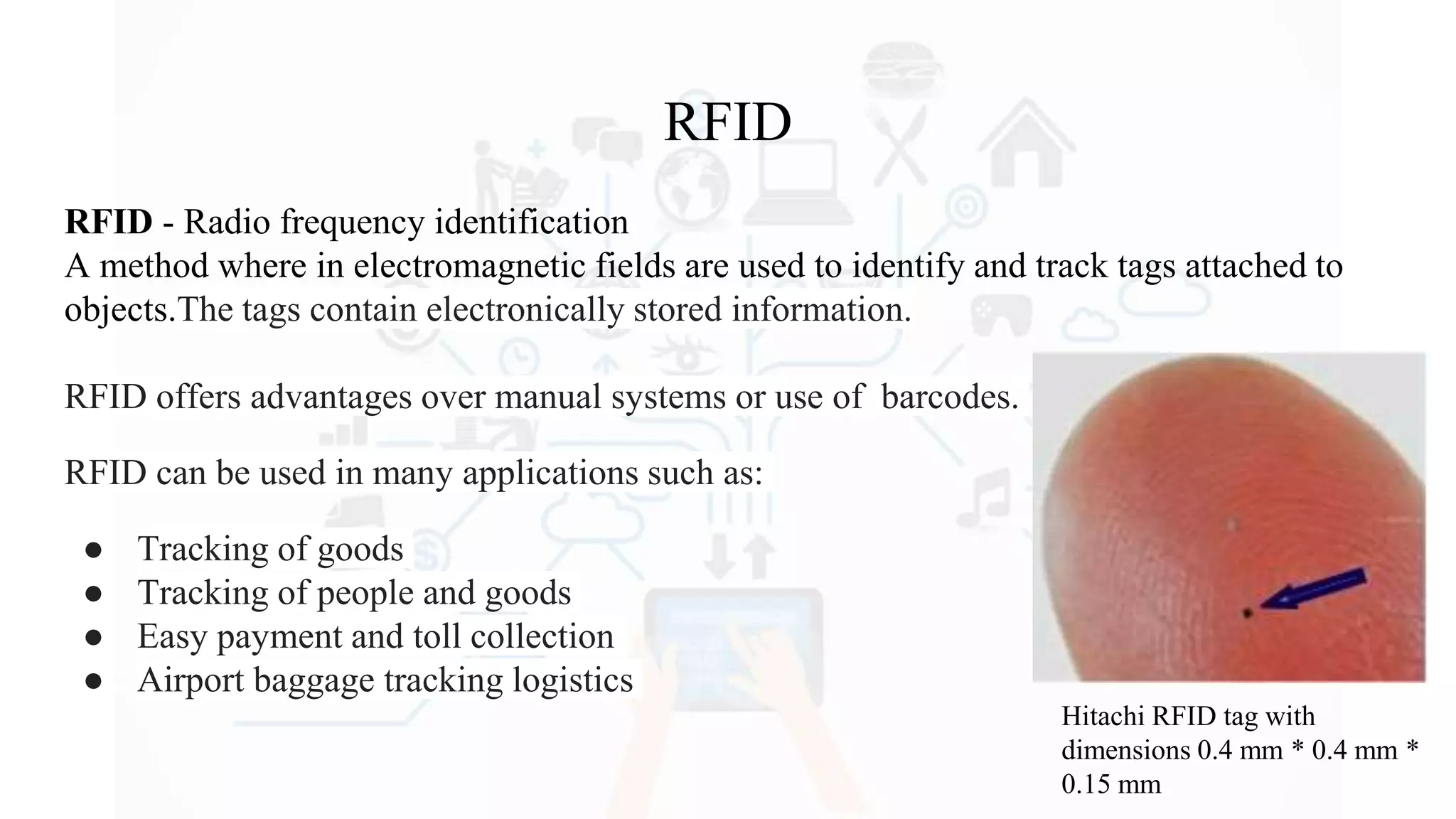
Hitachi RFID tag with
dimensions 0.4 mm * 0.4 mm *
0.15 mm
WSN
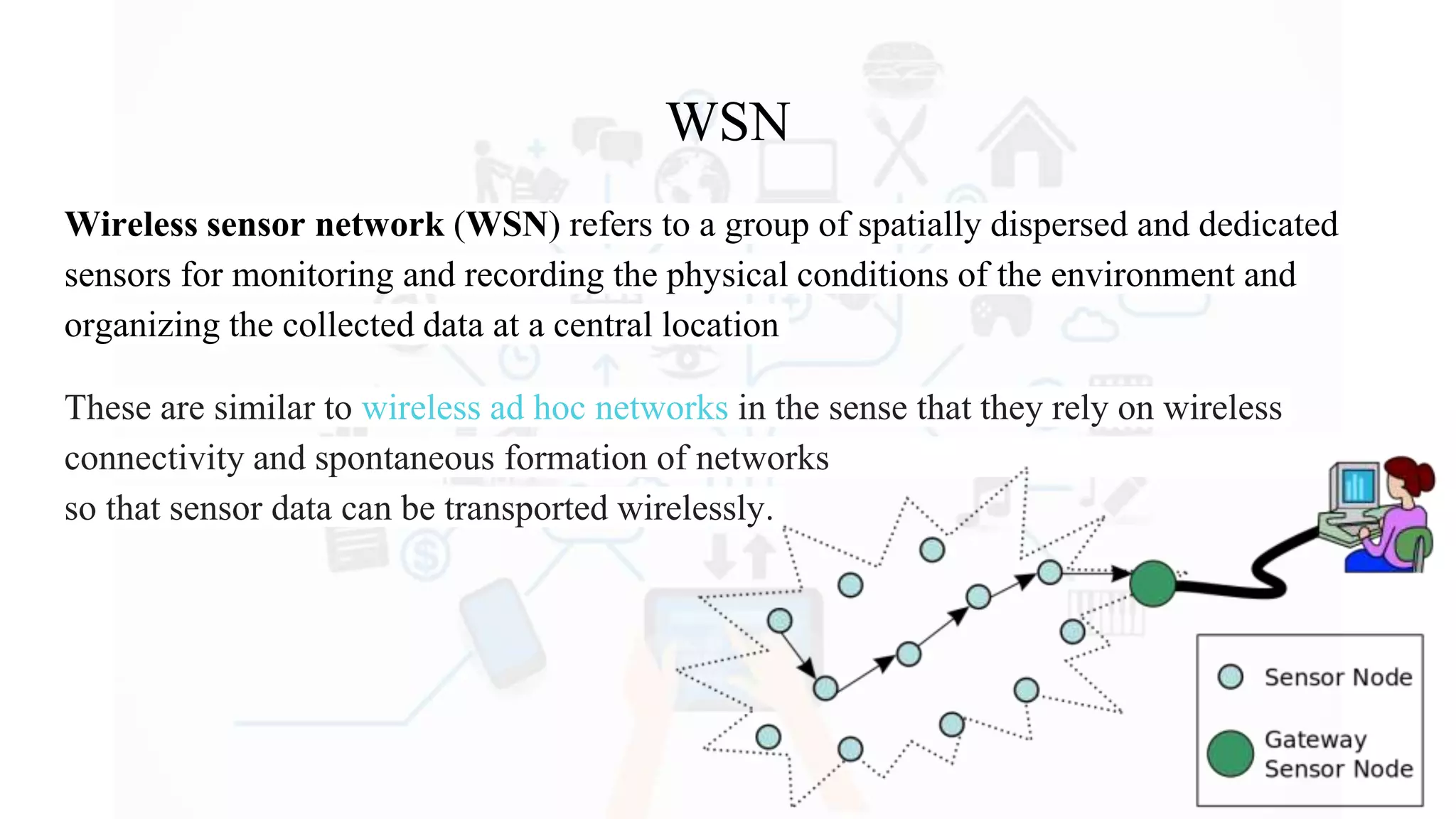
Wireless sensor network (WSN) refers to a group of spatially dispersed and dedicated
sensors for monitoring and recording the physical conditions of the environment and
organizing the collected data at a central location
These are similar to wireless ad hoc networks in the sense that they rely on wireless
connectivity and spontaneous formation of networks
so that sensor data can be transported wirelessly.
Middleware
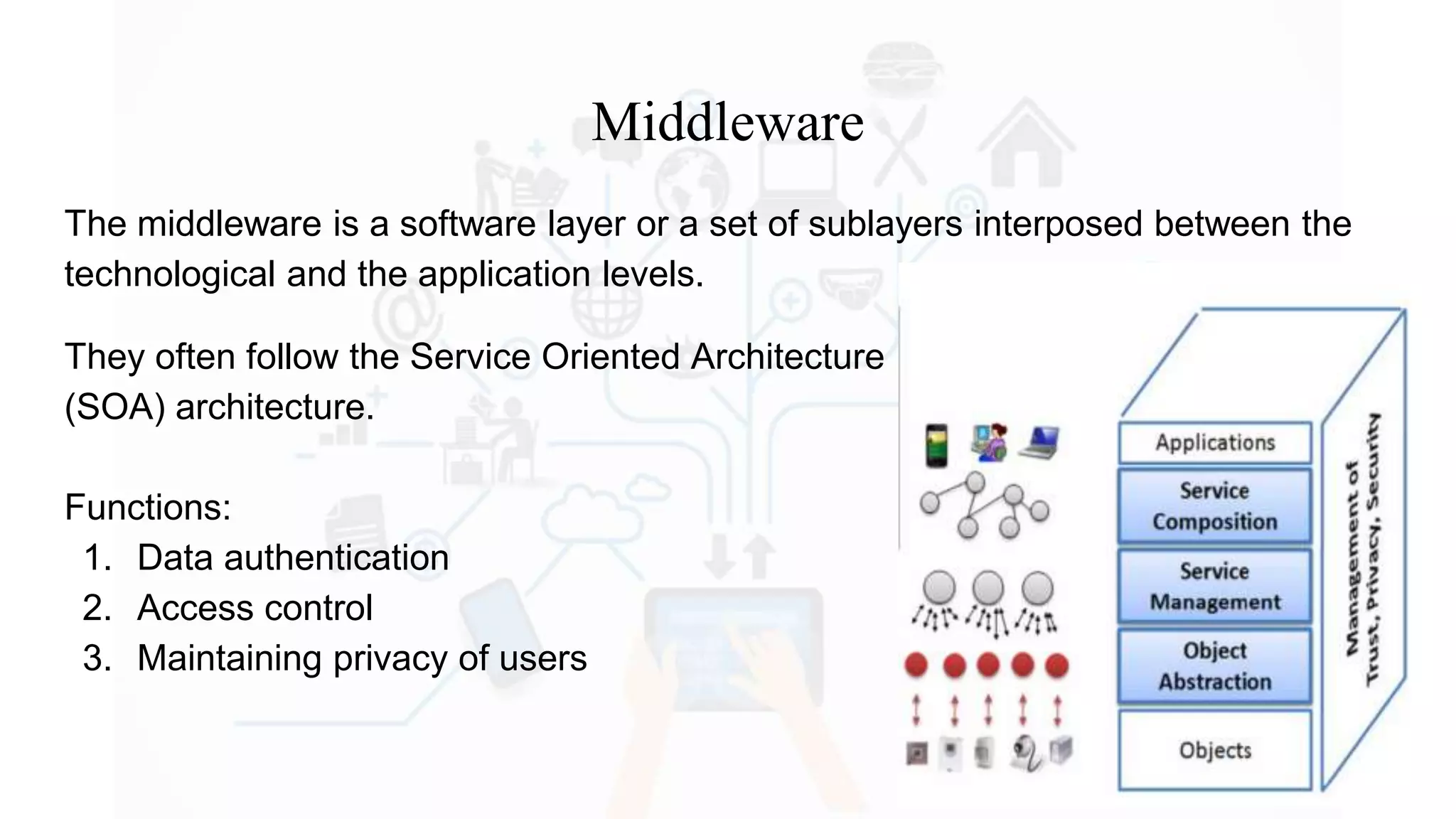
The middleware is a software layer or a set of sublayers interposed between the
technological and the application levels.
They often follow the Service Oriented Architecture
(SOA) architecture.
Functions:
1. Data authentication
2. Access control
3. Maintaining privacy of users
Presentation
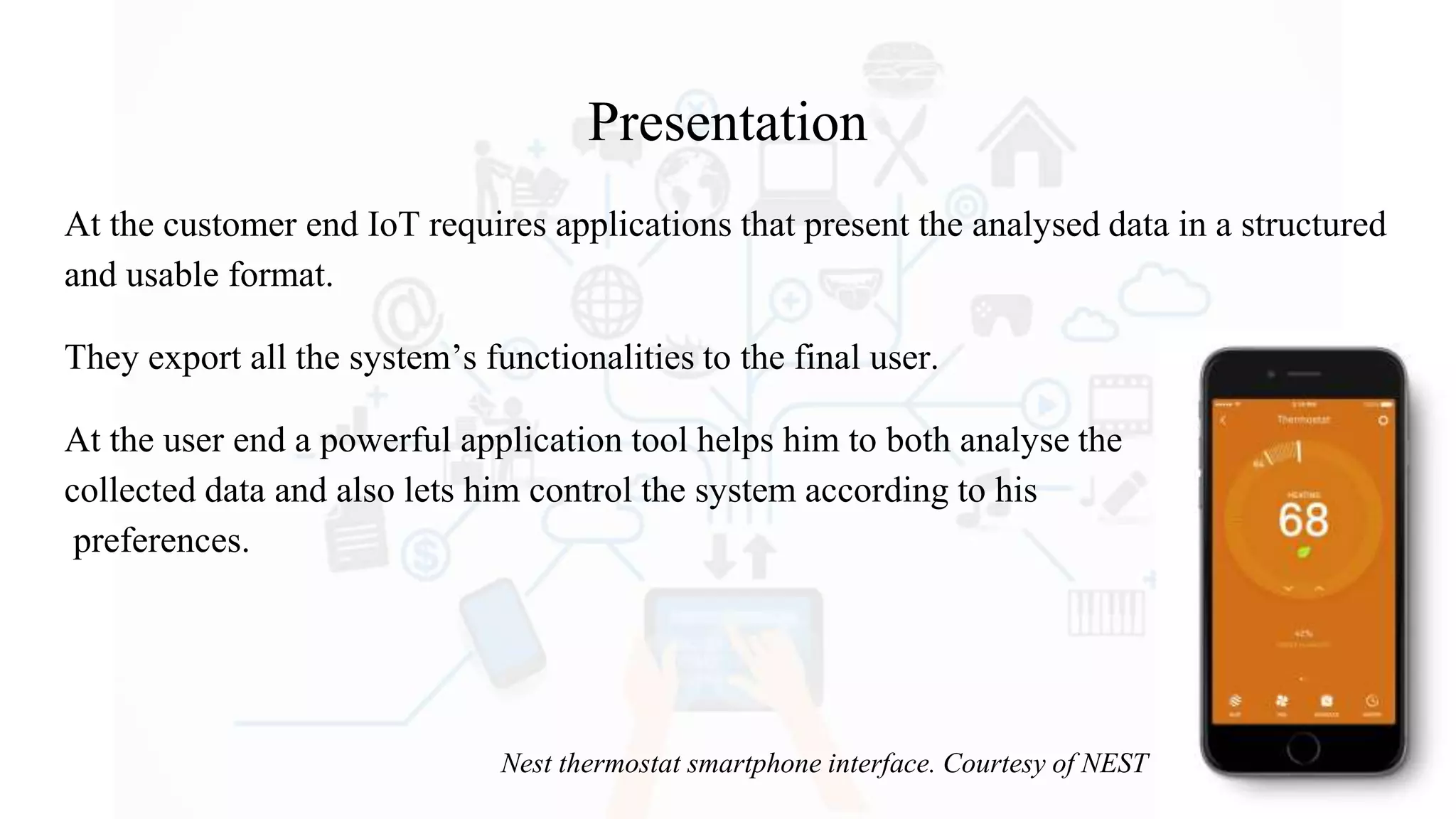
At the customer end IoT requires applications that present the analysed data in a structured
and usable format.
They export all the system’s functionalities to the final user.
At the user end a powerful application tool helps him to both analyse the
collected data and also lets him control the system according to his
preferences.
Nest thermostat smartphone interface. Courtesy of NEST
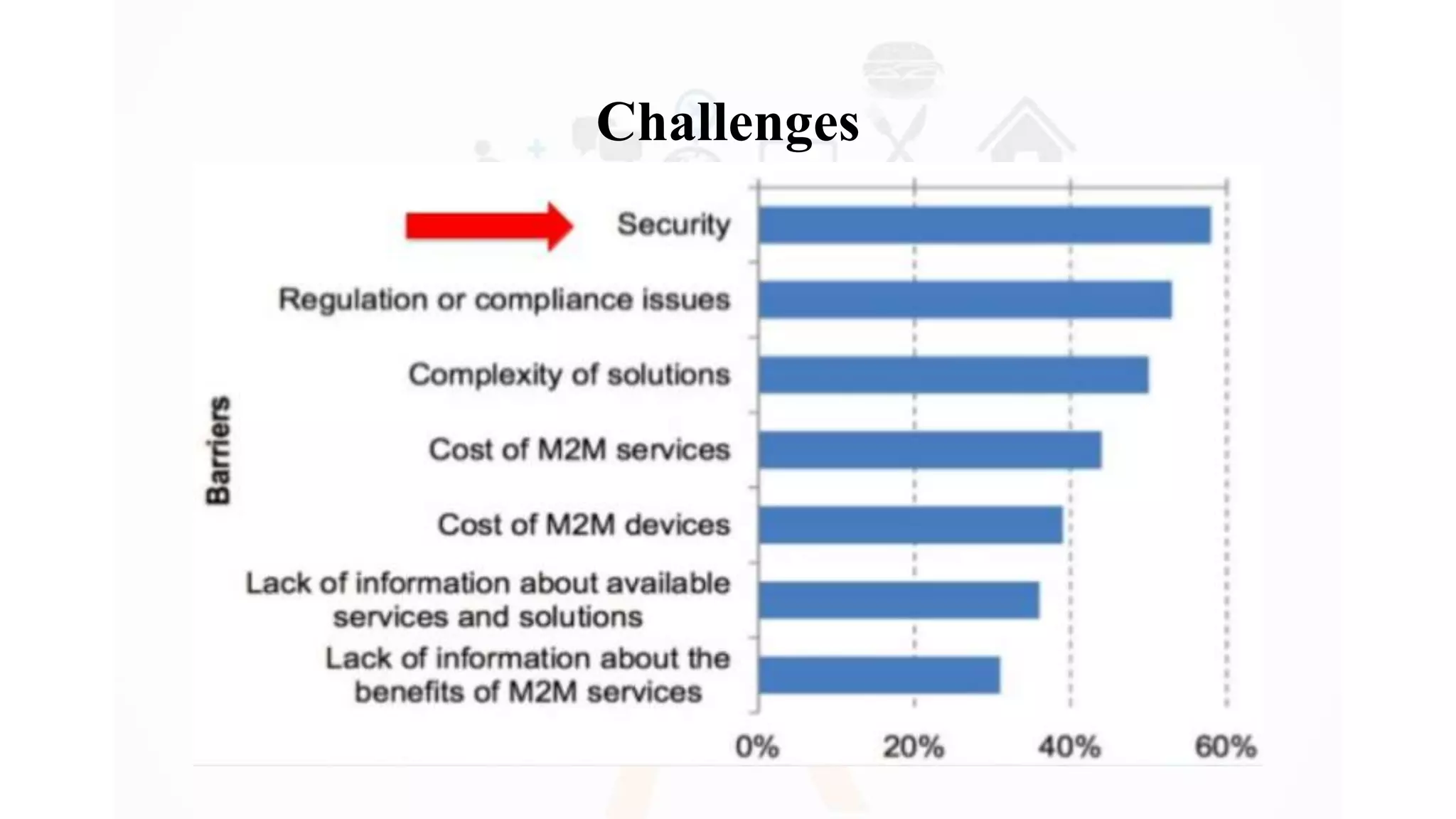
Challenges
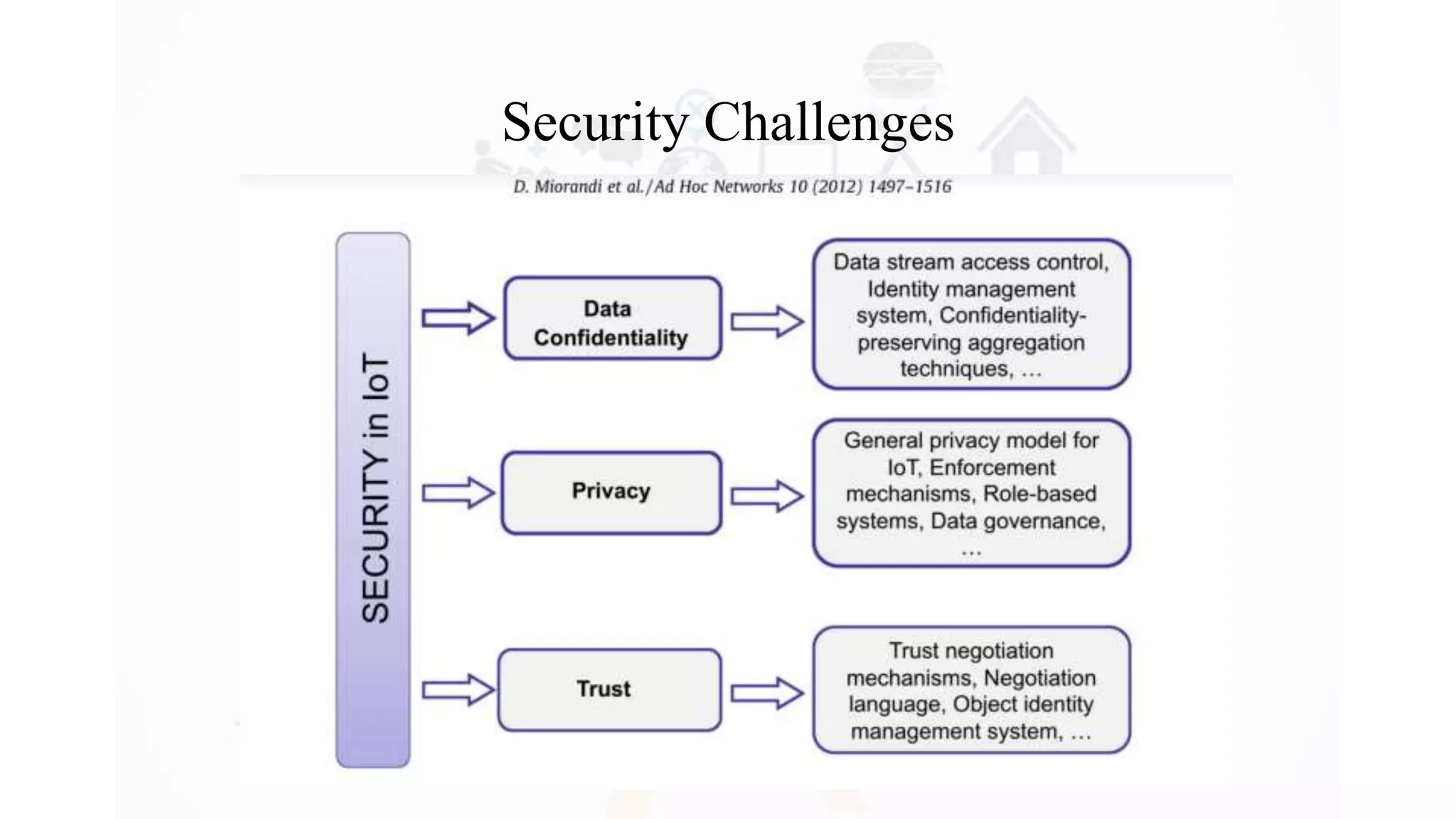
Security Challenges
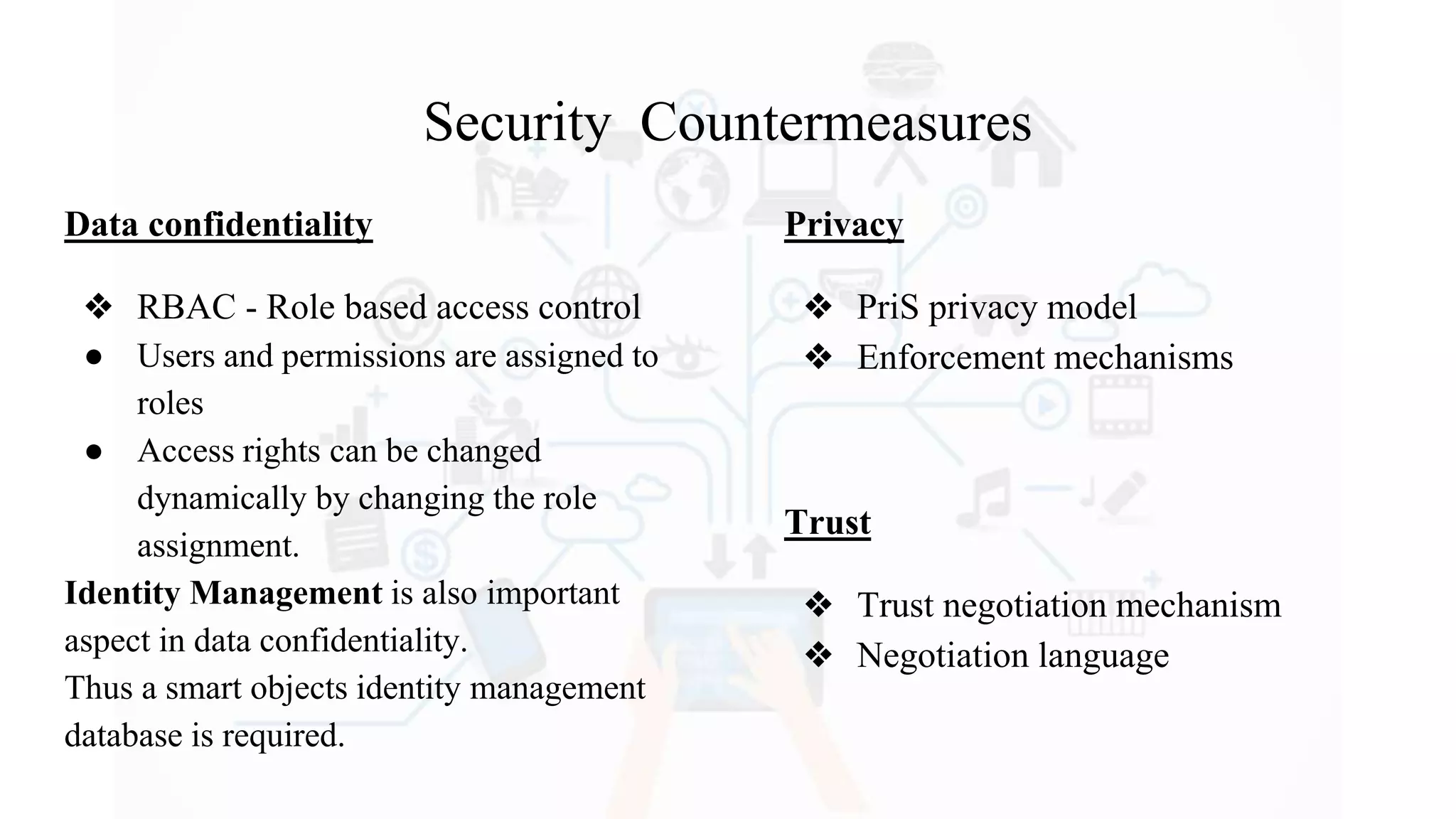
Security Countermeasures
Data confidentiality
❖ RBAC - Role based access control
● Users and permissions are assigned to
roles
● Access rights can be changed
dynamically by changing the role
assignment.
Identity Management is also important
aspect in data confidentiality.
Thus a smart objects identity management
database is required.
Privacy
❖ PriS privacy model
❖ Enforcement mechanisms
Trust
❖ Trust negotiation mechanism
❖ Negotiation language
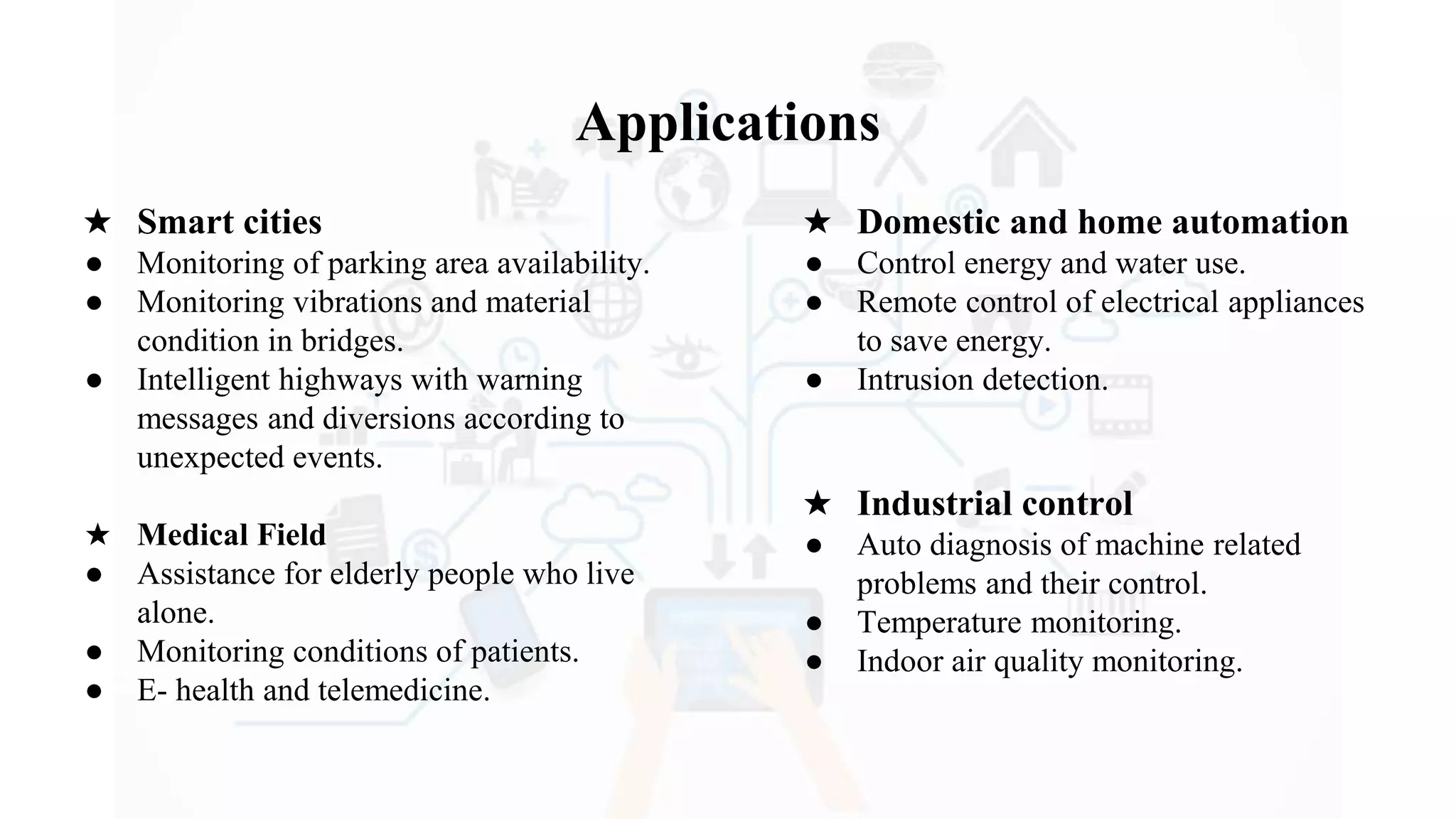
Applications
★ Smart cities
● Monitoring of parking area availability.
● Monitoring vibrations and material
condition in bridges.
● Intelligent highways with warning
messages and diversions according to
unexpected events.
★ Medical Field
● Assistance for elderly people who live
alone.
● Monitoring conditions of patients.
● E- health and telemedicine.
★ Domestic and home automation
● Control energy and water use.
● Remote control of electrical appliances
to save energy.
● Intrusion detection.
★ Industrial control
● Auto diagnosis of machine related
problems and their control.
● Temperature monitoring.
● Indoor air quality monitoring.
Conclusion- The Future
The IoT promises to deliver a step change in individuals’ quality of life and enterprises’
productivity.
Through a widely distributed, locally intelligent network of smart devices, the IoT has the
potential to enable extensions and enhancements to fundamental services in transportation,
security, utilities, education, healthcare and other areas.
Connecting smart devices (things) to the web has already started happening although at a
slower rate.The pieces of the technology puzzle are coming together to accommodate the
Internet of Things sooner than most people expect.
Just as the Internet phenomenon happened not so long ago and caught like a wildfire, IoT
will touch every aspect of our lives in less than a decade.
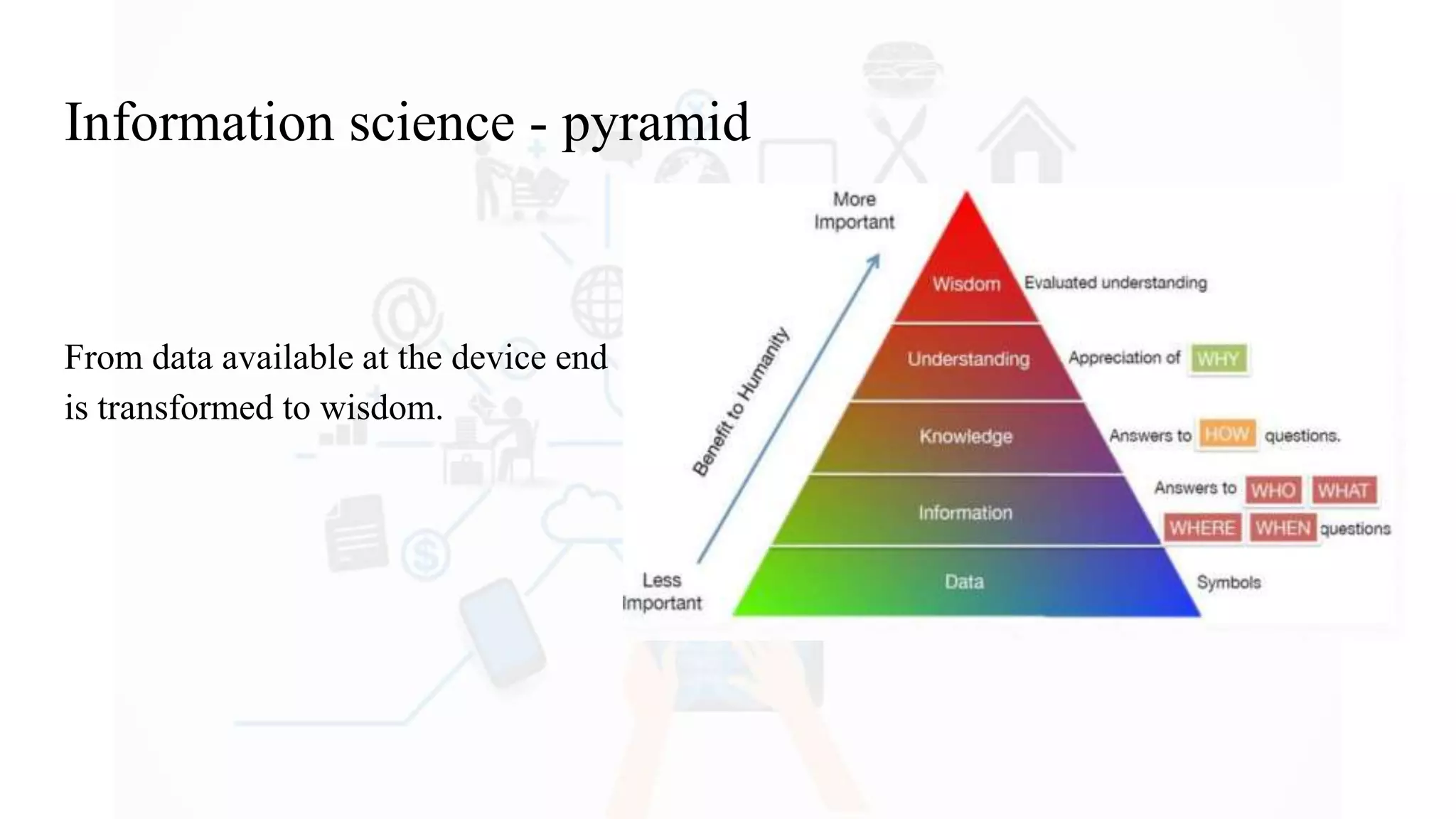
Information science - pyramid
From data available at the device end
is transformed to wisdom.
Thank you very much!

Internet of Things - Recent developments and Trends

  • 1.
    IoT - Internetof Things Recent developments and trends PRESENTED BY DENNIS JACOB VARGHESE P8 ROLL NO: 8525 GUIDED BY Mr. AGESH MARKOSE ASSISTANT PROFESSOR DEPARTMENT OF MECHANICAL ENGINEERING TKMCE
  • 2.
    Contents ● Literature review ●Introduction ● How it works? - Enabling Technologies for IoT ● IoT around us ● Challenges faced ● Major applications ● Conclusion - The future
  • 3.
    Literature Review ● Thenumber of “things” connected to the internet is estimated to reach 50 billion by 2020. ● These “things” contain data that when channeled properly can give a better living experience for us. IoT (Internet of Things) can be used for proper data management, analysis and presentation of data in a way that they can be utilised by the end user. Courtesy of cisco survey conducted in the year 2013.
  • 4.
    Literature Review (continued..) ●As there is a hike in the number of devices connected to the network the challenges faced in running the system also increases. ● As mentioned in her paper by Sabrina, data handled in IoT networks are different from the traditional internet. ● They mostly contain sensitive data of the users. ● Existing protocols for data transfer (TCP/IP) cannot be used here. ● We require a new security system to meet the new challenges. Reference: Ad Hoc Networks, Sabrina Sicari
  • 5.
    “Internet” & “Things” Internet- Global system of interconnected computers that use the standard Internet Protocol Suite (TCP/IP) to serve billions of users worldwide. “Things” in this context refers to not only electronics but everything including food, clothing, furniture, automobile, infrastructure, people etc. So at this point “things” refers to any real object in this physical or material world.
  • 6.
    What is IoT- Introduction Coined from two words “Internet” & “Things”. The Internet of things is the network of physical devices,vehicles or other items embedded with electronic sensors, software and connectivity which enables these objects to connect and exchange data. In simple words IoT is an ecosystem of connected physical objects that are accessible through the internet.
  • 7.
    Coining and firstapplication Kevin Aston is credited for coining the term “Internet of things” even though the buzzword was popularised by the coffee vending machine in Carnegie Mellon university.
  • 8.
  • 9.
    How it works?- Enabling Technologies There are mainly three main requirements for implementing an IoT network. ➔ Hardware - sensors, actuators, CCTV, RFID tags. ➔ Middleware - on demand storage and computing tools for data analytics ➔ Presentation - visualization,interpretation and control tools.
  • 10.
    RFID RFID - Radiofrequency identification A method where in electromagnetic fields are used to identify and track tags attached to objects.The tags contain electronically stored information. RFID offers advantages over manual systems or use of barcodes. RFID can be used in many applications such as: ● Tracking of goods ● Tracking of people and goods ● Easy payment and toll collection ● Airport baggage tracking logistics Hitachi RFID tag with dimensions 0.4 mm * 0.4 mm * 0.15 mm
  • 11.
    WSN Wireless sensor network(WSN) refers to a group of spatially dispersed and dedicated sensors for monitoring and recording the physical conditions of the environment and organizing the collected data at a central location These are similar to wireless ad hoc networks in the sense that they rely on wireless connectivity and spontaneous formation of networks so that sensor data can be transported wirelessly.
  • 12.
    Middleware The middleware isa software layer or a set of sublayers interposed between the technological and the application levels. They often follow the Service Oriented Architecture (SOA) architecture. Functions: 1. Data authentication 2. Access control 3. Maintaining privacy of users
  • 13.
    Presentation At the customerend IoT requires applications that present the analysed data in a structured and usable format. They export all the system’s functionalities to the final user. At the user end a powerful application tool helps him to both analyse the collected data and also lets him control the system according to his preferences. Nest thermostat smartphone interface. Courtesy of NEST
  • 15.
  • 16.
  • 17.
    Security Countermeasures Data confidentiality ❖RBAC - Role based access control ● Users and permissions are assigned to roles ● Access rights can be changed dynamically by changing the role assignment. Identity Management is also important aspect in data confidentiality. Thus a smart objects identity management database is required. Privacy ❖ PriS privacy model ❖ Enforcement mechanisms Trust ❖ Trust negotiation mechanism ❖ Negotiation language
  • 18.
    Applications ★ Smart cities ●Monitoring of parking area availability. ● Monitoring vibrations and material condition in bridges. ● Intelligent highways with warning messages and diversions according to unexpected events. ★ Medical Field ● Assistance for elderly people who live alone. ● Monitoring conditions of patients. ● E- health and telemedicine. ★ Domestic and home automation ● Control energy and water use. ● Remote control of electrical appliances to save energy. ● Intrusion detection. ★ Industrial control ● Auto diagnosis of machine related problems and their control. ● Temperature monitoring. ● Indoor air quality monitoring.
  • 19.
    Conclusion- The Future TheIoT promises to deliver a step change in individuals’ quality of life and enterprises’ productivity. Through a widely distributed, locally intelligent network of smart devices, the IoT has the potential to enable extensions and enhancements to fundamental services in transportation, security, utilities, education, healthcare and other areas. Connecting smart devices (things) to the web has already started happening although at a slower rate.The pieces of the technology puzzle are coming together to accommodate the Internet of Things sooner than most people expect. Just as the Internet phenomenon happened not so long ago and caught like a wildfire, IoT will touch every aspect of our lives in less than a decade.
  • 20.
    Information science -pyramid From data available at the device end is transformed to wisdom.
  • 21.

Editor's Notes

  • #8 Kevin Aston was the Executive Director of Auto-ID labs in MIT in 1999.