WEEK 5
THE INTERNET OF THINGS IS CHANGING
HOW WE LIVE
IAS101- INFORMATION ASSURANCE AND SECURITY
By : Raul S. Acapulco
2
• Determine the evolution of IoT
• Recognize the impact of the Internet of Things
on people and businesses.
• Understand how the different IoT applications
are applied in many devices.
3
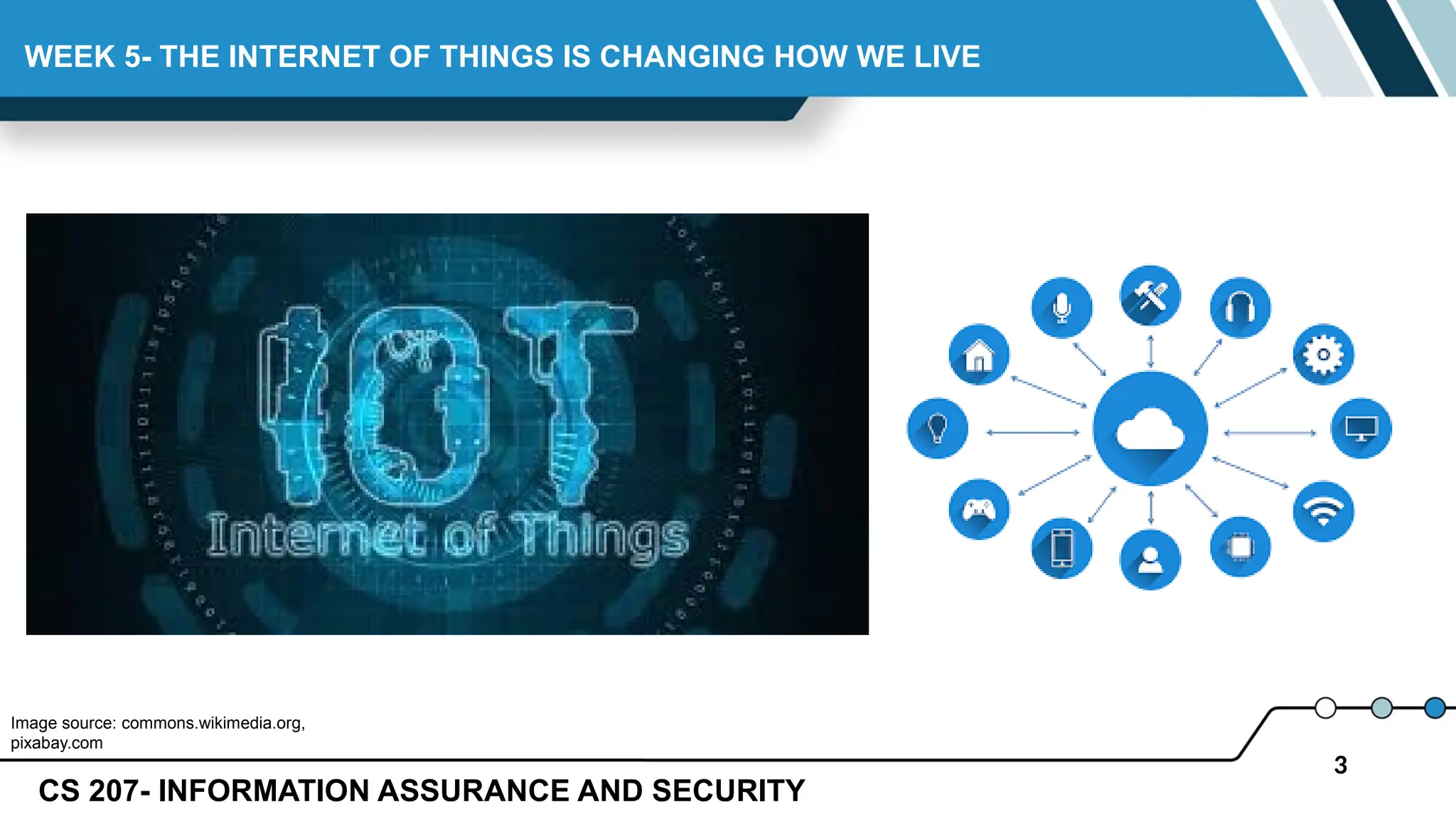
Image source: commons.wikimedia.org,
pixabay.com
WEEK 5- THE INTERNET OF THINGS IS CHANGING HOW WE LIVE
CS 207- INFORMATION ASSURANCE AND SECURITY
4
What is IOT?
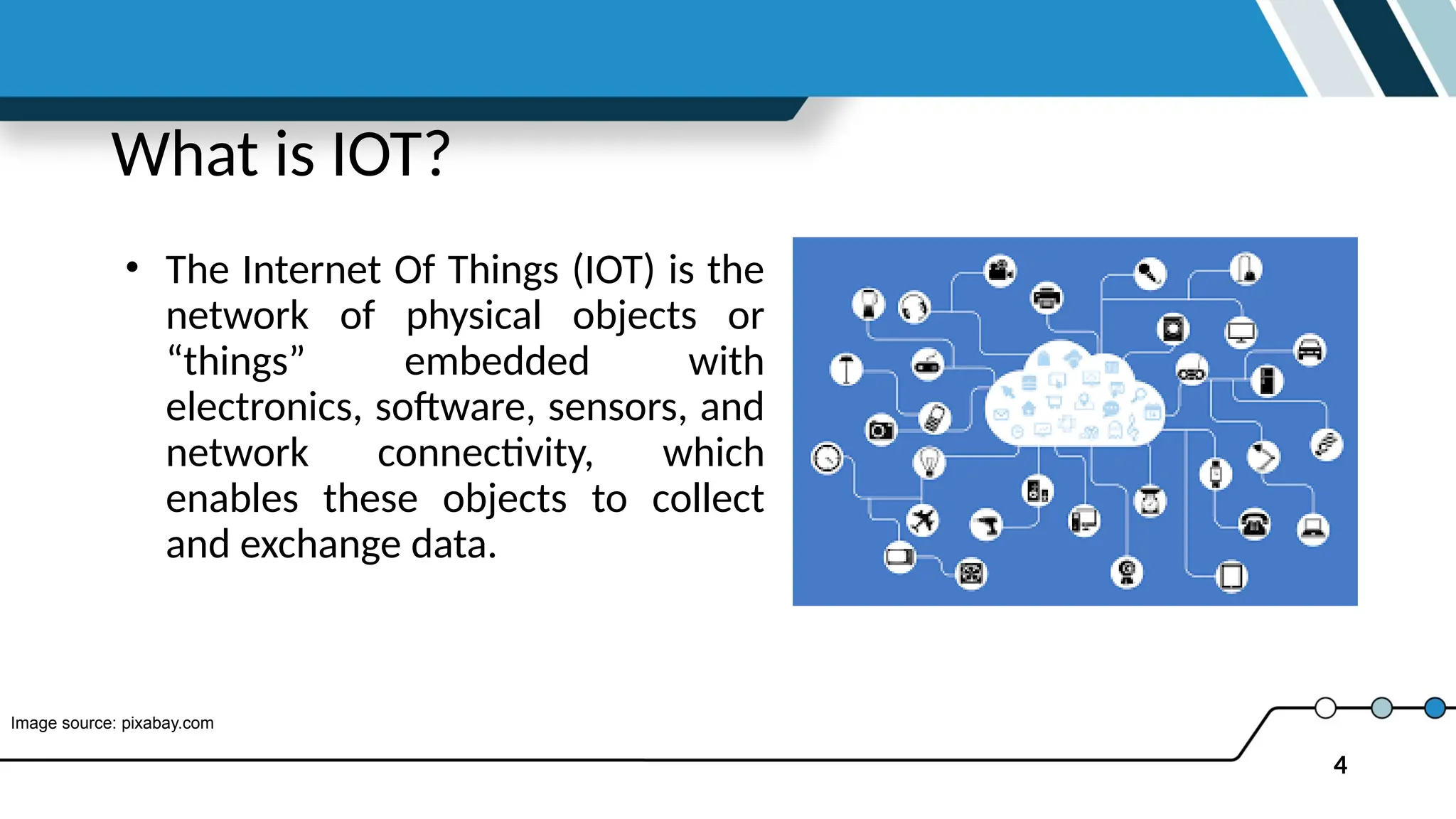
• The Internet Of Things (IOT) is the
network of physical objects or
“things” embedded with
electronics, software, sensors, and
network connectivity, which
enables these objects to collect
and exchange data.
Image source: pixabay.com
5
What is IOT?
• The “Thing” in the context of IOT, is an entity or physical object
that has a unique identifier, an embedded system and the ability
to transfer data over a network.
6
What is IOT?
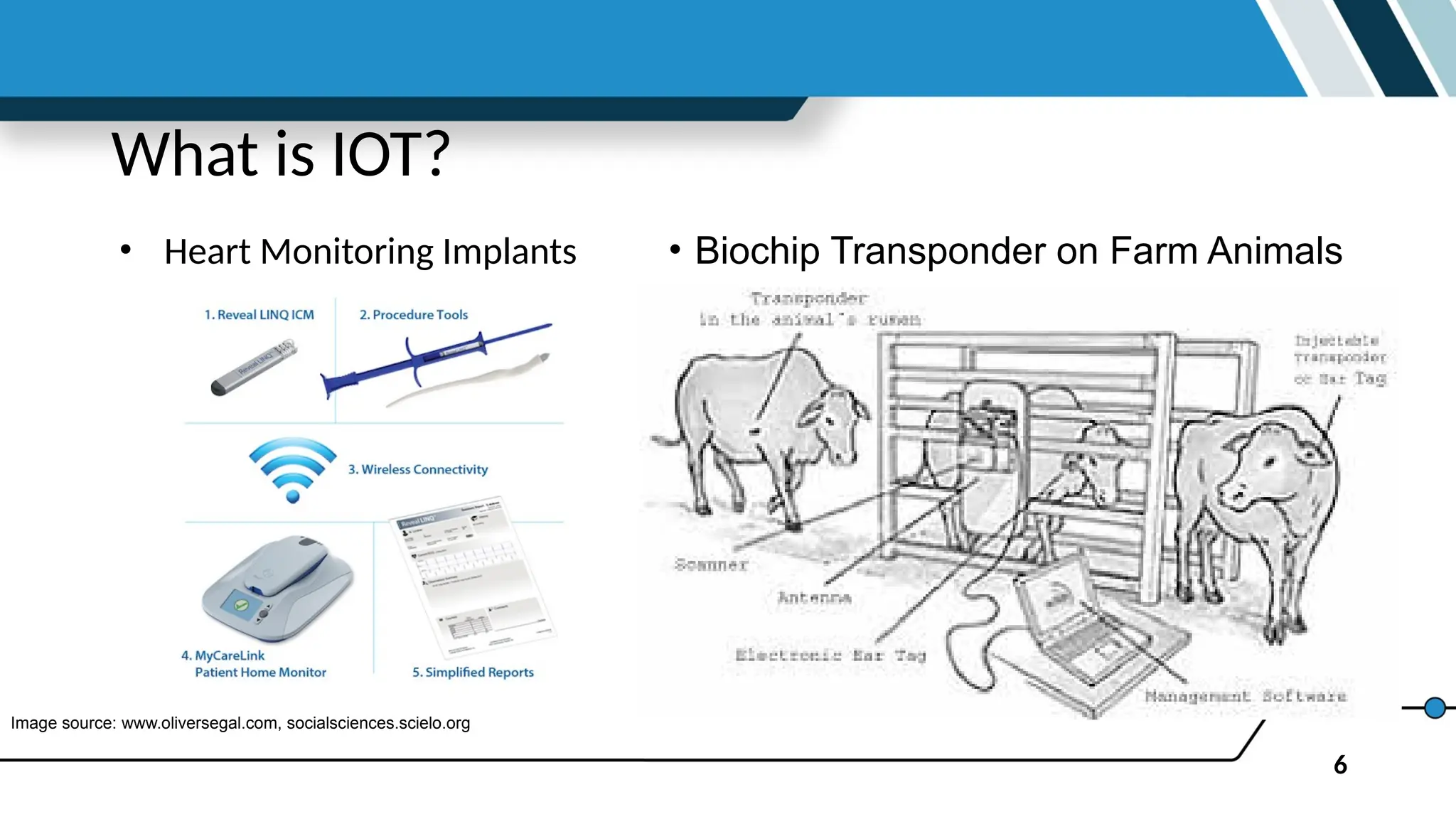
• Heart Monitoring Implants • Biochip Transponder on Farm Animals
Image source: www.oliversegal.com, socialsciences.scielo.org
7
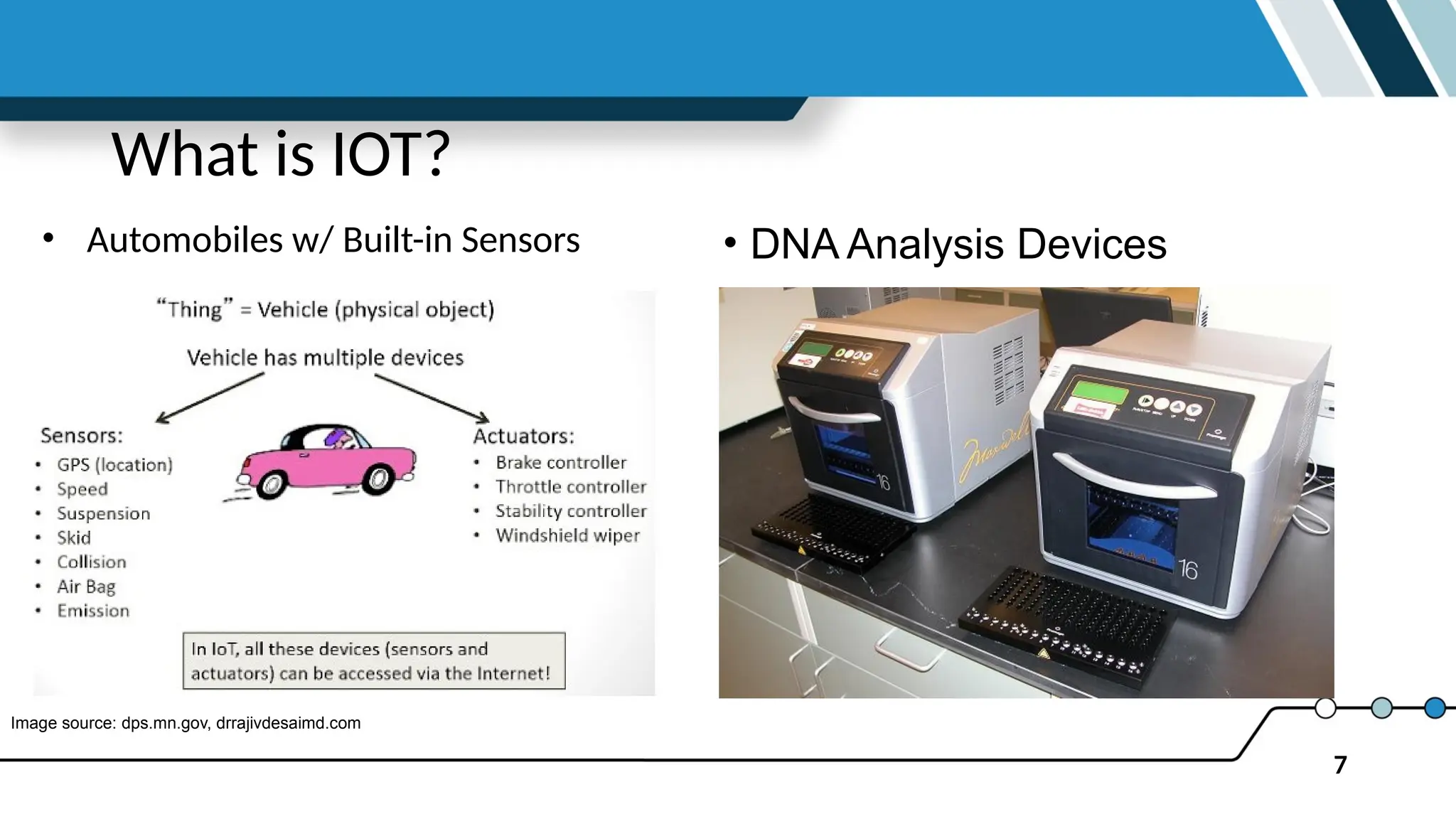
What is IOT?
• Automobiles w/ Built-in Sensors
Image source: dps.mn.gov, drrajivdesaimd.com
• DNA Analysis Devices
8
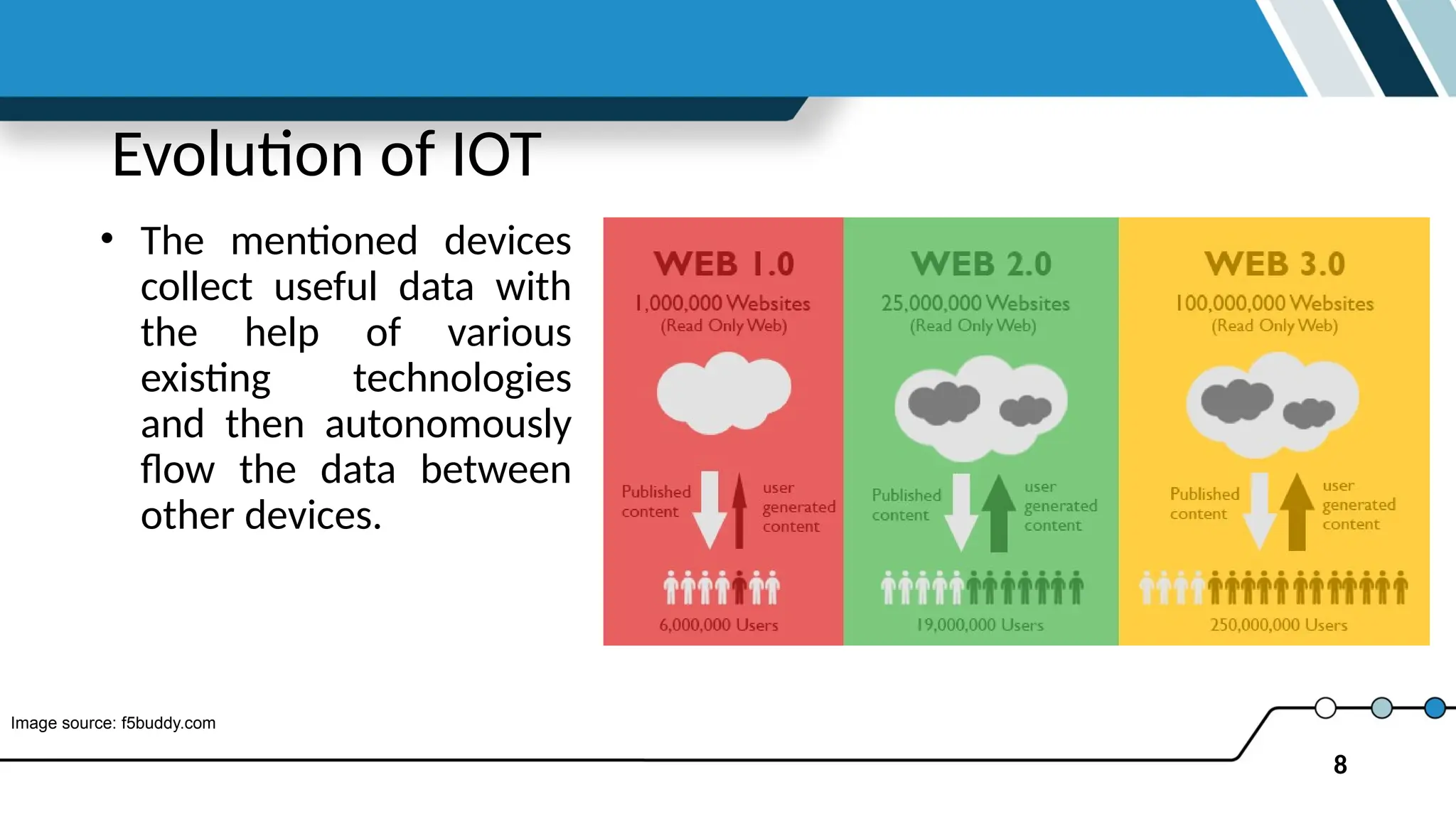
Evolution of IOT
• The mentioned devices
collect useful data with
the help of various
existing technologies
and then autonomously
flow the data between
other devices.
Image source: f5buddy.com
9
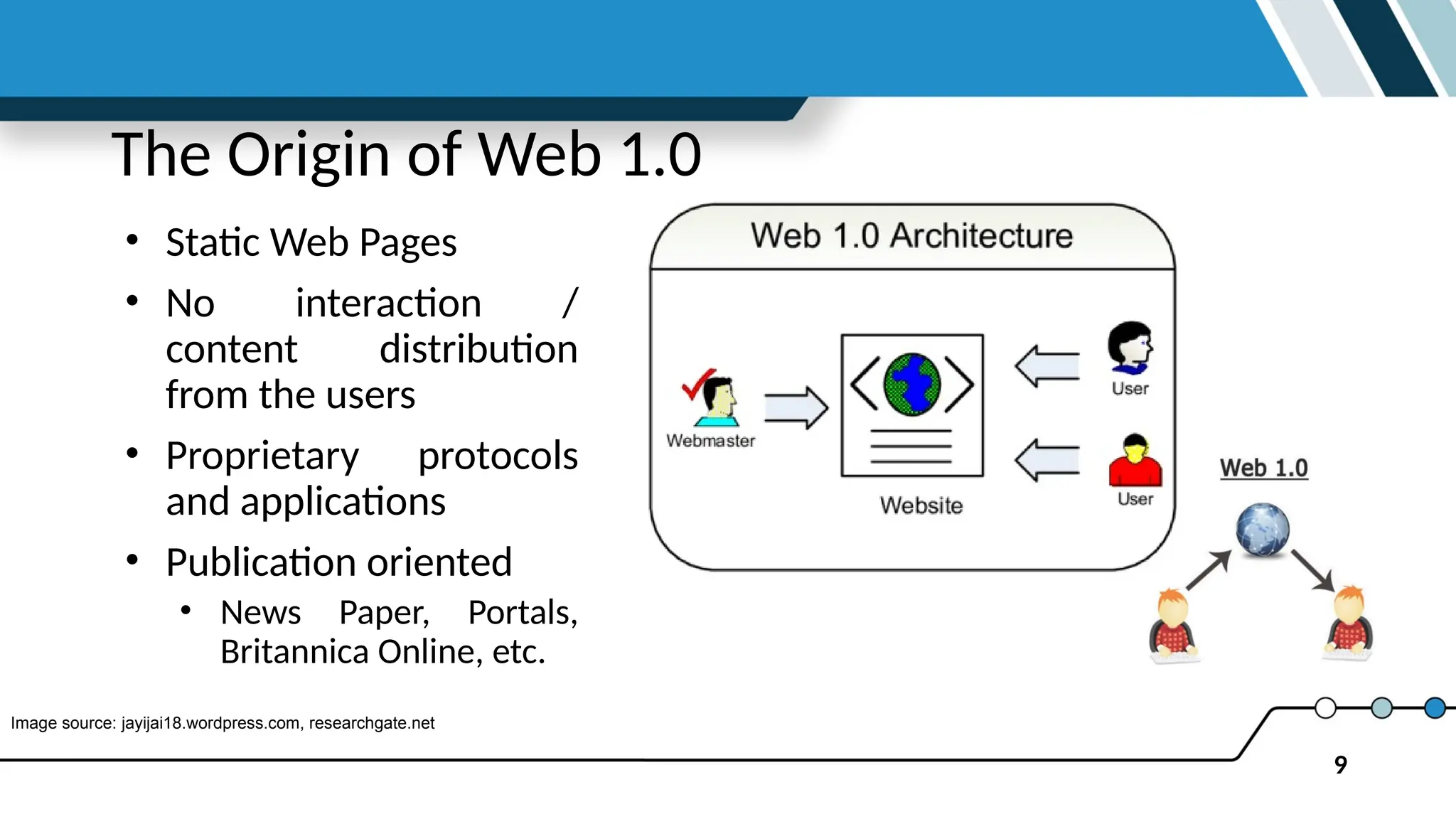
The Origin of Web 1.0
• Static Web Pages
• No interaction /
content distribution
from the users
• Proprietary protocols
and applications
• Publication oriented
• News Paper, Portals,
Britannica Online, etc.
Image source: jayijai18.wordpress.com, researchgate.net
10
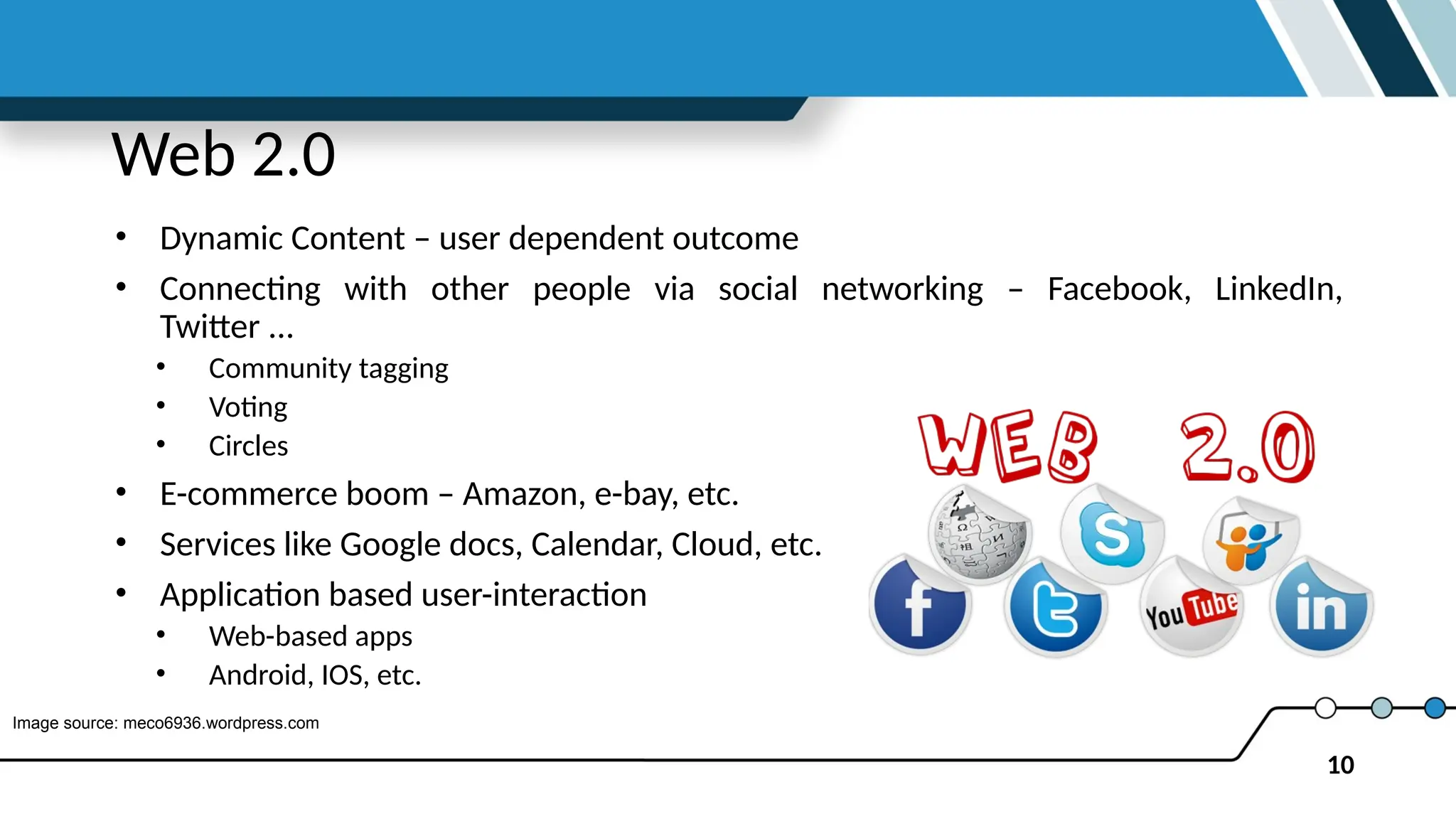
Web 2.0
• Dynamic Content – user dependent outcome
• Connecting with other people via social networking – Facebook, LinkedIn,
Twitter ...
• Community tagging
• Voting
• Circles
• E-commerce boom – Amazon, e-bay, etc.
• Services like Google docs, Calendar, Cloud, etc.
• Application based user-interaction
• Web-based apps
• Android, IOS, etc.
Image source: meco6936.wordpress.com
11
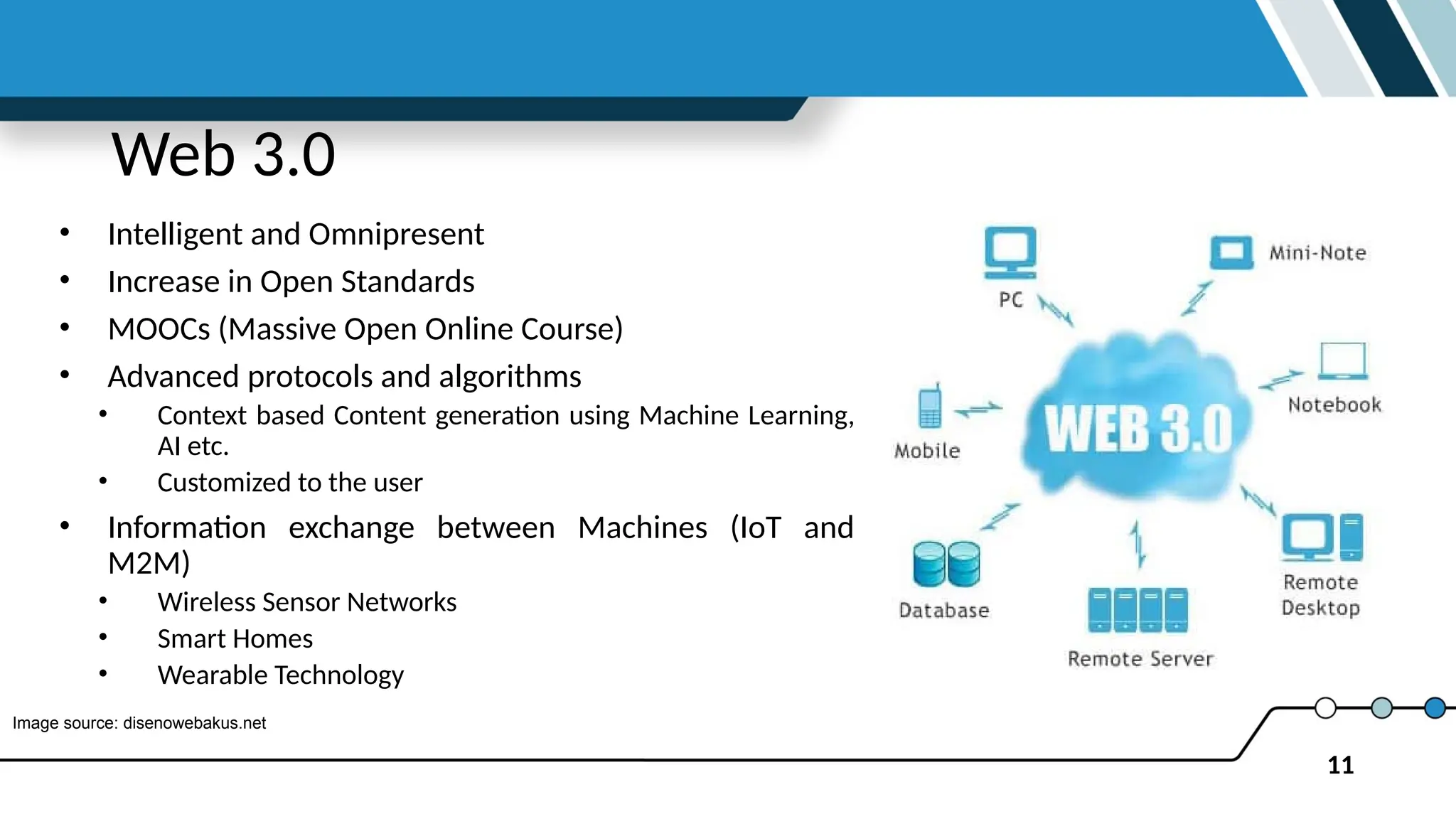
Web 3.0
• Intelligent and Omnipresent
• Increase in Open Standards
• MOOCs (Massive Open Online Course)
• Advanced protocols and algorithms
• Context based Content generation using Machine Learning,
AI etc.
• Customized to the user
• Information exchange between Machines (IoT and
M2M)
• Wireless Sensor Networks
• Smart Homes
• Wearable Technology
Image source: disenowebakus.net
12
The Internet of Things (IoT)
• Conceptualized in the early 2000’s, at MIT’s Auto-ID lab by Kevin Aston
“If we had computers that knew everything there was to about things – using data
they gathered without any help from us – we would be able to track and count
everything, and greatly reduce waste, loss and cost” – Kevin Aston in 1999
Image source: ya-webdesign.com
13
The Internet of Things (IoT)
“The Internet of Things is a system where items in the physical world,
and sensors within or attached to these items, are connected to the
Internet via wireless or wired internet connections”.
Image source: ya-webdesign.com
14
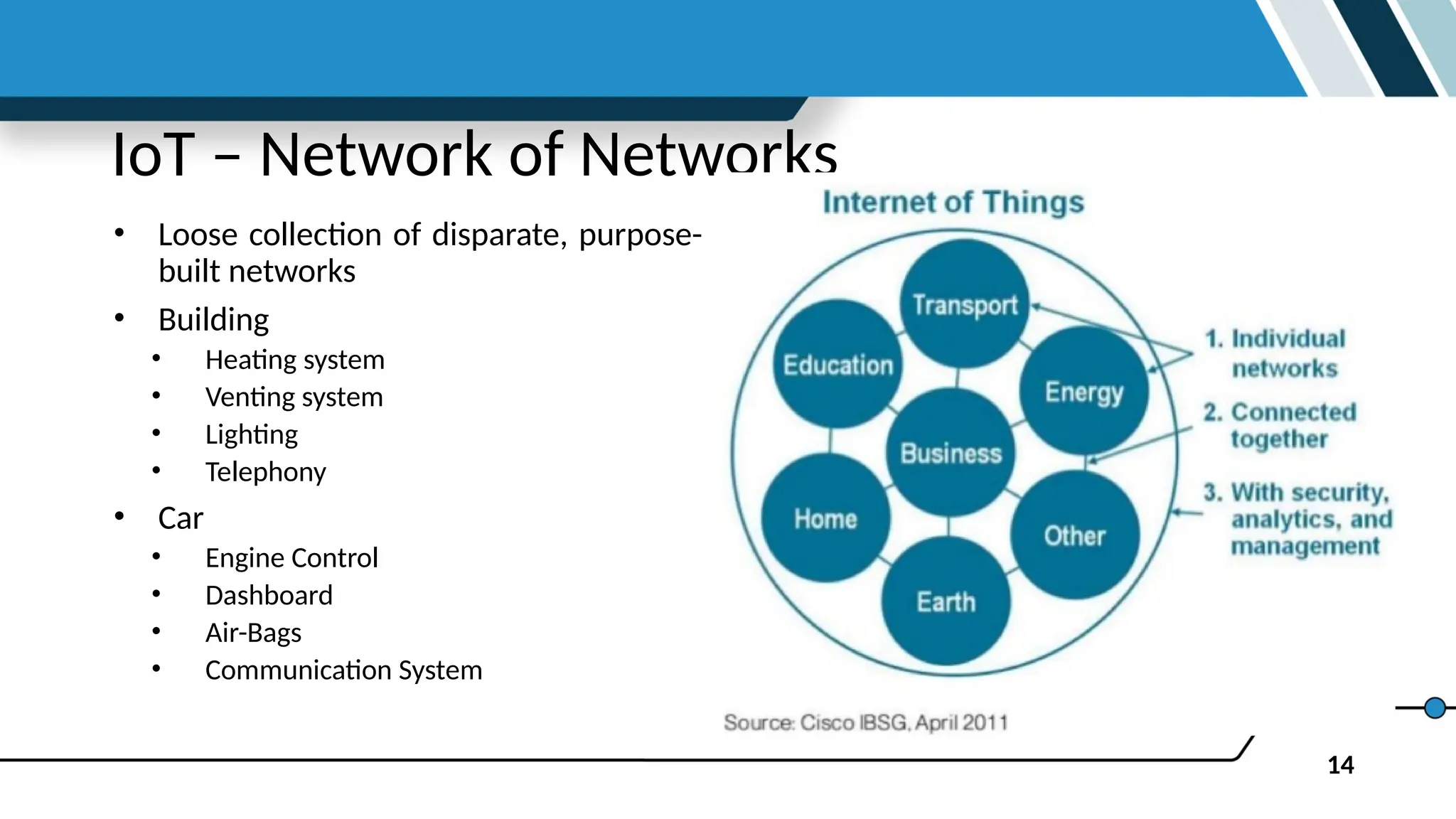
IoT – Network of Networks
• Loose collection of disparate, purpose-
built networks
• Building
• Heating system
• Venting system
• Lighting
• Telephony
• Car
• Engine Control
• Dashboard
• Air-Bags
• Communication System
15
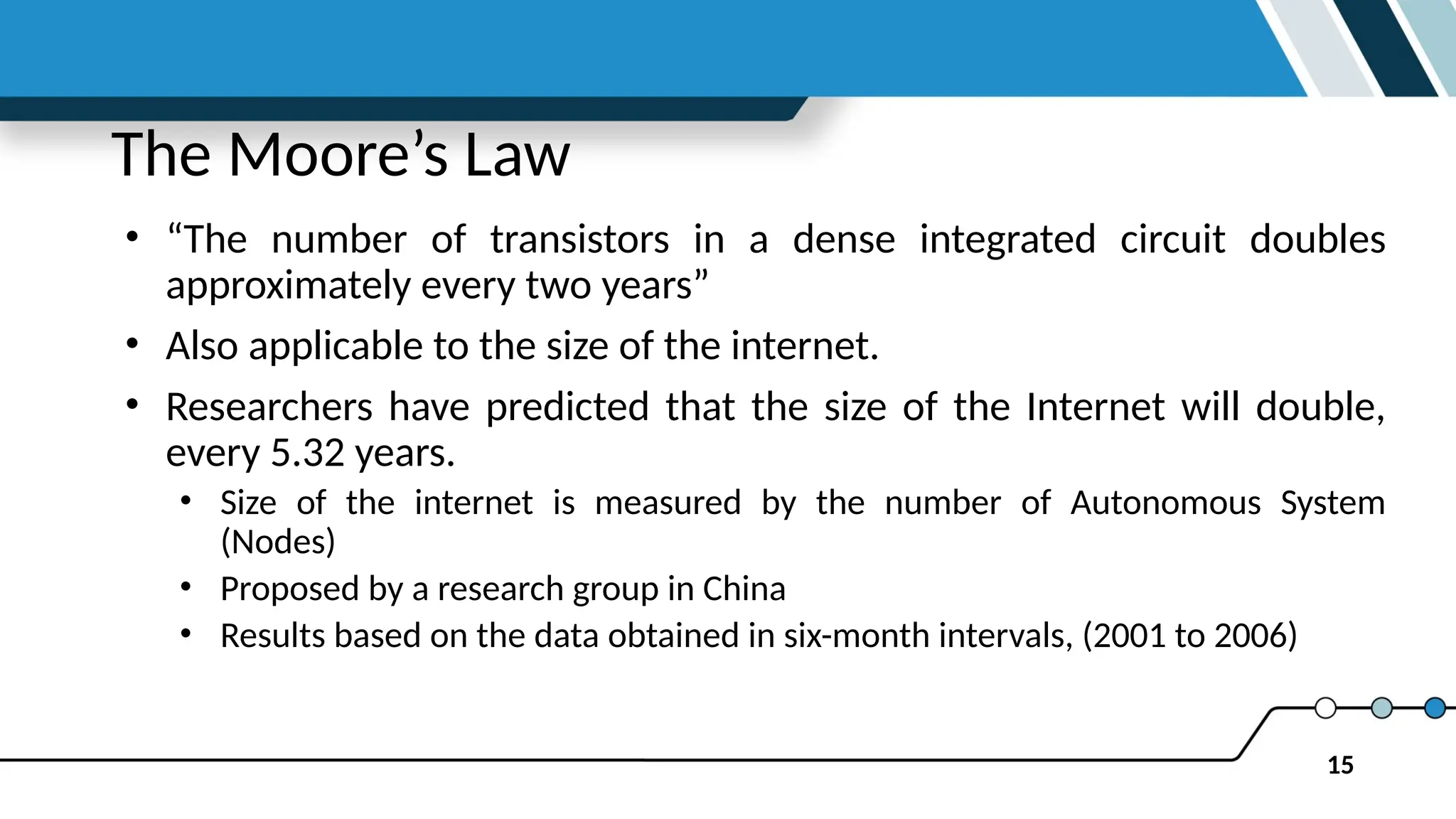
The Moore’s Law
• “The number of transistors in a dense integrated circuit doubles
approximately every two years”
• Also applicable to the size of the internet.
• Researchers have predicted that the size of the Internet will double,
every 5.32 years.
• Size of the internet is measured by the number of Autonomous System
(Nodes)
• Proposed by a research group in China
• Results based on the data obtained in six-month intervals, (2001 to 2006)
16
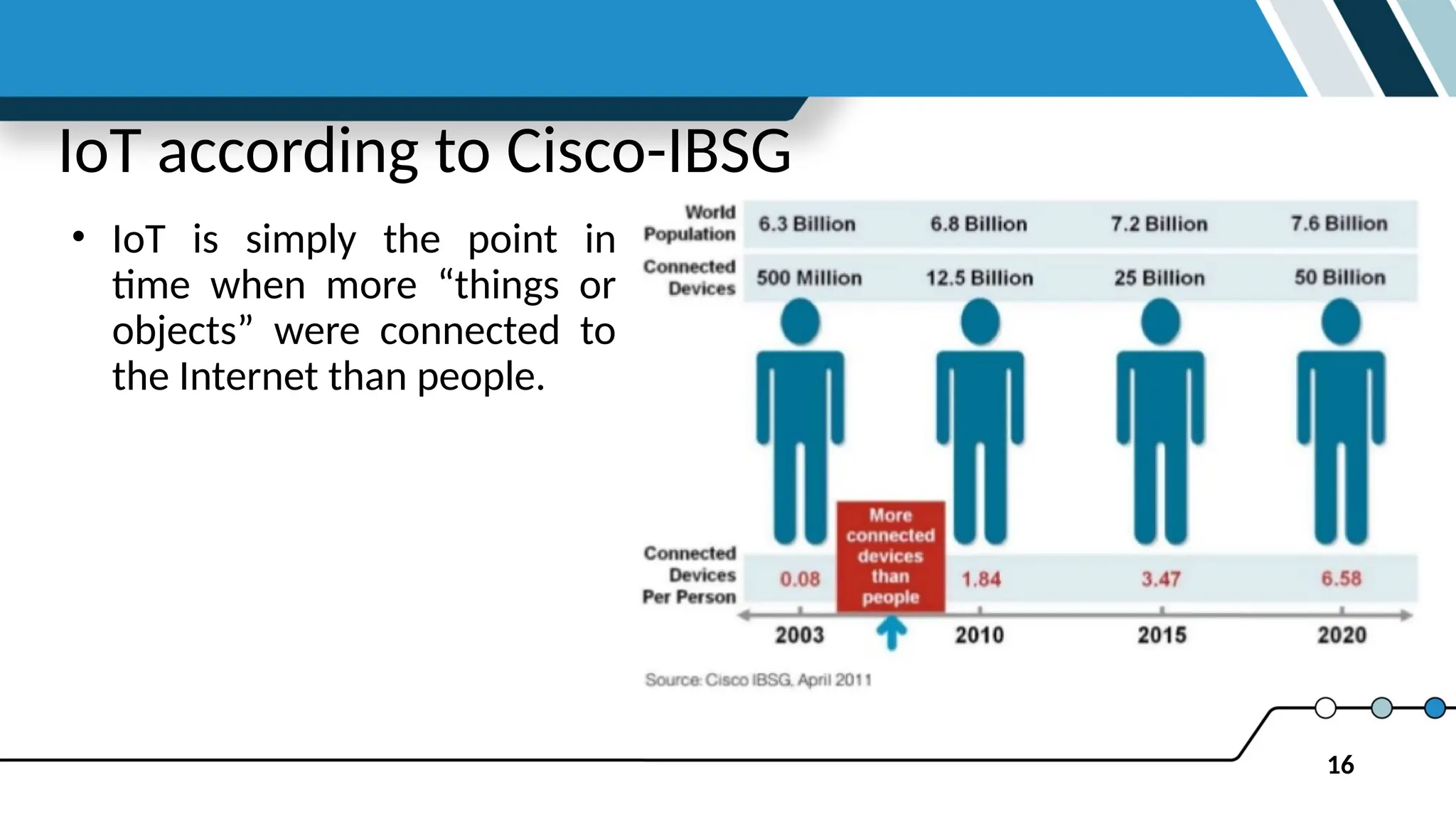
IoT according to Cisco-IBSG
• IoT is simply the point in
time when more “things or
objects” were connected to
the Internet than people.
17
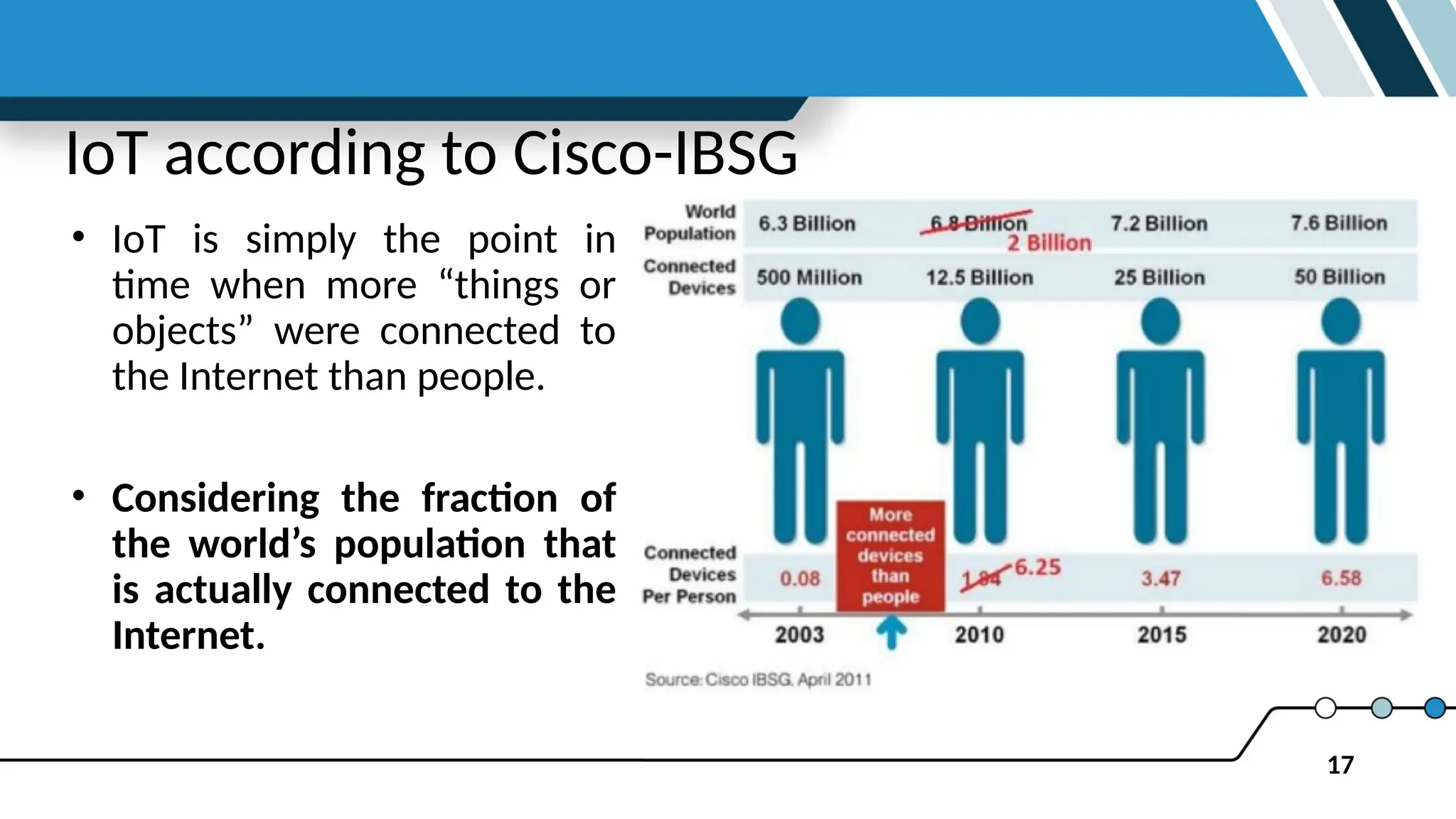
IoT according to Cisco-IBSG
• IoT is simply the point in
time when more “things or
objects” were connected to
the Internet than people.
• Considering the fraction of
the world’s population that
is actually connected to the
Internet.
18
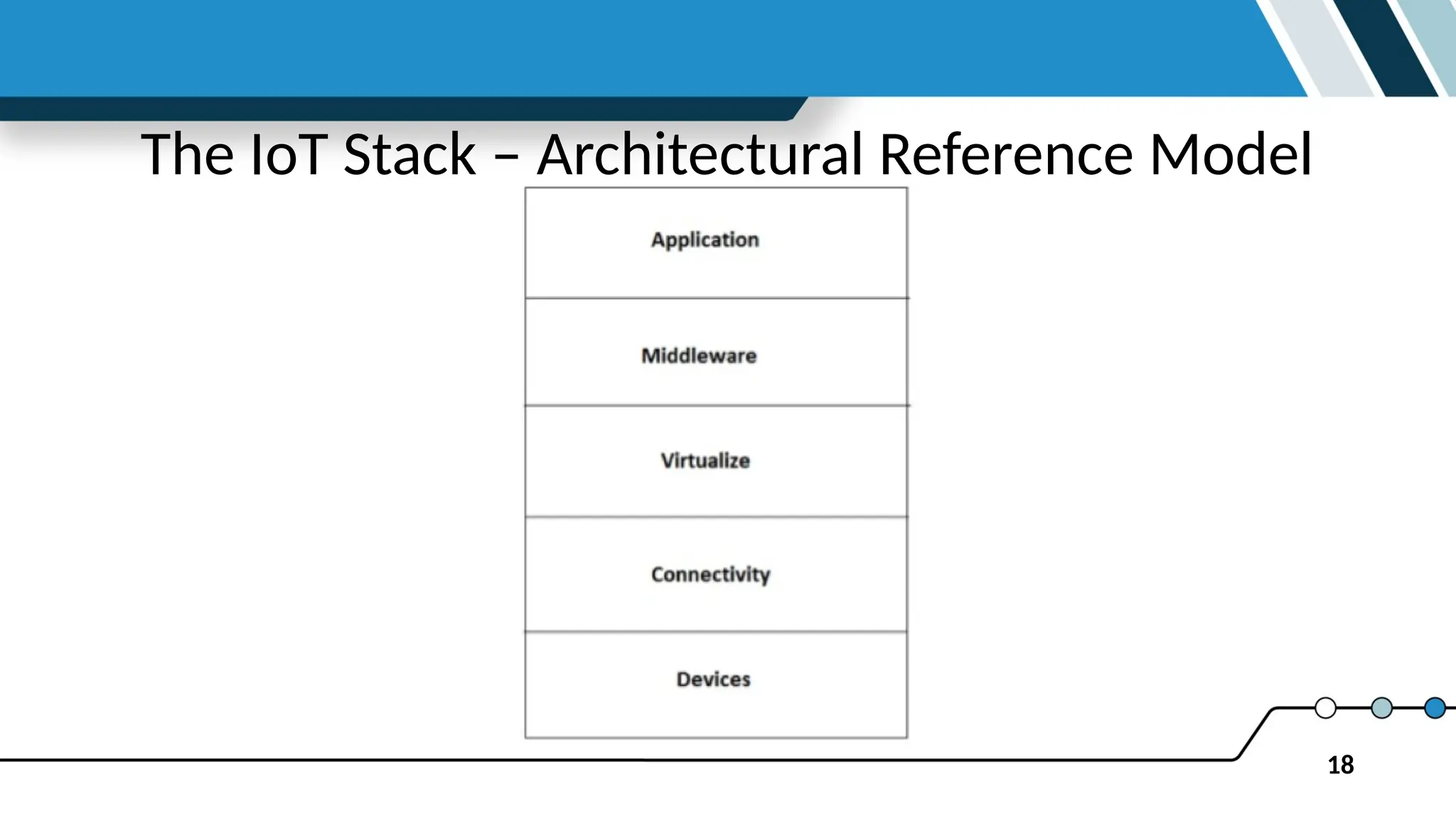
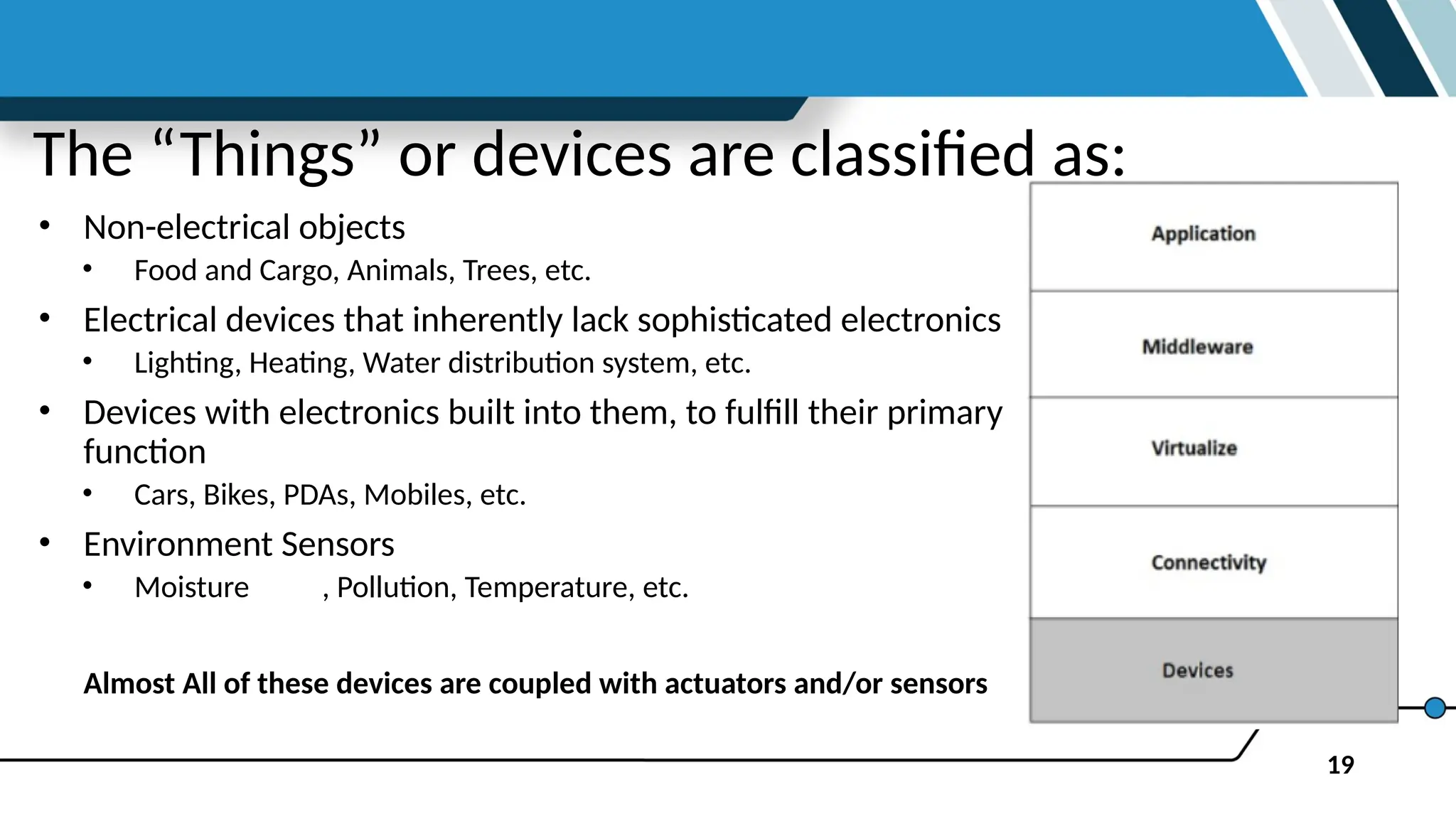
The IoT Stack – Architectural Reference Model
19
The “Things” or devices are classified as:
• Non-electrical objects
• Food and Cargo, Animals, Trees, etc.
• Electrical devices that inherently lack sophisticated electronics
• Lighting, Heating, Water distribution system, etc.
• Devices with electronics built into them, to fulfill their primary
function
• Cars, Bikes, PDAs, Mobiles, etc.
• Environment Sensors
• Moisture , Pollution, Temperature, etc.
Almost All of these devices are coupled with actuators and/or sensors
20
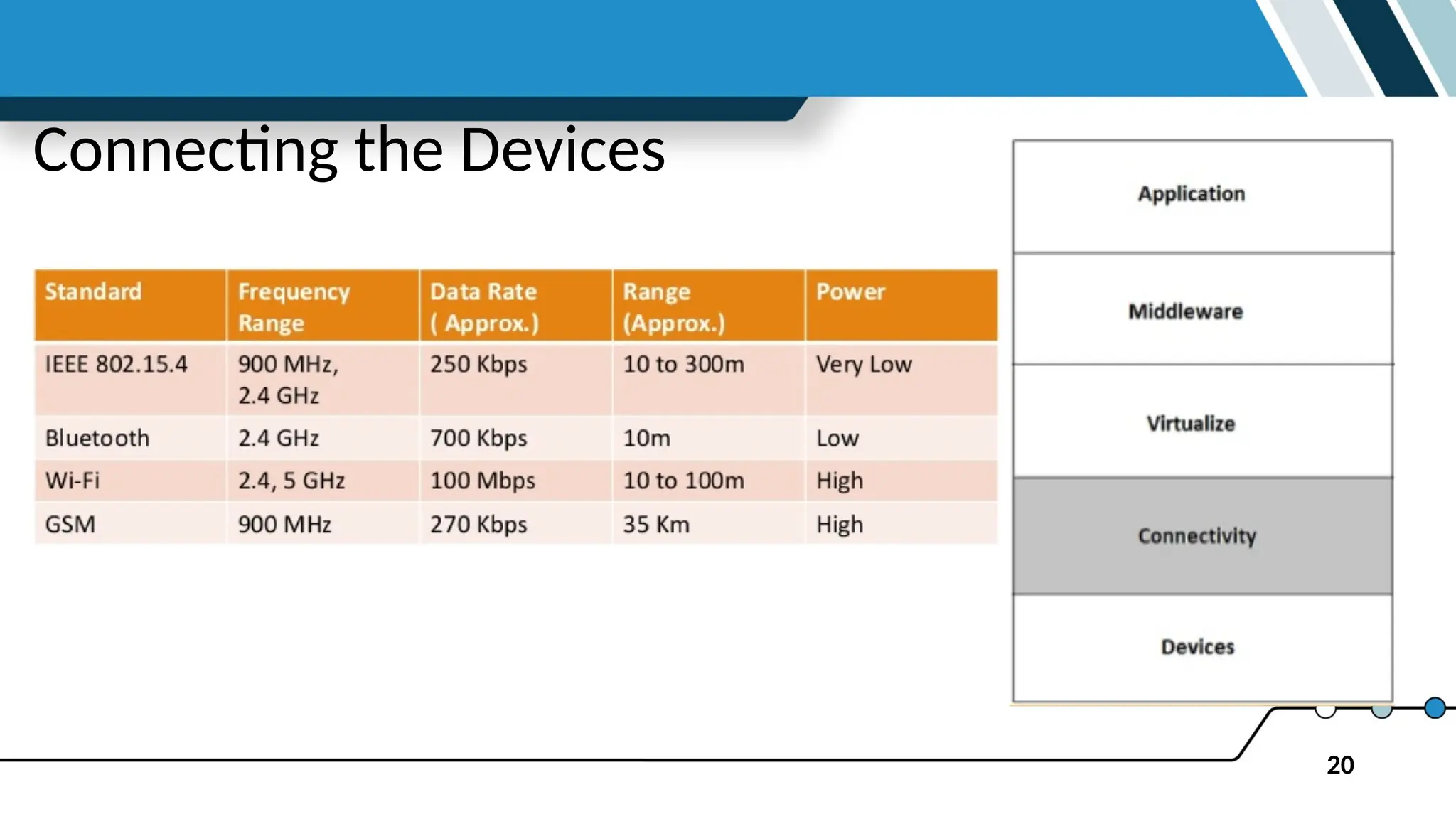
Connecting the Devices
21
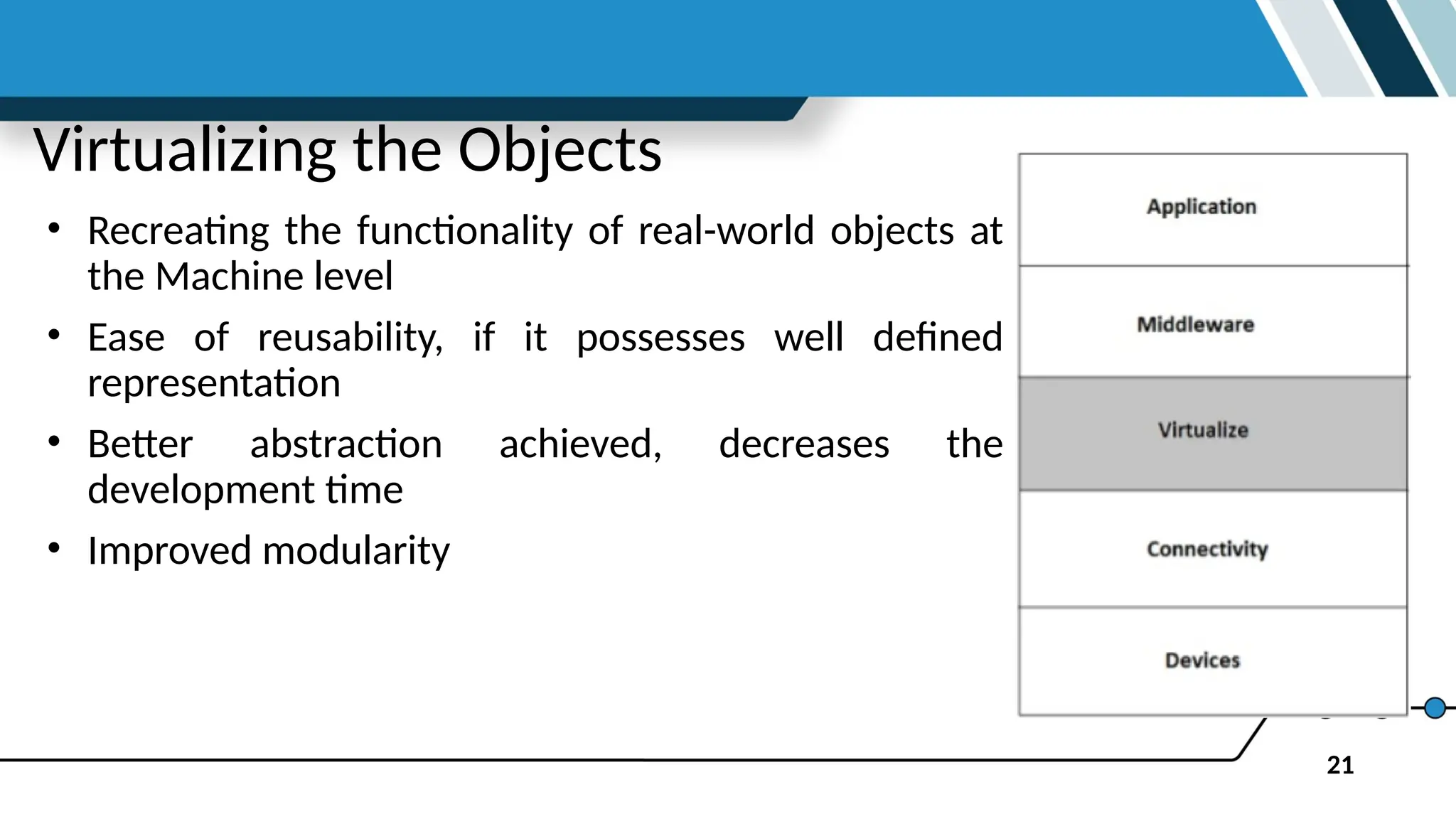
Virtualizing the Objects
• Recreating the functionality of real-world objects at
the Machine level
• Ease of reusability, if it possesses well defined
representation
• Better abstraction achieved, decreases the
development time
• Improved modularity
22
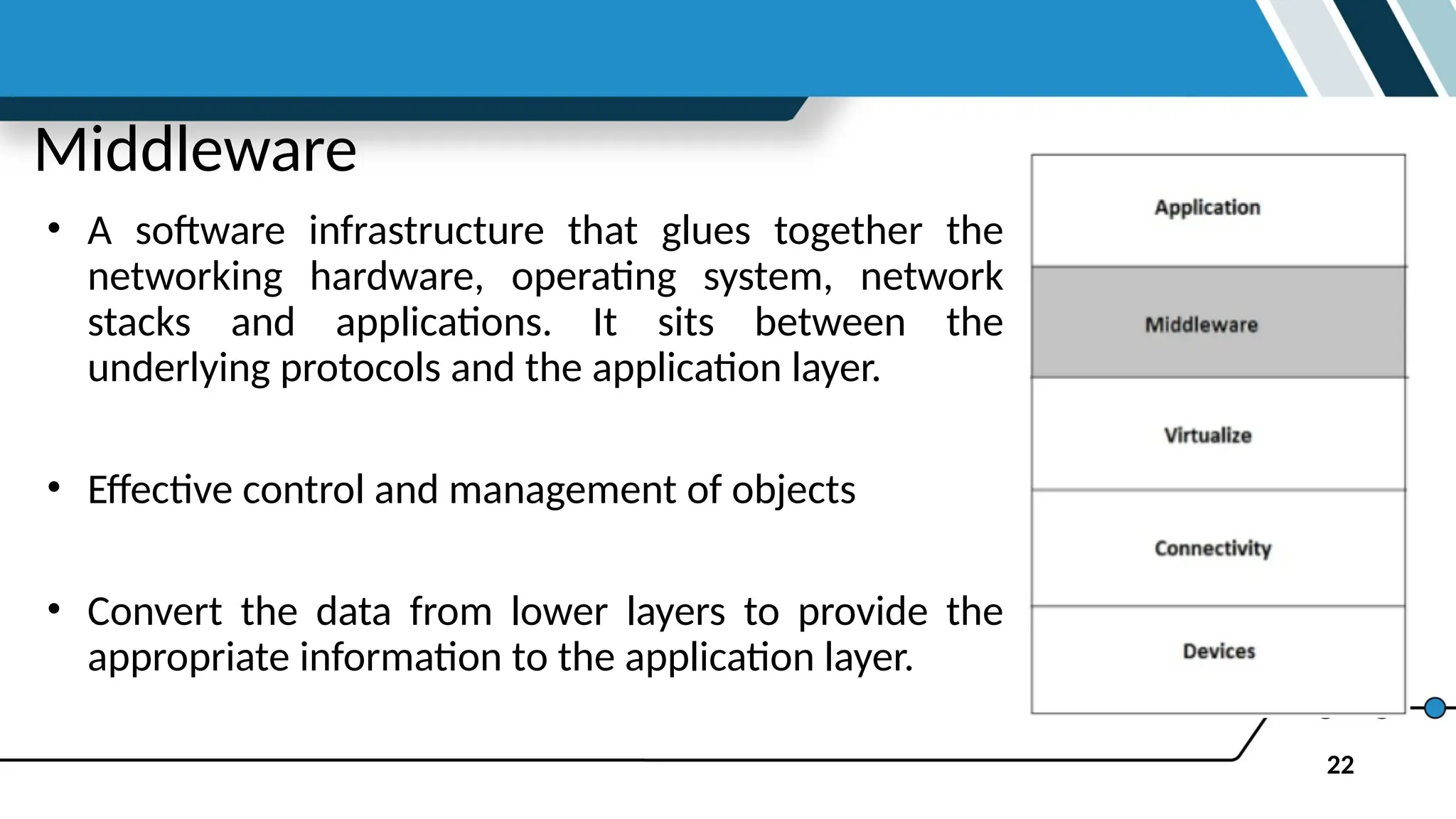
Middleware
• A software infrastructure that glues together the
networking hardware, operating system, network
stacks and applications. It sits between the
underlying protocols and the application layer.
• Effective control and management of objects
• Convert the data from lower layers to provide the
appropriate information to the application layer.
23
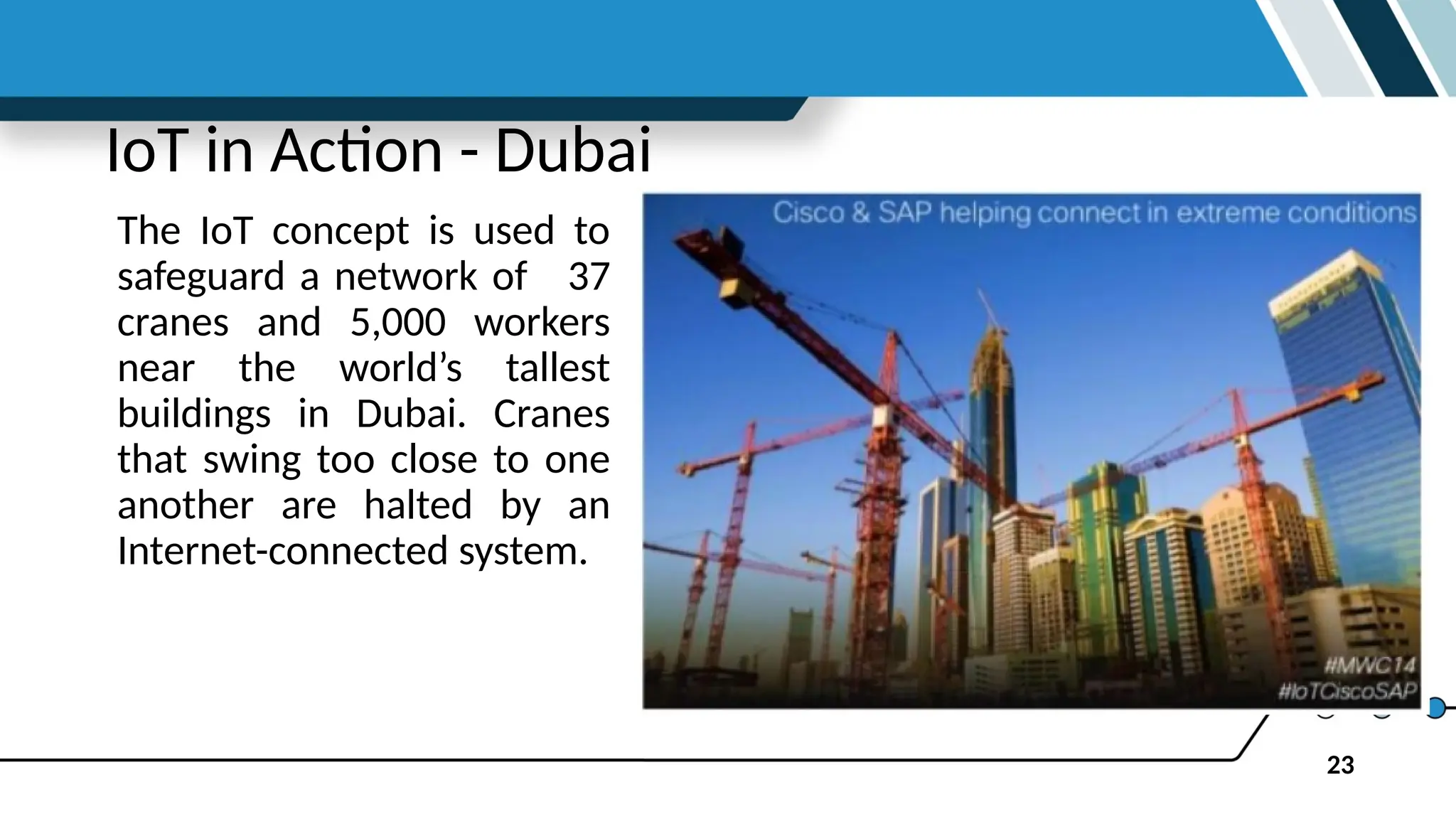
IoT in Action - Dubai
The IoT concept is used to
safeguard a network of 37
cranes and 5,000 workers
near the world’s tallest
buildings in Dubai. Cranes
that swing too close to one
another are halted by an
Internet-connected system.
24
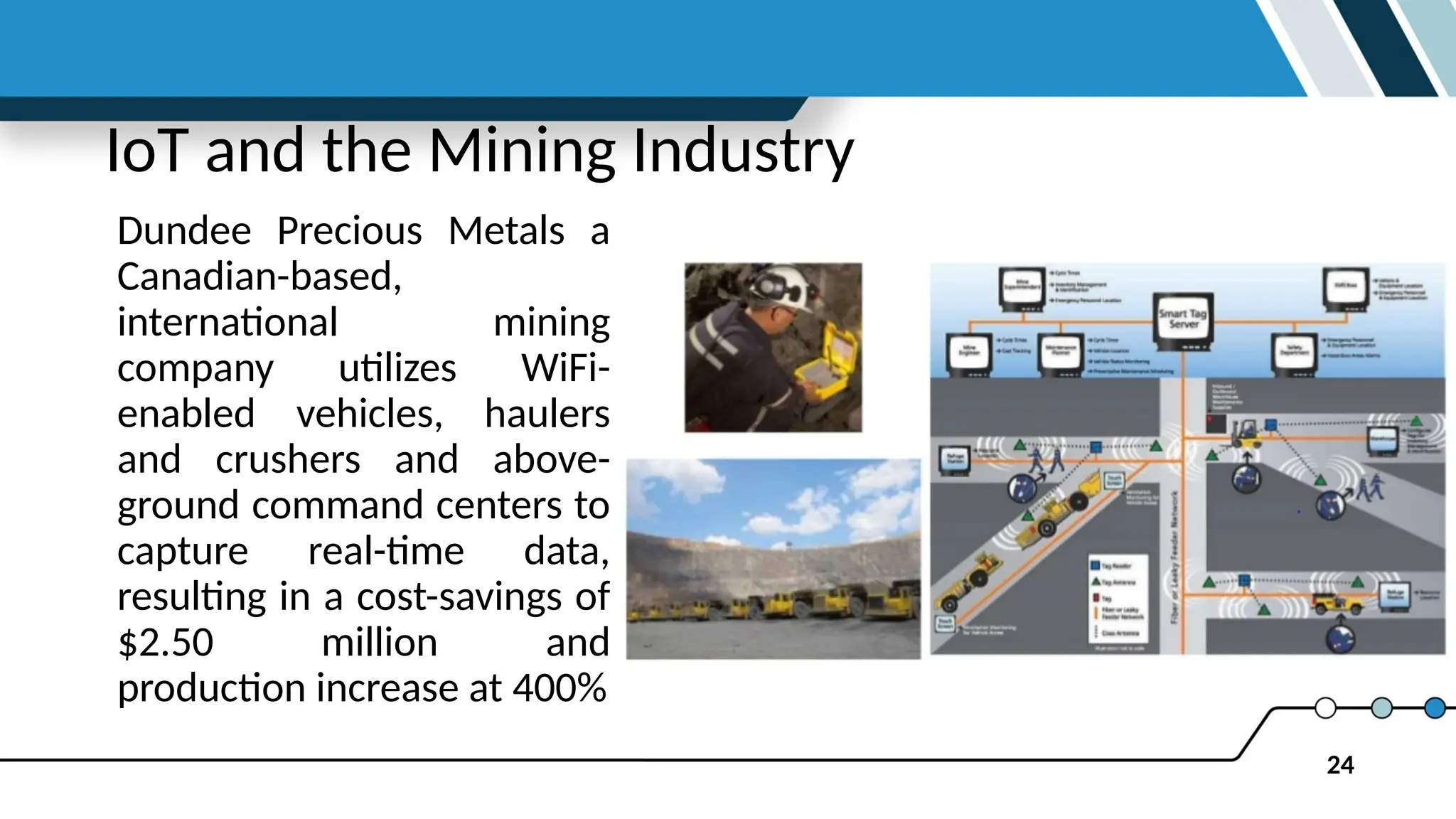
IoT and the Mining Industry
Dundee Precious Metals a
Canadian-based,
international mining
company utilizes WiFi-
enabled vehicles, haulers
and crushers and above-
ground command centers to
capture real-time data,
resulting in a cost-savings of
$2.50 million and
production increase at 400%
25
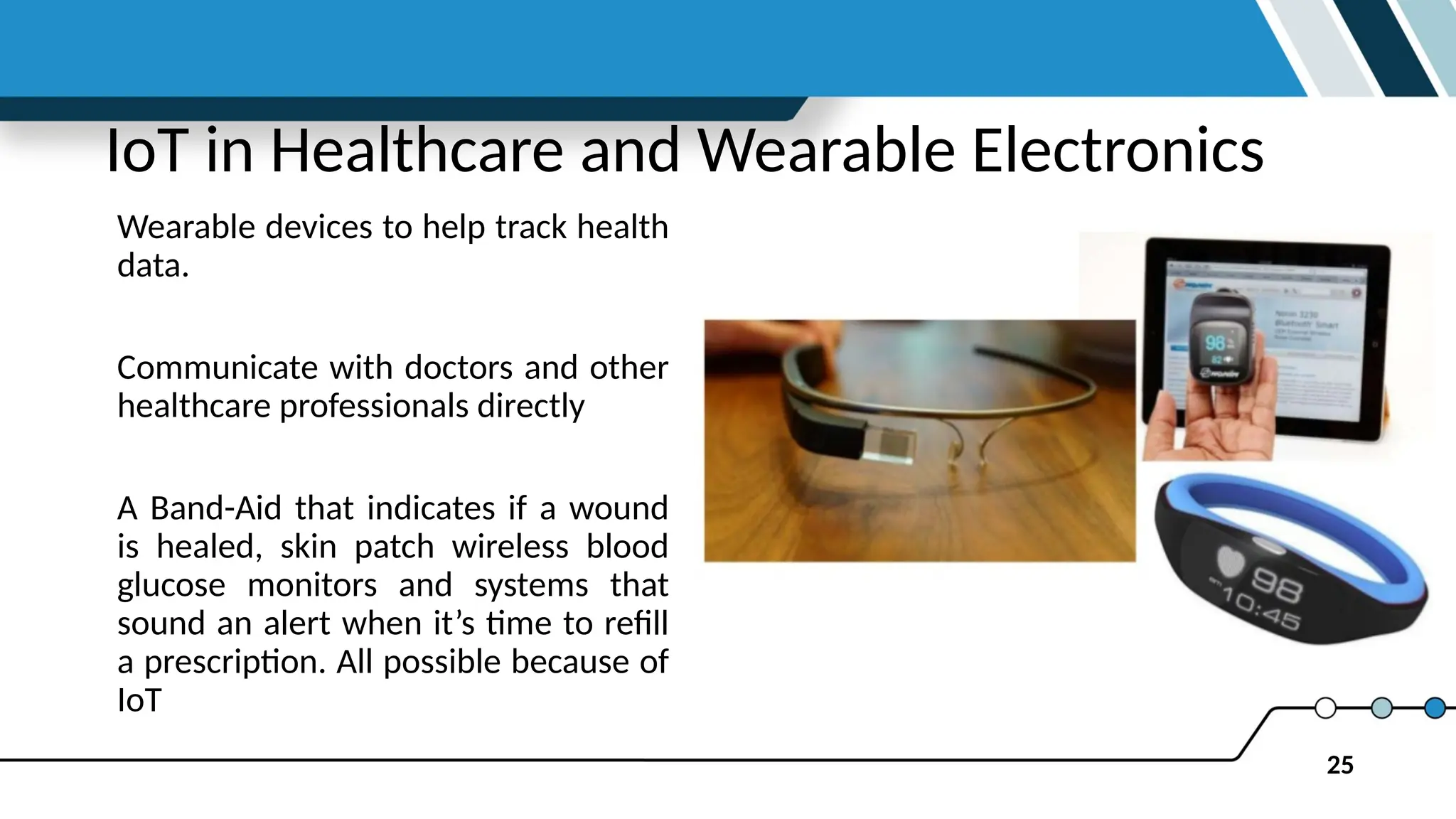
IoT in Healthcare and Wearable Electronics
Wearable devices to help track health
data.
Communicate with doctors and other
healthcare professionals directly
A Band-Aid that indicates if a wound
is healed, skin patch wireless blood
glucose monitors and systems that
sound an alert when it’s time to refill
a prescription. All possible because of
IoT
26
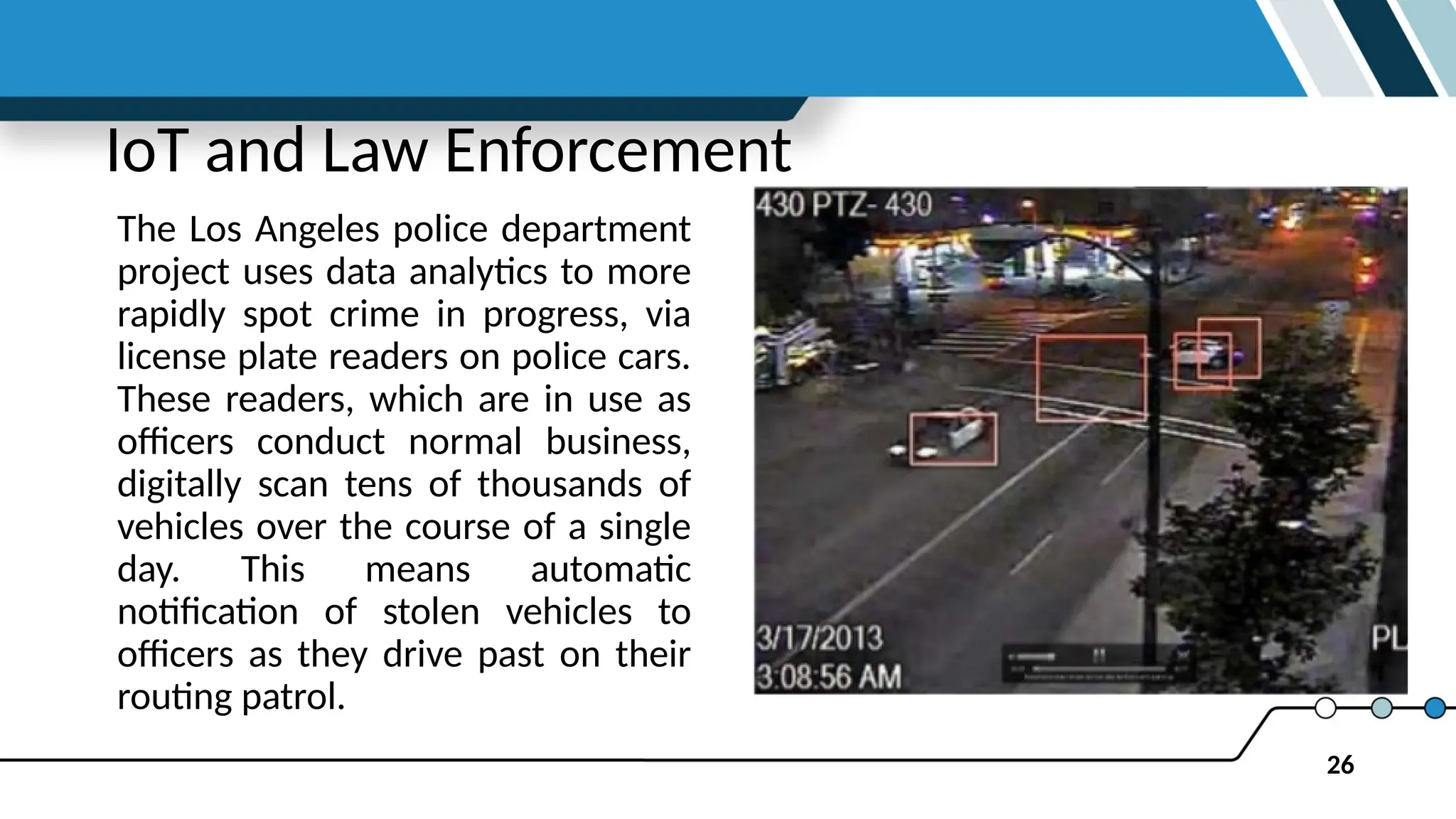
IoT and Law Enforcement
The Los Angeles police department
project uses data analytics to more
rapidly spot crime in progress, via
license plate readers on police cars.
These readers, which are in use as
officers conduct normal business,
digitally scan tens of thousands of
vehicles over the course of a single
day. This means automatic
notification of stolen vehicles to
officers as they drive past on their
routing patrol.
27
Other Applications of IoT
• Home
• Monitor the Air-conditioning
system
• Manage Lighting
• Keep track of the Power
usage
• Industry
• Monitoring
• Information and Analysis
• Safety and Maintenance
• City
• Pollution monitoring and
control
• Traffic management
• Information sharing – Tourism
• Body
• Medicine reminders
• Tracking activity level
• Monitor an aging family
• Keep track of the children
28
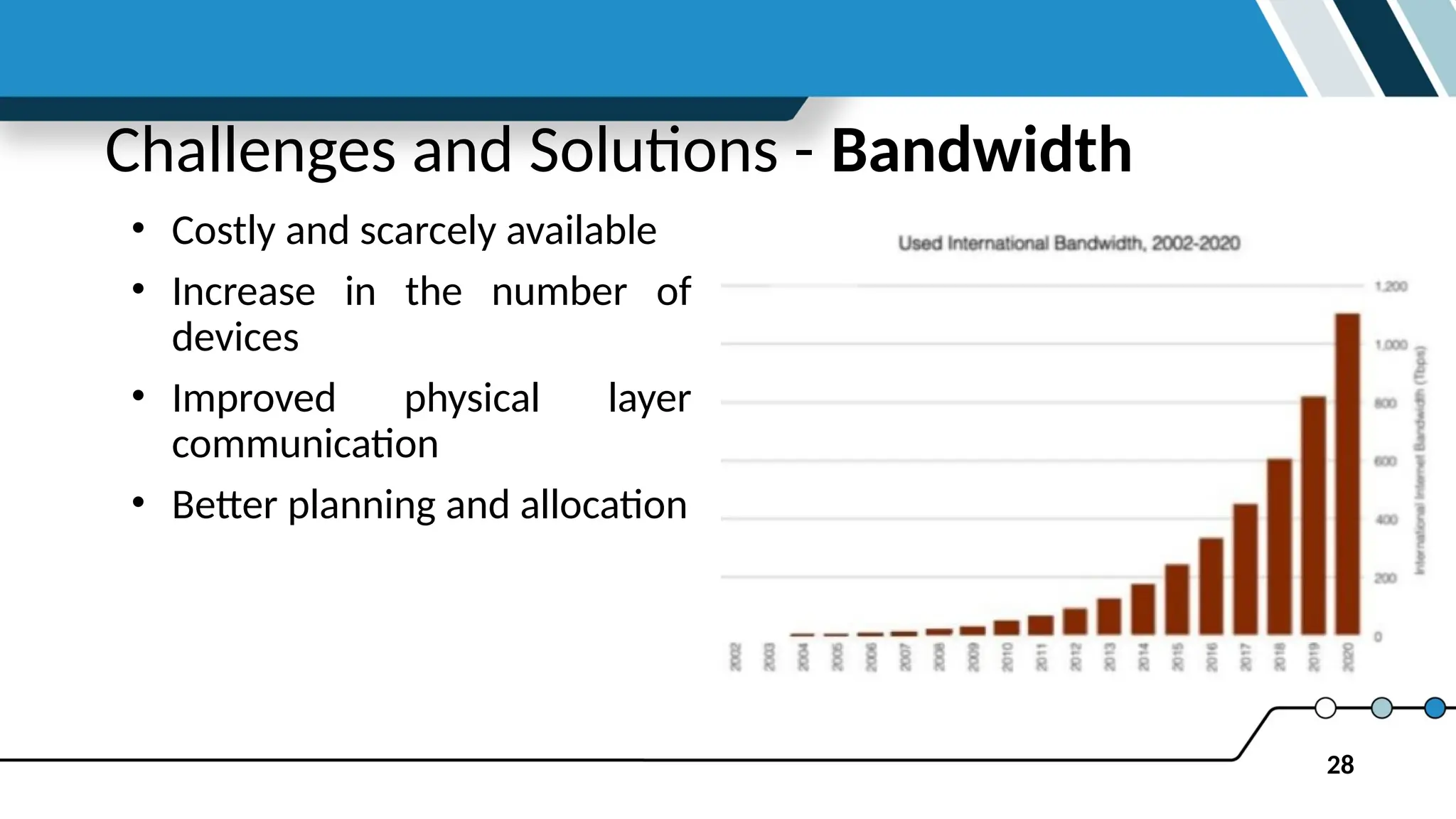
Challenges and Solutions - Bandwidth
• Costly and scarcely available
• Increase in the number of
devices
• Improved physical layer
communication
• Better planning and allocation
29
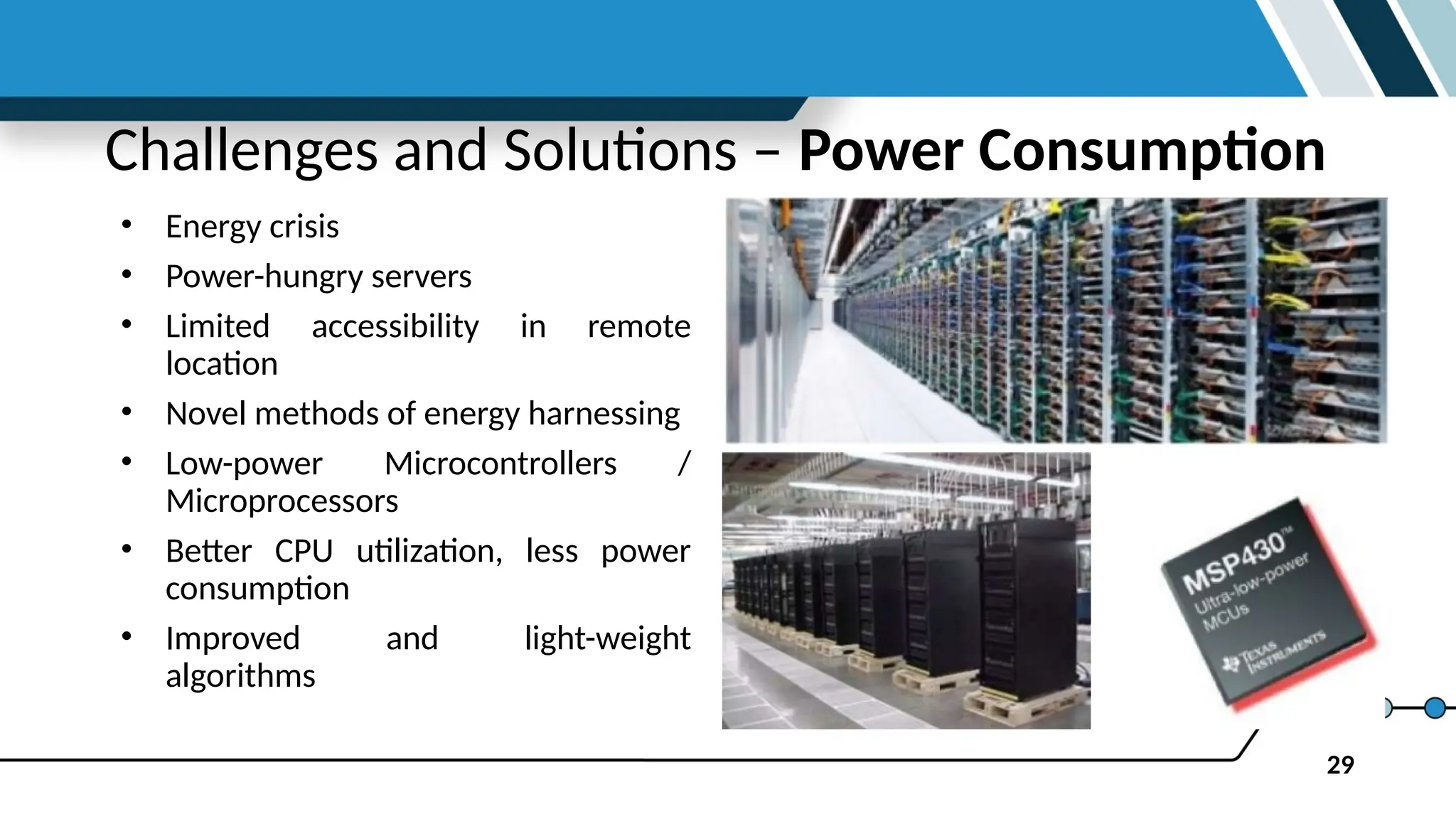
Challenges and Solutions – Power Consumption
• Energy crisis
• Power-hungry servers
• Limited accessibility in remote
location
• Novel methods of energy harnessing
• Low-power Microcontrollers /
Microprocessors
• Better CPU utilization, less power
consumption
• Improved and light-weight
algorithms
30
Challenges and Solutions – Security
• Authorization – Proper authorization for
sending and receiving
• Open ports
• Increase vulnerability
• Improved in the quality of the process that uses
the port
• Denial of service
• Encryption
• Improved and less power intensive encryption
algorithms
• Eavesdropping
• Privacy and Trust
31
Challenges and Solutions – Signaling
• Improved reliability
• Better bidirectional communication
• Improved routing data transfer methods
• Better addressing
• IPv4 (32 bits – Number of addresses = ~ 4 billion) – “Things” by 2020 = ~ 50
billion
• IPv6 (128 bits – Number of addresses = ~ 3.4 x 10^38)
32
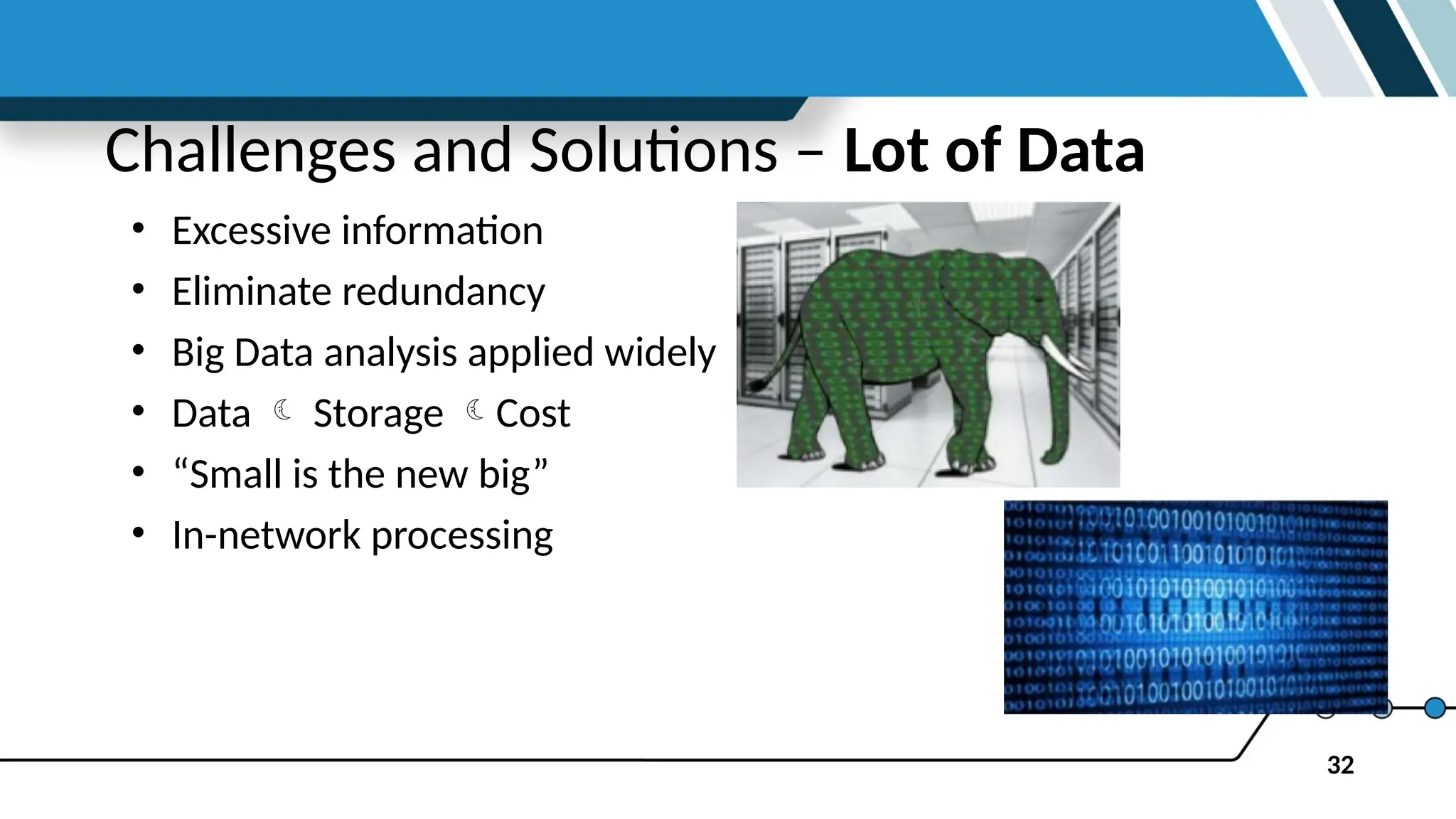
Challenges and Solutions – Lot of Data
• Excessive information
• Eliminate redundancy
• Big Data analysis applied widely
• Data  Storage Cost
• “Small is the new big”
• In-network processing
33
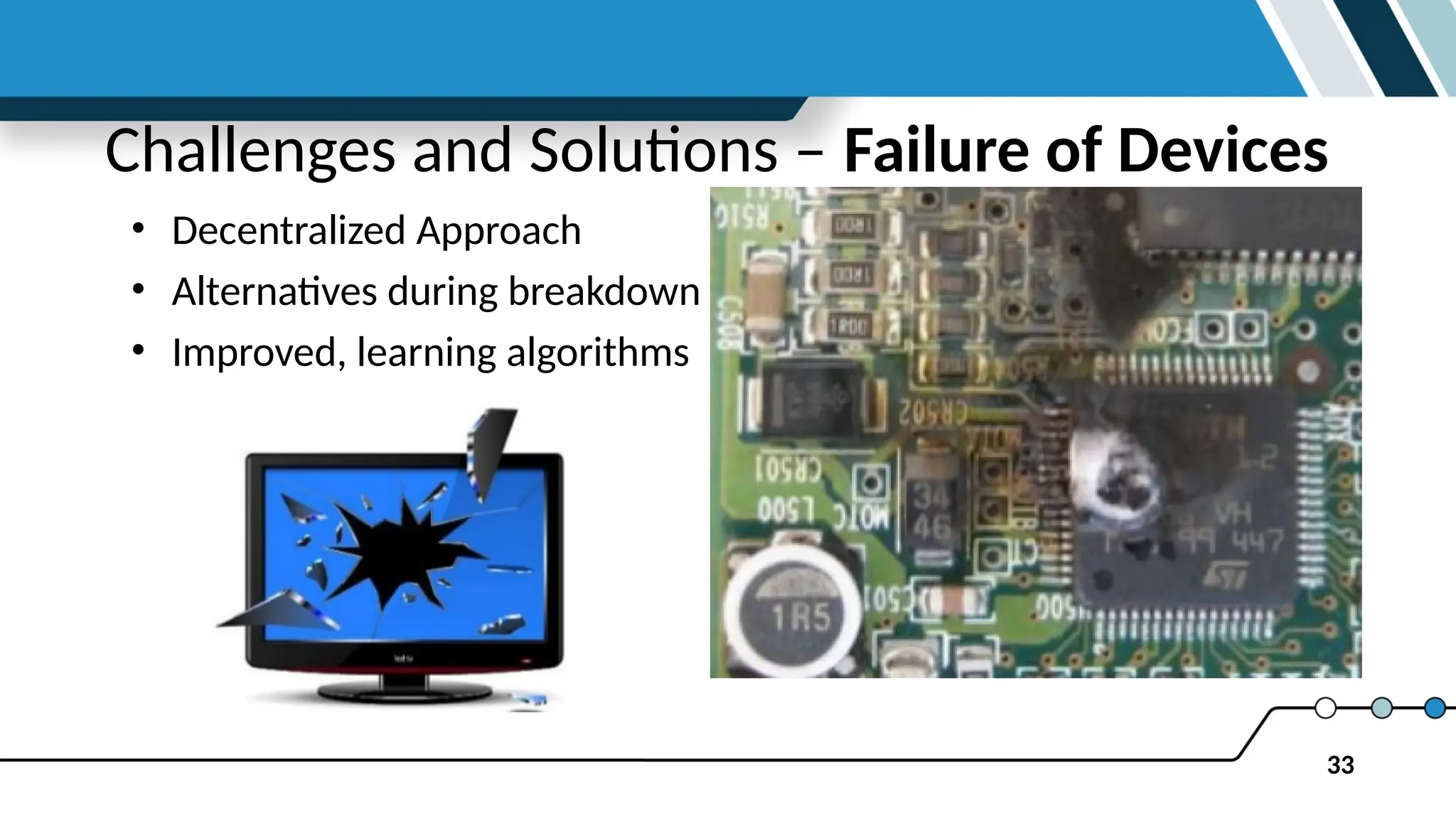
Challenges and Solutions – Failure of Devices
• Decentralized Approach
• Alternatives during breakdown
• Improved, learning algorithms
34
Is IoT full of good stuffs?
• Breach of Privacy and monopoly
• Security Concerns
• Over-dependency on technology
• Employment issues
35
What Next - IoE
The Internet of Things – “Things”
The Internet of Everything (IoE) – “People”, “Process”, “Data” and
“Things”
• Social networking and Wearable technology – People
• Correct information, at right time in a relevant manner – Process
• Better usage of information available – Data
• Physical objects connected to the Internet/each other - Things
36
Summary
• The IoT is the network of physical objects embedded with different
technologies
• Evolution of IoT starts from Web 1.0 that includes static web pages wherein
interaction and content distribution from the users are not feasible
• Web 2.0 is the next evolution of IoT which includes dynamic content
website.
• Web 3.0 allows information exchange between Machine (IoT and M2M)
• There are different challenges involves in IoT that applies different type of
solutions: Bandwidth, Power Consumption, Security, Signaling, Lot of Data,
Failure of Devices.
• Internet of Everything (IoE) is the next to IoT.
37

Presentation Week 2-4_Introduction to Information Systems and Security Final.pptx

  • 1.
    WEEK 5 THE INTERNETOF THINGS IS CHANGING HOW WE LIVE IAS101- INFORMATION ASSURANCE AND SECURITY By : Raul S. Acapulco
  • 2.
    2 • Determine theevolution of IoT • Recognize the impact of the Internet of Things on people and businesses. • Understand how the different IoT applications are applied in many devices.
  • 3.
    3 Image source: commons.wikimedia.org, pixabay.com WEEK5- THE INTERNET OF THINGS IS CHANGING HOW WE LIVE CS 207- INFORMATION ASSURANCE AND SECURITY
  • 4.
    4 What is IOT? •The Internet Of Things (IOT) is the network of physical objects or “things” embedded with electronics, software, sensors, and network connectivity, which enables these objects to collect and exchange data. Image source: pixabay.com
  • 5.
    5 What is IOT? •The “Thing” in the context of IOT, is an entity or physical object that has a unique identifier, an embedded system and the ability to transfer data over a network.
  • 6.
    6 What is IOT? •Heart Monitoring Implants • Biochip Transponder on Farm Animals Image source: www.oliversegal.com, socialsciences.scielo.org
  • 7.
    7 What is IOT? •Automobiles w/ Built-in Sensors Image source: dps.mn.gov, drrajivdesaimd.com • DNA Analysis Devices
  • 8.
    8 Evolution of IOT •The mentioned devices collect useful data with the help of various existing technologies and then autonomously flow the data between other devices. Image source: f5buddy.com
  • 9.
    9 The Origin ofWeb 1.0 • Static Web Pages • No interaction / content distribution from the users • Proprietary protocols and applications • Publication oriented • News Paper, Portals, Britannica Online, etc. Image source: jayijai18.wordpress.com, researchgate.net
  • 10.
    10 Web 2.0 • DynamicContent – user dependent outcome • Connecting with other people via social networking – Facebook, LinkedIn, Twitter ... • Community tagging • Voting • Circles • E-commerce boom – Amazon, e-bay, etc. • Services like Google docs, Calendar, Cloud, etc. • Application based user-interaction • Web-based apps • Android, IOS, etc. Image source: meco6936.wordpress.com
  • 11.
    11 Web 3.0 • Intelligentand Omnipresent • Increase in Open Standards • MOOCs (Massive Open Online Course) • Advanced protocols and algorithms • Context based Content generation using Machine Learning, AI etc. • Customized to the user • Information exchange between Machines (IoT and M2M) • Wireless Sensor Networks • Smart Homes • Wearable Technology Image source: disenowebakus.net
  • 12.
    12 The Internet ofThings (IoT) • Conceptualized in the early 2000’s, at MIT’s Auto-ID lab by Kevin Aston “If we had computers that knew everything there was to about things – using data they gathered without any help from us – we would be able to track and count everything, and greatly reduce waste, loss and cost” – Kevin Aston in 1999 Image source: ya-webdesign.com
  • 13.
    13 The Internet ofThings (IoT) “The Internet of Things is a system where items in the physical world, and sensors within or attached to these items, are connected to the Internet via wireless or wired internet connections”. Image source: ya-webdesign.com
  • 14.
    14 IoT – Networkof Networks • Loose collection of disparate, purpose- built networks • Building • Heating system • Venting system • Lighting • Telephony • Car • Engine Control • Dashboard • Air-Bags • Communication System
  • 15.
    15 The Moore’s Law •“The number of transistors in a dense integrated circuit doubles approximately every two years” • Also applicable to the size of the internet. • Researchers have predicted that the size of the Internet will double, every 5.32 years. • Size of the internet is measured by the number of Autonomous System (Nodes) • Proposed by a research group in China • Results based on the data obtained in six-month intervals, (2001 to 2006)
  • 16.
    16 IoT according toCisco-IBSG • IoT is simply the point in time when more “things or objects” were connected to the Internet than people.
  • 17.
    17 IoT according toCisco-IBSG • IoT is simply the point in time when more “things or objects” were connected to the Internet than people. • Considering the fraction of the world’s population that is actually connected to the Internet.
  • 18.
    18 The IoT Stack– Architectural Reference Model
  • 19.
    19 The “Things” ordevices are classified as: • Non-electrical objects • Food and Cargo, Animals, Trees, etc. • Electrical devices that inherently lack sophisticated electronics • Lighting, Heating, Water distribution system, etc. • Devices with electronics built into them, to fulfill their primary function • Cars, Bikes, PDAs, Mobiles, etc. • Environment Sensors • Moisture , Pollution, Temperature, etc. Almost All of these devices are coupled with actuators and/or sensors
  • 20.
  • 21.
    21 Virtualizing the Objects •Recreating the functionality of real-world objects at the Machine level • Ease of reusability, if it possesses well defined representation • Better abstraction achieved, decreases the development time • Improved modularity
  • 22.
    22 Middleware • A softwareinfrastructure that glues together the networking hardware, operating system, network stacks and applications. It sits between the underlying protocols and the application layer. • Effective control and management of objects • Convert the data from lower layers to provide the appropriate information to the application layer.
  • 23.
    23 IoT in Action- Dubai The IoT concept is used to safeguard a network of 37 cranes and 5,000 workers near the world’s tallest buildings in Dubai. Cranes that swing too close to one another are halted by an Internet-connected system.
  • 24.
    24 IoT and theMining Industry Dundee Precious Metals a Canadian-based, international mining company utilizes WiFi- enabled vehicles, haulers and crushers and above- ground command centers to capture real-time data, resulting in a cost-savings of $2.50 million and production increase at 400%
  • 25.
    25 IoT in Healthcareand Wearable Electronics Wearable devices to help track health data. Communicate with doctors and other healthcare professionals directly A Band-Aid that indicates if a wound is healed, skin patch wireless blood glucose monitors and systems that sound an alert when it’s time to refill a prescription. All possible because of IoT
  • 26.
    26 IoT and LawEnforcement The Los Angeles police department project uses data analytics to more rapidly spot crime in progress, via license plate readers on police cars. These readers, which are in use as officers conduct normal business, digitally scan tens of thousands of vehicles over the course of a single day. This means automatic notification of stolen vehicles to officers as they drive past on their routing patrol.
  • 27.
    27 Other Applications ofIoT • Home • Monitor the Air-conditioning system • Manage Lighting • Keep track of the Power usage • Industry • Monitoring • Information and Analysis • Safety and Maintenance • City • Pollution monitoring and control • Traffic management • Information sharing – Tourism • Body • Medicine reminders • Tracking activity level • Monitor an aging family • Keep track of the children
  • 28.
    28 Challenges and Solutions- Bandwidth • Costly and scarcely available • Increase in the number of devices • Improved physical layer communication • Better planning and allocation
  • 29.
    29 Challenges and Solutions– Power Consumption • Energy crisis • Power-hungry servers • Limited accessibility in remote location • Novel methods of energy harnessing • Low-power Microcontrollers / Microprocessors • Better CPU utilization, less power consumption • Improved and light-weight algorithms
  • 30.
    30 Challenges and Solutions– Security • Authorization – Proper authorization for sending and receiving • Open ports • Increase vulnerability • Improved in the quality of the process that uses the port • Denial of service • Encryption • Improved and less power intensive encryption algorithms • Eavesdropping • Privacy and Trust
  • 31.
    31 Challenges and Solutions– Signaling • Improved reliability • Better bidirectional communication • Improved routing data transfer methods • Better addressing • IPv4 (32 bits – Number of addresses = ~ 4 billion) – “Things” by 2020 = ~ 50 billion • IPv6 (128 bits – Number of addresses = ~ 3.4 x 10^38)
  • 32.
    32 Challenges and Solutions– Lot of Data • Excessive information • Eliminate redundancy • Big Data analysis applied widely • Data  Storage Cost • “Small is the new big” • In-network processing
  • 33.
    33 Challenges and Solutions– Failure of Devices • Decentralized Approach • Alternatives during breakdown • Improved, learning algorithms
  • 34.
    34 Is IoT fullof good stuffs? • Breach of Privacy and monopoly • Security Concerns • Over-dependency on technology • Employment issues
  • 35.
    35 What Next -IoE The Internet of Things – “Things” The Internet of Everything (IoE) – “People”, “Process”, “Data” and “Things” • Social networking and Wearable technology – People • Correct information, at right time in a relevant manner – Process • Better usage of information available – Data • Physical objects connected to the Internet/each other - Things
  • 36.
    36 Summary • The IoTis the network of physical objects embedded with different technologies • Evolution of IoT starts from Web 1.0 that includes static web pages wherein interaction and content distribution from the users are not feasible • Web 2.0 is the next evolution of IoT which includes dynamic content website. • Web 3.0 allows information exchange between Machine (IoT and M2M) • There are different challenges involves in IoT that applies different type of solutions: Bandwidth, Power Consumption, Security, Signaling, Lot of Data, Failure of Devices. • Internet of Everything (IoE) is the next to IoT.
  • 37.