A Conference Gateway Supporting
Interoperability Between SIP and H.323
Jiann-Min Ho (Presenter) Jia-Cheng Hu
Information Networking Institute
Peter Steenkiste
School of Computer Science
Dept. of Electrical and Computer Engineering
Carnegie Mellon University
Agenda
Overview
Target network and goal
Signaling protocols and comparison
Design
Implementation
Performance evaluation
Discussion
Related work
Conclusion
Overview -
Multi-party Media Conference
Media conference application drivers
 Network bandwidth and endpoint capability
Signaling and media streaming protocols
 Signaling protocols:
 H.323 (ITU-T) vs. SIP (IETF)
 Media transport protocol: RTP (RFC1889)
Target Network and Goal
Target network –
 Packet switching network (e.g. IP), not PSTN
 Future network infrastructure
Goal – two folds
 Build a practical system allowing SIP and H.323
clients to participate in one video conferencing
session.
 A set of recommendations and for developers and
standard bodies that would improve
interoperability issues.
Signal Protocols -
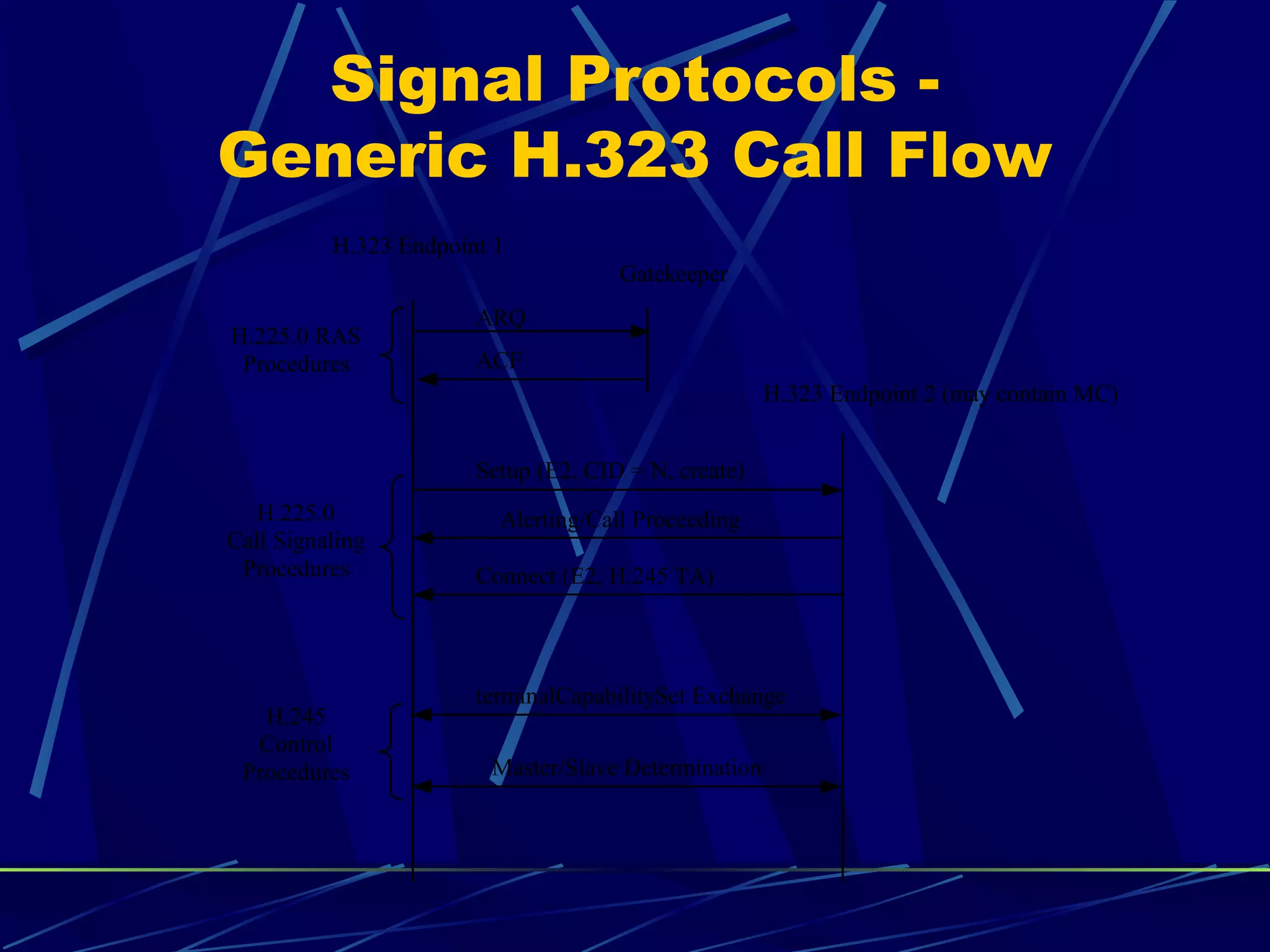
Generic H.323 Call Flow
H.323 Endpoint 1
Setup (E2, CID = N, create)
Alerting/Call Proceeding
ARQ
ACF
Connect (E2, H.245 TA)
terminalCapabilitySet Exchange
Master/Slave Determination
H.323 Endpoint 2 (may contain MC)
H.225.0 RAS
Procedures
H.225.0
Call Signaling
Procedures
H.245
Control
Procedures
Gatekeeper
Signal Protocols -
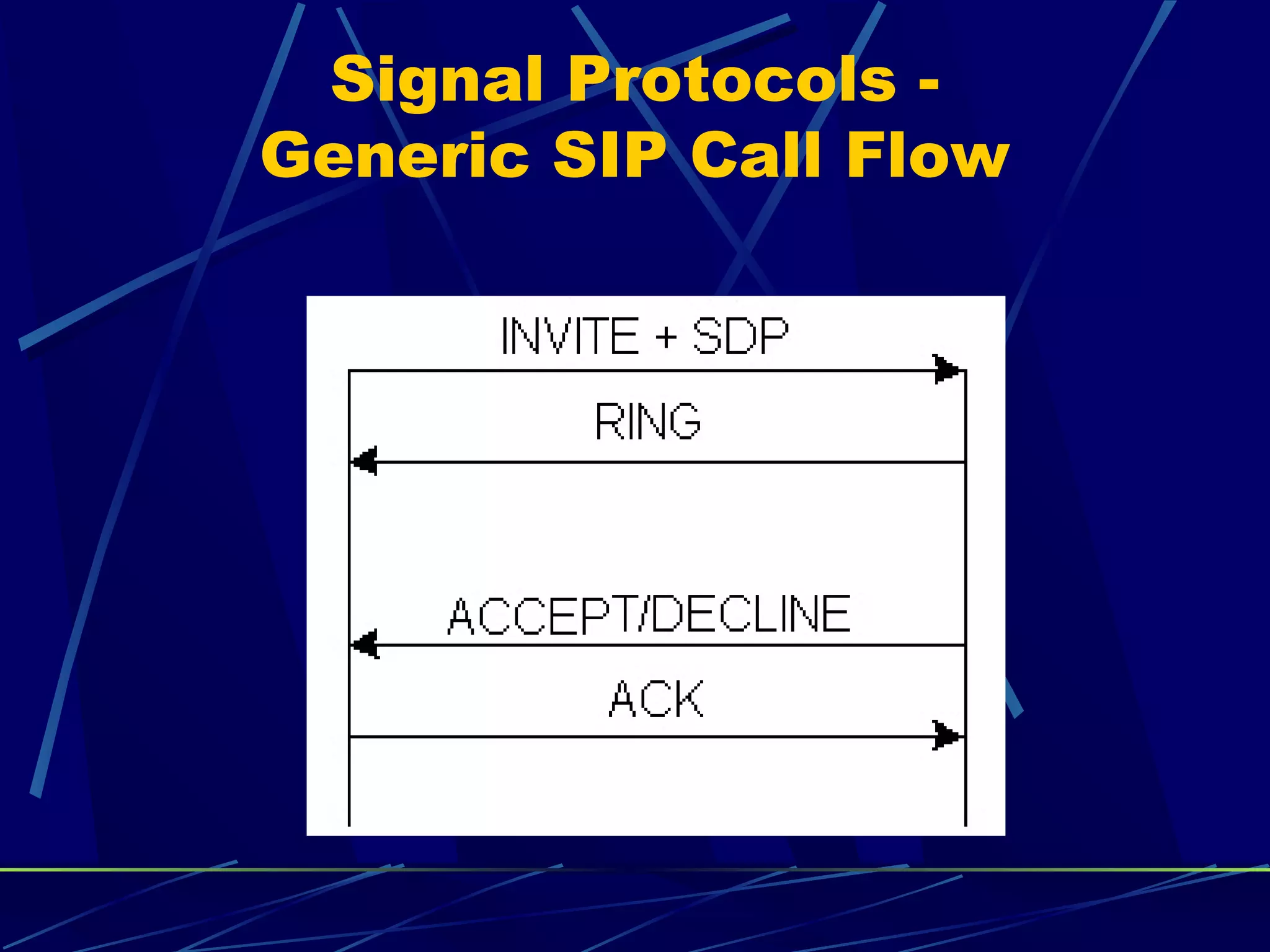
Generic SIP Call Flow
Signal Protocols -
Comparison of H.323 and SIP
Modularity
 Synchronization of the mapping procedures during
operation
Message presentation
 Translation of syntax
Mapping of an H.323 conference and a SIP
session
 Map H.323 conference ID and SIP session ID
 Map the H.245 capabilityDescriptor structure to SDP
syntax
Signal Protocols -
Comparison of H.323 and SIP(cont.)
Advertising
 Conference information availability
Determination of conference media capability
Applicable solution:
 Central determination via an intermediate agent serving
as an H.323 mc
Control over membership
 Generic admission control mechanisms and strategies
handling conference membership
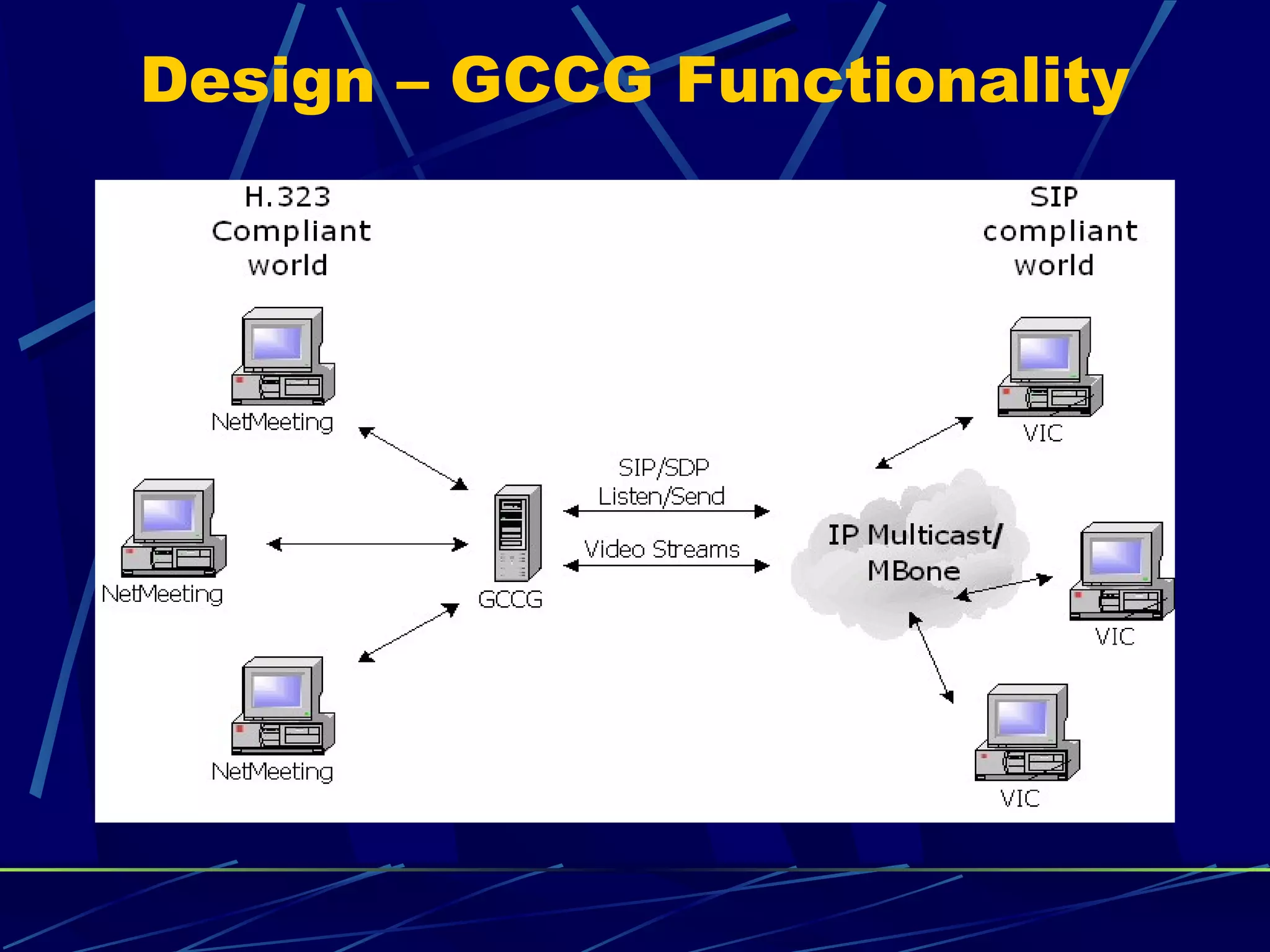
Design – GCCG Functionality
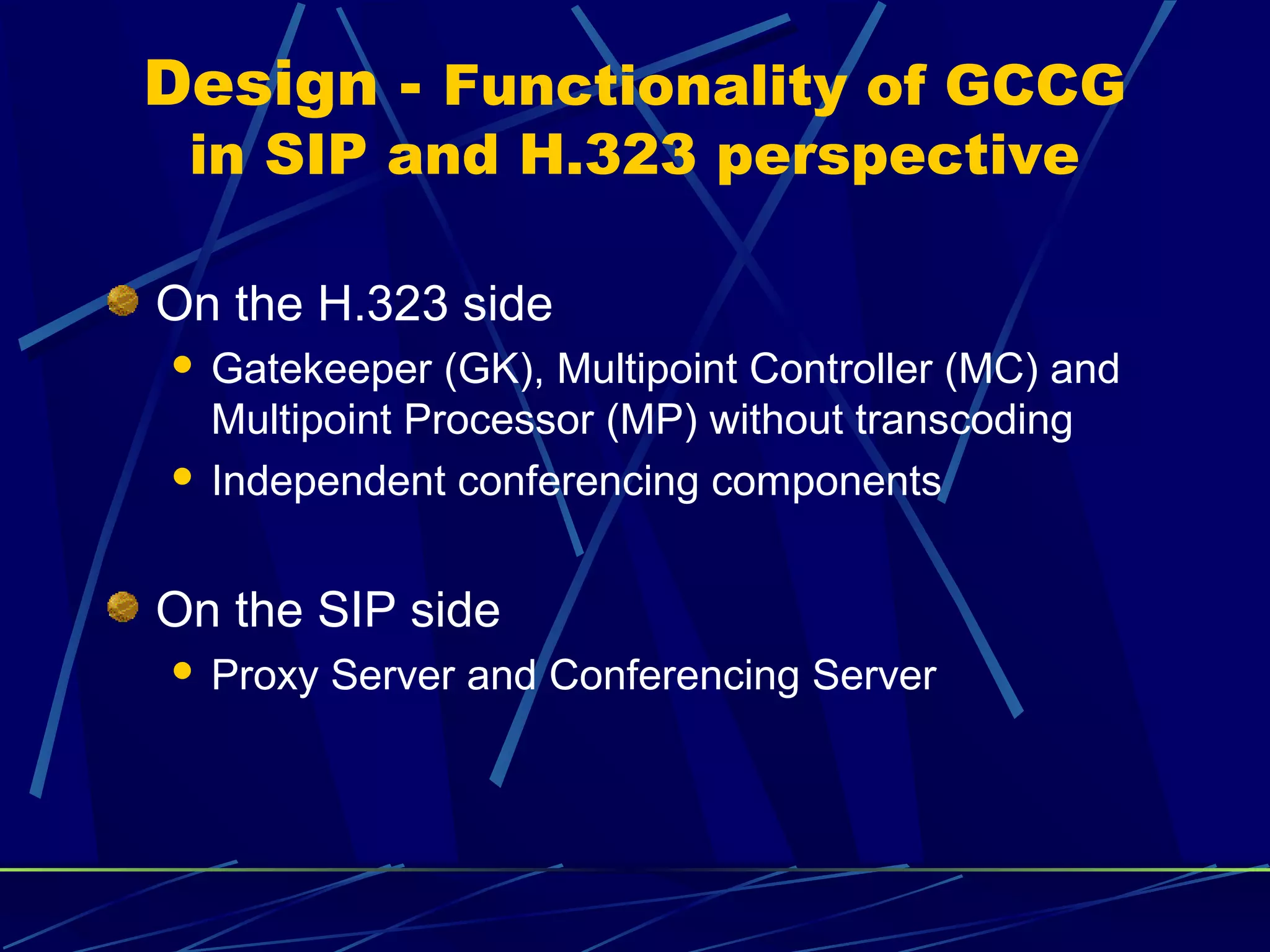
Design - Functionality of GCCG
in SIP and H.323 perspective
On the H.323 side
 Gatekeeper (GK), Multipoint Controller (MC) and
Multipoint Processor (MP) without transcoding
 Independent conferencing components
On the SIP side
 Proxy Server and Conferencing Server
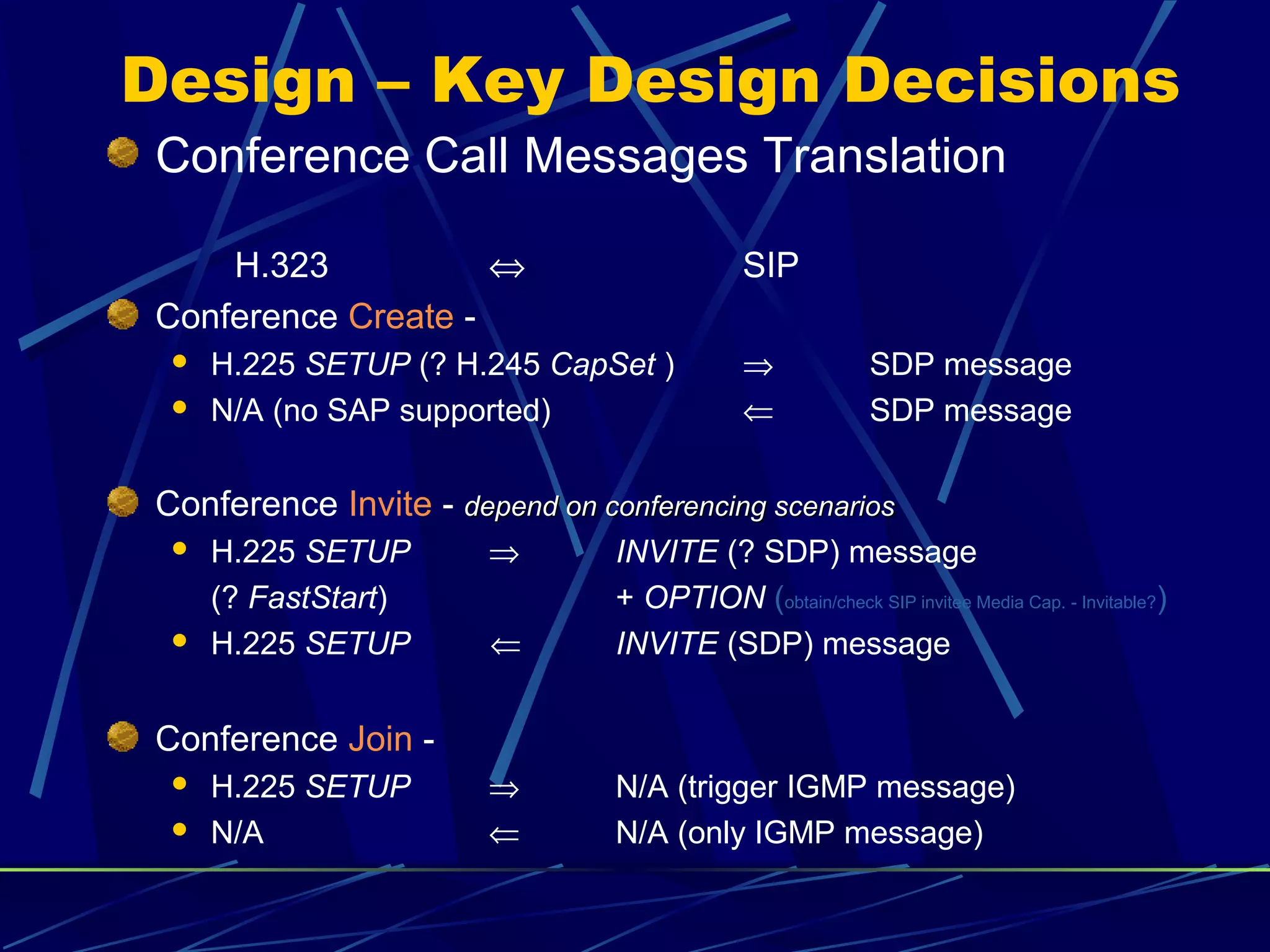
Design – Key Design Decisions
Conference Call Messages Translation
H.323 ⇔ SIP
Conference Create -
 H.225 SETUP (? H.245 CapSet ) ⇒ SDP message
 N/A (no SAP supported) ⇐ SDP message
Conference Invite - depend on conferencing scenariosdepend on conferencing scenarios
 H.225 SETUP ⇒ INVITE (? SDP) message
(? FastStart) + OPTION (obtain/check SIP invitee Media Cap. - Invitable?)
 H.225 SETUP ⇐ INVITE (SDP) message
Conference Join -
 H.225 SETUP ⇒ N/A (trigger IGMP message)
 N/A ⇐ N/A (only IGMP message)
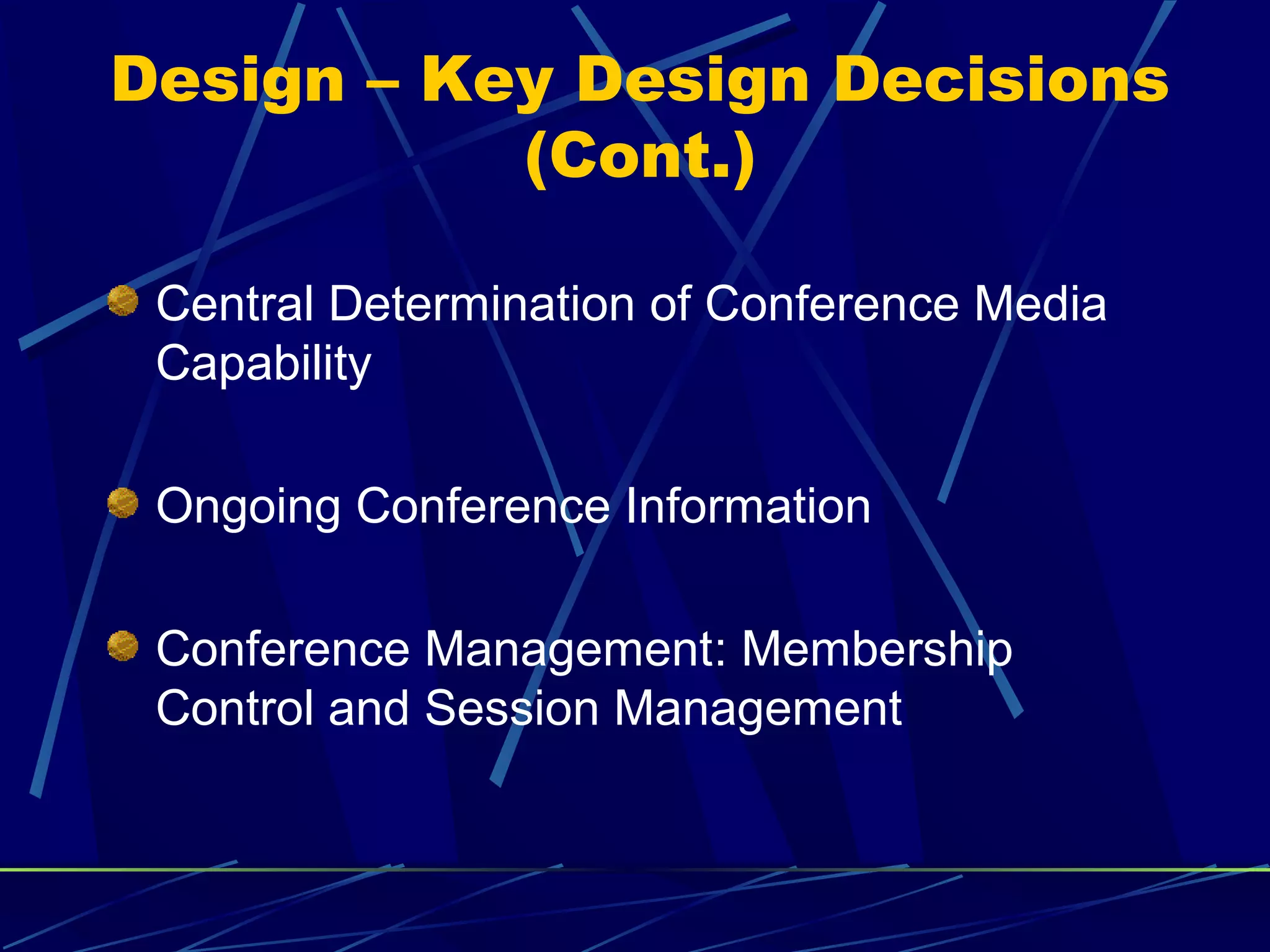
Design – Key Design Decisions
(Cont.)
Central Determination of Conference Media
Capability
Ongoing Conference Information
Conference Management: Membership
Control and Session Management
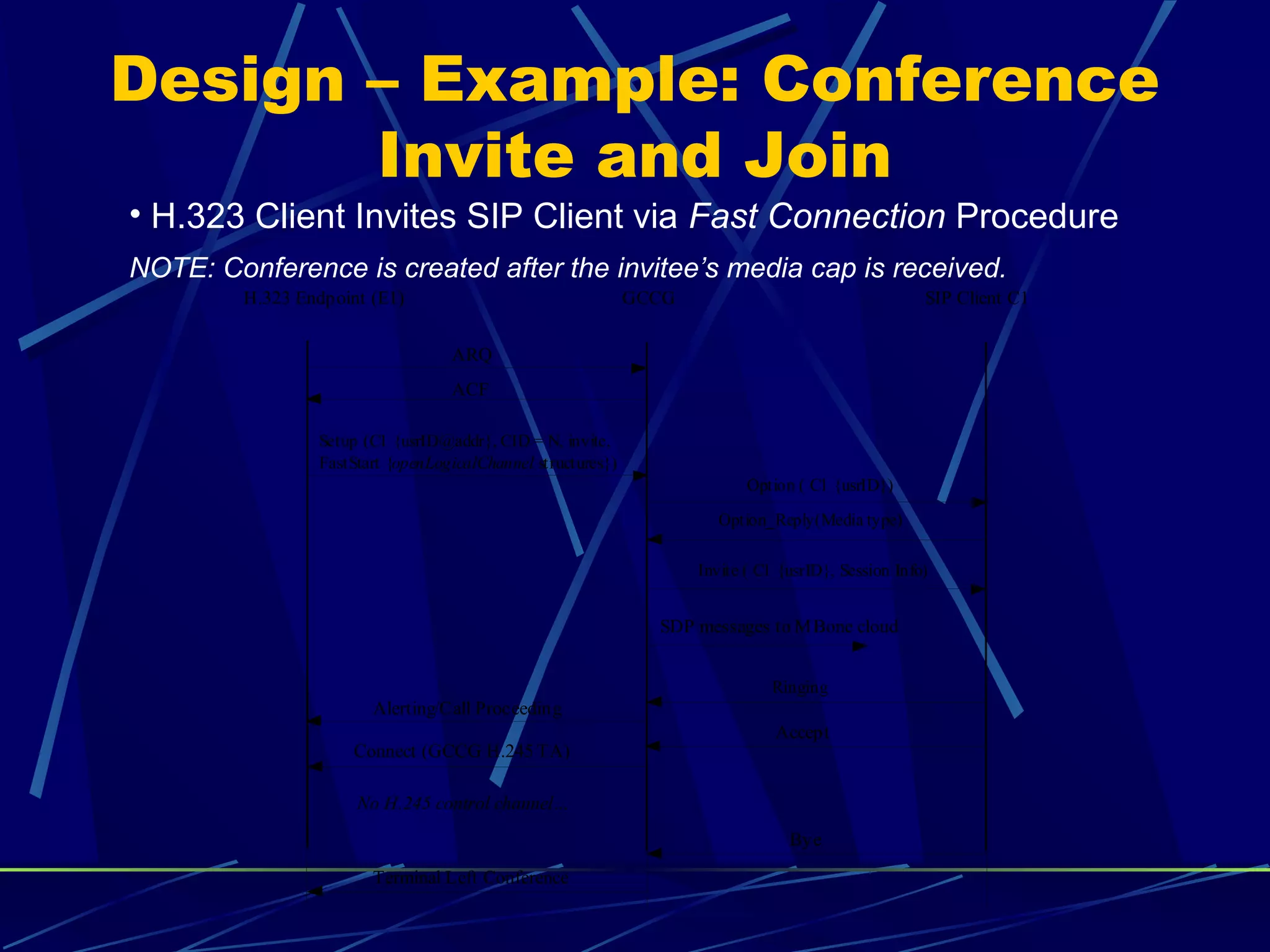
Design – Example: Conference
Invite and Join
H.323 Endpoint (E1) GCCG SIP Client C1
Setup (C1 {usrID@addr}, CID = N, invite,
FastStart {openLogicalChannel structures})
Alerting/Call Proceeding
ARQ
ACF
Connect (GCCG H.245 TA)
Ringing
Accept
Invite ( C1 {usrID}, Session Info)
Bye
Terminal Left Conference
No H.245 control channel…
Option ( C1 {usrID})
Option_Reply(Media type)
SDP messages to MBone cloud
• H.323 Client Invites SIP Client via Fast Connection Procedure
NOTE: Conference is created after the invitee’s media cap is received.
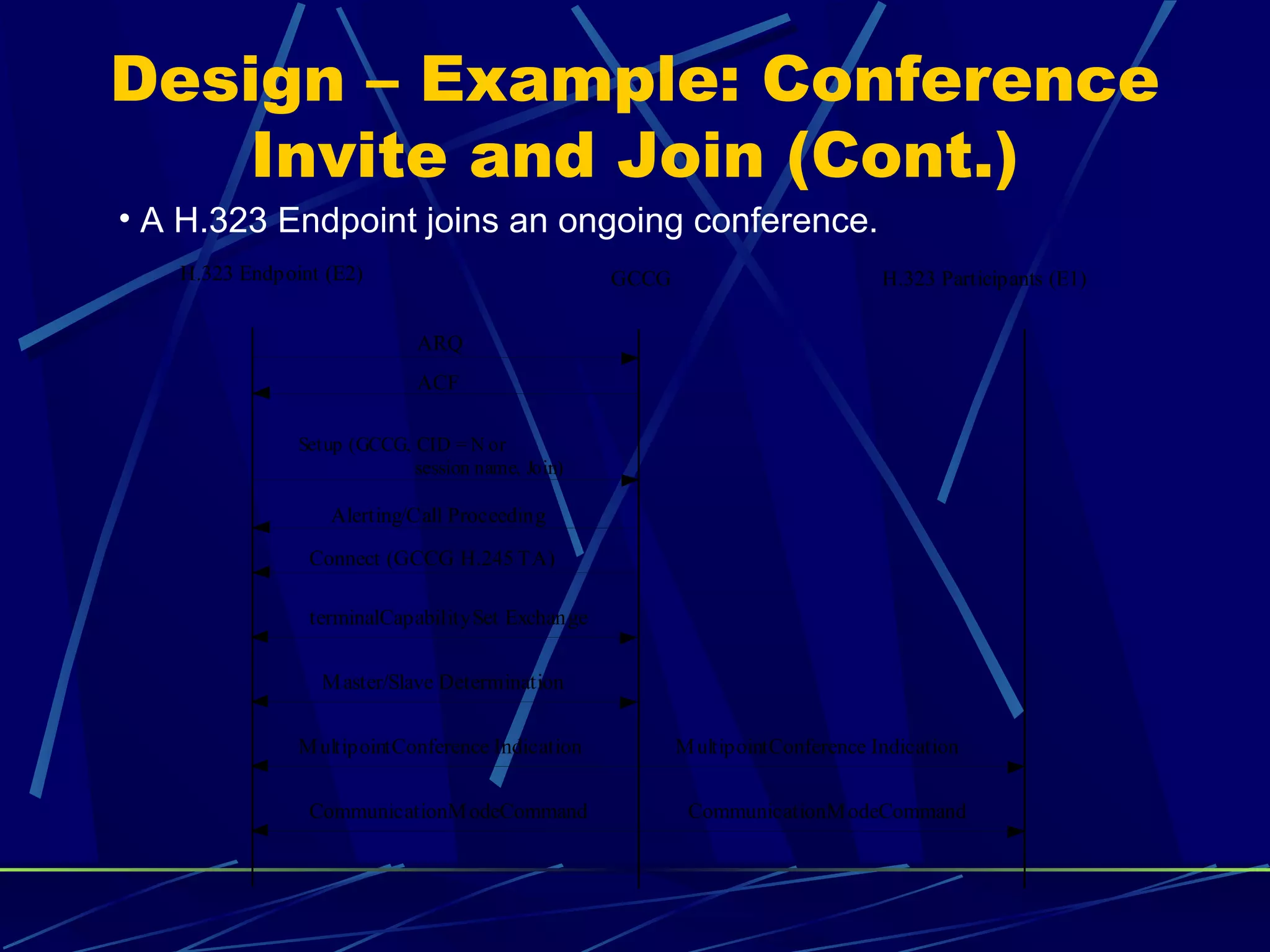
Design – Example: Conference
Invite and Join (Cont.)
H.323 Endpoint (E2) GCCG H.323 Participants (E1)
Setup (GCCG, CID = N or
session name, Join)
Alerting/Call Proceeding
ARQ
ACF
Connect (GCCG H.245 TA)
terminalCapabilitySet Exchange
Master/Slave Determination
CommunicationModeCommand
MultipointConference Indication MultipointConference Indication
CommunicationModeCommand
• A H.323 Endpoint joins an ongoing conference.
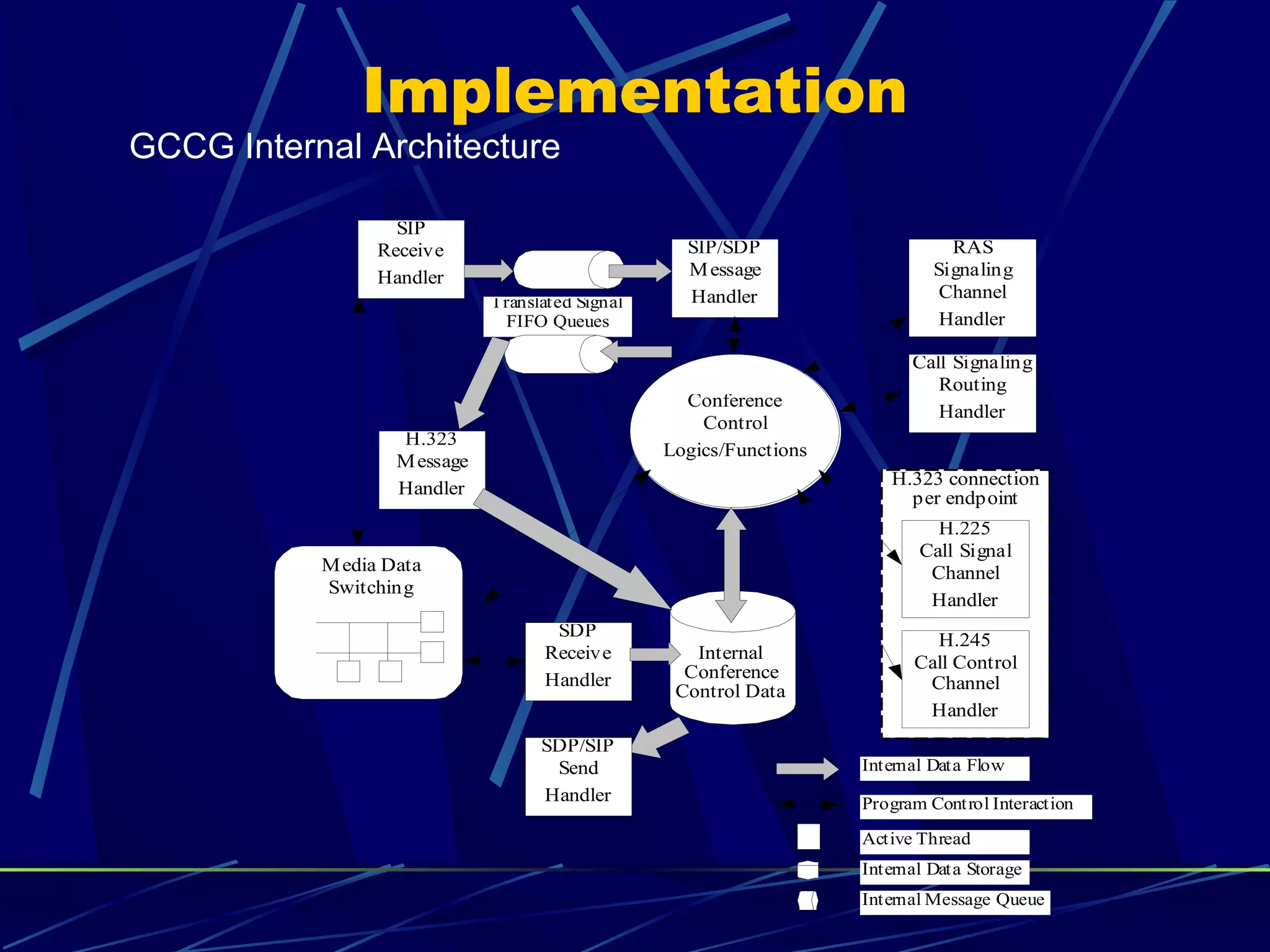
Implementation
RAS
Signaling
Channel
Handler
Call Signaling
Routing
Handler
H.323 connection
per endpoint
H.225
Call Signal
Channel
Handler
H.245
Call Control
Channel
Handler
Conference
Control
Logics/Functions
SIP/SDP
Message
HandlerTranslated Signal
FIFO Queues
H.323
Message
Handler
Internal
Conference
Control Data
Media Data
Switching
Internal Data Flow
Active Thread
Program Control Interaction
Internal Data Storage
Internal Message Queue
SDP
Receive
Handler
SDP/SIP
Send
Handler
SIP
Receive
Handler
GCCG Internal Architecture
Implementation –
Operation and Status
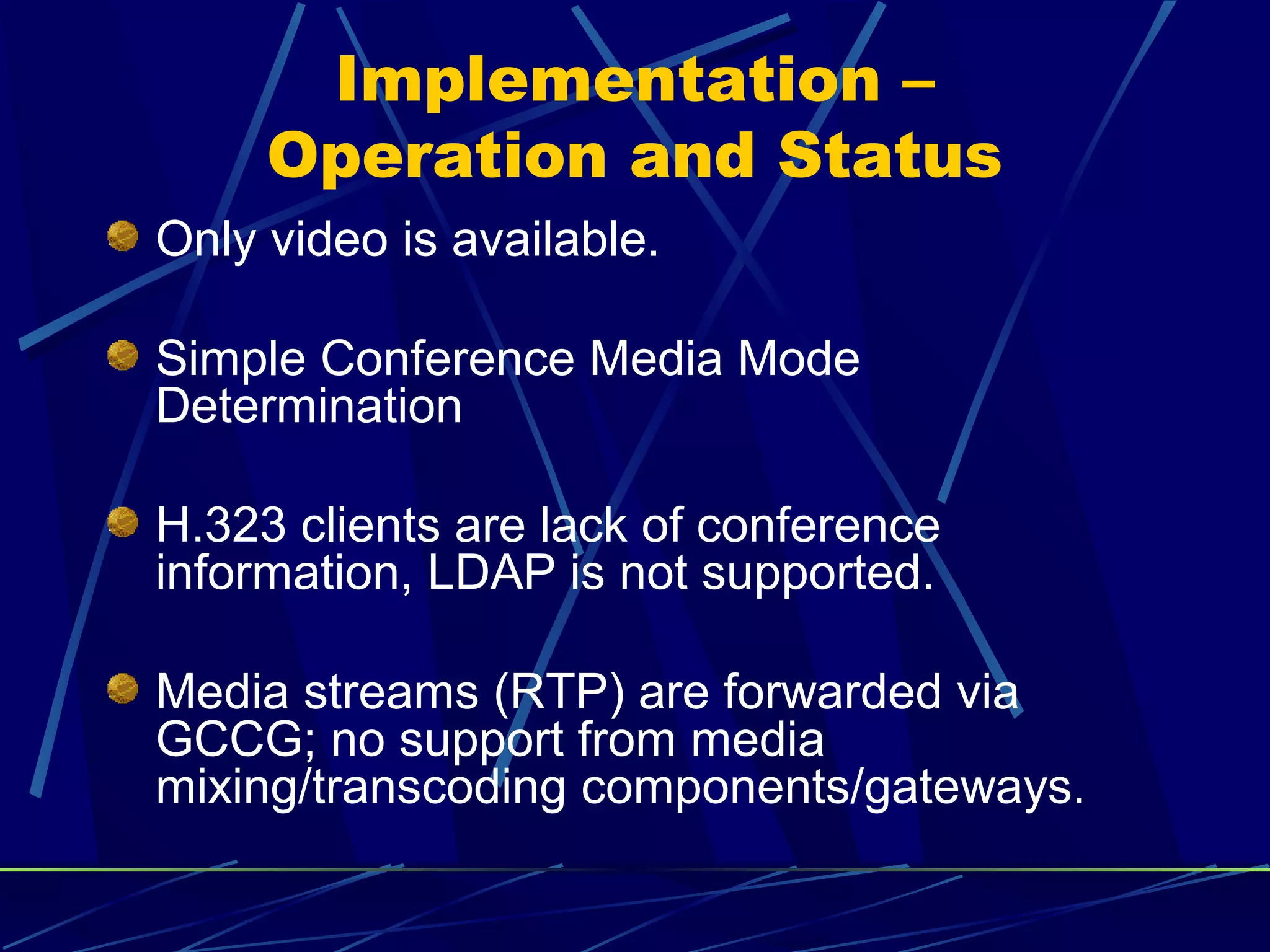
Only video is available.
Simple Conference Media Mode
Determination
H.323 clients are lack of conference
information, LDAP is not supported.
Media streams (RTP) are forwarded via
GCCG; no support from media
mixing/transcoding components/gateways.
Performance Evaluation
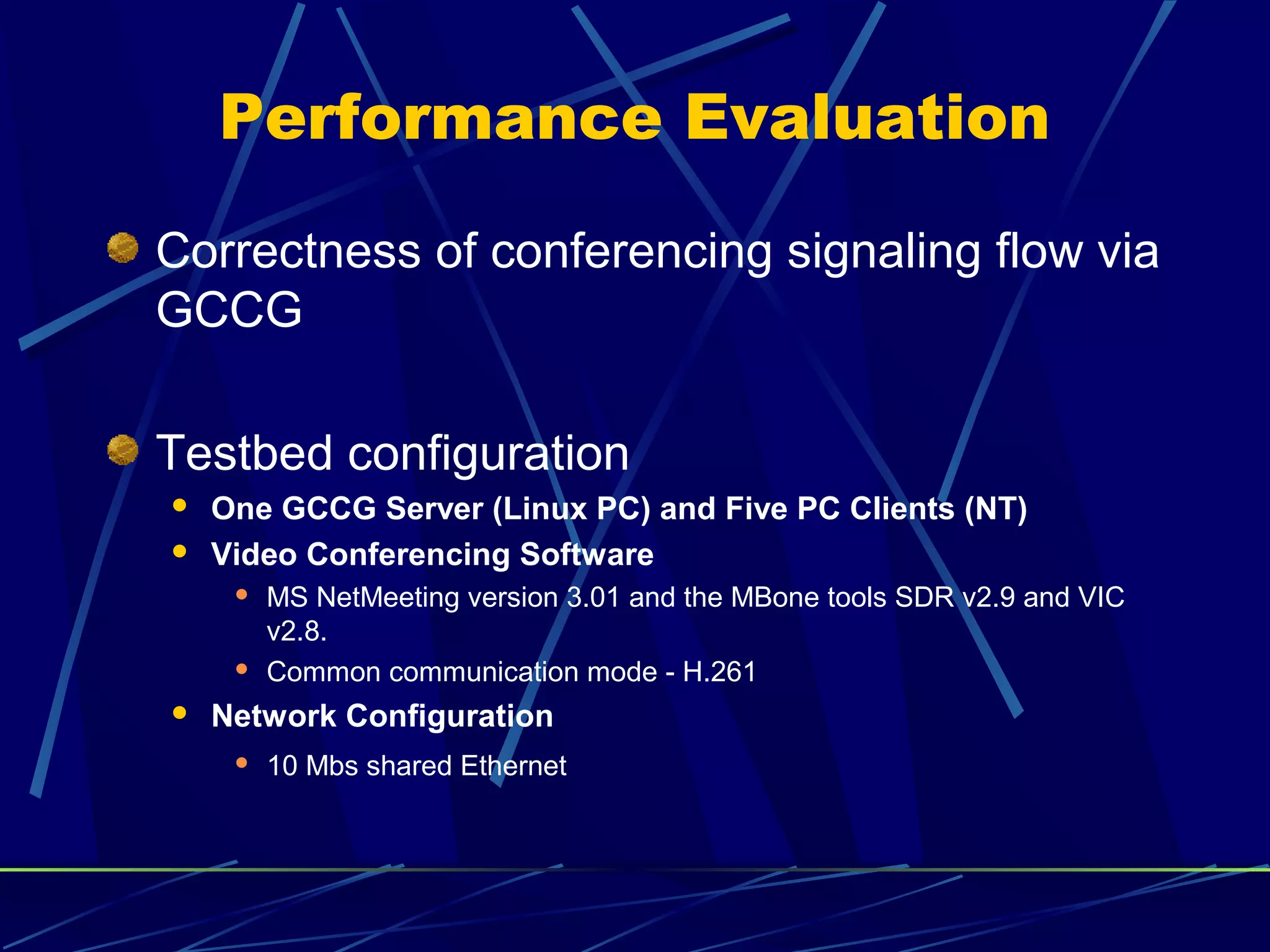
Correctness of conferencing signaling flow via
GCCG
Testbed configuration
 One GCCG Server (Linux PC) and Five PC Clients (NT)
 Video Conferencing Software
 MS NetMeeting version 3.01 and the MBone tools SDR v2.9 and VIC
v2.8.
 Common communication mode - H.261
 Network Configuration
 10 Mbs shared Ethernet
Performance Evaluation (cont.)
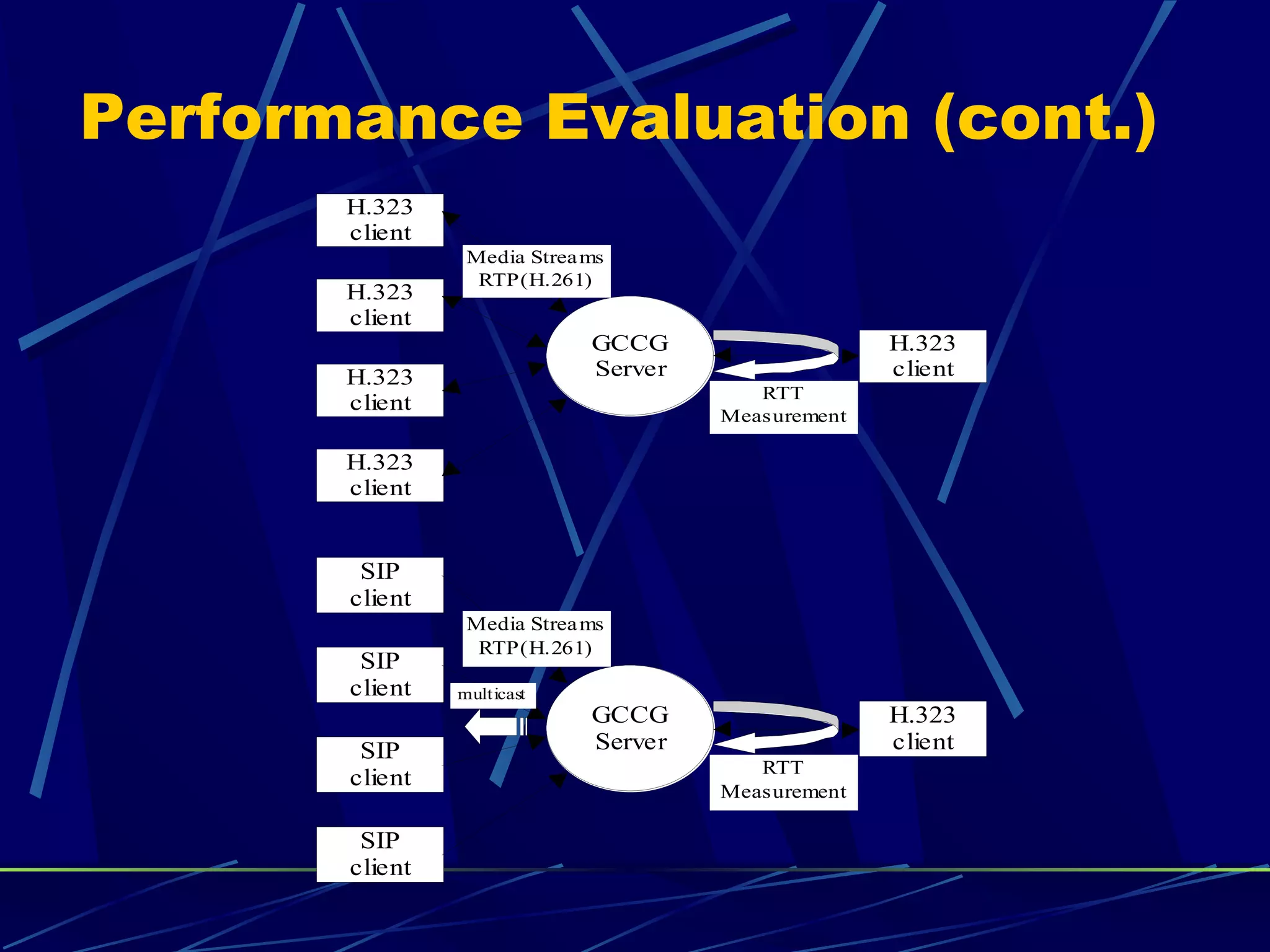
GCCG
Server
H.323
client
H.323
client
H.323
client
H.323
client
H.323
client
RTT
Measurement
Media Streams
RTP(H.261)
GCCG
Server
SIP
client
H.323
client
SIP
client
SIP
client
SIP
client
RTT
Measurement
Media Streams
RTP(H.261)
multicast
Performance Evaluation (cont.)
6
8
10
12
14
16
18
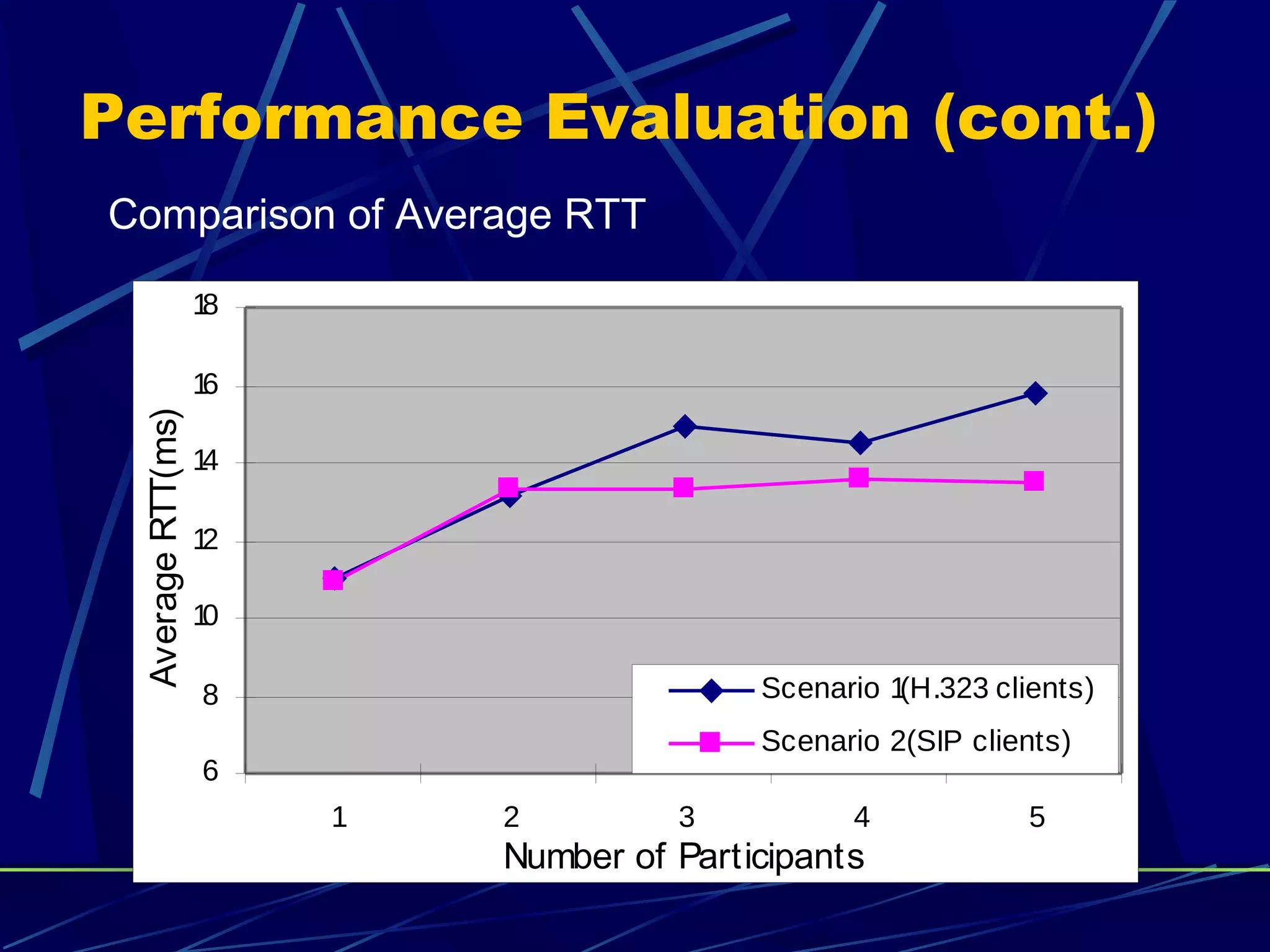
1 2 3 4 5
Number of Participants
AverageRTT(ms)
Scenario 1(H.323 clients)
Scenario 2(SIP clients)
Comparison of Average RTT
Discussion
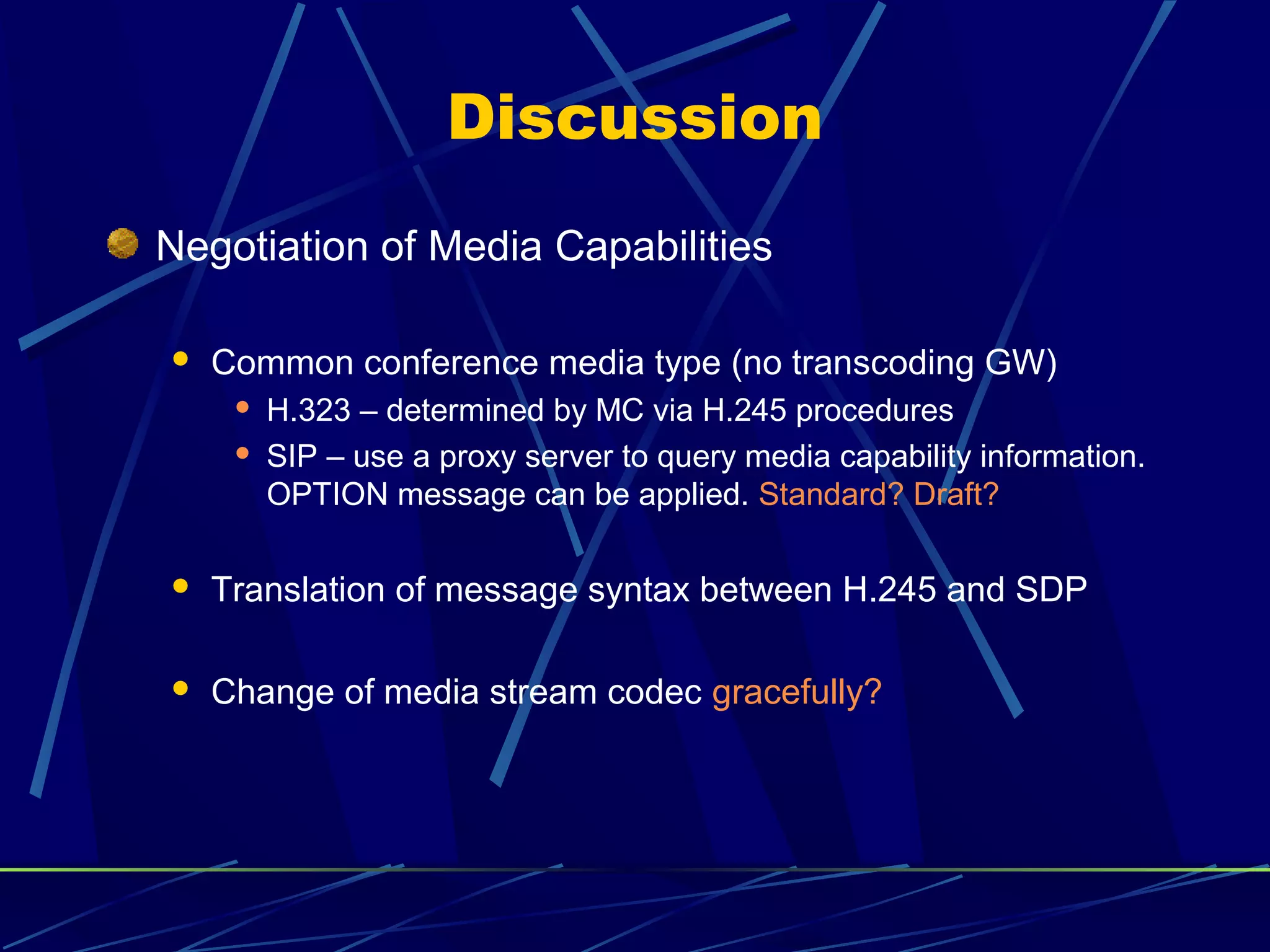
Negotiation of Media Capabilities
 Common conference media type (no transcoding GW)
 H.323 – determined by MC via H.245 procedures
 SIP – use a proxy server to query media capability information.
OPTION message can be applied. Standard? Draft?
 Translation of message syntax between H.245 and SDP
 Change of media stream codec gracefully?
Discussion (cont.)
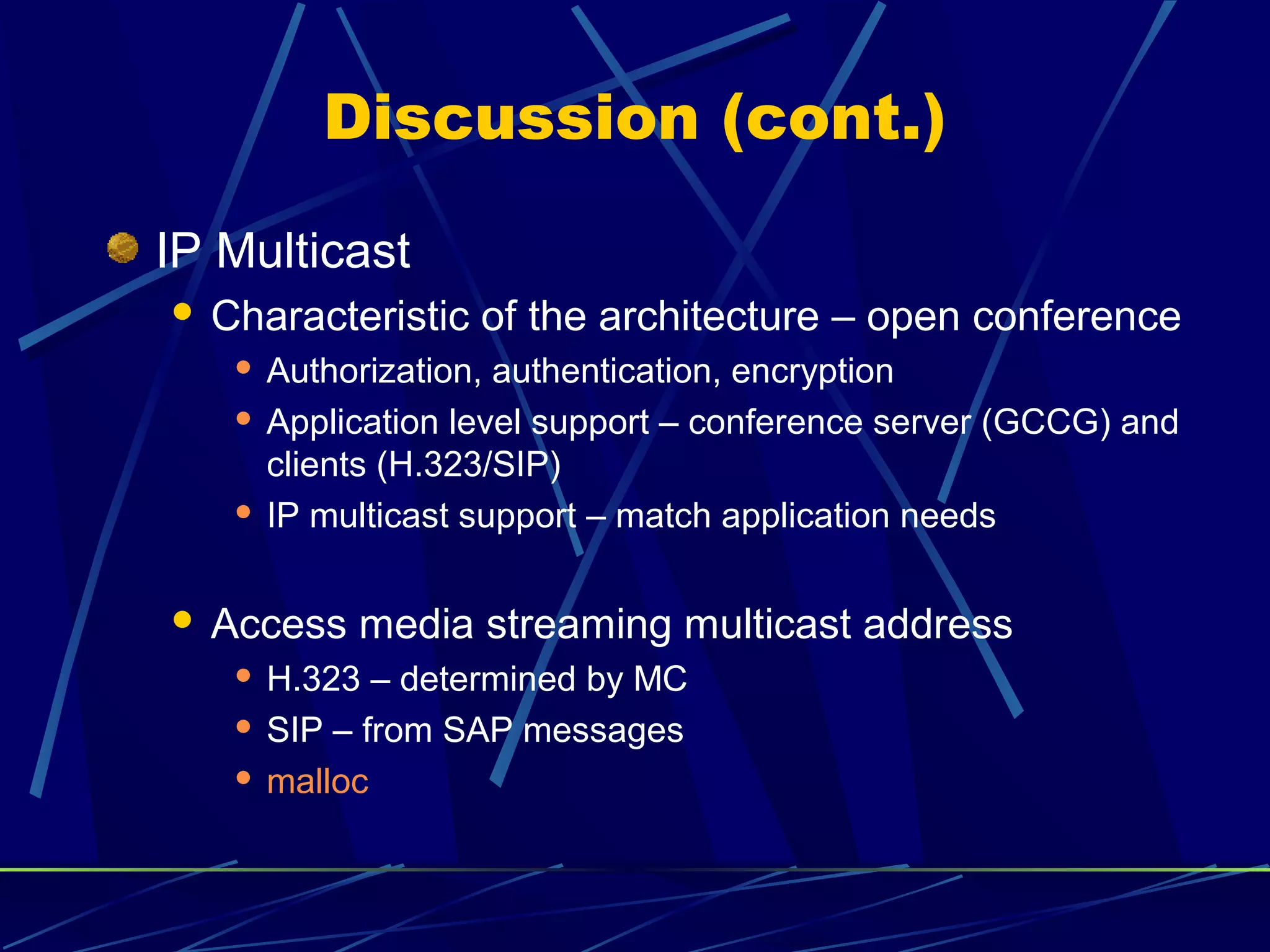
Session Advertising
 Conference information advertisement
 SIP – operate with SAP (push)
 H.323 – LDAP can be used (pull) if clients require this feature
 Conference information mapping
Adaptation of Call Signaling Semantics
 Reduce signaling overhead via H.323 FastConnect
Conference Control
 H.323 – ITU-T T series, e.g. T.124, GCCP…
 SIP – drafting, standards?
Discussion (cont.)
IP Multicast
 Characteristic of the architecture – open conference
 Authorization, authentication, encryption
 Application level support – conference server (GCCG) and
clients (H.323/SIP)
 IP multicast support – match application needs
 Access media streaming multicast address
 H.323 – determined by MC
 SIP – from SAP messages
 malloc
Related Work
Several active groups, e.g. aHIT! from IMTC,
ITU-T SG 16 and TIPHON, and …
H.323/SIP signaling gateway
 - Columbia University
Our prototype implementation focus
 Multi-party media conferencing signaling support
 IP multicast efficiency
Conclusion
Completion of interoperability for H323 and
SIP in multiparty media conferencing
sessions
Recommendation for raised interoperability
issues.
Q & A

MM2001-Presentation.ppt

  • 1.
    A Conference GatewaySupporting Interoperability Between SIP and H.323 Jiann-Min Ho (Presenter) Jia-Cheng Hu Information Networking Institute Peter Steenkiste School of Computer Science Dept. of Electrical and Computer Engineering Carnegie Mellon University
  • 2.
    Agenda Overview Target network andgoal Signaling protocols and comparison Design Implementation Performance evaluation Discussion Related work Conclusion
  • 3.
    Overview - Multi-party MediaConference Media conference application drivers  Network bandwidth and endpoint capability Signaling and media streaming protocols  Signaling protocols:  H.323 (ITU-T) vs. SIP (IETF)  Media transport protocol: RTP (RFC1889)
  • 4.
    Target Network andGoal Target network –  Packet switching network (e.g. IP), not PSTN  Future network infrastructure Goal – two folds  Build a practical system allowing SIP and H.323 clients to participate in one video conferencing session.  A set of recommendations and for developers and standard bodies that would improve interoperability issues.
  • 5.
    Signal Protocols - GenericH.323 Call Flow H.323 Endpoint 1 Setup (E2, CID = N, create) Alerting/Call Proceeding ARQ ACF Connect (E2, H.245 TA) terminalCapabilitySet Exchange Master/Slave Determination H.323 Endpoint 2 (may contain MC) H.225.0 RAS Procedures H.225.0 Call Signaling Procedures H.245 Control Procedures Gatekeeper
  • 6.
  • 7.
    Signal Protocols - Comparisonof H.323 and SIP Modularity  Synchronization of the mapping procedures during operation Message presentation  Translation of syntax Mapping of an H.323 conference and a SIP session  Map H.323 conference ID and SIP session ID  Map the H.245 capabilityDescriptor structure to SDP syntax
  • 8.
    Signal Protocols - Comparisonof H.323 and SIP(cont.) Advertising  Conference information availability Determination of conference media capability Applicable solution:  Central determination via an intermediate agent serving as an H.323 mc Control over membership  Generic admission control mechanisms and strategies handling conference membership
  • 9.
    Design – GCCGFunctionality
  • 10.
    Design - Functionalityof GCCG in SIP and H.323 perspective On the H.323 side  Gatekeeper (GK), Multipoint Controller (MC) and Multipoint Processor (MP) without transcoding  Independent conferencing components On the SIP side  Proxy Server and Conferencing Server
  • 11.
    Design – KeyDesign Decisions Conference Call Messages Translation H.323 ⇔ SIP Conference Create -  H.225 SETUP (? H.245 CapSet ) ⇒ SDP message  N/A (no SAP supported) ⇐ SDP message Conference Invite - depend on conferencing scenariosdepend on conferencing scenarios  H.225 SETUP ⇒ INVITE (? SDP) message (? FastStart) + OPTION (obtain/check SIP invitee Media Cap. - Invitable?)  H.225 SETUP ⇐ INVITE (SDP) message Conference Join -  H.225 SETUP ⇒ N/A (trigger IGMP message)  N/A ⇐ N/A (only IGMP message)
  • 12.
    Design – KeyDesign Decisions (Cont.) Central Determination of Conference Media Capability Ongoing Conference Information Conference Management: Membership Control and Session Management
  • 13.
    Design – Example:Conference Invite and Join H.323 Endpoint (E1) GCCG SIP Client C1 Setup (C1 {usrID@addr}, CID = N, invite, FastStart {openLogicalChannel structures}) Alerting/Call Proceeding ARQ ACF Connect (GCCG H.245 TA) Ringing Accept Invite ( C1 {usrID}, Session Info) Bye Terminal Left Conference No H.245 control channel… Option ( C1 {usrID}) Option_Reply(Media type) SDP messages to MBone cloud • H.323 Client Invites SIP Client via Fast Connection Procedure NOTE: Conference is created after the invitee’s media cap is received.
  • 14.
    Design – Example:Conference Invite and Join (Cont.) H.323 Endpoint (E2) GCCG H.323 Participants (E1) Setup (GCCG, CID = N or session name, Join) Alerting/Call Proceeding ARQ ACF Connect (GCCG H.245 TA) terminalCapabilitySet Exchange Master/Slave Determination CommunicationModeCommand MultipointConference Indication MultipointConference Indication CommunicationModeCommand • A H.323 Endpoint joins an ongoing conference.
  • 15.
    Implementation RAS Signaling Channel Handler Call Signaling Routing Handler H.323 connection perendpoint H.225 Call Signal Channel Handler H.245 Call Control Channel Handler Conference Control Logics/Functions SIP/SDP Message HandlerTranslated Signal FIFO Queues H.323 Message Handler Internal Conference Control Data Media Data Switching Internal Data Flow Active Thread Program Control Interaction Internal Data Storage Internal Message Queue SDP Receive Handler SDP/SIP Send Handler SIP Receive Handler GCCG Internal Architecture
  • 16.
    Implementation – Operation andStatus Only video is available. Simple Conference Media Mode Determination H.323 clients are lack of conference information, LDAP is not supported. Media streams (RTP) are forwarded via GCCG; no support from media mixing/transcoding components/gateways.
  • 17.
    Performance Evaluation Correctness ofconferencing signaling flow via GCCG Testbed configuration  One GCCG Server (Linux PC) and Five PC Clients (NT)  Video Conferencing Software  MS NetMeeting version 3.01 and the MBone tools SDR v2.9 and VIC v2.8.  Common communication mode - H.261  Network Configuration  10 Mbs shared Ethernet
  • 18.
    Performance Evaluation (cont.) GCCG Server H.323 client H.323 client H.323 client H.323 client H.323 client RTT Measurement MediaStreams RTP(H.261) GCCG Server SIP client H.323 client SIP client SIP client SIP client RTT Measurement Media Streams RTP(H.261) multicast
  • 19.
    Performance Evaluation (cont.) 6 8 10 12 14 16 18 12 3 4 5 Number of Participants AverageRTT(ms) Scenario 1(H.323 clients) Scenario 2(SIP clients) Comparison of Average RTT
  • 20.
    Discussion Negotiation of MediaCapabilities  Common conference media type (no transcoding GW)  H.323 – determined by MC via H.245 procedures  SIP – use a proxy server to query media capability information. OPTION message can be applied. Standard? Draft?  Translation of message syntax between H.245 and SDP  Change of media stream codec gracefully?
  • 21.
    Discussion (cont.) Session Advertising Conference information advertisement  SIP – operate with SAP (push)  H.323 – LDAP can be used (pull) if clients require this feature  Conference information mapping Adaptation of Call Signaling Semantics  Reduce signaling overhead via H.323 FastConnect Conference Control  H.323 – ITU-T T series, e.g. T.124, GCCP…  SIP – drafting, standards?
  • 22.
    Discussion (cont.) IP Multicast Characteristic of the architecture – open conference  Authorization, authentication, encryption  Application level support – conference server (GCCG) and clients (H.323/SIP)  IP multicast support – match application needs  Access media streaming multicast address  H.323 – determined by MC  SIP – from SAP messages  malloc
  • 23.
    Related Work Several activegroups, e.g. aHIT! from IMTC, ITU-T SG 16 and TIPHON, and … H.323/SIP signaling gateway  - Columbia University Our prototype implementation focus  Multi-party media conferencing signaling support  IP multicast efficiency
  • 24.
    Conclusion Completion of interoperabilityfor H323 and SIP in multiparty media conferencing sessions Recommendation for raised interoperability issues.
  • 25.

Editor's Notes

  • #24 Requirements to integrate cross-domain call signaling in transparency Then is the proposed solution Based on the solution, what kinds of co-operation scenarios it can support At last, the functionality of the key component in our solution will be presented.
  • #25 The first requirement is call signaling mapping, translation and semantics adaptation. The most remarkable semantic in this project is call establishment. The following is call signaling messages and semantics mapping between H.323 and SIP protocol H.323 SETUP-JOIN message maps to no SIP message but… IGMP message should be sent to a corresponding multicast router demon in order to forward the media streams from that ongoing MBone session. NOTE: if a SIP client participates in a conference created by an H.323 client, the conference must have at least two H.323 clients
  • #26 Three exceptions Wait for the first joining H.323 client to determine common media communication modes 2.SETUP message contains media data types of that inviting terminal 3.In order to invite other client join that session or joins that session by itself